Defect-engineered scaling of lead-free ferroelectrics with ultralow-voltage switching
Pith reviewed 2026-06-28 22:12 UTC · model grok-4.3
The pith
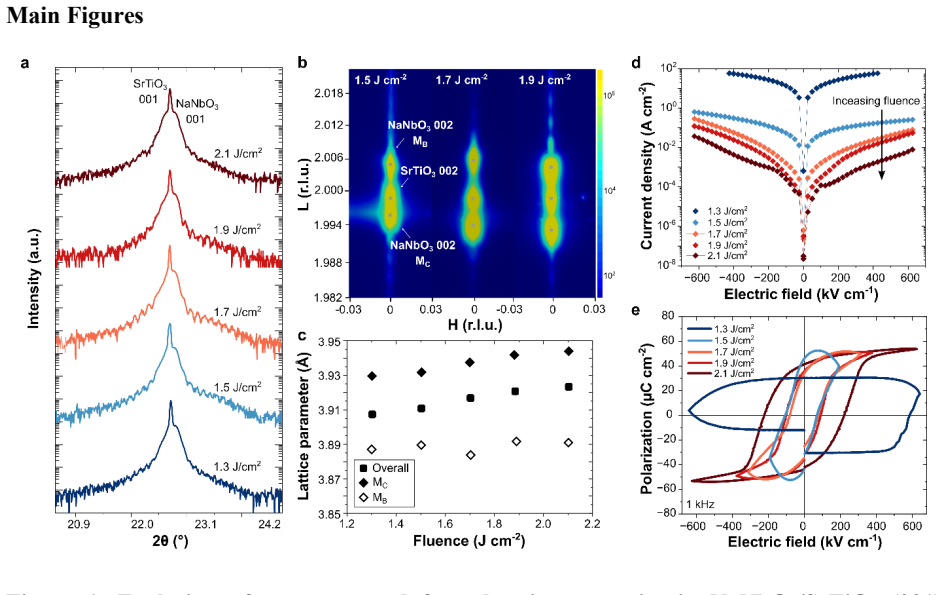
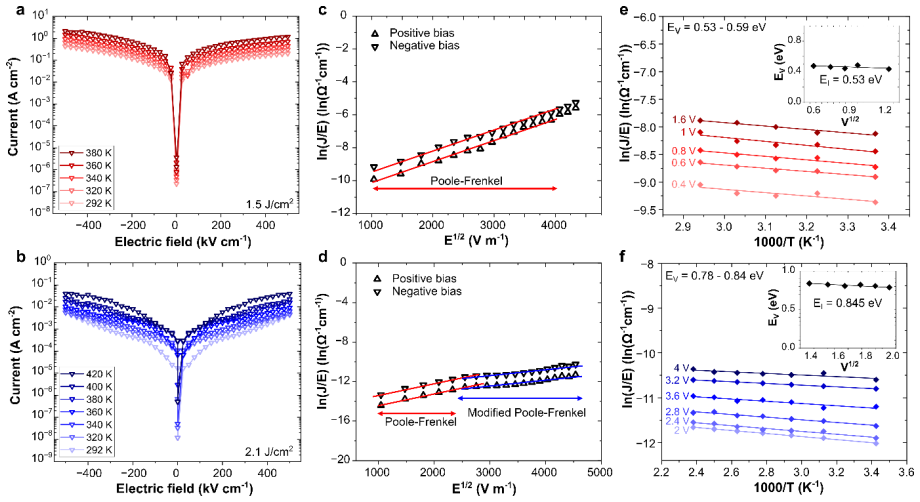
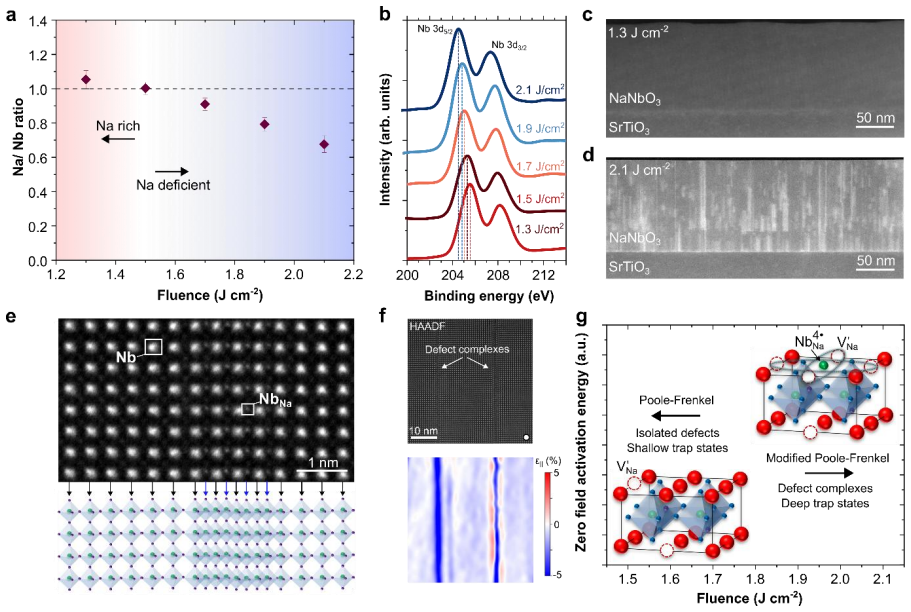
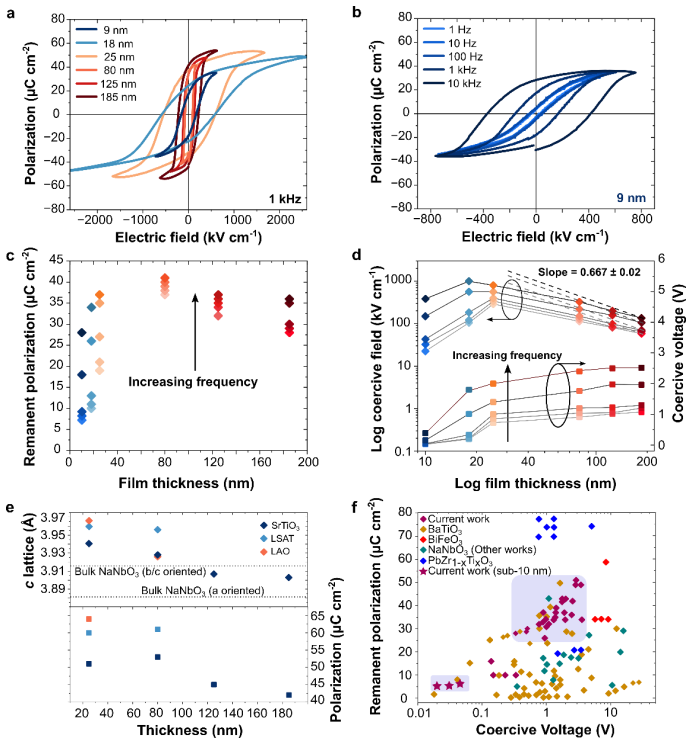
Modulating alkali deficiency during synthesis creates clustered defect complexes that act as deep trap states, suppressing leakage to enable sub-10 nm lead-free ferroelectric films with switching below 100 mV.
A machine-rendered reading of the paper's core claim, the machinery that carries it, and where it could break.
Core claim
By precisely modulating alkali deficiency during thin-film synthesis, clustered defect complexes are engineered that function as deep trap states, strongly suppressing leakage and enabling robust ferroelectric operation in ultrathin films down to the sub-10 nm regime at voltages below 100 mV.
What carries the argument
Clustered defect complexes formed by controlled alkali deficiency, which serve as deep trap states to block leakage currents while preserving ferroelectric switching.
If this is right
- Lead-free ferroelectric films become usable at thicknesses below 10 nm without leakage currents dominating device behavior.
- Switching can occur at voltages under 100 mV, directly lowering the energy needed for nonvolatile memory operation.
- An intrinsic materials limitation is converted into a controllable process parameter for scaling.
- Environmentally benign ferroelectrics gain a practical route toward integration in ultra-low-power electronics.
Where Pith is reading between the lines
- Similar defect-control strategies could be tested in other alkali-containing or volatile-element ferroelectrics to check if the leakage-suppression effect generalizes.
- If the trap states remain stable under repeated cycling, the films might support endurance levels needed for commercial memory cells.
- The same synthesis tuning might allow further thickness reduction below the current sub-10 nm limit if trap density can be increased without side effects.
Load-bearing premise
That adjusting alkali deficiency during film growth will reliably form the desired clustered defects that trap charges without harming the material's ability to switch polarization or creating other problems.
What would settle it
Direct measurement showing that leakage currents stay high or that polarization switching vanishes in sub-10 nm films when alkali deficiency is deliberately varied during synthesis.
Figures
read the original abstract
Scaling ferroelectrics to nanometer thicknesses remains a central challenge for low-power, nonvolatile electronics, as leakage currents increasingly dominate with reduced dimensions. Alkali-based, lead-free ferroelectrics offer an environmentally sustainable alternative to lead-based systems, yet their scaling is severely limited by leakage arising from volatile alkali constituents. Here, we show that this intrinsic limitation can be transformed into an advantageous degree of freedom through defect engineering. By precisely modulating alkali deficiency during thin-film synthesis, we engineer clustered defect complexes that function as deep trap states, strongly suppressing leakage and enabling robust ferroelectric operation in ultrathin films down to the sub-10 nm regime at voltages below 100 mV. Our results establish defect-enabled scaling as a viable pathway for advancing environmentally benign ferroelectrics toward ultra-low-power, non-volatile electronic technologies.
Editorial analysis
A structured set of objections, weighed in public.
Referee Report
Summary. The manuscript claims that precisely modulating alkali deficiency during thin-film synthesis of lead-free alkali-based ferroelectrics engineers clustered defect complexes that serve as deep trap states. These traps strongly suppress leakage currents, enabling robust ferroelectric switching in ultrathin films down to the sub-10 nm regime at operating voltages below 100 mV, thereby transforming an intrinsic materials limitation into a scaling advantage for low-power nonvolatile electronics.
Significance. If substantiated, the result would be significant for the development of environmentally sustainable ferroelectrics in ultra-low-power nonvolatile memory and logic applications, as it directly addresses the leakage-dominated scaling barrier that has limited alkali-based systems relative to lead-based counterparts.
major comments (2)
- [Abstract and Methods description of 'precise modulation'] The central claim that alkali deficiency produces clustered defect complexes functioning as deep trap states (Abstract) is load-bearing for the entire scaling result, yet the manuscript provides no direct evidence (DLTS, EPR, or DFT defect formation energies) confirming these specific complexes as the cause of leakage suppression rather than secondary effects such as microstructure changes, stoichiometry variations, or interface modifications.
- [Results on sub-10 nm films] The assumption that the same defect-engineering process leaves switchable polarization intact without introducing compensating shallow states, domain pinning, or endurance degradation is untested in the presented data; quantitative control of deficiency level and reliability metrics (e.g., endurance, retention) down to <10 nm are required to support the ultralow-voltage claim.
Simulated Author's Rebuttal
We thank the referee for the constructive feedback on our manuscript. We address each major comment below and will revise the manuscript to incorporate additional supporting analysis and data where appropriate.
read point-by-point responses
-
Referee: [Abstract and Methods description of 'precise modulation'] The central claim that alkali deficiency produces clustered defect complexes functioning as deep trap states (Abstract) is load-bearing for the entire scaling result, yet the manuscript provides no direct evidence (DLTS, EPR, or DFT defect formation energies) confirming these specific complexes as the cause of leakage suppression rather than secondary effects such as microstructure changes, stoichiometry variations, or interface modifications.
Authors: We agree that the manuscript relies on indirect evidence from electrical transport, compositional analysis, and structural characterization to link alkali deficiency to leakage suppression via deep traps. No direct spectroscopic confirmation (DLTS or EPR) or explicit DFT defect calculations are presented. To strengthen the central claim, we will add DFT calculations of defect formation energies and trap depths in a revised Methods and Results section. revision: yes
-
Referee: [Results on sub-10 nm films] The assumption that the same defect-engineering process leaves switchable polarization intact without introducing compensating shallow states, domain pinning, or endurance degradation is untested in the presented data; quantitative control of deficiency level and reliability metrics (e.g., endurance, retention) down to <10 nm are required to support the ultralow-voltage claim.
Authors: The manuscript presents ferroelectric switching data for sub-10 nm films at <100 mV, but we acknowledge that detailed quantitative mapping of deficiency levels and full reliability metrics (endurance, retention) are not comprehensively reported for the thinnest films. We will expand the Results section with these metrics and additional control experiments on deficiency variation in the revised manuscript. revision: yes
Circularity Check
No circularity: purely experimental claims with no derivation chain
full rationale
The paper is an experimental materials science study reporting synthesis, characterization, and electrical measurements on alkali-deficient ferroelectric thin films. No equations, models, fitted parameters, predictions, or uniqueness theorems appear in the abstract or described content. The central claim—that modulating alkali deficiency produces deep-trap defect complexes suppressing leakage—is presented as an empirical observation rather than a derived result. No self-citation load-bearing steps, self-definitional constructs, or renamings of known results are identifiable. The work is therefore self-contained against external benchmarks with no reduction of outputs to inputs by construction.
Axiom & Free-Parameter Ledger
Reference graph
Works this paper leans on
-
[1]
J. D. Meindl et al., Limits on silicon nanoelectronics for terascale integration. Science 293, 2044-2049 (2001)
2044
-
[2]
J. F. Ihlefeld et al. , Scaling effects in perovskite ferroelectrics: fundamental limits and process‐structure‐property relations. J. Am. Ceram. Soc. 99, 2537-2557 (2016)
2016
-
[3]
D. D. Fong et al., Ferroelectricity in ultrathin perovskite films. Science 304, 1650-1653 (2004)
2004
-
[4]
Gao et al., Possible absence of critical thickness and size effect in ultrathin perovskite ferroelectric films
P. Gao et al., Possible absence of critical thickness and size effect in ultrathin perovskite ferroelectric films. Nat. Commun. 8, 15549 (2017)
2017
-
[5]
Junquera, P
J. Junquera, P. Ghosez, Critical thickness for ferroelectricity in perovskite ultrathin films. Nature 422, 506-509 (2003)
2003
-
[6]
Jiang et al., Enabling ultra-low-voltage switching in BaTiO 3
Y. Jiang et al., Enabling ultra-low-voltage switching in BaTiO 3. Nat. Mater. 21, 779-785 (2022)
2022
-
[7]
Dawber et al., Physics of thin-film ferroelectric oxides
M. Dawber et al., Physics of thin-film ferroelectric oxides. Rev. Mod. Phys. 77, 1083-1130 (2005)
2005
-
[8]
Fernandez et al., Thin‐film ferroelectrics
A. Fernandez et al., Thin‐film ferroelectrics. Adv. Mater. 34, 2108841 (2022)
2022
-
[9]
T. R. Shrout, S. J. Zhang, Lead -free piezoelectric ceramics: Alternatives for PZT? J. Electroceram. 19, 113-126 (2007)
2007
-
[10]
Aksel, J
E. Aksel, J. L. Jones, Advances in lead -free piezoelectric materials for sensors and actuators. Sensors 10, 1935-1954 (2010)
1935
-
[11]
Hazra et al., Colossal Strain Tuning of Ferroelectric Transitions in KNbO 3 Thin Films
S. Hazra et al., Colossal Strain Tuning of Ferroelectric Transitions in KNbO 3 Thin Films. Adv. Mater. 36, 2408664 (2024)
2024
-
[12]
Boes et al
A. Boes et al. , Lithium niobate photonics: Unlocking the electromagnetic spectrum. Science 379, eabj4396 (2023)
2023
-
[13]
Ghanbari et al., Strain-induced lead-free morphotropic phase boundary
R. Ghanbari et al., Strain-induced lead-free morphotropic phase boundary. Nat. Commun. 16, 7766 (2025)
2025
-
[14]
M. H. Zhang et al., Field‐Induced Polarization Rotation in Order–Disorder (K, Na)NbO3‐ Based Ferroelectrics. Adv. Mater. 37, 2413587 (2025)
2025
-
[15]
Wang et al., Giant piezoelectricity in potassium–sodium niobate lead-free ceramics
X. Wang et al., Giant piezoelectricity in potassium–sodium niobate lead-free ceramics. J. Am. Chem. Soc. 136, 2905-2910 (2014). 21
2014
-
[16]
Guo et al., Dielectric and piezoelectric properties of lead-free (Na0
Y. Guo et al., Dielectric and piezoelectric properties of lead-free (Na0. 5K0. 5)NbO3–SrTiO3 ceramics. Solid State Commun. 129, 279-284 (2004)
2004
-
[17]
Lin et al., Ultrahigh electromechanical response from competing ferroic orders
B. Lin et al., Ultrahigh electromechanical response from competing ferroic orders. Nature 633, 798-803 (2024)
2024
-
[18]
Khandelwal et al., Coexisting Phases in NaNbO 3 Thin Films Influenced by Epitaxial Strain and Size Effects
A. Khandelwal et al., Coexisting Phases in NaNbO 3 Thin Films Influenced by Epitaxial Strain and Size Effects. Adv. Sci. 12, e10099 (2025)
2025
-
[19]
Kp et al
H. Kp et al. , Electron ptychography reveals a ferroelectricity dominated by anion displacements. Nat. Mater. 24, 1433–1440 (2025)
2025
-
[20]
Liu et al., Giant piezoelectricity in oxide thin films with nanopillar structure
H. Liu et al., Giant piezoelectricity in oxide thin films with nanopillar structure. Science 369, 292-297 (2020)
2020
-
[21]
Shimizu et al., Lead-free antiferroelectric: x CaZrO 3-(1− x) NaNbO 3 system (0≤ x≤ 0.10)
H. Shimizu et al., Lead-free antiferroelectric: x CaZrO 3-(1− x) NaNbO 3 system (0≤ x≤ 0.10). Dalton Trans. 44, 10763-10772 (2015)
2015
-
[22]
Xu et al
R. Xu et al. , Size‐Induced Ferroelectricity in Antiferroelectric Oxide Membranes. Adv. Mater. 35, 2210562 (2023)
2023
-
[23]
Luo et al., Achieving giant electrostrain of above 1% in (Bi, Na)TiO 3-based lead-free piezoelectrics via introducing oxygen-defect composition
H. Luo et al., Achieving giant electrostrain of above 1% in (Bi, Na)TiO 3-based lead-free piezoelectrics via introducing oxygen-defect composition. Sci. Adv. 9, eade7078 (2023)
2023
-
[24]
Zhang et al
N. Zhang et al. , Lead -free (K, Na)NbO 3-based materials: preparation techniques and piezoelectricity. ACS Omega 5, 3099-3107 (2020)
2020
-
[25]
Wu et al
H. Wu et al. , Alkali -deficiency driven charged out -of-phase boundaries for giant electromechanical response. Nat. Commun. 12, 2841 (2021)
2021
-
[26]
Damodaran et al., Enhancement of ferroelectric Curie temperature in BaTiO3 films via strain‐induced defect dipole alignment
A. Damodaran et al., Enhancement of ferroelectric Curie temperature in BaTiO3 films via strain‐induced defect dipole alignment. Adv. Mater. 26, 6341-6347 (2014)
2014
-
[27]
Sarott et al., Controlling the polarization in ferroelectric PZT films via the epitaxial growth conditions
M. Sarott et al., Controlling the polarization in ferroelectric PZT films via the epitaxial growth conditions. Adv. Funct. Mater. 33, 2214849 (2023)
2023
-
[28]
Saremi et al., Enhanced electrical resistivity and properties via ion bombardment of ferroelectric thin films
S. Saremi et al., Enhanced electrical resistivity and properties via ion bombardment of ferroelectric thin films. Adv. Mater. 28, 10750-10756 (2016)
2016
-
[29]
Saremi et al., Electronic transport and ferroelectric switching in ion‐bombarded, defect‐ engineered BiFeO3 thin films
S. Saremi et al., Electronic transport and ferroelectric switching in ion‐bombarded, defect‐ engineered BiFeO3 thin films. Adv. Mater. Interfaces 5, 1700991 (2018)
2018
-
[30]
Saremi et al., Local control of defects and switching properties in ferroelectric thin films
S. Saremi et al., Local control of defects and switching properties in ferroelectric thin films. Phys. Rev. Mater. 2, 084414 (2018). 22
2018
-
[31]
Wu et al., KNN-based lead-free piezoelectric ceramics with high Qm and enhanced d33 via a donor–acceptor codoping strategy
Y. Wu et al., KNN-based lead-free piezoelectric ceramics with high Qm and enhanced d33 via a donor–acceptor codoping strategy. Inorg. Chem. 62, 15094-15103 (2023)
2023
-
[32]
Dong et al
W. Dong et al. , Engineering the defects and microstructures in ferroelectrics for enhanced/novel properties: an emerging way to cope with energy crisis and environmental pollution. Adv. Sci. 9, 2105368 (2022)
2022
-
[33]
L. R. Dedon et al., Nonstoichiometry, structure, and properties of BiFeO 3 films. Chem. Mater. 28, 5952-5961 (2016)
2016
-
[34]
G. W. Pabst et al., Leakage mechanisms in BiFeO3 thin films. Appl. Phys. Lett. 90, 072902 (2007)
2007
-
[35]
Chiu, A review on conduction mechanisms in dielectric films
F.-C. Chiu, A review on conduction mechanisms in dielectric films. Adv. Mater. Sci. Eng. 2014, 578168 (2014)
2014
-
[36]
Villa et al., Role of intrinsic defects in cubic NaNbO3: A computational study based on hybrid density-functional theory
L. Villa et al., Role of intrinsic defects in cubic NaNbO3: A computational study based on hybrid density-functional theory. J. Appl. Phys. 131, 124106 (2022)
2022
-
[37]
Waqar et al., Origin of giant electric-field-induced strain in faulted alkali niobate films
M. Waqar et al., Origin of giant electric-field-induced strain in faulted alkali niobate films. Nat. Commun. 13, 3922 (2022)
2022
-
[38]
Zhang et al
M.-H. Zhang et al. , Tailoring high -energy storage NaNbO 3-based materials from antiferroelectric to relaxor states. Nat. Commun. 14, 1525 (2023)
2023
-
[39]
Li et al
B. Li et al. , Insights into Antisite Defect Complex Induced High Ferro -Piezoelectric Properties in KNbO3 Perovskite: First-Principles Study. Materials 17, 3442 (2024)
2024
-
[40]
Moriwake et al., First-principles study of point defect formation in AgNbO 3
H. Moriwake et al., First-principles study of point defect formation in AgNbO 3. Jpn. J. Appl. Phys. 52, 09KF08 (2013)
2013
-
[41]
Pérez De La Cruz et al., Thickness effect on the dielectric, ferroelectric, and piezoelectric properties of ferroelectric lead zirconate titanate thin films
J. Pérez De La Cruz et al., Thickness effect on the dielectric, ferroelectric, and piezoelectric properties of ferroelectric lead zirconate titanate thin films. J. Appl. Phys. 108, 114106 (2010)
2010
-
[42]
Xu et al., Ferroelectric polarization reversal via successive ferroelastic transitions
R. Xu et al., Ferroelectric polarization reversal via successive ferroelastic transitions. Nat. Mater. 14, 79-86 (2015)
2015
-
[43]
Xu et al., Kinetic control of tunable multi-state switching in ferroelectric thin films
R. Xu et al., Kinetic control of tunable multi-state switching in ferroelectric thin films. Nat. Commun. 10, 1282 (2019)
2019
-
[44]
Xu et al
R. Xu et al. , Reducing coercive -field scaling in ferroelectric thin films via orientation control. ACS Nano 12, 4736-4743 (2018). 23
2018
-
[45]
Vrejoiu et al
I. Vrejoiu et al. , Intrinsic ferroelectric properties of strained tetragonal PbZr 0. 2Ti0. 8O3 obtained on layer –by–layer grown, defect –free single–crystalline films. Adv. Mater. 18, 1657-1661 (2006)
2006
-
[46]
Chen et al., Polarization fatigue of BiFeO3 films with ferromagnetic metallic electrodes
C. Chen et al., Polarization fatigue of BiFeO3 films with ferromagnetic metallic electrodes. AIP Adv. 7, 055829 (2017)
2017
-
[47]
Shuai et al., Reduced leakage current in BiFeO 3 thin films with rectifying contacts
Y. Shuai et al., Reduced leakage current in BiFeO 3 thin films with rectifying contacts. Appl. Phys. Lett. 98, 232901 (2011)
2011
-
[48]
Lebeugle et al
D. Lebeugle et al. , Room -temperature coexistence of large electric polarization and magnetic order in BiFeO3 single crystals. Phys. Rev. B 76, 024116 (2007)
2007
-
[49]
Saito et al., Pulsed-laser deposition of ferroelectric NaNbO 3 thin films
T. Saito et al., Pulsed-laser deposition of ferroelectric NaNbO 3 thin films. Jpn. J. Appl. Phys. 44, 6969 (2005)
2005
-
[50]
Yamazoe et al., The effect of SrTiO 3 substrate orientation on the surface morphology and ferroelectric properties of pulsed laser deposited NaNbO 3 films
S. Yamazoe et al., The effect of SrTiO 3 substrate orientation on the surface morphology and ferroelectric properties of pulsed laser deposited NaNbO 3 films. Appl. Phys. Lett. 95, 062906 (2009)
2009
-
[51]
Mino et al., Piezoelectric properties of epitaxial NaNbO3 thin films deposited on (001) SrRuO3/Pt/MgO substrates
T. Mino et al., Piezoelectric properties of epitaxial NaNbO3 thin films deposited on (001) SrRuO3/Pt/MgO substrates. Jpn. J. Appl. Phys. 46, 6960 (2007)
2007
-
[52]
Schneider et al., Evidence for antipolar displacements in NaNbO3 thin films
T. Schneider et al., Evidence for antipolar displacements in NaNbO3 thin films. Appl. Phys. Lett. 121, 122906 (2022)
2022
-
[53]
Schneider et al., Impact of strain engineering on antiferroelectricity in NaNbO 3 thin films
T. Schneider et al., Impact of strain engineering on antiferroelectricity in NaNbO 3 thin films. ACS Omega 8, 23587-23595 (2023)
2023
-
[54]
Schnitzer et al., Quantitative approaches for multiscale structural analysis with atomic resolution electron microscopy
N. Schnitzer et al., Quantitative approaches for multiscale structural analysis with atomic resolution electron microscopy. Phys. Rev. Mater. 9, 093802 (2025)
2025
-
[55]
B. H. Goodge et al. , Disentangling coexisting structural order through phase lock -in analysis of atomic-resolution STEM data. Microsc. Microanal. 28, 404-411 (2022)
2022
discussion (0)
Sign in with ORCID, Apple, or X to comment. Anyone can read and Pith papers without signing in.