Dissipative generation of spin squeezing in the resolved vacuum Rabi splitting limit
Pith reviewed 2026-06-28 22:11 UTC · model grok-4.3
The pith
Symmetry-protected dissipative spin squeezing works in the resolved vacuum Rabi splitting regime of cavity QED.
A machine-rendered reading of the paper's core claim, the machinery that carries it, and where it could break.
Core claim
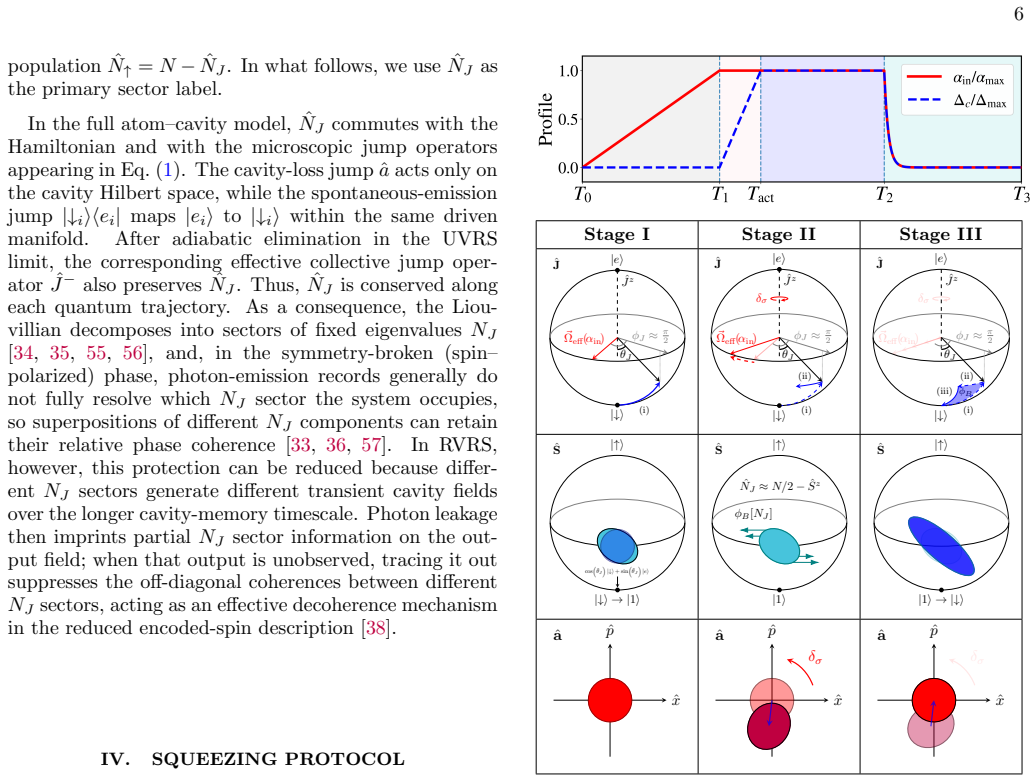
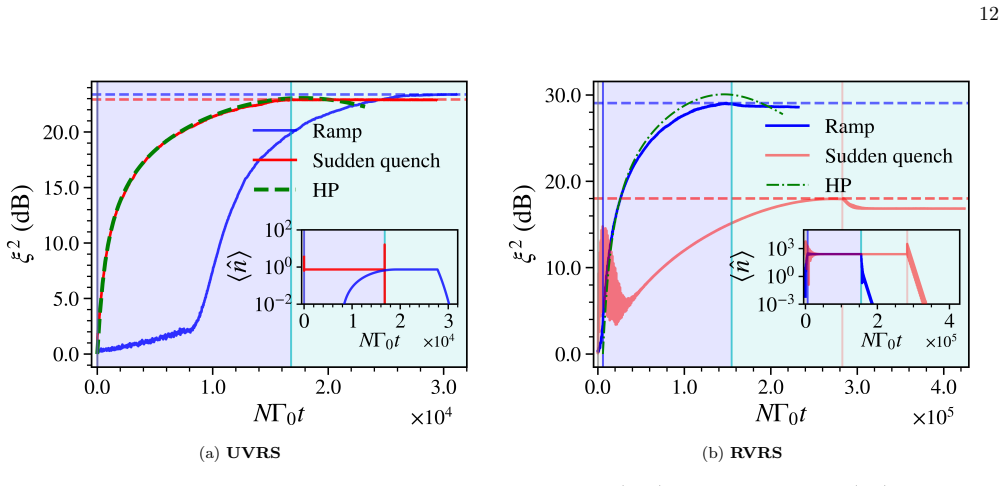
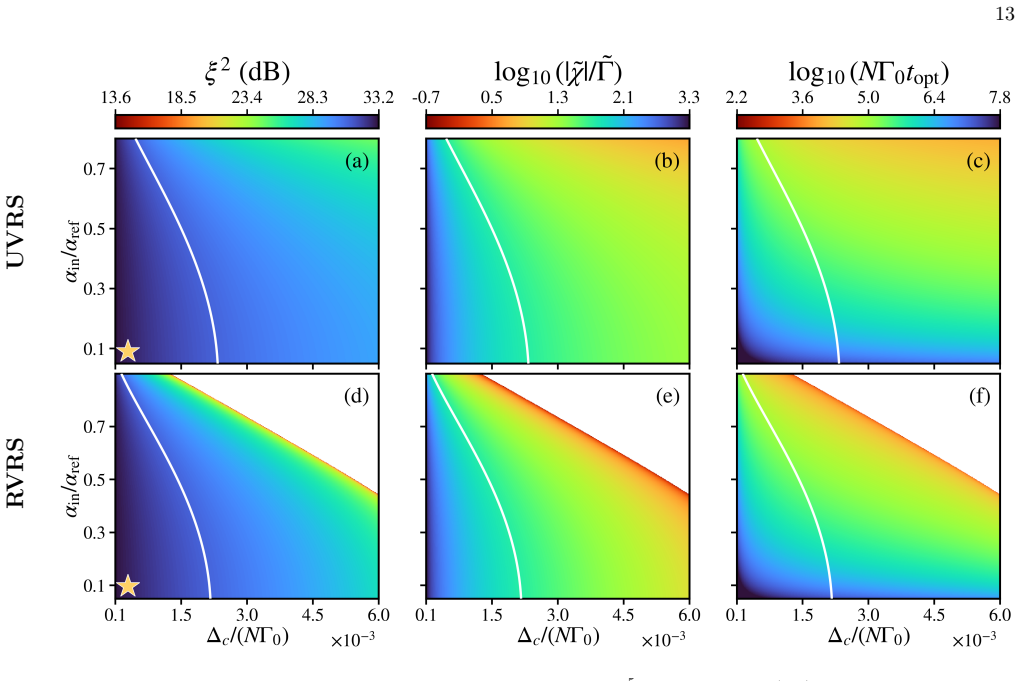
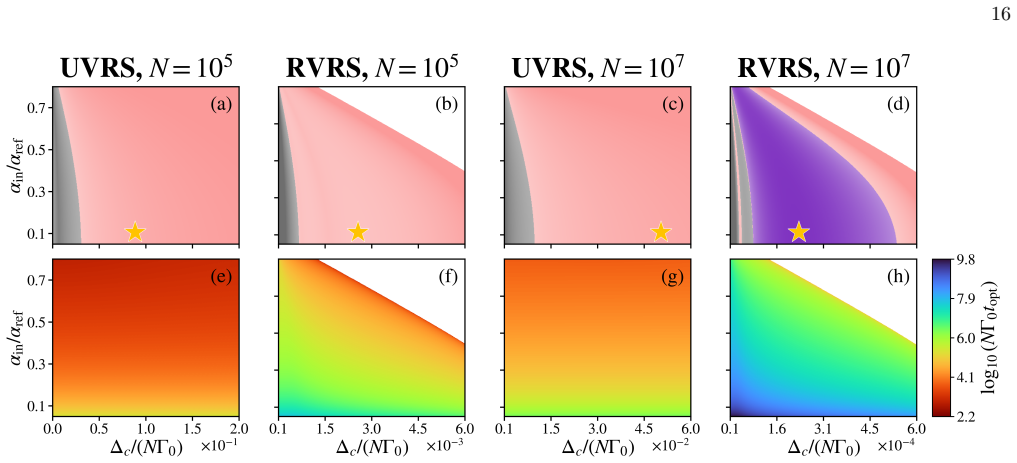
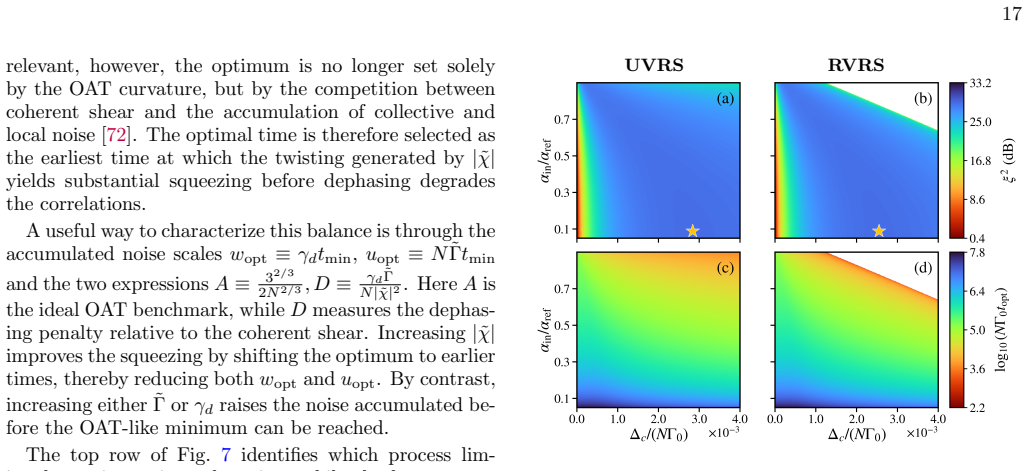
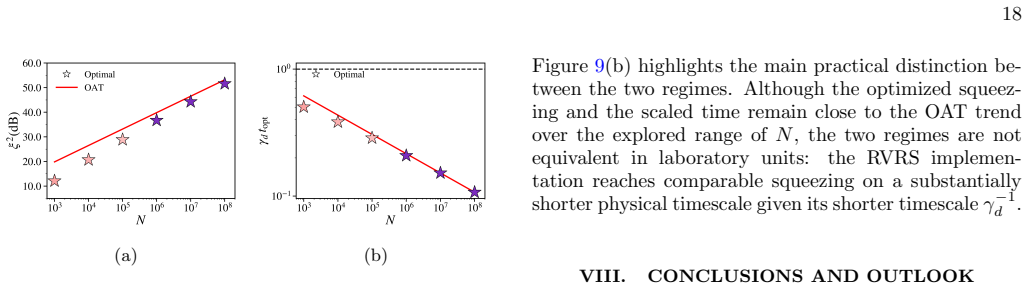
In the resolved vacuum Rabi splitting limit, driven-dissipative evolution under smooth parameter ramps reaches a stable low-photon regime in which nonadiabatic cavity excitations and sector-resolving leakage remain controlled; the resulting sector-dependent geometric phase implements effective one-axis twisting, yielding more than 25 dB of squeezing for 10^5 atoms that closely follows the ideal scaling ξ_min² ∝ N^{-2/3} and can be transferred to clock states.
What carries the argument
The sector-dependent geometric phase that realizes effective one-axis twisting once the driven-dissipative dynamics enters the stable low-photon regime.
If this is right
- More than 25 dB of squeezing is generated for experimentally realistic parameters with 10^5 atoms.
- At fixed cooperativity the achieved squeezing is comparable to the unresolved-regime case but occurs on a substantially shorter physical timescale.
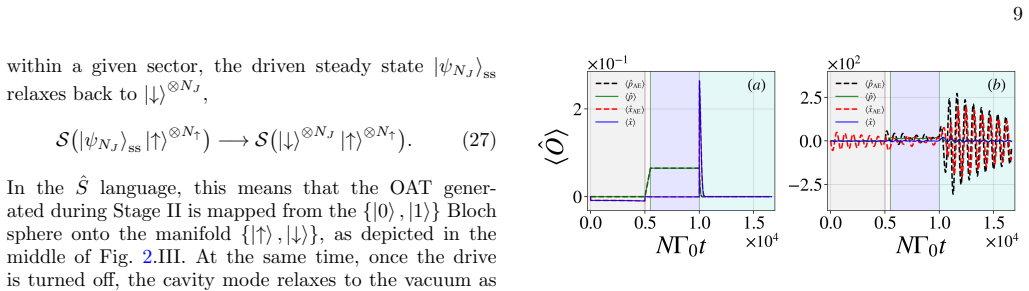
- The generated entanglement can be transferred directly to the long-lived clock states by turning the drive off.
- Symmetry-protected dissipative dynamics extends to cavity-QED platforms operating near or inside the resolved vacuum Rabi splitting limit.
- The approach provides a practical route to beyond-standard-quantum-limit performance in optical-clock systems.
Where Pith is reading between the lines
- The same ramp protocol may be adaptable to other three-level atomic species or different cavity geometries that also operate in the resolved regime.
- Because the squeezing reaches the ideal one-axis-twisting limit on shorter times, the method could reduce the impact of technical noise sources that accumulate over longer durations.
- Direct transfer to clock states suggests the squeezed ensemble could be used immediately in clock interrogation sequences without additional mapping steps.
Load-bearing premise
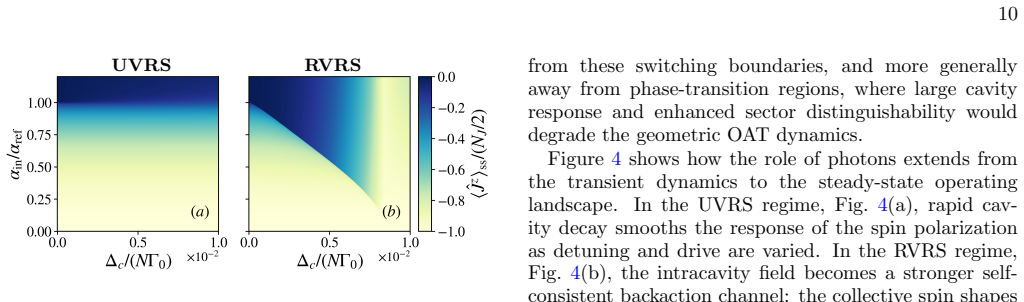
Smooth ramps of the drive amplitude and detunings allow the system to enter and remain in a stable low-photon regime where nonadiabatic excitations and sector-resolving leakage stay controlled.
What would settle it
Perform the protocol with 10^5 strontium atoms in a cavity tuned to the resolved vacuum Rabi regime and measure whether the final clock-state squeezing exceeds 25 dB while matching the predicted N^{-2/3} scaling.
Figures
read the original abstract
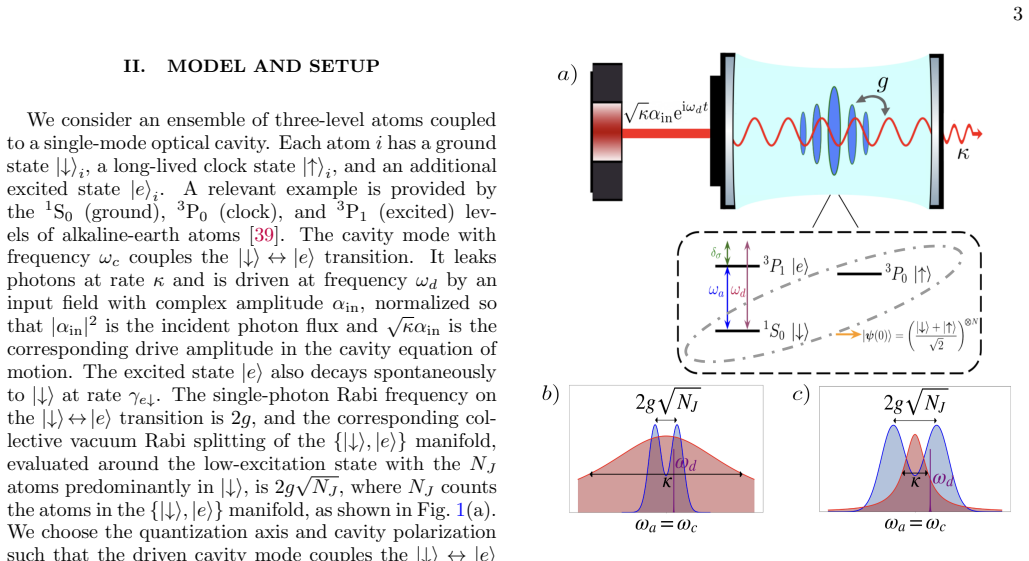
Harnessing dissipation in the presence of strong symmetries has recently emerged as a promising route for generating entanglement in atomic clocks. However, previous proposals relied on regimes where cavity photons can be adiabatically eliminated, significantly limiting their applicability to experimentally relevant cavity-QED regimes that lie in or near the resolved vacuum Rabi splitting regime. Here we show that symmetry-protected dissipative spin squeezing can be realized even when cavity photons actively participate in the dynamics, extending the experimental relevance of the protocol. We study a three-level ensemble of $^{87}\mathrm{Sr}$ atoms coupled to an optical cavity in the resolved vacuum Rabi splitting regime and demonstrate that, with smooth ramps of the drive amplitude and detunings, the driven-dissipative dynamics enters a stable low-photon regime in which nonadiabatic cavity excitations and sector-resolving photon leakage can be controlled. Within this low-photon operating window, sector-resolving photon leakage is suppressed and the sector-dependent geometric phase realizes effective one-axis twisting. At the end of the protocol the entanglement can also be efficiently transferred directly onto the long-lived clock states by turning the drive off. For experimentally realistic parameters, we theoretically show that more than $25\,\mathrm{dB}$ of squeezing can be generated for $10^5$ atoms, closely saturating the ideal one-axis twisting scaling $\xi_{\min}^2 \propto N^{-2/3}$. At fixed cooperativity, the optimized squeezing remains broadly comparable to the unresolved-regime implementation, while the resolved-regime implementation reaches comparable squeezing on a substantially shorter physical timescale. These results establish symmetry-protected dissipative dynamics as a practical route to beyond the standard-quantum-limit performance in optical-clock platforms.
Editorial analysis
A structured set of objections, weighed in public.
Referee Report
Summary. The manuscript proposes a driven-dissipative protocol for symmetry-protected spin squeezing in a three-level 87Sr ensemble coupled to an optical cavity in the resolved vacuum Rabi splitting regime. Smooth ramps of drive amplitude and detunings are used to reach a stable low-photon regime in which nonadiabatic excitations and sector-resolving leakage are suppressed, allowing the sector-dependent geometric phase to implement effective one-axis twisting; the protocol ends by transferring entanglement to clock states. For realistic parameters the work reports >25 dB squeezing at N=10^5 atoms that saturates the ideal ξ_min² ∝ N^{-2/3} scaling and reaches comparable performance to the unresolved regime on shorter timescales.
Significance. If the low-photon regime is robustly realized, the result meaningfully extends dissipative squeezing methods to experimentally relevant cavity-QED parameters, providing a concrete route to entanglement-enhanced optical clocks with shorter protocol times at fixed cooperativity. The use of realistic Sr parameters and the explicit transfer step to long-lived clock states are practical strengths.
major comments (2)
- [numerical results / protocol description] The central claim of >25 dB squeezing at N=10^5 (abstract and numerical-results section) rests on the driven-dissipative dynamics remaining in a stable low-photon regime under the chosen smooth ramps. No explicit scaling or tabulated values of steady-state photon population versus N (or versus ramp duration) are provided for the largest system sizes, leaving the quantitative margin by which nonadiabatic excitations and sector-resolving leakage remain negligible unverified.
- [results / comparison paragraph] The statement that the optimized squeezing 'remains broadly comparable' to the unresolved-regime implementation at fixed cooperativity (abstract) is load-bearing for the practical-advantage claim, yet the specific cooperativity value employed in the resolved-regime simulations is not stated, preventing direct verification of the comparison.
minor comments (2)
- [figures] Figure captions and axis labels should explicitly state the ramp functional form and the precise definition of the squeezing parameter ξ² used in all panels.
- [methods / parameter table] The manuscript would benefit from a short table listing the numerical values of all drive amplitudes, detunings, and decay rates employed for the N=10^5 case.
Simulated Author's Rebuttal
We thank the referee for the careful reading and constructive comments. We address each major point below and will revise the manuscript to improve verifiability of the claims.
read point-by-point responses
-
Referee: The central claim of >25 dB squeezing at N=10^5 (abstract and numerical-results section) rests on the driven-dissipative dynamics remaining in a stable low-photon regime under the chosen smooth ramps. No explicit scaling or tabulated values of steady-state photon population versus N (or versus ramp duration) are provided for the largest system sizes, leaving the quantitative margin by which nonadiabatic excitations and sector-resolving leakage remain negligible unverified.
Authors: We agree that explicit data on photon population scaling would strengthen the central claim. In the revised manuscript we will add a new figure (or supplementary table) showing steady-state photon number versus N up to 10^5 and versus ramp duration for the protocol parameters, thereby quantifying the margin by which the low-photon regime is maintained and nonadiabatic leakage suppressed. revision: yes
-
Referee: The statement that the optimized squeezing 'remains broadly comparable' to the unresolved-regime implementation at fixed cooperativity (abstract) is load-bearing for the practical-advantage claim, yet the specific cooperativity value employed in the resolved-regime simulations is not stated, preventing direct verification of the comparison.
Authors: We will explicitly state the cooperativity value (C = g²/(κγ)) used in the resolved-regime simulations both in the abstract and in the numerical-results section, allowing direct comparison at fixed C with the unresolved-regime results. This addition will make the practical-advantage claim verifiable without altering the reported performance. revision: yes
Circularity Check
No circularity: result from explicit dynamical simulation of master equation
full rationale
The paper derives the >25 dB squeezing claim from numerical integration of the driven-dissipative master equation under smooth ramps that stabilize a low-photon regime, realizing effective one-axis twisting via sector-dependent geometric phase. This is not equivalent to any input parameter by construction, nor does it rename a fitted quantity as a prediction. No load-bearing self-citation chain or ansatz smuggling is required for the central scaling result; the protocol is self-contained against external benchmarks of cavity-QED parameters. Minor self-citations to prior symmetry-protected squeezing work exist but are not used to force the present numerical outcome.
Axiom & Free-Parameter Ledger
axioms (2)
- standard math Driven-dissipative master equation for three-level atoms coupled to a cavity
- domain assumption Existence of a stable low-photon regime under smooth parameter ramps where sector-resolving leakage is suppressed
Reference graph
Works this paper leans on
-
[1]
The columns correspond to differ- ent resonance choices, while the row labels distinguish the UVRS and RVRS regimes
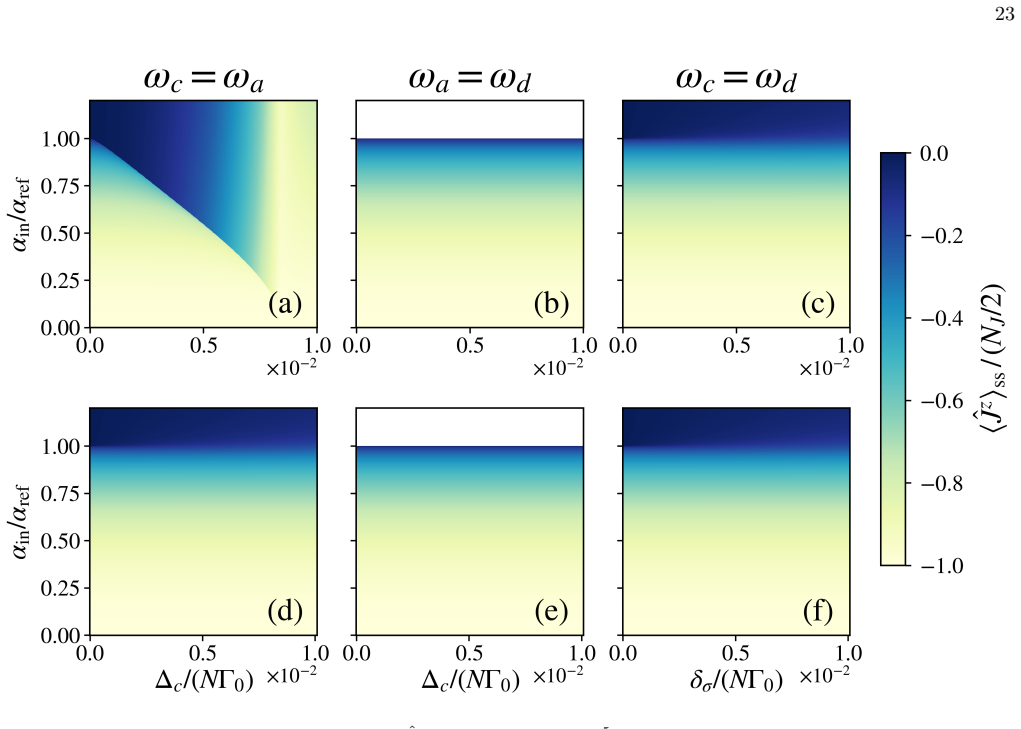
Comparison of resonance conditions Figure 10 compares the steady-state normalized spin projection⟨ ˆJ z⟩ss/(NJ /2) in the (∆ c/(NΓ0), αin/αref) plane for the three resonance conditions used in the mean-field analysis. The columns correspond to differ- ent resonance choices, while the row labels distinguish the UVRS and RVRS regimes. The comparison shows t...
-
[2]
We remove it by working in a frame rotating at ωB = δσ 2 cos ˜θJ ,ˆw ωB(t) =e iωB t ˆw(t),ˆw∈ { ˆd,ˆe}, (D2) so that the mean-field amplitudes are time independent
Rotating frame and fluctuation basis We define the sector fractions fJ = NJ N , f ↑ = 1−f J .(D1) In the spin-polarized phase the optical spin in the driven {|↓⟩,|e⟩}manifold has a common phase rotation. We remove it by working in a frame rotating at ωB = δσ 2 cos ˜θJ ,ˆw ωB(t) =e iωB t ˆw(t),ˆw∈ { ˆd,ˆe}, (D2) so that the mean-field amplitudes are time i...
-
[3]
# −∆ cˆa′†ˆa′ −δ σ sec ˜θJ ˆȷ†ˆȷ
Quadratic HP Hamiltonian and cavity elimination Displacing the cavity field as ˆa=α+ ˆa ′, withαthe mean-field cavity amplitude, and keeping terms up to quadratic order in ˆs, ˆȷ, and ˆa′ gives ˆHHP ≃g r NJ 2 " ei˜ϕJ iˆpȷ −cos ˜θJ ˆxȷ − p f↑ sin ˜θJ ˆxs ˆa′+h.c. # −∆ cˆa′†ˆa′ −δ σ sec ˜θJ ˆȷ†ˆȷ. (D7) with cavity jump operator ˆℓHP = ˆa′. Setting∂ tˆa′ ≃0 ...
-
[4]
Elimination of the fast driven-manifold mode The remaining mode ˆȷrelaxes rapidly towards a steady-state behavior relative to the squeezing dynamics in ˆsand can likewise be adiabatically eliminated. Setting ∂tˆȷ≃0 gives ˆȷ=Vj(ˆs+ ˆs†),ˆȷ † =V ∗ j (ˆs+ ˆs†),(D12) with Vj = cja∗ j −c ∗ j bj |aj|2 − |bj|2 ,(D13) where cj = g2NJ sin ˜θJ p f↑ κ2 + 4∆2c κ+ 2i∆...
-
[5]
Collective-spin model Since the metrological quadrature is related to the en- coded collective spin by ˆxs = ˆs+ ˆs† √ 2 ≈ r 2 N ˆSz,(D20) Eqs. (D18) and (D19) reduce to the effective OAT master equation ∂t ˆρ=−i[˜χˆS2 z ,ˆρ] +˜ΓD[ ˆSz]ˆρ.(D21) The exact coefficients obtained from the nested elimina- tion are ˜χ= 4 N 4g2NJ∆c κ2 + 4∆2c Aj −δ σ sec ˜θJ |Vj|...
-
[6]
D. J. Wineland, J. J. Bollinger, W. M. Itano, F. L. Moore, and D. J. Heinzen, Spin squeezing and reduced quantum noise in spectroscopy, Phys. Rev. A46, R6797 (1992)
1992
-
[7]
Kitagawa and M
M. Kitagawa and M. Ueda, Squeezed spin states, Phys. Rev. A47, 5138 (1993)
1993
-
[8]
D. J. Wineland, J. J. Bollinger, W. M. Itano, and D. J. Heinzen, Squeezed atomic states and projection noise in spectroscopy, Phys. Rev. A50, 67 (1994)
1994
-
[9]
Pezz` e, A
L. Pezz` e, A. Smerzi, M. K. Oberthaler, R. Schmied, and P. Treutlein, Quantum metrology with nonclassical states of atomic ensembles, Rev. Mod. Phys.90, 035005 (2018)
2018
-
[10]
B. J. Bloom, T. L. Nicholson, J. R. Williams, S. L. Camp- bell, M. Bishof, X. Zhang, W. Zhang, S. L. Bromley, and J. Ye, An optical lattice clock with accuracy and stability 27 at the 10 −18 level, Nature506, 71 (2014)
2014
-
[11]
A. D. Ludlow, M. M. Boyd, J. Ye, E. Peik, and P. O. Schmidt, Optical atomic clocks, Reviews of Modern Physics87, 637 (2015)
2015
-
[12]
M. Schulte, C. Lisdat, P. O. Schmidt, U. Sterr, and K. Hammerer, Prospects and challenges for squeezing- enhanced optical atomic clocks, Nature Communications 11, 10.1038/s41467-020-19403-7 (2020)
-
[13]
Aeppli, K
A. Aeppli, K. Kim, W. Warfield, M. S. Safronova, and J. Ye, Clock with 8×10 −19 systematic uncertainty, Phys. Rev. Lett.133, 023401 (2024)
2024
-
[14]
T. M. Fortier, A. N. Luiten, and H. S. Margolis, Optical atomic clocks: defining the future of time and frequency metrology, Optica13, 143 (2026)
2026
-
[15]
Pedrozo-Pe˜ nafiel, S
E. Pedrozo-Pe˜ nafiel, S. Colombo, C. Shu, A. F. Adiy- atullin, Z. Li, E. Mendez, B. Braverman, A. Kawasaki, D. Akamatsu, Y. Xiao, and V. Vuleti´ c, Entanglement on an optical atomic-clock transition, Nature (London)588, 414 (2020)
2020
-
[16]
Y. A. Yang, M. Miklos, Y. M. Tso, S. Kraus, J. Hur, and J. Ye, Clock precision beyond the standard quantum limit at 10−18 level, Physical Review Letters135, 193202 (2025)
2025
-
[17]
J. M. Robinson, M. Miklos, Y. M. Tso, C. J. Kennedy, T. Bothwell, D. Kedar, J. K. Thompson, and J. Ye, Direct comparison of two spin-squeezed optical clock ensembles at the 10 −17 level, Nature Physics20, 208 (2024)
2024
-
[18]
H. J. Kimble, Strong interactions of single atoms and photons in cavity qed, Physica ScriptaT76, 127 (1998)
1998
-
[19]
I. D. Leroux, M. H. Schleier-Smith, and V. Vuleti´ c, Im- plementation of Cavity Squeezing of a Collective Atomic Spin, Phys. Rev. Lett.104, 073602 (2010)
2010
-
[20]
M. H. Schleier-Smith, I. D. Leroux, and V. Vuleti´ c, Squeezing the collective spin of a dilute atomic ensem- ble by cavity feedback, Phys. Rev. A81, 021804 (2010)
2010
-
[21]
G. P. Greve, C. Luo, B. Wu, and J. K. Thompson, Entanglement-enhanced matter-wave interferometry in a high-finesse cavity, Nature (London)610, 472 (2022)
2022
-
[22]
M. A. Norcia, R. J. Lewis-Swan, J. R. K. Cline, B. Zhu, A. M. Rey, and J. K. Thompson, Cavity-mediated col- lective spin-exchange interactions in a strontium super- radiant laser, Science361, 259 (2018)
2018
-
[24]
Z. Chen, J. G. Bohnet, J. M. Weiner, K. C. Cox, and J. K. Thompson, Cavity-aided nondemolition measure- ments for atom counting and spin squeezing, Phys. Rev. A89, 043837 (2014)
2014
-
[25]
K. C. Cox, G. P. Greve, J. M. Weiner, and J. K. Thomp- son, Deterministic Squeezed States with Collective Mea- surements and Feedback, Phys. Rev. Lett.116, 093602 (2016)
2016
-
[26]
Hosten, N
O. Hosten, N. J. Engelsen, R. Krishnakumar, and M. A. Kasevich, Measurement noise 100 times lower than the quantum-projection limit using entangled atoms, Nature (London)529, 505 (2016)
2016
-
[27]
Hobson, W
R. Hobson, W. Bowden, A. Vianello, I. R. Hill, and P. Gill, Cavity-enhanced non-destructive detection of atoms for an optical lattice clock, Optics Express27, 37099 (2019)
2019
-
[28]
E. G. Dalla Torre, J. Otterbach, E. Demler, V. Vuletic, and M. D. Lukin, Dissipative Preparation of Spin Squeezed Atomic Ensembles in a Steady State, Phys. Rev. Lett.110, 120402 (2013)
2013
-
[29]
T. E. Lee, C.-K. Chan, and S. F. Yelin, Dissipative phase transitions: Independent versus collective decay and spin squeezing, Phys. Rev. A90, 052109 (2014)
2014
-
[30]
Fern´ andez-Lorenzo and D
S. Fern´ andez-Lorenzo and D. Porras, Quantum sensing close to a dissipative phase transition: Symmetry break- ing and criticality as metrological resources, Phys. Rev. A96, 1 (2017)
2017
-
[31]
Groszkowski, M
P. Groszkowski, M. Koppenh¨ ofer, H.-K. Lau, and A. A. Clerk, Reservoir-Engineered Spin Squeezing: Macro- scopic Even-Odd Effects and Hybrid-Systems Implemen- tations, Phys. Rev. X12, 011015 (2022)
2022
-
[32]
V. P. Pavlov, D. Porras, and P. A. Ivanov, Quantum metrology with critical driven-dissipative collective spin system, Phys. Scr.98, 095103 (2023)
2023
-
[34]
A. Gonz´ alez-Tudela and D. Porras, Mesoscopic en- tanglement induced by spontaneous emission in solid- state quantum optics, Physical Review Letters110, 10.1103/physrevlett.110.080502 (2013)
-
[35]
E. Wolfe and S. F. Yelin, Spin squeezing by means of driven superradiance (2014), arXiv:1405.5288 [quant-ph]
Pith/arXiv arXiv 2014
-
[36]
O. Somech and E. Shahmoon, Quantum entangled states of a classically radiating macroscopic spin, PRX Quan- tum5, 10.1103/prxquantum.5.010349 (2024)
-
[37]
A. Chu, M. Mamaev, M. Koppenh¨ ofer, M. Yuan, and A. A. Clerk, Reconfigurable dissipative entangle- ment between many spin ensembles: from robust quan- tum sensing to many-body state engineering (2025), arXiv:2510.07616 [quant-ph]
Pith/arXiv arXiv 2025
-
[39]
Prosen and T
T. Prosen and T. H. Seligman, Quantization over boson operator spaces, J. Phys. A43, 1 (2010)
2010
-
[40]
Buˇ ca and T
B. Buˇ ca and T. Prosen, A note on symmetry reductions of the Lindblad equation: transport in constrained open spin chains, New J. Phys.14, 073007 (2012)
2012
-
[41]
S. Lieu, R. Belyansky, J. T. Young, R. Lundgren, V. V. Albert, and A. V. Gorshkov, Symmetry Breaking and Error Correction in Open Quantum Systems, Phys. Rev. Lett.125, 240405 (2020)
2020
-
[42]
Barberena, R
D. Barberena, R. J. Lewis-Swan, J. K. Thompson, and A. M. Rey, Driven-dissipative quantum dynamics in ultra-long-lived dipoles in an optical cavity, Phys. Rev. A99, 1 (2019)
2019
-
[44]
J. R. K. Cline, V. M. Sch¨ afer, Z. Niu, D. J. Young, T. H. Yoon, and J. K. Thompson, Continuous collec- tive strong coupling of strontium atoms to a high finesse ring cavity, Physical Review Letters134, 10.1103/phys- revlett.134.013403 (2025)
-
[45]
E. Y. Song, D. Barberena, D. J. Young, E. Chaparro, A. Chu, S. Agarwal, Z. Niu, J. T. Young, A. M. Rey, 28 and J. K. Thompson, A dissipation-induced superradi- ant transition in a strontium cavity-qed system, Science Advances11, 10.1126/sciadv.adu5799 (2025)
-
[46]
M. N. Winchester, M. A. Norcia, J. R. K. Cline, and J. K. Thompson, Magnetically induced optical trans- parency on a forbidden transition in strontium for cavity- enhanced spectroscopy, Physical Review Letters118, 10.1103/physrevlett.118.263601 (2017)
-
[47]
Polkovnikov, Phase space representation of quantum dynamics, Ann
A. Polkovnikov, Phase space representation of quantum dynamics, Ann. Phys. (N. Y).325, 1790 (2010)
2010
-
[48]
J. Schachenmayer, A. Pikovski, and A. M. Rey, Many- body quantum spin dynamics with monte carlo trajec- tories on a discrete phase space, Physical Review X5, 10.1103/physrevx.5.011022 (2015)
-
[49]
Huber, A
J. Huber, A. M. Rey, and P. Rabl, Realistic simulations of spin squeezing and cooperative coupling effects in large ensembles of interacting two-level systems, Phys. Rev. A 105, 013716 (2022)
2022
-
[50]
C. D. Mink, D. Petrosyan, and M. Fleischhauer, Hy- brid discrete-continuous truncated wigner approximation for driven, dissipative spin systems, Physical Review Re- search4, 10.1103/physrevresearch.4.043136 (2022)
-
[51]
C. D. Mink and M. Fleischhauer, Collective radiative in- teractions in the discrete truncated wigner approxima- tion, SciPost Physics15, 233 (2023)
2023
-
[52]
H. Hosseinabadi, O. Chelpanova, and J. Marino, User- friendly truncated wigner approximation for dissipative spin dynamics, PRX Quantum6, 10.1103/1wwv-k7hg (2025)
-
[53]
Holstein and H
T. Holstein and H. Primakoff, Field dependence of the in- trinsic domain magnetization of a ferromagnet, Physical Review58, 1098 (1940)
1940
-
[54]
C. Emary and T. Brandes, Chaos and the quantum phase transition in the dicke model, Physical Review E67, 10.1103/physreve.67.066203 (2003)
-
[55]
Z. Kurucz and K. Mølmer, Multilevel holstein-primakoff approximation and its application to atomic spin squeez- ing and ensemble quantum memories, Physical Review A 81, 10.1103/physreva.81.032314 (2010)
-
[56]
Pi˜ neiro Orioli, J
A. Pi˜ neiro Orioli, J. K. Thompson, and A. M. Rey, Emer- gent Dark States from Superradiant Dynamics in Multi- level Atoms in a Cavity, Phys. Rev. X12, 11054 (2022)
2022
-
[57]
R. H. Dicke, Coherence in spontaneous radiation pro- cesses, Physical Review93, 99 (1954)
1954
-
[58]
Gross and S
M. Gross and S. Haroche, Superradiance: An essay on the theory of collective spontaneous emission, Physics Reports93, 301 (1982)
1982
-
[59]
M. A. Norcia and J. K. Thompson, Cold-strontium laser in the superradiant crossover regime, Physical Review X 6, 10.1103/physrevx.6.011025 (2016)
-
[60]
V. V. Albert and L. Jiang, Symmetries and conserved quantities in lindblad master equations, Phys. Rev. A 89, 022118 (2014)
2014
-
[61]
S´ anchez Mu˜ noz, B
C. S´ anchez Mu˜ noz, B. Buˇ ca, J. Tindall, A. Gonz´ alez- Tudela, D. Jaksch, and D. Porras, Symmetries and con- servation laws in quantum trajectories: Dissipative freez- ing, Phys. Rev. A100, 042113 (2019)
2019
-
[62]
Y.-J. Liu and S. Lieu, Dissipative phase transitions and passive error correction, Physical Review A109, 10.1103/physreva.109.022422 (2024)
-
[63]
M. V. Berry, Quantal phase factors accompanying adia- batic changes, Proceedings of the Royal Society of Lon- don. A. Mathematical and Physical Sciences392, 45 (1984)
1984
-
[64]
D. Barberena, A. Chu, J. K. Thompson, and A. M. Rey, Trade-offs between unitary and measurement induced spin squeezing in cavity qed, Physical Review Research 6, 10.1103/physrevresearch.6.l032037 (2024)
-
[65]
Bonifacio and L
R. Bonifacio and L. A. Lugiato, Optical bistability and cooperative effects in resonance fluorescence, Physical Review A18, 1129 (1978)
1978
-
[66]
H. J. Carmichael, Analytical and numerical results for the steady state in cooperative resonance fluorescence, J. Phys. B13, 3551 (1980)
1980
-
[67]
Schachenmayer, A
J. Schachenmayer, A. Pikovski, and A. M. Rey, Many- Body Quantum Spin Dynamics with Monte Carlo Trajec- tories on a Discrete Phase Space, Phys. Rev. X5, 011022 (2015)
2015
-
[68]
B. Zhu, A. M. Rey, and J. Schachenmayer, A generalized phase space approach for solving quantum spin dynamics, New J. Phys.21, 082001 (2019)
2019
-
[69]
A. Chu, P. He, J. K. Thompson, and A. M. Rey, Quantum Enhanced Cavity QED Interferometer with Partially De- localized Atoms in Lattices, Phys. Rev. Lett.127, 210401 (2021)
2021
-
[70]
J. Gambetta, A. Blais, D. I. Schuster, A. Wallraff, L. Frunzio, J. Majer, M. H. Devoret, S. M. Girvin, and R. J. Schoelkopf, Qubit-photon interactions in a cav- ity: Measurement-induced dephasing and number split- ting, Physical Review A74, 10.1103/physreva.74.042318 (2006)
-
[71]
J. Gambetta, A. Blais, M. Boissonneault, A. A. Houck, D. I. Schuster, and S. M. Girvin, Quantum trajectory ap- proach to circuit qed: Quantum jumps and the zeno ef- fect, Physical Review A77, 10.1103/physreva.77.012112 (2008)
-
[72]
Baamara, A
Y. Baamara, A. Sinatra, and M. Gessner, Squeezing of nonlinear spin observables by one axis twisting in the presence of decoherence: An analytical study, Comptes Rendus. Phys.23, 1 (2022)
2022
-
[73]
Tanji-Suzuki, I
H. Tanji-Suzuki, I. D. Leroux, M. H. Schleier-Smith, M. Cetina, A. T. Grier, J. Simon, and V. Vuleti´ c, Inter- action between atomic ensembles and optical resonators, inAdvances in Atomic, Molecular, and Optical Physics (Elsevier, 2011) pp. 201–237
2011
-
[74]
A. K. Tuchman, R. Long, G. Vrijsen, J. Boudet, J. Lee, and M. A. Kasevich, Normal-mode splitting with large collective cooperativity, Physical Review A74, 10.1103/physreva.74.053821 (2006)
-
[75]
M. A. Norcia and J. K. Thompson, Strong coupling on a forbidden transition in strontium and nondestructive atom counting, Physical Review A93, 023804 (2016)
2016
-
[76]
J. A. Muniz, D. J. Young, J. R. K. Cline, and J. K. Thompson, Cavity-qed measurements of the 87Sr milli- hertz optical clock transition and determination of its natural linewidth, Phys. Rev. Research3, 023152 (2021)
2021
-
[77]
K. Tucker, D. Barberena, R. J. Lewis-Swan, J. K. Thompson, J. G. Restrepo, and A. M. Rey, Facili- tating spin squeezing generated by collective dynamics with single-particle decoherence, Physical Review A102, 10.1103/physreva.102.051701 (2020)
-
[78]
Simon, Holonomy, the quantum adiabatic theorem, and berry’s phase, Physical Review Letters51, 2167 (1983)
B. Simon, Holonomy, the quantum adiabatic theorem, and berry’s phase, Physical Review Letters51, 2167 (1983)
1983
-
[79]
Wilczek and A
F. Wilczek and A. Zee, Appearance of gauge structure in simple dynamical systems, Physical Review Letters52, 2111 (1984)
1984
-
[80]
Zanardi and M
P. Zanardi and M. Rasetti, Holonomic quantum compu- 29 tation, Physics Letters A264, 94 (1999)
1999
-
[81]
Zhang, T
J. Zhang, T. H. Kyaw, S. Filipp, L.-C. Kwek, E. Sj¨ oqvist, and D. Tong, Geometric and holonomic quantum com- putation, Physics Reports1027, 1 (2023)
2023
-
[82]
H. M. Gibbs,Optical Bistability: Controlling Light with Light(Academic Press, Orlando, FL, 1985)
1985
-
[83]
Rivero, C
D. Rivero, C. A. Pessoa Jr, G. H. de Fran¸ ca, R. C. Teix- eira, S. Slama, and P. W. Courteille, Quantum resonant optical bistability with a narrow atomic transition: bista- bility phase diagram in the bad cavity regime, New Jour- nal of Physics25, 093053 (2023)
2023
-
[84]
M. J. Bhaseen, J. Mayoh, B. D. Simons, and J. Keeling, Dynamics of nonequilibrium Dicke models, Phys. Rev. A 85, 1 (2012)
2012
discussion (0)
Sign in with ORCID, Apple, or X to comment. Anyone can read and Pith papers without signing in.