Quantum Photonic Time Crystals: From Temporal Boundaries to Floquet Light-Matter Interactions
Pith reviewed 2026-06-28 21:28 UTC · model grok-4.3
The pith
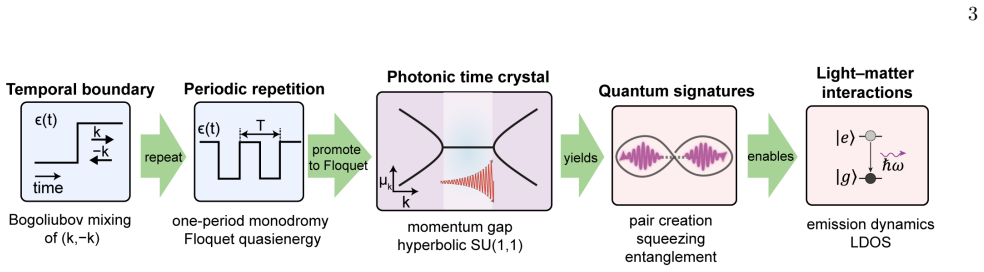
A single temporal boundary in a photonic time crystal mixes modes and creates photon pairs; periodicity turns this into a Floquet problem with momentum gaps described by two-mode SU(1,1) squeezing in a fixed Nambu basis.
A machine-rendered reading of the paper's core claim, the machinery that carries it, and where it could break.
Core claim
A single temporal boundary induces Bogoliubov mode mixing and photon-pair creation; in homogeneous bulk media, momentum conservation isolates counter-propagating (k,-k) sectors and yields a two-mode SU(1,1) squeezing structure; temporal periodicity promotes this to a Floquet problem with band and momentum-gap regimes, compactly described in a fixed Nambu basis.
What carries the argument
Two-mode SU(1,1) squeezing structure in a fixed Nambu basis that isolates counter-propagating sectors and encodes the transition from single-boundary mixing to Floquet momentum gaps.
If this is right
- Momentum gaps enable parametric amplification and effective non-Hermitian dynamics for the quantum vacuum.
- The same pair-creation process links photonic time crystals to the dynamical Casimir effect and parametric amplifiers.
- Light-matter extensions include spontaneous-emission decay rates, modulation-assisted excitation, and atom-PTC dynamics.
- LDOS-based observables remain well-defined only within the homogeneous, non-dispersive limit.
- Finite, dispersive, and experimentally accessible platforms can realize these effects.
Where Pith is reading between the lines
- The Nambu-basis description may simplify calculations of vacuum fluctuations in other time-modulated systems.
- Momentum-gap regimes could be used to engineer controlled sources of entangled photon pairs.
- The discrete-resonance organization suggests direct analogies to Floquet engineering in atomic and solid-state systems.
- Limits of the homogeneous approximation could be tested by measuring LDOS deviations in finite samples.
Load-bearing premise
Photonic time crystals and the dynamical Casimir effect share the same pair-creation mechanism but organize it through discrete temporal resonances rather than a continuous momentum-resolved spectrum.
What would settle it
Observation (or absence) of counter-propagating photon pairs carrying the exact squeezing correlations predicted by the SU(1,1) structure immediately after a single temporal boundary, or the appearance of momentum-gap parametric amplification in a homogeneous periodic medium.
Figures
read the original abstract
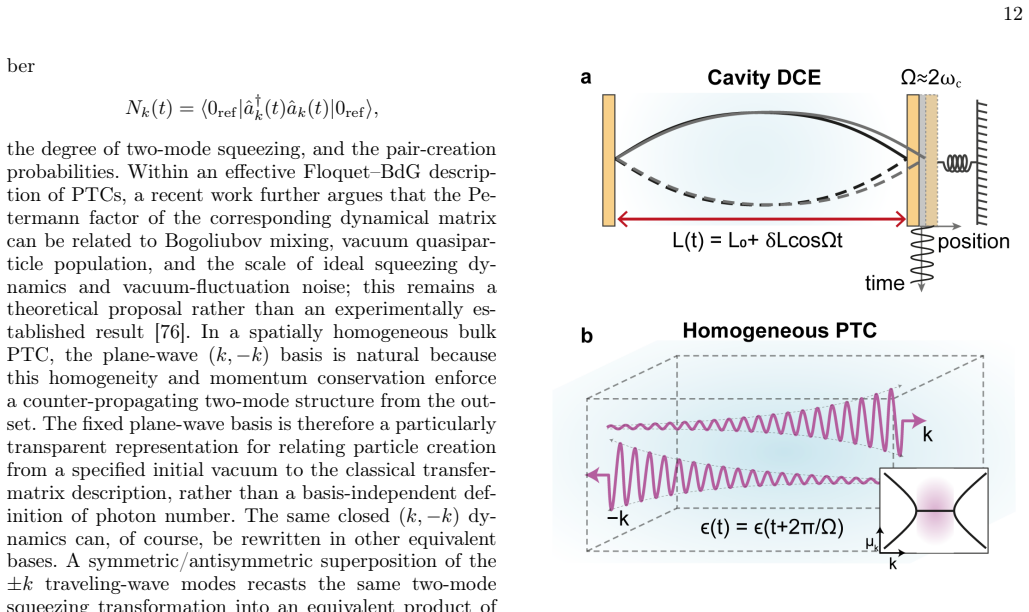
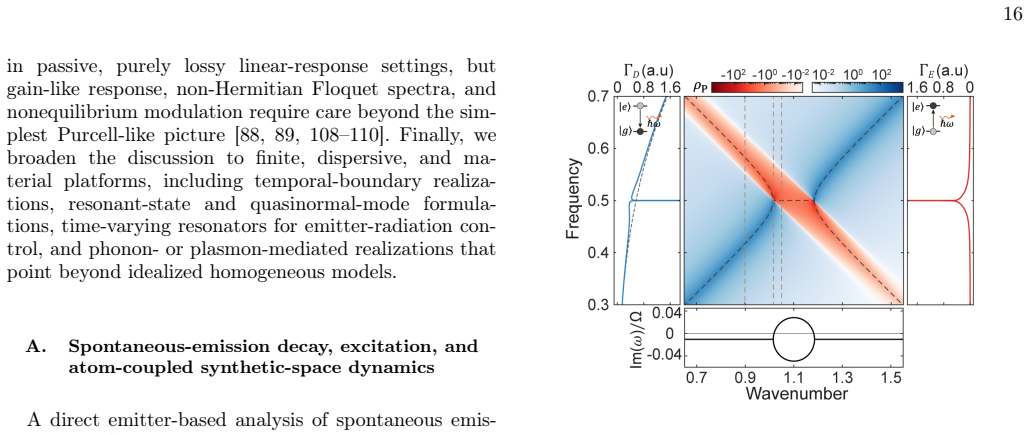
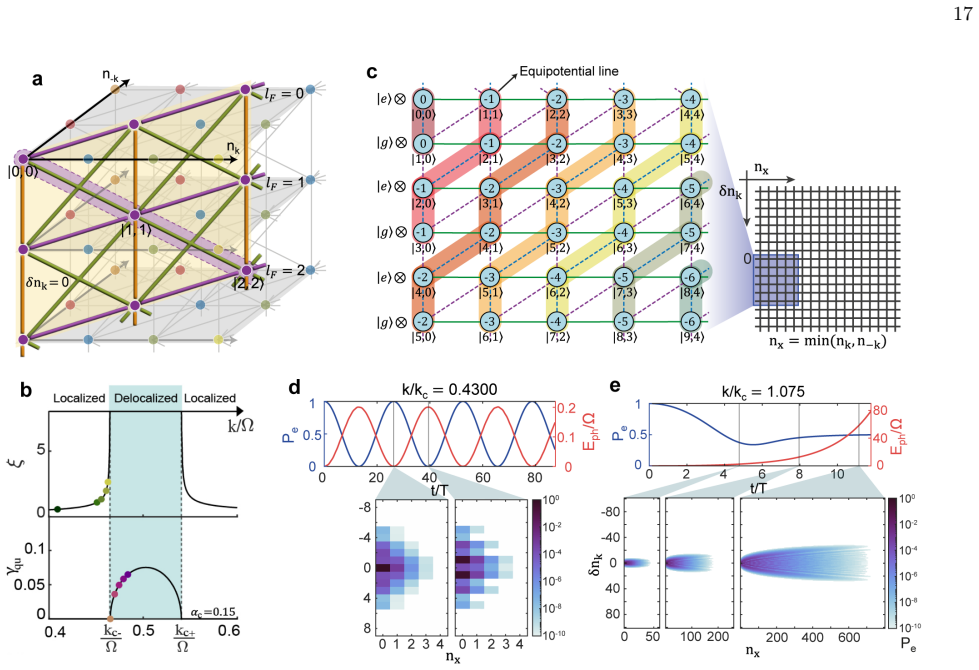
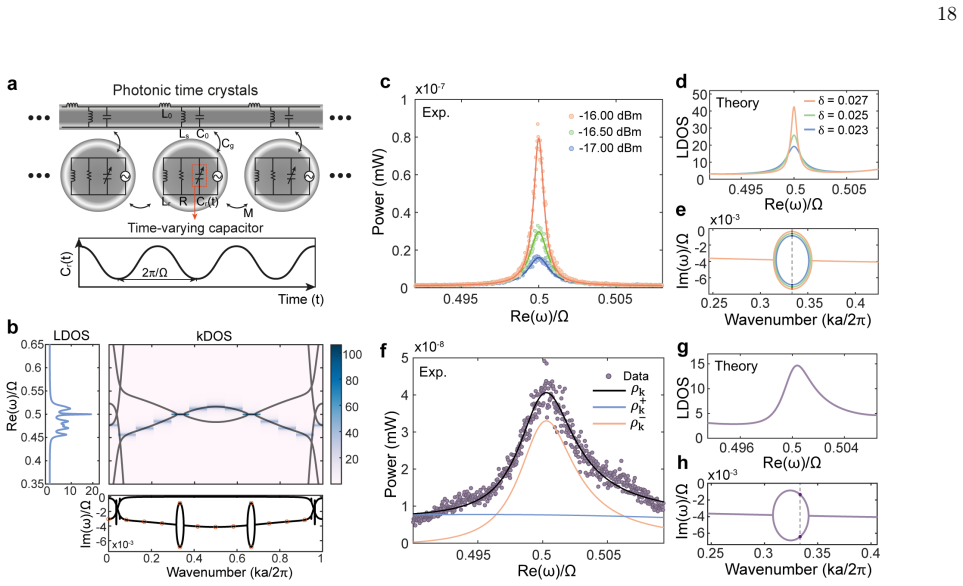
Photonic time crystals (PTCs) are temporally periodic media whose Floquet spectra can exhibit momentum gaps, parametric amplification, and effective non-Hermitian descriptions, making them an idealized setting for vacuum amplification and nonequilibrium light-matter dynamics. Their classical electrodynamics is now well developed; the quantum side is less so, and this focused review is an attempt to organize what exists. We trace that account from temporal boundaries to homogeneous Floquet media and light-matter dynamics. A single temporal boundary induces Bogoliubov mode mixing and photon-pair creation; in homogeneous bulk media, momentum conservation isolates counter-propagating $(k,-k)$ sectors and yields a two-mode $SU(1,1)$ squeezing structure. Temporal periodicity promotes this to a Floquet problem with band and momentum-gap regimes, compactly described in a fixed Nambu basis. We then relate PTCs to the dynamical Casimir effect and parametric amplification, which share the same pair-creation mechanism but organize it through discrete resonances rather than a momentum-resolved bulk spectrum. We close with light-matter settings: spontaneous-emission decay and modulation-assisted excitation, atom-PTC dynamics, LDOS-based observables and their limits, and finite, dispersive, and experimentally accessible platforms.
Editorial analysis
A structured set of objections, weighed in public.
Referee Report
Summary. The manuscript is a focused review organizing the quantum theory of photonic time crystals. It begins with a single temporal boundary inducing Bogoliubov mode mixing and photon-pair creation, proceeds to homogeneous bulk media where momentum conservation isolates counter-propagating (k,-k) sectors yielding two-mode SU(1,1) squeezing, then extends to temporally periodic Floquet media with band and momentum-gap regimes compactly described in a fixed Nambu basis. The review relates these to the dynamical Casimir effect and parametric amplification (sharing the pair-creation mechanism but via discrete resonances), and closes with light-matter settings including spontaneous-emission decay, modulation-assisted excitation, atom-PTC dynamics, LDOS observables, and finite/dispersive platforms.
Significance. As a review synthesizing the quantum side of PTCs (less developed than the classical electrodynamics), the manuscript provides a coherent narrative connecting temporal boundaries, Bogoliubov transformations, Floquet spectra in Nambu bases, and relations to established pair-creation phenomena. Its value lies in compactly framing existing literature for researchers in quantum optics and nonequilibrium photonics; no new derivations or predictions are advanced, but the organizational framework is a strength if the cited connections are accurately represented.
Simulated Author's Rebuttal
We thank the referee for their positive and accurate summary of the manuscript. We are pleased that the review's organizational framework and connections to related phenomena were found valuable, and we appreciate the recommendation to accept.
Circularity Check
No significant circularity; review paper organizes prior literature without new derivations
full rationale
This manuscript is explicitly presented as a focused review that traces and organizes established concepts from prior literature on temporal boundaries, Bogoliubov mixing, SU(1,1) squeezing, Floquet spectra, dynamical Casimir effect, and parametric amplification. No new derivations, theorems, quantitative predictions, or fitted parameters are advanced; the central claims restate mechanisms already present in the cited body of work. No load-bearing steps reduce to self-citation chains or self-definitional inputs by construction. The paper is self-contained as a synthesis against external benchmarks.
Axiom & Free-Parameter Ledger
Reference graph
Works this paper leans on
-
[1]
F. R. Morgenthaler, IRE Transactions on Microwave Theory and Techniques6, 167 (1958)
1958
-
[2]
R. L. Fante, IEEE Transactions on Antennas and Prop- agation19, 417 (1971). 23
1971
-
[3]
Felsen and G
L. Felsen and G. Whitman, IEEE Transactions on An- tennas and Propagation18, 242 (1970)
1970
-
[4]
Ortega-Gomez, M
A. Ortega-Gomez, M. Lobet, J. E. Vázquez-Lozano, and I. Liberal, Opt. Mater. Express13, 1598 (2023)
2023
-
[5]
Caloz and Z.-L
C. Caloz and Z.-L. Deck-Léger, IEEE Transactions on Antennas and Propagation68, 1569 (2019)
2019
-
[6]
Liberal, A
I. Liberal, A. Ganfornina-Andrades, and J. E. Vázquez- Lozano, ACS Photonics11, 5273 (2024)
2024
-
[7]
Y. Xiao, D. N. Maywar, and G. P. Agrawal, Opt. Lett. 39, 574 (2014)
2014
-
[8]
B. W. Plansinis, W. R. Donaldson, and G. P. Agrawal, Phys. Rev. Lett.115, 183901 (2015)
2015
-
[9]
K. Lee, J. Son, J. Park, B. Kang, W. Jeon, F. Roter- mund, and B. Min, Nature Photonics12, 765 (2018)
2018
-
[10]
K. Lee, J. Park, S. Lee, S. Baek, J. Park, F. Rotermund, and B. Min, Nanophotonics11, 2045 (2022)
2045
-
[11]
Moussa, G
H. Moussa, G. Xu, S. Yin, E. Galiffi, Y. Ra’di, and A. Alù, Nature Physics19, 863 (2023)
2023
-
[12]
Ptitcyn, D
G. Ptitcyn, D. M. Solís, M. S. Mirmoosa, and N. En- gheta, Nanophotonics14, 4207 (2025)
2025
-
[13]
Tirole, S
R. Tirole, S. Vezzoli, E. Galiffi, I. Robertson, D. Mau- rice, B. Tilmann, S. A. Maier, J. B. Pendry, and R. Sapienza, Nature Physics19, 999 (2023)
2023
-
[14]
Tirole, S
R. Tirole, S. Vezzoli, D. Saxena, S. Yang, T. Raziman, E. Galiffi, S. A. Maier, J. B. Pendry, and R. Sapienza, Nature Communications15, 7752 (2024)
2024
-
[15]
E.S.CassedyandA.A.Oliner,ProceedingsoftheIEEE 51, 1342 (1963)
1963
-
[16]
E. S. Cassedy, Proceedings of the IEEE55, 1154 (1967)
1967
-
[17]
D. E. Holberg and K. S. Kunz, IEEE Transactions on Antennas and Propagation14, 183 (1966)
1966
-
[18]
J. R. Zurita-Sánchez, P. Halevi, and J. C. Cervantes- González, Physical Review A79, 053821 (2009)
2009
-
[19]
Wilczek, Physical Review Letters109, 160401 (2012)
F. Wilczek, Physical Review Letters109, 160401 (2012)
2012
-
[20]
Shapere and F
A. Shapere and F. Wilczek, Phys. Rev. Lett.109, 160402 (2012)
2012
-
[21]
D. V. Else, B. Bauer, and C. Nayak, Phys. Rev. Lett. 117, 090402 (2016)
2016
-
[22]
N. Y. Yao, A. C. Potter, I.-D. Potirniche, and A. Vish- wanath, Phys. Rev. Lett.118, 030401 (2017)
2017
-
[23]
S. Choi, J. Choi, R. Landig, G. Kucsko, H. Zhou, J. Isoya, F. Jelezko, S. Onoda, H. Sumiya, V. Khemani, C. von Keyserlingk, N. Y. Yao, E. Demler, and M. D. Lukin, Nature543, 221 (2017)
2017
-
[24]
Zhang, P
J. Zhang, P. W. Hess, A. Kyprianidis, P. Becker, A. Lee, J. Smith, G. Pagano, I.-D. Potirniche, A. C. Potter, A. Vishwanath, N. Y. Yao, and C. Monroe, Nature543, 217 (2017)
2017
-
[25]
Kongkhambut, J
P. Kongkhambut, J. Skulte, L. Mathey, J. G. Cosme, A. Hemmerich, and H. Keßler, Science377, 670 (2022)
2022
-
[26]
Self-organized photonic time quasicrystal from a single imposed clock
M. Kyung, K. Lee, Y. Kim, E.-G. Moon, J. Choi, and B. Min, Self-organized photonic time quasicrystal from a single imposed clock (2026), arXiv:2605.05649 [physics.optics]
work page internal anchor Pith review Pith/arXiv arXiv 2026
-
[27]
Lustig, Y
E. Lustig, Y. Sharabi, and M. Segev, Optica5, 1390 (2018)
2018
-
[28]
Wang, Z.-Q
N. Wang, Z.-Q. Zhang, and C. T. Chan, Phys. Rev. B 98, 085142 (2018)
2018
-
[29]
Park and B
J. Park and B. Min, Opt. Lett.46, 484 (2021)
2021
-
[30]
Galiffi, R
E. Galiffi, R. Tirole, S. Yin, H. Li, S. Vezzoli, P. A. Huidobro, M. G. Silveirinha, R. Sapienza, A. Alù, and J. B. Pendry, Advanced Photonics4, 014002 (2022)
2022
-
[31]
Lustig, O
E. Lustig, O. Segal, S. Saha, C. Fruhling, V. M. Shalaev, A. Boltasseva, and M. Segev, Optics Express31, 9165 (2023)
2023
-
[32]
M. M. Asgari, P. Garg, X. Wang, M. S. Mirmoosa, C. Rockstuhl, and V. Asadchy, Advances in optics and photonics16, 958 (2024)
2024
-
[33]
J. R. Zurita-Sánchez and P. Halevi, Physical Review A 81, 053834 (2010)
2010
-
[34]
J. R. Zurita-Sánchez, J. H. Abundis-Patiño, and P. Halevi, Optics Express20, 5586 (2012)
2012
-
[35]
J. R. Reyes-Ayona and P. Halevi, Applied Physics Let- ters107, 074101 (2015)
2015
-
[36]
J. Park, H. Cho, S. Lee, K. Lee, K. Lee, H. C. Park, J.- W. Ryu, N. Park, S. Jeon, and B. Min, Science advances 8, eabo6220 (2022)
2022
-
[37]
S. Lee, J. Park, H. Cho, Y. Wang, B. Kim, C. Daraio, and B. Min, Photonics Research9, 142 (2021)
2021
-
[38]
Sharabi, A
Y. Sharabi, A. Dikopoltsev, E. Lustig, Y. Lumer, and M. Segev, Optica9, 585 (2022)
2022
-
[39]
J. B. Khurgin, ACS Photonics11, 2150 (2024)
2024
-
[40]
X. Wang, M. S. Mirmoosa, V. S. Asadchy, C. Rock- stuhl, S. Fan, and S. A. Tretyakov, Science advances9, eadg7541 (2023)
2023
-
[41]
X. Wang, P. Garg, M. Mirmoosa, A. Lamprianidis, C. Rockstuhl, and V. Asadchy, Nature Photonics19, 149 (2025)
2025
-
[42]
Xiong, X
J. Xiong, X. Zhang, L. Duan, J. Wang, Y. Long, H. Hou, L. Yu, L. Zou, and B. Zhang, Nature Communications 16, 11182 (2025)
2025
-
[43]
J. Park, K. Lee, R.-Y. Zhang, H.-C. Park, J.-W. Ryu, G. Y. Cho, M. Y. Lee, Z. Zhang, N. Park, W. Jeon, J. Shin, C. T. Chan, and B. Min, Phys. Rev. Lett.135, 133801 (2025)
2025
-
[44]
K. Lee, M. Kyung, Y. Kim, J. Park, H. Lee, J. Choi, C. T. Chan, J. Shin, K. W. Kim, and B. Min, Phys. Rev. Lett.136, 093802 (2026)
2026
-
[45]
G. T. Moore, Journal of mathematical physics11, 2679 (1970)
1970
-
[46]
S. A. Fulling and P. C. Davies, Proceedings of the Royal Society of London. A. Mathematical and Physical Sci- ences348, 393 (1976)
1976
-
[47]
P. C. Davies and S. A. Fulling, Proceedings of the Royal Society of London. A. Mathematical and Physical Sci- ences356, 237 (1977)
1977
-
[48]
P. D. Nation, J. R. Johansson, M. P. Blencowe, and F. Nori, Rev. Mod. Phys.84, 1 (2012)
2012
-
[49]
Dodonov, Physics2, 67 (2020)
V. Dodonov, Physics2, 67 (2020)
2020
-
[50]
Yablonovitch, Phys
E. Yablonovitch, Phys. Rev. Lett.62, 1742 (1989)
1989
-
[51]
V. V. Dodonov, A. B. Klimov, and D. E. Nikonov, Phys. Rev. A47, 4422 (1993)
1993
-
[52]
C. K. Law, Phys. Rev. A49, 433 (1994)
1994
-
[53]
Artoni, A
M. Artoni, A. Bulatov, and J. Birman, Phys. Rev. A 53, 1031 (1996)
1996
-
[54]
Cirone, K
M. Cirone, K. Rzążewski, and J. Mostowski, Phys. Rev. A55, 62 (1997)
1997
-
[55]
C. M. Caves, Phys. Rev. D26, 1817 (1982)
1982
-
[56]
C. M. Caves and B. L. Schumaker, Phys. Rev. A31, 3068 (1985)
1985
-
[57]
B. L. Schumaker and C. M. Caves, Phys. Rev. A31, 3093 (1985)
1985
-
[58]
Yurke, S
B. Yurke, S. L. McCall, and J. R. Klauder, Phys. Rev. A33, 4033 (1986)
1986
-
[59]
T.Mendonça, A.Guerreiro, andA
J. T.Mendonça, A.Guerreiro, andA. M.Martins, Phys. Rev. A62, 033805 (2000). 24
2000
-
[60]
J. T. Mendonça and A. Guerreiro, Phys. Rev. A72, 063805 (2005)
2005
-
[61]
J. T. Mendonça, Journal of Russian Laser Research32, 445 (2011)
2011
-
[62]
T.Mendonça, A.M
J. T.Mendonça, A.M. Martins,and A.Guerreiro, Phys. Rev. A68, 043801 (2003)
2003
-
[63]
Ganfornina-Andrades, J
A. Ganfornina-Andrades, J. E. Vázquez-Lozano, and I. Liberal, Phys. Rev. Res.6, 043320 (2024)
2024
-
[64]
J. E. Vázquez-Lozano and I. Liberal, Nanophotonics12, 539 (2023)
2023
-
[65]
Photon State Evolution in Arbitrary Time-Varying Media
A. Stevens and C. Caloz, Photon state evolution in arbitrary time-varying media (2025), arXiv:2501.04836 [physics.optics]
work page internal anchor Pith review Pith/arXiv arXiv 2025
-
[66]
Liberal, J
I. Liberal, J. E. Vázquez-Lozano, and V. Pacheco-Peña, Laser & Photonics Reviews17, 2200720 (2023)
2023
-
[67]
M. S. Mirmoosa, T. Setälä, and A. Norrman, Phys. Rev. Res.7, 013120 (2025)
2025
-
[68]
Svidzinsky, Optics Express32, 15623 (2024)
A. Svidzinsky, Optics Express32, 15623 (2024)
2024
-
[69]
Z. Dong, H. Li, T. Wan, Q. Liang, Z. Yang, and B. Yan, Nature Photonics18, 68 (2024)
2024
-
[70]
Lyubarov, Y
M. Lyubarov, Y. Lumer, A. Dikopoltsev, E. Lustig, Y. Sharabi, and M. Segev, Science377, 425 (2022)
2022
-
[71]
Dikopoltsev, Y
A. Dikopoltsev, Y. Sharabi, M. Lyubarov, Y. Lumer, S. Tsesses, E. Lustig, I. Kaminer, and M. Segev, Pro- ceedings of the National Academy of Sciences119, e2119705119 (2022)
2022
-
[72]
J. E. Sustaeta-Osuna, F. J. García-Vidal, and P. A. Huidobro, ACS photonics12, 1873 (2025)
2025
-
[73]
J. Bae, K. Lee, B. Min, and K. W. Kim, Nature Com- munications17, 858 (2026)
2026
-
[74]
Lyubarov, A
M. Lyubarov, A. Gorlach, O. Segal, M. Birk, L. Nemirovsky-Levy, Y. Plotnik, and M. Segev, Optica Quantum3, 366 (2025)
2025
- [75]
- [76]
-
[77]
Galiffi, D
E. Galiffi, D. M. Solís, S. Yin, N. Engheta, and A. Alù, Light: Science & Applications14, 338 (2025)
2025
-
[78]
L. A. Ostrovski˘ ı, Soviet Physics Uspekhi18, 452 (1975)
1975
-
[79]
B. J. Dalton, E. S. Guerra, and P. L. Knight, Phys. Rev. A54, 2292 (1996)
1996
-
[80]
J. G. Gaxiola-Luna and P. Halevi, Physical Review B 103, 144306 (2021)
2021
discussion (0)
Sign in with ORCID, Apple, or X to comment. Anyone can read and Pith papers without signing in.