Photon State Evolution in Arbitrary Time-Varying Media
Pith reviewed 2026-05-23 06:10 UTC · model grok-4.3
The pith
Instantaneous eigenstate method caps single photon pair generation at 25 percent in time-varying media
A machine-rendered reading of the paper's core claim, the machinery that carries it, and where it could break.
Core claim
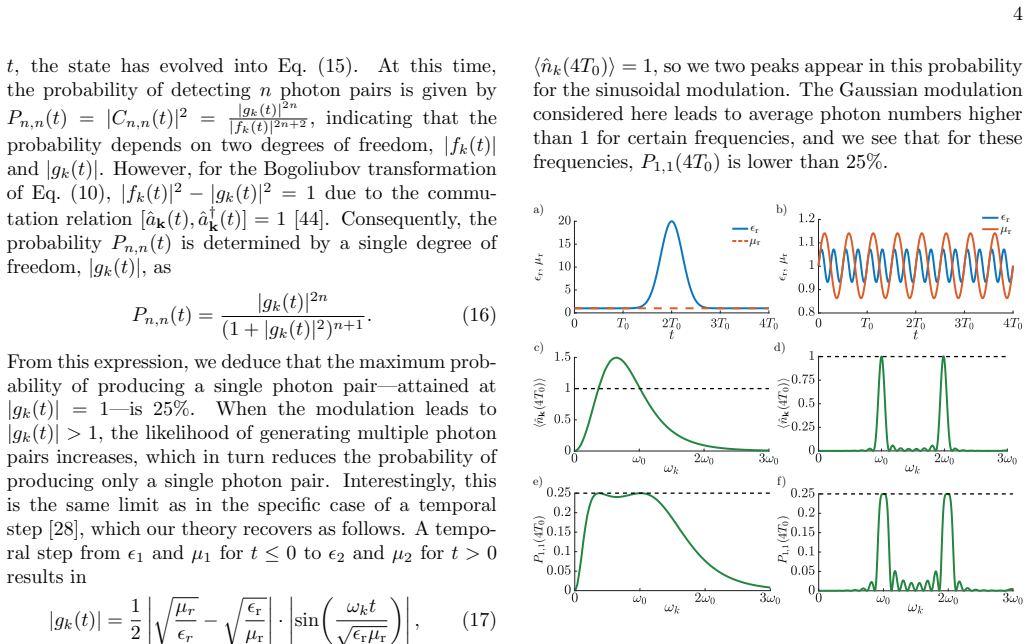
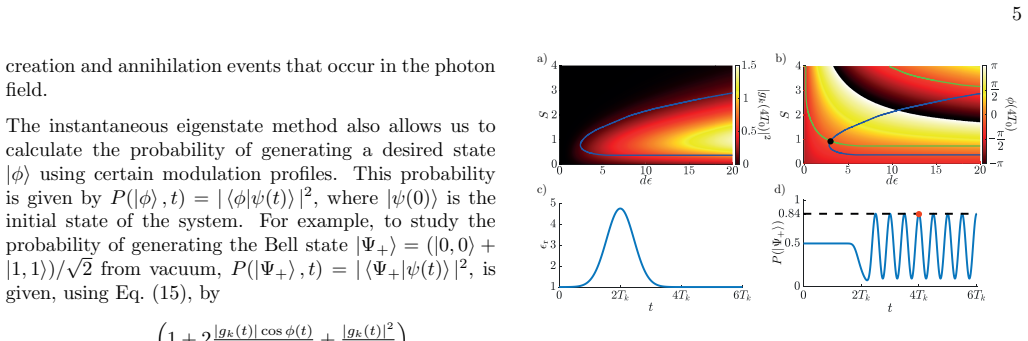
The instantaneous eigenstate method allows the computation of the state evolution by solving only two coupled differential equations. Using this approach, the maximum probability of generating a single photon pair from vacuum in such media is 25 percent, while Bell states can be created with a maximum probability of 84 percent. The spectral profile of emitted photons can be precisely controlled through the temporal profiles of permittivity and permeability.
What carries the argument
The instantaneous eigenstate method, which reduces quantum state evolution in time-varying media to two coupled differential equations derived from the Heisenberg equation.
Load-bearing premise
The instantaneous eigenstate method correctly reduces the state evolution to two coupled differential equations via the Heisenberg equation for arbitrary time-varying permittivity and permeability.
What would settle it
A calculation or measurement that produces a single photon pair from vacuum with probability exceeding 25 percent in a time-varying medium would disprove the derived bound.
Figures
read the original abstract
We introduce the instantaneous eigenstate method to study the evolution of quantum states in media with arbitrary time-varying permittivity and permeability. This method leverages the Heisenberg equation to bypass the Schr\"odinger equation, which leads to a complicated infinite set of coupled differential equations. Instead, the method allows the computation of the state evolution by solving only two coupled differential equations. Using this approach, we draw general conclusions about photon statistics in time-varying media. Our findings reveal that the maximum probability of generating a single photon pair from vacuum in such media is 25%, while Bell states can be created with a maximum probability of 84%. Additionally, we demonstrate that the spectral profile of emitted photons can be precisely controlled through the temporal profiles of permittivity and permeability. These results provide deeper insights into photon state manipulation in time-varying media. Furthermore, the instantaneous eigenstate method opens new opportunities to study state evolution in other systems where the Heisenberg equation offers a more tractable solution than the Schr\"odinger equation.
Editorial analysis
A structured set of objections, weighed in public.
Referee Report
Summary. The manuscript introduces the instantaneous eigenstate method to study photon state evolution in media with arbitrary time-varying permittivity and permeability. It claims that the Heisenberg equation reduces the dynamics to two coupled differential equations (bypassing the infinite hierarchy from the Schrödinger equation), from which general conclusions follow: the maximum probability of generating a single photon pair from vacuum is 25%, Bell states reach a maximum probability of 84%, and the spectral profile of emitted photons can be controlled via the temporal profiles of ε(t) and μ(t). The method is positioned as applicable to other systems where the Heisenberg picture is more tractable.
Significance. If the reduction to two equations holds rigorously for arbitrary ε(t), μ(t) without hidden assumptions, the work would provide a useful analytical framework for quantum state manipulation in dynamic media and yield parameter-free bounds on photon-pair and entanglement probabilities. These bounds, if derived generally, could inform designs for photon sources and entangled-state generation. The approach of closing the Heisenberg dynamics on a minimal set of equations is a potential strength when properly demonstrated.
major comments (2)
- [Instantaneous eigenstate method (abstract and § describing the reduction)] The central claim that the instantaneous eigenstate method reduces the Heisenberg dynamics to exactly two coupled differential equations for arbitrary time-varying ε(t) and μ(t) (abstract and method section) is load-bearing for all probability bounds and spectral-control results. The manuscript must explicitly demonstrate that the time-dependent basis introduces no non-adiabatic couplings, preserves commutation relations, and produces no additional source terms; general time-dependent mode expansions in quantized fields typically generate such terms unless spatial uniformity and frequency support are restricted in ways not stated.
- [Photon statistics results (abstract and corresponding results section)] The stated maxima of 25% for single-pair generation from vacuum and 84% for Bell states (abstract and results on photon statistics) are presented as general outcomes of the two-equation system. Without the explicit derivation of these bounds from the reduced equations, numerical checks, or error analysis, the figures cannot be verified and rest entirely on the unproven closure of the dynamics.
minor comments (1)
- [Abstract] The abstract asserts precise spectral control through temporal profiles of permittivity and permeability, but no explicit mapping or example equations are referenced; adding a brief illustration would improve clarity.
Simulated Author's Rebuttal
We thank the referee for the careful reading and constructive comments. We address each major point below and will revise the manuscript to provide the requested explicit demonstrations and derivations.
read point-by-point responses
-
Referee: The central claim that the instantaneous eigenstate method reduces the Heisenberg dynamics to exactly two coupled differential equations for arbitrary time-varying ε(t) and μ(t) (abstract and method section) is load-bearing for all probability bounds and spectral-control results. The manuscript must explicitly demonstrate that the time-dependent basis introduces no non-adiabatic couplings, preserves commutation relations, and produces no additional source terms; general time-dependent mode expansions in quantized fields typically generate such terms unless spatial uniformity and frequency support are restricted in ways not stated.
Authors: We agree that an explicit demonstration strengthens the manuscript. The reduction relies on spatial homogeneity (explicitly assumed and stated in the paper), under which the instantaneous eigenmodes remain plane-wave solutions with time-dependent frequencies but fixed wavevectors. The Heisenberg equations for the mode operators then close exactly on two coupled ODEs because the Hamiltonian is bilinear; the time-dependent basis change is absorbed into the instantaneous frequency without generating non-adiabatic source terms or violating [a(t),a†(t)]=1. In the revision we will add a dedicated appendix with the full derivation from the quantized Hamiltonian to the two-equation system, confirming the absence of extra couplings. revision: yes
-
Referee: The stated maxima of 25% for single-pair generation from vacuum and 84% for Bell states (abstract and results on photon statistics) are presented as general outcomes of the two-equation system. Without the explicit derivation of these bounds from the reduced equations, numerical checks, or error analysis, the figures cannot be verified and rest entirely on the unproven closure of the dynamics.
Authors: The 25% and 84% bounds follow directly from solving the two closed ODEs for the relevant expectation values (or Bogoliubov coefficients) starting from vacuum or Bell-state initial conditions and maximizing over admissible ε(t), μ(t) trajectories. The 1/4 limit arises because the pair amplitude cannot exceed the value permitted by the conserved quantity in the two-equation dynamics. We will include the analytical maximization steps, explicit solutions for representative modulations, and numerical verification in a new subsection of the results. revision: yes
Circularity Check
No significant circularity; new method yields independent probability bounds
full rationale
The paper presents the instantaneous eigenstate method as a novel reduction of the Heisenberg dynamics to two coupled DEs for arbitrary time-varying ε(t), μ(t), explicitly contrasting it with the infinite hierarchy from the Schrödinger picture. The 25% single-pair and 84% Bell-state probabilities are stated as computed outcomes of applying this method to vacuum evolution, not as fitted inputs, self-defined quantities, or results imported via self-citation. No load-bearing step reduces by construction to prior author work or ansatz smuggling; the central claims rest on the method's algebraic closure rather than tautological renaming or parameter fitting. This is the normal case of a self-contained derivation whose validity is an external question of correctness, not circularity.
Axiom & Free-Parameter Ledger
axioms (1)
- domain assumption The Heisenberg equation offers a more tractable route than the Schrödinger equation for photon evolution in time-varying media.
Reference graph
Works this paper leans on
-
[1]
that Dn,m(t) satisfy Dn,m(t) = − gk(t) fk(t) n D0,0(t)δn,m. (12) Since the instantaneous eigenstate must be normalized, ⟨ξ0,0(t)|ξ0,0(t)⟩ = 1, we find that D0,0(t) is determined up to a phase factor θ(t), so that D0,0(t) = eiθ(t)/fk(t). Therefore, we conclude that the instantaneous ground state |ξ0,0(t)⟩ is given by |ξ0,0(t)⟩ = eiθ(t) fk(t) X n − gk(t) fk...
-
[2]
W. H. Louisell, A. Yariv, and A. E. Siegman, Quantum Fluctuations and Noise in Parametric Processes. I., Phys- ical Review 124, 1646 (1961)
work page 1961
-
[3]
J. P. Gordon, W. H. Louisell, and L. R. Walker, Quan- tum Fluctuations and Noise in Parametric Processes. II, Physical Review 129, 481 (1963)
work page 1963
-
[4]
J. T. Mendon¸ ca, A. Guerreiro, and A. M. Martins, Quan- tum theory of time refraction, Physical Review A 62, 033805 (2000)
work page 2000
-
[5]
S. A. R. Horsley and J. B. Pendry, Quantum electrody- namics of time-varying gratings, Proceedings of the Na- tional Academy of Sciences 120, e2302652120 (2023)
work page 2023
-
[6]
G. T. Moore, Quantum Theory of the Electromag- netic Field in a Variable-Length One-Dimensional Cavity, Journal of Mathematical Physics 11, 2679 (1970)
work page 1970
-
[7]
J. Hui, S. Qing-Yun, and W. Jian-Sheng, Dynamical casimir effect at finite temperature, Physics Letters A 268, 174 (2000)
work page 2000
-
[8]
V. V. Dodonov, Dynamical Casimir effect: Some theoret- ical aspects, Journal of Physics: Conference Series 161, 012027 (2009)
work page 2009
-
[9]
R. Rom´ an-Ancheyta, I. Ramos-Prieto, A. Perez-Leija, K. Busch, and R. d. J. Le´ on-Montiel, Dynamical Casimir effect in stochastic systems: Photon harvesting through noise, Physical Review A 96, 032501 (2017)
work page 2017
-
[10]
S. Ma, H. Miao, Y. Xiang, and S. Zhang, Enhanced Dy- namic Casimir Effect in Temporally and Spatially Mod- ulated Josephson Transmission Line, Laser & Photonics Reviews 13, 1900164 (2019)
work page 2019
- [11]
-
[12]
C. M. Wilson, G. Johansson, A. Pourkabirian, M. Simoen, J. R. Johansson, T. Duty, F. Nori, and P. Delsing, Observation of the dynamical Casimir effect in a superconducting circuit, Nature 479, 376 (2011)
work page 2011
- [13]
-
[14]
T. R. Jones, A. V. Kildishev, M. Segev, and D. Per- oulis, Time-reflection of microwaves by a fast optically- controlled time-boundary, Nature Communications 15, 6786 (2024)
work page 2024
-
[15]
L. Caspani, R. Kaipurath, M. Clerici, M. Ferrera, T. Roger, J. Kim, N. Kinsey, M. Pietrzyk, A. Di Falco, V. Shalaev, A. Boltasseva, and D. Faccio, Enhanced Non- linear Refractive Index in ε-Near-Zero Materials, Physi- cal Review Letters 116, 233901 (2016)
work page 2016
-
[16]
Y. Zhou, M. Z. Alam, M. Karimi, J. Upham, O. Reshef, C. Liu, A. E. Willner, and R. W. Boyd, Broadband fre- quency translation through time refraction in an epsilon- near-zero material, Nature Communications 11, 2180 (2020)
work page 2020
-
[17]
J. Bohn, T. S. Luk, S. Horsley, and E. Hendry, Spatiotem- poral refraction of light in an epsilon-near-zero indium tin oxide layer: frequency shifting effects arising from inter- faces, Optica 8, 1532 (2021)
work page 2021
- [18]
-
[19]
E. Galiffi, A. C. Harwood, S. Vezzoli, R. Tirole, A. Al` u, and R. Sapienza, Optical coherent perfect absorption and amplification in a time-varying medium (2024), arXiv:2410.16426
-
[20]
V. Pacheco-Pe˜ na and N. Engheta, Antireflection tempo- ral coatings, Optica 7, 323 (2020)
work page 2020
-
[21]
I. Liberal, J. E. V´ azquez-Lozano, and V. Pacheco-Pe˜ na, Quantum Antireflection Temporal Coatings: Quantum State Frequency Shifting and Inhibited Thermal Noise Amplification, Laser & Photonics Reviews 17, 2200720 (2023)
work page 2023
-
[22]
A. Dikopoltsev, Y. Sharabi, M. Lyubarov, Y. Lumer, S. Tsesses, E. Lustig, I. Kaminer, and M. Segev, Light emission by free electrons in photonic time-crystals, Proceedings of the National Academy of Sciences 119, e2119705119 (2022)
work page 2022
-
[23]
M. Lyubarov, Y. Lumer, A. Dikopoltsev, E. Lustig, Y. Sharabi, and M. Segev, Amplified emission and las- ing in photonic time crystals, Science 377, 425 (2022)
work page 2022
-
[24]
M. Lyubarov, A. Dikopoltsev, O. Segal, Y. Plotnik, and M. Segev, Controlling spontaneous emission through the preparation of a photonic time-crystal, Optics Express 32, 39734 (2024)
work page 2024
-
[25]
J. E. V´ azquez-Lozano and I. Liberal, Shaping the quantum vacuum with anisotropic temporal boundaries, Nanophotonics 12, 539 (2023)
work page 2023
-
[26]
A. Ganfornina-Andrades, J. E. V´ azquez-Lozano, and I. Liberal, Quantum vacuum amplification in time- varying media with arbitrary temporal profiles, Physical Review Research 6, 043320 (2024)
work page 2024
-
[27]
J. T. Mendon¸ ca, A. M. Martins, and A. Guerreiro, Tem- poral beam splitter and temporal interference, Physical Review A 68, 043801 (2003)
work page 2003
-
[28]
J. T. Mendon¸ ca and A. Guerreiro, Time refraction and the quantum properties of vacuum, Physical Review A 72, 063805 (2005)
work page 2005
-
[29]
M. S. Mirmoosa, T. Set¨ al¨ a, and A. Norrman, Quantum state engineering and photon statistics at electromag- netic time interfaces, Physical Review Research7, 013120 (2025)
work page 2025
-
[30]
M. Hillery, An introduction to the quantum theory of nonlinear optics, Acta Physica Slovaca 59, 1 (2009)
work page 2009
-
[31]
C. Cohen-Tannoudji, J. Dupont-Roc, and G. Grynberg, Photons and Atoms: Introduction to Quantum Electro- dynamics (John Wiley & Sons, 2024)
work page 2024
-
[32]
Loudon, The Quantum Theory of Light (OUP Oxford, 2000)
R. Loudon, The Quantum Theory of Light (OUP Oxford, 2000)
work page 2000
-
[33]
See supplemental material at [url will be inserted by pub- lisher] for detailed derivations
-
[34]
A. Stevens and C. Caloz, Photon transitions in arbitrary time-varying metamaterials, in 2024 Eighteenth Interna- tional Congress on Artificial Materials for Novel Wave Phenomena (Metamaterials) (2024) pp. 1–3
work page 2024
-
[35]
F. Morgenthaler, Velocity Modulation of Electromag- netic Waves, IRE Transactions on Microwave Theory and Techniques 6, 167 (1958)
work page 1958
-
[36]
C. Caloz and Z.-L. Deck-Leger, Spacetime metamateri- als—Part II: Theory and applications, IEEE Transac- tions on Antennas and Propagation 68, 1583 (2019)
work page 2019
-
[37]
T. T. Koutserimpas and R. Fleury, Electromagnetic Fields in a Time-Varying Medium: Exceptional Points 7 and Operator Symmetries, IEEE Transactions on Anten- nas and Propagation 68, 6717 (2020)
work page 2020
-
[38]
A. Ortega-Gomez, M. Lobet, J. E. V´ azquez-Lozano, and I. Liberal, Tutorial on the conservation of momentum in photonic time-varying media [Invited], Optical Materials Express 13, 1598 (2023)
work page 2023
-
[39]
E. Galiffi, R. Tirole, S. Yin, H. Li, S. Vezzoli, P. A. Huidobro, M. G. Silveirinha, R. Sapienza, A. Al` u, and J. B. Pendry, Photonics of time-varying media, Advanced Photonics 4, 014002 (2022)
work page 2022
-
[40]
R. W. Boyd, Nonlinear Optics (3rd Edition), 2nd ed. (El- sevier, Chantilly, 2008)
work page 2008
-
[41]
M. O. Scully and M. S. Zubairy, Quantum Optics (Cam- bridge University Press, 1997)
work page 1997
-
[42]
F. J. Dyson, The S Matrix in Quantum Electrodynamics, Physical Review 75, 1736 (1949)
work page 1949
-
[43]
J. J. Sakurai and J. Napolitano, Modern Quantum Me- chanics (Cambridge University Press, 2020)
work page 2020
-
[44]
K.-H. Bennemann and J. B. Ketterson, Superconductiv- ity: Volume 1: Conventional and Unconventional Super- conductors Volume 2: Novel Superconductors (Springer Science & Business Media, 2008)
work page 2008
-
[45]
D. Bermudez and U. Leonhardt, Hawking spectrum for a fiber-optical analog of the event horizon, Physical Review A 93, 053820 (2016)
work page 2016
- [46]
- [47]
-
[48]
S. A. R. Horsley and R. K. Baker, Macroscopic QED and noise currents in time-varying media, Physical Review A 111, 053511 (2025)
work page 2025
-
[49]
T. T. Koutserimpas and F. Monticone, Time-varying me- dia, dispersion, and the principle of causality [Invited], Optical Materials Express 14, 1222 (2024)
work page 2024
-
[50]
H. Goldstein, C. Poole, J. Safko, and S. R. Addison, Clas- sical Mechanics, 3rd ed., American Journal of Physics70, 782 (2002). 8 SUPPLEMENT AR Y MA TERIAL
work page 2002
-
[51]
(4)] The Hamiltonian of a system is the operator that leads to the appropriate equations of motion
TIME-DEPENDENT HAMIL TONIAN [EQ. (4)] The Hamiltonian of a system is the operator that leads to the appropriate equations of motion. In a system with time- varying permittivity and permeability, the equations of motion are the Maxwell’s equations, which may be writtenas ϵ(t)∇ · E = 0, ∇ × E = − ∂B ∂t , ∇ · B = 0, ∇ × B = µ(t) ∂D ∂t . (S1) However, if we u...
-
[52]
SCHR ¨ODINGER EQUA TION [EQ. (5)] We consider the photon state evolution in a single forward mode ( k, λ) and related backward mode ( −k, λ). The state of the photon field is then |ψ(t)⟩ = P n Cn,m(t) |n, m⟩, where |n, m⟩ ≡ | n⟩k,λ |m⟩−k,λ. To determine the evolution of this state, we need to calculate the coefficients Cn,m(t), which are governed by the S...
-
[53]
INST ANT ANEOUS GROUND ST A TE [EQ. (13)] In the Heisenberg picture, the evolution of an operator ˆA(0) is given by ˆA(t) = ˆU †(t) ˆA(0) ˆU(t), where ˆU(t) = e−i ˆHt/ℏ is the unitary time-evolution operator. This unitarity, along with |ξn,m(t)⟩ = ˆU †(t) |n, m⟩, implies ˆA(t) |ξn,m(t)⟩ = ˆU †(t) ˆA(0) |n, m⟩ . (S15) In the case of the number operator ˆnk...
-
[54]
SOLUTIONS TO HEISENBERG EQUA TIONS FOR TEMPORAL STEP The differential equations ∂tfk(t) = −iαk(t)fk(t) − iβk(t)g∗ k(t), f k(0) = 1, ∂tgk(t) = −iαk(t)gk(t) − iβk(t)f ∗ k (t), g k(0) = 0, (S22) are generally difficult to solve, but they can be analytically solved for temporal step modulations. For a temporal step, the permittivity and permeability of the sy...
-
[55]
INITIAL V ACUUM ST A TE EVOLUTION [EQ. (15)] When there are initially no photons present, |ψ(0)⟩ = |0, 0⟩, the state of the system at later times is described by |ψ(t)⟩ =P n,m Cn,m(t) |n, m⟩. As explained in the paper, the coefficients Cn,m(t) can be calculated as Cn,m(t) = 1√ n!m! ξ0,0(t) ˆan k,λ(t)ˆam −k,λ(t) 0, 0 (S27) With the time-dependent annihilat...
discussion (0)
Sign in with ORCID, Apple, or X to comment. Anyone can read and Pith papers without signing in.