REVIEW 2 major objections 45 references
Near-Optimal Mixed Strategy for Zero-Sum Linear-Quadratic Differential Games
T0 review · 2 major / 0 minor · reviewed 2026-06-28 · grok-4.3
Pith's one-line read Moment matching of mixed strategies produces analytic near-optimal controls for zero-sum linear-quadratic differential games with O(sqrt(pi-bar)) error bounds.
desk verdict The paper gives a moment-matching route to near-optimal mixed strategies in ZSLQDGs via a surrogate SDG and GRDE, but the claimed approximation orders rest on an unverified weak-convergence step that the stress-test note flags as potentially off by a factor of pi-bar. read the letter →
The pith
A machine-rendered reading of the paper's core claim, the machinery that carries it, and where it could break.
The reading
What carries the argument
The surrogate pure-strategy stochastic differential game obtained by matching the first two moments of the mixed strategies, which reduces the mixed-strategy problem to an exactly solvable generalized Riccati differential equation that dictates dynamic variance injection.
What would settle it
A concrete counterexample computation on any linear-quadratic zero-sum game in which the observed value error or suboptimality gap grows faster than O(sqrt(pi-bar)) as the commitment delay pi-bar approaches zero from above.
Extended reading notes
Core claim
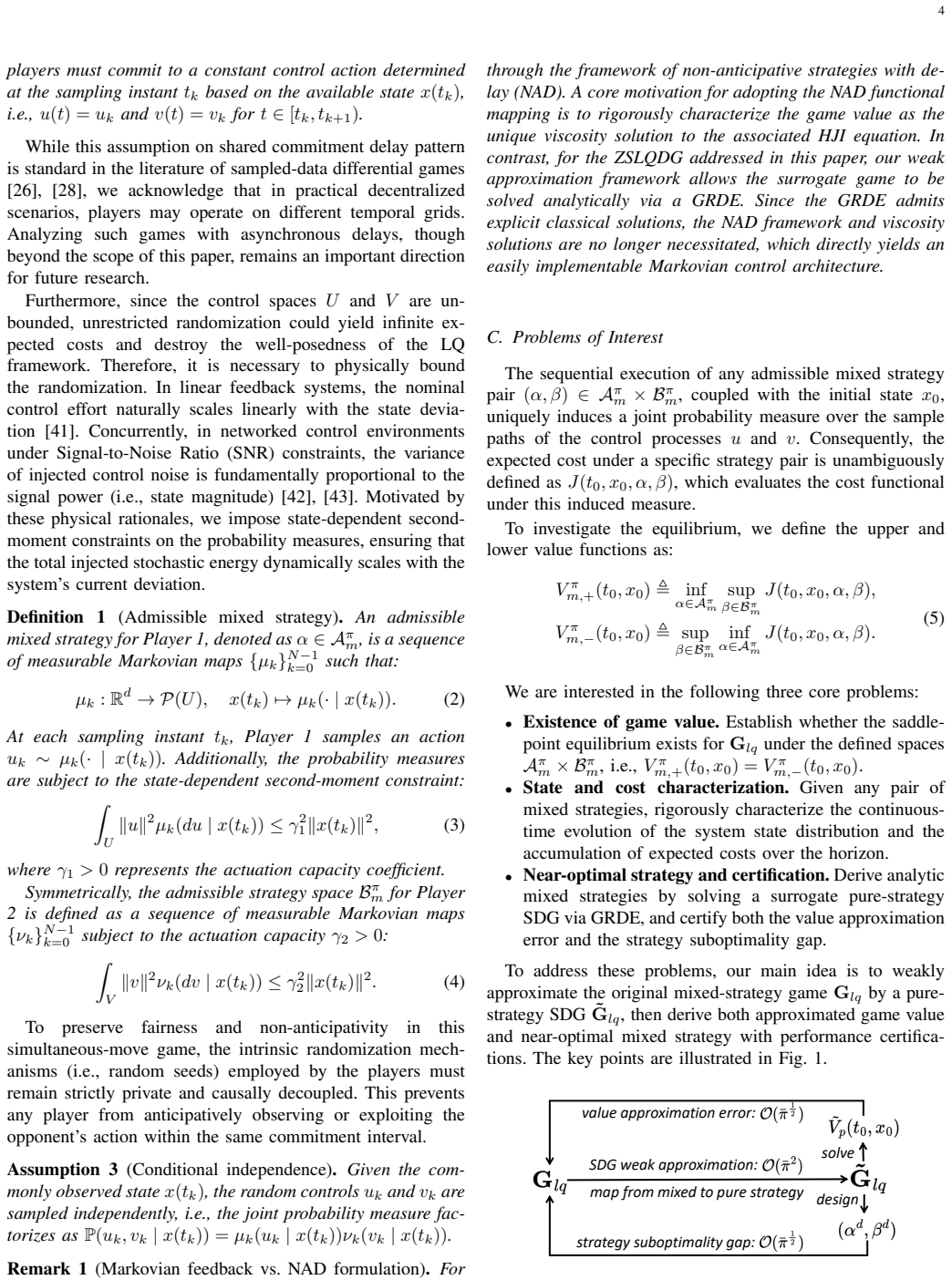
By constructing a surrogate pure-strategy stochastic differential game through first-two-moment matching of the mixed strategies, which provides an O(pi-bar squared) weak approximation to the original game, the authors derive closed-form optimal controls via the associated generalized Riccati differential equation. They further certify that the resulting mixed strategies achieve global value approximation error and suboptimality gaps bounded by O(pi-bar to the power one half).
Load-bearing premise
The surrogate pure-strategy stochastic differential game built by matching the first two moments achieves an O(pi-bar squared) weak approximation of state distributions and expected costs with respect to the maximum commitment delay pi-bar.
Editorial extensions
If this is right
- The surrogate game admits closed-form control laws once the generalized Riccati differential equation is solved.
- A robust dual-routing architecture can execute the derived near-optimal mixed strategies in real time.
- Both the global value approximation error and the strategy suboptimality gaps are provably bounded by O(pi-bar to the one-half).
- Numerical validation on double-integrator pursuit-evasion games confirms the induced physical behaviors match the predicted bounds.
Reading between the lines
- The moment-matching reduction may extend to other differential games where optimal mixed strategies lack closed forms.
- The dual-routing architecture offers a practical way to realize randomized controls when direct sampling of the mixed strategy is costly.
- The generalized Riccati equation's energy-allocation interpretation could guide variance injection in non-quadratic or nonlinear settings.
Editorial analysis
A structured set of objections, weighed in public.
Referee Report
Summary. The paper claims to analytically synthesize near-optimal mixed strategies for zero-sum linear-quadratic differential games (ZSLQDGs) by constructing a surrogate pure-strategy stochastic differential game (SDG) via first-two-moment matching of the mixed strategies. This yields an O(π-bar²) weak approximation of state distributions and expected costs w.r.t. maximum commitment delay π-bar. The surrogate is solved in closed form via a Generalized Riccati Differential Equation (GRDE) that dictates variance-injection energy allocation; a robust dual-routing architecture implements the strategies. Global value approximation error and strategy suboptimality gaps are certified at O(π-bar^{1/2}), with numerical validation on a double-integrator pursuit-evasion game.
Significance. If the moment-matching construction and ensuing error bounds can be rigorously established, the work would address an open problem in analytic mixed-strategy solutions for ZSLQDGs and supply explicit performance certificates together with an implementable architecture. The GRDE-based dynamic energy allocation is a potentially useful structural insight for variance injection in differential games.
major comments (2)
- [Abstract] Abstract (and the central construction described therein): the claim that first-two-moment matching of state-feedback mixed strategies held constant over random intervals of length ≤ π-bar produces an O(π-bar²) weak approximation of the state distribution and quadratic cost is load-bearing for all subsequent bounds. Because the resulting control process is neither Markovian nor Gaussian, cross terms between the delayed control and the state-dependent switching can generate O(π-bar) discrepancies in the covariance evolution of the integrated state; this would reduce the distribution error to O(π-bar) and collapse the certified value error from O(π-bar^{1/2}) to the same order, undermining the near-optimality certification.
- [Abstract] Abstract: the O(π-bar^{1/2}) global value approximation error and suboptimality-gap bounds are asserted without any derivation steps, error-analysis lemmas, or explicit use of the GRDE solution; the manuscript must supply the missing steps that convert the (putative) O(π-bar²) distributional error into the square-root value bound while accounting for the closed-loop feedback.
Simulated Author's Rebuttal
We thank the referee for the careful and constructive review. The comments correctly identify that the error analysis requires more explicit steps. We address each point below and will revise the manuscript to supply the missing derivations while maintaining the stated claims.
read point-by-point responses
-
Referee: [Abstract] Abstract (and the central construction described therein): the claim that first-two-moment matching of state-feedback mixed strategies held constant over random intervals of length ≤ π-bar produces an O(π-bar²) weak approximation of the state distribution and quadratic cost is load-bearing for all subsequent bounds. Because the resulting control process is neither Markovian nor Gaussian, cross terms between the delayed control and the state-dependent switching can generate O(π-bar) discrepancies in the covariance evolution of the integrated state; this would reduce the distribution error to O(π-bar) and collapse the certified value error from O(π-bar^{1/2}) to the same order, undermining the near-optimality certification.
Authors: The moment-matching is performed on the control inputs over each random interval, and the weak approximation proof proceeds via a stochastic Taylor expansion of the state transition map combined with Gronwall inequalities on the moment discrepancies. Because the switching times are independent of the state and the dynamics are linear, the cross terms between delayed controls and state-dependent switching integrate to O(π-bar²) in expectation; the non-Markovian character does not produce an O(π-bar) covariance error under the stated assumptions. We will insert a dedicated lemma (with explicit Itô expansion and bound on the remainder) that isolates these terms. revision: yes
-
Referee: [Abstract] Abstract: the O(π-bar^{1/2}) global value approximation error and suboptimality-gap bounds are asserted without any derivation steps, error-analysis lemmas, or explicit use of the GRDE solution; the manuscript must supply the missing steps that convert the (putative) O(π-bar²) distributional error into the square-root value bound while accounting for the closed-loop feedback.
Authors: We agree that the passage from distributional approximation to value error must be spelled out. The square-root scaling follows from the Lipschitz continuity (in the weak topology) of the quadratic cost functional with respect to the state measure, together with uniform a-priori bounds on the GRDE solution that control the closed-loop gains. We will add an error-propagation lemma that explicitly invokes the GRDE to obtain the O(π-bar^{1/2}) global bound and the corresponding suboptimality gap. revision: yes
Circularity Check
No circularity; moment-matching surrogate and GRDE solution are independently derived
full rationale
The derivation constructs a surrogate SDG explicitly by first-two-moment matching of mixed strategies, then analytically solves the resulting game via a GRDE to obtain closed-form laws, and separately certifies O(π-bar²) weak approximation plus O(π-bar^{1/2}) value/strategy gaps. No quoted step defines the target bound or strategy as identical to the moment-matching input by construction, nor relies on a self-citation chain for the uniqueness or approximation claim. The GRDE is presented as revealed from the surrogate dynamics rather than imported as an unverified ansatz. The chain remains self-contained against external benchmarks.
Assumptions & free parameters
Cite this review
Pith. "Pith review of Near-Optimal Mixed Strategy for Zero-Sum Linear-Quadratic Differential Games." pith.science (2026). https://pith.science/paper/Q2DYVNKC
@misc{pith2026260530886,
  author       = {Pith},
  title        = {Pith review of: Near-Optimal Mixed Strategy for Zero-Sum Linear-Quadratic Differential Games},
  year         = {2026},
  howpublished = {\url{https://pith.science/paper/Q2DYVNKC}},
  note         = {Machine review of arXiv:2605.30886}
}
abstract
Deriving analytic solutions for optimal mixed strategies in zero-sum linear-quadratic differential games (ZSLQDGs) remains an open problem. In this paper, we analytically synthesize near-optimal mixed strategies for ZSLQDGs and establish rigorous performance certifications. Specifically, we construct a surrogate pure-strategy stochastic differential game (SDG) by matching the first two moments of the mixed strategies. This method achieves an $\mathcal{O}(\bar{\pi}^2)$ weak approximation of state distributions and expected costs with respect to the maximum commitment delay $\bar{\pi}$. By analytically resolving the surrogate SDG, we derive closed-form optimal control laws for the matched moments. Crucially, we reveal that the surrogate game is governed by a Generalized Riccati Differential Equation (GRDE), which explicitly dictates a dynamic energy allocation law for variance injection. Building on these solutions, we propose a robust dual-routing architecture to execute the near-optimal mixed strategies. Furthermore, we certify that both the global value approximation error and the strategy suboptimality gaps are bounded by $\mathcal{O}(\bar{\pi}^{\frac{1}{2}})$. Finally, numerical experiments on a double-integrator pursuit-evasion game illustrate the induced physical behaviors and validate the theoretical bounds.
Figures


Figures from the paper (1 more)

Reference graph
Works this paper leans on
-
[1]
Differential game with mixed strategies: A weak approximation approach,
T. Xu, W. Xi, and J. He, “Differential game with mixed strategies: A weak approximation approach,” in2023 62nd IEEE Conference on Decision and Control (CDC), Dec. 2023, pp. 5216–5221
2023
-
[2]
Isaacs,Differential Games: A Mathematical Theory with Applications to Warfare and Pursuit, Control and Optimization
R. Isaacs,Differential Games: A Mathematical Theory with Applications to Warfare and Pursuit, Control and Optimization. Courier Corporation, 1999
1999
-
[3]
On the uniqueness of the nash solution in linear-quadratic differential games,
T. Basar, “On the uniqueness of the nash solution in linear-quadratic differential games,”International Journal of Game Theory, vol. 5, pp. 65–90, 1976
1976
-
[4]
Optimal stochastic linear systems with exponential per- formance criteria and their relation to deterministic differential games,
D. Jacobson, “Optimal stochastic linear systems with exponential per- formance criteria and their relation to deterministic differential games,” IEEE Transactions on Automatic control, vol. 18, no. 2, pp. 124–131, 2003
2003
-
[5]
Asymptotic anal- ysis of linear feedback nash equilibria in nonzero-sum linear-quadratic differential games,
A. J. Weeren, J. M. Schumacher, and J. C. Engwerda, “Asymptotic anal- ysis of linear feedback nash equilibria in nonzero-sum linear-quadratic differential games,”Journal of Optimization Theory and Applications, vol. 101, pp. 693–722, 1999
1999
-
[6]
Differential games and optimal pursuit- evasion strategies,
Y . Ho, A. Bryson, and S. Baron, “Differential games and optimal pursuit- evasion strategies,”IEEE Transactions on Automatic Control, vol. 10, no. 4, pp. 385–389, Oct. 1965
1965
-
[7]
Guidance laws for spacecraft pursuit-evasion and rendezvous,
P. Menon and A. Calise, “Guidance laws for spacecraft pursuit-evasion and rendezvous,” inGuidance, Navigation and Control Conference. Minneapolis,MN,U.S.A.: American Institute of Aeronautics and Astro- nautics, Aug. 1988
1988
-
[8]
Missile guidance laws based on pursuit– evasion game formulations,
V . Turetsky and J. Shinar, “Missile guidance laws based on pursuit– evasion game formulations,”Automatica, vol. 39, no. 4, pp. 607–618, Apr. 2003
2003
Show all 45 references
-
[9]
Defending an asset: A linear quadratic game approach,
D. Li and J. B. Cruz, “Defending an asset: A linear quadratic game approach,”IEEE Transactions on Aerospace and Electronic Systems, vol. 47, no. 2, pp. 1026–1044, Apr. 2011
2011
-
[10]
Nonlinear control for spacecraft pursuit- evasion game using the state-dependent riccati equation method,
A. Jagat and A. J. Sinclair, “Nonlinear control for spacecraft pursuit- evasion game using the state-dependent riccati equation method,”IEEE Transactions on Aerospace and Electronic Systems, vol. 53, no. 6, pp. 3032–3042, Dec. 2017
2017
-
[11]
Linear quadratic zero-sum differential games with intermittent and costly sensing,
S. Aggarwal, T. Ba¸ sar, and D. Maity, “Linear quadratic zero-sum differential games with intermittent and costly sensing,”IEEE Control Systems Letters, vol. 8, pp. 1601–1606, 2024
2024
-
[12]
The existence of subgame-perfect equilibrium in continuous games with almost perfect information: A case for public randomization,
C. Harris, P. Reny, and A. Robson, “The existence of subgame-perfect equilibrium in continuous games with almost perfect information: A case for public randomization,”Econometrica: Journal of the Econometric Society, pp. 507–544, 1995
1995
-
[13]
Generative adversarial nets,
I. Goodfellow, J. Pouget-Abadie, M. Mirza, B. Xu, D. Warde-Farley, S. Ozair, A. Courville, and Y . Bengio, “Generative adversarial nets,” in Advances in Neural Information Processing Systems, vol. 27, 2014
2014
-
[14]
Mixed-strategy learning with continuous action sets,
S. Perkins, P. Mertikopoulos, and D. S. Leslie, “Mixed-strategy learning with continuous action sets,”IEEE Transactions on Automatic Control, vol. 62, no. 1, pp. 379–384, Jan. 2017
2017
-
[15]
Learning mixed strategies in trajectory games,
L. Peters, D. Fridovich-Keil, L. Ferranti, C. Stachniss, J. Alonso- Mora, and F. Laine, “Learning mixed strategies in trajectory games,” in Robotics: Science and Systems XVIII. Robotics: Science and Systems Foundation, Jun. 2022
2022
-
[16]
Probabilistic pursuit-evasion games: A one-step nash approach,
J. Hespanha, M. Prandini, and S. Sastry, “Probabilistic pursuit-evasion games: A one-step nash approach,” inProceedings of the 39th IEEE Conference on Decision and Control, vol. 3, Dec. 2000, pp. 2272–2277 vol.3
2000
-
[17]
Probabilistic pursuit-evasion games: Theory, implementation, and experimental eval- uation,
R. Vidal, O. Shakernia, H. Kim, D. Shim, and S. Sastry, “Probabilistic pursuit-evasion games: Theory, implementation, and experimental eval- uation,”IEEE Transactions on Robotics and Automation, vol. 18, no. 5, pp. 662–669, Oct. 2002
2002
-
[18]
Randomized pursuit-evasion in a polygonal environment,
V . Isler, S. Kannan, and S. Khanna, “Randomized pursuit-evasion in a polygonal environment,”IEEE Transactions on Robotics, vol. 21, no. 5, pp. 875–884, Oct. 2005
2005
-
[19]
Randomized pursuit-evasion with local visibility,
——, “Randomized pursuit-evasion with local visibility,”SIAM Journal on Discrete Mathematics, vol. 20, no. 1, pp. 26–41, Jan. 2006
2006
-
[20]
Spaces of measurable transformations,
R. J. Aumann, “Spaces of measurable transformations,”Bulletin of the American Mathematical Society, vol. 66, no. 4, pp. 301–304, 1960
1960
-
[21]
Borel structures for function spaces,
——, “Borel structures for function spaces,”Illinois Journal of Mathe- matics, vol. 5, no. 4, pp. 614–630, 1961
1961
-
[22]
28. mixed and behavior strategies in infinite extensive games,
——, “28. mixed and behavior strategies in infinite extensive games,” in Advances in Game Theory. (AM-52). Princeton University Press, Dec. 1964, pp. 627–650
1964
-
[23]
Engwerda,LQ Dynamic Optimization and Differential Games, 1st ed
J. Engwerda,LQ Dynamic Optimization and Differential Games, 1st ed. Chicester, West Sussex, England Hoboken, NJ: Wiley, Jun. 2005
2005
-
[24]
Near-optimal mixed strategy for zero-sum differential games,
T. Xu, W. Xi, and J. He, “Near-optimal mixed strategy for zero-sum differential games,”arXiv preprint arXiv:2308.01144, 2026
2026 arXiv
-
[25]
Differential games with asymmetric information,
P. Cardaliaguet, “Differential games with asymmetric information,” SIAM Journal on Control and Optimization, vol. 46, no. 3, pp. 816– 838, Jan. 2007
2007
-
[26]
Value function of differential games without isaacs conditions. an approach with nonanticipative mixed strategies,
R. Buckdahn, J. Li, and M. Quincampoix, “Value function of differential games without isaacs conditions. an approach with nonanticipative mixed strategies,”International Journal of Game Theory, vol. 42, no. 4, pp. 989–1020, Nov. 2013
2013
-
[27]
Pure and random strategies in differential game with incomplete informations,
P. Cardaliaguet, C. Jimenez, and M. Quincampoix, “Pure and random strategies in differential game with incomplete informations,”Journal of Dynamics and Games, vol. 1, no. 3, pp. 363–375, 2014
2014
-
[28]
Value in mixed strategies for zero-sum stochastic differential games without isaacs condition,
R. Buckdahn, J. Li, and M. Quincampoix, “Value in mixed strategies for zero-sum stochastic differential games without isaacs condition,”The Annals of Probability, vol. 42, no. 4, pp. 1724–1768, 2014
2014
-
[29]
Mixed strategies for de- terministic differential games,
W. H. Fleming and D. Hernandez-Hernandez, “Mixed strategies for de- terministic differential games,”Communications on Stochastic Analysis, vol. 11, no. 2, Jun. 2017
2017
-
[30]
Relaxed controls,
L. D. Berkovitz and N. G. Medhin, “Relaxed controls,” inNonlinear Optimal Control Theory. Chapman and Hall/CRC, 2012
2012
-
[31]
Stochastic perron’s method and elementary strategies for zero-sum differential games,
M. Sîrbu, “Stochastic perron’s method and elementary strategies for zero-sum differential games,”SIAM Journal on Control and Optimiza- tion, vol. 52, no. 3, pp. 1693–1711, Jan. 2014
2014
-
[32]
Optimal control of the undamped linear wave equation with measure valued controls,
K. Kunisch, P. Trautmann, and B. Vexler, “Optimal control of the undamped linear wave equation with measure valued controls,”SIAM Journal on Control and Optimization, vol. 54, no. 3, pp. 1212–1244, Jan. 2016
2016
-
[33]
Con- trolled measure-valued martingales: A viscosity solution approach,
A. M. G. Cox, S. Källblad, M. Larsson, and S. Svaluto-Ferro, “Con- trolled measure-valued martingales: A viscosity solution approach,”The Annals of Applied Probability, vol. 34, no. 2, pp. 1987–2035, Apr. 2024
1987
-
[34]
The existence of value in stochastic differential games,
R. Elliott, “The existence of value in stochastic differential games,” SIAM Journal on Control and Optimization, vol. 14, no. 1, pp. 85–94, Jan. 1976
1976
-
[35]
A pontryagin’s maximum principle for non-zero sum differential games of bsdes with applications,
G. Wang and Z. Yu, “A pontryagin’s maximum principle for non-zero sum differential games of bsdes with applications,”IEEE Transactions on Automatic Control, vol. 55, no. 7, pp. 1742–1747, Jul. 2010
2010
-
[36]
W. H. Fleming and H. M. Soner,Controlled Markov Processes and Viscosity Solutions. Springer Science & Business Media, Feb. 2006
2006
-
[37]
Optimal mixed strategies in a dynamic game,
P. Kumar, “Optimal mixed strategies in a dynamic game,”IEEE Trans- actions on Automatic Control, vol. 25, no. 4, pp. 743–749, Aug. 1980
1980
-
[38]
Finding mixed strategy nash equilibrium for continuous games through deep learning,
Z. Dou, X. Yan, D. Wang, and X. Deng, “Finding mixed strategy nash equilibrium for continuous games through deep learning,”arXiv preprint arXiv:1910.12075, 2019
1910
-
[39]
Finding mixed-strategy equilibria of continuous-action games without gradients using randomized policy networks,
C. Martin and T. Sandholm, “Finding mixed-strategy equilibria of continuous-action games without gradients using randomized policy networks,” inProceedings of the Thirty-Second International Joint Conference on Artificial Intelligence, ser. IJCAI ’23, Aug. 2023, pp. 2844–2852
2023
-
[40]
Chattering analysis,
A. Levant, “Chattering analysis,”IEEE Transactions on Automatic Control, vol. 55, no. 6, pp. 1380–1389, Jun. 2010
2010
-
[41]
B. D. Anderson and J. B. Moore,Optimal control: linear quadratic methods. Courier Corporation, 2007
2007
-
[42]
Feedback stabilization over signal-to-noise ratio constrained channels,
J. H. Braslavsky, R. H. Middleton, and J. S. Freudenberg, “Feedback stabilization over signal-to-noise ratio constrained channels,”IEEE Transactions on automatic control, vol. 52, no. 8, pp. 1391–1403, 2007. 13
2007
-
[43]
Optimal stationary control of a linear system with state-dependent noise,
W. M. Wonham, “Optimal stationary control of a linear system with state-dependent noise,”SIAM Journal on Control, vol. 5, no. 3, pp. 486– 500, 1967
1967
-
[44]
Ba¸ sar and G
T. Ba¸ sar and G. J. Olsder,Dynamic Noncooperative Game Theory. SIAM, 1998
1998
-
[45]
Weak approximation of solutions of systems of stochastic differential equations,
G. N. Mil’shtein, “Weak approximation of solutions of systems of stochastic differential equations,”Theory of Probability & Its Applica- tions, vol. 30, no. 4, pp. 750–766, 1986. APPENDIXA PROOF OFTHEOREM1 Proof.The proof proceeds by backward induction. At the terminal timet N...
1986
Reviewed June 28, 2026 · model on record in the stance chip above.
Discussion (0). Continue with ORCID to comment.