Finite-time Scaling with Arbitrary Driving Rates: Bridging the Kibble-Zurek and De Grandi-Gritsev-Polkovnikov Limits
Pith reviewed 2026-06-28 20:56 UTC · model grok-4.3
The pith
Generalized finite-time scaling unifies Kibble-Zurek and De Grandi-Gritsev-Polkovnikov regimes for arbitrary driving rates when dynamics stay in the critical region.
A machine-rendered reading of the paper's core claim, the machinery that carries it, and where it could break.
Core claim
When driven dynamics are restricted to the critical region, a single finite-time scaling form holds for arbitrary driving rates and bridges the Kibble-Zurek scaling of the slow-driving regime with the De Grandi-Gritsev-Polkovnikov scaling of the sudden-quench limit.
What carries the argument
The generalized finite-time scaling form, which treats the driving rate as an additional scaling variable that produces data collapse across the entire range of rates.
If this is right
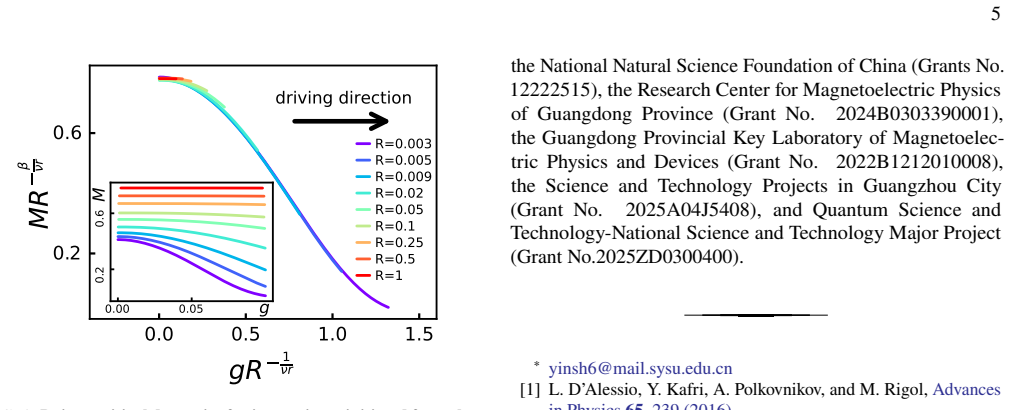
- The unified scaling applies at both quantum critical points and tricritical points.
- It supplies a single description instead of separate theories for slow and fast regimes.
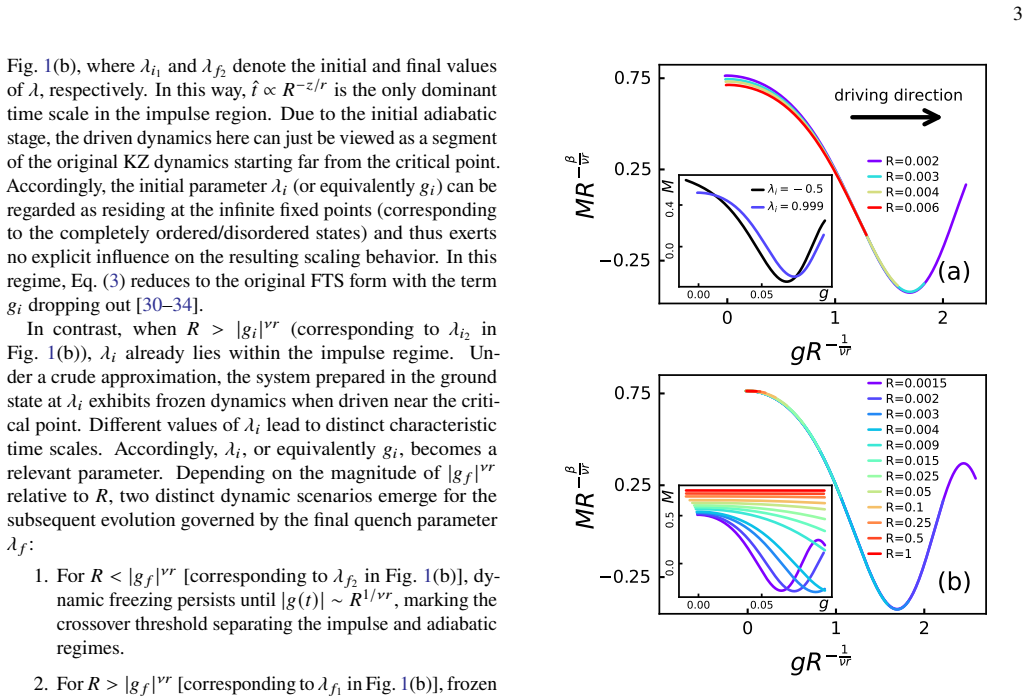
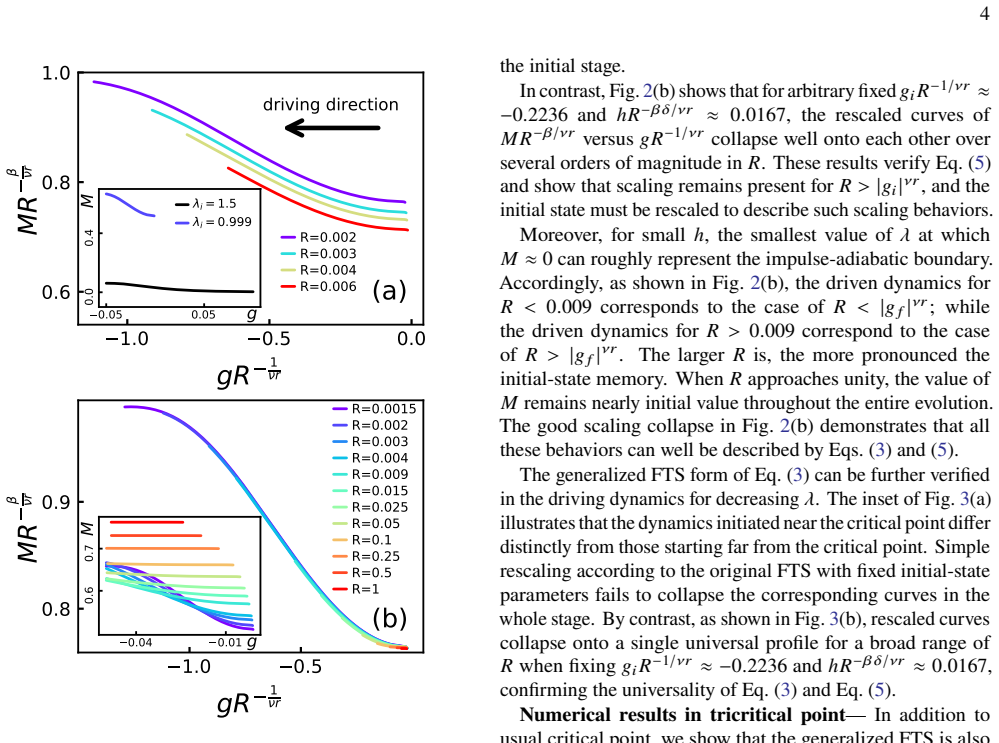
- Numerical simulations confirm agreement between the predicted form and observed dynamics for any rate.
- The framework extends the reach of scaling analysis to quantum quench experiments with uncontrolled or intermediate driving speeds.
Where Pith is reading between the lines
- This form could let experiments extract critical exponents even when quench rates vary and cannot be tuned into a single limiting regime.
- It suggests similar unification might exist for other driving protocols such as periodic driving or spatially inhomogeneous quenches.
- The restriction to the critical region implies that protocols which keep the system inside that region for longer times will show cleaner scaling regardless of overall speed.
Load-bearing premise
The assumption that restricting the driven dynamics to the critical region is sufficient to produce robust scaling for arbitrary driving rates.
What would settle it
Numerical or experimental data for an intermediate driving rate in a quantum critical system that fails to collapse when plotted with the generalized finite-time scaling variables.
Figures
read the original abstract
The pursuit of a universal description for nonequilibrium critical dynamics in quantum many-body systems stands as a central frontier in modern statistical physics. For driven critical dynamics starting far from the critical point, the well-known Kibble-Zurek (KZ) scaling holds only when the driving rate lies below an upper bound. Here we study driven dynamics restricted to the critical region, and show that robust dynamic scaling behavior exists for arbitrary driving rates. We develop a generalized finite-time scaling (FTS) framework, which provides a unified understanding on the driven dynamics for the full range of quench rates, bridging the KZ scaling in the slow-driving regime and the De~Grandi-Gritsev-Polkovnikov (DGP) scaling in the sudden-quench limit. We verify this unified FTS form through numerical simulations in both quantum critical and tricritical points. The good agreement between theoretical predictions and numerical results confirms the generality of our theory. Our work establishes a universal theory for nonequilibrium critical dynamics spanning the full range of driving rates, with broad implications for quantum quench experiments and out-of-equilibrium statistical mechanics.
Editorial analysis
A structured set of objections, weighed in public.
Referee Report
Summary. The manuscript develops a generalized finite-time scaling (FTS) framework for driven critical dynamics in quantum many-body systems when the evolution is restricted to the critical region. This single scaling form is claimed to recover the Kibble-Zurek (KZ) scaling in the slow-driving regime and the De Grandi-Gritsev-Polkovnikov (DGP) scaling in the sudden-quench limit, thereby covering arbitrary driving rates. The framework is verified by numerical simulations at both a quantum critical point and a tricritical point, with reported agreement between the predicted collapses and the data.
Significance. If the central derivation and collapses hold, the work supplies a unified description that bridges two previously distinct limits in nonequilibrium critical dynamics. This has clear implications for quantum-quench experiments and out-of-equilibrium statistical mechanics. The explicit construction of a rate-independent scaling function together with numerical verification at two distinct critical points constitutes a concrete strength of the manuscript.
minor comments (3)
- The precise functional form of the generalized FTS scaling function (including any auxiliary scaling variables) should be stated explicitly in the main text, ideally with an equation number, so that readers can directly reproduce the predicted collapses without consulting supplementary material.
- Figure captions for the numerical data collapses should include the precise range of driving rates examined and the system sizes employed, to allow immediate assessment of the quality of the data collapse across the full rate interval.
- A short paragraph comparing the present restriction to the critical region with the conventional KZ setup (which starts far from criticality) would help readers understand the scope of the new framework.
Simulated Author's Rebuttal
We thank the referee for the positive assessment of our work, the recognition of its significance in unifying Kibble-Zurek and De Grandi-Gritsev-Polkovnikov scaling, and the recommendation for minor revision. No specific major comments were raised in the report.
Circularity Check
No significant circularity
full rationale
The provided abstract and context present a generalized FTS framework obtained by restricting driven dynamics to the critical region, which is stated as a deliberate scope condition that recovers both KZ (slow) and DGP (sudden) limits. No equations, fitting procedures, or self-citations are visible that would reduce any prediction to its inputs by construction. The derivation is described as internally consistent with numerical collapses at critical and tricritical points, and the central claim retains independent content outside any self-referential loop. This is the expected outcome for a paper whose load-bearing steps are not shown to collapse into definitions or prior self-citations.
Axiom & Free-Parameter Ledger
Reference graph
Works this paper leans on
-
[1]
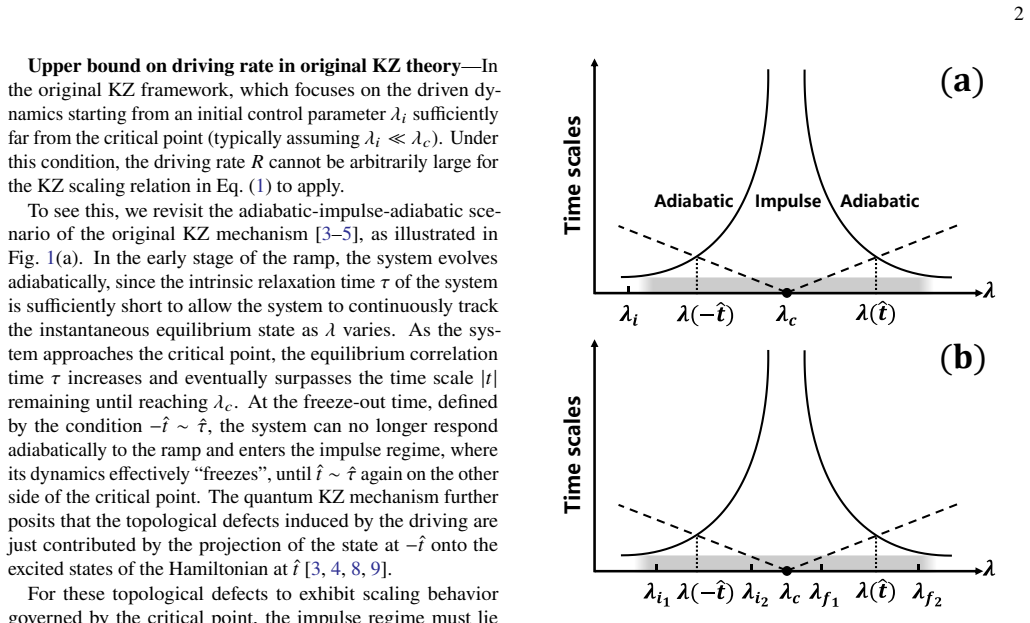
1(b)], dy- namic freezing persists until |𝑔(𝑡)| ∼𝑅 1/𝜈𝑟 , marking the crossover threshold separating the impulse and adiabatic regimes
For 𝑅 <|𝑔 𝑓 |𝜈𝑟 [corresponding to 𝜆 𝑓2 in Fig. 1(b)], dy- namic freezing persists until |𝑔(𝑡)| ∼𝑅 1/𝜈𝑟 , marking the crossover threshold separating the impulse and adiabatic regimes
-
[2]
1(b)], frozen behavior prevails throughout the entire driving process, such that the evolution is primarily governed by the initial configuration
For 𝑅 >|𝑔 𝑓 |𝜈𝑟 [corresponding to 𝜆 𝑓1 in Fig. 1(b)], frozen behavior prevails throughout the entire driving process, such that the evolution is primarily governed by the initial configuration. Both (1) and (2) differ markedly from the case with 𝑅 <|𝑔 𝑖 |𝜈𝑟 , where the influence of the initial parameter 𝜆𝑖 (or equivalently 𝑔𝑖) becomes irrelevant. Here, by...
-
[3]
D’ Alessio, Y
L. D’ Alessio, Y. Kafri, A. Polkovnikov, and M. Rigol, Advances in Physics65, 239 (2016)
2016
-
[4]
Mitra, Annual Review of Condensed Matter Physics9, 245 (2018)
A. Mitra, Annual Review of Condensed Matter Physics9, 245 (2018)
2018
-
[5]
Dziarmaga, Advances in Physics59, 1063 (2010)
J. Dziarmaga, Advances in Physics59, 1063 (2010)
2010
-
[6]
Polkovnikov, K
A. Polkovnikov, K. Sengupta, A. Silva, and M. Vengalattore, Rev. Mod. Phys.83, 863 (2011)
2011
-
[7]
A. del Campo and W. H. Zurek, International Jour- nal of Modern Physics A29, 1430018 (2014), https://doi.org/10.1142/S0217751X1430018X
-
[8]
T. W. B. Kibble, Journal of Physics A: Mathematical and General 9, 1387 (1976)
1976
-
[9]
W. H. Zurek, Nature317, 505 (1985)
1985
-
[10]
W. H. Zurek, U. Dorner, and P. Zoller, Phys. Rev. Lett.95, 105701 (2005)
2005
-
[11]
Dziarmaga, Phys
J. Dziarmaga, Phys. Rev. Lett.95, 245701 (2005)
2005
-
[12]
Sch¨ utzhold, M
R. Sch¨ utzhold, M. Uhlmann, Y. Xu, and U. R. Fischer, Phys. Rev. Lett.97, 200601 (2006)
2006
-
[13]
D. Sen, K. Sengupta, and S. Mondal, Phys. Rev. Lett.101, 016806 (2008)
2008
-
[14]
K. Du, X. Fang, C. Won, C. De, F.-T. Huang, W. Xu, H. You, F. J. G´omez-Ruiz, A. del Campo, and S.-W. Cheong, Nature Physics 19, 1495 (2023)
2023
-
[15]
N. Navon, A. L. Gaunt, R. P. Smith, and Z. Hadzibabic, Science347, 167 (2015), https://www.science.org/doi/pdf/10.1126/science.1258676
-
[16]
Lamporesi, S
G. Lamporesi, S. Donadello, S. Serafini, F. Dalfovo, and G. Fer- rari, Nature Physics9, 656 (2013)
2013
-
[17]
S.-Z. Lin, X. Wang, Y. Kamiya, G.-W. Chern, F. Fan, D. Fan, B. Casas, Y. Liu, V. Kiryukhin, W. H. Zurek, C. D. Batista, and S.-W. Cheong, Nature Physics10, 970 (2014)
2014
-
[18]
F. J. G´omez-Ruiz, J. J. Mayo, and A. del Campo, Phys. Rev. Lett. 124, 240602 (2020)
2020
-
[19]
Balducci, M
F. Balducci, M. Beau, J. Yang, A. Gambassi, and A. del Campo, Phys. Rev. Lett.131, 230401 (2023)
2023
-
[20]
Z. Fei, N. Freitas, V. Cavina, H. T. Quan, and M. Esposito, Phys. Rev. Lett.124, 170603 (2020)
2020
-
[21]
M. Deng, Z. Sun, and F. Li, Phys. Rev. Lett.134, 010409 (2025)
2025
-
[22]
S. Sunami, V. P. Singh, D. Garrick, A. Beregi, A. J. Barker, K. Luksch, E. Bentine, L. Mathey, and C. J. Foot, Science382, 443 (2023), https://www.science.org/doi/pdf/10.1126/science.abq6753
-
[23]
De Grandi, V
C. De Grandi, V. Gritsev, and A. Polkovnikov, Phys. Rev. B81, 012303 (2010)
2010
-
[24]
S. Deng, G. Ortiz, and L. Viola, Phys. Rev. B83, 094304 (2011)
2011
-
[25]
De Grandi, R
C. De Grandi, R. A. Barankov, and A. Polkovnikov, Phys. Rev. Lett.101, 230402 (2008)
2008
-
[26]
De Grandi, V
C. De Grandi, V. Gritsev, and A. Polkovnikov, Phys. Rev. B81, 6 224301 (2010)
2010
-
[27]
Yin, C.-Y
S. Yin, C.-Y. Lo, and P. Chen, Phys. Rev. B94, 064302 (2016)
2016
-
[28]
Haller, R
E. Haller, R. Hart, M. J. Mark, J. G. Danzl, L. Reichs ¨ollner, M. Gustavsson, M. Dalmonte, G. Pupillo, and H.-C. N ¨agerl, Nature466, 597 (2010)
2010
-
[29]
Zeng, C.-Y
H.-B. Zeng, C.-Y. Xia, and A. del Campo, Phys. Rev. Lett.130, 060402 (2023)
2023
-
[30]
X. Rao, Y. Liu, M. Li, T. Liu, H. Zeng, and L. Luo, arXiv: 2506.06841 (2025)
arXiv 2025
-
[31]
Silvi, G
P. Silvi, G. Morigi, T. Calarco, and S. Montangero, Phys. Rev. Lett.116, 225701 (2016)
2016
-
[32]
Zhong and Z
F. Zhong and Z. Xu, Phys. Rev. B71, 132402 (2005)
2005
-
[33]
S. Gong, F. Zhong, X. Huang, and S. Fan, New Journal of Physics 12, 043036 (2010)
2010
-
[34]
S. Yin, P. Mai, and F. Zhong, Phys. Rev. B89, 094108 (2014)
2014
-
[35]
Huang, S
Y. Huang, S. Yin, B. Feng, and F. Zhong, Phys. Rev. B90, 134108 (2014)
2014
-
[36]
B. Feng, S. Yin, and F. Zhong, Phys. Rev. B94, 144103 (2016)
2016
-
[37]
Yin, G.-Y
S. Yin, G.-Y. Huang, C.-Y. Lo, and P. Chen, Phys. Rev. Lett.118, 065701 (2017)
2017
-
[38]
S. Deng, G. Ortiz, and L. Viola, Europhysics Letters84, 67008 (2009)
2009
-
[39]
Chandran, A
A. Chandran, A. Erez, S. S. Gubser, and S. L. Sondhi, Phys. Rev. B86, 064304 (2012)
2012
-
[40]
De Grandi, A
C. De Grandi, A. Polkovnikov, and A. W. Sandvik, Phys. Rev. B 84, 224303 (2011)
2011
-
[41]
Kolodrubetz, B
M. Kolodrubetz, B. K. Clark, and D. A. Huse, Phys. Rev. Lett. 109, 015701 (2012)
2012
-
[42]
C.-W. Liu, A. Polkovnikov, and A. W. Sandvik, Phys. Rev. B89, 054307 (2014)
2014
-
[43]
Keesling, A
A. Keesling, A. Omran, H. Levine, H. Bernien, H. Pichler, S. Choi, R. Samajdar, S. Schwartz, P. Silvi, S. Sachdev, P. Zoller, M. Endres, M. Greiner, V. Vuleti´c, and M. D. Lukin, Nature568, 207 (2019)
2019
-
[44]
Ebadi, T
S. Ebadi, T. T. Wang, H. Levine, A. Keesling, G. Semeghini, A. Omran, D. Bluvstein, R. Samajdar, H. Pichler, W. W. Ho, S. Choi, S. Sachdev, M. Greiner, V. Vuleti´c, and M. D. Lukin, Nature595, 227 (2021)
2021
-
[45]
Zhang, H
T. Zhang, H. Wang, W. Zhang, Y. Wang, A. Du, Z. Li, Y. Wu, C. Li, J. Hu, H. Zhai, and W. Chen, Phys. Rev. Lett.135, 093403 (2025)
2025
-
[46]
A. D. King, J. Raymond, T. Lanting, R. Harris, A. Zucca, F. Altomare, A. J. Berkley, K. Boothby, S. Ejtemaee, C. Enderud, E. Hoskinson, S. Huang, E. Ladizinsky, A. J. R. MacDonald, G. Marsden, R. Molavi, T. Oh, G. Poulin-Lamarre, M. Reis, C. Rich, Y. Sato, N. Tsai, M. Volkmann, J. D. Whittaker, J. Yao, A. W. Sandvik, and M. H. Amin, Nature617, 61 (2023)
2023
-
[47]
J. Tindall, A. F. Mello, M. Fishman, E. M. Stoudenmire, and D. Sels, Science392, 868 (2026), https://www.science.org/doi/pdf/10.1126/science.adx2728
-
[48]
Vidal, Phys
G. Vidal, Phys. Rev. Lett.98, 070201 (2007)
2007
-
[49]
Wang, Y.-F
T.-L. Wang, Y.-F. Jiang, and S. Yin, Chinese Physics Letters42, 110001 (2025)
2025
-
[50]
H. Wang, X. Li, and C. Li, Nature Communications16, 10584 (2025)
2025
-
[51]
C. Li, S. Liu, H. Wang, W. Zhang, Z.-X. Li, H. Zhai, and Y. Gu, Phys. Rev. Lett.133, 223401 (2024)
2024
-
[52]
T. Grover, D. N. Sheng, and A. Vish- wanath, Science344, 280 (2014), https://www.science.org/doi/pdf/10.1126/science.1248253
-
[53]
Shu, S.-K
Y.-R. Shu, S.-K. Jian, A. W. Sandvik, and S. Yin, Nat. Commun. 16, 3402 (2025)
2025
-
[54]
Zeng, Y.-K
Z. Zeng, Y.-K. Yu, Z.-X. Li, Z.-X. Li, and S. Yin, Nat. Commun. 16(2025)
2025
-
[55]
Huang and S
R.-Z. Huang and S. Yin, Phys. Rev. Res.2, 023175 (2020)
2020
-
[56]
Kang, C.-Y
Y.-T. Kang, C.-Y. Lo, S. Yin, and P. Chen, Phys. Rev. A101, 023610 (2020)
2020
-
[57]
W. Wang, S. Liu, J. Li, S.-X. Zhang, and S. Yin, arXiv: 2411.06648 (2024)
arXiv 2024
-
[58]
Shu, L.-Y
Y.-R. Shu, L.-Y. Yang, and S. Yin, Phys. Rev. B113, 134303 (2026)
2026
-
[59]
Zeng, Y.-K
Z. Zeng, Y.-K. Yu, Z.-X. Li, and S. Yin, Phys. Rev. B112, L060301 (2025)
2025
discussion (0)
Sign in with ORCID, Apple, or X to comment. Anyone can read and Pith papers without signing in.