Evaluating higher-order product formulae for molecular ground-state energy estimation
Pith reviewed 2026-06-28 22:00 UTC · model grok-4.3
The pith
A new fourth-order product formula achieves the lowest total gate count for molecular ground-state energy estimation near chemical accuracy on hydrogen chains.
A machine-rendered reading of the paper's core claim, the machinery that carries it, and where it could break.
Core claim
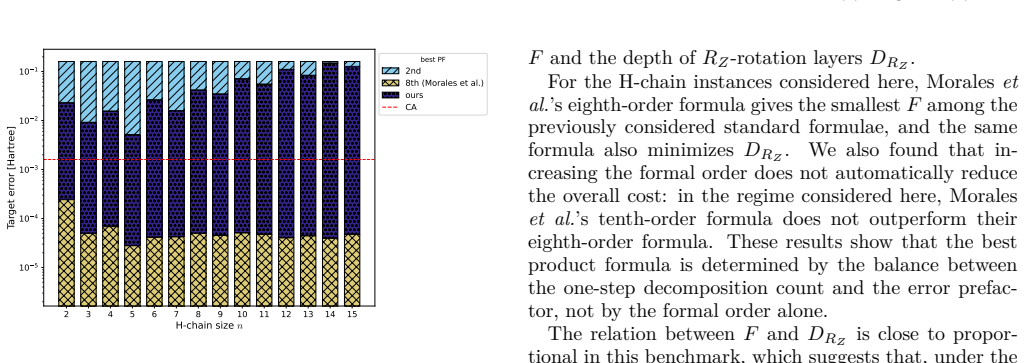
The paper claims that a newly constructed fourth-order product formula achieves the lowest total gate count among the formulae considered for all H-chain instances near chemical accuracy and over much of the 0.1-10 mHa target-error window for most instances, while also reducing the RZ-layer depth; among previously published formulae the eighth-order construction minimizes both cost metrics at a chemically relevant target error, and increasing formal order does not automatically reduce total cost.
What carries the argument
The perturbative method that estimates the eigenvalue error induced by each product formula, allowing the cost of the corresponding phase-estimation procedure to be evaluated at larger system sizes without full simulation; the new fourth-order product formula carries the reported efficiency gain.
If this is right
- The tenth-order formula can require more total gates than the eighth-order formula near chemical accuracy.
- The new fourth-order formula also reduces RZ-layer depth relative to the higher-order alternatives.
- Product-formula order for molecular simulations must be chosen by explicit benchmarking rather than by assuming higher order is always cheaper.
- The relative advantage of any given order changes with the target error window.
Where Pith is reading between the lines
- The observed advantage of the new fourth-order formula may persist for molecular systems whose Hamiltonians have different locality or interaction structure than linear hydrogen chains.
- In hardware models where non-Clifford gates are generated locally at low cost, the optimal choice of product-formula order may shift even further toward lower orders with favorable constants.
- Systematic optimization of the free parameters inside a fixed-order product formula could produce additional reductions in gate count for specific error targets.
Load-bearing premise
The perturbative method used to estimate the eigenvalue error induced by each product formula is accurate enough to reliably predict the gate cost of the corresponding phase-estimation procedure across the tested system sizes and error targets.
What would settle it
A direct numerical computation of the actual eigenvalue error produced by applying the new fourth-order formula inside a phase-estimation circuit on one of the larger hydrogen chains (H10 or H15) and comparing that error to the perturbative prediction.
Figures
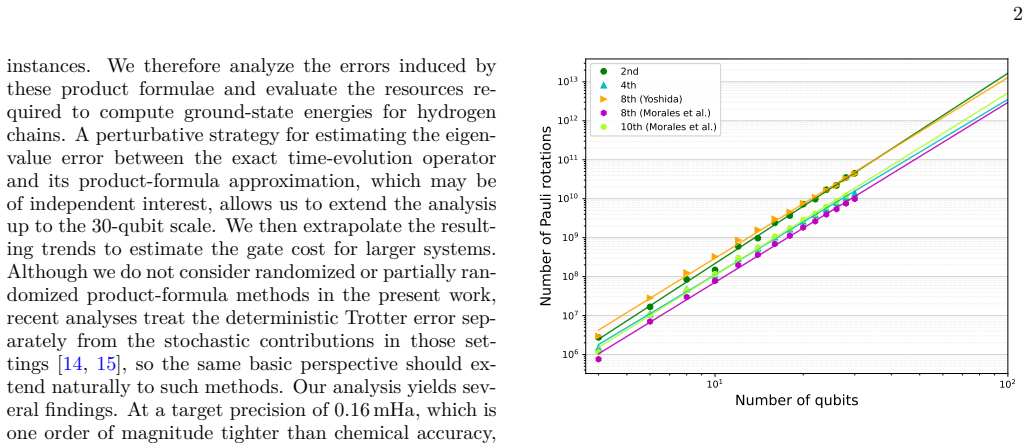
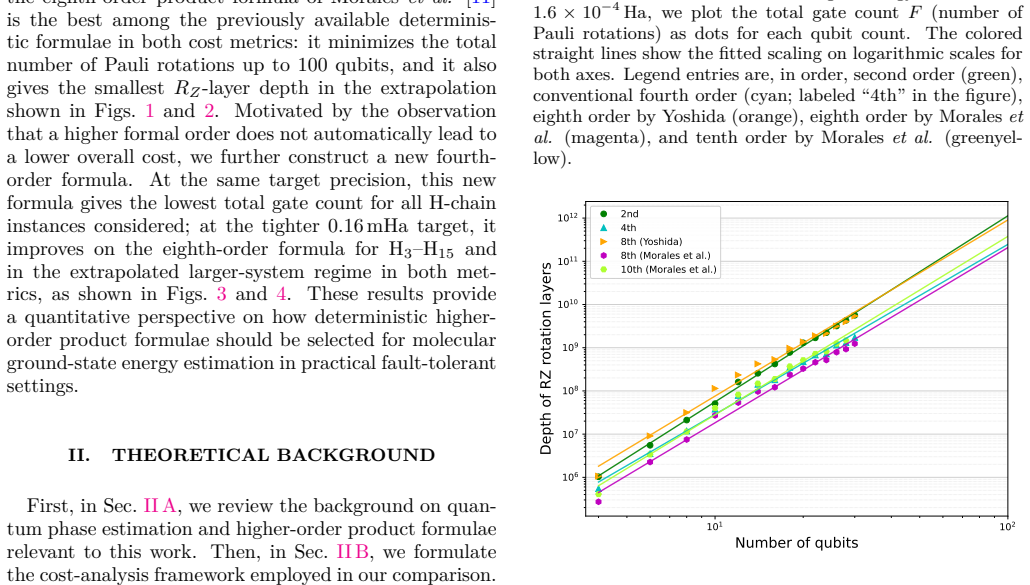
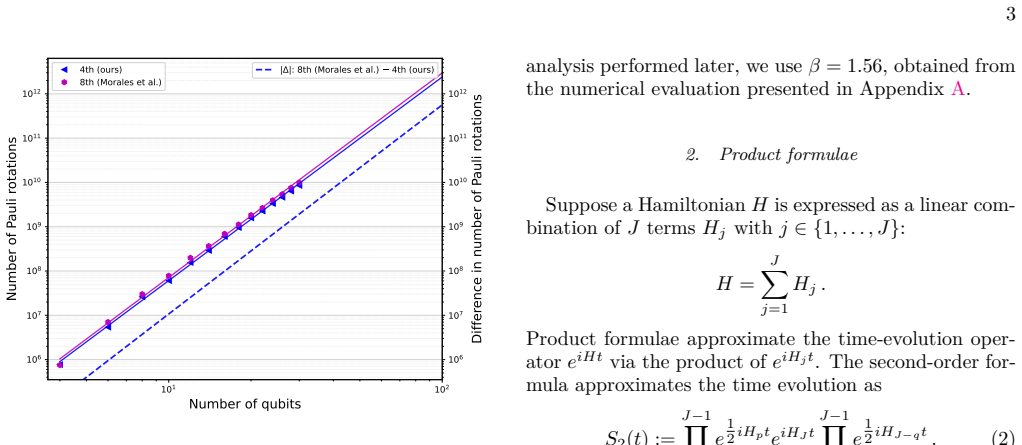
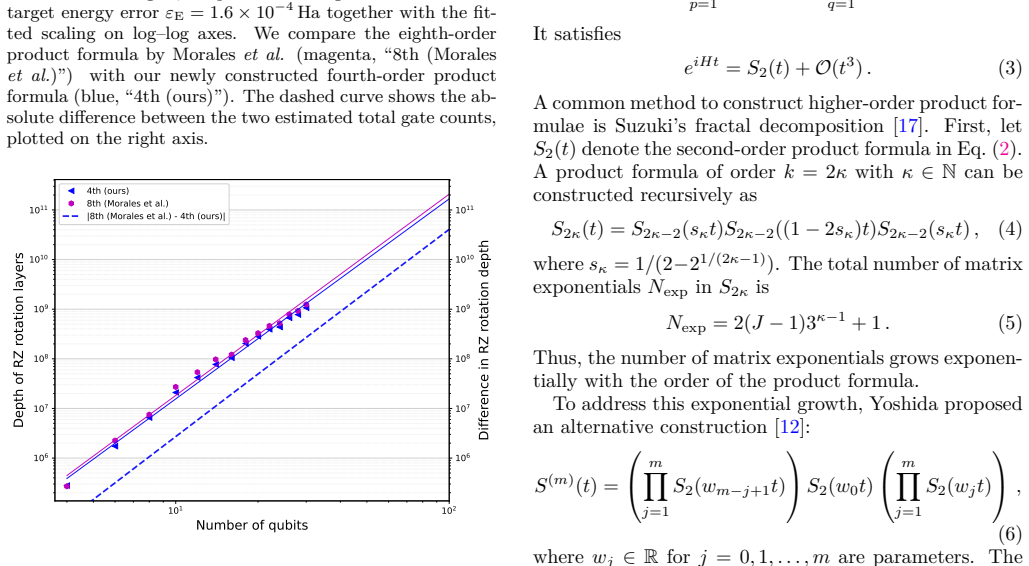
read the original abstract
We evaluate deterministic higher-order product formulae for molecular ground-state energy estimation. Motivated by recent fault-tolerant architectures in which non-Clifford operations may be generated more locally and cheaply than in conventional assumptions, we re-examine such formulae as practical candidates for quantum chemistry. Using one-dimensional hydrogen chains from $\mathrm{H}_2$ to $\mathrm{H}_{15}$ as benchmarks, we estimate both the total gate count and the depth of $R_Z$-rotation layers required to reach a target energy error. To make this comparison feasible at larger system sizes, we use a perturbative method to estimate the eigenvalue error induced by each product formula and thereby evaluate the cost of the corresponding phase-estimation procedure. Among the previously considered formulae, the eighth-order construction introduced by Morales et al. [M. E. S. Morales et al., "Greatly improved higher-order product formulae for quantum simulation," arXiv:2210.15817v2 (2024)] minimizes both cost metrics in the benchmark at a chemically relevant target error. We also find that increasing the formal order does not automatically reduce the total cost: near chemical accuracy, the tenth-order formula introduced in the same work can be less efficient than the eighth-order one. Motivated by this observation, we construct a new fourth-order formula; it achieves the lowest total gate count among the formulae considered for all H-chain instances near chemical accuracy and over much of the 0.1-10 mHa target-error window for most instances, while also reducing the $R_Z$-layer depth. These results clarify how deterministic higher-order product formulae should be selected for molecular ground-state energy estimation.
Editorial analysis
A structured set of objections, weighed in public.
Referee Report
Summary. The manuscript evaluates deterministic higher-order product formulae for Trotterized simulation in quantum phase estimation of molecular ground-state energies. Using one-dimensional hydrogen chains H2–H15 as test cases, it compares total gate counts and RZ-layer depths required to reach target energy errors in the 0.1–10 mHa range. A perturbative estimator is used to predict the eigenvalue error induced by each formula, which is then fed into the phase-estimation resource formula. Among existing formulae the eighth-order construction of Morales et al. performs best; the authors introduce a new fourth-order formula that yields the lowest total gate count near chemical accuracy for all tested instances and reduces RZ depth over much of the error window.
Significance. If the perturbative error estimates prove reliable, the work supplies concrete, system-size-dependent guidance on formula selection for fault-tolerant quantum chemistry. It demonstrates that formal order does not monotonically improve cost and supplies an explicit new fourth-order construction whose performance is competitive on the chosen benchmarks. The emphasis on both total gate count and RZ-layer depth is a useful addition to the resource-estimation literature.
major comments (2)
- The central cost claims rest on feeding perturbative eigenvalue-error estimates into the phase-estimation resource formula. No section reports a direct numerical check of these estimates against exact diagonalization or exact Trotter simulation of the effective Hamiltonian, even for the smallest chains (H2–H4) where such validation is computationally trivial. Without this check it is impossible to know whether higher-order perturbative corrections or non-perturbative effects alter the relative ordering of the formulae near chemical accuracy.
- The perturbative estimator is described only at leading order. The manuscript should state the explicit form of the leading correction (including any dependence on the number of Trotter steps and the norm of the commutators) and quantify the expected size of the neglected terms for the H-chain Hamiltonians at the step counts used.
minor comments (2)
- The abstract states that the new fourth-order formula “achieves the lowest total gate count … for all H-chain instances near chemical accuracy,” yet the text should clarify whether this holds after rounding the number of steps to the nearest integer required by the phase-estimation formula.
- Figure captions and axis labels should explicitly indicate whether the plotted gate counts include the cost of the phase-estimation circuit or only the simulation cost per Trotter step.
Simulated Author's Rebuttal
We thank the referee for their careful reading and constructive feedback on our manuscript. We address each major comment below and will incorporate the suggested revisions.
read point-by-point responses
-
Referee: The central cost claims rest on feeding perturbative eigenvalue-error estimates into the phase-estimation resource formula. No section reports a direct numerical check of these estimates against exact diagonalization or exact Trotter simulation of the effective Hamiltonian, even for the smallest chains (H2–H4) where such validation is computationally trivial. Without this check it is impossible to know whether higher-order perturbative corrections or non-perturbative effects alter the relative ordering of the formulae near chemical accuracy.
Authors: We agree that direct numerical validation would strengthen the central claims. Although the perturbative estimator follows from standard Trotter-error analysis, we will add comparisons of the perturbative predictions against exact diagonalization and full Trotter simulations for H2–H4 in a new appendix of the revised manuscript. These checks will confirm whether the relative ordering of the formulae is preserved near chemical accuracy. revision: yes
-
Referee: The perturbative estimator is described only at leading order. The manuscript should state the explicit form of the leading correction (including any dependence on the number of Trotter steps and the norm of the commutators) and quantify the expected size of the neglected terms for the H-chain Hamiltonians at the step counts used.
Authors: We will revise the manuscript to state the explicit leading-order correction formula, including its dependence on the number of Trotter steps and the norms of the relevant commutators. We will also add quantitative bounds on the size of the neglected higher-order terms evaluated at the Trotter step counts used for the H-chain benchmarks. revision: yes
Circularity Check
No significant circularity; evaluation uses independent perturbative estimates and explicit benchmarks
full rationale
The paper's central results rest on applying a perturbative estimator for eigenvalue error induced by each product formula, then feeding those estimates into a phase-estimation resource formula to obtain gate counts and RZ depths on H-chain instances. This estimator is an approximation technique whose validity is external to the paper's own fitted values or self-referential definitions. The new fourth-order formula is constructed from prior observations and then ranked via the same benchmark procedure; no equation reduces the reported ordering or cost metric to a tautology by construction. The cited Morales et al. work is by different authors and supplies an independent higher-order construction. No self-citation chain, ansatz smuggling, or renaming of known results is load-bearing for the headline claim. The derivation chain is therefore self-contained against the stated numerical benchmarks.
Axiom & Free-Parameter Ledger
axioms (1)
- domain assumption The perturbative method accurately estimates the eigenvalue error induced by each product formula for the purpose of cost comparison.
Reference graph
Works this paper leans on
-
[1]
8th (Morales et al.)
Quantum phase estimation Quantum phase estimation (QPE) [1] is an algorithm to estimate eigenphasesφof a unitaryUusing controlled- version ofU. Throughout this work, we assume the ide- alized case in which the input state to QPE is the exact eigenstate of interest, namely the true molecular ground state. Thus, the resource estimates below do not include t...
-
[2]
Product formulae approximate the time-evolution oper- atore iHt via the product ofe iHjt
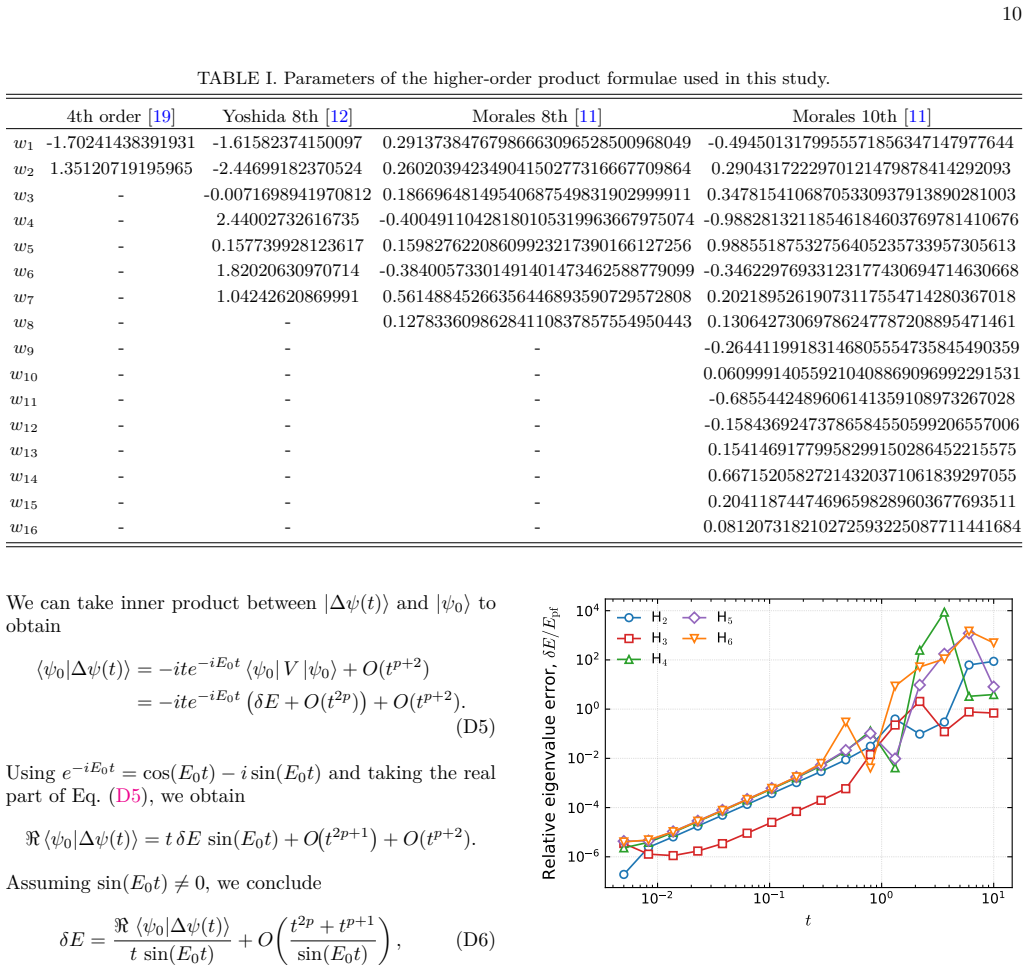
Product formulae Suppose a HamiltonianHis expressed as a linear com- bination ofJtermsH j withj∈{1,...,J}: H= J∑ j=1 Hj. Product formulae approximate the time-evolution oper- atore iHt via the product ofe iHjt. The second-order for- mula approximates the time evolution as S2(t) := J−1∏ p=1 e 1 2iHpteiHJt J−1∏ q=1 e 1 2iHJ−qt.(2) It satisfies eiHt =S 2(t) ...
-
[3]
We then translate it into Pauli operators using Jordan- Wigner transformation [22] withOpenFermion[23, 24]
Perform restricted Hartree-Fock (HF) calculations usingPySCF[20, 21], and construct the second- quantized HamiltonianHusing the HF basis. We then translate it into Pauli operators using Jordan- Wigner transformation [22] withOpenFermion[23, 24]. We also calculate the true ground state en- ergyEby performing full configuration interaction calculation usingPySCF
-
[4]
In the QPE resource estimates below, we fixpto the formal order of each product formula and fit onlyα
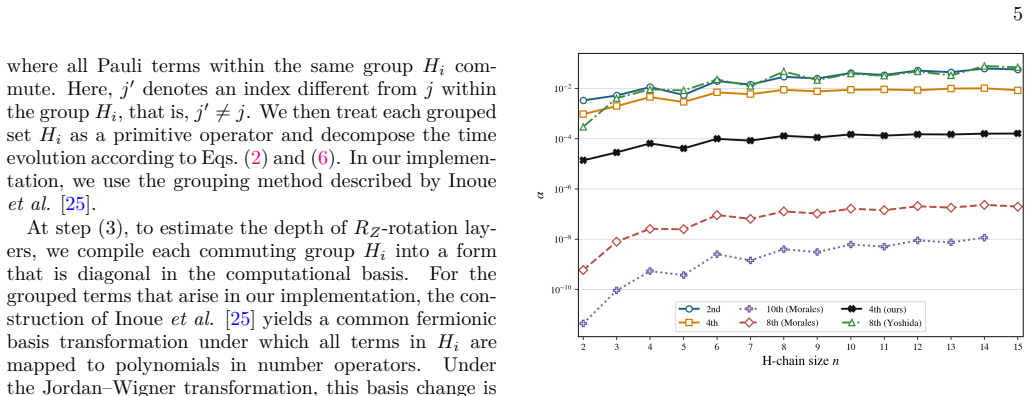
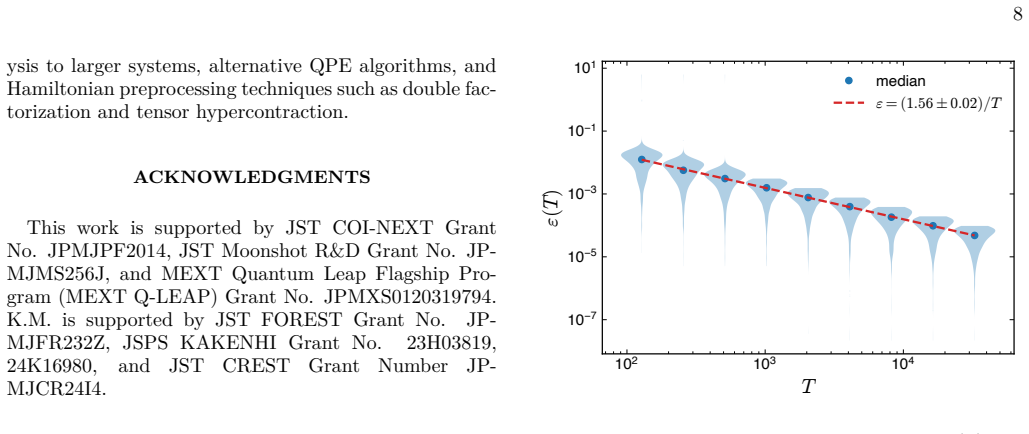
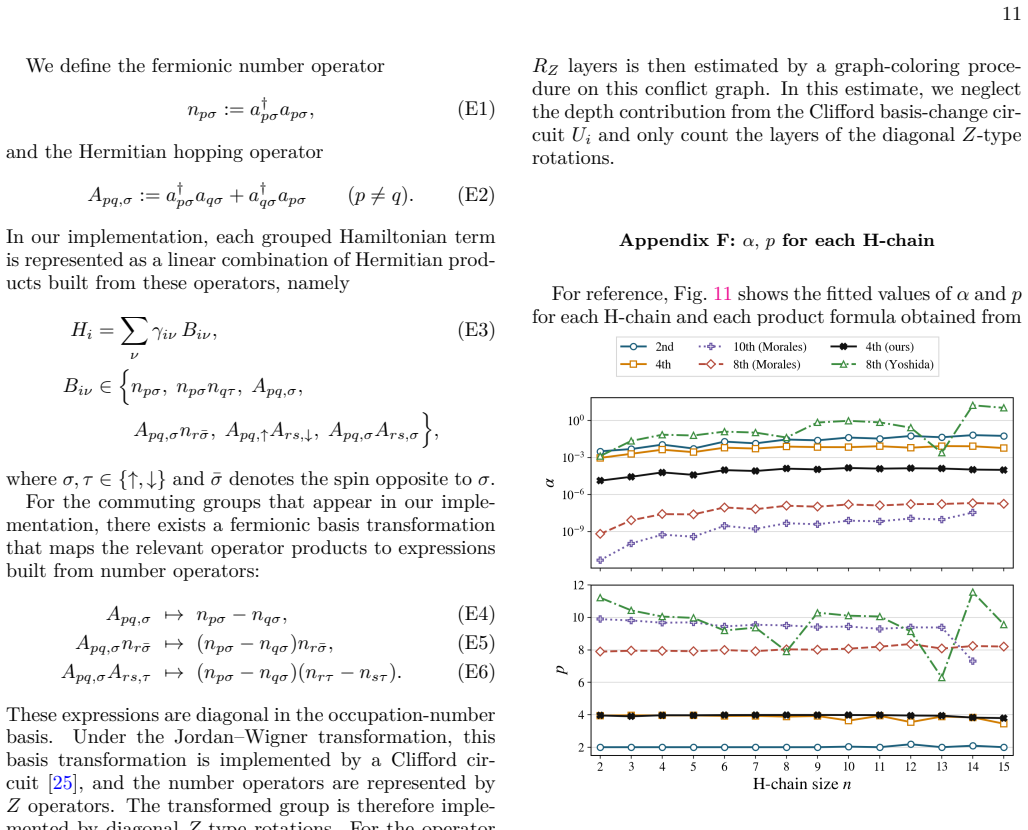
Evaluate the errorδEbetweenEandE pf for mul- tiple values oft, and fit it to the formαtp using the perturbative method described in Appendix D. In the QPE resource estimates below, we fixpto the formal order of each product formula and fit onlyα. For reference only, Appendix F reports the values obtained from an unconstrained fit in which both αandpare tr...
-
[5]
(9) to calculateF, and also evaluate DRZ
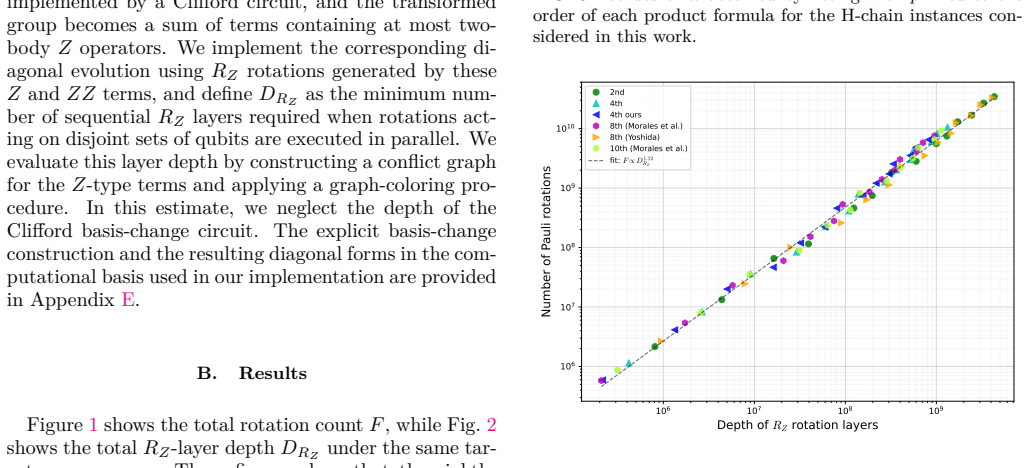
Substitute the fittedαtogether with the fixed value ofpinto Eq. (9) to calculateF, and also evaluate DRZ. We then compare these costs for each prod- uct formula as functions of the target errorεE
-
[6]
(T) median
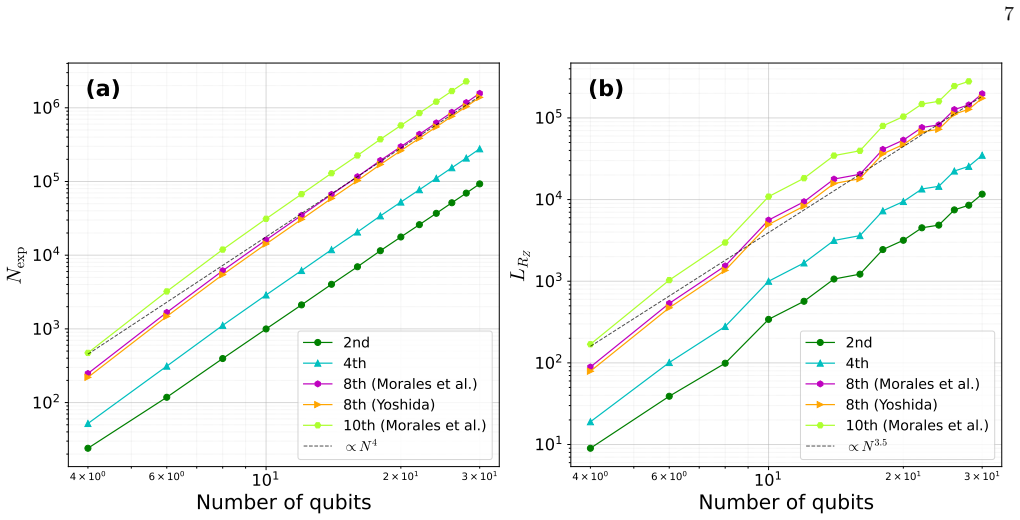
Analyze how each cost metric scales with system size. Specifically, for systems that achieve the tar- get errorεE, we fitFandD RZ as functions of the number of qubitsNusing the models F(N) =a FNbF, D RZ(N) =a DNbD, wherea F ,b F ,a D, andb D are fitting parameters. We then use the fitted models to extrapolate these costs to larger qubit counts. Note that,...
-
[7]
A. Y. Kitaev, arXiv:quant-ph/9511026 [quant-ph] (1995)
Pith/arXiv arXiv 1995
-
[8]
D. S. Abrams and S. Lloyd, Physical Review Letters83, 5162 (1999)
1999
-
[9]
H. F. Trotter, Proceedings of the American Mathematical Society10, 545 (1959)
1959
-
[10]
Suzuki, Communications in Mathematical Physics51, 183 (1976)
M. Suzuki, Communications in Mathematical Physics51, 183 (1976)
1976
-
[11]
G. H. Low and I. L. Chuang, Quantum3, 163 (2019)
2019
-
[12]
Gily´ en, Y
A. Gily´ en, Y. R. Sanders, G. H. Low, and N. Wiebe, in Proceedings of the 51st Annual ACM SIGACT Sympo- sium on Theory of Computing (STOC ’19)(ACM, 2019) pp. 193–204
2019
-
[13]
Bravyi and A
S. Bravyi and A. Kitaev, Physical Review A71, 022316 (2005)
2005
-
[14]
C. Gidney, N. Shutty, and C. Jones, arXiv:2409.17595 [quant-ph] (2024). 12
Pith/arXiv arXiv 2024
-
[15]
Hirano, T
Y. Hirano, T. Itogawa, and K. Fujii, in2024 IEEE In- ternational Conference on Quantum Computing and En- gineering (QCE)(IEEE, 2024) pp. 843–853
2024
-
[16]
Akahoshi, K
Y. Akahoshi, K. Maruyama, H. Oshima, S. Sato, and K. Fujii, PRX Quantum5, 010337 (2024)
2024
-
[17]
M. E. S. Morales, P. Costa, G. Pantaleoni, D. K. Bur- garth, Y. R. Sanders, and D. W. Berry, arXiv:2210.15817 [quant-ph] (2024), arXiv:2210.15817v2
arXiv 2024
-
[18]
Yoshida, Physics letters A150, 262 (1990)
H. Yoshida, Physics letters A150, 262 (1990)
1990
-
[19]
M. E. S. Morales, P. C. S. Costa, G. Pantaleoni, D. K. Burgarth, Y. R. Sanders, and D. W. Berry, Quan- tum Information and Computation 10.2478/qic-2025- 0001 (2025)
-
[20]
J. G¨ unther, F. Witteveen, A. Schmidhuber, M. Miller, M. Christandl, and A. W. Harrow, arXiv:2503.05647 [quant-ph] (2025)
Pith/arXiv arXiv 2025
-
[21]
S. Kanasugi, R. Toshio, K. Maruyama, and H. Oshima, arXiv:2603.22778 [quant-ph] (2026)
arXiv 2026
-
[22]
Reiher, N
M. Reiher, N. Wiebe, K. M. Svore, D. Wecker, and M. Troyer, Proceedings of the National Academy of Sci- ences114, 7555 (2017)
2017
-
[23]
Suzuki, Physics Letters A146, 319 (1990)
M. Suzuki, Physics Letters A146, 319 (1990)
1990
-
[24]
Blanes and F
S. Blanes and F. Casas, Linear algebra and its applica- tions378, 135 (2004)
2004
-
[25]
Kahan and R.-C
W. Kahan and R.-C. Li, Mathematics of Computation 66, 1089 (1997)
1997
-
[26]
Q. Sun, T. C. Berkelbach, N. S. Blunt, G. H. Booth, S. Guo, Z. Li, J. Liu, J. D. McClain, E. R. Sayfutyarova, S. Sharma, S. Wouters, and G. K.-L. Chan, Wiley Inter- disciplinary Reviews: Computational Molecular Science 8, e1340 (2018)
2018
-
[27]
Q. Sun, X. Zhang, S. Banerjee, P. Bao, M. Barbry, N. S. Blunt, N. A. Bogdanov, G. H. Booth, J. Chen, Z.-H. Cui, J. J. Eriksen, Y. Gao, S. Guo, J. Hermann, M. R. Hermes, K. Koh, P. Koval, S. Lehtola, Z. Li, J. Liu, N. Mardirossian, J. D. McClain, M. Motta, B. Mussard, H. Q. Pham, A. Pulkin, W. Purwanto, P. J. Robin- son, E. Ronca, E. R. Sayfutyarova, M. Sc...
2020
-
[28]
Ortiz, J
G. Ortiz, J. E. Gubernatis, E. Knill, and R. Laflamme, Physical Review A64, 022319 (2001)
2001
-
[29]
J. R. McClean, I. D. Kivlichan, K. J. Sung, D. Steudt- ner, Y. Cao, C. Dai, E. S. Fried, C. Gidney, B. Gimby, T. H¨ aner, J. Izaac, Z. Jiang, M. Kusumoto, Y. Li, S. McArdle, M. Neeley, T. E. O’Brien, B. O’Gorman, M. Ozols, A. D. Patterson, J. Romero, N. C. Rubin, N. P. D. Sawaya, K. Setia, S. Sim, M. Steudtner, Q. Sun, W. Sun, D. Wang, F. Zhang, P. D. Nat...
Pith/arXiv arXiv 2017
-
[30]
J. R. McClean, N. C. Rubin, K. J. Sung, I. D. Kivlichan, X. Bonet-Monroig, Y. Cao, C. Dai, E. S. Fried, C. Gidney, B. Gimby, P. Gokhale, T. H¨ aner, T. Hardikar, V. Havl´ ıˇ cek, O. Higgott, C. Huang, J. Izaac, Z. Jiang, X. Liu, S. McArdle, M. Neeley, T. E. O’Brien, B. O’Gorman, M. Ozols, D. Packwood, R. Santagati, M. S. Scheurer, K. Setia, S. Sim, S. Sin...
2020
-
[31]
Inoue, K
W. Inoue, K. Aoyama, Y. Teranishi, K. Kanno, Y. O. Nakagawa, and K. Mitarai, Phys. Rev. Res.6, 013096 (2024)
2024
discussion (0)
Sign in with ORCID, Apple, or X to comment. Anyone can read and Pith papers without signing in.