Omni-Supervised Motion Editing: Balancing Change and Invariance through Positive-Negative Learning
Pith reviewed 2026-06-28 22:59 UTC · model grok-4.3
The pith
A positive-negative supervision framework balances precise text-driven motion edits with preservation of unchanged parts.
A machine-rendered reading of the paper's core claim, the machinery that carries it, and where it could break.
Core claim
The Omni-Supervised Positive-Negative Learning framework (OmniME) integrates retrospective feature supervision for coarse-to-fine consistency, a motion preservation mechanism focused on subtle variations, and triplet-based semantic alignment to strengthen text-motion correspondence, together forming a unified supervision paradigm that balances change and invariance.
What carries the argument
The three-component Omni-Supervised Positive-Negative Learning framework that enforces layer-wise consistency, similarity-based preservation, and triplet semantic alignment.
If this is right
- State-of-the-art editing alignment on the MotionFix and STANCE Adjustment datasets.
- Reduced motion distortion while following text instructions.
- Stronger correspondence between language commands and the regions that actually change.
- A reusable supervision pattern that treats edited and unedited regions symmetrically.
Where Pith is reading between the lines
- The same positive-negative structure might transfer to other conditional generation tasks such as video or 3D shape editing.
- The retrospective supervision idea could be tested on non-diffusion backbones to check if the balance holds outside the current model family.
- Extending the triplet alignment to longer or multi-sentence instructions would test whether the invariance property scales.
Load-bearing premise
That the three supervision components can be combined into one framework without introducing new distortions or leaving alignment suboptimal.
What would settle it
Quantitative results on the MotionFix dataset where OmniME scores no higher than prior diffusion baselines on editing alignment metrics.
Figures
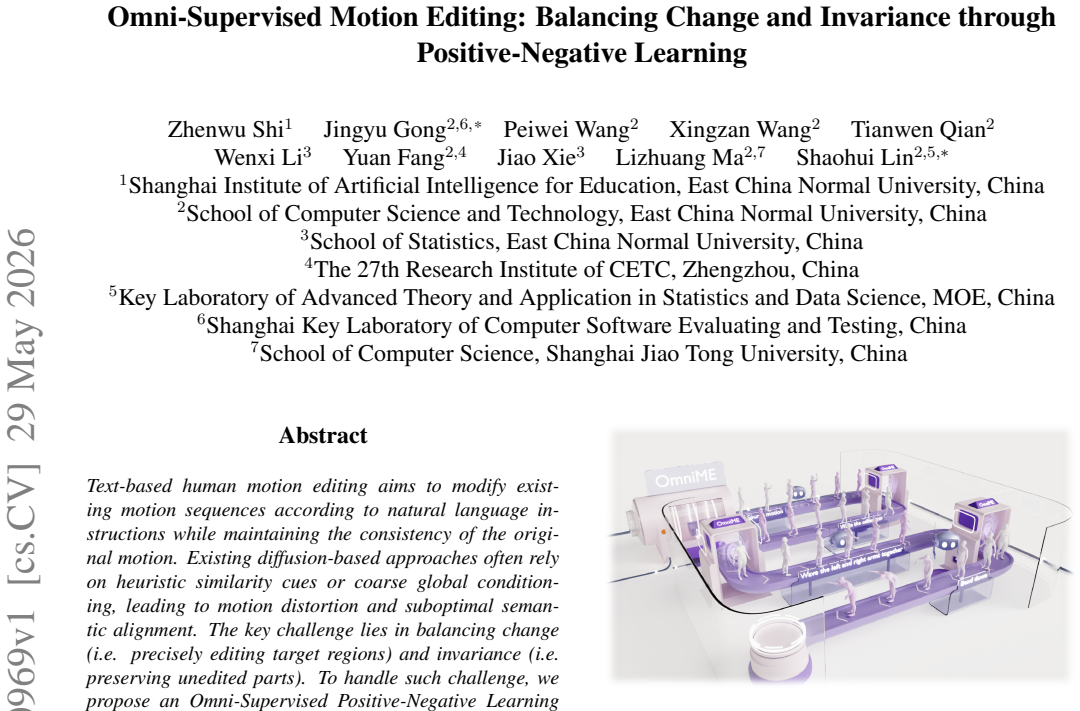


read the original abstract
Text-based human motion editing aims to modify existing motion sequences according to natural language instructions while maintaining the consistency of the original motion. Existing diffusion-based approaches often rely on heuristic similarity cues or coarse global conditioning, leading to motion distortion and suboptimal semantic alignment. The key challenge lies in balancing change (i.e. precisely editing target regions) and invariance (i.e. preserving unedited parts). To handle such challenge, we propose an Omni-Supervised Positive-Negative Learning framework, named OmniME. Our method integrates three complementary components: (1) retrospective feature supervision that enforces coarse-to-fine consistency across transformer layers,(2) motion preservation mechanism that focuses on subtle variations according to the source-target similarity, and (3) triplet-based semantic alignment that strengthens text-motion correspondence. Together, these components form a unified supervision paradigm that balances change and invariance. Extensive experiments on the MotionFix and STANCE Adjustment datasets demonstrate that OmniME achieves state-of-the-art performance in editing alignment, validating the effectiveness of our unified learning framework. Our source codes and models have been released at: https://github.com/rocket-ycyer/OmniME.git
Editorial analysis
A structured set of objections, weighed in public.
Referee Report
Summary. The paper proposes OmniME, an Omni-Supervised Positive-Negative Learning framework for text-based human motion editing. It integrates retrospective feature supervision for coarse-to-fine consistency across transformer layers, a motion preservation mechanism based on source-target similarity, and triplet-based semantic alignment to strengthen text-motion correspondence. These components are claimed to form a unified paradigm balancing change and invariance. The manuscript asserts state-of-the-art performance on the MotionFix and STANCE Adjustment datasets via extensive experiments.
Significance. If the SOTA claims hold with proper validation, the work could advance text-conditioned motion editing by offering a more principled positive-negative supervision strategy that mitigates distortion and improves semantic alignment, with potential benefits for animation and interactive applications.
major comments (2)
- [Abstract] Abstract: The central claim that 'OmniME achieves state-of-the-art performance in editing alignment' is unsupported by any quantitative metrics, baseline comparisons, tables, or error analysis, which is load-bearing for validating the unified learning framework.
- [Abstract] Abstract: No equations, implementation details, or ablation results are supplied for the three components (retrospective feature supervision, motion preservation mechanism, triplet-based semantic alignment), preventing verification that they balance change and invariance without introducing new distortions or suboptimal alignment.
Simulated Author's Rebuttal
We thank the referee for the constructive feedback. We address the two major comments on the abstract point by point. The full manuscript contains the supporting experiments, equations, and ablations referenced in the abstract summary.
read point-by-point responses
-
Referee: [Abstract] Abstract: The central claim that 'OmniME achieves state-of-the-art performance in editing alignment' is unsupported by any quantitative metrics, baseline comparisons, tables, or error analysis, which is load-bearing for validating the unified learning framework.
Authors: We agree the abstract would be strengthened by including key quantitative highlights. The full manuscript (Section 4) reports SOTA results on MotionFix and STANCE with tables comparing against baselines, including alignment metrics and error analysis. We will revise the abstract to add concise performance numbers and baseline references while preserving its length. revision: yes
-
Referee: [Abstract] Abstract: No equations, implementation details, or ablation results are supplied for the three components (retrospective feature supervision, motion preservation mechanism, triplet-based semantic alignment), preventing verification that they balance change and invariance without introducing new distortions or suboptimal alignment.
Authors: Abstracts are high-level summaries and do not conventionally include equations or ablations; these appear in the main text (Section 3 for component formulations and Section 4 for ablations demonstrating the change-invariance balance). The manuscript structure follows standard practice and enables verification. No revision to the abstract is needed on this point. revision: no
Circularity Check
No significant circularity identified
full rationale
The provided abstract and description contain no equations, fitted parameters, predictions, or self-citations. The framework is presented as the integration of three named components whose joint effect is asserted to balance change and invariance; this is a conventional high-level claim structure without any reduction of outputs to inputs by construction. The SOTA performance claim is attributed to experiments on external datasets, which constitutes independent empirical support rather than a self-referential derivation. No load-bearing step reduces to a fit, renaming, or self-citation chain.
Axiom & Free-Parameter Ledger
Reference graph
Works this paper leans on
-
[1]
Skeleton- aware networks for deep motion retargeting.ACM Transac- tions on Graphics (TOG), 39(4):62–1, 2020
Kfir Aberman, Peizhuo Li, Dani Lischinski, Olga Sorkine- Hornung, Daniel Cohen-Or, and Baoquan Chen. Skeleton- aware networks for deep motion retargeting.ACM Transac- tions on Graphics (TOG), 39(4):62–1, 2020. 2
2020
-
[2]
A stochastic con- ditioning scheme for diverse human motion prediction
Sadegh Aliakbarian, Fatemeh Sadat Saleh, Mathieu Salz- mann, Lars Petersson, and Stephen Gould. A stochastic con- ditioning scheme for diverse human motion prediction. In Proceedings of the IEEE/CVF conference on computer vi- sion and pattern recognition, pages 5223–5232, 2020. 2
2020
-
[3]
Look like me: matching robot personality via gaze to increase moti- vation
Sean Andrist, Bilge Mutlu, and Adriana Tapus. Look like me: matching robot personality via gaze to increase moti- vation. InProceedings of the 33rd annual ACM conference on human factors in computing systems, pages 3603–3612,
-
[4]
Teach: Temporal action composition for 3d hu- mans
Nikos Athanasiou, Mathis Petrovich, Michael J Black, and G¨ul Varol. Teach: Temporal action composition for 3d hu- mans. In2022 International Conference on 3D Vision (3DV), pages 414–423. IEEE, 2022. 2
2022
-
[5]
Sinc: Spatial composition of 3d human motions for simultaneous action generation
Nikos Athanasiou, Mathis Petrovich, Michael J Black, and G¨ul Varol. Sinc: Spatial composition of 3d human motions for simultaneous action generation. InProceedings of the IEEE/CVF International Conference on Computer Vision, pages 9984–9995, 2023. 2
2023
-
[6]
Motionfix: Text-driven 3d human motion editing
Nikos Athanasiou, Alp ´ar Cseke, Markos Diomataris, Michael J Black, and G ¨ul Varol. Motionfix: Text-driven 3d human motion editing. InSIGGRAPH Asia 2024 Conference Papers, pages 1–11, 2024. 1, 2, 3, 4, 5, 6, 7, 8
2024
-
[7]
Speech2affectivegestures: Synthesizing co-speech ges- tures with generative adversarial affective expression learning
Uttaran Bhattacharya, Elizabeth Childs, Nicholas Rewkowski, and Dinesh Manocha. Speech2affectivegestures: Synthesizing co-speech ges- tures with generative adversarial affective expression learning. InProceedings of the 29th ACM International Conference on Multimedia, pages 2027–2036, 2021. 1
2027
-
[8]
Xiaoyu Bie, Wen Guo, Simon Leglaive, Lauren Girin, Francesc Moreno-Noguer, and Xavier Alameda-Pineda. Hit- dvae: Human motion generation via hierarchical transformer dynamical vae.arXiv preprint arXiv:2204.01565, 2022. 2
-
[9]
In- structpix2pix: Learning to follow image editing instructions
Tim Brooks, Aleksander Holynski, and Alexei A Efros. In- structpix2pix: Learning to follow image editing instructions. InProceedings of the IEEE/CVF conference on computer vi- sion and pattern recognition, pages 18392–18402, 2023. 5
2023
-
[10]
A simple framework for contrastive learning of visual representations
Ting Chen, Simon Kornblith, Mohammad Norouzi, and Ge- offrey Hinton. A simple framework for contrastive learning of visual representations. InInternational conference on ma- chine learning, pages 1597–1607. PmLR, 2020. 2
2020
-
[11]
Executing your commands via motion diffusion in latent space
Xin Chen, Biao Jiang, Wen Liu, Zilong Huang, Bin Fu, Tao Chen, and Gang Yu. Executing your commands via motion diffusion in latent space. InProceedings of the IEEE/CVF conference on computer vision and pattern recognition, pages 18000–18010, 2023. 2, 5
2023
-
[12]
Mofusion: A framework for denoising-diffusion-based motion synthesis
Rishabh Dabral, Muhammad Hamza Mughal, Vladislav Golyanik, and Christian Theobalt. Mofusion: A framework for denoising-diffusion-based motion synthesis. InProceed- ings of the IEEE/CVF conference on computer vision and pattern recognition, pages 9760–9770, 2023
2023
-
[13]
Motionlcm: Real-time controllable motion generation via latent consistency model
Wenxun Dai, Ling-Hao Chen, Jingbo Wang, Jinpeng Liu, Bo Dai, and Yansong Tang. Motionlcm: Real-time controllable motion generation via latent consistency model. InEuropean Conference on Computer Vision, pages 390–408. Springer,
-
[14]
Posefix: correcting 3d hu- man poses with natural language
Ginger Delmas, Philippe Weinzaepfel, Francesc Moreno- Noguer, and Gr ´egory Rogez. Posefix: correcting 3d hu- man poses with natural language. InProceedings of the IEEE/CVF International Conference on Computer Vision, pages 15018–15028, 2023. 2
2023
-
[15]
Ke Fan, Jiangning Zhang, Ran Yi, Jingyu Gong, Yabiao Wang, Yating Wang, Xin Tan, Chengjie Wang, and Lizhuang Ma. Textual decomposition then sub-motion-space scatter- ing for open-vocabulary motion generation.arXiv preprint arXiv:2411.04079, 2024. 2
-
[16]
Imos: Intent-driven full-body motion synthesis for human-object interactions
Anindita Ghosh, Rishabh Dabral, Vladislav Golyanik, Chris- tian Theobalt, and Philipp Slusallek. Imos: Intent-driven full-body motion synthesis for human-object interactions. In Computer Graphics Forum, pages 1–12. Wiley Online Li- brary, 2023. 1
2023
-
[17]
Remos: 3d motion- conditioned reaction synthesis for two-person interactions
Anindita Ghosh, Rishabh Dabral, Vladislav Golyanik, Chris- tian Theobalt, and Philipp Slusallek. Remos: 3d motion- conditioned reaction synthesis for two-person interactions. InEuropean Conference on Computer Vision, pages 418–
-
[18]
Motion editing with spacetime con- straints
Michael Gleicher. Motion editing with spacetime con- straints. InProceedings of the 1997 symposium on Inter- active 3D graphics, pages 139–ff, 1997. 2
1997
-
[19]
Motion path editing
Michael Gleicher. Motion path editing. InProceedings of the 2001 symposium on Interactive 3D graphics, pages 195– 202, 2001. 2
2001
-
[20]
Iterative motion editing with natural language
Purvi Goel, Kuan-Chieh Wang, C Karen Liu, and Kayvon Fatahalian. Iterative motion editing with natural language. InACM SIGGRAPH 2024 Conference Papers, pages 1–9,
2024
-
[21]
Human motion synthesis in 3d scenes via unified scene se- mantic occupancy
Jingyu Gong, Kunkun Tong, Zhuoran Chen, Chuanhan Yuan, Mingang Chen, Zhizhong Zhang, Xin Tan, and Yuan Xie. Human motion synthesis in 3d scenes via unified scene se- mantic occupancy. InProceedings of the AAAI Conference on Artificial Intelligence, 2026. 1
2026
-
[22]
Diffusion implicit policy for unpaired scene-aware motion synthesis
Jingyu Gong, Chong Zhang, Fengqi Liu, Ke Fan, Qianyu Zhou, Xin Tan, Zhizhong Zhang, and Yuan Xie. Diffusion implicit policy for unpaired scene-aware motion synthesis. InProceedings of the AAAI Conference on Artificial Intelli- gence, 2026. 1
2026
-
[23]
Generating diverse and natural 3d human motions from text
Chuan Guo, Shihao Zou, Xinxin Zuo, Sen Wang, Wei Ji, Xingyu Li, and Li Cheng. Generating diverse and natural 3d human motions from text. InProceedings of the IEEE/CVF conference on computer vision and pattern recognition, pages 5152–5161, 2022. 2
2022
-
[24]
Robust motion in-betweening.ACM Trans- actions on Graphics (TOG), 39(4):60–1, 2020
F ´elix G Harvey, Mike Yurick, Derek Nowrouzezahrai, and Christopher Pal. Robust motion in-betweening.ACM Trans- actions on Graphics (TOG), 39(4):60–1, 2020. 2
2020
-
[25]
Denoising dif- fusion probabilistic models.Advances in neural information processing systems, 33:6840–6851, 2020
Jonathan Ho, Ajay Jain, and Pieter Abbeel. Denoising dif- fusion probabilistic models.Advances in neural information processing systems, 33:6840–6851, 2020. 2
2020
-
[26]
Avatarclip: zero-shot text- driven generation and animation of 3d avatars.ACM Trans- actions on Graphics (TOG), 41(4):1–19, 2022
Fangzhou Hong, Mingyuan Zhang, Liang Pan, Zhongang Cai, Lei Yang, and Ziwei Liu. Avatarclip: zero-shot text- driven generation and animation of 3d avatars.ACM Trans- actions on Graphics (TOG), 41(4):1–19, 2022. 2
2022
-
[27]
Como: Controllable motion generation through language guided pose code edit- ing
Yiming Huang, Weilin Wan, Yue Yang, Chris Callison- Burch, Mark Yatskar, and Lingjie Liu. Como: Controllable motion generation through language guided pose code edit- ing. InEuropean Conference on Computer Vision, pages 180–196. Springer, 2024. 2
2024
-
[28]
Dynamic motion blending for versatile motion editing
Nan Jiang, Hongjie Li, Ziye Yuan, Zimo He, Yixin Chen, Tengyu Liu, Yixin Zhu, and Siyuan Huang. Dynamic motion blending for versatile motion editing. InProceedings of the Computer Vision and Pattern Recognition Conference, pages 22735–22745, 2025. 2, 3, 5, 6, 7, 8
2025
-
[29]
Act as you wish: Fine-grained control of motion diffusion model with hierarchical semantic graphs
Peng Jin, Yang Wu, Yanbo Fan, Zhongqian Sun, Wei Yang, and Li Yuan. Act as you wish: Fine-grained control of motion diffusion model with hierarchical semantic graphs. Advances in Neural Information Processing Systems, 36: 15497–15518, 2023. 1
2023
-
[30]
Perceptual losses for real-time style transfer and super-resolution
Justin Johnson, Alexandre Alahi, and Li Fei-Fei. Perceptual losses for real-time style transfer and super-resolution. In European conference on computer vision, pages 694–711. Springer, 2016. 2
2016
-
[31]
Flame: Free- form language-based motion synthesis & editing
Jihoon Kim, Jiseob Kim, and Sungjoon Choi. Flame: Free- form language-based motion synthesis & editing. InPro- ceedings of the AAAI Conference on Artificial Intelligence, pages 8255–8263, 2023. 2
2023
-
[32]
Synchronized multi-character motion editing.ACM transactions on graphics (TOG), 28(3):1–9, 2009
Manmyung Kim, Kyunglyul Hyun, Jongmin Kim, and Jehee Lee. Synchronized multi-character motion editing.ACM transactions on graphics (TOG), 28(3):1–9, 2009. 2
2009
-
[33]
A hierarchical approach to interactive motion editing for human-like figures
Jehee Lee and Sung Yong Shin. A hierarchical approach to interactive motion editing for human-like figures. InPro- ceedings of the 26th annual conference on Computer graph- ics and interactive techniques, pages 39–48, 1999. 2
1999
-
[34]
Simmotionedit: Text-based human motion editing with motion similarity pre- diction
Zhengyuan Li, Kai Cheng, Anindita Ghosh, Uttaran Bhat- tacharya, Liangyan Gui, and Aniket Bera. Simmotionedit: Text-based human motion editing with motion similarity pre- diction. InProceedings of the Computer Vision and Pattern Recognition Conference, pages 27827–27837, 2025. 1, 2, 3, 4, 5, 6, 7, 8
2025
-
[35]
Omg: Towards open-vocabulary motion generation via mix- ture of controllers
Han Liang, Jiacheng Bao, Ruichi Zhang, Sihan Ren, Yuecheng Xu, Sibei Yang, Xin Chen, Jingyi Yu, and Lan Xu. Omg: Towards open-vocabulary motion generation via mix- ture of controllers. InProceedings of the IEEE/CVF Con- ference on Computer Vision and Pattern Recognition, pages 482–493, 2024. 2
2024
-
[36]
Intergen: Diffusion-based multi-human motion genera- tion under complex interactions.International Journal of Computer Vision, 132(9):3463–3483, 2024
Han Liang, Wenqian Zhang, Wenxuan Li, Jingyi Yu, and Lan Xu. Intergen: Diffusion-based multi-human motion genera- tion under complex interactions.International Journal of Computer Vision, 132(9):3463–3483, 2024. 2
2024
-
[37]
Motion-x: A large-scale 3d expressive whole-body human motion dataset
Jing Lin, Ailing Zeng, Shunlin Lu, Yuanhao Cai, Ruimao Zhang, Haoqian Wang, and Lei Zhang. Motion-x: A large-scale 3d expressive whole-body human motion dataset. Advances in Neural Information Processing Systems, 36: 25268–25280, 2023. 2
2023
-
[38]
Human Motion Modeling using DVGANs
Xiao Lin and Mohamed R Amer. Human motion modeling using dvgans.arXiv preprint arXiv:1804.10652, 2018. 2
work page internal anchor Pith review Pith/arXiv arXiv 2018
-
[39]
Decoupled weight de- cay regularization
Ilya Loshchilov and Frank Hutter. Decoupled weight de- cay regularization. InInternational Conference on Learning Representations, 2019. 6
2019
-
[40]
Learning human motion pre- diction via stochastic differential equations
Kedi Lyu, Zhenguang Liu, Shuang Wu, Haipeng Chen, Xuhong Zhang, and Yuyu Yin. Learning human motion pre- diction via stochastic differential equations. InProceedings of the 29th ACM International Conference on Multimedia, pages 4976–4984, 2021. 2
2021
-
[41]
3d human motion prediction: A survey.Neuro- computing, 489:345–365, 2022
Kedi Lyu, Haipeng Chen, Zhenguang Liu, Beiqi Zhang, and Ruili Wang. 3d human motion prediction: A survey.Neuro- computing, 489:345–365, 2022. 2
2022
-
[42]
Amass: Archive of motion capture as surface shapes
Naureen Mahmood, Nima Ghorbani, Nikolaus F Troje, Ger- ard Pons-Moll, and Michael J Black. Amass: Archive of motion capture as surface shapes. InProceedings of the IEEE/CVF international conference on computer vision, pages 5442–5451, 2019. 2
2019
-
[43]
Protores: Proto-residual network for pose authoring via learned inverse kinematics
Boris N Oreshkin, Florent Bocquelet, Felix G Harvey, Bay Raitt, and Dominic Laflamme. Protores: Proto-residual network for pose authoring via learned inverse kinematics. InInternational Conference on Learning Representations,
-
[44]
A survey of motion planning and con- trol techniques for self-driving urban vehicles.IEEE Trans- actions on intelligent vehicles, 1(1):33–55, 2016
Brian Paden, Michal ˇC´ap, Sze Zheng Yong, Dmitry Yershov, and Emilio Frazzoli. A survey of motion planning and con- trol techniques for self-driving urban vehicles.IEEE Trans- actions on intelligent vehicles, 1(1):33–55, 2016. 1
2016
-
[45]
Scalable diffusion models with transformers
William Peebles and Saining Xie. Scalable diffusion models with transformers. InProceedings of the IEEE/CVF inter- national conference on computer vision, pages 4195–4205,
-
[46]
Temos: Generating diverse human motions from textual descriptions
Mathis Petrovich, Michael J Black, and G ¨ul Varol. Temos: Generating diverse human motions from textual descriptions. InEuropean Conference on Computer Vision, pages 480–
-
[47]
Tmr: Text-to-motion retrieval using contrastive 3d human motion synthesis
Mathis Petrovich, Michael J Black, and G ¨ul Varol. Tmr: Text-to-motion retrieval using contrastive 3d human motion synthesis. InProceedings of the IEEE/CVF International Conference on Computer Vision, pages 9488–9497, 2023. 5
2023
-
[48]
Multi-track timeline control for text-driven 3d human motion generation
Mathis Petrovich, Or Litany, Umar Iqbal, Michael J Black, Gul Varol, Xue Bin Peng, and Davis Rempe. Multi-track timeline control for text-driven 3d human motion generation. InProceedings of the IEEE/CVF Conference on Computer Vision and Pattern Recognition Workshops (CVPRW), pages 1911–1921, 2024. 2
1911
-
[49]
Mmm: Generative masked motion model
Ekkasit Pinyoanuntapong, Pu Wang, Minwoo Lee, and Chen Chen. Mmm: Generative masked motion model. InPro- ceedings of the IEEE/CVF Conference on Computer Vision and Pattern Recognition, pages 1546–1555, 2024. 2
2024
-
[50]
Babel: Bodies, action and behavior with english la- bels
Abhinanda R Punnakkal, Arjun Chandrasekaran, Nikos Athanasiou, Alejandra Quiros-Ramirez, and Michael J Black. Babel: Bodies, action and behavior with english la- bels. InProceedings of the IEEE/CVF conference on com- puter vision and pattern recognition, pages 722–731, 2021. 2
2021
-
[51]
Motion in-betweening via two-stage transformers.ACM Trans
Jia Qin, Youyi Zheng, and Kun Zhou. Motion in-betweening via two-stage transformers.ACM Trans. Graph., 41(6):184– 1, 2022. 2
2022
-
[52]
Monkey see, monkey do: Harnessing self- attention in motion diffusion for zero-shot motion transfer
Sigal Raab, Inbar Gat, Nathan Sala, Guy Tevet, Rotem Shalev-Arkushin, Ohad Fried, Amit Haim Bermano, and Daniel Cohen-Or. Monkey see, monkey do: Harnessing self- attention in motion diffusion for zero-shot motion transfer. InSIGGRAPH Asia 2024 Conference Papers, pages 1–13,
2024
-
[53]
Learning transferable visual models from natural language supervi- sion
Alec Radford, Jong Wook Kim, Chris Hallacy, Aditya Ramesh, Gabriel Goh, Sandhini Agarwal, Girish Sastry, Amanda Askell, Pamela Mishkin, Jack Clark, et al. Learning transferable visual models from natural language supervi- sion. InInternational conference on machine learning, pages 8748–8763. PmLR, 2021. 3, 5
2021
-
[54]
Trace and pace: Controllable pedestrian animation via guided trajec- tory diffusion
Davis Rempe, Zhengyi Luo, Xue Bin Peng, Ye Yuan, Kris Kitani, Karsten Kreis, Sanja Fidler, and Or Litany. Trace and pace: Controllable pedestrian animation via guided trajec- tory diffusion. InProceedings of the IEEE/CVF Conference on Computer Vision and Pattern Recognition, pages 13756– 13766, 2023. 2
2023
-
[55]
Insactor: Instruction-driven physics- based characters.Advances in Neural Information Process- ing Systems, 36:59911–59923, 2023
Jiawei Ren, Mingyuan Zhang, Cunjun Yu, Xiao Ma, Liang Pan, and Ziwei Liu. Insactor: Instruction-driven physics- based characters.Advances in Neural Information Process- ing Systems, 36:59911–59923, 2023. 2
2023
-
[56]
Improved techniques for training gans.Advances in neural information processing systems, 29, 2016
Tim Salimans, Ian Goodfellow, Wojciech Zaremba, Vicki Cheung, Alec Radford, and Xi Chen. Improved techniques for training gans.Advances in neural information processing systems, 29, 2016. 2
2016
-
[57]
Facenet: A unified embedding for face recognition and clus- tering
Florian Schroff, Dmitry Kalenichenko, and James Philbin. Facenet: A unified embedding for face recognition and clus- tering. InProceedings of the IEEE conference on computer vision and pattern recognition, pages 815–823, 2015. 2
2015
-
[58]
Human motion diffusion as a generative prior
Yoni Shafir, Guy Tevet, Roy Kapon, and Amit Haim Bermano. Human motion diffusion as a generative prior. InThe Twelfth International Conference on Learning Rep- resentations, 2024. 2, 3
2024
-
[59]
Ntu rgb+ d: A large scale dataset for 3d human activity anal- ysis
Amir Shahroudy, Jun Liu, Tian-Tsong Ng, and Gang Wang. Ntu rgb+ d: A large scale dataset for 3d human activity anal- ysis. InProceedings of the IEEE conference on computer vision and pattern recognition, pages 1010–1019, 2016. 2
2016
-
[60]
Interactive character control with auto- regressive motion diffusion models.ACM Transactions on Graphics (TOG), 43(4):1–14, 2024
Yi Shi, Jingbo Wang, Xuekun Jiang, Bingkun Lin, Bo Dai, and Xue Bin Peng. Interactive character control with auto- regressive motion diffusion models.ACM Transactions on Graphics (TOG), 43(4):1–14, 2024. 2
2024
-
[61]
Deep unsupervised learning using nonequilibrium thermodynamics
Jascha Sohl-Dickstein, Eric Weiss, Niru Maheswaranathan, and Surya Ganguli. Deep unsupervised learning using nonequilibrium thermodynamics. InInternational confer- ence on machine learning, pages 2256–2265. pmlr, 2015. 2
2015
-
[62]
Local motion phases for learning multi-contact char- acter movements.ACM Transactions on Graphics, 39(4),
Sebastian Starke, Yiwei Zhao, Taku Komura, and Kazi Za- man. Local motion phases for learning multi-contact char- acter movements.ACM Transactions on Graphics, 39(4),
-
[63]
A survey on human interaction mo- tion generation.International Journal of Computer Vision, 134(3):113, 2026
Kewei Sui, Anindita Ghosh, Inwoo Hwang, Bing Zhou, Jian Wang, and Chuan Guo. A survey on human interaction mo- tion generation.International Journal of Computer Vision, 134(3):113, 2026. 2
2026
-
[64]
Positive-negative receptive field reasoning for omni- supervised 3d segmentation.IEEE Transactions on Pattern Analysis and Machine Intelligence, 45(12):15328–15344,
Xin Tan, Qihang Ma, Jingyu Gong, Jiachen Xu, Zhizhong Zhang, Haichuan Song, Yanyun Qu, Yuan Xie, and Lizhuang Ma. Positive-negative receptive field reasoning for omni- supervised 3d segmentation.IEEE Transactions on Pattern Analysis and Machine Intelligence, 45(12):15328–15344,
-
[65]
Motionclip: Exposing human motion generation to clip space
Guy Tevet, Brian Gordon, Amir Hertz, Amit H Bermano, and Daniel Cohen-Or. Motionclip: Exposing human motion generation to clip space. InEuropean Conference on Com- puter Vision, pages 358–374. Springer, 2022. 2
2022
-
[66]
Human motion diffu- sion model
Guy Tevet, Sigal Raab, Brian Gordon, Yoni Shafir, Daniel Cohen-or, and Amit Haim Bermano. Human motion diffu- sion model. InThe Eleventh International Conference on Learning Representations, 2023. 2, 3, 5, 6
2023
-
[67]
Edge: Editable dance generation from music
Jonathan Tseng, Rodrigo Castellon, and Karen Liu. Edge: Editable dance generation from music. InProceedings of the IEEE/CVF conference on computer vision and pattern recognition, pages 448–458, 2023. 2
2023
-
[68]
Fourier principles for emotion-based human figure animation
Munetoshi Unuma, Ken Anjyo, and Ryozo Takeuchi. Fourier principles for emotion-based human figure animation. In Proceedings of the 22nd annual conference on Computer graphics and interactive techniques, pages 91–96, 1995. 2
1995
-
[69]
Dif- fusionphase: Motion diffusion in frequency domain.arXiv preprint arXiv:2312.04036, 2023
Weilin Wan, Yiming Huang, Shutong Wu, Taku Komura, Wenping Wang, Dinesh Jayaraman, and Lingjie Liu. Dif- fusionphase: Motion diffusion in frequency domain.arXiv preprint arXiv:2312.04036, 2023. 2
-
[70]
You think, you act: The new task of arbitrary text to motion generation
Runqi Wang, Caoyuan Ma, Guopeng Li, Hanrui Xu, Yuke Li, and Zheng Wang. You think, you act: The new task of arbitrary text to motion generation. InProceedings of the IEEE/CVF International Conference on Computer Vision, pages 12012–12022, 2025. 2
2025
-
[71]
Learning diverse stochastic human-action generators by learning smooth la- tent transitions
Zhenyi Wang, Ping Yu, Yang Zhao, Ruiyi Zhang, Yufan Zhou, Junsong Yuan, and Changyou Chen. Learning diverse stochastic human-action generators by learning smooth la- tent transitions. InProceedings of the AAAI conference on artificial intelligence, pages 12281–12288, 2020. 2
2020
-
[72]
Enhanced fine-grained motion diffusion for text-driven human motion synthesis
Dong Wei, Xiaoning Sun, Huaijiang Sun, Shengxiang Hu, Bin Li, Weiqing Li, and Jianfeng Lu. Enhanced fine-grained motion diffusion for text-driven human motion synthesis. In Proceedings of the AAAI Conference on Artificial Intelli- gence, pages 5876–5884, 2024. 2
2024
-
[73]
Retro-fpn: Retrospective feature pyra- mid network for point cloud semantic segmentation
Peng Xiang, Xin Wen, Yu-Shen Liu, Hui Zhang, Yi Fang, and Zhizhong Han. Retro-fpn: Retrospective feature pyra- mid network for point cloud semantic segmentation. InPro- ceedings of the IEEE/CVF international conference on com- puter vision, pages 17826–17838, 2023. 3
2023
-
[74]
arXiv preprint arXiv:2310.08580 (2023)
Yiming Xie, Varun Jampani, Lei Zhong, Deqing Sun, and Huaizu Jiang. Omnicontrol: Control any joint at any time for human motion generation.arXiv preprint arXiv:2310.08580,
-
[75]
Interdiff: Generating 3d human-object interactions with physics-informed diffusion
Sirui Xu, Zhengyuan Li, Yu-Xiong Wang, and Liang-Yan Gui. Interdiff: Generating 3d human-object interactions with physics-informed diffusion. InProceedings of the IEEE/CVF International Conference on Computer Vision, pages 14928–14940, 2023. 2
2023
-
[76]
Mt-vae: Learning motion transformations to generate multimodal human dynamics
Xinchen Yan, Akash Rastogi, Ruben Villegas, Kalyan Sunkavalli, Eli Shechtman, Sunil Hadap, Ersin Yumer, and Honglak Lee. Mt-vae: Learning motion transformations to generate multimodal human dynamics. InProceedings of the European conference on computer vision (ECCV), pages 265–281, 2018. 2
2018
-
[77]
Dance style transfer with cross-modal transformer
Wenjie Yin, Hang Yin, Kim Baraka, Danica Kragic, and M˚arten Bj ¨orkman. Dance style transfer with cross-modal transformer. InProceedings of the IEEE/CVF winter confer- ence on applications of computer vision, pages 5058–5067,
-
[78]
Re- modiffuse: Retrieval-augmented motion diffusion model
Mingyuan Zhang, Xinying Guo, Liang Pan, Zhongang Cai, Fangzhou Hong, Huirong Li, Lei Yang, and Ziwei Liu. Re- modiffuse: Retrieval-augmented motion diffusion model. In Proceedings of the IEEE/CVF International Conference on Computer Vision, pages 364–373, 2023. 2
2023
-
[79]
Finemogen: Fine-grained spatio- temporal motion generation and editing.Advances in Neural Information Processing Systems, 36:13981–13992, 2023
Mingyuan Zhang, Huirong Li, Zhongang Cai, Jiawei Ren, Lei Yang, and Ziwei Liu. Finemogen: Fine-grained spatio- temporal motion generation and editing.Advances in Neural Information Processing Systems, 36:13981–13992, 2023. 1, 2, 3
2023
-
[80]
Motiondif- fuse: Text-driven human motion generation with diffusion model.IEEE transactions on pattern analysis and machine intelligence, 46(6):4115–4128, 2024
Mingyuan Zhang, Zhongang Cai, Liang Pan, Fangzhou Hong, Xinying Guo, Lei Yang, and Ziwei Liu. Motiondif- fuse: Text-driven human motion generation with diffusion model.IEEE transactions on pattern analysis and machine intelligence, 46(6):4115–4128, 2024. 2
2024
discussion (0)
Sign in with ORCID, Apple, or X to comment. Anyone can read and Pith papers without signing in.