Dimensionality of a strongly interacting 2D-3D Fermi-Fermi mixture from the perspective of superfluid instability and excitation properties
Pith reviewed 2026-06-28 20:10 UTC · model grok-4.3
The pith
In a 2D-3D Fermi mixture, pairing fluctuations suppress the superfluid transition temperature to zero while the pseudogap retains three-dimensional character.
A machine-rendered reading of the paper's core claim, the machinery that carries it, and where it could break.
Core claim
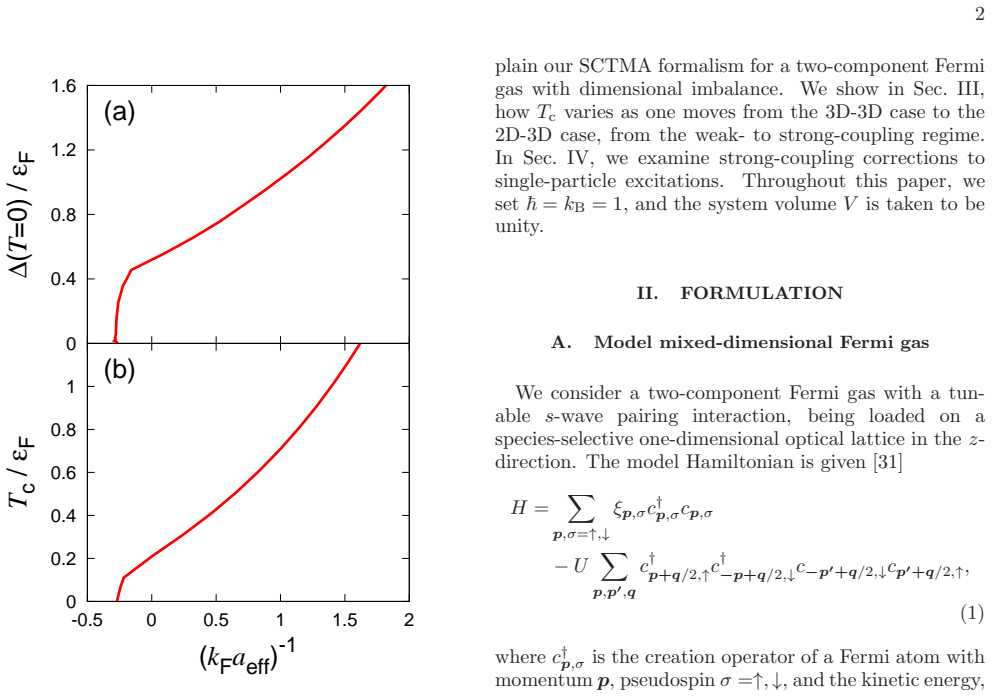
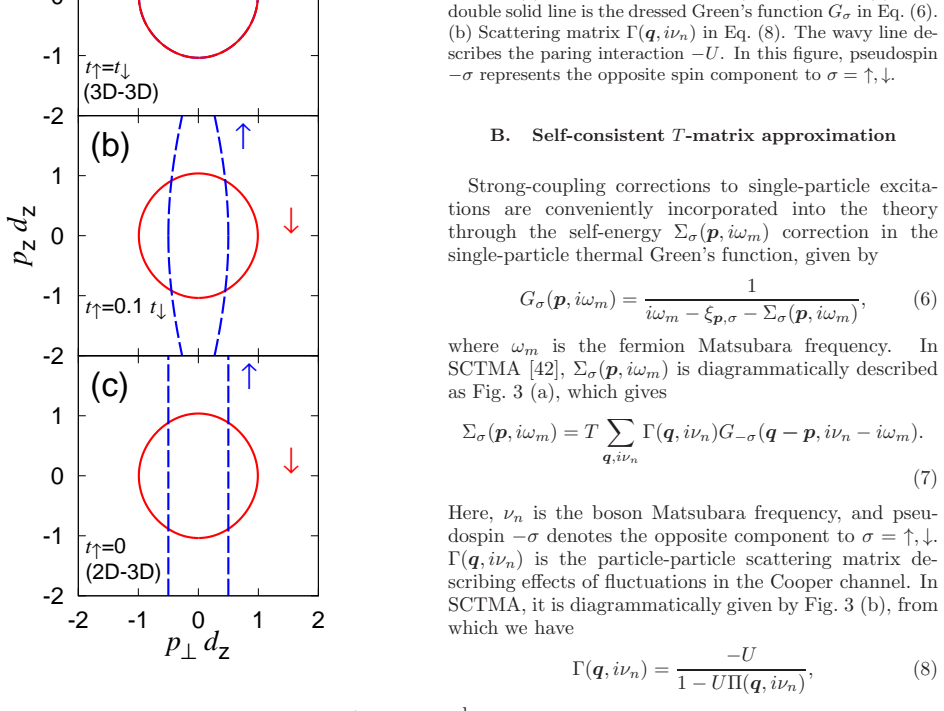
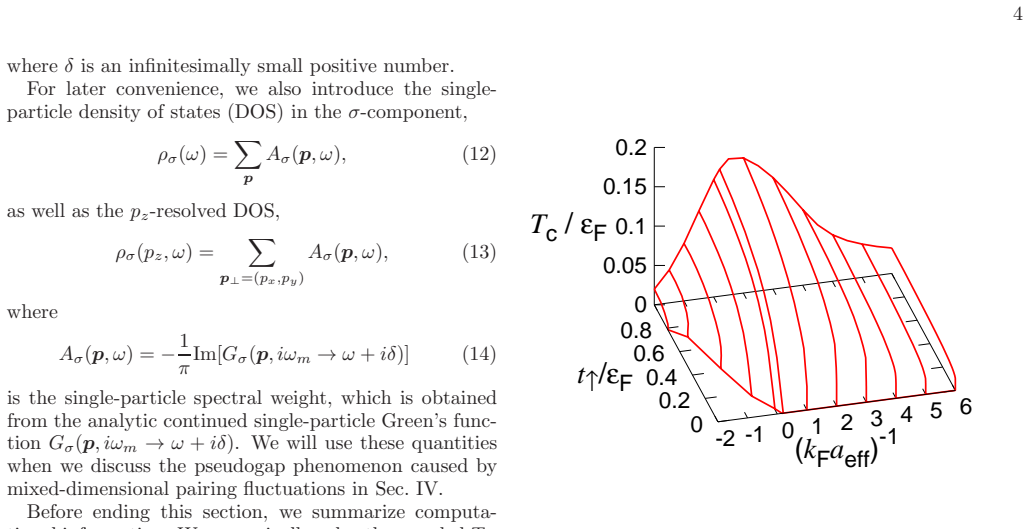
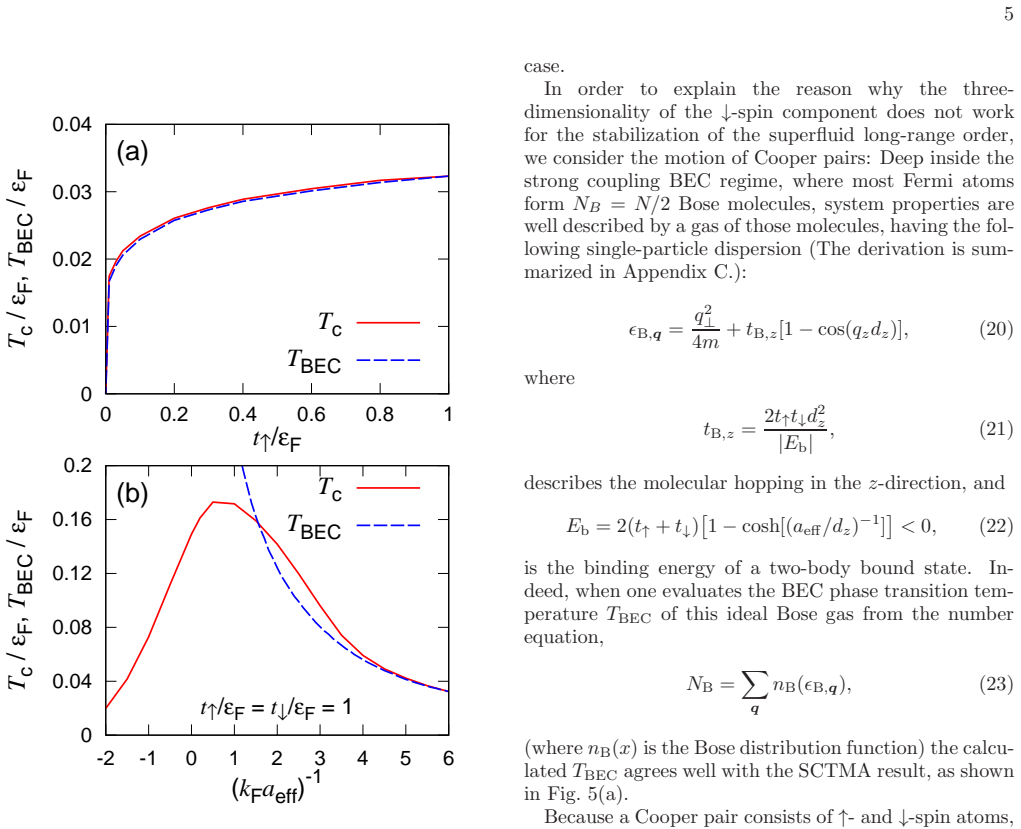
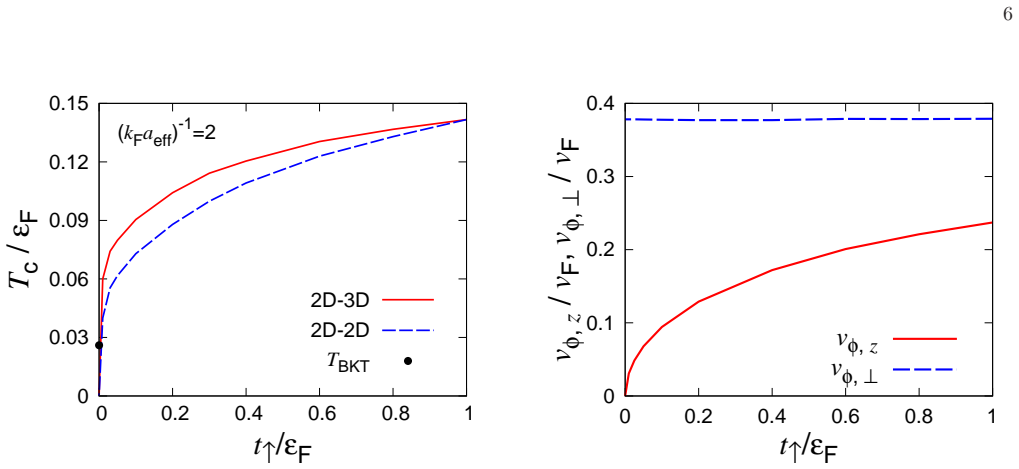
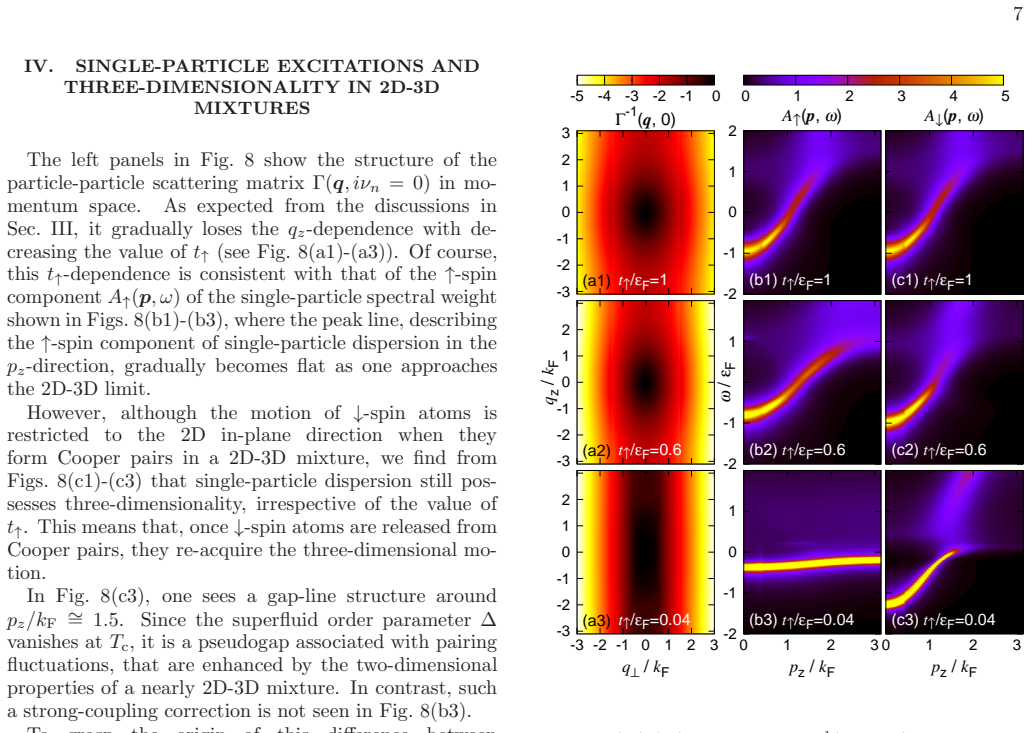
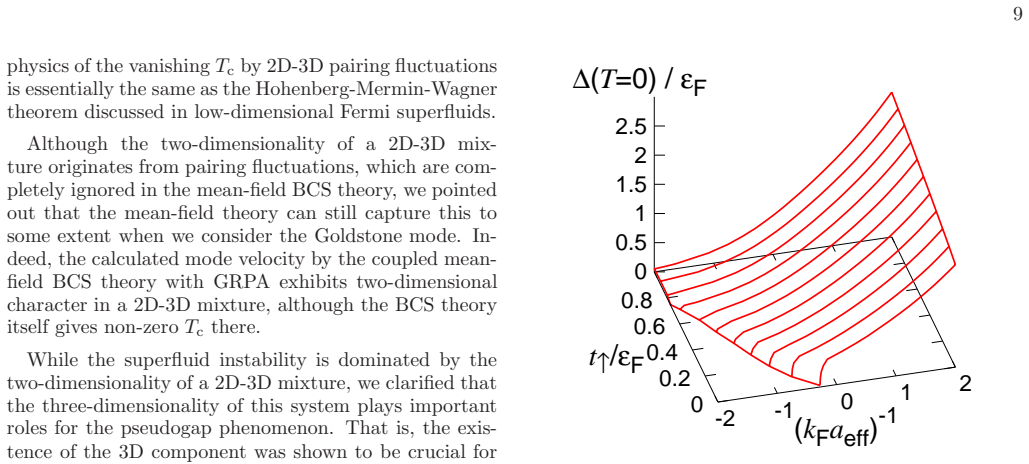
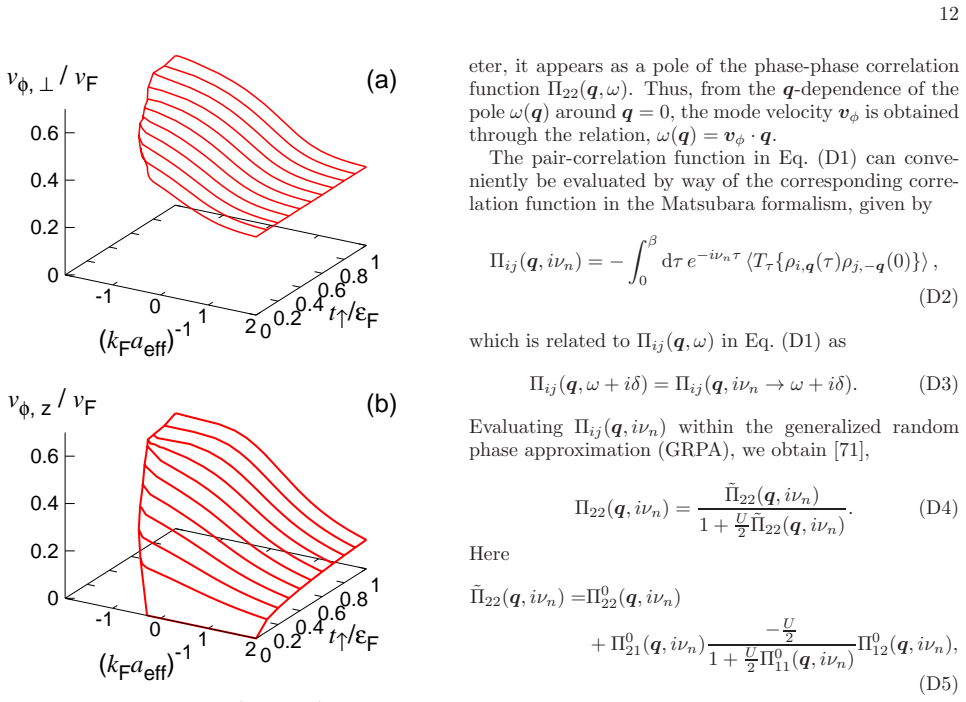
In the 2D-3D limit, while the mean-field BCS theory predicts Tc > 0 in the strong-coupling regime, Tc is remarkably suppressed down to zero by pairing fluctuations that are strongly enhanced by the mixed-dimensionality of the system. The lower-dimensional (2D) component dominates the superfluid instability, so that the vanishing Tc is the same phenomenon as that in the 2D-2D case. The pseudogap phenomenon exhibits a 3D character of the 2D-3D system.
What carries the argument
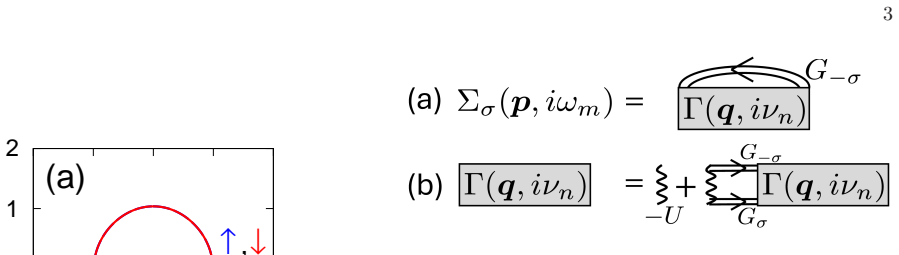
Self-consistent T-matrix approximation (SCTMA) that includes pairing fluctuations to determine the superfluid instability and pseudogap in mixed 2D-3D bands.
If this is right
- The 2D component's dominance makes the vanishing Tc identical to the pure 2D-2D case.
- The same suppression can already be seen at the mean-field level through the propagation of the Goldstone mode.
- The pseudogap shows 3D character even as Tc vanishes, so different observables can report different dimensionalities.
- Dimensionality of a strongly interacting Fermi gas is not a single property but depends on the measured quantity.
Where Pith is reading between the lines
- Hybrid-dimensional systems may allow selective tuning where superfluid order is suppressed but precursor pairing signatures persist.
- Similar mixed-dimensionality effects could appear in other observables such as specific heat or collective modes.
- Experiments varying the population or confinement of the 2D versus 3D components could map the crossover where Tc reaches zero.
Load-bearing premise
The self-consistent T-matrix approximation remains quantitatively reliable when the system has mixed 2D-3D character and the 2D component dominates the instability.
What would settle it
A direct measurement of a finite superfluid transition temperature in the strong-coupling regime of a 2D-3D Fermi mixture would contradict the predicted suppression to zero.
Figures
read the original abstract
We theoretically investigate strong-coupling properties of an attractively interacting Fermi atomic gas, where the Cooper-pair formation occurs between atoms belonging to different dimensional bands. Including pairing fluctuations within the framework of the self-consistent $T$-matrix approximation (SCTMA), we examine how the BCS-type superfluid phase transition temperature $T_\mathrm{c}$ varies as one moves from the 3D-3D to the 2D-3D system, in the wide parameter region with respect to the strength of the pairing interaction. In the 2D-3D limit, we find that, while the mean-field BCS theory predicts $T_\mathrm{c}>0$ in the strong-coupling regime, $T_\mathrm{c}$ is remarkably suppressed down to zero by pairing fluctuations that are strongly enhanced by the mixed-dimensionality of the system. As the origin of this, we clarify that the lower-dimensional (2D) component dominates the superfluid instability, so that the vanishing $T_\mathrm{c}$ is the same phenomenon as that in the 2D-2D case. We also point out that this can already be seen in the mean-field level, when one examines the propagation of the Goldstone mode. On the other hand, we find that the pseudogap phenomenon, which is known as a precursor of Cooper-pair formation, exhibits a 3D character of the 2D-3D system. These results indicate that the dimensionality of a strongly interacting Fermi gas depends on what we observe.
Editorial analysis
A structured set of objections, weighed in public.
Referee Report
Summary. The paper investigates strong-coupling properties of an attractively interacting Fermi gas with Cooper-pair formation between atoms in different dimensional bands. Using the self-consistent T-matrix approximation (SCTMA) to include pairing fluctuations, it examines the BCS superfluid transition temperature Tc as the system varies from 3D-3D to 2D-3D. In the 2D-3D limit, mean-field theory predicts Tc > 0 in the strong-coupling regime, but SCTMA shows Tc suppressed to zero due to enhanced pairing fluctuations dominated by the 2D component; this is argued to be visible already in the mean-field Goldstone-mode propagation. The pseudogap is found to retain 3D character, indicating that dimensionality depends on the observable considered.
Significance. If the SCTMA results hold, the work shows that mixed-dimensional Fermi gases can exhibit different effective dimensionalities for superfluid instability versus pseudogap phenomena, clarifying how 2D fluctuations can dominate Tc while 3D features persist in other quantities. This provides a concrete example of observable-dependent dimensionality in strongly interacting systems.
major comments (2)
- [§4] §4 (results on Tc in 2D-3D limit): The central claim that Tc is suppressed to zero rests on SCTMA remaining quantitatively reliable when the 2D component dominates the instability. No benchmarking against QMC, FRG, or exact 2D-2D limits is reported for the mixed-dimensional geometry, and SCTMA is known to overestimate Tc in pure 2D while missing BKT physics; this directly affects the quantitative conclusion of Tc=0 and the separation from the 3D pseudogap.
- [§3.1] §3.1 (mean-field Goldstone mode analysis): The statement that the vanishing Tc 'can already be seen in the mean-field level' via Goldstone-mode propagation is load-bearing for the claim that 2D dominance is intrinsic rather than an SCTMA artifact, but the dispersion relation is not compared to the pure 2D-2D case or tested for consistency with the mixed-dimensional density of states.
minor comments (1)
- [§2] Notation for the mixed-dimensional interaction strength and the definition of the 2D-3D limit should be clarified in the formalism section to avoid ambiguity when comparing to pure 2D-2D results.
Simulated Author's Rebuttal
We thank the referee for the careful reading and constructive comments. We address the major points below.
read point-by-point responses
-
Referee: [§4] §4 (results on Tc in 2D-3D limit): The central claim that Tc is suppressed to zero rests on SCTMA remaining quantitatively reliable when the 2D component dominates the instability. No benchmarking against QMC, FRG, or exact 2D-2D limits is reported for the mixed-dimensional geometry, and SCTMA is known to overestimate Tc in pure 2D while missing BKT physics; this directly affects the quantitative conclusion of Tc=0 and the separation from the 3D pseudogap.
Authors: We agree that SCTMA is an approximation with known limitations in purely 2D systems, where it overestimates Tc and does not capture BKT physics. Our claim is that the 2D component dominates the instability in the mixed-dimensional case, leading to Tc suppression to zero, consistent with the 2D-2D phenomenology. While direct QMC/FRG benchmarks for the mixed geometry are not included (and would require substantial additional effort), the qualitative result follows from the enhanced 2D fluctuations and is corroborated by the mean-field Goldstone-mode analysis. In revision we will expand the discussion of SCTMA limitations and its applicability here. revision: partial
-
Referee: [§3.1] §3.1 (mean-field Goldstone mode analysis): The statement that the vanishing Tc 'can already be seen in the mean-field level' via Goldstone-mode propagation is load-bearing for the claim that 2D dominance is intrinsic rather than an SCTMA artifact, but the dispersion relation is not compared to the pure 2D-2D case or tested for consistency with the mixed-dimensional density of states.
Authors: We will add a direct comparison of the Goldstone-mode dispersion between the 2D-3D and pure 2D-2D cases in the revised manuscript. The mixed-dimensional density of states produces a low-energy dispersion that exhibits 2D character, which can be derived from the mean-field gap equation; this supports that the Tc suppression is intrinsic to the dimensionality rather than an SCTMA-specific effect. revision: yes
Circularity Check
No circularity; SCTMA calculation of Tc suppression is independent of inputs
full rationale
The paper applies the standard self-consistent T-matrix approximation (SCTMA) to compute Tc and pseudogap properties in the mixed 2D-3D geometry. The reported suppression of Tc to zero in the 2D-3D limit follows directly from solving the fluctuation equations for that geometry; it is not obtained by fitting a parameter to a subset of data and renaming the output as a prediction, nor does any load-bearing step reduce to a self-citation whose content is itself unverified. The mean-field Goldstone-mode observation is likewise an independent diagnostic within the same framework. No self-definitional, ansatz-smuggling, or renaming patterns appear. The derivation remains self-contained against external benchmarks such as the known pure-2D and pure-3D limits of SCTMA.
Axiom & Free-Parameter Ledger
axioms (1)
- domain assumption The self-consistent T-matrix approximation accurately incorporates pairing fluctuations in systems with mixed 2D-3D dimensionality.
Reference graph
Works this paper leans on
-
[1]
↑” and “ ↓
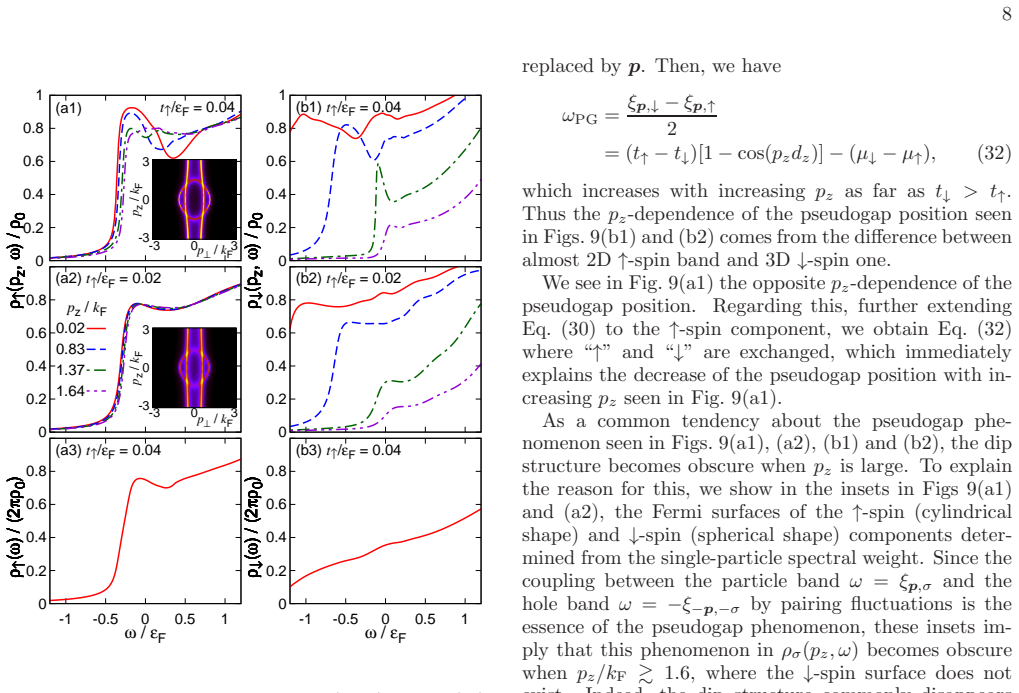
+ A↓ (p, ω = 0), where the peaks correspond to the Fermi surfaces. DOS is normalized by ρ0 = mkF/π . Eq. (31) that single-particle excitations gradually lose the pz-dependence. Indeed, while the pz-dependent pseudo- gap (dip around 0 <∼ ω/ǫ F<∼ 0. 5) is seen in the pz-resolved DOSρ↑ (pz,ω ) when t↑/ǫ = 0. 04 (panel (a1)), it becomes almost pz-independent ...
-
[2]
3D-like” ef- fective scattering length [31] in Eq. (4). If we remove this divergence by using the “2D-like
at T = 0, as a function of the interaction strength (kFaeff )− 1 and the dimensional imbalance tuned by t↑ . (Note that t↓ /ǫ F = 1.) can be written as H = |∆ |2 U + ∑ p ˆΨ † p(ξ+, pτ3 +ξ− , pτ0 − ∆ τ1) ˆΨ p + ∑ p ξ− p, ↓ − U 4 ∑ q,i =1, 2 ρi, qρi, − q, (A1) where ˆΨ † p ≡ (c† p, ↑,c − p, ↓) is the Nambu field and the Pauli matrices τi=1, 2, 3 act on the pa...
-
[3]
Bloch, J
I. Bloch, J. Dalibard, and W. Zwerger, Rev. Mod. Phys. 80, 885 (2008)
2008
-
[4]
Bloch, J
I. Bloch, J. Dalibard, and S. Nascimb` ene, Nat. Phys. 8, 267 (2012)
2012
-
[5]
Giorgini, L
S. Giorgini, L. P. Pitaevskii, and S. Stringari, Rev. Mod . Phys. 80, 1215 (2008)
2008
-
[6]
Randeria and E
M. Randeria and E. Taylor, Annu. Rev. Condens. Matter Phys. 5, 209 (2014)
2014
-
[7]
Ohashi, H
Y. Ohashi, H. Tajima, and P. van Wyk, Prog. Part. Nucl. Phys. 111, 103739 (2020)
2020
-
[8]
Sch¨ afer, T
F. Sch¨ afer, T. Fukuhara, S. Sugawa, Y. Takasu, and Y. Takahashi, Nat. Rev. Phys. 2, 411 (2020)
2020
-
[9]
C. A. Regal, M. Greiner, and D. S. Jin, Phys. Rev. Lett. 92, 040403 (2004)
2004
-
[10]
M. W. Zwierlein, C. A. Stan, C. H. Schunck, S. M. F. Raupach, A. J. Kerman, and W. Ketterle, Phys. Rev. Lett. 92, 120403 (2004)
2004
-
[11]
Bartenstein, A
M. Bartenstein, A. Altmeyer, S. Riedl, S. Jochim, C. Chin, J. H. Denschlag, and R. Grimm, Phys. Rev. Lett. 92, 120401 (2004)
2004
-
[12]
Bourdel, L
T. Bourdel, L. Khaykovich, J. Cubizolles, J. Zhang, F. Chevy, M. Teichmann, L. Tarruell, S. J. J. M. F. Kokkelmans, and C. Salomon, Phys. Rev. Lett. 93, 050401 (2004)
2004
-
[13]
M. W. Zwierlein, J. R. Abo-Shaeer, A. Schirotzek, C. H. Schunck, and W. Ketterle, Nature 435, 1047 (2005)
2005
-
[14]
D. S. Petrov, C. Salomon, and G. V. Shlyapnikov, Phys. Rev. A 71, 012708 (2005)
2005
-
[15]
Chevy, Phys
F. Chevy, Phys. Rev. A 74, 063628 (2006)
2006
-
[16]
Schirotzek, C.-H
A. Schirotzek, C.-H. Wu, A. Sommer, and M. W. Zwier- lein, Phys. Rev. Lett. 102, 230402 (2009)
2009
-
[17]
Cetina, M
M. Cetina, M. Jag, R. S. Lous, I. Fritsche, J. T. M. Wal- raven, R. Grimm, J. Levinsen, M. M. Parish, R. Schmidt, M. Knap, and E. Demler, Science 354, 96 (2016)
2016
-
[18]
Tempere, S
J. Tempere, S. N. Klimin, and J. T. Devreese, Phys. Rev. B 79, 134506 (2009)
2009
-
[19]
S. N. Klimin, J. Tempere, and J. T. Devreese, New J. Phys. 14, 103044 (2012)
2012
-
[20]
Greiner, I
M. Greiner, I. Bloch, O. Mandel, T. W. H¨ ansch, and T. Esslinger, Phys. Rev. Lett. 87, 160405 (2001)
2001
-
[21]
Moritz, T
H. Moritz, T. St¨ oferle, M. K¨ ohl, and T. Esslinger, Phy s. Rev. Lett. 91, 250402 (2003)
2003
-
[22]
B. L. Tolra, K. M. O’Hara, J. H. Huckans, W. D. Phillips, S. L. Rolston, and J. V. Porto, Phys. Rev. Lett. 92, 190401 (2004)
2004
-
[23]
Kinoshita, T
T. Kinoshita, T. Wenger, and D. S. Weiss, Science 305, 1125 (2004)
2004
-
[24]
Paredes, A
B. Paredes, A. Widera, M. Murg, O. Mandel, S. F¨ olling, I. Cirac, G. V. Shlyapnikov, T. W. H¨ ansch, and I. Bloch, Nature 429, 277 (2004)
2004
-
[25]
Catani, G
J. Catani, G. Barontini, G. Lamporesi, F. Rabatti, G. Thalhammer, F. Minardi, S. Stringari, and M. In- guscio, Phys. Rev. Lett. 103, 140401 (2009)
2009
-
[26]
M. G. Ries, A. N. Wenz, G. Z¨ urn, L. Bayha, I. Boettcher, D. Kedar, P. A. Murthy, M. Neidig, T. Lompe, and S. Jochim, Phys. Rev. Lett. 114, 230401 (2015)
2015
-
[27]
Masaki, S
A. Masaki, S. Tsukada, and H. Mori, J. Phys. Soc. Jpn. 77, 054301 (2008)
2008
-
[28]
Massignan and Y
P. Massignan and Y. Castin, Phys. Rev. A 74, 013616 (2006)
2006
-
[29]
L. J. LeBlanc and J. H. Thywissen, Phys. Rev. A 75, 053612 (2007)
2007
-
[30]
Lamporesi, J
G. Lamporesi, J. Catani, G. Barontini, Y. Nishida, M. In - guscio, and F. Minardi, Phys. Rev. Lett. 104, 153202 (2010)
2010
-
[31]
Sch¨ afer, N
F. Sch¨ afer, N. Mizukami, P. Yu, S. Koibuchi, A. Bouscal, and Y. Takahashi, Phys. Rev. A 98, 051602 (2018)
2018
-
[32]
Nishida and S
Y. Nishida and S. Tan, Phys. Rev. Lett. 101, 170401 (2008)
2008
-
[33]
Iskin and A
M. Iskin and A. L. Suba¸ sı, Phys. Rev. A 82, 063628 14 (2010)
2010
-
[34]
X. Yang, B. Huang, and S. Wan, Eur. Phys. J. B 83, 445 (2011)
2011
-
[35]
Okamoto, L
J. Okamoto, L. Mathey, and W.-M. Huang, Phys. Rev. A 95, 053633 (2017)
2017
-
[36]
N. D. Mermin and H. Wagner, Phys. Rev. Lett. 17, 1133 (1966)
1966
-
[37]
P. C. Hohenberg, Phys. Rev. 158, 383 (1967)
1967
-
[38]
Haussmann, Phys
R. Haussmann, Phys. Rev. B 49, 12975 (1994)
1994
-
[39]
Haussmann, Self-consistent Quantum-Field Theory and Bosonization for Strongly Correlated Electron Sys- tems, Lecture Notes in Physics Monographs (Springer, Berlin, 2003)
R. Haussmann, Self-consistent Quantum-Field Theory and Bosonization for Strongly Correlated Electron Sys- tems, Lecture Notes in Physics Monographs (Springer, Berlin, 2003)
2003
-
[40]
Haussmann, W
R. Haussmann, W. Rantner, S. Cerrito, and W. Zwerger, Phys. Rev. A 75, 023610 (2007)
2007
-
[41]
K. B. Gubbels and H. T. C. Stoof, Phys. Rev. Lett. 100, 140407 (2008)
2008
-
[42]
J. E. Baarsma, K. B. Gubbels, and H. T. C. Stoof, Phys. Rev. A 82, 013624 (2010)
2010
-
[43]
T. Enss, R. Haussmann, and W. Zwerger, Ann. Phys. 326, 770 (2011)
2011
-
[44]
Hanai and Y
R. Hanai and Y. Ohashi, Phys. Rev. A 90, 043622 (2014)
2014
-
[45]
Kagamihara, D
D. Kagamihara, D. Inotani, and Y. Ohashi, J. Phys. Soc. Jpn. 88, 114001 (2019)
2019
-
[46]
Nozi` eres and S
P. Nozi` eres and S. Schmitt-Rink, J. Low Temp. Phys. 59, 195 (1985)
1985
-
[47]
Ohashi and A
Y. Ohashi and A. Griffin, Phys. Rev. A 67, 063612 (2003)
2003
-
[48]
C. A. R. S´ a de Melo, M. Randeria, and J. R. Engelbrecht, Phys. Rev. Lett. 71, 3202 (1993)
1993
-
[49]
Liu and H
X.-J. Liu and H. Hu, Europhys. Lett. 75, 364 (2006)
2006
-
[50]
Iwasaki, T
S. Iwasaki, T. Kawamura, K. Manabe, and Y. Ohashi, Phys. Rev. A 109, 063309 (2024)
2024
-
[51]
Pieri, L
P. Pieri, L. Pisani, and G. C. Strinati, Phys. Rev. B 70, 094508 (2004)
2004
-
[53]
Chen and K
Q. Chen and K. Levin, Phys. Rev. Lett. 102, 190402 (2009)
2009
-
[54]
Hu, X.-J
H. Hu, X.-J. Liu, P. D. Drummond, and H. Dong, Phys. Rev. Lett. 104, 240407 (2010)
2010
-
[55]
Tsuchiya, R
S. Tsuchiya, R. Watanabe, and Y. Ohashi, Phys. Rev. A 84, 043647 (2011)
2011
-
[56]
Palestini, A
F. Palestini, A. Perali, P. Pieri, and G. C. Strinati, Ph ys. Rev. B 85, 024517 (2012)
2012
-
[57]
E. J. Mueller, Phys. Rev. A 83, 053623 (2011)
2011
-
[58]
Watanabe, S
R. Watanabe, S. Tsuchiya, and Y. Ohashi, Phys. Rev. A 88, 013637 (2013)
2013
-
[59]
Palestini, P
F. Palestini, P. Pieri, and G. C. Strinati, Phys. Rev. Le tt. 108, 080401 (2012)
2012
-
[60]
R. L. Compton, Y.-J. Lin, K. Jim´ enez-Garc ´ ıa, J. V. Porto, and I. B. Spielman, Phys. Rev. A 86, 063601 (2012)
2012
-
[61]
Hanai, T
R. Hanai, T. Kashimura, R. Watanabe, D. Inotani, and Y. Ohashi, Phys. Rev. A 88, 053621 (2013)
2013
-
[62]
Tajima, T
H. Tajima, T. Kashimura, R. Hanai, R. Watanabe, and Y. Ohashi, Phys. Rev. A 89, 033617 (2014)
2014
-
[63]
M. Pini, P. Pieri, and G. C. Strinati, Phys. Rev. B 99, 094502 (2019)
2019
-
[64]
Kashimura, R
T. Kashimura, R. Watanabe, and Y. Ohashi, Phys. Rev. A 86, 043622 (2012)
2012
-
[65]
Kashimura, R
T. Kashimura, R. Watanabe, and Y. Ohashi, Phys. Rev. A 89, 013618 (2014)
2014
-
[66]
Watanabe, S
R. Watanabe, S. Tsuchiya, and Y. Ohashi, Phys. Rev. A 82, 043630 (2010)
2010
-
[67]
D. J. Thouless, Ann. Phys. 10, 553 (1960)
1960
-
[68]
H. J. Vidberg and J. W. Serene, J. Low Temp. Phys. 29, 179 (1977)
1977
-
[69]
Q. Chen, J. Stajic, S. Tan, and K. Levin, Phys. Rep. 412, 1 (2005)
2005
-
[70]
Perali, P
A. Perali, P. Pieri, G. C. Strinati, and C. Castellani, Phys. Rev. B 66, 024510 (2002)
2002
-
[71]
Tsuchiya, R
S. Tsuchiya, R. Watanabe, and Y. Ohashi, Phys. Rev. A 80, 033613 (2009)
2009
-
[72]
Iskin and C
M. Iskin and C. A. R. S. de Melo, Phys. Rev. Lett. 103, 165301 (2009)
2009
-
[73]
Ohashi and S
Y. Ohashi and S. Takada, J. Phys. Soc. Jpn. 66, 2437 (1997)
1997
-
[74]
P. W. Anderson, Phys. Rev. 115, 2 (1959)
1959
-
[75]
Micnas, J
R. Micnas, J. Ranninger, and S. Robaszkiewicz, Rev. Mod. Phys. 62, 113 (1990)
1990
discussion (0)
Sign in with ORCID, Apple, or X to comment. Anyone can read and Pith papers without signing in.