Spin-Spiral Enhancement of Ultrafast Light-Polarization-Robust Magnetization
Pith reviewed 2026-06-28 22:04 UTC · model grok-4.3
The pith
Spin-spiral antiferromagnets produce strong light-polarization-robust ultrafast magnetization while collinear ones suppress it.
A machine-rendered reading of the paper's core claim, the machinery that carries it, and where it could break.
Core claim
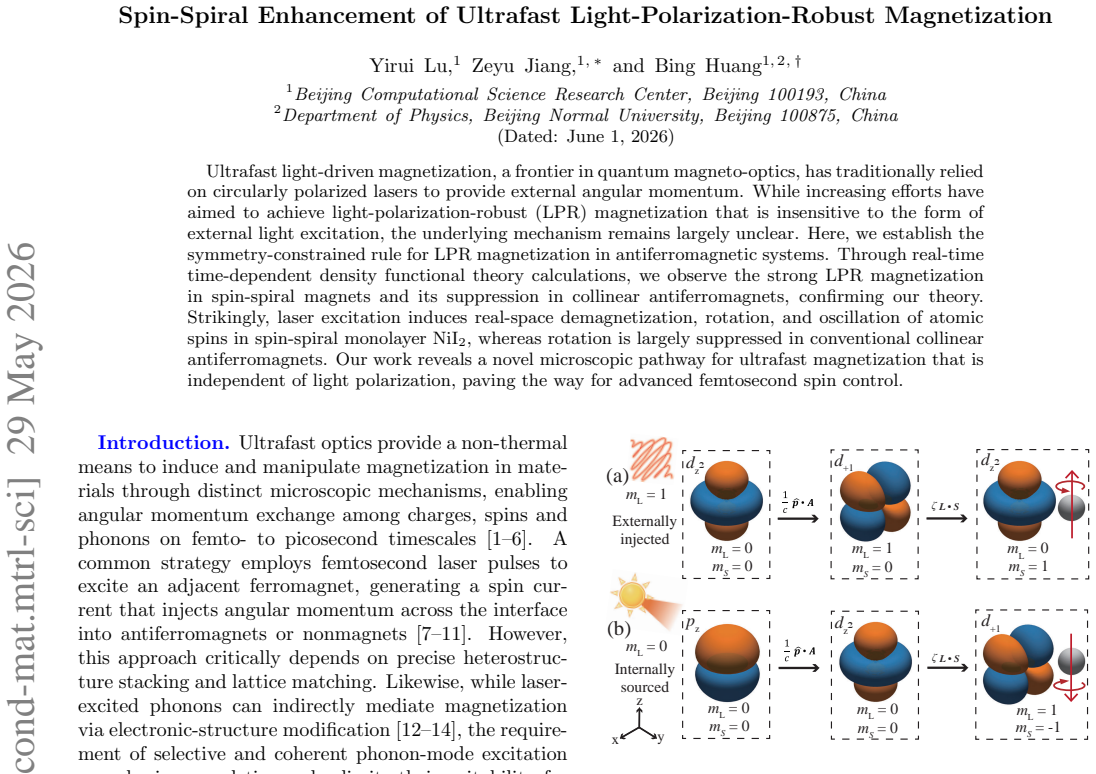
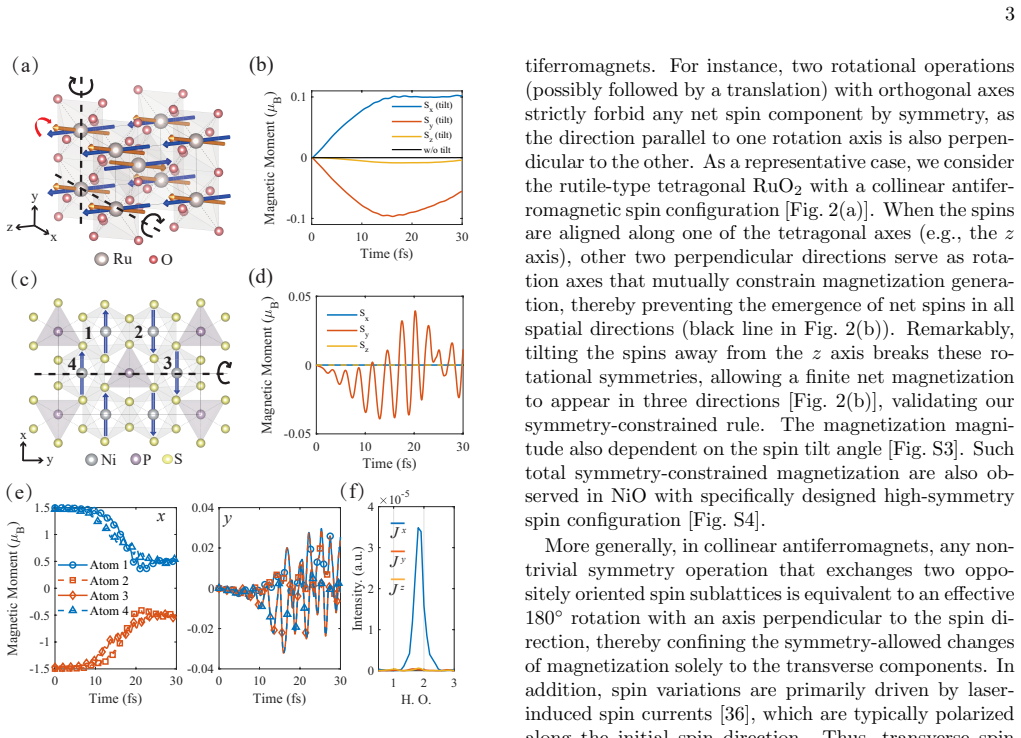
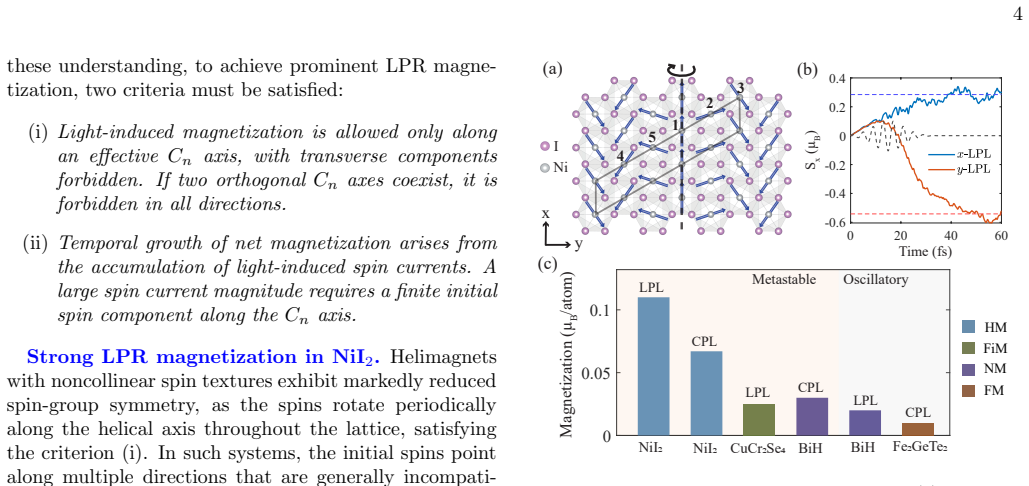
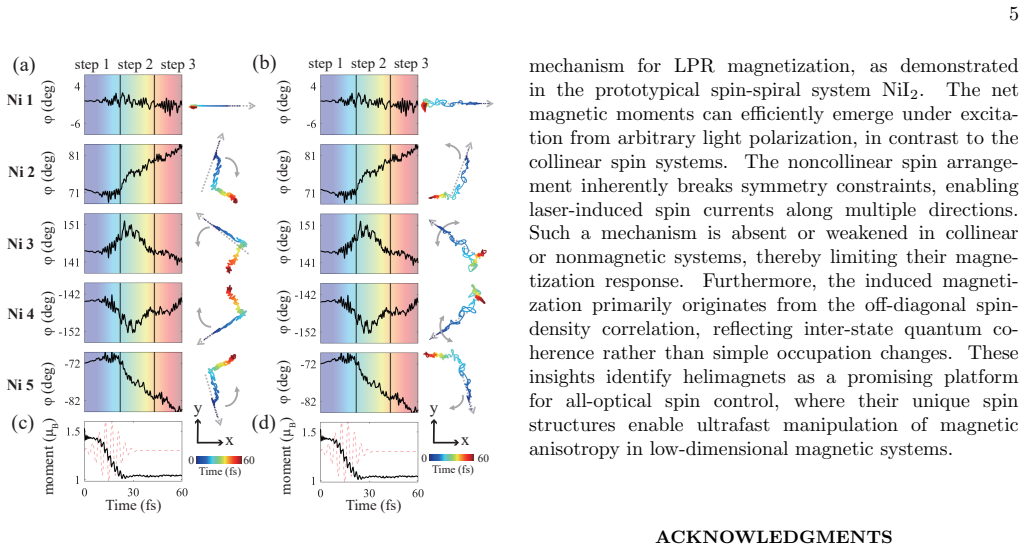
We establish the symmetry-constrained rule for LPR magnetization in antiferromagnetic systems. Through real-time time-dependent density functional theory calculations, we observe the strong LPR magnetization in spin-spiral magnets and its suppression in collinear antiferromagnets, confirming our theory. Strikingly, laser excitation induces real-space demagnetization, rotation, and oscillation of atomic spins in spin-spiral monolayer NiI2, whereas rotation is largely suppressed in conventional collinear antiferromagnets. Our work reveals a novel microscopic pathway for ultrafast magnetization that is independent of light polarization.
What carries the argument
The symmetry-constrained rule for LPR magnetization, which distinguishes spin-spiral from collinear antiferromagnets and enables polarization-independent response.
If this is right
- Strong LPR magnetization occurs in spin-spiral magnets.
- LPR magnetization is suppressed in collinear antiferromagnets.
- Laser excitation in spin-spiral NiI2 induces real-space demagnetization, rotation, and oscillation of atomic spins.
- Rotation of atomic spins is largely suppressed in conventional collinear antiferromagnets.
- A novel microscopic pathway exists for ultrafast magnetization independent of light polarization.
Where Pith is reading between the lines
- The symmetry rule may extend to other non-collinear antiferromagnetic orders beyond the spin-spiral case examined.
- Polarization-independent control could reduce the need for precise laser alignment in proposed spintronic devices.
- Testing the rule in bulk spin-spiral crystals rather than monolayers would check dimensionality effects.
- Varying laser intensity or frequency in the same materials would map the range where the LPR behavior holds.
Load-bearing premise
The symmetry-constrained rule derived from antiferromagnetic properties accurately governs real ultrafast dynamics, and the calculations faithfully reproduce the polarization-independent magnetization.
What would settle it
Direct comparison of measured magnetization amplitude and spin rotation under linear versus circular polarization in spin-spiral NiI2 versus a collinear antiferromagnet would confirm or refute the predicted enhancement and suppression.
Figures
read the original abstract
Ultrafast light-driven magnetization, a frontier in quantum magneto-optics, has traditionally relied on circularly polarized lasers to provide external angular momentum. While increasing efforts have aimed to achieve light-polarization-robust (LPR) magnetization that is insensitive to the form of external light excitation, the underlying mechanism remains largely unclear. Here, we establish the symmetry-constrained rule for LPR magnetization in antiferromagnetic systems. Through real-time time-dependent density functional theory calculations, we observe the strong LPR magnetization in spin-spiral magnets and its suppression in collinear antiferromagnets, confirming our theory. Strikingly, laser excitation induces real-space demagnetization, rotation, and oscillation of atomic spins in spin-spiral monolayer NiI$_2$, whereas rotation is largely suppressed in conventional collinear antiferromagnets. Our work reveals a novel microscopic pathway for ultrafast magnetization that is independent of light polarization, paving the way for advanced femtosecond spin control.
Editorial analysis
A structured set of objections, weighed in public.
Referee Report
Summary. The manuscript claims to establish a symmetry-constrained rule for light-polarization-robust (LPR) magnetization in antiferromagnetic systems. Real-time time-dependent density functional theory (rt-TDDFT) calculations are used to show strong LPR magnetization in spin-spiral magnets such as monolayer NiI₂ (with laser-induced real-space demagnetization, rotation, and oscillation of atomic spins) and its suppression in collinear antiferromagnets, thereby confirming the proposed rule and identifying a polarization-independent pathway for ultrafast magnetization.
Significance. If the symmetry rule holds and the rt-TDDFT results are robust, the work identifies a microscopic mechanism for polarization-independent ultrafast spin control that is specific to spin-spiral antiferromagnets. This distinction from collinear systems could enable new routes in femtosecond magneto-optics and spintronics. The computational evidence contrasting the two classes of antiferromagnets is a concrete strength of the approach.
major comments (2)
- [Abstract] Abstract: the central claim rests on establishing a 'symmetry-constrained rule' for LPR magnetization, yet no explicit derivation, symmetry analysis steps, or resulting mathematical expression is provided; without this, it is not possible to verify whether the rule follows directly from antiferromagnetic symmetry constraints or whether it accurately predicts the reported spin-spiral vs. collinear distinction.
- [Abstract] Abstract/Results: the rt-TDDFT observations of strong LPR in NiI₂ and suppression in collinear AFMs are presented as direct confirmation, but the text supplies no quantitative metrics (e.g., magnetization amplitude ratios, time scales, laser parameters), error estimates, or validation against known limits; this leaves the computational support for the rule load-bearing yet unverifiable from the given information.
minor comments (1)
- [Abstract] Abstract: the acronym LPR is introduced without an immediate parenthetical definition; adding '(light-polarization-robust)' on first use would improve readability.
Simulated Author's Rebuttal
We thank the referee for the constructive comments on our manuscript. We respond point by point to the major comments below. Both concerns can be addressed through targeted revisions that improve clarity without altering the core findings.
read point-by-point responses
-
Referee: [Abstract] Abstract: the central claim rests on establishing a 'symmetry-constrained rule' for LPR magnetization, yet no explicit derivation, symmetry analysis steps, or resulting mathematical expression is provided; without this, it is not possible to verify whether the rule follows directly from antiferromagnetic symmetry constraints or whether it accurately predicts the reported spin-spiral vs. collinear distinction.
Authors: The symmetry-constrained rule is derived in the main text via magnetic point-group analysis of antiferromagnetic systems. This analysis shows that spin-spiral order permits additional magnetization channels independent of light polarization that are symmetry-forbidden in collinear antiferromagnets, yielding a specific mathematical condition on the magnetic susceptibility tensor. We will add a concise statement of the key symmetry steps and the resulting expression to the abstract so that the central claim can be verified directly from the abstract. revision: yes
-
Referee: [Abstract] Abstract/Results: the rt-TDDFT observations of strong LPR in NiI₂ and suppression in collinear AFMs are presented as direct confirmation, but the text supplies no quantitative metrics (e.g., magnetization amplitude ratios, time scales, laser parameters), error estimates, or validation against known limits; this leaves the computational support for the rule load-bearing yet unverifiable from the given information.
Authors: We agree that quantitative details are needed for verifiability. In the revised manuscript we will report the magnetization amplitude ratios for orthogonal polarizations, the time scales of demagnetization/rotation/oscillation, the specific laser parameters (fluence, frequency, pulse duration), numerical error estimates from the rt-TDDFT runs, and comparisons to known limiting cases of the symmetry rule. These additions will be placed in both the abstract and the results section. revision: yes
Circularity Check
No significant circularity
full rationale
The paper states it establishes a symmetry-constrained rule for LPR magnetization from antiferromagnetic properties, then performs independent rt-TDDFT calculations on spin-spiral NiI2 versus collinear AFMs to observe the predicted distinction. No equations or steps reduce the rule to a fit, self-citation, or renaming of simulation outputs; the symmetry derivation is presented as prior to and confirmed by the numerics, with the central claim retaining independent content from the computational distinction.
Axiom & Free-Parameter Ledger
axioms (2)
- domain assumption Symmetry constraints in antiferromagnetic systems determine the existence of light-polarization-robust magnetization
- domain assumption Real-time TDDFT accurately models ultrafast laser-induced spin dynamics including demagnetization and rotation
Reference graph
Works this paper leans on
-
[1]
Siegrist, J.A
F. Siegrist, J.A. Gessner, M. Ossianderet al., Light-wave dynamic control of magnetism, Nature571, 240 (2019)
2019
-
[2]
Chen and L
Z. Chen and L. W. Wang, Role of initial magnetic dis- order: A time-dependentab initiostudy of ultrafast de- magnetization mechanisms, Sci. Adv.5, eaau8000 (2019)
2019
-
[3]
J. Chen, Y. Li, H. Yuet al., Light-induced magnetic phase transition in van der Waals antiferromagnets, Sci. China Phys. Mech. Astron.66, 277511 (2023)
2023
-
[4]
Kirilyuk, A
A. Kirilyuk, A. V. Kimel, and T. Rasing, Ultrafast opti- cal manipulation of magnetic order, Rev. Mod. Phys.82, 2731 (2010)
2010
-
[5]
M. S. Okyay, A. H. Kulahlioglu, D. Kochan, and N. Park, Resonant amplification of the inverse Faraday effect mag- netization dynamics of time reversal symmetric insula- tors, Phys. Rev. B102, 104304 (2020)
2020
-
[6]
J. Y. Bigot, M. Vomir, and E. Beaurepaire, Coherent ultrafast magnetism induced by femtosecond laser pulses, Nat. Phys.5, 515 (2009)
2009
-
[7]
Geneaux, H
R. Geneaux, H. Chang, A. Guggenmos, Spin Dy- namics across Metallic Layers on the Few-Femtosecond Timescale, Phys. Rev. Lett.133, 106902 (2024)
2024
-
[8]
J. He, S. Li, T. Frauenheim, and Z. Zhou, Ultrafast Laser Pulse Induced Transient Ferrimagnetic State and Spin Relaxation Dynamics in Two-Dimensional Antiferromag- nets, Nano Lett.23, 8348 (2023)
2023
-
[9]
Z. Chen, J. W. Luo, and L. W. Wang, Light-induced ultrafast spin transport in multilayer metallic films orig- 6 inates fromsp-dspin exchange coupling, Sci. Adv.9, eadi1618 (2023)
2023
-
[10]
K. Kang, H. Omura, D. Yesudaset al., Spin current driven by ultrafast magnetization of FeRh, Nat. Com- mun.14, 3619 (2023)
2023
-
[11]
Melnikov, I
A. Melnikov, I. Razdolski, O.T. Wehlinget al., Ultrafast Transport of Laser-Excited Spin-Polarized Carriers in Au/Fe/MgO(001), Phys. Rev. Lett.107, 076601 (2011)
2011
-
[12]
N. Wu, S. Zhang, D. Chen, Y. Wang, and S. Meng, Three-stage ultrafast demagnetization dynamics in a monolayer ferromagnet, Nat. Commun.15, 2804 (2024)
2024
-
[13]
H. Liu, M. T. Trinh, E. M. Clementset al., Elastically induced magnetization at ultrafast time scales in a chiral helimagnet, Phys. Rev. B106, 035103 (2022)
2022
-
[14]
Lu and Y
Y. Lu and Y. Li and B. Huang, Recent progress on photoinduced phase transitions in materials from first- principles calculations, Computational Materials Today 2-3, 100012 (2024)
2024
-
[15]
Berritta, R
M. Berritta, R. Mondal, K. Carva, and P. M. Oppeneer, Ab InitioTheory of Coherent Laser-Induced Magnetiza- tion in Metals, Phys. Rev. Lett.117, 137203 (2016)
2016
-
[16]
J. P. van der Ziel, P. S. Pershan, L. D. Malmstrom, Optically-Induced Magnetization Resulting from the In- verse Faraday Effect, Phys. Rev. Lett.15, 190 (1965)
1965
-
[17]
A. V. Kimel, A. Kirilyuk, P. Usachevet al., Ultrafast non-thermal control of magnetization by instantaneous photomagnetic pulses, Nature435, 655 (2005)
2005
-
[18]
Amano, Y
T. Amano, Y. Kawakami, H. Itohet al., Light-induced magnetization driven by interorbital charge motion in the spin-orbit assisted Mott insulatorα-RuCl 3, Phys. Rev. Lett.14, L032032 (2022)
2022
-
[19]
Finazzi, M
M. Finazzi, M. Savoini, A. R. Khorsandet al., Laser- Induced Magnetic Nanostructures with Tunable Topo- logical Properties, Phys. Rev. Lett.110, 177205 (2013)
2013
-
[20]
A. V. Kimel, A. Kirilyuk, F. Hansteen, R. V. Pisarev, and T. Rasing, Nonthermal optical control of magnetism and ultrafast laser-induced spin dynamics in solids, J. Phys.: Condens. Matter19, 043201 (2007)
2007
-
[21]
S. Li, R. Wang, T. Frauenheim, and J. He, Optical- Helicity-Dependent Orbital and Spin Dynamics in Two- Dimensional Ferromagnets, J. Phys. Chem. Lett.15, 5939 (2024)
2024
-
[22]
Neufeld, N
O. Neufeld, N. Tancogne-Dejean, U. De Giovannini, H. H¨ ubener, and A. Rubio, Attosecond magnetization dy- namics in non-magnetic materials driven by intense fem- tosecond lasers, npj Comput. Mater.9, 39 (2023)
2023
-
[23]
Wadleyet al., Electrical switching of an antiferromag- net, Science351, 587 (2016)
P. Wadleyet al., Electrical switching of an antiferromag- net, Science351, 587 (2016)
2016
-
[24]
Jungwirth, X
T. Jungwirth, X. Marti, P. Wadley, and J. Wunder- lich, Antiferromagnetic spintronics, Nat. Nanotechnol. 11, 231 (2016)
2016
-
[25]
Gupta, M
D. Gupta, M. Pankratova, M.Rieppet al., Tuning ultra- fast demagnetization with ultrashort spin polarized cur- rents in multi-sublattice ferrimagnets, Nat. Commun.16, 3097 (2025)
2025
-
[26]
X. Sui, J. Wang, C. Yam, and B. Huang, Two- Dimensional Magnetic Anionic Electrons in Electrides: Generation and Manipulation, Nano Lett.21, 3813 (2021)
2021
-
[27]
J. Zhou, C. Zhang, Contrasting Light-Induced Spin Torque in Antiferromagnetic and Altermagnetic Systems, Phys. Rev. Lett.134, 176902 (2025)
2025
-
[28]
Y. Liu, S. Guo, Y. Li, C. Liu, Two-Dimensional Fully Compensated Ferrimagnetism, Phys. Rev. Lett.134, 116703 (2025)
2025
-
[29]
Afanasievet al., Controlling the anisotropy of a van der Waals antiferromagnet with light, Sci
D. Afanasievet al., Controlling the anisotropy of a van der Waals antiferromagnet with light, Sci. Adv.7, eabf3096 (2021)
2021
-
[30]
L. Q. Shen, L. F. Zhou, J. Y. Shi, M. Tang, Z. Zheng, D. Wu, S. M. Zhou, L. Y. Chen, and H. B. Zhao, Dominant role of inverse Cotton-Mouton effect in ultrafast stimu- lation of magnetization precession in undoped yttrium iron garnet films by 400-nm laser pulses, Phys. Rev. B 97, 224430 (2018)
2018
-
[31]
M. Sato, S. Takayoshi, T. Oka, Laser-Driven Multifer- roics and Ultrafast Spin Current Generation, Phys. Rev. Lett.117, 147202 (2016)
2016
-
[32]
J. Zhao, Y. Feng, K. Dou, X. Li, Y. Dai, B. Huang, and Y. Ma, Light-Induced Spin Slanting in 2D Multiferroic Magnet, ACS Nano19, 24005 (2025)
2025
-
[33]
G¨ urtler, F
A. G¨ urtler, F. Robicheaux, W. J. van der Zande and L. D. Noordam, Asymmetry in the Strong-Field Ionization of Rydberg Atoms by Few-Cycle Pulses, Phys. Rev. Lett. 92, 033002 (2004)
2004
-
[34]
Friedrich, P
F. Friedrich, P. Herrmann, S.S. Shanbhag, et al. Measure- ment of optically induced broken time-reversal symmetry in atomically thin crystals. Nat. Photon. (2025)
2025
-
[35]
Ofer Neufeld, Linearly Polarized Few-Cycle Pulses Drive Carrier-Envelope Phase-Sensitive Coherent Magnetiza- tion Injection, Phys. Rev. Lett.135, 206902 (2025)
2025
-
[36]
Krieger, P
K. Krieger, P. Elliott, T. M¨ ulleret al., Ultrafast de- magnetization in bulk versus thin films: anab initio study, Journal of Physics: Condensed Matter,29, 224001 (2017)
2017
-
[37]
Elliott, N
P. Elliott, N. Singh, K. Krieger, E.K.U. Gross, S. Sharma, and J.K. Dewhurst, The microscopic origin of spin-orbit mediated spin-flips, Journal of Magnetism and Magnetic Materials,502, 166473 (2020)
2020
-
[38]
J. K. Dewhurst, P. Elliott, S. Shallcross, E. K. U. Gross, and S. Sharma, Laser-induced intersite spin transfer, Nano Lett.18, 1842 (2018)
2018
-
[39]
Electrical switch- ing of ap-wave magnet, Nature642, 64–70 (2025)
Song, Q., Stavri´ c, S., Barone, P.et al.. Electrical switch- ing of ap-wave magnet, Nature642, 64–70 (2025)
2025
-
[40]
M. Miao, N. Liu, W. Zhang, J. Zhou, D. Wang, C. Wang, W. Ji, and Y. Fu, Spin-resolved imaging of atomic-scale helimagnetism in mono- and bilayerN iI 2, Proc. Natl. Acad. Sci. U.S.A.122, e2422868122 (2025)
2025
-
[41]
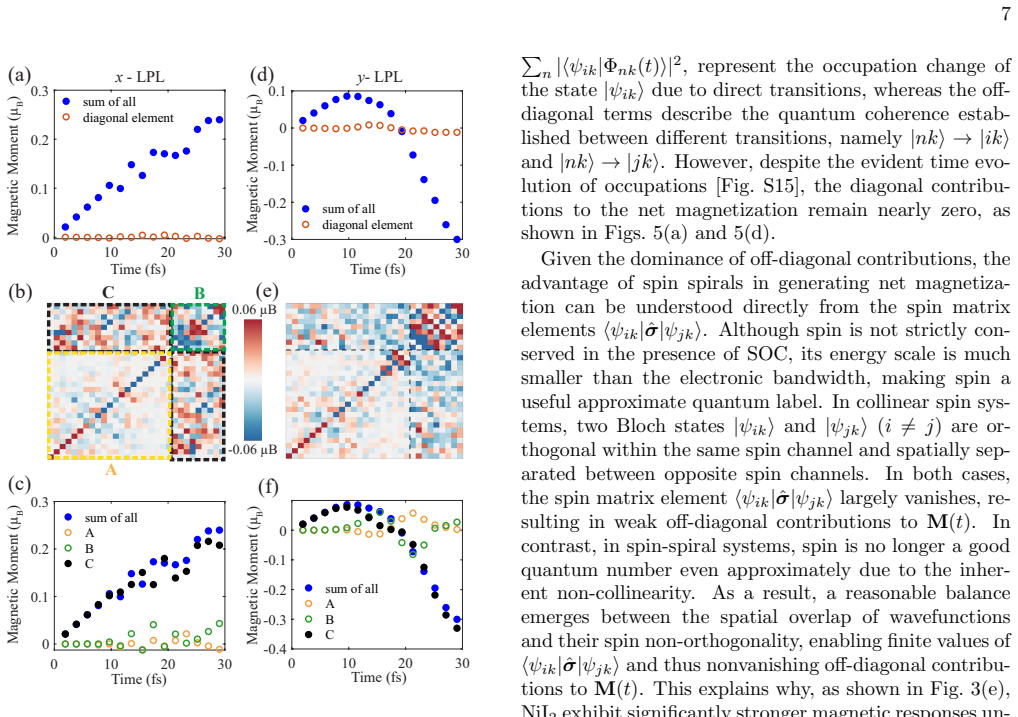
F. Y. Gaoet al., Giant chiral magnetoelectric oscillations in a van der Waals multiferroic, Nature632, 273 (2024). End Matter Off-diagonal spin-density correlation.A micro- scopic understanding of the light-induced magnetiza- tion in NiI 2 can be obtained from the occupied time- dependent Bloch states|Φ nk(t)⟩as M(t) =µ B X n,k ⟨Φnk(t)|ˆσ|Φnk(t)⟩,(7) wher...
2024
discussion (0)
Sign in with ORCID, Apple, or X to comment. Anyone can read and Pith papers without signing in.