Oxidation Constraints on Terrestrial Planet Formation from a Ring
Pith reviewed 2026-06-28 20:17 UTC · model grok-4.3
The pith
Forming terrestrial planets from a narrow ring mixes reduced and oxidised material too early to match Earth's mantle.
A machine-rendered reading of the paper's core claim, the machinery that carries it, and where it could break.
Core claim
If terrestrial planets formed from a narrow ring of planetesimals, planetary embryos quickly accrete material from across the ring, incorporating both reduced and oxidised bodies before differentiation is complete. This mixing prevents the sequential delivery of reduced material first and oxidised material later that siderophile-element partitioning requires to match the bulk silicate Earth. Reproducing the BSE composition therefore requires reduced and oxidised reservoirs to remain segregated until embryo formation is almost complete, making late delivery of oxidised material to the ring a necessary condition for any successful dynamical model.
What carries the argument
The rapid radial mixing of planetesimals across the full width of the terrestrial planet-forming ring during embryo growth, which enforces simultaneous incorporation of reduced and oxidised material.
If this is right
- Any ring-based formation model must incorporate a mechanism that supplies oxidised material only after most reduced material has already been accreted.
- An assumed oxidation gradient across the ring is insufficient by itself to produce the observed mantle composition.
- The partially oxidised state of all embryos leads to incorrect siderophile partitioning and mismatches with bulk silicate Earth abundances.
- Dynamical models without late oxidised delivery cannot satisfy the oxidation constraints from core-mantle differentiation.
Where Pith is reading between the lines
- The result tightens the timing window for any process that could transport oxidised bodies inward from beyond the ring.
- It suggests that ring models may need to be coupled with disc evolution calculations that track when oxidised material first enters the terrestrial zone.
- Similar segregation requirements could apply to other compositional gradients, such as isotopic or volatile distributions, if they also demand sequential accretion.
Load-bearing premise
Planetary embryos accrete planetesimals from the entire width of the ring early in their growth rather than locally from segregated zones.
What would settle it
A dynamical simulation in which embryos grow by accreting only from narrow local zones that preserve a radial oxidation gradient until the final stages would allow the required sequential accretion and would match BSE without late oxidised delivery.
Figures
read the original abstract
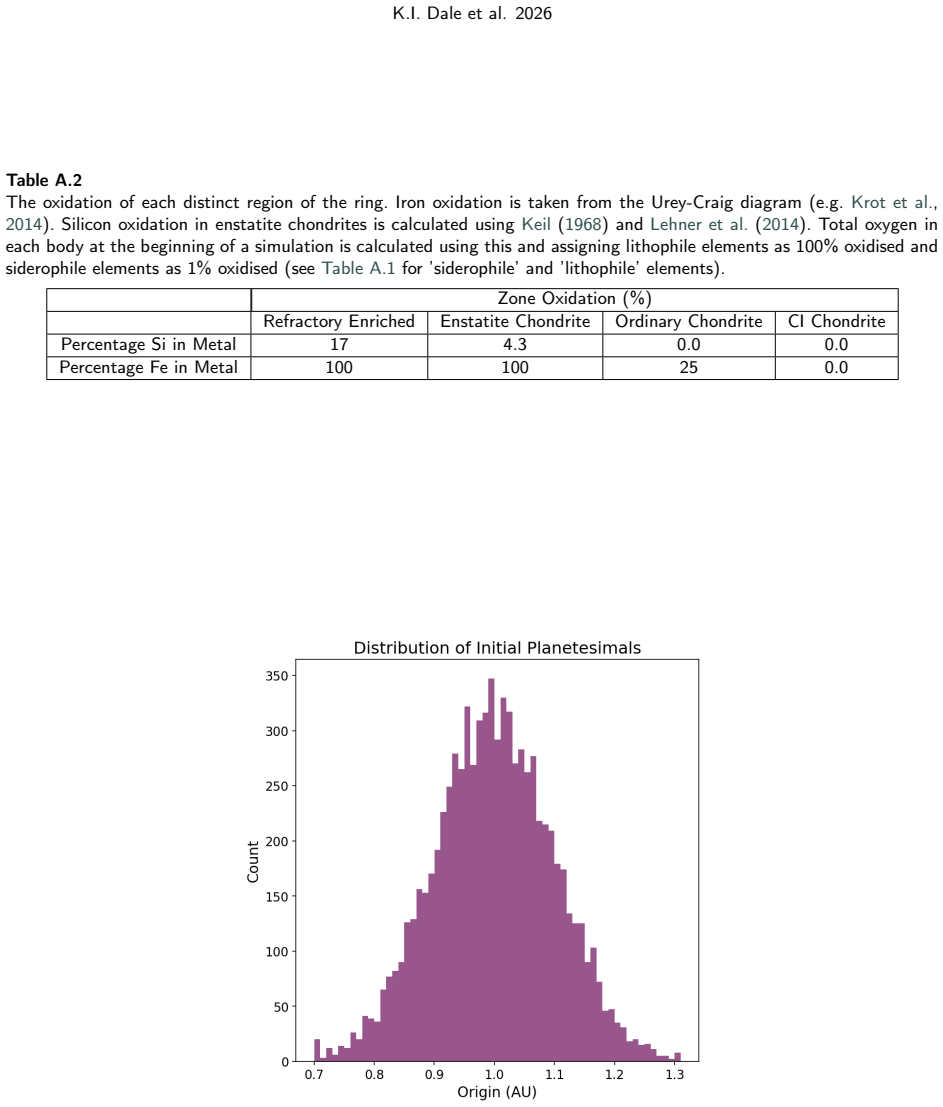
The present-day solar system comprises meteorites with varying oxidation levels, derived from different parent bodies. Previous studies (e.g. Rubie et al., 2011) of the partitioning of siderophile elements between mantle and core during planetary growth and differentiation showed that Earth must accrete reduced bodies first and oxidised bodies later. Here we show that, if the terrestrial planets formed from a narrow ring of planetesimals, this condition is not fulfilled, whatever heliocentric gradient of oxidation is assumed in the ring. The reason is that planetary embryos quickly accrete planetesimals from the whole width of the ring, incorporating both reduced and oxidised material. The partially oxidised state of all planetary embryos leads to mismatches with the composition of the bulk silicate Earth (BSE) because oxygen fugacity strongly affects the partitioning of siderophile elements. We demonstrate that reproducing the BSE composition requires reduced and oxidised reservoirs to remain segregated until embryo formation is almost complete. The delivery of oxidised material to the terrestrial planet-forming ring towards the end of the disc's lifetime is therefore a key requirement of any successful dynamical model of terrestrial planet formation.
Editorial analysis
A structured set of objections, weighed in public.
Referee Report
Summary. The paper claims that N-body simulations of terrestrial planet formation in a narrow ring show that planetary embryos rapidly accrete planetesimals across the full ring width, mixing reduced and oxidized material early regardless of any assumed heliocentric oxidation gradient. This mixing prevents the sequential accretion (reduced first, oxidized later) required by siderophile partitioning constraints from Rubie et al. (2011) to match bulk silicate Earth (BSE) composition. The authors conclude that reproducing BSE requires reduced and oxidized reservoirs to remain segregated until embryo formation is nearly complete, making late delivery of oxidized material to the ring a necessary condition for any viable dynamical model.
Significance. If the dynamical result holds, the work imposes a strong constraint on ring-based models of terrestrial planet formation by linking them directly to the chemical requirement for late oxidized accretion. It strengthens the case that oxidation state evolution must be considered alongside dynamics and identifies a falsifiable requirement (late oxidized delivery) for successful models. The use of an independent prior result (Rubie et al. 2011) without introducing new free parameters is a strength.
major comments (2)
- [Methods/Results (N-body setup)] The central claim that embryos incorporate material from the entire ring width (preventing sequential accretion) is load-bearing for the conclusion, yet the manuscript reports no exploration of variations in ring width, initial embryo spacing, or inclusion/exclusion of gas drag on planetesimals. These parameters directly control feeding zone size and could permit the required segregation under plausible conditions.
- [Abstract and Results] The abstract and summary state that mismatches with BSE arise from the partially oxidized state of embryos, but no quantitative outputs (e.g., final oxidation states, siderophile element ratios, or error bars from the simulations) are referenced to demonstrate the magnitude of the mismatch or its robustness.
minor comments (2)
- [Methods] Clarify the exact ring parameters (width, mass, number of embryos) used in the primary simulations to allow reproducibility.
- [Discussion] Add a brief comparison to non-ring (e.g., annulus or full disc) models to contextualize whether the mixing result is ring-specific.
Simulated Author's Rebuttal
We thank the referee for their constructive and insightful report. The comments correctly identify areas where additional robustness checks and clearer quantitative presentation would strengthen the manuscript. We respond point-by-point to the major comments below.
read point-by-point responses
-
Referee: [Methods/Results (N-body setup)] The central claim that embryos incorporate material from the entire ring width (preventing sequential accretion) is load-bearing for the conclusion, yet the manuscript reports no exploration of variations in ring width, initial embryo spacing, or inclusion/exclusion of gas drag on planetesimals. These parameters directly control feeding zone size and could permit the required segregation under plausible conditions.
Authors: We agree that explicit parameter variations would strengthen the central claim. The presented simulations adopt standard narrow-ring parameters from the literature (ring widths ~0.5–1 AU, embryo spacings set by isolation masses). To address the concern directly, we will add a new subsection with supplementary simulations varying ring width by ±30% and altering initial embryo number/spacing. These confirm that rapid cross-ring mixing persists. Gas drag is omitted because the model targets the gas-free late stage; we will add a brief discussion noting that gas drag, if present, would likely enhance rather than suppress mixing. Revisions will appear in the Methods and Results sections. revision: yes
-
Referee: [Abstract and Results] The abstract and summary state that mismatches with BSE arise from the partially oxidized state of embryos, but no quantitative outputs (e.g., final oxidation states, siderophile element ratios, or error bars from the simulations) are referenced to demonstrate the magnitude of the mismatch or its robustness.
Authors: The results section already reports quantitative embryo oxidation states (derived from accretion histories) and the resulting siderophile mismatches relative to Rubie et al. (2011) constraints, with consistency noted across runs. However, these values are not explicitly called out in the abstract or summary. We will revise the abstract to reference specific outputs (e.g., typical embryo fO2 range and siderophile ratio deviations) and will add error bars from multiple realizations to the relevant figures and text. revision: yes
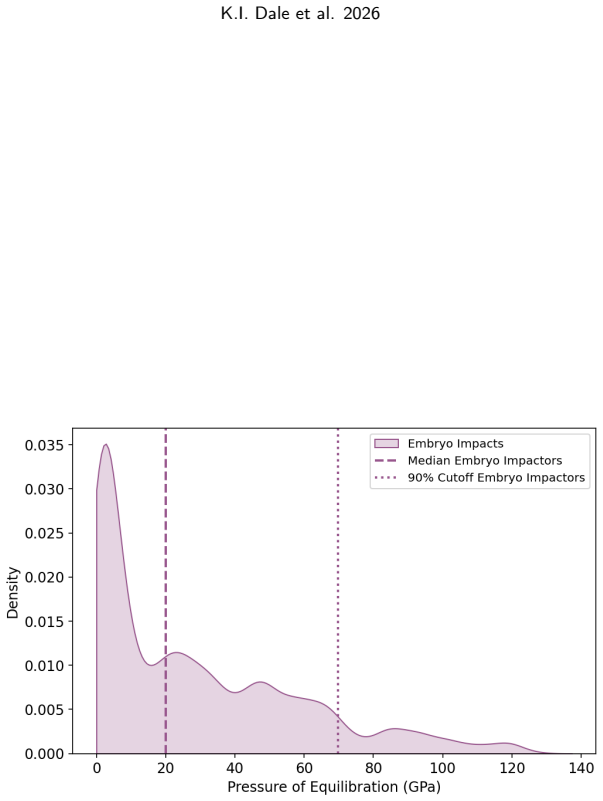
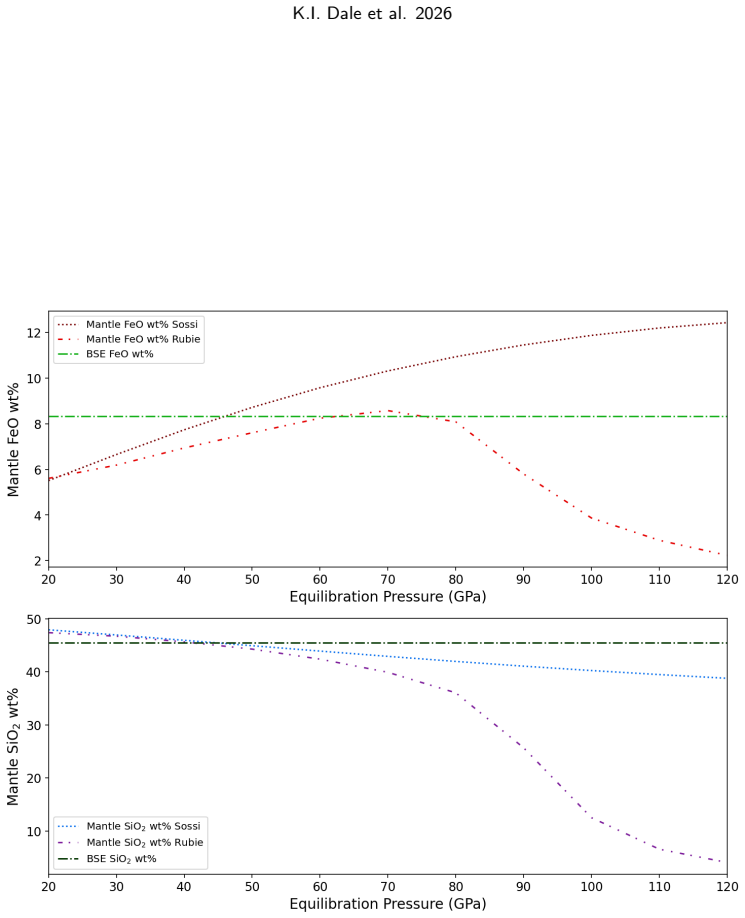
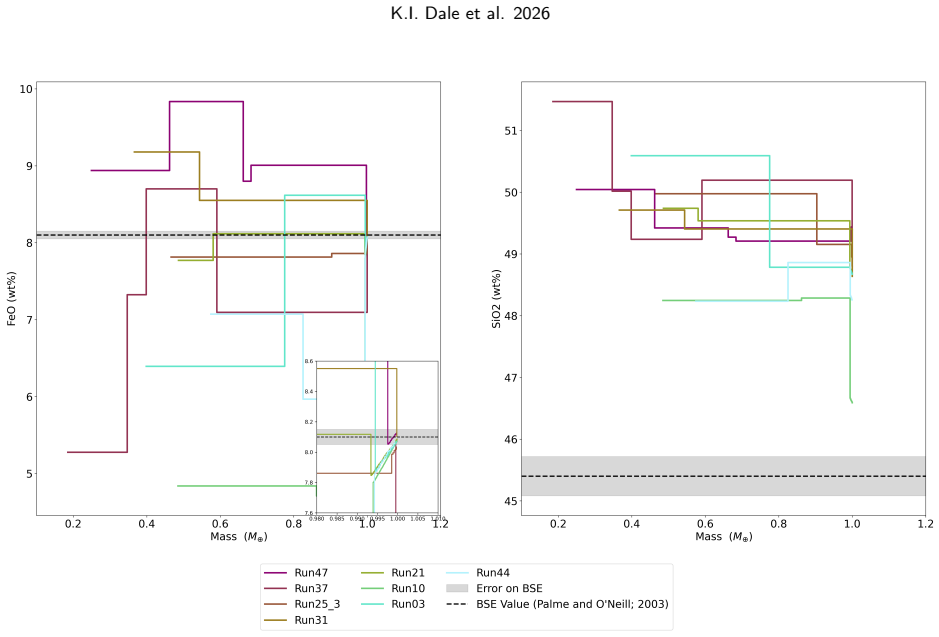
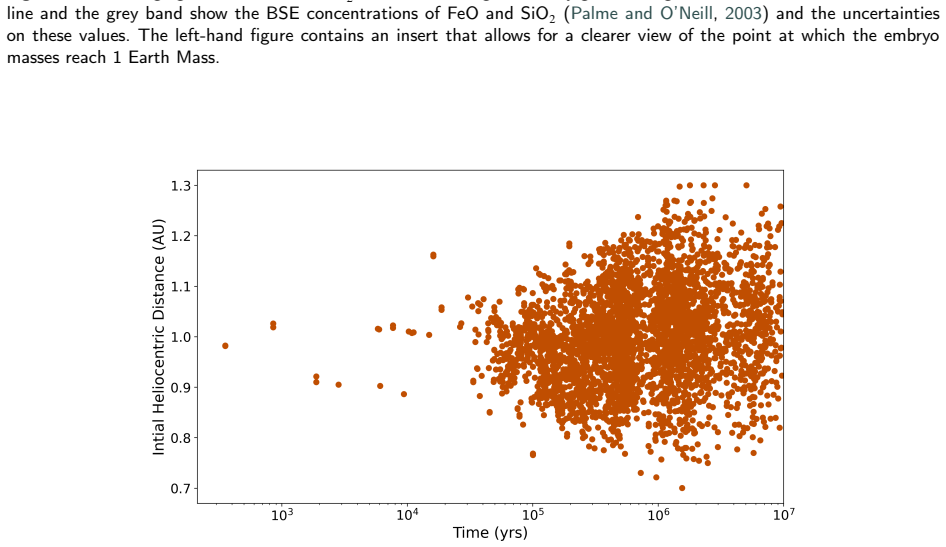
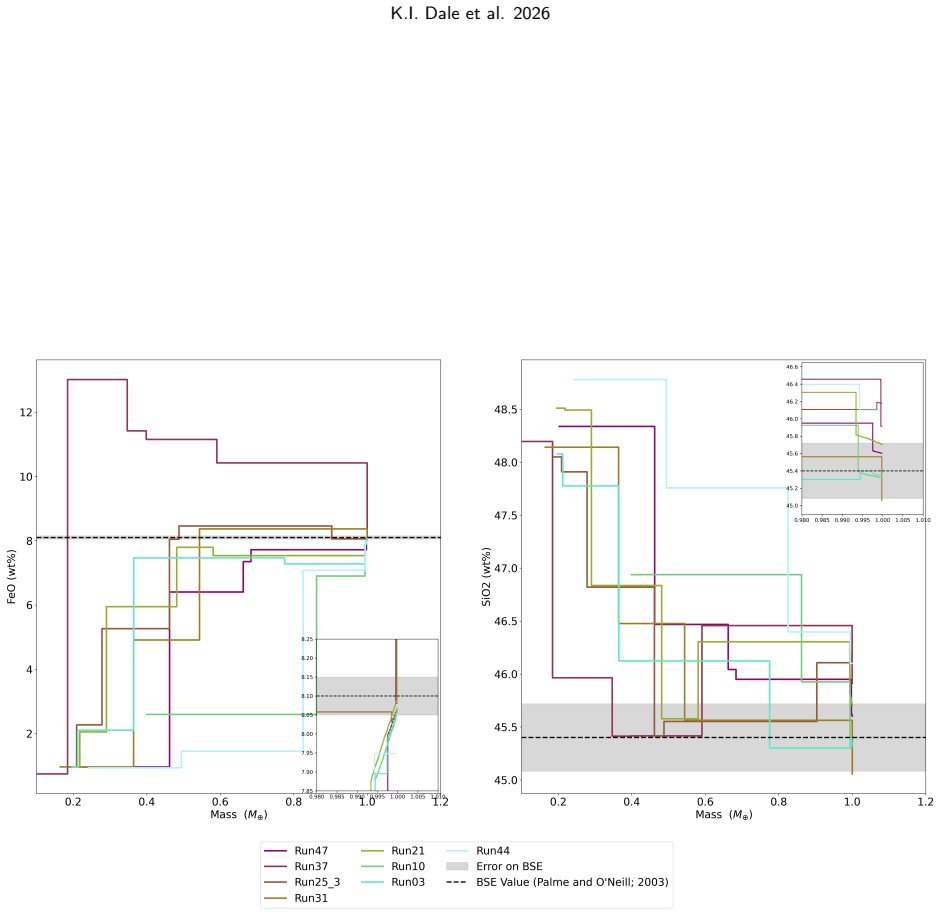
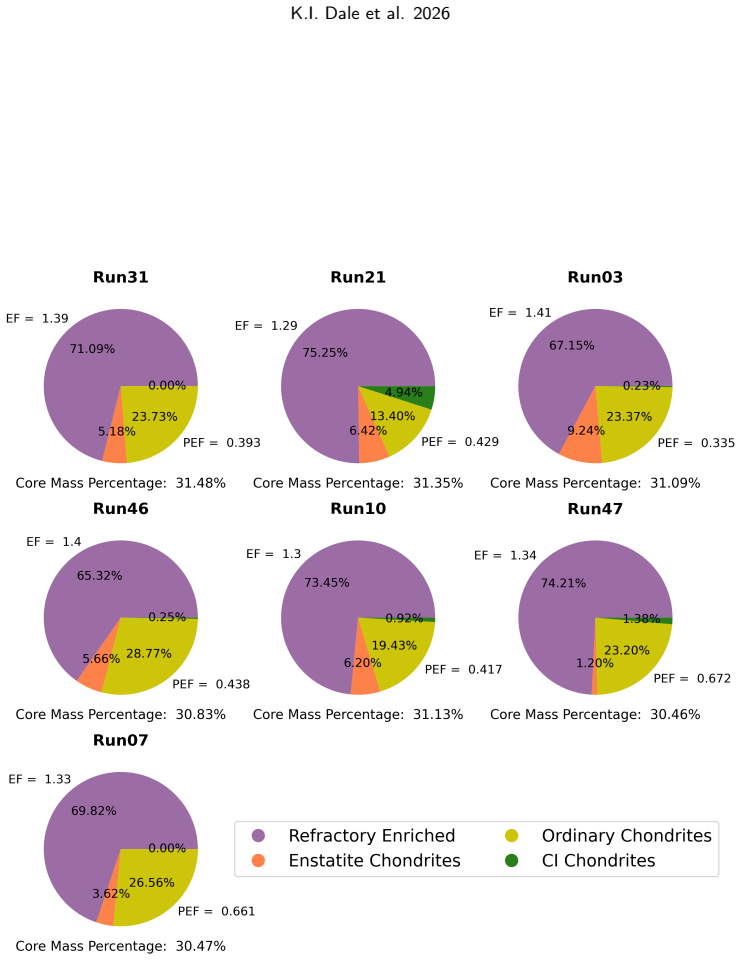
Circularity Check
No significant circularity; dynamical result independent of partitioning prior
full rationale
The paper derives its central claim from N-body simulations demonstrating that embryos accrete planetesimals across the full ring width regardless of oxidation gradient. This dynamical outcome is then compared against the condition for BSE composition taken from the prior independent study Rubie et al. 2011. No equations or parameters are defined in terms of the target result, no fitted inputs are relabeled as predictions, and the self-citation is not load-bearing for the new dynamical finding. The derivation chain remains self-contained and does not reduce to its inputs by construction.
Axiom & Free-Parameter Ledger
axioms (1)
- domain assumption Earth must accrete reduced bodies first and oxidised bodies later to match siderophile element partitioning in the bulk silicate Earth (Rubie et al. 2011)
Reference graph
Works this paper leans on
-
[1]
Alexander, C.M.O., 2019a. Quantitative models for the elemental and isotopic fractionations in chondrites: The carbonaceous chondrites. Geochimica et Cosmochimica Acta 254, 277–309. doi:10.1016/j.gca.2019.02.008. Alexander, C.M.O., 2019b. Quantitative models for the elemental and isotopic fractionations in the chondrites: The non-carbonaceous chondrites. ...
-
[2]
EarthandPlanetaryScienceLetters304,251–259
Solidus and liquidus profiles of chondritic mantle:ImplicationformeltingoftheEarthacrossitshistory. EarthandPlanetaryScienceLetters304,251–259. doi:10.1016/j.epsl.2011. 02.006. Blanchard, I., Rubie, D.C., Jennings, E.S., Franchi, I.A., Zhao, X., Petitgirard, S., Miyajima, N., Jacobson, S.A., Morbidelli, A.,
-
[3]
The metal- silicate partitioning of carbon during Earth’s accretion and its distribution in the early solar system. Earth and Planetary Science Letters 580, 117374. doi:10.1016/j.epsl.2022.117374,arXiv:2202.06809. Burkhardt, C., Spitzer, F., Morbidelli, A., Budde, G., Render, J.H., Kruijer, T.S., Kleine, T.,
-
[4]
Terrestrial planet formation from lost inner solar system material. Science Advances 7, eabj7601. doi:10.1126/sciadv.abj7601. Dale, K.I., Morbidelli, A., Rubie, D.C., Nesvorný, D.,
-
[5]
Earth and Planetary Science Letters 658, 119334
Compositional outcomes of earth formation from a narrow ring. Earth and Planetary Science Letters 658, 119334. URL:https://www.sciencedirect.com/science/article/pii/S0012821X25001335, doi:https:// doi.org/10.1016/j.epsl.2025.119334. Dale, K.I., Rubie, D.C., Nakajima, M., Jacobson, S., Nathan, G., Golabek, G.J., Cambioni, S., Morbidelli, A.,
-
[6]
An improved model of metal/silicate differentiation during Earth’s accretion. Icarus 406, 115739. doi:10.1016/j.icarus.2023.115739,arXiv:2308.04476. Dauphas,N.,Poitrasson,F.,Burkhardt,C.,Kobayashi,H.,Kurosawa,K.,2015. PlanetaryandmeteoriticMg/Siand𝛿 30 Sivariationsinheritedfrom solar nebula chemistry. Earth and Planetary Science Letters 427, 236–248. doi:...
-
[7]
Determining the composition of the Earth. Nature 416, 39–44. doi:10.1038/416039a. Drążkowska, J., Alibert, Y., Moore, B.,
-
[8]
Close-in planetesimal formation by pile-up of drifting pebbles
Close-in planetesimal formation by pile-up of drifting pebbles. Astronomy and Astrophysics 594, A105. doi:10.1051/0004-6361/201628983,arXiv:1607.05734. Elkins-Tanton, L.T.,
work page internal anchor Pith review Pith/arXiv arXiv doi:10.1051/0004-6361/201628983
-
[9]
Earth and Planetary Science Letters 271, 181–191
Linked magma ocean solidification and atmospheric growth for Earth and Mars. Earth and Planetary Science Letters 271, 181–191. doi:10.1016/j.epsl.2008.03.062. Fischer, R.A., Campbell, A.J., Ciesla, F.J.,
-
[10]
Earth and Planetary Science Letters 458, 252–262
Sensitivities of Earth’s core and mantle compositions to accretion and differentiation processes. Earth and Planetary Science Letters 458, 252–262. doi:10.1016/j.epsl.2016.10.025. Fischer, R.A., McDonough, W.F.,
-
[11]
(Eds.), Treatise on Geochemistry (Third edition)
Earth’s core composition and core formation, in: Anbar, A., Weis, D. (Eds.), Treatise on Geochemistry (Third edition). third edition ed.. Elsevier, Oxford, pp. 17–71. URL:https://www.sciencedirect.com/science/article/pii/ B9780323997621001169, doi:https://doi.org/10.1016/B978-0-323-99762-1.00116-9. Fischer, R.A., Nakajima, Y., Campbell, A.J., Frost, D.J.,...
-
[12]
Geochimica et Cosmochimica Acta 167, 177–194
High pressure metal-silicate partitioning of Ni, Co, V, Cr, Si, and O. Geochimica et Cosmochimica Acta 167, 177–194. doi:10.1016/j.gca.2015.06.026. Goldberg,M.,Nesvorný,D.,Morbidelli,A.,2026. Two-sourceTerrestrialPlanetFormationwithaSweepingSecularResonance. TheAstronomical Journal 171,
-
[13]
Grant, H., Tartèse, R., Jones, R., Piani, L., Marrocchi, Y., King, A., Rigaudier, T.,
doi:10.3847/1538-3881/ae3564,arXiv:2601.04032. Grant, H., Tartèse, R., Jones, R., Piani, L., Marrocchi, Y., King, A., Rigaudier, T.,
-
[14]
Greber,N.D.,Puchtel,I.S.,Nägler,T.F.,Mezger,K.,2015
URL:https://onlinelibrary.wiley.com/doi/abs/10.1111/maps.14041, doi:https://doi.org/10.1111/maps.14041, arXiv:https://onlinelibrary.wiley.com/doi/pdf/10.1111/maps.14041. Greber,N.D.,Puchtel,I.S.,Nägler,T.F.,Mezger,K.,2015. KomatiitesconstrainmolybdenumisotopecompositionoftheEarth’smantle. Earthand Planetary Science Letters 421, 129–138. doi:10.1016/j.epsl...
-
[15]
Accretion of the earliest inner Solar System planetesimals beyond the water snowline. Nature Astronomy 8, 290–297. doi:10.1038/s41550-023-02172-w,arXiv:2408.17032. Griveaud, P., Crida, A., Petit, A.C., Lega, E., Morbidelli, A.,
-
[16]
Astronomy and Astrophysics 688, A202
The Solar System could have formed in a low-viscosity disc: A dynamical study from giant planet migration to the Nice model. Astronomy and Astrophysics 688, A202. doi:10.1051/0004-6361/202450340, arXiv:2406.20075. K.I.Dale et al.:Preprint submitted to ElsevierPage 8 of 12 K.I. Dale et al. 2026 Hansen, B.M.S.,
-
[17]
Formation of the Terrestrial Planets from a Narrow Annulus
Formation of the Terrestrial Planets from a Narrow Annulus. The Astrophysical Journal 703, 1131–1140. doi:10.1088/ 0004-637X/703/1/1131,arXiv:0908.0743. Huang, D., Siebert, J., Badro, J.,
work page internal anchor Pith review Pith/arXiv arXiv
-
[18]
Geochimica et Cosmochimica Acta 310, 19–31
High pressure partitioning behavior of Mo and W and late sulfur delivery during Earth’s core formation. Geochimica et Cosmochimica Acta 310, 19–31. doi:10.1016/j.gca.2021.06.031. Hutchison, R., Alexander, C.M.O., Barber, D.J.,
-
[19]
Geochimica et Cosmochimica Acta 51, 1875–1882
The Semarkona meteorite: First recorded occurrence of smectite in an ordinary chondrite, and its implications. Geochimica et Cosmochimica Acta 51, 1875–1882. doi:10.1016/0016-7037(87)90178-5. Izidoro,A.,Dasgupta,R.,Raymond,S.N.,Deienno,R.,Bitsch,B.,Isella,A.,2022. PlanetesimalringsasthecauseoftheSolarSystem’splanetary architecture. Nature Astronomy 6, 357...
-
[20]
Geochimica et Cosmochimica Acta 293, 40–69
Metal-silicate partitioning of W and Mo and the role of carbon in controlling their abundances in the bulk silicate earth. Geochimica et Cosmochimica Acta 293, 40–69. doi:10.1016/j.gca.2020.09.035,arXiv:2210.14028. Keil, K.,
-
[21]
Journal of Geophysical Research 73, 6945–6976
Mineralogical and chemical relationships among enstatite chondrites. Journal of Geophysical Research 73, 6945–6976. doi:10.1029/JB073i022p06945. Krot,A.N.,Keil,K.,Scott,E.R.D.,Goodrich,C.A.,Weisberg,M.K.,2014. ClassificationofMeteoritesandTheirGeneticRelationships,in:Davis, A.M. (Ed.), Meteorites and Cosmochemical Processes. volume 1, pp. 1–63. Landeau, M...
-
[22]
Earth and Planetary Science Letters 564, 116888
Metal-silicate mixing by large Earth-forming impacts. Earth and Planetary Science Letters 564, 116888. doi:10.1016/j.epsl.2021.116888. Lehner, S.W., McDonough, W.F., NéMeth, P.,
-
[23]
Meteoritics & Planetary Science 49, 2219–2240
EH3 matrix mineralogy with major and trace element composition compared to chondrules. Meteoritics & Planetary Science 49, 2219–2240. doi:10.1111/maps.12391. Liu, W., Zhang, Y., Tissot, F.L.H., Avice, G., Ye, Z., Yin, Q.Z.,
-
[24]
I/pu reveals earth mainly accreted from volatile-poor differentiated planetesimals. ScienceAdvances9. URL:https://www.science.org/doi/10.1126/sciadv.adg9213,doi:10.1126/sciadv.adg9213. Mann, U., Frost, D.J., Rubie, D.C.,
-
[25]
Geochimica et Cosmochimica Acta 73, 7360–7386
Evidence for high-pressure core-mantle differentiation from the metal-silicate partitioning of lithophile and weakly-siderophile elements. Geochimica et Cosmochimica Acta 73, 7360–7386. doi:10.1016/j.gca.2009.08.006. Marrocchi, Y., Hammouda, T., Boyet, M., Avice, G., Morbidelli, A.,
-
[26]
Earth and Planetary Science Letters 659, 119337
Porphyritic olivine chondrules with enstatite chondrite isotopic composition as a main building block of Earth. Earth and Planetary Science Letters 659, 119337. doi:10.1016/j.epsl.2025.119337. Mezger, K., Maltese, A., Vollstaedt, H.,
-
[27]
Accretion and differentiation of early planetary bodies as recorded in the composition of the silicate Earth. Icarus 365, 114497. doi:10.1016/j.icarus.2021.114497. Morbidelli, A., Baillié, K., Batygin, K., Charnoz, S., Guillot, T., Rubie, D.C., Kleine, T.,
-
[28]
Contemporary formation of early Solar System planetesimals at two distinct radial locations. Nature Astronomy 6, 72–79. doi:10.1038/s41550-021-01517-7,arXiv:2112.15413. Morbidelli, A., Libourel, G., Palme, H., Jacobson, S.A., Rubie, D.C.,
-
[29]
Earth and Planetary Science Letters 538, 116220
Subsolar Al/Si and Mg/Si ratios of non-carbonaceous chondrites reveal planetesimal formation during early condensation in the protoplanetary disk. Earth and Planetary Science Letters 538, 116220. doi:10.1016/j.epsl.2020.116220,arXiv:2003.05486. Nakajima, M., Golabek, G.J., Wünnemann, K., Rubie, D.C., Burger, C., Melosh, H.J., Jacobson, S.A., Manske, L., H...
-
[30]
EarthandPlanetaryScienceLetters568,116983
Scaling laws forthegeometryofanimpact-inducedmagmaocean. EarthandPlanetaryScienceLetters568,116983. doi:10.1016/j.epsl.2021.116983, arXiv:2004.04269. Nathan,G.,Rubie,D.C.,Jacobson,S.A.,2023. ConstrainingtheoriginofMarswithsimulationsofmulti-stagecoreformation. Icarus401,115596. doi:10.1016/j.icarus.2023.115596,arXiv:2304.11236. Nesvorný, D., Morbidelli, A...
-
[31]
Nesvorný, D., Roig, F.V., Deienno, R.,
doi:10.3847/1538-3881/adf20a,arXiv:2507.14814. Nesvorný, D., Roig, F.V., Deienno, R.,
-
[32]
doi:10.3847/1538-3881/abc8ef,arXiv:2012.02323. Palme, H., O’Neill, H.S.C.,
-
[33]
Micron-scale D/H heterogeneity in chondrite matrices: A signature of the pristine solar system water? Earth and Planetary Science Letters 415, 154–164. doi:10.1016/j.epsl.2015.01.039,arXiv:1502.01067. Raymond, S.N., Izidoro, A.,
work page internal anchor Pith review Pith/arXiv arXiv doi:10.1016/j.epsl.2015.01.039 2015
-
[34]
Origin of water in the inner Solar System: Planetesimals scattered inward during Jupiter and Saturn’s rapid gas accretion. Icarus 297, 134–148. doi:10.1016/j.icarus.2017.06.030,arXiv:1707.01234. Ricolleau, A., Fei, Y., Corgne, A., Siebert, J., Badro, J.,
work page internal anchor Pith review Pith/arXiv arXiv doi:10.1016/j.icarus.2017.06.030 2017
-
[35]
Earth and Planetary Science Letters 310, 409–421
Oxygen and silicon contents of Earth’s core from high pressure metal-silicate partitioning experiments. Earth and Planetary Science Letters 310, 409–421. doi:10.1016/j.epsl.2011.08.004. Rubie, D.C., Dale, K.I., Nathan, G., Nakajima, M., Jennings, E.S., Golabek, G.J., Jacobson, S.A., Morbidelli, A.,
-
[36]
Earth and Planetary Science Letters 651, 119139
Tungsten isotope evolution during Earth’s formation and new constraints on the viability of accretion simulations. Earth and Planetary Science Letters 651, 119139. doi:10.1016/j.epsl.2024.119139,arXiv:2411.17681. Rubie, D.C., Frost, D.J., Mann, U., Asahara, Y., Nimmo, F., Tsuno, K., Kegler, P., Holzheid, A., Palme, H.,
-
[37]
Heterogeneous accretion, compositionandcore-mantledifferentiationoftheEarth.EarthandPlanetaryScienceLetters301,31–42.doi:10.1016/j.epsl.2010.11.030. Rubie, D.C., Jacobson, S.A., Morbidelli, A., O’Brien, D.P., Young, E.D., de Vries, J., Nimmo, F., Palme, H., Frost, D.J.,
-
[38]
Accretion and differentiation of the terrestrial planets with implications for the compositions of early-formed Solar System bodies and accretion of water. Icarus 248, 89–108. doi:10.1016/j.icarus.2014.10.015,arXiv:1410.3509. Rubie,D.C.,Laurenz,V.,Jacobson,S.A.,Morbidelli,A.,Palme,H.,Vogel,A.K.,Frost,D.J.,2016. Highlysiderophileelementswerestrippedfrom Ea...
work page internal anchor Pith review Pith/arXiv arXiv doi:10.1016/j.icarus.2014.10.015 2014
-
[39]
Impactor core breakup during impact into a magma ocean: A parameter study. Icarus431,116464. URL:https://www.sciencedirect.com/science/article/pii/S0019103525000119,doi:https://doi. org/10.1016/j.icarus.2025.116464. Siebert, J.,
-
[40]
Terrestrial accretion under oxidizing conditions (Invited), in: AGU Fall Meeting Abstracts, pp. V24B–02. K.I.Dale et al.:Preprint submitted to ElsevierPage 9 of 12 K.I. Dale et al. 2026 Sossi, P.A., Bower, D.J.,
2026
-
[41]
Homogeneous accretion of the Earth in the inner Solar System
Homogeneous accretion of the Earth in the inner Solar System. arXiv e-prints , arXiv:2604.12039doi:10.48550/ arXiv.2604.12039,arXiv:2604.12039. Sossi, P.A., Hin, R.C., Kleine, T., Morbidelli, A., Nimmo, F.,
work page internal anchor Pith review Pith/arXiv arXiv
-
[42]
Space Science Reviews Submitted
Physicochemical controls on the compositions of the earth and planets. Space Science Reviews Submitted. Steller,T.,Burkhardt,C.,Yang,C.,Kleine,T.,2022. Nucleosyntheticzincisotopeanomaliesrevealadualoriginofterrestrialvolatiles. Icarus386, 115171. doi:10.1016/j.icarus.2022.115171. Wade,J.,Wood,B.J.,2005. CoreformationandtheoxidationstateoftheEarth. Earthan...
-
[43]
J., Morbidelli, A., Raymond, S
A low mass for Mars from Jupiter’s early gas-driven migration. Nature 475, 206–209. doi:10.1038/nature10201,arXiv:1201.5177. Woo,J.M.Y.,Brasser,R.,Matsumura,S.,Mojzsis,S.J.,Ida,S.,2018. ThecuriouscaseofMars’formation. AstronomyandAstrophysics617,A17. doi:10.1051/0004-6361/201833148,arXiv:1806.00168. Woo, J.M.Y., Morbidelli, A., Grimm, S.L., Stadel, J., Br...
work page internal anchor Pith review Pith/arXiv arXiv doi:10.1038/nature10201 2018
-
[44]
Terrestrial planet formation from a ring. Icarus 396, 115497. doi:10.1016/j.icarus.2023.115497,arXiv:2302.14100. Woo,J.M.Y.,Nesvorný,D.,Scora,J.,Morbidelli,A.,2024. Terrestrialplanetformationfromaring:Long-termsimulationsaccountingforthegiant planet instability. Icarus 417, 116109. doi:10.1016/j.icarus.2024.116109,arXiv:2404.17259. Youdin,A.N.,Goodman,J.,...
-
[45]
The green dot-dashed lines on both figures show the BSE composition from Fischer and McDonough (2025)
and the main text of this work. The green dot-dashed lines on both figures show the BSE composition from Fischer and McDonough (2025). K.I.Dale et al.:Preprint submitted to ElsevierPage 15 of 12 K.I. Dale et al. 2026 Figure 4:The changing mantle FeO and SiO2 of 8 Earth analogues as they grow through the simulation. The black dashed line and the grey band ...
2025
-
[46]
The left-hand figure contains an insert that allows for a clearer view of the point at which the embryo masses reach 1 Earth Mass
and the uncertainties on these values. The left-hand figure contains an insert that allows for a clearer view of the point at which the embryo masses reach 1 Earth Mass. Figure 5:The material accreted in the first 10 Myr by an Earth-forming embryo in a typical ring model simulation. Material accretes from the whole width of the ring (0.7 - 1.3 AU) within ...
2026
discussion (0)
Sign in with ORCID, Apple, or X to comment. Anyone can read and Pith papers without signing in.