REVIEW 2 major objections 2 minor 2 references
Smoothed stochastic interventions on treatment initiation permit debiased causal estimation of effects on survival time.
Reviewed by Pith at T0; open to challenge. T0 means a machine referee read the full paper against a public rubric. the ladder, T0–T4 →
Proposes conditions for feasible stochastic interventions to match causal ones and derives a debiased estimator via efficient influence function for a smoothed treatment initiation window in survival data.
T0 review reviewed 2026-06-28 challenge →
load-bearing objection The paper fixes non-differentiability in causal survival analysis by smoothing a stochastic intervention on treatment initiation in an illness-death model, then derives the EIF and a one-step estimator. the 2 major comments →
Debiased inference for stochastic treatment interventions with survival outcomes
The pith
A machine-rendered reading of the paper's core claim, the machinery that carries it, and where it could break.
The reading
Core claim
In the illness-death model a stochastic intervention that alters the hazard of treatment initiation is not pathwise differentiable when applied at a fixed time; smoothing the intervention over a time window around the target time renders the parameter pathwise differentiable, yields an explicit efficient influence function, and supports construction of a one-step estimator that remains consistent and asymptotically normal when the nuisance functions are estimated at appropriate rates and when the observable intervention coincides with the causal one.
What carries the argument
The efficient influence function of the smoothed stochastic intervention parameter, which is used to form the debiased one-step estimator.
Load-bearing premise
The observable intervention that can be implemented on the data corresponds to the desired causal intervention under the stated conditions on the data-generating process.
What would settle it
A simulation study in which the correspondence condition between observable and causal interventions is deliberately violated and the one-step estimator is shown to be inconsistent or to have incorrect coverage.
If this is right
- The estimator is consistent and asymptotically normal even when the hazard and censoring models are estimated at slower than parametric rates.
- Varying the target time point inside the smoothing window produces a family of causal parameters that can be compared directly.
- The same influence-function construction applies to both the Stanford Heart Transplant data and the subfertility treatment-delay data.
- Double robustness holds with respect to misspecification of either the outcome or the treatment-initiation hazard model.
Where Pith is reading between the lines
- The smoothing device may be adaptable to other non-differentiable causal functionals that arise in continuous-time survival settings.
- Choice of window width trades bias for variance and therefore invites data-driven or sensitivity-based selection rules not developed in the paper.
- Extension to multiple sequential interventions would require iterated smoothing and a corresponding multivariate efficient influence function.
Editorial analysis
A structured set of objections, weighed in public.
Referee Report
Summary. The paper addresses causal inference for the effect of a time-dependent stochastic intervention on treatment initiation on survival outcomes, formulated in an illness-death model. It notes that fixed-time interventions yield non-pathwise-differentiable parameters and replaces them with a smoothed intervention over a time window. The authors derive the efficient influence function for this parameter, propose a debiased one-step estimator claimed to have double robustness properties, state conditions under which the observable-data intervention matches the causal target, and support the method with simulations plus applications to the Stanford Heart Transplant data and subfertility treatment-delay data.
Significance. If the EIF derivation and robustness claims hold, the work supplies a practical, assumption-lean tool for stochastic interventions in survival settings where standard g-computation or fixed-time approaches fail differentiability. The explicit handling of the non-differentiability issue via smoothing and the provision of matching conditions between observable and causal interventions are useful contributions to semiparametric causal survival analysis.
major comments (2)
- The central claim that the one-step estimator is debiased and possesses the stated robustness properties rests on the EIF derivation; without explicit verification (e.g., proof that the EIF is indeed the canonical gradient and that the estimator achieves the semiparametric efficiency bound under the stated conditions), the finite-sample and asymptotic claims cannot be assessed.
- The conditions under which the practically feasible (observable) intervention corresponds to the desired causal intervention are load-bearing for external validity; these conditions should be stated formally, shown to be checkable from data, and accompanied by a sensitivity analysis or counter-example when they are mildly violated.
minor comments (2)
- [Abstract] The abstract states the main results but contains no equations or proof sketches; adding a brief display of the EIF or the one-step update would improve readability for readers familiar with semiparametric theory.
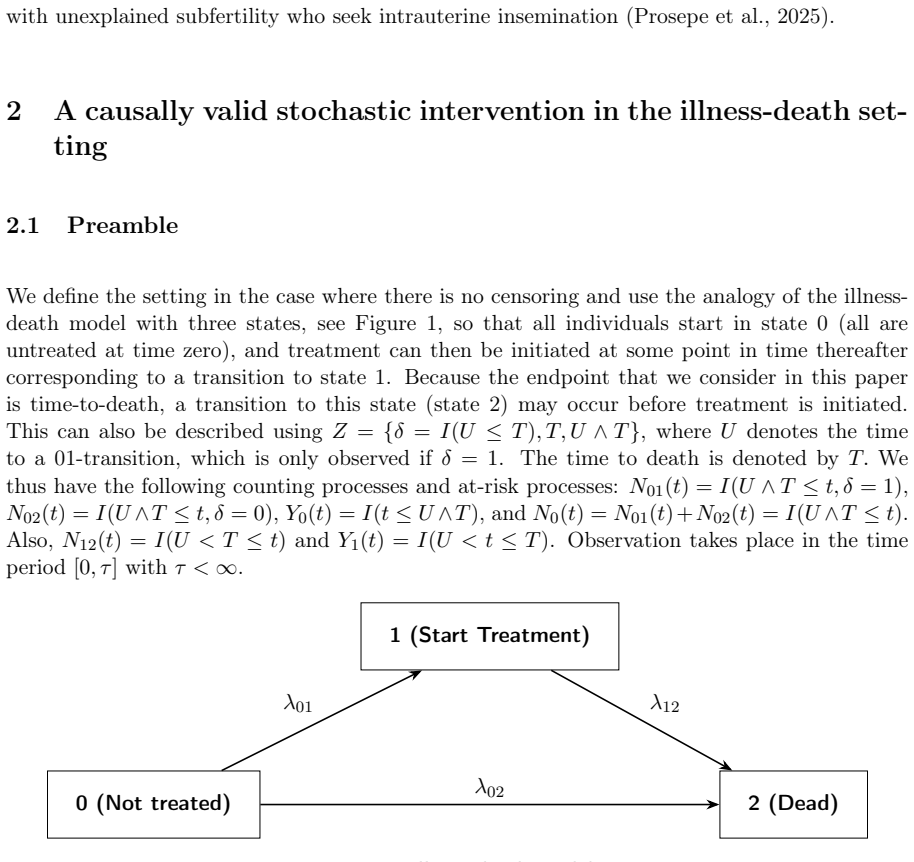
- Notation for the illness-death model (states, transition hazards, censoring) should be introduced once with a diagram or table and then used consistently; current usage appears to mix observed-data and counterfactual notation without explicit separation.
Simulated Author's Rebuttal
We thank the referee for their careful reading and constructive comments on our work. We address each major comment below and will revise the manuscript accordingly.
read point-by-point responses
-
Referee: The central claim that the one-step estimator is debiased and possesses the stated robustness properties rests on the EIF derivation; without explicit verification (e.g., proof that the EIF is indeed the canonical gradient and that the estimator achieves the semiparametric efficiency bound under the stated conditions), the finite-sample and asymptotic claims cannot be assessed.
Authors: The efficient influence function is derived in Section 4 by explicitly computing the pathwise derivative of the target parameter with respect to one-dimensional submodels and identifying the unique element of the tangent space that satisfies the differentiability condition; this is by definition the canonical gradient. The one-step estimator is then shown in Theorem 2 to be asymptotically linear with influence function equal to this EIF (hence attaining the efficiency bound) under the stated regularity conditions and Donsker-class assumptions. We will expand the appendix with a more detailed, step-by-step verification of these steps to improve transparency. revision: yes
-
Referee: The conditions under which the practically feasible (observable) intervention corresponds to the desired causal intervention are load-bearing for external validity; these conditions should be stated formally, shown to be checkable from data, and accompanied by a sensitivity analysis or counter-example when they are mildly violated.
Authors: The conditions are stated formally as Assumption 3 and Proposition 2. They equate certain observable conditional hazards to their causal counterparts and are checkable by comparing nonparametric estimates of these hazards on the observed data. We agree that a sensitivity analysis strengthens external validity and will add both a simulation study under mild violations and a brief theoretical counter-example in the revised manuscript. revision: yes
Circularity Check
No significant circularity; derivation self-contained
full rationale
The paper formulates a stochastic intervention in an illness-death model, notes non-differentiability of fixed-time versions, replaces with a smoothed version, derives the EIF, and constructs a one-step estimator. The abstract presents the EIF derivation as a standard semiparametric step independent of any fitted parameters being renamed as predictions. No self-definitional equations, fitted inputs called predictions, or load-bearing self-citations are described. Conditions for the observable intervention matching the causal target are stated explicitly. This matches the most common honest finding of a self-contained derivation.
Axiom & Free-Parameter Ledger
Cite this review
Pith. "Pith review of Debiased inference for stochastic treatment interventions with survival outcomes." pith.science (2026). https://pith.science/paper/C6PFSDJG
@misc{pith2026260531130,
  author       = {Pith},
  title        = {Pith review of: Debiased inference for stochastic treatment interventions with survival outcomes},
  year         = {2026},
  howpublished = {\url{https://pith.science/paper/C6PFSDJG}},
  note         = {Machine review of arXiv:2605.31130}
}
read the original abstract
Estimating the causal effect of a time-dependent treatment on time to death is challenging. In this paper, we formulate the problem using the illness-death model and focus on a stochastic intervention that modifies the hazard governing the transition from no treatment to treatment initiation. Such an intervention can only be implemented at the level of the observed data, whereas the causally valid intervention is defined at the level of the true data-generating process. We provide conditions under which the practically feasible intervention corresponds to the desired causal intervention in the specific setting. We first consider an intervention in which treatment is initiated at a fixed time point, which may subsequently be varied across the relevant time span. However, the resulting estimand is not pathwise differentiable, preventing the development of assumption-lean inference. To address this, we instead consider a smoothed intervention that assigns treatment within a time window around the target time point, thereby yielding a parameter amenable to semiparametric analysis. We derive the corresponding efficient influence function and propose a debiased one-step estimator with desirable robustness properties. We investigate its finite-sample performance in a simulation study and apply the method to the classical Stanford Heart Transplant data, as well as to data on treatment delay among couples with unexplained subfertility seeking intrauterine insemination.
Figures


Reference graph
Works this paper leans on
-
[1]
Erdmann, A.,Loos, A.&Beyersmann, J.(2023). A connection between survival multi- state models and causal inference for external treatment interruptions.Statistical Methods in Medical Research32, 267–286. Hernán, M. A.(2010). The hazards of hazard ratios.Epidemiology21, 13–15. Hernán, M. A.(2018). How to estimate the effect of treatment duration on survival...
-
[2]
Transplant from start
=S 0(u)K(u)α 01(u). Proof of Theorem 3.1 Define h(1) η (u, t)c∗ ={1−S 1(t|u)}S 0(u) h(1) µ (u, t)c∗ =e−A01(u∗ +) n e−A02(u∗ −) −e −A02(t∧u∗ +) o − Z t∧u∗ + u∨u∗ − S0(v)dA02(v) h(2) µ (u, t)c∗ =I u > u ∗ − H ∗ 01(u)e−A02(u) − Z t∧u∗ + u∨u∗ − H ∗ 01(v)e−A02(v)dA02(v) The claimed result follows from Lemma 6.1, the tips and tricks of Kennedy (2022) and some a...
2022
This paper was first reviewed by grok-4.3 on June 28, 2026.
discussion (0)
Sign in with ORCID, Apple, or X to comment. Anyone can read and Pith papers without signing in.