Asymptotic distinguishability of Haar-averaged measurement models
Pith reviewed 2026-06-28 22:26 UTC · model grok-4.3
The pith
Closed-form expressions and asymptotics quantify the total variation distance between aggregate histogram laws from collective versus independent local Haar-random unitaries.
A machine-rendered reading of the paper's core claim, the machinery that carries it, and where it could break.
Core claim
For the Haar-averaged aggregate histogram laws induced by a single collective unitary of the form U to the power of n1 plus n2 versus independent local unitaries U1 to n1 tensor U2 to n2, closed-form expressions exist for the total variation distance; this distance serves as a coarse-grained lower bound on the distinguishability available from the block-resolved pair-of-histograms law, and explicit asymptotic forms are derived in the fixed-N large-d, fixed-d large-N, N=o(sqrt d), and N/sqrt d to c regimes.
What carries the argument
The aggregate (block-label-free) histogram laws and the total variation distance between the two Haar-averaged distributions they induce.
If this is right
- The type-II error for discriminating the Haar-random measure-and-prepare channel from the identity admits an explicit expression when an entangled tester is used.
- The total variation distance between the two aggregate histogram laws can be computed exactly from the closed-form expressions in every regime considered.
- The aggregate total variation distance is always a lower bound on the distinguishability that becomes available once block labels are retained.
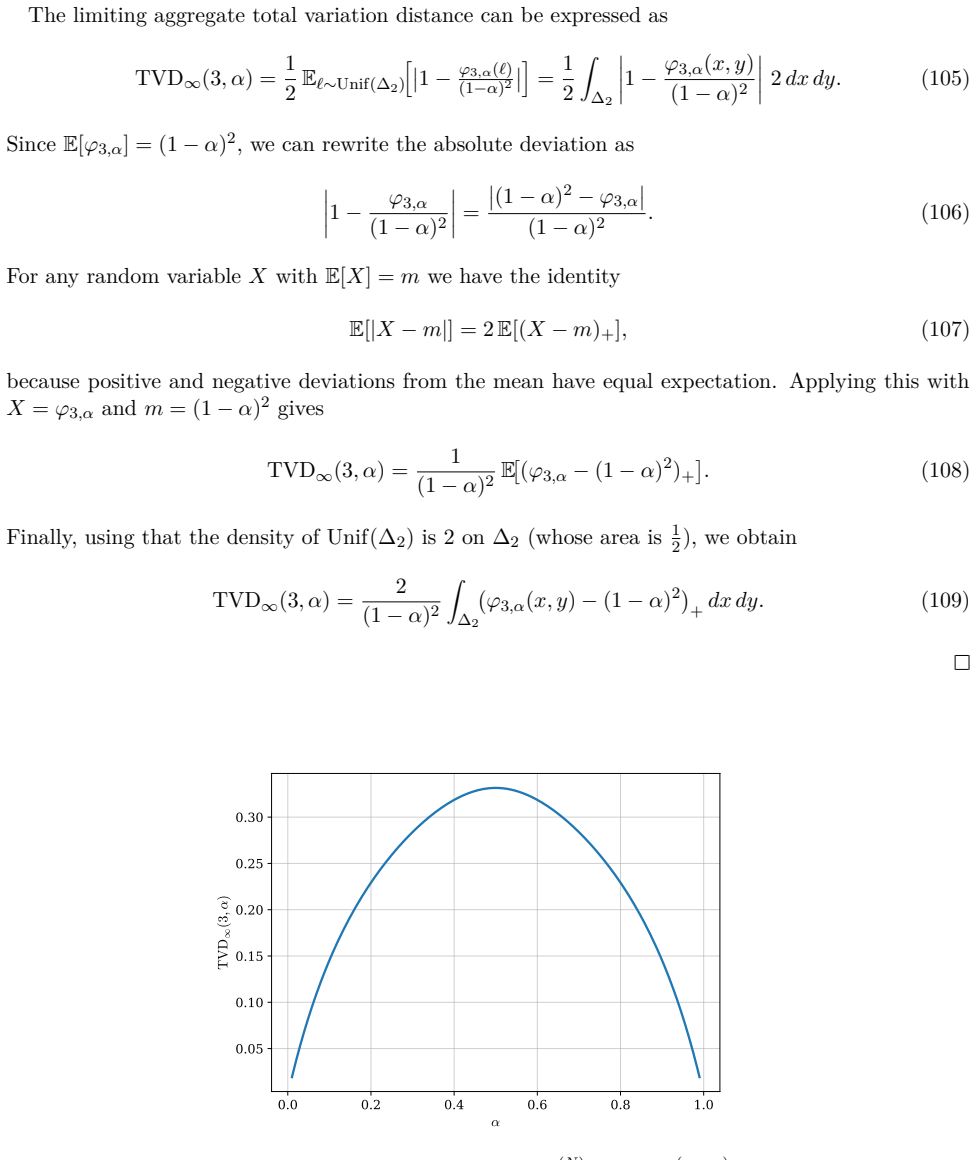
- Asymptotic expressions describe the scaling of the distance in the fixed-N large-d limit, the fixed-d large-N limit, the sparse joint-scaling limit, and the critical scaling limit.
Where Pith is reading between the lines
- The block-resolved law identified in the paper shows that retaining labels supplies strictly more distinguishing information than the aggregate case alone.
- The closed-form results enable direct comparison of measurement models without Monte-Carlo sampling for any finite N and d inside the analyzed regimes.
Load-bearing premise
The models are generated exactly by Haar-random unitaries and the aggregate histogram laws without block labels are the appropriate observable for the distinguishability task.
What would settle it
A direct computation or simulation of the total variation distance for concrete finite d and N in the regime N over square root d approaching c that deviates from the derived closed-form or asymptotic expression would falsify the central claim.
Figures
read the original abstract
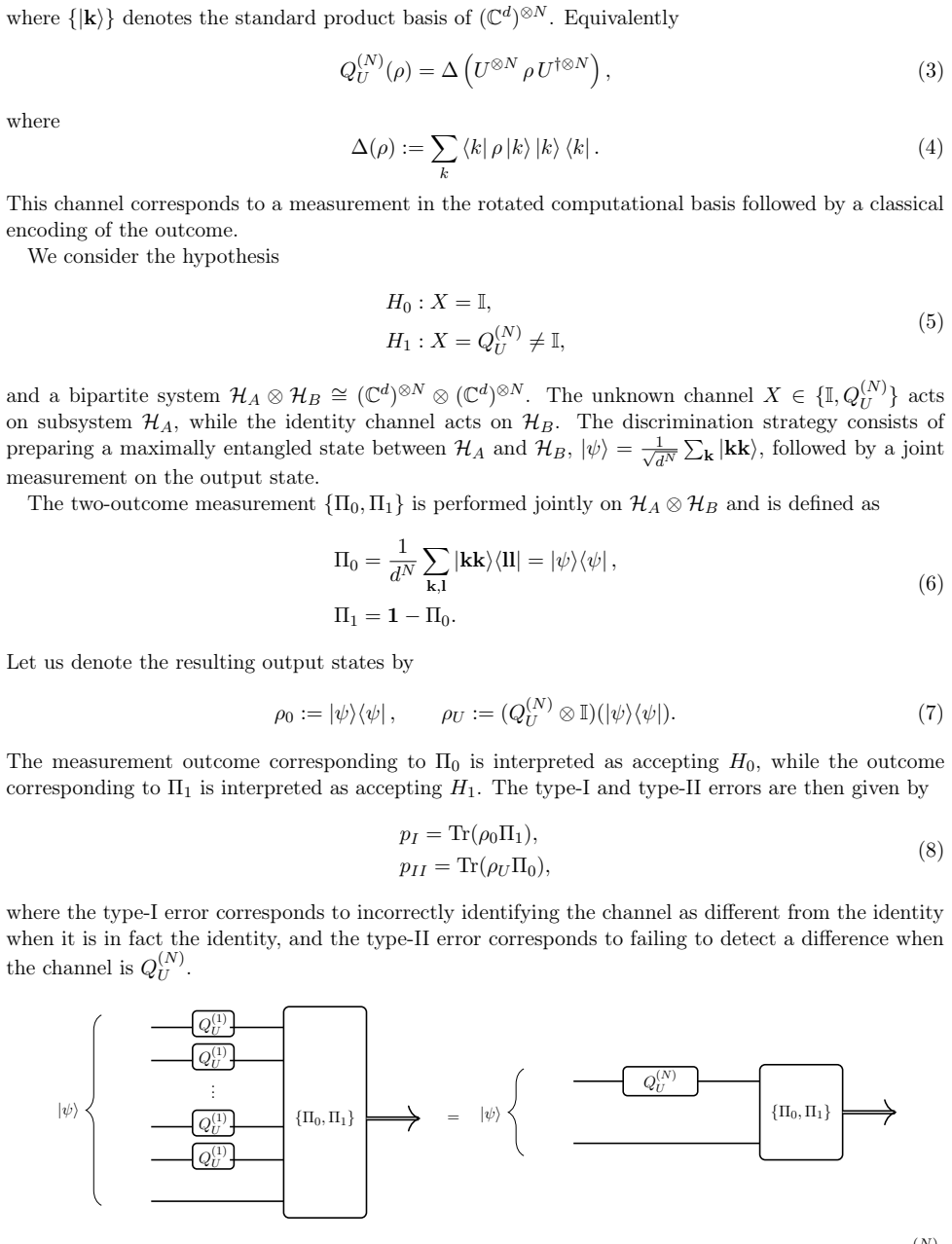
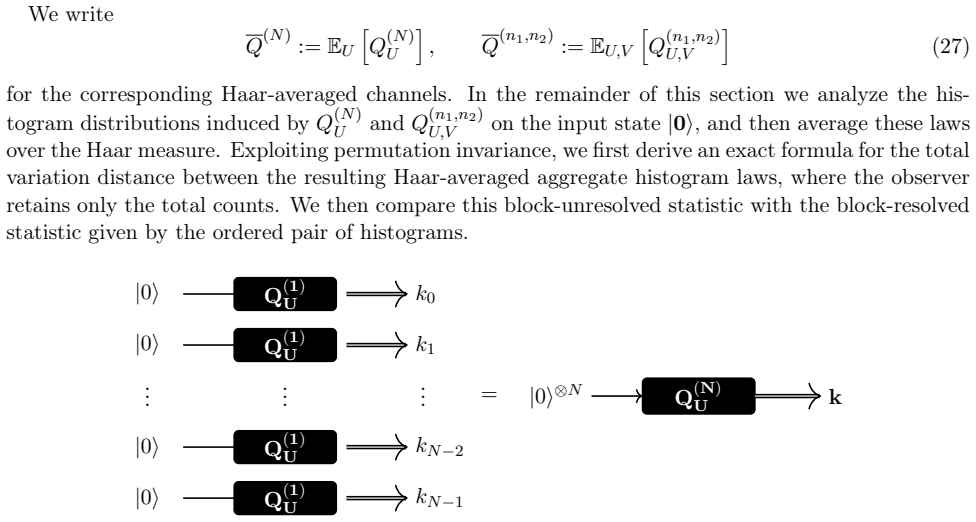
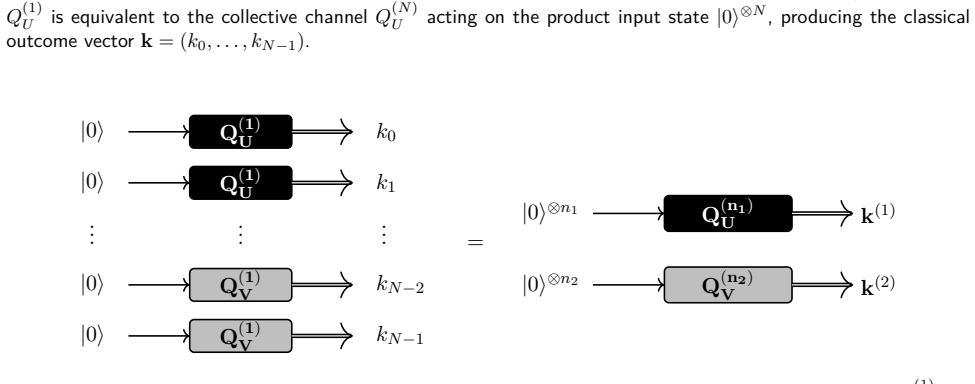
We study discrimination problems generated by the same basic Haar-random measurement mechanism at two observational levels. First, we derive an explicit expression for the type-II error in the task of discriminating a Haar-random measure-and-prepare channel from the identity channel $\mathbb{I}$, using a coherence-sensitive entangled tester. Second, after passing to the induced classical measurement records, we compare two random measurement models: one induced by a single collective unitary of the form $U^{\otimes (n_1+n_2)}$ with $U\in U(d)$, and another induced by independent local unitaries $U_1^{\otimes n_1}\otimes U_2^{\otimes n_2}$. For the associated Haar-averaged aggregate histogram laws, in which the block of origin of each count is not retained, we obtain closed-form formulas and quantify their discrepancy through the total variation distance. We derive asymptotic expressions in the fixed-$N$, large-$d$ regime, the fixed-$d$, large-$N$ regime, the sparse joint-scaling regime $N=o(\sqrt d)$, and the critical scaling regime $N/\sqrt d\to c$. We also identify the block-resolved pair-of-histograms law, showing that the aggregate total variation distance is a coarse-grained lower bound on the distinguishability available when block labels are retained.
Editorial analysis
A structured set of objections, weighed in public.
Referee Report
Summary. The paper derives an explicit expression for the type-II error when discriminating a Haar-random measure-and-prepare channel from the identity channel using a coherence-sensitive entangled tester. It then compares two Haar-averaged measurement models—one induced by a collective unitary U^{\otimes(n_1+n_2)} and one by independent local unitaries U_1^{\otimes n_1} \otimes U_2^{\otimes n_2}—via their aggregate (block-label-free) histogram laws, obtaining closed-form expressions for the total variation distance between these laws together with asymptotic expansions in the fixed-N large-d regime, the fixed-d large-N regime, the sparse regime N=o(\sqrt{d}), and the critical regime N/\sqrt{d}\to c. It additionally identifies the block-resolved pair-of-histograms law and shows that the aggregate TV distance is a lower bound on the distinguishability available when block labels are retained.
Significance. If the derivations hold, the work supplies precise closed-form and asymptotic characterizations of distinguishability for Haar-averaged quantum measurement models, which are relevant to quantum channel discrimination and classical post-processing of random unitary measurements. The explicit formulas, the four-regime asymptotic analysis, and the explicit lower-bound relation between aggregate and block-resolved distances constitute concrete strengths that could serve as reference results in quantum information theory.
minor comments (2)
- [Abstract] Abstract: the statement that the aggregate TV distance 'is a coarse-grained lower bound' is clear, but the precise sense in which it bounds the block-resolved distinguishability (e.g., whether it is the TV between the marginals or a different contraction) would benefit from a one-sentence clarification when first introduced.
- The four scaling regimes are listed in the abstract; a short paragraph early in the introduction that defines the parameters N (total copies) and d (dimension) and states the asymptotic ordering of each regime would improve readability for readers outside the immediate subfield.
Simulated Author's Rebuttal
We thank the referee for the positive summary, significance assessment, and recommendation of minor revision. No specific major comments were listed in the report, so we have no points to address individually at this stage. We will incorporate any minor editorial suggestions that may arise during the revision process.
Circularity Check
No significant circularity identified
full rationale
The paper derives explicit expressions for type-II error and closed-form total variation distances between Haar-averaged aggregate histogram laws, along with their asymptotics in multiple scaling regimes, directly from properties of the Haar measure on U(d) and integration over the induced classical records. These steps are self-contained mathematical computations on well-defined objects (Haar-random unitaries and multinomial-like histograms) without reduction to fitted parameters, self-referential definitions, or load-bearing self-citations. The aggregate TV distance is explicitly noted as a lower bound, which is a definitional modeling choice rather than a circular step. No load-bearing steps reduce to their own inputs by construction.
Axiom & Free-Parameter Ledger
axioms (2)
- standard math Properties of the Haar measure on the unitary group U(d)
- domain assumption Existence and usability of coherence-sensitive entangled testers for channel discrimination
Reference graph
Works this paper leans on
-
[1]
Quantum state discrimination
Anthony Chefles. “Quantum state discrimination”. Contemporary Physics41, 401–424 (2000)
2000
-
[2]
Quantum state discrimination
Stephen M Barnett and Sarah Croke. “Quantum state discrimination”. Advances in Optics and Photonics1, 238–278 (2009)
2009
-
[3]
Quantum detection and estimation theory
Carl W Helstrom. “Quantum detection and estimation theory”. Journal of statistical physics1, 231–252 (1969)
1969
-
[4]
Statistical decision theory for quantum systems
Alexander S Holevo. “Statistical decision theory for quantum systems”. Journal of multivariate analysis3, 337–394 (1973)
1973
-
[5]
Discrimination of two channels by adaptive methods and its application to quantum system
Masahito Hayashi. “Discrimination of two channels by adaptive methods and its application to quantum system”. IEEE Transactions on Information Theory55, 3807–3820 (2009)
2009
-
[6]
Ultimate limits for multiple quantum channel discrimi- nation
Quntao Zhuang and Stefano Pirandola. “Ultimate limits for multiple quantum channel discrimi- nation”. Phys. Rev. Lett.125, 080505 (2020)
2020
-
[7]
The theory of quantum information
John Watrous. “The theory of quantum information”. Cambridge University Press. (2018)
2018
-
[8]
Entanglement is not necessary for perfect discrimination between unitary operations
Runyao Duan, Yuan Feng, and Mingsheng Ying. “Entanglement is not necessary for perfect discrimination between unitary operations”. Phys. Rev. Lett.98, 100503 (2007)
2007
-
[9]
Perfect distinguishability of quantum opera- tions
Runyao Duan, Yuan Feng, and Mingsheng Ying. “Perfect distinguishability of quantum opera- tions”. Phys. Rev. Lett.103, 210501 (2009)
2009
-
[10]
Decision problems with quantum black boxes
Mark Hillery, Erika Andersson, Stephen M. Barnett, and Daniel Oi. “Decision problems with quantum black boxes”. Journal of Modern Optics57, 244–252 (2010)
2010
-
[11]
Optimal quantum discrimination of single-qubit unitary gates between two candidates
Akihito Soeda, Atsushi Shimbo, and Mio Murao. “Optimal quantum discrimination of single-qubit unitary gates between two candidates”. Phys. Rev. A104, 022422 (2021)
2021
-
[12]
Comparison of unknown unitary channels with multiple uses
Yutaka Hashimoto, Akihito Soeda, and Mio Murao. “Comparison of unknown unitary channels with multiple uses” (2022). arXiv:2208.12519
-
[13]
Strategies for op- timal single-shot discrimination of quantum measurements
Zbigniew Puchała, Łukasz Pawela, Aleksandra Krawiec, and Ryszard Kukulski. “Strategies for op- timal single-shot discrimination of quantum measurements”. Physical Review A98, 042103 (2018)
2018
-
[14]
Multiple-shot and unambiguous discrimination of von neumann measurements
Zbigniew Puchała, Łukasz Pawela, Aleksandra Krawiec, Ryszard Kukulski, and Michał Osz- maniec. “Multiple-shot and unambiguous discrimination of von neumann measurements”. Quan- tum5, 425 (2021)
2021
-
[15]
Discrimination and certification of unknown quantum measurements
Aleksandra Krawiec, Łukasz Pawela, and Zbigniew Puchała. “Discrimination and certification of unknown quantum measurements”. Quantum8, 1269 (2024)
2024
-
[16]
Unambiguous comparison of quantum mea- surements
Mario Ziman, Teiko Heinosaari, and Michal Sedlák. “Unambiguous comparison of quantum mea- surements”. Physical Review A—Atomic, Molecular, and Optical Physics80, 052102 (2009)
2009
-
[17]
Optimal single-shot strategies for discrimination of quantum measurements
Michal Sedlák and Mário Ziman. “Optimal single-shot strategies for discrimination of quantum measurements”. Physical Review A90, 052312 (2014)
2014
-
[18]
Symbolic integration with respect to the haar measure on the unitary group
Zbigniew Puchała and Jarosław Adam Miszczak. “Symbolic integration with respect to the haar measure on the unitary group” (2011). 25
2011
-
[19]
Integration with respect to the Haar measure on unitary, orthogonal and symplectic group
Benoît Collins and Piotr Śniady. “Integration with respect to the haar measure on unitary, or- thogonal and symplectic group”. Communications in Mathematical Physics264, 773–795 (2006). url:https://arxiv.org/abs/math-ph/0402073v1
work page internal anchor Pith review Pith/arXiv arXiv 2006
-
[20]
Theoretical framework for quantum networks
Giulio Chiribella, Giacomo Mauro D’Ariano, and Paolo Perinotti. “Theoretical framework for quantum networks”. Physical Review A—Atomic, Molecular, and Optical Physics80, 022339 (2009)
2009
-
[21]
Random positive operator valued measures
Teiko Heinosaari, Maria Anastasia Jivulescu, and Ion Nechita. “Random positive operator valued measures”. Journal of Mathematical Physics61(2020)
2020
-
[22]
Gen- erating random quantum channels
Ryszard Kukulski, Ion Nechita, Łukasz Pawela, Zbigniew Puchała, and Karol Życzkowski. “Gen- erating random quantum channels”. Journal of Mathematical Physics62(2021)
2021
-
[23]
Almost all quantum channels are equidistant
Ion Nechita, Zbigniew Puchała, Łukasz Pawela, and Karol Życzkowski. “Almost all quantum channels are equidistant”. Journal of Mathematical Physics59, 052201 (2018)
2018
-
[24]
Two moments suffice for poisson approximations: the chen-stein method
Richard Arratia, Larry Goldstein, and Louis Gordon. “Two moments suffice for poisson approximations: the chen-stein method”. The An- nals of ProbabilityPages 9–25 (1989). url:https://scispace.com/pdf/ two-moments-suffice-for-poisson-approximations-the-chen-2irpxe1jnb.pdf. A Weingarten calculus A.1 Evaluation of the integralI n,d We evaluate 1 d2NIN,d = 1 ...
1989
discussion (0)
Sign in with ORCID, Apple, or X to comment. Anyone can read and Pith papers without signing in.