Thermal chemical reactivity in Frenkel exciton-polariton cavities
Pith reviewed 2026-06-28 20:09 UTC · model grok-4.3
The pith
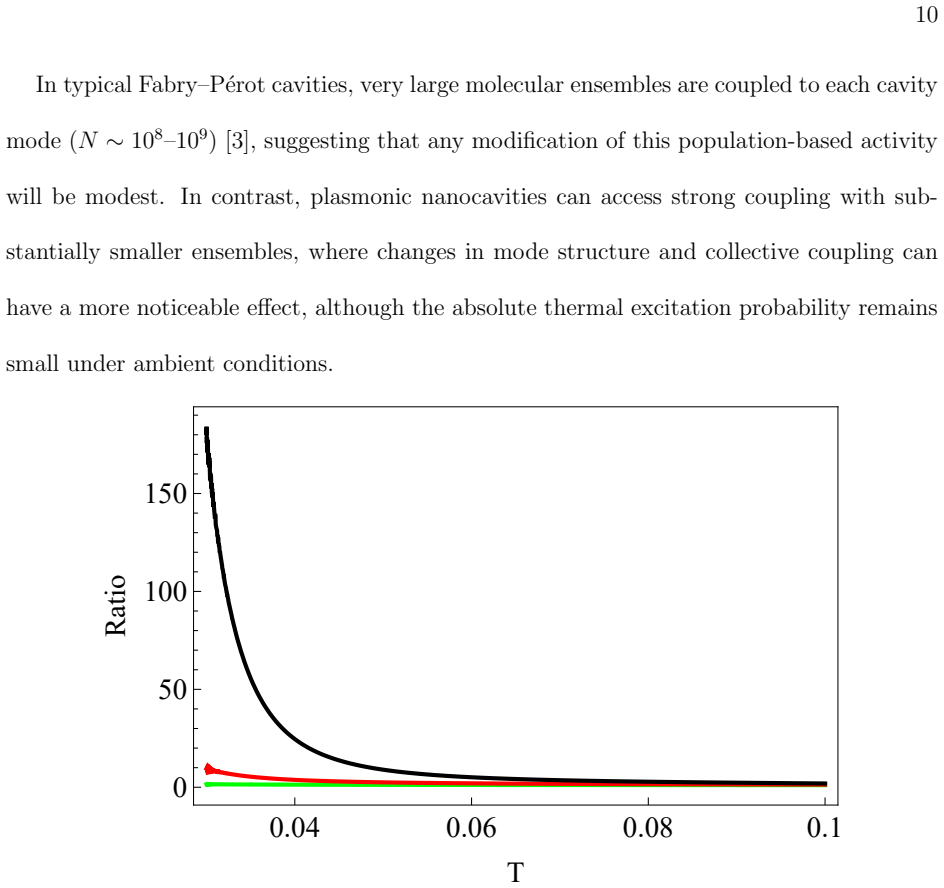
Cavity-induced changes in thermal chemical activity are largest for small molecular ensembles and grow with collective coupling at low temperatures.
A machine-rendered reading of the paper's core claim, the machinery that carries it, and where it could break.
Core claim
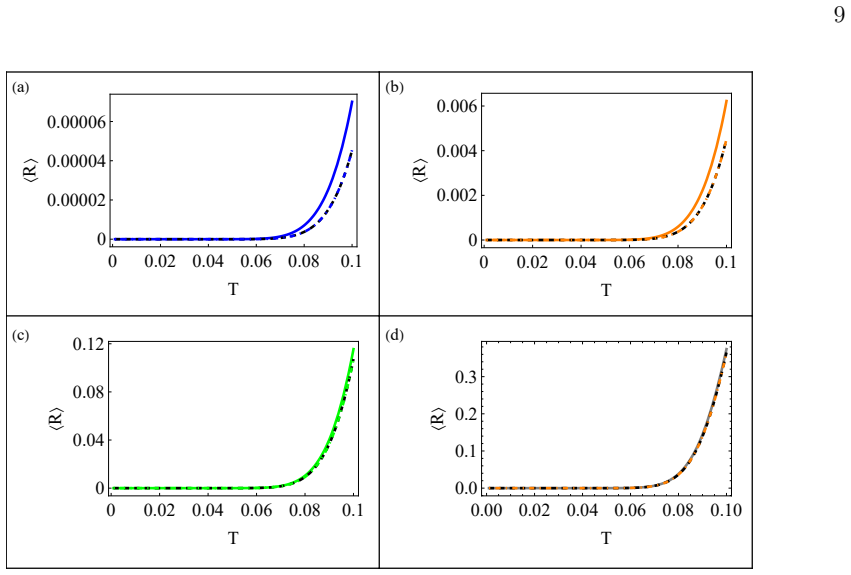
Within a generalized Tavis-Cummings description, the cavity-induced change in thermal chemical activity is most pronounced for small molecular ensembles (low areal density within a given cavity mode volume) and increases with the collective coupling strength (Rabi splitting), particularly at low temperatures.
What carries the argument
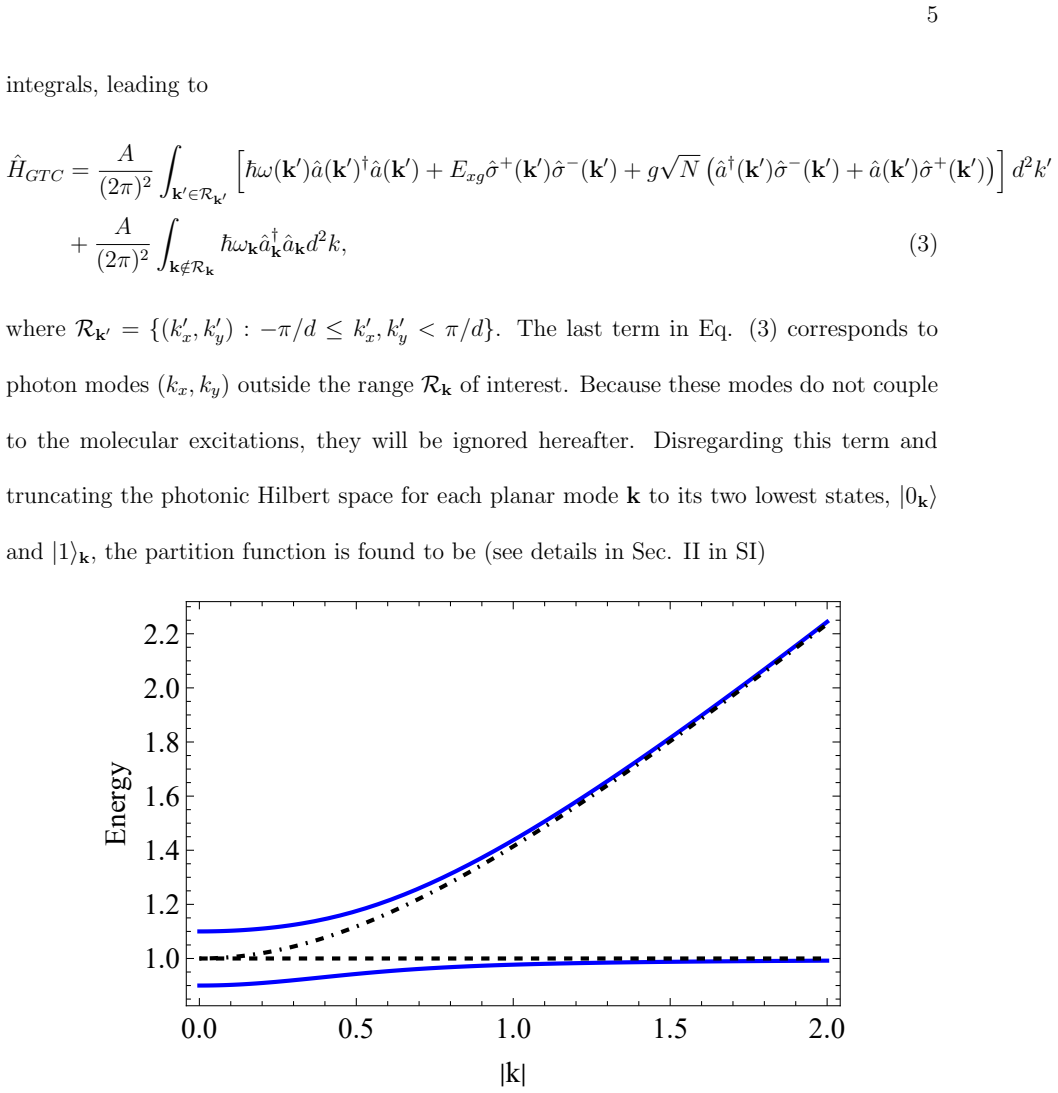
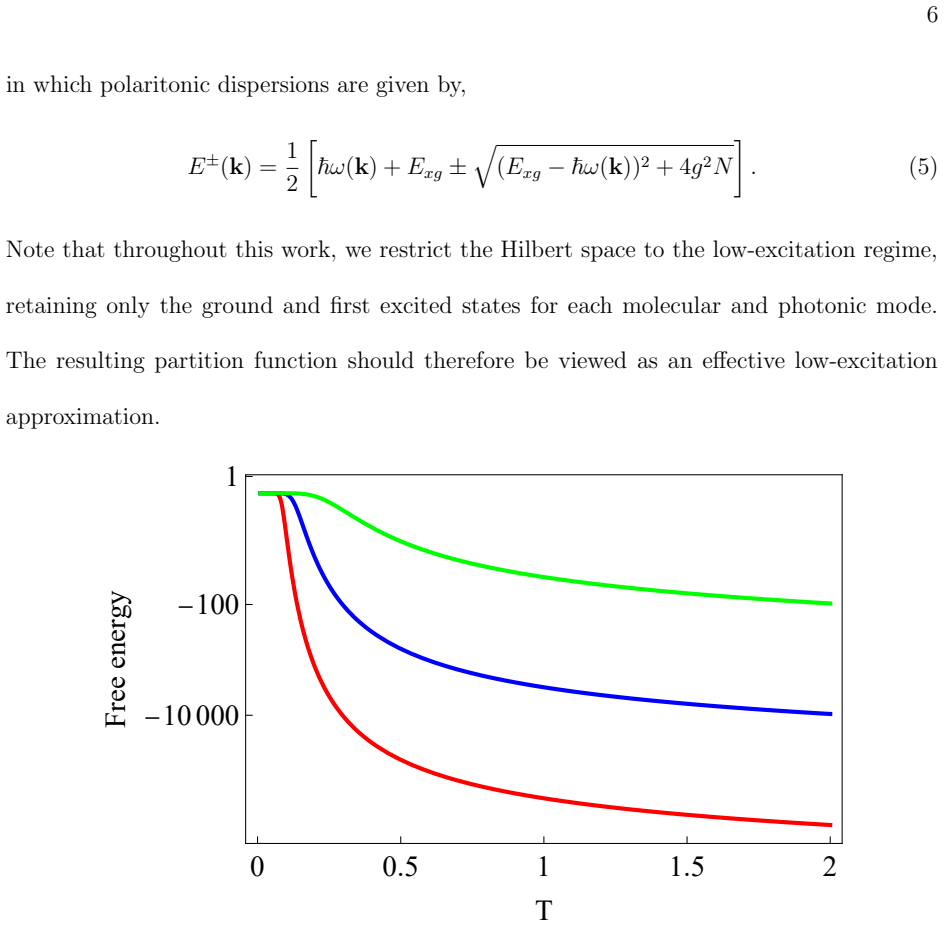
The generalized Tavis-Cummings model that incorporates polariton dispersion from the spatial distribution of molecules and computes the thermally averaged chemical activity from the equilibrium ensemble of polariton states.
If this is right
- Cavity modifications to reactivity are stronger for fewer molecules per cavity mode.
- The effect increases as the Rabi splitting becomes larger.
- Lower temperatures amplify the cavity-induced change.
- Proper accounting for in-plane wavevector dispersion is necessary to evaluate the modification accurately.
Where Pith is reading between the lines
- Experiments might observe larger effects by using dilute molecular films or low-density samples in cavities.
- The model could be extended to predict reactivity changes in other cavity geometries or with different molecular distributions.
- These findings suggest testing reactivity at cryogenic temperatures where thermal effects are minimized.
Load-bearing premise
The chemical activity is determined solely from the equilibrium distribution of polariton states without additional dissipative or non-radiative processes that could change the effective rates.
What would settle it
An experiment measuring the temperature dependence of a reaction rate for varying molecular densities inside versus outside a microcavity, checking whether the difference is largest at low density, low temperature, and high Rabi splitting.
Figures
read the original abstract
Hybrid light-matter states formed under strong coupling between molecular excitations and confined electromagnetic modes provide a potential route to modify chemical properties. Here we compute and compare a thermally averaged measure of molecular chemical activity for an equilibrium ensemble of molecules inside and outside a planar microcavity, explicitly accounting for the spatial distribution (and hence the in-plane wavevector dispersion) of the coupled light-matter states. Within a generalized Tavis-Cummings description, we find that the cavity-induced change in thermal chemical activity is most pronounced for small molecular ensembles (low areal density within a given cavity mode volume) and increases with the collective coupling strength (Rabi splitting), particularly at low temperatures. These results highlight the importance of the polariton dispersion and molecular-mode counting in assessing cavity modifications of thermally driven molecular reactivity.
Editorial analysis
A structured set of objections, weighed in public.
Referee Report
Summary. The manuscript computes a thermally averaged measure of molecular chemical activity for an equilibrium ensemble inside versus outside a planar microcavity, using a generalized Tavis-Cummings Hamiltonian that incorporates in-plane wavevector dispersion. The central claim is that the cavity-induced change is most pronounced at low areal molecular density (small ensembles), grows with collective Rabi splitting, and is stronger at low temperatures.
Significance. If the central claim holds within the stated model, the work usefully emphasizes the role of polariton dispersion and finite mode counting when evaluating cavity effects on thermal reactivity. The direct inside/outside comparison and explicit treatment of spatial distribution constitute a clear methodological strength relative to zero-dimensional models.
major comments (1)
- [Theoretical model and computational procedure] The thermally averaged chemical-activity measure is obtained directly from the equilibrium distribution over polariton eigenstates of the generalized Tavis-Cummings Hamiltonian (see the description following the abstract and the computational procedure in the main text). This construction is load-bearing for the reported trends with ensemble size and temperature; the manuscript must therefore state the precise functional form of the activity measure (e.g., which matrix element or energy difference is averaged) and explicitly justify the neglect of non-radiative, vibrational, or cavity-loss channels that would redistribute population outside the coherent manifold.
minor comments (1)
- [Results] Notation for the areal density and the collective Rabi splitting should be introduced once with a clear symbol and units in the first results paragraph.
Simulated Author's Rebuttal
We thank the referee for their careful reading and constructive comments on our manuscript. We address the single major comment below and have made revisions to improve clarity on the model details.
read point-by-point responses
-
Referee: The thermally averaged chemical-activity measure is obtained directly from the equilibrium distribution over polariton eigenstates of the generalized Tavis-Cummings Hamiltonian (see the description following the abstract and the computational procedure in the main text). This construction is load-bearing for the reported trends with ensemble size and temperature; the manuscript must therefore state the precise functional form of the activity measure (e.g., which matrix element or energy difference is averaged) and explicitly justify the neglect of non-radiative, vibrational, or cavity-loss channels that would redistribute population outside the coherent manifold.
Authors: We agree that an explicit functional form and justification for model assumptions will strengthen the presentation. In the revised manuscript we have inserted the precise definition of the activity measure as the Boltzmann-weighted average A = Σ_i p_i A_i, where p_i = exp(-E_i/k_B T)/Z with E_i the eigenenergies of the generalized Tavis-Cummings Hamiltonian and A_i the state-specific chemical activity taken as the inverse effective barrier (derived from the molecular excitation component of each polariton eigenstate). We have also added a paragraph in the methods section justifying the restriction to the coherent manifold: within the Tavis-Cummings framework we assume thermal equilibrium is reached inside the polariton subspace on the relevant timescales, with non-radiative, vibrational, and cavity-loss processes treated as perturbations that lie outside the model scope; their inclusion would require an open-system treatment that is noted as a limitation for future work. These changes clarify the construction without affecting the reported trends. revision: yes
Circularity Check
No circularity: direct computation of defined thermal average from model eigenstates
full rationale
The paper defines a thermally averaged measure of chemical activity and evaluates it by direct comparison of equilibrium ensembles inside versus outside the cavity, using the eigenstates and in-plane dispersion of the generalized Tavis-Cummings Hamiltonian. This construction is self-contained within the stated model assumptions and does not reduce any reported trend (dependence on ensemble size, Rabi splitting, or temperature) to a fitted parameter, self-citation chain, or definitional tautology. No equations or steps in the abstract or reader's summary exhibit the enumerated circularity patterns.
Axiom & Free-Parameter Ledger
free parameters (2)
- collective Rabi splitting
- areal molecular density
axioms (2)
- domain assumption Thermal average is performed over the equilibrium polariton states of the Tavis-Cummings Hamiltonian.
- domain assumption The chemical-activity measure can be extracted from the polariton eigenstates without additional rate equations or non-equilibrium dynamics.
Reference graph
Works this paper leans on
-
[1]
Kohler, J
B. Kohler, J. L. Krause, F. Raksi, K. R. Wilson, V. V. Yakovlev, R. M. Whitnell, and Y. Yan, Accounts of Chemical Research28, 133–140 (1995)
1995
-
[2]
F. F. Crim, Accounts of Chemical Research32, 877–884 (1999)
1999
-
[3]
A. D. Dunkelberger, B. S. Simpkins, I. Vurgaftman, and J. C. Owrutsky, Annual Review of Physical Chemistry73, 429–451 (2022)
2022
-
[4]
Raman spectroscopy: Theory,
G. Keresztury, “Raman spectroscopy: Theory,” in Handbook of Vibrational Spectroscopy (John Wiley & Sons, Ltd, 2006)
2006
-
[5]
Theory of infrared absorption and raman spectroscopy,
“Theory of infrared absorption and raman spectroscopy,” in Vibrational Spectroscopy in Life Science (John Wiley & Sons, Ltd, 2007) Chap. 2, pp. 11–61
2007
-
[6]
Nitzan and L
A. Nitzan and L. E. Brus, The Journal of Chemical Physics75, 2205–2214 (1981)
1981
-
[7]
Ueno and H
K. Ueno and H. Misawa, Journal of Photochemistry and Photobiology C: Photochemistry Reviews15, 31 (2013), next Generation Photochemistry from Asia
2013
-
[8]
Sukharev and A
M. Sukharev and A. Nitzan, Journal of Physics: Condensed Matter29, 443003 (2017)
2017
-
[9]
B. Cui and A. Nitzan, The Journal of Chemical Physics157(2022), 10.1063/5.0101528
-
[10]
Nagarajan, A
K. Nagarajan, A. Thomas, and T. W. Ebbesen, Journal of the American Chemical Society 143, 16877–16889 (2021). 14
2021
-
[11]
J. A. Hutchison, T. Schwartz, C. Genet, E. Devaux, and T. W. Ebbesen, Angewandte Chemie International Edition51, 1592–1596 (2012)
2012
-
[12]
Thomas, J
A. Thomas, J. George, A. Shalabney, M. Dryzhakov, S. J. Varma, J. Moran, T. Chervy, X. Zhong, E. Devaux, C. Genet, J. A. Hutchison, and T. W. Ebbesen, Angewandte Chemie International Edition55, 11462–11466 (2016)
2016
-
[13]
Thomas, L
A. Thomas, L. Lethuillier-Karl, K. Nagarajan, R. M. A. Vergauwe, J. George, T. Chervy, A. Shalabney, E. Devaux, C. Genet, J. Moran, and T. W. Ebbesen, Science363, 615–619 (2019)
2019
-
[14]
Thomas, A
A. Thomas, A. Jayachandran, L. Lethuillier-Karl, R. M. Vergauwe, K. Nagarajan, E. Devaux, C. Genet, J. Moran, and T. W. Ebbesen, Nanophotonics9, 249–255 (2019)
2019
-
[15]
Lather, P
J. Lather, P. Bhatt, A. Thomas, T. W. Ebbesen, and J. George, Angewandte Chemie Inter- national Edition58, 10635–10638 (2019)
2019
-
[16]
Nitzan, Chemical Dynamics in Condensed Phases, Oxford Graduate Texts (OUP Oxford, 2006)
A. Nitzan, Chemical Dynamics in Condensed Phases, Oxford Graduate Texts (OUP Oxford, 2006)
2006
-
[17]
T. E. Li, A. Nitzan, and J. E. Subotnik, The Journal of Chemical Physics152(2020), 10.1063/5.0006472
-
[18]
Feist, A
J. Feist, A. I. Fern´ andez-Dom´ ınguez, and F. J. Garc´ ıa-Vidal, Nanophotonics10, 477–489 (2020)
2020
-
[19]
G. D. Scholes, C. A. DelPo, and B. Kudisch, The Journal of Physical Chemistry Letters11, 6389–6395 (2020)
2020
-
[20]
Our calculations apply to localized Frenkel-type excitations, appropriate for organic materials in the strong-coupling regime. 15
-
[21]
J. Keeling and S. K´ ena-Cohen, Annual Review of Physical Chemistry71, 435 (2020), https://doi.org/10.1146/annurev-physchem-010920-102509
-
[22]
Cohen-Tannoudji, J
C. Cohen-Tannoudji, J. Dupont-Roc, and G. Grynberg, Atom—Photon Interactions: Basic Process and Appilcations (Wiley, 1998)
1998
-
[23]
Obviously, this is a very simplified reaction model that assumes that the reaction rate does not depend on the energy in the excited molecular manifold
-
[24]
Forn-D´ ıaz, L
P. Forn-D´ ıaz, L. Lamata, E. Rico, J. Kono, and E. Solano, Rev. Mod. Phys.91, 025005 (2019)
2019
-
[25]
Litinskaya, P
M. Litinskaya, P. Reineker, and V. Agranovich, Journal of Luminescence110, 364–372 (2004)
2004
-
[26]
V. N. Popov and S. A. Fedotov, Soviet Journal of Experimental and Theoretical Physics67, 535 (1988)
1988
discussion (0)
Sign in with ORCID, Apple, or X to comment. Anyone can read and Pith papers without signing in.