Topological Interstitial-Electron Conductor
Pith reviewed 2026-06-28 21:56 UTC · model grok-4.3
The pith
Insulating electrides can carry current via interstitial electrons moving along crystal void channels under weak electric fields.
A machine-rendered reading of the paper's core claim, the machinery that carries it, and where it could break.
Core claim
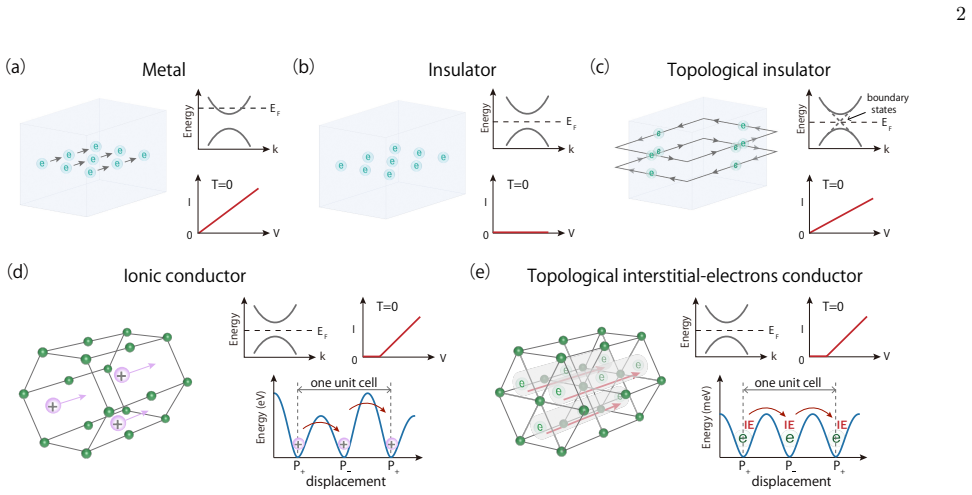
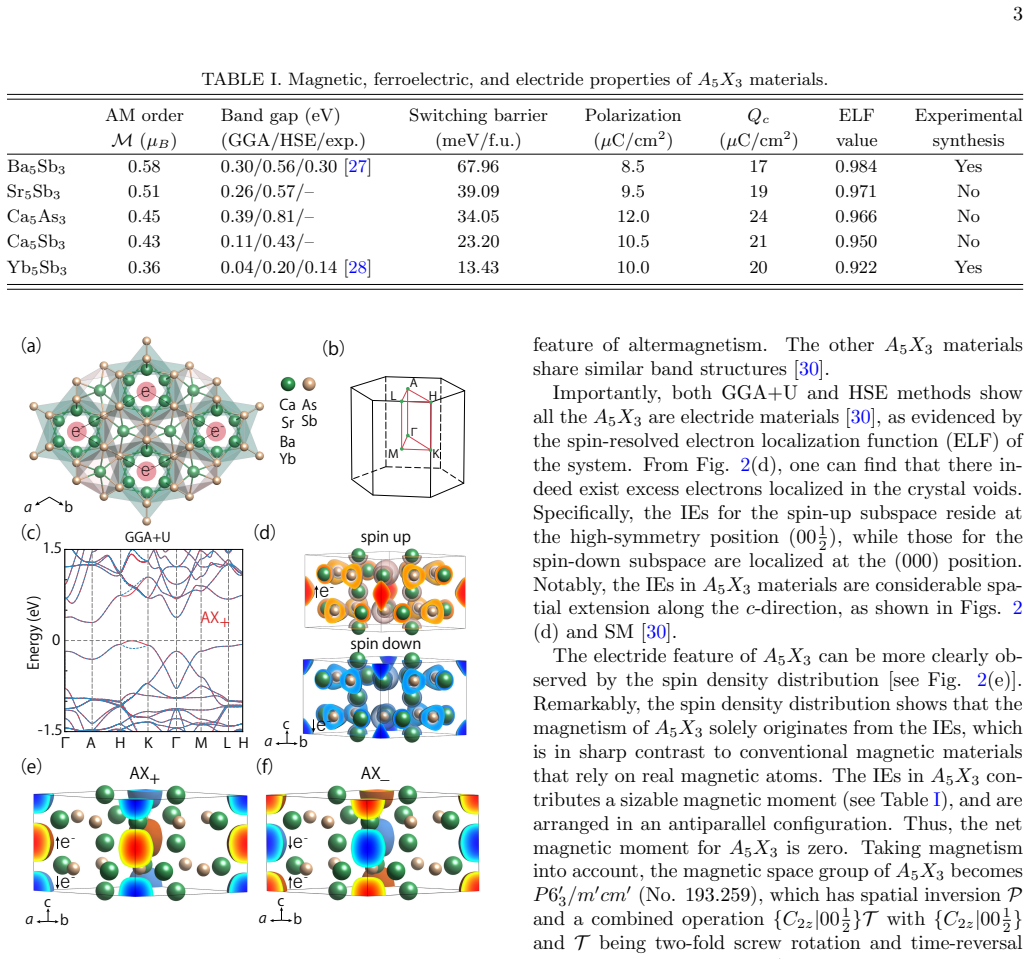
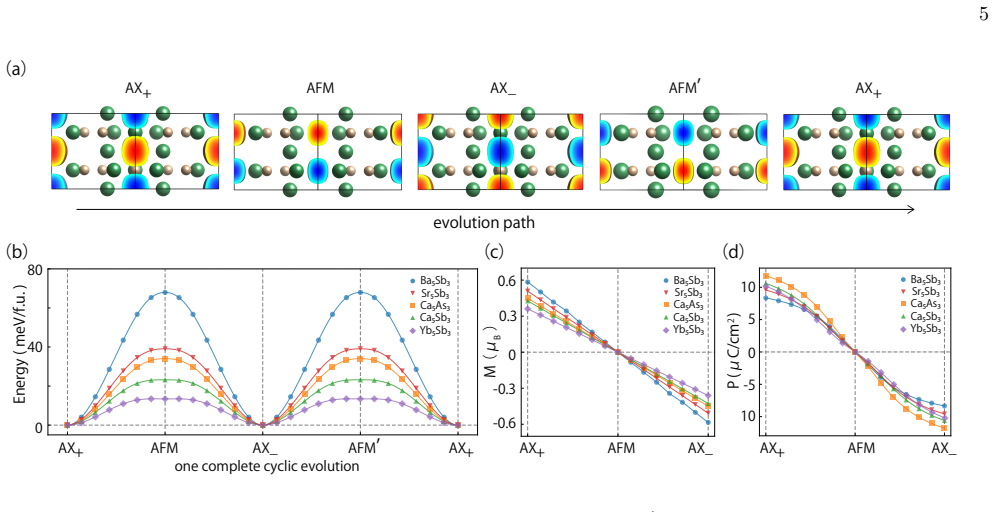
Topological interstitial-electron conductors are insulating electrides whose interstitial electrons occupy void channels that cross the entire unit cell; because the electrons are not tightly bound to ions they experience ultralow periodic potential barriers (13.43–67.96 meV per formula unit in A5X3), permitting a persistent current along the channels under a weak electric field far below dielectric breakdown, while the same periodic motion generates topological surface states that traverse the bulk gap at the perpendicular boundaries.
What carries the argument
The TIEC mechanism, in which interstitial electrons traverse void channels with ultralow periodic potential barriers and produce topological surface states when driven periodically.
If this is right
- A weak electric field applied to A5X3 crystals produces a persistent current carried by the interstitial electrons along the void channels.
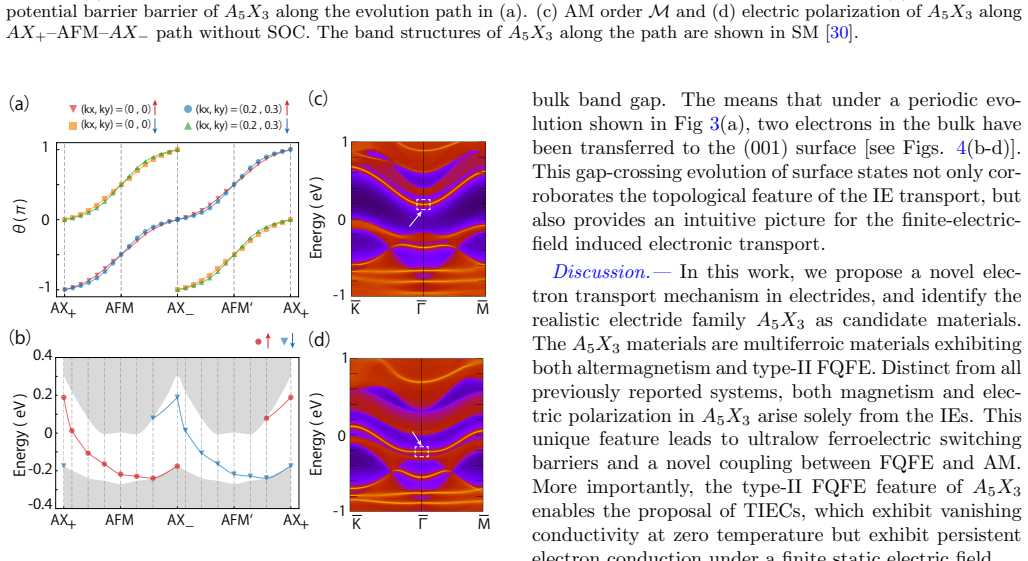
- Periodic motion of the interstitial electrons induces topological surface states at boundaries perpendicular to the channel direction.
- These surface states move continuously across the bulk band gap, providing a pumping-like transport that is consistent with band theory.
- The ultralow barrier heights make the predicted current observable in experiment without approaching dielectric breakdown.
Where Pith is reading between the lines
- Similar low-barrier void channels may exist in other electrides, extending the TIEC class beyond the A5X3 stoichiometry.
- The coexistence of altermagnetic order and channel conduction could produce spin-selective transport effects not examined in the paper.
- Device geometries that align electrodes with the void channels would be the natural testbed for the proposed low-power conduction.
Load-bearing premise
The interstitial electrons in the A5X3 materials experience periodic potential barriers low enough that a weak electric field can sustain a persistent current without reaching the dielectric breakdown threshold.
What would settle it
Direct measurement of anisotropic conductivity along the void-channel directions in single-crystal A5X3 samples under applied fields below the computed barrier values but without dielectric breakdown; lack of such field-induced channel current would falsify the claim.
Figures
read the original abstract
Electron transport in solids arises primarily from two mechanisms: freely moving bulk electrons in metals, and gapless boundary states in topological insulators. Here, we report a new mechanism discovered in electrides. The topological interstitial-electron conductors (TIECs) proposed here are insulating electrides, but host interstitial electrons (IEs) distributed within crystal voids that traverse the entire unit cell. Without being tightly bound to real ions, the IEs generally experience low periodic potential barrier along the void channels. As a consequence, by applying a weak electric field sufficient to overcome the IE barriers but far below the system's dielectric breakdown threshold, one can expect that the TIECs would generate a persistent current contributed by the IEs and propagating along the void channels. We identify a family of realistic altermagnetic electrides, $A_5X_3$ ($A$ = Ca, Sr, Ba, Yb; $X$ = As, Sb), as TIECs. Remarkably, for $A_5X_3$ materials, the periodic potential barrier of the IEs along the void channels are ultralow, ranging from 13.43 to 67.96 meV per formula unit. This renders our proposal readily accessible to experimental verification. We further demonstrate that when the IEs of $A_5X_3$ undergo periodic motion along the channels, topological surface states will emerge at the boundary perpendicular to the channel direction, and continuously move across the bulk band gap. This pumping-like behaviour not only corroborates the topological nature of TIECs, but also rationalizes the finite-electric-field induced electronic transport within the band theory. Our findings expand the classification of electronic conductors, uncover unexplored transport properties of electrides, and establish a new material platform for low-power electronic devices.
Editorial analysis
A structured set of objections, weighed in public.
Referee Report
Summary. The manuscript introduces topological interstitial-electron conductors (TIECs) as a new transport mechanism in insulating electrides. Interstitial electrons (IEs) occupy crystal voids that span the unit cell and experience low periodic potential barriers along these channels. Application of a weak electric field sufficient to surmount the barriers (but below dielectric breakdown) is predicted to produce persistent IE current along the channels. The authors identify the altermagnetic electrides A5X3 (A = Ca, Sr, Ba, Yb; X = As, Sb) as TIECs, reporting computed barriers of 13.43–67.96 meV per formula unit, and further claim that periodic IE motion induces topological surface states that traverse the bulk gap.
Significance. If the barrier-to-field conversion and breakdown comparison hold, the work would define a distinct class of conductors that combines features of electrides with topological pumping, offering a potential platform for low-power devices. The concrete material family and the link between channel motion and surface-state pumping are positive elements.
major comments (2)
- [Abstract and barrier-results section] Abstract and the section presenting the barrier values: the periodic potential barriers are reported only as energies per formula unit (13.43–67.96 meV/f.u.). The central claim that a weak field suffices to drive persistent current while remaining far below dielectric breakdown requires conversion to an electric-field strength via E_crit ≈ ΔE/(e·Δx), where Δx is the spatial period along the void channel. Neither Δx, the resulting E_crit values, nor a comparison to calculated or measured breakdown fields for A5X3 compounds is supplied; this quantitative step is load-bearing for the “weak field” and “readily accessible to experimental verification” assertions.
- [Methods/computational details] Computational-methods section (or equivalent): the manuscript provides no details on the DFT functional, k-point sampling, supercell construction for the barrier scan, convergence criteria, or error estimates on the reported barrier energies. Without these, the numerical support for the TIEC mechanism cannot be assessed.
minor comments (2)
- [Figures showing channel geometry] Figure captions and text should explicitly state the direction of the void channels relative to the crystal axes when discussing the barrier profile.
- [Introduction] The acronym TIEC is introduced in the abstract but should be defined at first use in the main text as well.
Simulated Author's Rebuttal
We thank the referee for the detailed and constructive report. The two major comments identify important omissions that affect the clarity and reproducibility of the central claims. We will revise the manuscript to address both points fully.
read point-by-point responses
-
Referee: [Abstract and barrier-results section] Abstract and the section presenting the barrier values: the periodic potential barriers are reported only as energies per formula unit (13.43–67.96 meV/f.u.). The central claim that a weak field suffices to drive persistent current while remaining far below dielectric breakdown requires conversion to an electric-field strength via E_crit ≈ ΔE/(e·Δx), where Δx is the spatial period along the void channel. Neither Δx, the resulting E_crit values, nor a comparison to calculated or measured breakdown fields for A5X3 compounds is supplied; this quantitative step is load-bearing for the “weak field” and “readily accessible to experimental verification” assertions.
Authors: We agree that the conversion from energy per formula unit to electric-field strength is necessary to substantiate the “weak field” and experimental-accessibility statements. In the revised manuscript we will extract the channel period Δx directly from the relaxed A5X3 structures, compute the corresponding E_crit values, and compare them with literature values for dielectric breakdown fields in related alkaline-earth pnictides (typically >10^6 V m^{-1}). This addition will be placed in a new subsection following the barrier results. revision: yes
-
Referee: [Methods/computational details] Computational-methods section (or equivalent): the manuscript provides no details on the DFT functional, k-point sampling, supercell construction for the barrier scan, convergence criteria, or error estimates on the reported barrier energies. Without these, the numerical support for the TIEC mechanism cannot be assessed.
Authors: We acknowledge that the computational protocol was not described. The revised manuscript will contain a dedicated “Computational Methods” subsection specifying the exchange-correlation functional, plane-wave cutoff, k-point meshes, supercell sizes employed for the one-dimensional potential scans along the void channels, electronic and ionic convergence thresholds, and the estimated uncertainty on the barrier heights obtained from convergence tests. revision: yes
Circularity Check
No significant circularity detected
full rationale
The paper derives its central claim from first-principles electronic-structure calculations that output the interstitial-electron potential barriers (quoted range 13.43–67.96 meV per formula unit). These computed quantities are independent inputs to the transport argument rather than quantities defined in terms of the target persistent-current or topological-pumping results. No self-definitional loop, fitted-input-renamed-as-prediction, or load-bearing self-citation chain appears in the provided text; the derivation therefore remains self-contained against external benchmarks.
Axiom & Free-Parameter Ledger
axioms (1)
- domain assumption Standard assumptions underlying density functional theory calculations of electronic potentials and band structures
invented entities (1)
-
Topological interstitial-electron conductor (TIEC)
no independent evidence
Reference graph
Works this paper leans on
-
[1]
and finally to (001) position, while the spin-down IEs evolve from (000) to (00 1
-
[2]
Interestingly, when the two IEs respectively moving to (00 1
and then to (00 1 2). Interestingly, when the two IEs respectively moving to (00 1
-
[3]
'."9 "9@
positions, the system become a high symmetric AFM phase withPTsymmetry [30]. The energy barriers along this path forA 5X3 materials range from 13.43 to 67.96 meV/f.u. [see Fig. 3(b) and Table I]. All the energy barrier are rather low, showing that the IE switching of all theA 5X3 materials proposed here are accessible in the experiment. The variation ofMa...
-
[4]
B. A. Bernevig and T. L. Hughes,Topological Insulators and Topological Superconductors(Princeton University Press, Princeton, 2013)
2013
-
[5]
Shen,Topological Insulators: Dirac Equation in Condensed Matter, Springer Series in Solid-State Sci- ences, Vol
S.-Q. Shen,Topological Insulators: Dirac Equation in Condensed Matter, Springer Series in Solid-State Sci- ences, Vol. 187 (Springer Singapore, Singapore, 2017)
2017
-
[6]
D. J. Thouless, Quantization of particle transport, Phys. Rev. B27, 6083 (1983)
1983
-
[7]
Energy2, 022001 (2020)
Ohno, Saneyuki and Banik, Ananya and Dewald, Georg F and Kraft, Marvin A and Krauskopf, Thorben and Minafra, Nicol´ o and Till, Paul and Weiss, Manuel and Zeier, Wolfgang G, Materials design of ionic conductors for solid state batteries, Prog. Energy2, 022001 (2020)
2020
-
[8]
X. Wang, Y. Ren, and M. Wu, Unconventional ferro- electricity with quantized polarizations in ionic conduc- tors: High-throughput screening, J. Phys. Chem. Lett. 13, 9552 (2022), pMID: 36201434
2022
-
[9]
Yan and M
Y. Yan and M. Wu, Ionic sliding ferroelectricity in layered ion conductors, Phys. Rev. Lett.135, 236801 (2025)
2025
-
[10]
J. L. Dye, Anionic electron in electrides, Nature365, 10 (1993)
1993
-
[11]
J. L. Dye, Electrides: early examples of quantum con- finement, Acc. Chem. Res.42, 1564 (2009)
2009
-
[12]
Hosono and M
H. Hosono and M. Kitano, Advances in materials and ap- plications of inorganic electrides, Chem. Rev.121, 3121 (2021)
2021
-
[13]
Zhang, W
X. Zhang, W. Meng, Y. Liu, X. Dai, G. Liu, and L. Kou, Magnetic electrides: High-throughput material screening, intriguing properties, and applications, J. Am. Chem. Soc.145, 5523 (2023)
2023
-
[14]
Zhou, J.-Y
J. Zhou, J.-Y. You, Y.-M. Zhao, Y. P. Feng, and L. Shen, Van der waals electrides, Acc. Chem. Res.57, 2572 (2024)
2024
-
[15]
R. H. Huang and J. L. Dye, Low temperature (- 80 c) thermionic electron emission from alkalides and elec- trides, Chem. Phys. Lett.166, 133 (1990)
1990
-
[16]
Y. Toda, S. W. Kim, K. Hayashi, M. Hirano, T. Kamiya, H. Hosono, T. Haraguchi, and H. Yasuda, Intense ther- mal field electron emission from room-temperature stable electride, Appl. Phys. Lett.87, 254103 (2005)
2005
-
[17]
Y. Shao, J. Zhang, C. Li, H. Zhang, J. Xu, T. Li, Y. Bai, and B. Wang, DFT Investigation of Strain-Controlled Magnetic Anisotropy in Electride [LaCl]2+·2e− Monolay- ers: Implications for Spintronic Applications, ACS Appl. Nano Mater.8, 6755 (2025)
2025
-
[18]
Rafiqul, C
I. Rafiqul, C. Weber, B. Lehmann, and A. Voss, En- ergy efficiency improvements in ammonia production- perspectives and uncertainties, Energy30, 2487 (2005)
2005
-
[19]
Kitano, Y
M. Kitano, Y. Inoue, H. Ishikawa, K. Yamagata, T. Nakao, T. Tada, S. Matsuishi, T. Yokoyama, M. Hara, and H. Hosono, Essential role of hydride ion in ruthenium-based ammonia synthesis catalysts, Chem. Sci.7, 4036 (2016)
2016
-
[20]
Kitano, Y
M. Kitano, Y. Inoue, M. Sasase, K. Kishida, Y. Kobayashi, K. Nishiyama, T. Tada, S. Kawa- mura, T. Yokoyama, M. Hara, and H. Hosono, Self- organized Ruthenium-Barium Core-Shell Nanoparticles on a Mesoporous Calcium Amide Matrix for Efficient Low-Temperature Ammonia Synthesis, Angew. Chem. Int. Ed.57, 2648 (2018)
2018
-
[21]
J. Wu, J. Li, Y. Gong, M. Kitano, T. Inoshita, and H. Hosono, Intermetallic electride catalyst as a platform for ammonia synthesis, Angew. Chem. Int. Ed.58, 825 (2019)
2019
-
[22]
J. Li, S. Inagi, T. Fuchigami, H. Hosono, and S. Ito, Selective monocarboxylation of olefins at 12CaO·7Al2O3 electride cathode, Electrochem. Commun.44, 45 (2014)
2014
-
[23]
K. Khan, A. K. Tareen, J. Li, U. Khan, A. Nairan, Y. Yuan, X. Zhang, M. Yang, and Z. Ouyang, Facile synthesis of tin-doped mayenite electride composite as a non-noble metal durable electrocatalyst for oxygen re- duction reaction (ORR), Dalton Trans47, 13498 (2018)
2018
-
[24]
W. Meng, X. Zhang, Y. Liu, X. Dai, G. Liu, Y. Gu, E. P. Kenny, and L. Kou, Multifold Fermions and Fermi Arcs Boosted Catalysis in Nanoporous Electride 12CaO·7Al2O3, Adv. Sci.10, 2205940 (2023)
2023
-
[25]
Hosono and M
H. Hosono and M. Kitano, Advances in materials and ap- plications of inorganic electrides, Chem. Rev.121, 3121 (2021), pMID: 33606511
2021
-
[26]
D. L. Druffel, K. L. Kuntz, A. H. Woomer, F. M. Alcorn, J. Hu, C. L. Donley, and S. C. Warren, Experimental Demonstration of an Electride as a 2D Material, J. Am. Chem. Soc.138, 16089 (2016), pMID: 27960319
2016
-
[27]
J. Wang, K. Hanzawa, H. Hiramatsu, J. Kim, N. Umezawa, K. Iwanaka, T. Tada, and H. Hosono, Ex- ploration of stable strontium phosphide-based electrides: Theoretical structure prediction and experimental vali- dation, J. Am. Chem. Soc.139, 15668 (2017)
2017
-
[28]
Zheng, T
Q. Zheng, T. Feng, J. A. Hachtel, R. Ishikawa, Y. Cheng, L. Daemen, J. Xing, J. C. Idrobo, J. Yan, N. Shibata, Y. Ikuhara, B. C. Sales, S. T. Pantelides, and M. Chi, Direct visualization of anionic electrons in an electride reveals inhomogeneities, Sci. Adv.7, eabe6819 (2021)
2021
-
[29]
Huang, K.-H
H. Huang, K.-H. Jin, S. Zhang, and F. Liu, Topological Electride Y2C, Nano Lett.18, 1972 (2018)
1972
-
[30]
Wolfe,Electrical resistivity of some Zintl phase and the precursors, Tech
L. Wolfe,Electrical resistivity of some Zintl phase and the precursors, Tech. Rep. (Ames Lab., Ames, IA (United States), 1990)
1990
-
[31]
Y. Lu, J. Wang, J. Li, J. Wu, S. Kanno, T. Tada, and H. Hosono, Realization of Mott-insulating electrides in dimorphic Yb5Sb3, Phys. Rev. B98, 125128 (2018)
2018
-
[32]
Y. Xu, L. Zheng, Y. Zhang, Z. Zhang, Q. Wang, Y. Zhang, L. Chen, C. Fang, B. Wan, and H. Gou, Strong electron correlation-induced Mott-insulating electrides of 7 Ae5X3 (Ae = Ca, Sr, and Ba; X = As and Sb), Matter Radiat. Extremes9, 037402 (2024)
2024
-
[33]
See Supplemental Material for the calculation methods, spin density distribution, surface states on the (001) surface, the band structures ofA 5X3 electrides calcu- lated from the HSE method, the electronic band struc- ture, switching energy barrier and electric polarization of A5X3 electrides without SOC and with SOC
-
[34]
ˇSmejkal, Libor and Sinova, Jairo and Jungwirth, Tomas, Beyond conventional ferromagnetism and antiferromag- netism: A phase with nonrelativistic spin and crystal rotation symmetry, Phys. Rev. X12, 031042 (2022)
2022
-
[35]
G. Yu, J. Ji, Y. Chen, C. Xu, and H. J. Xiang, Symmetry strategy for rapid discovery of abundant fractional quan- tum ferroelectrics, Phys. Rev. Lett.134, 016801 (2025)
2025
-
[36]
M. Q. Dong, B. Liu, Z. H. Dai, Z.-X. Guo, H. Xiang, and X.-G. Gong, Fractional quantum multiferroics from coupling of fractional quantum ferroelectricity and alter- magnetism, Phys. Rev. Lett.136, 136702 (2026)
2026
-
[37]
W. Luo, S. Deng, H. Xiang, and L. Bellaiche, Unified definition of ferroelectricity (2026), arXiv:2605.14328
Pith/arXiv arXiv 2026
-
[38]
J. Wang, J. B. Neaton, H. Zheng, V. Nagarajan, S. B. Ogale, B. Liu, D. Viehland, V. Vaithyanathan, D. G. Schlom, U. V. Waghmare, N. A. Spaldin, K. M. Rabe, M. Wuttig, and R. Ramesh, Epitaxial BiFeO 3 Multi- ferroic Thin Film Heterostructures, Science299, 1719 (2003)
2003
-
[39]
Y. K. Jeong, J.-H. Lee, S.-J. Ahn, S.-W. Song, H. M. Jang, H. Choi, and J. F. Scott, Structurally Tailored Hexagonal Ferroelectricity and Multiferroism in Epitax- ial YbFeO3 Thin-Film Heterostructures, J. Am. Chem. Soc.134, 1450 (2012)
2012
-
[40]
Mizoguchi, Y
H. Mizoguchi, Y. Muraba, D. C. Fredrickson, S. Matsu- ishi, T. Kamiya, and H. Hosono, The Unique Electronic Structure of Mg 2Si: Shaping the Conduction Bands of Semiconductors with Multicenter Bonding, Angew. Chem. Int. Ed.56, 10135 (2017)
2017
-
[41]
C. Liu, M. M. Mukta, B. Kang, and Q. Zhu, Semi- conducting electrides derived from sodalite: A first- principles study, ACS Omega10, 1635 (2025)
2025
-
[42]
J. Zhou, L. Shen, M. Yang, H. Cheng, W. Kong, and Y. P. Feng, Discovery of hidden classes of layered electrides by extensive high-throughput material screening, Chem. Mater.31, 1860 (2019)
2019
-
[43]
B. Wan, Y. Lu, Z. Xiao, Y. Muraba, J. Kim, D. Huang, L. Wu, H. Gou, J. Zhang, F. Gao, H.-k. Mao, and H. Hosono, Identifying quasi-2D and 1D electrides in yt- trium and scandium chlorides via geometrical identifica- tion, npj Comput. Mater.4, 77 (2018)
2018
-
[44]
J. D. F. Y. C. W. F. P. Z. C. W. Ji, Layered semicon- ducting electrides in p-block metal oxides, Front. Phys. 20, 024207 (2025)
2025
-
[45]
L. M. McRae, R. C. Radomsky, J. T. Pawlik, D. L. Druf- fel, J. D. Sundberg, M. G. Lanetti, C. L. Donley, K. L. White, and S. C. Warren, Sc 2C, a 2D Semiconducting Electride, J. Am. Chem. Soc.144, 10862 (2022)
2022
-
[46]
Y. Chen, G. Wang, H. Yuan, and H. Chen, A van der waals cacl semiconducting electrene and ferromag- netic half-metallicity induced by superhalogen decora- tion, Mater. Today Commun.32, 104176 (2022)
2022
discussion (0)
Sign in with ORCID, Apple, or X to comment. Anyone can read and Pith papers without signing in.