A unified study of the \(B_c\) meson: from spectrum and form factors to weak and radiative decays
Pith reviewed 2026-06-28 22:03 UTC · model grok-4.3
The pith
Spectroscopic wave functions fix the couplings for B_c weak decays and radiative transitions.
A machine-rendered reading of the paper's core claim, the machinery that carries it, and where it could break.
Core claim
The spectroscopic wave functions determine the short-distance couplings that enter both weak and electromagnetic observables, while the Regge analysis serves as a complementary global consistency test of the same dynamical picture.
What carries the argument
Screened potential model wave functions that supply inputs to mass-updated three-point QCD sum rules for decay calculations.
If this is right
- Weak decay widths to S-, P-, and D-wave charmonium states follow directly from the same wave functions used for the mass spectrum.
- Radiative E1 and M1 transition rates are fixed by the spectroscopic parameters without additional model inputs.
- Leptonic decay widths are determined consistently with the computed decay constants.
- Regge trajectories of the computed spectrum provide an independent test of the overall dynamical picture.
Where Pith is reading between the lines
- The same wave-function inputs could be reused for other doubly-heavy mesons by repeating only the mass update step.
- Future precision measurements of B_c branching fractions would directly test whether the controlled refit captures the dominant mass dependence.
- If the approach holds, sum-rule normalizations for heavy-meson transitions may be more stable under modest mass shifts than a full rederivation would suggest.
Load-bearing premise
Updating the heavy-quark masses and refitting only the overall normalization is enough to update the QCD sum-rule results without recomputing all perturbative and condensate contributions.
What would settle it
A measured branching fraction for B_c decay to a specific P-wave charmonium state that lies well outside the range predicted from the updated masses and wave functions.
Figures
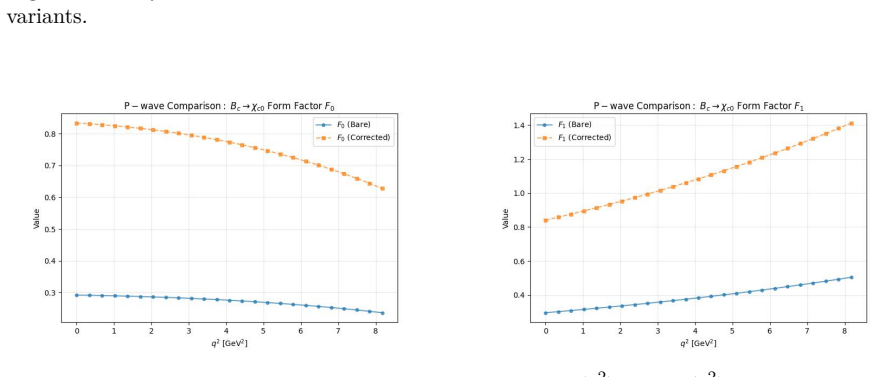
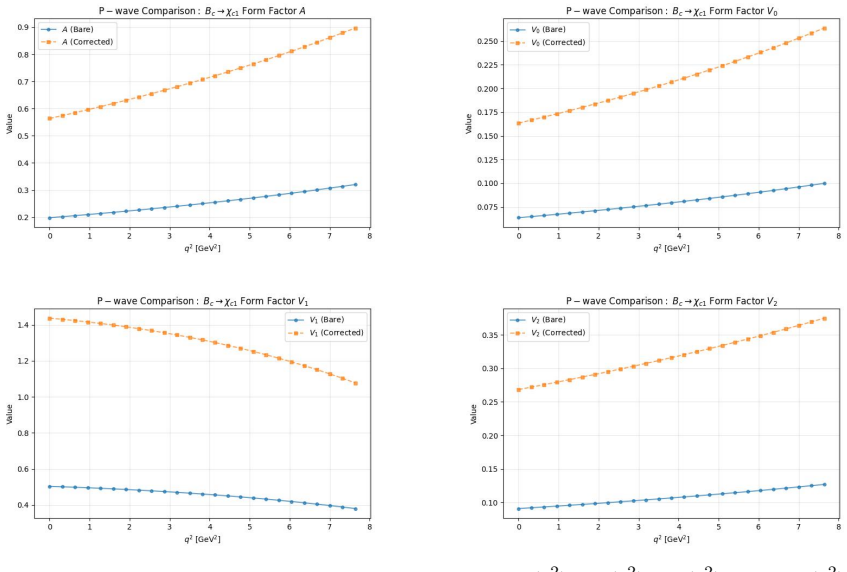
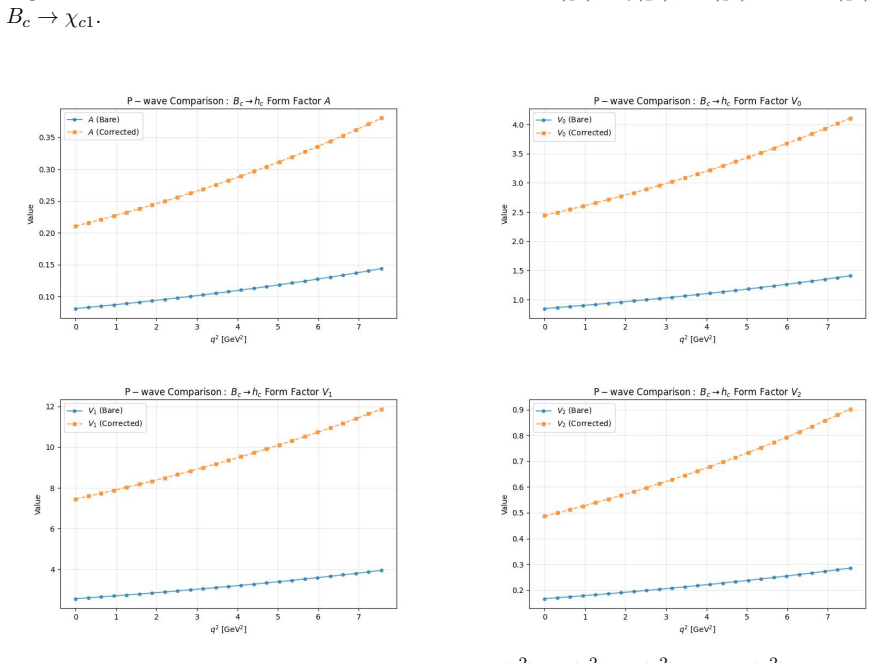
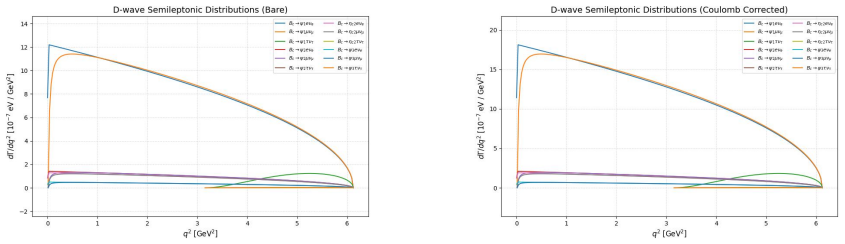
read the original abstract
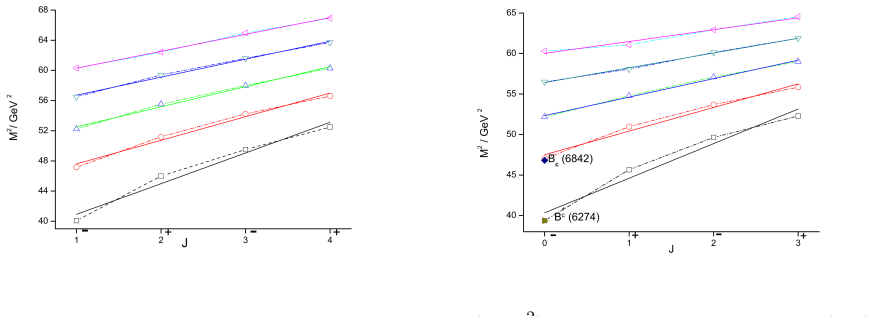
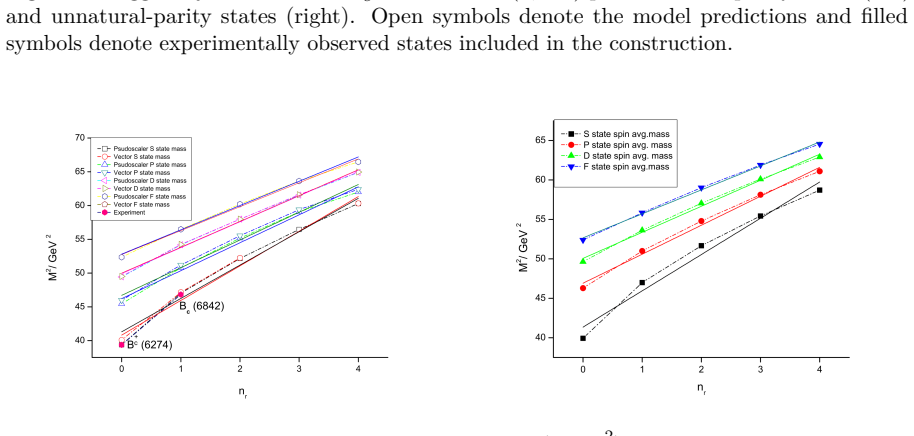
The $B_c$ meson constitutes a unique system for investigating heavy-hadron dynamics, since it exhibits quarkonium-like bound-state structure while decaying predominantly through weak interactions. In this work, we present a unified study of $B_c$-meson spectroscopy, decay constants, weak decays, radiative transitions, and Regge trajectories within a single framework. The mass spectrum is computed in a screened potential model including relativistic kinetic-energy corrections and spin-dependent interactions, from which we obtain both spin-averaged and spin-resolved states together with the corresponding pseudoscalar and vector decay constants. Using these spectroscopic inputs, we then analyze weak decays within a mass-updated three-point QCD sum-rule framework for transitions to $S$-, $P$-, and $D$-wave charmonium states, as well as to final states containing charmonium and $D^{(*)}_{(s)}$ mesons. In this part of the analysis, the hadronic thresholds, Borel-window prescriptions, Lorentz decompositions, and decay-width expressions of the underlying sum-rule formulations are retained, while the heavy-quark masses are updated to $m_c=1.48~\mathrm{GeV}$ and $m_b=4.90~\mathrm{GeV}$, leading to a controlled refit of the overall normalization rather than a full rederivation of all perturbative and condensate contributions. We further investigate purely leptonic decay widths and radiative $E1$ and $M1$ transitions, and examine the Regge behavior of the resulting spectrum. The present study therefore provides a coherent description of the $B_c$ meson in which the spectroscopic wave functions determine the short-distance couplings that enter both weak and electromagnetic observables, while the Regge analysis serves as a complementary global consistency test of the same dynamical picture.
Editorial analysis
A structured set of objections, weighed in public.
Referee Report
Summary. The paper claims to provide a unified description of the B_c meson by computing its mass spectrum and decay constants in a screened potential model with relativistic and spin-dependent corrections, then feeding these into a three-point QCD sum-rule analysis (with updated heavy-quark masses m_c=1.48 GeV, m_b=4.90 GeV and a controlled refit of overall normalization while retaining prior thresholds, Borel windows, and Lorentz structures) to obtain form factors and widths for weak decays to S-, P-, D-wave charmonia and D^{(*)}(s) states, supplemented by leptonic widths, E1/M1 radiative transitions, and a Regge-trajectory consistency check.
Significance. If the central results hold, the work supplies a coherent dynamical picture in which spectroscopic wave functions fix the short-distance couplings entering both weak and electromagnetic observables, with the Regge analysis providing an independent global test. The unified scope across spectrum, form factors, and multiple decay channels is a strength, as is the explicit retention of the underlying sum-rule structures for reproducibility.
major comments (1)
- [Abstract] Abstract (and the three-point QCD sum-rule framework section): the claim that spectroscopic inputs determine the short-distance couplings for weak decays rests on form factors obtained by updating only m_c and m_b and refitting the overall normalization while keeping all prior hadronic thresholds, Borel windows, and Lorentz decompositions. Because the perturbative spectral densities in three-point sum rules depend explicitly on the heavy-quark masses (and condensates enter with mass-dependent coefficients), this shortcut is load-bearing for the accuracy of the predicted weak widths and requires explicit justification or a full rederivation of the spectral densities.
minor comments (1)
- The abstract states that the Regge analysis serves as a 'complementary global consistency test'; a brief quantitative statement of how well the computed spectrum aligns with linear Regge trajectories (e.g., slope values or χ^{2}) would strengthen this claim.
Simulated Author's Rebuttal
We thank the referee for the thorough review and positive assessment of the unified approach in our manuscript. We provide a point-by-point response to the major comment below.
read point-by-point responses
-
Referee: [Abstract] Abstract (and the three-point QCD sum-rule framework section): the claim that spectroscopic inputs determine the short-distance couplings for weak decays rests on form factors obtained by updating only m_c and m_b and refitting the overall normalization while keeping all prior hadronic thresholds, Borel windows, and Lorentz decompositions. Because the perturbative spectral densities in three-point sum rules depend explicitly on the heavy-quark masses (and condensates enter with mass-dependent coefficients), this shortcut is load-bearing for the accuracy of the predicted weak widths and requires explicit justification or a full rederivation of the spectral densities.
Authors: We agree that the perturbative spectral densities in three-point sum rules depend on the heavy quark masses, and that a full rederivation would be the most rigorous approach. However, in our work, the spectroscopic inputs from the screened potential model are used to fix the B_c masses and decay constants, which serve as inputs to the sum rules. The update of m_c and m_b is done to be consistent with the model, and the refit of the normalization is performed to account for the changes in the spectral densities and condensate contributions. To address the referee's concern, we will include in the revised manuscript an additional subsection or paragraph in the QCD sum-rule framework section that provides explicit justification for this procedure. Specifically, we will discuss the mass dependence of the leading perturbative terms and show that the refit captures the dominant effects, supported by numerical checks on the stability of the results. This constitutes a partial revision as we add the requested justification without performing a complete rederivation of all terms. revision: partial
Circularity Check
Normalization refit after mass update in three-point QCD sum-rules makes form factors partly fitted by construction
specific steps
-
fitted input called prediction
[Abstract]
"the hadronic thresholds, Borel-window prescriptions, Lorentz decompositions, and decay-width expressions of the underlying sum-rule formulations are retained, while the heavy-quark masses are updated to m_c=1.48 GeV and m_b=4.90 GeV, leading to a controlled refit of the overall normalization rather than a full rederivation of all perturbative and condensate contributions"
The refit of overall normalization after the mass update means the form factors (short-distance couplings) entering the weak-decay predictions are scaled to match data or prior results inside the same sum-rule setup. Because the perturbative spectral densities depend explicitly on the heavy-quark masses, this shortcut forces the outputs to be consistent with the fit rather than providing an independent derivation from the spectroscopic wave functions.
full rationale
The paper's unified claim rests on spectroscopic wave functions feeding into short-distance couplings via three-point sum-rules for weak decays. However, the abstract explicitly states that only masses are updated while retaining prior thresholds/Borel windows and performing a controlled refit of overall normalization instead of rederiving perturbative densities and condensates. This directly matches the fitted_input_called_prediction pattern: the refit adjusts the output to data within the framework, so subsequent decay-width predictions are statistically forced rather than independently derived from the potential-model inputs. No other patterns (self-definitional, self-citation load-bearing, etc.) are exhibited in the provided text. The central derivation therefore contains partial circularity but retains independent content from the spectrum calculation.
Axiom & Free-Parameter Ledger
free parameters (3)
- m_c =
1.48 GeV
- m_b =
4.90 GeV
- overall normalization
axioms (2)
- domain assumption The screened potential model with relativistic kinetic-energy corrections and spin-dependent interactions accurately reproduces the B_c spectrum and wave functions.
- domain assumption Retaining the hadronic thresholds, Borel-window prescriptions, and Lorentz decompositions of prior sum-rule formulations remains valid after the mass update.
Reference graph
Works this paper leans on
-
[1]
Masses of new particles containingb quarks,
W.-K. Kwong and J. L. Rosner, “Masses of new particles containingb quarks,” Phys. Rev. D44, 212 (1991)
1991
-
[2]
Mesons with beauty and charm: Spectroscopy,
E. J. Eichten and C. Quigg, “Mesons with beauty and charm: Spectroscopy,” Phys. Rev. D49, 5845 (1994)
1994
-
[3]
Bc spectroscopy,
S. S. Gershtein, V. V. Kiselev, A. K. Likhoded and A. V. Tkabladze, “Bc spectroscopy,” Phys. Rev. D51, 3613 (1995)
1995
-
[4]
Bc spectroscopy in a quantum chromodynamic potential model,
S. N. Gupta and J. M. Johnson, “Bc spectroscopy in a quantum chromodynamic potential model,” Phys. Rev. D53, 312 (1996)
1996
-
[5]
TheBc mass up to orderα4 s,
N. Brambilla and A. Vairo, “TheBc mass up to orderα4 s,” Phys. Rev. D62, 094019 (2000)
2000
-
[6]
Spectroscopy ofBc mesons in the relativized quark model,
S. Godfrey, “Spectroscopy ofBc mesons in the relativized quark model,” Phys. Rev. D70, 054017 (2004). 38
2004
-
[7]
Spectroscopy and Regge trajectories of heavy quarkonia andBc mesons,
D. Ebert, R. N. Faustov and V. O. Galkin, “Spectroscopy and Regge trajectories of heavy quarkonia andBc mesons,” Eur. Phys. J. C71, 1825 (2011)
2011
-
[8]
Excited bottom-charmed mesons in a nonrelativistic quark model,
Q. Li, M.-S. Liu, L.-S. Lu, Q.-F. Lü, L.-C. Gui and X.-H. Zhong, “Excited bottom-charmed mesons in a nonrelativistic quark model,” Phys. Rev. D99, 096020 (2019)
2019
-
[9]
Unravelling theoretical challenges in understanding Bc mesons,
S. Patnaik, S. Tripathy and A. K. Rai, “Unravelling theoretical challenges in understanding Bc mesons,” arXiv:2411.11413 [hep-ph]
-
[10]
The production ofBc or ¯Bc meson associated with two heavy-quark jets inZ0 boson decay,
C.-H. Chang and Y.-Q. Chen, “The production ofBc or ¯Bc meson associated with two heavy-quark jets inZ0 boson decay,” Phys. Rev. D46, 3845 (1992)
1992
-
[11]
The decays ofBc meson,
C.-H. Chang and Y.-Q. Chen, “The decays ofBc meson,” Phys. Rev. D49, 3399 (1994)
1994
-
[12]
Physics ofBc mesons,
S. S. Gershtein, V. V. Kiselev, A. K. Likhoded and A. V. Tkabladze, “Physics ofBc mesons,” Phys. Usp.38, 1 (1995)
1995
-
[13]
Bc decays and lifetime in QCD sum rules,
V. V. Kiselev, A. E. Kovalsky and A. K. Likhoded, “Bc decays and lifetime in QCD sum rules,” Nucl. Phys. B585, 353 (2000)
2000
-
[14]
Properties of heavy quarkonia andBc mesons in the relativistic quark model,
D. Ebert, R. N. Faustov and V. O. Galkin, “Properties of heavy quarkonia andBc mesons in the relativistic quark model,” Phys. Rev. D67, 014027 (2003)
2003
-
[15]
Semileptonic and nonleptonicBc decays,
A. Abd El-Hady, J. H. Munoz and J. P. Vary, “Semileptonic and nonleptonicBc decays,” Phys. Rev. D62, 014019 (2000)
2000
-
[16]
Exclusive semileptonic and nonleptonic decays of theBc meson,
M. A. Ivanov, J. G. Korner and P. Santorelli, “Exclusive semileptonic and nonleptonic decays of theBc meson,” Phys. Rev. D73, 054024 (2006)
2006
-
[17]
Bc mesons and their properties on the light front,
S. Tang, Y. Li, P. Maris and J. P. Vary, “Bc mesons and their properties on the light front,” Phys. Rev. D98, 114038 (2018)
2018
-
[18]
Bc→J/ψform factors for the fullq2 range from lattice QCD,
J. Harrison, C. T. H. Davies and A. Lytle [HPQCD Collaboration], “Bc→J/ψform factors for the fullq2 range from lattice QCD,” Phys. Rev. D102, 094518 (2020)
2020
-
[19]
Relations among Bc→J/ψ,ηc form factors,
P. Colangelo, F. De Fazio, F. Loparco, N. Losacco and M. N. Brunet, “Relations among Bc→J/ψ,ηc form factors,” JHEP09, 028 (2022)
2022
-
[20]
Spectroscopy ofBc mesons and the possibility of finding exoticBc-like structures,
P. G. Ortega, J. Segovia, D. R. Entem and F. Fernandez, “Spectroscopy ofBc mesons and the possibility of finding exoticBc-like structures,” Eur. Phys. J. C80, 223 (2020)
2020
-
[21]
Spectroscopic survey of higher-lying states of theB c meson family,
X.-J. Li, Y.-S. Li, F.-L. Wang and X. Liu, “Spectroscopic survey of higher-lying states of theB c meson family,” Eur. Phys. J. C83, 1148 (2023)
2023
-
[22]
Kaon and strangeonium spectrum in Regge phenomenology,
J. Oudichhya, K. Gandhi and A. K. Rai, “Kaon and strangeonium spectrum in Regge phenomenology,” Phys. Rev. D108, 014034 (2023)
2023
-
[23]
Spectroscopic study of D-meson in Regge phenomenology,
J. Oudichhya and A. K. Rai, “Spectroscopic study of D-meson in Regge phenomenology,” Int. J. Mod. Phys. A39, 2443004 (2024)
2024
-
[24]
Spectroscopic study of charm-strange meson in Regge phenomenology,
J. Oudichhya and A. K. Rai, “Spectroscopic study of charm-strange meson in Regge phenomenology,” PoS(HQL2023)090 (2024)
2024
-
[25]
Strangeonium spectra in Regge phenomenology,
J. Oudichhya and A. K. Rai, “Strangeonium spectra in Regge phenomenology,” DAE Symp. Nucl. Phys.68, 897–898 (2025)
2025
-
[26]
Kaon Spectroscopy within Regge Phenomenology,
J. Oudichhya, R. Tiwari, V. Patel and A. K. Rai, “Kaon Spectroscopy within Regge Phenomenology,” DAE Symp. Nucl. Phys.69, 851–852 (2026). 39
2026
-
[27]
Spectroscopic Exploration of Charmed-Strange Meson Using Regge Phenomenology,
J. Oudichhya and A. K. Rai, “Spectroscopic Exploration of Charmed-Strange Meson Using Regge Phenomenology,” inProceedings of the XXVI DAE-BRNS High Energy Physics (HEP) Symposium 2024, 19–23 December, Varanasi, India, Springer Proc. Phys.432, 896–899 (2026)
2024
-
[28]
Spectroscopic properties ofD-meson using screened potential,
V. Patel, R. Chaturvedi and A. K. Rai, “Spectroscopic properties ofD-meson using screened potential,” Eur. Phys. J. Plus136, no.1, 42 (2021), doi:10.1140/epjp/s13360-020-01039-7
-
[29]
Interpreting charm-strange mesons with a screened potential model,
V. Patel, K. Gandhi and A. K. Rai, “Interpreting charm-strange mesons with a screened potential model,” Few Body Syst.62, no.3, 68 (2021), doi:10.1007/s00601-021-01651-y
-
[30]
Spectroscopic properties ofB and Bs meson using screened potential,
V. Patel, R. Chaturvedi and A. K. Rai, “Spectroscopic properties ofB and Bs meson using screened potential,” Indian J. Phys.98, no.8, 2961–2979 (2024), doi:10.1007/s12648- 023-03048-5, arXiv:2201.01120 [hep-ph]
-
[31]
Exploring strangeonium meson and all strange tetraquark candidates through mass spectra and decay properties,
C. Lodha and A. K. Rai, “Exploring strangeonium meson and all strange tetraquark candidates through mass spectra and decay properties,” Eur. Phys. J. Plus139, 663 (2024)
2024
-
[32]
Exploring charm bound states: Mass spectra and decay dynamics of D mesons andcq¯q¯qtetraquarks,
C. Lodha, M. G. Parmar and A. K. Rai, “Exploring charm bound states: Mass spectra and decay dynamics of D mesons andcq¯q¯qtetraquarks,” Int. J. Mod. Phys. A40, 2550125 (2025)
2025
-
[33]
Probing Kaons as Light-Strange Tetraquarks through Spectral and Decay Dynamics,
C. Lodha and A. K. Rai, “Probing Kaons as Light-Strange Tetraquarks through Spectral and Decay Dynamics,” arXiv:2505.01195 [hep-ph]
-
[34]
Investigation of Mass and Decay Characteristics of the All-light Tetraquark,
C. Lodha and A. K. Rai, “Investigation of Mass and Decay Characteristics of the All-light Tetraquark,” Few-Body Syst.65, 99 (2024)
2024
-
[35]
Investigation of mass and decay characteristics of the light-strange tetraquark,
C. Lodha and A. K. Rai, “Investigation of mass and decay characteristics of the light-strange tetraquark,” Indian J. Phys.99, 3055–3081 (2025)
2025
-
[36]
Spectroscopy ofcc¯c¯cand ss¯c¯ctetraquarks within the framework of Regge phenomenology,
V. Patel, J. Oudichhya and A. K. Rai, “Spectroscopy ofcc¯c¯cand ss¯c¯ctetraquarks within the framework of Regge phenomenology,” Few Body Syst.66, no.4, 39 (2025), doi:10.1007/s00601-025-02011-w, arXiv:2511.02279 [hep-ph]
-
[37]
Spectroscopic study ofss¯b¯b and bb¯b¯b tetraquarks using Regge phenomenology,
V. Patel, J. Oudichhya and A. K. Rai, “Spectroscopic study ofss¯b¯b and bb¯b¯b tetraquarks using Regge phenomenology,” Int. J. Mod. Phys. A40, no.31, 2550152 (2025), doi:10.1142/S0217751X25501520, arXiv:2509.23149 [hep-ph]
-
[38]
Mass spectra ofqq¯q¯q,ss¯s¯sandqq¯s¯stetraquarks us- ing Regge phenomenology,
V. Patel, J. Oudichhya and A. K. Rai, “Mass spectra ofqq¯q¯q,ss¯s¯sandqq¯s¯stetraquarks us- ing Regge phenomenology,” Eur. Phys. J. A61, no.9, 218 (2025), doi:10.1140/epja/s10050- 025-01701-7, arXiv:2510.04496 [hep-ph]
-
[39]
Exploring beauty bound states: mass spectra and decay dynamics ofB mesons andbq¯q¯qtetraquarks,
C. Lodha, M. Parmar and A. K. Rai, “Exploring beauty bound states: mass spectra and decay dynamics ofB mesons andbq¯q¯qtetraquarks,” Eur. Phys. J. Plus141, no.4, 453 (2026), doi:10.1140/epjp/s13360-026-07724-3
-
[40]
Observation of the Bc meson in p¯pcollisions at√s= 1.8TeV,
F. Abeet al.[CDF Collaboration], “Observation of the Bc meson in p¯pcollisions at√s= 1.8TeV,” Phys. Rev. Lett.81, 2432 (1998)
1998
-
[41]
Observation ofBc mesons inp¯pcollisions at√s = 1.8 TeV,
F. Abeet al.[CDF Collaboration], “Observation ofBc mesons inp¯pcollisions at√s = 1.8 TeV,” Phys. Rev. D58, 112004 (1998)
1998
-
[42]
Measurement of theB+ c meson lifetime using B+ c →J/ψe+νe,
A. Abulenciaet al.[CDF Collaboration], “Measurement of theB+ c meson lifetime using B+ c →J/ψe+νe,” arXiv:hep-ex/0603027. 40
-
[43]
Measurement of the lifetime of theBc meson in the semileptonic decay channel,
V. M. Abazovet al.[D0 Collaboration], “Measurement of the lifetime of theBc meson in the semileptonic decay channel,” arXiv:0805.2614 [hep-ex]
-
[44]
Measurements ofB+ c production and mass with the B+ c →J/ψπ+ decay,
R. Aaijet al.[LHCb Collaboration], “Measurements ofB+ c production and mass with the B+ c →J/ψπ+ decay,” Phys. Rev. Lett.109, 232001 (2012)
2012
-
[45]
Measurement of the B+ c meson lifetime using B+ c →J/ψµ+νµX,
R. Aaijet al.[LHCb Collaboration], “Measurement of the B+ c meson lifetime using B+ c →J/ψµ+νµX,” Phys. Rev. Lett.113, 182003 (2014)
2014
-
[46]
Precision measurement of theB+ c meson mass,
R. Aaijet al.[LHCb Collaboration], “Precision measurement of theB+ c meson mass,” JHEP07, 123 (2020)
2020
-
[47]
Observation of an excitedB± c meson state with the ATLAS detector,
G. Aadet al.[ATLAS Collaboration], “Observation of an excitedB± c meson state with the ATLAS detector,” Phys. Rev. Lett.113, 212004 (2014)
2014
-
[48]
Observation of two excitedB+ c states and measurement of theB+ c (2S)mass in pp collisions at√s = 13TeV,
A. M. Sirunyanet al.[CMS Collaboration], “Observation of two excitedB+ c states and measurement of theB+ c (2S)mass in pp collisions at√s = 13TeV,” Phys. Rev. Lett.122, 132001 (2019)
2019
-
[49]
Observation of an excitedB+ c state,
R. Aaijet al.[LHCb Collaboration], “Observation of an excitedB+ c state,” Phys. Rev. Lett.122, 232001 (2019)
2019
-
[50]
Review of Particle Physics,
S. Navaset al.[Particle Data Group], “Review of Particle Physics,” Phys. Rev. D110, 030001 (2024)
2024
-
[51]
Bc meson weak decays and CP violation,
J.-F. Liu and K.-T. Chao, “Bc meson weak decays and CP violation,” Phys. Rev. D56, 4133 (1997)
1997
-
[52]
Radiative leptonicBc decays,
P. Colangelo and F. De Fazio, “Radiative leptonicBc decays,” Mod. Phys. Lett. A14, 2303 (1999)
1999
-
[53]
Using heavy quark spin symmetry in semileptonicBc decays,
P. Colangelo and F. De Fazio, “Using heavy quark spin symmetry in semileptonicBc decays,” Phys. Rev. D61, 034012 (2000)
2000
-
[54]
The semileptonic decays of theBc meson,
M. A. Ivanov, J. G. Korner and P. Santorelli, “The semileptonic decays of theBc meson,” arXiv:hep-ph/0007169
-
[55]
Bc→(J/ψ,ηc)τνsemileptonic decays within the Standard Model and beyond,
R. Dutta and A. Bhol, “Bc→(J/ψ,ηc)τνsemileptonic decays within the Standard Model and beyond,” Phys. Rev. D96, 076001 (2017)
2017
-
[56]
R(J/ψ)and B− c → J/ψℓ−¯νℓlepton-flavor-universality violating observables from lattice QCD,
J. Harrison, C. T. H. Davies and A. Lytle [HPQCD Collaboration], “R(J/ψ)and B− c → J/ψℓ−¯νℓlepton-flavor-universality violating observables from lattice QCD,” Phys. Rev. Lett.125, 222003 (2020)
2020
-
[57]
Properties ofBc meson,
A. K. Rai and P. C. Vinodkumar, “Properties ofBc meson,” Pramana66, 953 (2006)
2006
-
[58]
Bc mesons in a Bethe–Salpeter model,
A. Abd El-Hady, M. A. K. Lodhi and J. P. Vary, “Bc mesons in a Bethe–Salpeter model,” Phys. Rev. D59, 094001 (1999)
1999
-
[59]
Weak decays of theBc meson to charmonium andDmesons in the relativistic quark model,
D. Ebert, R. N. Faustov and V. O. Galkin, “Weak decays of theBc meson to charmonium andDmesons in the relativistic quark model,” Phys. Rev. D68, 094020 (2003)
2003
-
[60]
Weak decays of theBc meson toBs and B mesons in the relativistic quark model,
D. Ebert, R. N. Faustov and V. O. Galkin, “Weak decays of theBc meson toBs and B mesons in the relativistic quark model,” Eur. Phys. J. C32, 29 (2003)
2003
-
[61]
Radiative decays ofBc mesons in a Bethe–Salpeter model,
A. Abd El-Hady, J. R. Spence and J. P. Vary, “Radiative decays ofBc mesons in a Bethe–Salpeter model,” Phys. Rev. D71, 034006 (2005). 41
2005
-
[62]
The decaysBc→J/ψ+ ¯ℓνℓand Bc→ ηc + ¯ℓνℓin the covariant confined quark model,
A. Issadykov, M. A. Ivanov and S. Kovalenko, “The decaysBc→J/ψ+ ¯ℓνℓand Bc→ ηc + ¯ℓνℓin the covariant confined quark model,” Phys. Rev. D98, 014002 (2018)
2018
-
[63]
SemileptonicBc→ηc,J/ψtransitions,
Z.-Q. Yao, D. Binosi, Z.-F. Cui and C. D. Roberts, “SemileptonicBc→ηc,J/ψtransitions,” Phys. Lett. B818, 136344 (2021)
2021
-
[64]
Bc spectroscopy from lattice QCD,
C. T. H. Davies, K. Hornbostel, G. P. Lepage, A. Lidsey, J. Shigemitsu and J. H. Sloan, “Bc spectroscopy from lattice QCD,” Phys. Lett. B382, 131 (1996)
1996
-
[65]
Mass of the Bc meson in three-flavor lattice QCD,
I. F. Allisonet al.[HPQCD, Fermilab Lattice and UKQCD Collaborations], “Mass of the Bc meson in three-flavor lattice QCD,” Phys. Rev. Lett.94, 172001 (2005)
2005
-
[66]
A prediction of theBc mass in full lattice QCD,
E. B. Gregoryet al., “A prediction of theBc mass in full lattice QCD,” Phys. Rev. Lett. 104, 022001 (2010)
2010
-
[67]
PreciseB, Bs and Bc meson spectroscopy from full lattice QCD,
R. J. Dowdallet al.[HPQCD Collaboration], “PreciseB, Bs and Bc meson spectroscopy from full lattice QCD,” Phys. Rev. D85, 054509 (2012)
2012
-
[68]
B-meson decay constantsf Bc,f Bs andf B from QCD sum rules,
M. J. Baker, J. Bordes, C. A. Dominguez, J. Peñarrocha and K. Schilcher, “B-meson decay constantsf Bc,f Bs andf B from QCD sum rules,” JHEP07, 032 (2014)
2014
-
[69]
Three-loop QCD corrections to the decay constant of Bc,
F. Feng, Y. Jia and W.-L. Sang, “Three-loop QCD corrections to the decay constant of Bc,” arXiv:2301.11446 [hep-ph]
-
[70]
Potential model calculations and predictions for heavy quarkonium,
S. F. Radford and W. W. Repko, “Potential model calculations and predictions for heavy quarkonium,” Phys. Rev. D75, 074031 (2007)
2007
-
[71]
Masses and electromagnetic transitions of theBc mesons,
N. Devlani and A. K. Rai, “Masses and electromagnetic transitions of theBc mesons,” Eur. Phys. J. A50, 154 (2014)
2014
-
[72]
cb spectrum and decay properties with coupled-channel effects,
A. P. Monteiro, M. Bhat and K. B. V. Kumar, “cb spectrum and decay properties with coupled-channel effects,” Phys. Rev. D95, 054016 (2017)
2017
-
[73]
Conventional and hybridBc mesons in an extended potential model,
N. Akbar, F. Akram, B. Masud and M. A. Sultan, “Conventional and hybridBc mesons in an extended potential model,” Eur. Phys. J. A55, 82 (2019)
2019
-
[74]
Unified spectroscopic study of bottom mesons and doubly bottom baryons using a relativistic flux-tube model,
P. Jakhad and A. K. Rai, “Unified spectroscopic study of bottom mesons and doubly bottom baryons using a relativistic flux-tube model,” Phys. Rev. D112, 074011 (2025)
2025
-
[75]
Relativistic flux-tube model predictions from charmed mesons to double-charmed baryons,
P. Jakhad and A. K. Rai, “Relativistic flux-tube model predictions from charmed mesons to double-charmed baryons,” Phys. Rev. D113, 054046 (2026)
2026
-
[76]
Quarkonium spectroscopy of the linear plus modified Yukawa potential,
K. R. Purohit, P. Jakhad and A. K. Rai, “Quarkonium spectroscopy of the linear plus modified Yukawa potential,” Phys. Scr.97, 044002 (2022)
2022
-
[77]
Systematic analysis of the form factors ofBc→ηc, J/ψand corresponding weak decays,
B. Wu, G.-L. Yu, J. Lu and Z.-G. Wang, “Systematic analysis of the form factors ofBc→ηc, J/ψand corresponding weak decays,” Phys. Lett. B859, 139118 (2024), arXiv:2406.08181 [hep-ph]
Pith/arXiv arXiv 2024
-
[78]
Systematic analysis of the form factors ofBc to P-wave charmonia and corresponding weak decays,
J. Lu, D.-Y. Chen, G.-L. Yu, Z.-G. Wang and B. Wu, “Systematic analysis of the form factors ofBc to P-wave charmonia and corresponding weak decays,” Phys. Rev. D111, 114037 (2025), arXiv:2501.15534 [hep-ph]
arXiv 2025
-
[79]
Analysis of the form factors of Bc→D(∗),D (∗) s and relevant nonleptonic decays,
B. Wu, G.-L. Yu, Z.-G. Wang, Z. Zhou and J. Lu, “Analysis of the form factors of Bc→D(∗),D (∗) s and relevant nonleptonic decays,” Chin. Phys. C49, 103109 (2025), arXiv:2412.00515 [hep-ph]. 42
Pith/arXiv arXiv 2025
-
[80]
J. Lu, D.-Y. Chen, G.-L. Yu and Z.-G. Wang, “Systematic analysis of the transition form fac- tors ofBc to D-wave charmonia and corresponding semileptonic decays,” arXiv:2510.03757 [hep-ph]
discussion (0)
Sign in with ORCID, Apple, or X to comment. Anyone can read and Pith papers without signing in.