Classical Corrections to Black Hole Entropy II
Pith reviewed 2026-06-28 21:31 UTC · model grok-4.3
The pith
Discrete recursion in black-hole absorption produces the area law plus a logarithmic correction whose coefficient is fixed by the dimensional dependence of the mass step.
A machine-rendered reading of the paper's core claim, the machinery that carries it, and where it could break.
Core claim
Modeling black-hole growth as a discrete recursion with one-bit absorption units measured in natural logarithmic units yields the area-law scaling of entropy together with a logarithmic correction for Schwarzschild-Tangherlini black holes, the coefficient of the correction being fixed by the dimensional dependence of the mass step; the identical construction applied to fixed-charge Reissner-Nordström black holes produces a logarithmic coefficient that depends explicitly on charge. Ordered histories labeled by charge sign define formal ensembles rather than direct microstate counts, and the framework distinguishes dynamical entropy, thermodynamic state entropy, history entropy, and hidden con
What carries the argument
The discrete recursion that replaces the continuum absorption equation and incorporates the dimensional dependence of the mass step to determine the logarithmic correction coefficient.
If this is right
- The logarithmic correction coefficient for Schwarzschild-Tangherlini black holes is fixed by the mass step's dimensional dependence without additional fitting.
- In the fixed-charge Reissner-Nordström sector the logarithmic coefficient acquires an explicit dependence on charge.
- The fixed-charge recursion corresponds to the large-mass neutral growth stage after a charged seed has formed.
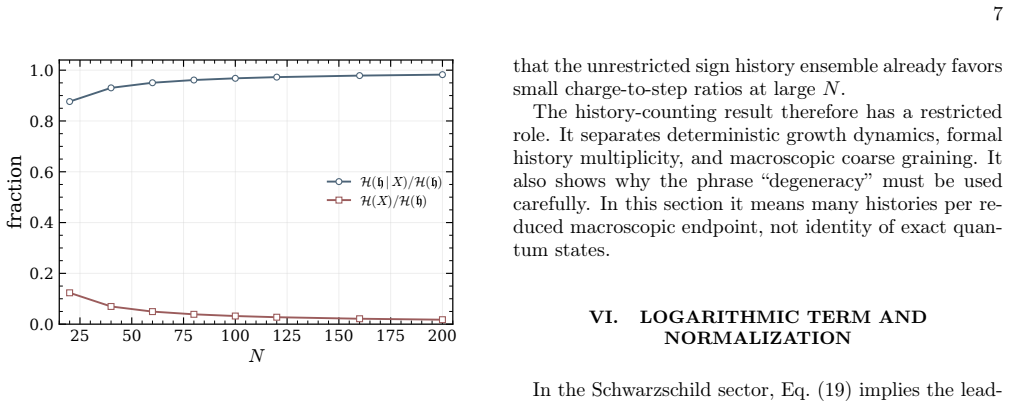
- Ordered charge histories define a formal ensemble in which two histories may reach the same macroscopic state while differing in hidden degrees of freedom.
- Adding a mass or energy label reduces endpoint degeneracy but does not eliminate it within the ensembles considered.
Where Pith is reading between the lines
- If the discrete recursion is a faithful model of accretion, the same logarithmic correction should appear in numerical simulations that enforce a minimal absorption unit.
- The charge dependence of the correction coefficient offers a potential observational signature when entropy is compared across black holes of different charge-to-mass ratios at large mass.
- Treating histories as ensembles rather than microstate counts suggests that unitary evolution can preserve distinctions invisible at the macroscopic level.
- The separation of entropy types can be applied to other classical growth models to check whether analogous corrections arise.
Load-bearing premise
Black-hole growth can be represented accurately as a discrete recursion whose absorption units are measured in natural logarithmic units and whose mass-step dimensional dependence alone fixes the logarithmic entropy correction without extra parameters.
What would settle it
A numerical evaluation of the discrete recursion across several spacetime dimensions that produces a logarithmic coefficient different from the one predicted by the mass-step dimensional dependence would falsify the central claim.
Figures
read the original abstract
We reconsider the classical one bit absorption model of black hole growth as a discrete recursion rather than a continuum equation. In this paper, one bit means one elementary absorption unit measured in natural logarithmic units. For a Schwarzschild Tangherlini black hole, the discrete treatment gives the expected area scaling and also produces a logarithmic correction. The coefficient of this correction is fixed by the dimensional dependence of the mass step. We then extend the construction to the Reissner Nordstr\"om case at fixed charge. In this sector, the logarithmic coefficient gains an explicit charge dependence. The fixed charge calculation can be interpreted as the large mass neutral growth stage after a charged seed has already formed. In that interpretation, realistic charged absorption affects the initial cutoff, while the large mass recursion controls the dominant entropy for weakly charged final states. We also study ordered histories built from positively charged, negatively charged, and neutral labels. These histories define a formal ensemble rather than a direct count of black hole microstates. In a unitary description, two different histories may lead to the same reduced macroscopic state, described by mass, charge, and entropy, while remaining different in hidden or environmental degrees of freedom. Adding a mass or energy label reduces the endpoint degeneracy, but it does not remove it in the ensembles considered here. The corrected interpretation separates dynamical entropy, thermodynamic state entropy, history entropy, and hidden conditional entropy. It also clarifies that the multinomial formula is a restricted history counting result, not a proof that different histories correspond to unique or identical microscopic black hole states.
Editorial analysis
A structured set of objections, weighed in public.
Referee Report
Summary. The manuscript reconsiders the classical one-bit absorption model of black hole growth as a discrete recursion in natural logarithmic units rather than a continuum equation. For Schwarzschild-Tangherlini black holes, the discrete treatment is claimed to produce the expected area scaling for entropy along with a logarithmic correction whose coefficient is fixed by the dimensional dependence of the mass step. The construction is extended to the Reissner-Nordström case at fixed charge, where the logarithmic coefficient acquires an explicit charge dependence. The paper also studies ordered histories with charged and neutral labels, interpreting them as a formal ensemble, and separates dynamical entropy, thermodynamic state entropy, history entropy, and hidden conditional entropy.
Significance. If the central derivation is free of circularity in the definition of the mass step, this work could provide a classical discrete model that naturally generates logarithmic corrections to black hole entropy with explicit dependence on dimension and charge. The separation of different entropy concepts and the interpretation of histories as ensembles rather than microstate counts is a positive clarification. However, the significance is tempered by the need to verify that the mass step rule is independently derived from geometry without encoding the logarithmic term.
major comments (2)
- [Abstract] Abstract: The claim that the logarithmic coefficient is fixed by the dimensional dependence of the mass step requires explicit demonstration that the recursion relation and the rule for ΔM (in natural log units) are defined using only the horizon geometry or mass in d dimensions, without reference to the target entropy form or the log term itself. If the step definition already incorporates logarithmic scaling to match the expected correction, the coefficient is imposed by construction rather than derived.
- [Abstract] The extension to Reissner-Nordström at fixed charge (abstract): the charge dependence of the log coefficient must be shown to follow solely from the same independent mass-step rule applied to the RN geometry, without additional modeling choices that encode the desired correction.
minor comments (1)
- The abstract refers to 'one bit means one elementary absorption unit measured in natural logarithmic units' without a precise definition of the unit or its relation to the horizon area; this should be clarified with an equation in the main text.
Simulated Author's Rebuttal
We thank the referee for the careful review and constructive feedback on our manuscript. We address the major comments point by point below, providing clarification on the independence of the mass-step definition while agreeing to strengthen the presentation for explicitness.
read point-by-point responses
-
Referee: [Abstract] Abstract: The claim that the logarithmic coefficient is fixed by the dimensional dependence of the mass step requires explicit demonstration that the recursion relation and the rule for ΔM (in natural log units) are defined using only the horizon geometry or mass in d dimensions, without reference to the target entropy form or the log term itself. If the step definition already incorporates logarithmic scaling to match the expected correction, the coefficient is imposed by construction rather than derived.
Authors: The mass increment ΔM per one-bit absorption is fixed by the d-dimensional horizon geometry alone: for the Schwarzschild-Tangherlini solution the relation M ∝ r^{d-3} together with the area-radius scaling determines the discrete change in mass that corresponds to a unit increment in the leading (area-law) entropy term. The recursion is then written directly in terms of this geometrically determined ΔM; the logarithmic correction appears only after summation of the discrete steps and is therefore a derived consequence rather than an input. We acknowledge that the abstract does not spell out this derivation in full detail and will revise the manuscript by adding an explicit subsection that derives ΔM from the metric without reference to the target entropy expression. revision: yes
-
Referee: [Abstract] The extension to Reissner-Nordström at fixed charge (abstract): the charge dependence of the log coefficient must be shown to follow solely from the same independent mass-step rule applied to the RN geometry, without additional modeling choices that encode the desired correction.
Authors: In the fixed-charge RN sector the identical geometric rule for ΔM is applied, now using the outer-horizon radius of the d-dimensional RN metric at constant Q. The charge dependence of the resulting logarithmic coefficient arises automatically from the modified M-r relation at fixed Q; no extra terms or ad-hoc adjustments are introduced. The fixed-charge regime is interpreted as the late-time neutral accretion phase after an initial charged seed, but this interpretation does not alter the mass-step definition itself. We will revise the text to display the explicit RN mass-step formula and its insertion into the recursion, thereby demonstrating that the charge dependence follows solely from the geometry. revision: yes
Circularity Check
Log coefficient fixed by input choice of mass-step dimensional dependence, reducing central claim to model assumption by construction
specific steps
-
fitted input called prediction
[Abstract]
"For a Schwarzschild Tangherlini black hole, the discrete treatment gives the expected area scaling and also produces a logarithmic correction. The coefficient of this correction is fixed by the dimensional dependence of the mass step."
The dimensional dependence of ΔM is an explicit modeling input. Inserting a chosen d-scaling for the step size into the recursion algebra immediately yields the log term with a specific coefficient; the coefficient is therefore not an output but the direct algebraic consequence of the chosen input scaling.
full rationale
The paper's core result is that the discrete recursion produces S ~ A/4 + c(d) log(A), with c fixed solely by the d-dependence chosen for the elementary mass step ΔM (in natural-log units). This dependence is introduced as part of the model definition rather than derived from horizon geometry alone or from an independent principle; once the d-scaling of ΔM is set, the logarithmic term and its coefficient follow directly from the recursion algebra. No external benchmark or parameter-free derivation is shown to constrain that d-dependence independently of the target correction. Consequently the claimed 'prediction' of the coefficient is equivalent to the modeling choice that was inserted to produce it.
Axiom & Free-Parameter Ledger
free parameters (1)
- mass step
axioms (1)
- domain assumption Black hole growth proceeds via discrete one-bit absorptions in natural log units
invented entities (1)
-
history entropy
no independent evidence
Reference graph
Works this paper leans on
-
[1]
Black holes and entropy,
J. D. Bekenstein, “Black holes and entropy,” Phys. Rev. D7, 2333 (1973)
1973
-
[2]
The four laws of black hole mechanics,
J. M. Bardeen, B. Carter, and S. W. Hawking, “The four laws of black hole mechanics,” Commun. Math. Phys.31, 161 (1973)
1973
-
[3]
Particle creation by black holes,
S. W. Hawking, “Particle creation by black holes,” Com- mun. Math. Phys.43, 199 (1975)
1975
-
[4]
Quan- tum source of entropy for black holes,
L. Bombelli, R. K. Koul, J. Lee, and R. D. Sorkin, “Quan- tum source of entropy for black holes,” Phys. Rev. D34, 373 (1986)
1986
-
[5]
Entropy and area,
M. Srednicki, “Entropy and area,” Phys. Rev. Lett.71, 666 (1993)
1993
-
[6]
On the quantum structure of a black hole,
G. ’t Hooft, “On the quantum structure of a black hole,” Nucl. Phys. B256, 727 (1985)
1985
-
[7]
Dynamical origin of the entropy of a black hole,
V. P. Frolov and I. D. Novikov, “Dynamical origin of the entropy of a black hole,” Phys. Rev. D48, 4545 (1993)
1993
-
[8]
Entanglement entropy of black holes,
S. N. Solodukhin, “Entanglement entropy of black holes,” Living Rev. Relativ.14, 8 (2011)
2011
-
[9]
Microscopic origin of the Bekenstein–Hawking entropy,
A. Strominger and C. Vafa, “Microscopic origin of the Bekenstein–Hawking entropy,” Phys. Lett. B379, 99 (1996). 13
1996
-
[10]
Black hole entropy from loop quantum grav- ity,
C. Rovelli, “Black hole entropy from loop quantum grav- ity,” Phys. Rev. Lett.77, 3288 (1996)
1996
-
[11]
Logarithmic correction to the Bekenstein-Hawking entropy,
R. K. Kaul and P. Majumdar, “Logarithmic correction to the Bekenstein-Hawking entropy,” Phys. Rev. Lett.84, 5255 (2000), arXiv:gr-qc/0002040
Pith/arXiv arXiv 2000
-
[12]
Logarithmic corrections to black hole entropy from the Cardy formula,
S. Carlip, “Logarithmic corrections to black hole entropy from the Cardy formula,” Class. Quant. Grav.17, 4175 (2000), arXiv:gr-qc/0005017
Pith/arXiv arXiv 2000
-
[13]
Classical corrections to black hole entropy inddimen- sions: a rear window to quantum gravity?,
M. Blaschke, Z. Stuchlík, F. Blaschke, and P. Blaschke, “Classical corrections to black hole entropy inddimen- sions: a rear window to quantum gravity?,” Int. J. Mod. Phys. D27, 1850096 (2018), arXiv:1711.05460 [gr-qc]
Pith/arXiv arXiv 2018
-
[14]
Do black holes destroy information?,
J. Preskill, “Do black holes destroy information?,” in Black Holes, Membranes, Wormholes and Superstrings, edited by S. Kalara and D. V. Nanopoulos, World Scien- tific, Singapore (1993), arXiv:hep-th/9209058
Pith/arXiv arXiv 1993
-
[15]
The information paradox: a pedagogical introduction,
S. D. Mathur, “The information paradox: a pedagogical introduction,” Class. Quantum Grav.26, 224001 (2009), arXiv:0909.1038
Pith/arXiv arXiv 2009
-
[16]
M. A. Nielsen and I. L. Chuang,Quantum Computation and Quantum Information, 10th anniversary ed., Cam- bridge University Press, Cambridge (2010)
2010
-
[17]
Black hole in a uniform magnetic field,
R. M. Wald, “Black hole in a uniform magnetic field,” Phys. Rev. D10, 1680 (1974)
1974
-
[18]
Vacuum polarization and the sponta- neous loss of charge by black holes,
G. W. Gibbons, “Vacuum polarization and the sponta- neous loss of charge by black holes,” Commun. Math. Phys.44, 245 (1975)
1975
-
[19]
Astrophysical processes near black holes,
D. M. Eardley and W. H. Press, “Astrophysical processes near black holes,” Ann. Rev. Astron. Astrophys.13, 381 (1975)
1975
-
[20]
Evolution of charged evaporating black holes,
W. A. Hiscock and L. D. Weems, “Evolution of charged evaporating black holes,” Phys. Rev. D41, 1142 (1990)
1990
-
[21]
Weinberg,The Quantum Theory of Fields, Vol
S. Weinberg,The Quantum Theory of Fields, Vol. II: Modern Applications(Cambridge University Press, Cam- bridge, 1996)
1996
-
[22]
M. E. Peskin and D. V. Schroeder,An Introduction to Quantum Field Theory(Addison–Wesley, Reading, 1995)
1995
-
[23]
R. M. Wald,General Relativity(University of Chicago Press, Chicago, 1984)
1984
-
[24]
Reversible transfor- mations of a charged black hole,
D. Christodoulou and R. Ruffini, “Reversible transfor- mations of a charged black hole,” Phys. Rev. D4, 3552 (1971)
1971
-
[25]
A mathematical theory of communica- tion,
C. E. Shannon, “A mathematical theory of communica- tion,” Bell Syst. Tech. J.27, 379–423, 623–656 (1948)
1948
-
[26]
Spectroscopy of the quantum black hole,
J. D. Bekenstein and V. F. Mukhanov, “Spectroscopy of the quantum black hole,” Phys. Lett. B360, 7 (1995), arXiv:gr-qc/9505012
Pith/arXiv arXiv 1995
-
[27]
General loga- rithmic corrections to black-hole entropy,
S. Das, P. Majumdar, and R. K. Bhaduri, “General loga- rithmic corrections to black-hole entropy,” Class. Quant. Grav.19, 2355 (2002), arXiv:hep-th/0111001
Pith/arXiv arXiv 2002
-
[28]
A. Sen, “Logarithmic corrections to Schwarzschild and other non-extremal black hole entropy in different dimen- sions,” JHEP04, 156 (2013), arXiv:1205.0971 [hep-th]
Pith/arXiv arXiv 2013
-
[29]
Information, physics, quantum: The search for links,
J. A. Wheeler, “Information, physics, quantum: The search for links,” inComplexity, Entropy, and the Physics of Information, edited by W. H. Zurek (Addison–Wesley, Redwood City, 1990)
1990
-
[30]
Dimensional reduction in quantum grav- ity,
G. ’t Hooft, “Dimensional reduction in quantum grav- ity,” inSalamfestschrift, edited by A. Ali, J. Ellis, and S. Randjbar-Daemi (World Scientific, Singapore, 1993), arXiv:gr-qc/9310026
Pith/arXiv arXiv 1993
-
[31]
J. A. Wheeler, “Geons,” Phys. Rev.97, 511 (1955)
1955
-
[32]
N. S. Manton and P. Sutcliffe,Topological Solitons(Cam- bridge University Press, Cambridge, 2004)
2004
-
[33]
Rajaraman,Solitons and Instantons(North Holland, Amsterdam, 1982)
R. Rajaraman,Solitons and Instantons(North Holland, Amsterdam, 1982)
1982
-
[34]
Black hole entropy is the Noether charge,
R. M. Wald, “Black hole entropy is the Noether charge,” Phys. Rev. D48, R3427 (1993), arXiv:gr-qc/9307038
Pith/arXiv arXiv 1993
-
[35]
Some properties of Noether charge and a proposal for dynamical black hole entropy,
V. Iyer and R. M. Wald, “Some properties of Noether charge and a proposal for dynamical black hole entropy,” Phys. Rev. D50, 846 (1994), arXiv:gr-qc/9403028
Pith/arXiv arXiv 1994
discussion (0)
Sign in with ORCID, Apple, or X to comment. Anyone can read and Pith papers without signing in.