Magnetic domains reconfiguration on the Fe3O4(110) surface across the Verwey transition by Spin-Polarized Low-Energy Electron Microscopy
Pith reviewed 2026-06-28 21:50 UTC · model grok-4.3
The pith
Magnetization on the Fe3O4(110) surface reconfigures below the Verwey transition but remains strictly in-plane.
A machine-rendered reading of the paper's core claim, the machinery that carries it, and where it could break.
Core claim
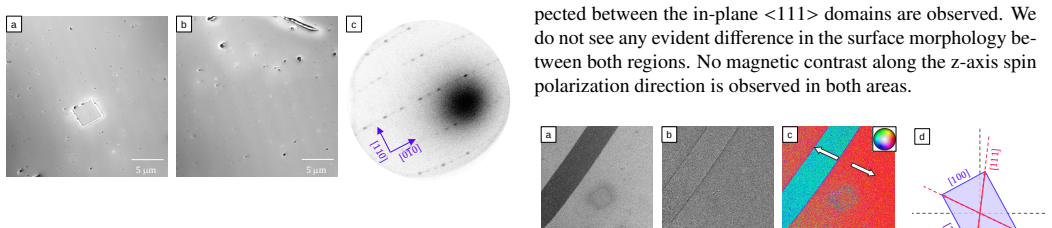
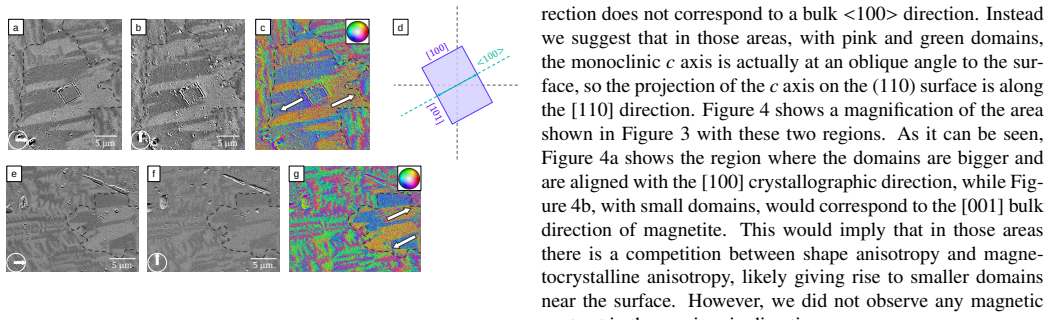
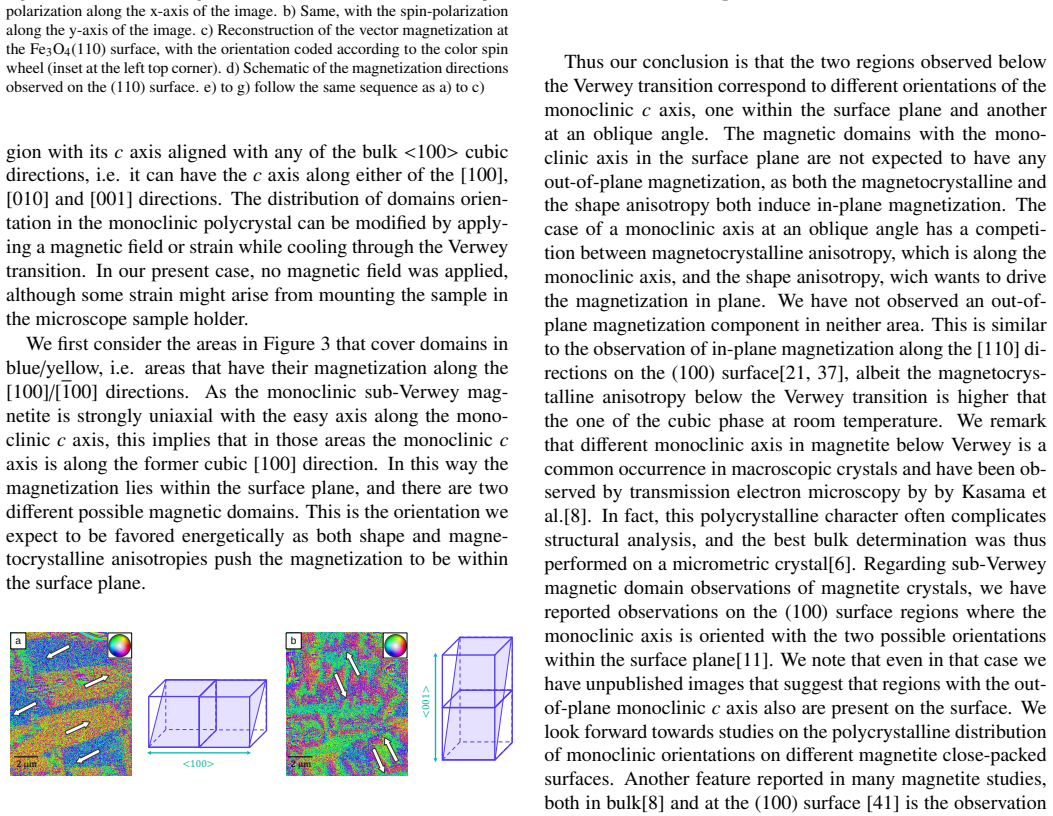
SPLEEM images acquired with different spin directions map the vector magnetization on the Fe3O4(110) surface both above and below the Verwey transition. Above the transition, domains follow the two <111> axes that lie in the (110) plane. Below the transition the magnetization reorients along the in-plane [100] and [001] directions, which correspond to monoclinic cells with the c axis either in-plane or oblique. The magnetization stays confined to the surface plane at all temperatures, and the surface itself consists of rows aligned along [010] after sputtering and annealing.
What carries the argument
Spin-polarized low-energy electron microscopy (SPLEEM) used to acquire images along different spin directions and thereby construct vector maps of surface magnetization on the reconstructed (110) surface.
Load-bearing premise
Sputtering and annealing produces a well-defined reconstructed surface composed of rows aligned in the [010] direction that allows reliable vector mapping of magnetization without artifacts from reconstruction or contamination.
What would settle it
Direct observation of any out-of-plane magnetization component or failure of the magnetization directions to reorient to the in-plane [100] and [001] axes when the sample is cooled below the Verwey transition.
Figures

read the original abstract
We have studied the (110) surface of Fe$_3$O$_4$ single crystals by means of spin-polarized low-energy electron microscopy (SPLEEM). After preparation by sputtering and annealing a well defined reconstructed surface was achieved, composed of rows aligned in the [010] direction. By acquiring SPLEEM images along different spin directions the vector magnetization was mapped on the surface, both at room temperature and at a temperature well below the Verwey transition. At room temperature, domains were observed with their magnetization aligned along the two <111> bulk easy axes which are in the (110) surface plane. They presented 180$^\circ$, 71$^\circ$ and 109$^\circ$ N\'eel-type domain walls. Below the Verwey transition, the magnetization directions changed to regions where the magnetization was oriented along the in-plane [100] and [001] directions. Those observations can be interpreted as the presence of magnetized regions on the surface where the monoclinic $c$ axis is in-plane in the former, and regions where the $c$ is out-of-plane in an oblique direction in the latter. However, the magnetization was at all times within the surface plane, with no out-of-plane component detected.
Editorial analysis
A structured set of objections, weighed in public.
Referee Report
Summary. The manuscript reports SPLEEM vector mapping of magnetic domains on the Fe3O4(110) surface prepared by sputtering and annealing, which produces a reconstructed surface with [010]-aligned rows. At room temperature, domains align with the two in-plane bulk <111> easy axes and exhibit 180°, 71°, and 109° Néel walls. Below the Verwey transition, magnetization reorients to in-plane [100] and [001] directions; these are interpreted as regions with monoclinic c-axis in-plane versus oblique out-of-plane, while magnetization remains strictly in-plane with no out-of-plane component detected at any temperature.
Significance. If the surface reconstruction is verified to be artifact-free, the observations supply direct, spatially resolved evidence of how the Verwey structural transition reconfigures surface magnetic domains in magnetite, linking bulk easy-axis changes to surface-specific monoclinic orientations. The strength of the work lies in the use of SPLEEM for full vector mapping rather than scalar contrast, yielding falsifiable domain-wall angle and direction assignments.
major comments (1)
- [Abstract / preparation paragraph] Abstract / preparation paragraph: the central interpretation of post-transition [100] and [001] directions as signatures of specific monoclinic c-axis orientations rests on the assumption that the sputtering/annealing procedure yields an artifact-free [010]-row reconstruction suitable for reliable SPLEEM vector mapping. No quantitative metrics (LEED spot sharpness, Auger spectra, or direct comparison to known (110) reconstructions) are supplied to substantiate this precondition, leaving open the possibility that reconstruction-induced scattering changes mimic or obscure the reported reorientation.
minor comments (2)
- [Abstract] Abstract: quantitative error bars on domain angles or contrast ratios, temperature calibration details, and image-processing steps are absent; their inclusion would allow readers to assess the statistical robustness of the claimed reconfiguration.
- [Abstract] Abstract: the statement that magnetization is 'at all times within the surface plane' would benefit from explicit description of how the three orthogonal spin-polarization channels were combined to exclude any out-of-plane component within the experimental noise floor.
Simulated Author's Rebuttal
We thank the referee for the careful reading of our manuscript and for recognizing the value of the SPLEEM vector mapping in linking the Verwey transition to surface magnetic domain reconfiguration. We address the single major comment below.
read point-by-point responses
-
Referee: [Abstract / preparation paragraph] Abstract / preparation paragraph: the central interpretation of post-transition [100] and [001] directions as signatures of specific monoclinic c-axis orientations rests on the assumption that the sputtering/annealing procedure yields an artifact-free [010]-row reconstruction suitable for reliable SPLEEM vector mapping. No quantitative metrics (LEED spot sharpness, Auger spectra, or direct comparison to known (110) reconstructions) are supplied to substantiate this precondition, leaving open the possibility that reconstruction-induced scattering changes mimic or obscure the reported reorientation.
Authors: We agree that the manuscript would be strengthened by explicit quantitative characterization of the surface reconstruction. The preparation follows established sputtering and annealing protocols for Fe3O4(110) that produce the [010]-row reconstruction, and the SPLEEM images themselves display clear row alignment consistent with this structure. However, to directly address the concern, we will revise the methods and results sections to include LEED spot profiles or images acquired during preparation, along with any available Auger electron spectroscopy data, and a brief comparison to literature reports on the (110) reconstruction. This addition will substantiate that the observed magnetic reorientation is not an artifact of scattering changes from an imperfect surface. revision: yes
Circularity Check
No circularity; pure experimental observation paper
full rationale
The manuscript reports SPLEEM imaging of surface magnetic domains on Fe3O4(110) at room temperature and below the Verwey transition. Domain orientations are directly observed and mapped from experimental images acquired along different spin directions. The interpretation linking [100]/[001] directions to monoclinic c-axis orientations is a standard crystallographic inference, not a derivation or fit that reduces to the paper's own inputs. No equations, parameters, or predictions appear; surface preparation is described as a precondition but is not invoked in any self-referential or load-bearing manner. No self-citations are used to justify uniqueness or ansatzes. The result is self-contained experimental data.
Axiom & Free-Parameter Ledger
axioms (1)
- domain assumption SPLEEM contrast directly maps the in-plane component of surface magnetization vector without significant contribution from out-of-plane or subsurface layers
Reference graph
Works this paper leans on
-
[1]
M. Blackman, The lodestone: A survey of the history and the physics, Contemporary Physics 24 (1983) 319–331. doi:10.1080/00107518308210689
-
[2]
R. M. Cornell, U. Schwertmann, The iron oxides: struc- ture, properties, reactions, occurrence, and uses, VCH, Weinheim, 1996
1996
-
[3]
G. S. Parkinson, Iron oxide surfaces, Surface Science Reports 71 (2016) 272–365. doi:10.1016/j.surfrep. 2016.02.001
-
[4]
E. Verwey, Electronic conduction of magnetite (Fe 3O4) and its transition point at low temperatures, Nature 144 (1939) 327–328. doi:10.1038/144327b0
-
[5]
Iizumi, T
M. Iizumi, T. F. Koetzle, G. Shirane, S. Chikazumi, M. Matsui, S. Todo, Structure of magnetite (Fe 3O4) below the verwey transition temperature, Acta Crys- tallographica Section B Structural Crystallography and Crystal Chemistry 38 (1982) 2121–2133. doi:10.1107/ s0567740882008176
1982
-
[6]
M. S. Senn, J. P. Wright, J. P. Attfield, Charge or- der and three-site distortions in the Verwey structure of magnetite, Nature 481 (2012) 173–176. doi:10.1038/ nature10704
2012
-
[7]
B. Truc, P. Usai, F. Pennacchio, G. Berruto, R. Claude, I. Madan, V . Sala, T. LaGrange, G. M. Vanacore, S. Ben- habib, F. Carbone, Ultrafast generation of hidden phases via energy-tuned electronic photoexcitation in magnetite, Proceedings of the National Academy of Sciences (2024) e2316438121. doi:10.1073/pnas.2316438121
-
[8]
Kasama, N
T. Kasama, N. S. Church, J. M. Feinberg, R. E. Dunin-Borkowski, R. J. Harrison, Direct obser- vation of ferrimagnetic/ferroelastic domain inter- actions in magnetite below the Verwey transition, Earth and Planetary Science Letters 297 (2010) 10–17. URL:http://www.sciencedirect.com/ science/article/pii/S0012821X10003213. doi:16/j.epsl.2010.05.004
2010
-
[10]
ˇRezní˘cek, V
R. ˇRezní˘cek, V . Chlan, H. Št ˇepánková, P. Novák, M. Maryško, Magnetocrystalline anisotropy of magnetite, J. Physics: Cond. Matt. 24 (2012) 055501. doi:10.1088/ 0953-8984/24/5/055501
2012
-
[12]
V . Chlan, K. Kou ˇril, H. Št ˇepánková, R. ˇRezníˇcek, J. Št ˇepánek, W. Tabi´s, G. Król, Z. Tarnawski, Z. K˛ akol, A. Kozłowski, Magnetically induced structural re- orientation in magnetite studied by nuclear mag- netic resonance, Journal of Applied Physics 108 (2010) 083914. URL:https://doi.org/10.1063/1. 3501108. doi:10.1063/1.3501108
work page doi:10.1063/1 2010
-
[13]
A. Kosterov, Low-temperature magnetization and AC sus- ceptibility of magnetite: effect of thermomagnetic his- tory, Geophysical Journal International 154 (2003) 58–71. doi:10.1046/j.1365-246X.2003.01938.x
-
[14]
C. A. Domenicali, Magnetic and electric properties of nat- ural and synthetic single crystals of magnetite, Physical Review 78 (1950) 458–467. doi:10.1103/PhysRev.78. 458
-
[15]
R. S. Coe, R. Egli, S. A. Gilder, J. P. Wright, The ther- modynamic effect of nonhydrostatic stress on the verwey transition, Earth and Planetary Science Letters 319-320 (2012) 207–217. doi:10.1016/j.epsl.2011.11.021
-
[16]
H. Kobayashi, T. Nagao, M. Itou, S. Todo, B. Barbiellini, P. E. Mijnarends, A. Bansil, N. Sakai, Direct observa- tion of localization of the minority-spin-band electrons in magnetite below the verwey temperature, Physical Re- view B 80 (2009) 104423. doi:10.1103/PhysRevB.80. 104423
-
[17]
J. Noh, O. I. Osman, S. G. Aziz, P. Winget, J.-L. Bredas, Magnetite Fe 3O4 (111) surfaces: Impact of defects on structure, stability, and electronic properties, Chemistry of Materials 27 (2015) 5856–5867. doi:10.1021/acs. chemmater.5b02885
work page doi:10.1021/acs 2015
-
[18]
A. Barbieri, W. Weiss, M. Van Hove, G. Somorjai, Mag- netite Fe3O4(111): surface structure by leed crystallogra- phy and energetics, Surface Science 302 (1994) 259–279. doi:10.1016/0039-6028(94)90832-x
-
[19]
J. D. Wei, I. Knittel, U. Hartmann, Y . Zhou, S. Mur- phy, I. V . Shvets, F. T. Parker, Influence of the antiphase domain distribution on the magnetic struc- ture of magnetite thin films, Applied Physics Let- ters 89 (2006). URL:http://dx.doi.org/10.1063/ 1.2356308. doi:10.1063/1.2356308
-
[20]
L. Martín-García, R. Gargallo-Caballero, M. Monti, M. Foerster, J. F. Marco, L. Aballe, J. de la Figuera, Spin and orbital magnetic moment of reconstructed √ 2×√ 2R45 magnetite (001), Physical Review B 91 (2015) 020408. doi:10.1103/physrevb.91.020408
-
[21]
J. de la Figuera, L. Vergara, A. T. N’Diaye, A. Quesada, A. K. Schmid, Micromagnetism in (001) magnetite by spin-polarized low-energy electron microscopy, Ultrami- croscopy 130 (2013) 77–81. doi:10.1016/j.ultramic. 2013.02.020
-
[22]
Maris, L
G. Maris, L. Jdira, J. Hermsen, S. Murphy, G. Manai, I. Shvets, S. Speller, J. Hermsen, S. Murphy, G. Manai, I. Shvets, S. Speller, Nano-magnetic probing on mag- netite, IEEE Transactions on Magnetics 42 (2006) 2927–
2006
-
[23]
doi:10.1109/tmag.2006.878405
-
[24]
G. Maris, L. Jdira, J. G. H. Hermsen, S. Murphy, G. Manai, I. V . Shvets, S. Speller, Towards spin- polarized scanning tunneling microscopy on magnetite (110), Japanese Journal of Applied Physics 45 (2006) 2225–2229. doi:10.1143/jjap.45.2225
-
[25]
K. Jordan, A. Cazacu, G. Manai, S. F. Ceballos, S. Mur- phy, I. V . Shvets, Scanning tunneling spectroscopy study of the electronic structure of Fe3O4 surfaces, Physical Re- view B 74 (2006). doi:10.1103/physrevb.74.085416
-
[26]
G. Maris, O. Shklyarevskii, L. Jdira, J. Hermsen, S. Speller, One-dimensional structural and electronic properties of magnetite Fe 3O4(110), Surface Science 600 (2006) 5084–5091. doi:10.1016/j.susc.2006. 08.029
-
[27]
T. K. Shimizu, J. Jung, H. S. Kato, Y . Kim, M. Kawai, Termination and verwey transition of the (111) surface of magnetite studied by scanning tunneling microscopy and first-principles calculations, Physical Review B 81 (2010). doi:10.1103/physrevb.81.235429
-
[28]
Theatomicsimulationenvironment—aPythonlibraryfor working with atoms
M. Creutzburg, K. Sellschopp, R. Gleißner, B. Arndt, G. B. V onbun-Feldbauer, V . V onk, H. Noei, A. Stierle, Surface structure of magnetite (111) under oxidizing and reducing conditions, Journal of Physics: Condensed Mat- ter 34 (2022) 164003. URL:http://dx.doi.org/10. 1088/1361-648X/ac4d5a. doi:10.1088/1361-648x/ ac4d5a
-
[29]
Subagyo, K
A. Subagyo, K. Sueoka, Correlation between surface structure and charge ordering in magnetite(001) stud- ied by scanning tunneling microscopy and spectroscopy, Journal of Physics: Conference Series 61 (2007) 1102–
2007
-
[30]
doi:10.1088/1742-6596/61/1/218
-
[31]
R. Jansen, V . Brabers, H. van Kempen, One-dimensional reconstruction observed on Fe 3O4(110) by scanning tun- neling microscopy, Surface Science 328 (1995) 237–247. doi:10.1016/0039-6028(95)00173-5
-
[32]
R. Jansen, H. van Kempen, R. M. Wolf, Scanning tun- neling microscopy and spectroscopy on thin Fe 3O4 (110) films on mgo, Journal of Vacuum Science Technology B 14 (1996) 1173–1175. doi:10.1116/1.588423
-
[33]
G. S. Parkinson, P. Lackner, O. Gamba, S. Maaß, S. Ger- hold, M. Riva, R. Bliem, U. Diebold, M. Schmid, Fe3O4(110)-(1×3) revisited: Periodic (111) nanofacets, 6 Surface Science 649 (2016) L120–L123. doi:10.1016/ j.susc.2016.02.020
2016
-
[34]
A. Mandziak, J. E. Prieto, C. Gutierrez-Cuesta, M. A. Nino, M. Foerster, J. de la Figuera, P. Nita, Structural and magnetic properties of the Fe3O4 (110) surface, Sci. Rep. 15 (2025) 10549. doi:10.1038/s41598-025-94599-6
-
[35]
K. Chiba, S. Chikazumi, Magnetocrystalline anisotropy of magnetite, Journal of Magnetism and Magnetic Materials 31-34 (1983) 813–814. doi:10.1016/0304-8853(83) 90698-4
-
[36]
O. Özdemir, S. Xu, D. J. Dunlop, Closure domains in magnetite, Journal of Geophysical Research: Solid Earth 100 (1995) 2193–2209. doi:10.1029/94jb02874
-
[37]
S. Foss, B. M. Moskowitz, R. Proksch, E. D. Dahlberg, Domain wall structures in single-crystal magnetite inves- tigated by magnetic force microscopy, Journal of Geo- physical Research: Solid Earth 103 (1998) 30551–30560. doi:10.1029/98jb00152
-
[38]
Halgedahl, Domain pattern observations in rock mag- netism: progress and problems, Physics of the Earth and Planetary Interiors 46 (1987) 127–163
S. Halgedahl, Domain pattern observations in rock mag- netism: progress and problems, Physics of the Earth and Planetary Interiors 46 (1987) 127–163. doi:10.1016/ 0031-9201(87)90178-6
1987
-
[39]
L. Martin-Garcia, G. Chen, Y . Montana, A. Mascaraque, B. M. Pabon, A. K. Schmid, J. de la Figuera, Memory ef- fect and magnetocrystalline anisotropy impact on the sur- face magnetic domains of magnetite(001), Sci. Rep. 8 (2018) 5991. doi:10.1038/s41598-018-24160-1
-
[40]
Ozdemir, D
O. Ozdemir, D. J. Dunlop, Magnetic domain structures on a natural single crystal of magnetite, Geophysical Research Letters 20 (1993) 1835–1838. doi:10.1029/ 93GL01936
1993
-
[42]
URL:http://www.springer.com/materials/ characterization+%26+evaluation/book/ 978-1-4939-0934-6
Bauer, Ernst, Surface Microscopy with Low En- ergy Electrons, Springer Berlin Heidelberg, 2014. URL:http://www.springer.com/materials/ characterization+%26+evaluation/book/ 978-1-4939-0934-6
2014
-
[43]
Generic transport formula for a system driven by marko- vian reservoirs.Phys
J. de la Figuera, Z. Novotny, M. Setvin, T. Liu, Z. Mao, G. Chen, A. T. N’Diaye, M. Schmid, U. Diebold, A. K. Schmid, G. S. Parkinson, Real-space imaging of the Ver- wey transition at the (100) surface of magnetite, Physical Review B 88 (2013) 161410. doi:10.1103/PhysRevB. 88.161410
-
[44]
T. Duden, E. Bauer, A compact electron-spin- polarization manipulator, Review of Scien- tific Instruments 66 (1995) 2861–2864. URL: https://pubs.aip.org/rsi/article/66/4/2861/ 440165/A-compact-electron-spin-polarization. doi:10.1063/1.1145569
-
[45]
N. Rougemaille, A. K. Schmid, Magnetic imaging with spin-polarized low-energy elec- tron microscopy, The European Physical Jour- nal Applied Physics 50 (2010) 20101. URL: http://www.epjap.org/10.1051/epjap/2010048. doi:10.1051/epjap/2010048. 7
discussion (0)
Sign in with ORCID, Apple, or X to comment. Anyone can read and Pith papers without signing in.