MoE-dqINR: A Unified Mixture-of-Experts Implicit Neural Representation Framework for Scan-Specific Dynamic and Quantitative MRI Reconstruction
Pith reviewed 2026-06-28 20:07 UTC · model grok-4.3
The pith
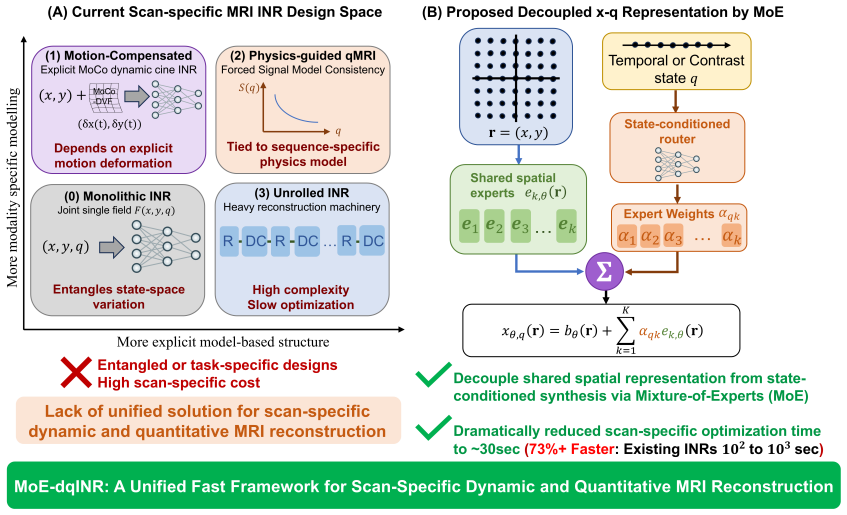
State-conditioned mixture-of-experts INR unifies shared spatial representation with dynamic and quantitative MRI synthesis from undersampled multicoil data.
A machine-rendered reading of the paper's core claim, the machinery that carries it, and where it could break.
Core claim
The proposed formulation establishes state-conditioned mixture-of-experts INR as a scan-specific multicoil MRI reconstruction prior that unifies shared spatial representation, dynamic- and qMRI-specific synthesis, and practical per-scan efficiency.
What carries the argument
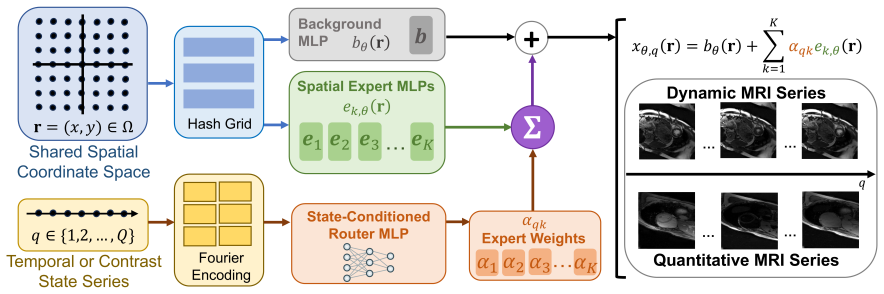
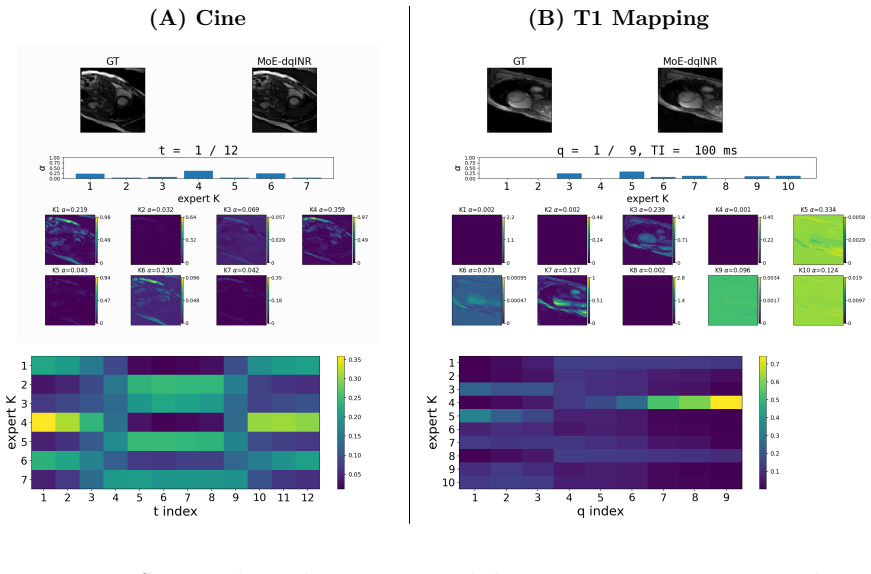
State-conditioned routing pathway that uses the normalized state index to compute weights over a bank of shared spatial experts, synthesizing each acquisition state from the common expert set.
If this is right
- Reduces per-scan INR optimization time to approximately 30 seconds while preserving state-dependent fidelity.
- Enables a single image-first architecture to handle both dynamic MRI and quantitative MRI without separate motion or deformation modules.
- Allows spatial information to be reused across acquisition states through the shared expert bank.
Where Pith is reading between the lines
- The routing design could be tested on modalities beyond MRI that involve ordered state changes, such as dynamic CT or ultrasound series.
- If the expert bank generalizes across patients, the per-scan training cost might drop further by initializing from a population-level expert set.
- Direct comparison of expert activation patterns across states might reveal whether the method implicitly captures contrast evolution without explicit physics models.
Load-bearing premise
Conditioning routing weights solely on the normalized state index is sufficient to synthesize each dynamic frame or contrast state from a shared expert bank without loss of fidelity or the need for additional sequence-specific quantitative signal models.
What would settle it
Reconstruction error or artifact levels that remain high on a held-out dynamic or quantitative dataset when the model is trained only on the shared experts and state-index routing without retraining or extra signal equations.
Figures
read the original abstract
Undersampled magnetic resonance imaging (MRI) reconstruction seeks to recover temporally or contrast-varying image series from incomplete multicoil k-space data while preserving state-dependent fidelity for dynamic and quantitative MRI (qMRI). Existing scan-specific implicit neural representations (INRs) often use monolithic spatiotemporal coordinate fields, explicit subspaces, motion or deformation models, calibration variables, or sequence-specific quantitative signal models. These design choices can limit flexibility in sharing spatial information while adapting image synthesis across acquisition states. Moreover, many INR-based baselines remain computationally demanding, typically requiring per-scan optimization times on the order of hundreds to thousands of seconds. We propose MoE-dqINR, a scan-specific multicoil MRI reconstruction framework that factorizes the image-domain representation into shared spatial experts and a state-conditioned routing pathway. Spatial experts encode reusable coordinate-dependent image content, whereas routing weights, conditioned on ordered acquisition states, synthesize each dynamic frame or contrast state from a common expert bank. The representation is coupled to a multicoil MRI forward model, uses the normalized state index to drive routing in both dynamic and quantitative MRI. By separating shared spatial representation from state-dependent synthesis, the framework provides an image-first architecture for dynamic and quantitative MRI while reducing scan-specific INR optimization to approximately 30 s per scan in our experiments. The proposed formulation establishes state-conditioned mixture-of-experts INR as a scan-specific multicoil MRI reconstruction prior that unifies shared spatial representation, dynamic- and qMRI-specific synthesis, and practical per-scan efficiency.
Editorial analysis
A structured set of objections, weighed in public.
Referee Report
Summary. The manuscript proposes MoE-dqINR, a scan-specific multicoil MRI reconstruction framework based on a mixture-of-experts implicit neural representation. It factorizes the representation into shared spatial experts encoding coordinate-dependent content and a state-conditioned routing pathway driven by the normalized acquisition state index to synthesize dynamic frames or contrast states from a common expert bank. The model is coupled only to the multicoil forward model and is claimed to unify dynamic and quantitative MRI while achieving approximately 30 s per-scan optimization.
Significance. If the central claims hold with supporting validation, the factorization into shared spatial experts plus scalar state routing could provide a flexible image-first prior that improves efficiency and adaptability over monolithic INRs or sequence-specific models for both dynamic and qMRI regimes.
major comments (2)
- [Abstract] Abstract (paragraph on routing pathway): the claim that conditioning routing weights solely on the normalized state index suffices to synthesize quantitative contrast states at full fidelity without sequence-specific quantitative signal models is load-bearing for the unification claim, yet no derivation, signal-physics justification, or empirical test is supplied to show that ordered acquisition index is an adequate proxy for nonlinear evolution (relaxation, flip-angle dependence, etc.).
- [Abstract] Abstract: the stated 30 s per-scan timing and unification benefit are presented without any quantitative results, error metrics, ablation studies, or baseline comparisons, so the central performance and unification assertions cannot be evaluated from the provided text.
minor comments (1)
- [Abstract] Abstract: the phrase 'in our experiments' for the timing claim is used without reference to datasets, acquisition protocols, or hardware, reducing clarity.
Simulated Author's Rebuttal
We thank the referee for the detailed feedback on the abstract. We address each major comment below and propose revisions where appropriate to strengthen the presentation.
read point-by-point responses
-
Referee: [Abstract] Abstract (paragraph on routing pathway): the claim that conditioning routing weights solely on the normalized state index suffices to synthesize quantitative contrast states at full fidelity without sequence-specific quantitative signal models is load-bearing for the unification claim, yet no derivation, signal-physics justification, or empirical test is supplied to show that ordered acquisition index is an adequate proxy for nonlinear evolution (relaxation, flip-angle dependence, etc.).
Authors: The manuscript presents the normalized state index as an empirical design choice for routing that enables unification across dynamic and quantitative regimes without explicit sequence-specific signal models. The full text includes supporting experiments on both task types that validate reconstruction fidelity. We agree the abstract would be strengthened by briefly noting this empirical basis and will revise it to reference the experimental validation while directing readers to the methods for the routing formulation. revision: yes
-
Referee: [Abstract] Abstract: the stated 30 s per-scan timing and unification benefit are presented without any quantitative results, error metrics, ablation studies, or baseline comparisons, so the central performance and unification assertions cannot be evaluated from the provided text.
Authors: We agree that the abstract would benefit from including representative quantitative support. The full manuscript reports specific timing, error metrics, and comparisons in the experiments. We will revise the abstract to incorporate key results (e.g., per-scan timing and performance metrics relative to baselines) to make the claims evaluable from the abstract alone. revision: yes
Circularity Check
No circularity detected; derivation is self-contained architectural proposal
full rationale
The paper presents MoE-dqINR as a new scan-specific INR architecture that factorizes shared spatial experts from state-conditioned routing weights driven by normalized acquisition index, coupled directly to the multicoil forward model. No equations, fitted parameters, or predictions are shown that reduce the claimed unification or efficiency to a definitional identity or self-citation chain. The central premise is an independent design choice rather than a re-derivation of prior results, with no load-bearing self-citations, ansatzes smuggled via citation, or uniqueness theorems invoked from the authors' own prior work. The derivation chain is therefore self-contained.
Axiom & Free-Parameter Ledger
Reference graph
Works this paper leans on
-
[1]
Li Feng, Qiuting Wen, Chenchan Huang, Angela Tong, Fang Liu, and Hersh Chandarana. GRASP-Pro: imProving GRASP DCE-MRI through self-calibrating subspace-modeling and contrast phase automation.Magnetic Resonance in Medicine, 83(1):94–108, 2020. ISSN 1522-2594. doi: 10.1002/mrm.27903
-
[2]
Sodickson, and Ricardo Otazo
Li Feng, Leon Axel, Hersh Chandarana, Kai Tobias Block, Daniel K. Sodickson, and Ricardo Otazo. XD-GRASP: Golden-angle radial MRI with reconstruction of extra motion-state dimensions using compressed sensing.Magnetic Resonance in Medicine, 75(2):775–788,
- [3]
-
[4]
Li Feng, Robert Grimm, Kai Tobias Block, Hersh Chandarana, Sungheon Kim, Jian Xu, Leon Axel, Daniel K. Sodickson, and Ricardo Otazo. Golden-angle radial sparse parallel MRI: Combination of compressed sensing, parallel imaging, and golden-angle radial sampling for fast and flexible dynamic volumetric MRI.Magnetic Resonance in Medicine, 72(3): 707–717, 2014...
-
[5]
Sajan Goud Lingala, Yue Hu, Edward DiBella, and Mathews Jacob. Accelerated Dynamic MRI Exploiting Sparsity and Low-Rank Structure: k-t SLR.IEEE Transactions on Medical Imaging, 30(5):1042–1054, May 2011. ISSN 1558-254X. doi: 10.1109/TMI.2010.2100850
-
[6]
Ricardo Otazo, Emmanuel Candès, and Daniel K. Sodickson. Low-rank plus sparse matrix decomposition for accelerated dynamic MRI with separation of background and dynamic components.Magnetic Resonance in Medicine, 73(3):1125–1136, 2015. ISSN 1522-2594. doi: 10.1002/mrm.25240
-
[7]
Tolga Çukur, Salman U. H. Dar, Valiyeh A. Nezhad, Yohan Jun, Tae Hyung Kim, Shohei Fujita, and Berkin Bilgic. A tutorial on MRI reconstruction: From modern methods to clinical implications.IEEE Transactions on Biomedical Engineering, 73(5):1900–1920, 2026. doi: 10.1109/TBME.2025.3617575
-
[8]
Data- and Physics-Driven Deep Learning Based Reconstruction for Fast MRI: Fundamentals and Methodologies.IEEE Reviews in Biomedical Engineering, 18:152–171,
Jiahao Huang, Yinzhe Wu, Fanwen Wang, Yingying Fang, Yang Nan, Cagan Alkan, Daniel Abraham, Congyu Liao, Lei Xu, Zhifan Gao, Weiwen Wu, Lei Zhu, Zhaolin Chen, Peter Lally, Neal Bangerter, Kawin Setsompop, Yike Guo, Daniel Rueckert, Ge Wang, and Guang Yang. Data- and Physics-Driven Deep Learning Based Reconstruction for Fast MRI: Fundamentals and Methodolo...
-
[9]
doi: 10.1109/RBME.2024.3485022
ISSN 1941-1189. doi: 10.1109/RBME.2024.3485022. 22
-
[10]
Hemant K. Aggarwal, Merry P. Mani, and Mathews Jacob. MoDL: Model-Based Deep Learning Architecture for Inverse Problems.IEEE Transactions on Medical Imaging, 38(2): 394–405, February 2019. ISSN 1558-254X. doi: 10.1109/TMI.2018.2865356
-
[11]
Jo Schlemper, Jose Caballero, Joseph V. Hajnal, Anthony N. Price, and Daniel Rueckert. A Deep cascade of convolutional neural networks for dynamic MR image reconstruction.IEEE Transactions on Medical Imaging, 37(2):491–503, 2018. doi: 10.1109/TMI.2017.2760978
-
[12]
Learned low-rank priors in dynamic mr imaging.IEEE Transactions on Medical Imaging, 40(12):3698–3710, 2021
Ziwen Ke, Wenqi Huang, Zhuo-Xu Cui, Jing Cheng, Sen Jia, Haifeng Wang, Xin Liu, Hairong Zheng, Leslie Ying, Yanjie Zhu, and Dong Liang. Learned low-rank priors in dynamic mr imaging.IEEE Transactions on Medical Imaging, 40(12):3698–3710, 2021
2021
-
[13]
Deep separable spatiotemporal learning for fast dynamic cardiac MRI.IEEE Transactions on Biomedical Engineering, 72(12):3642–3654,
Zi Wang, Min Xiao, Yirong Zhou, Chengyan Wang, Naiming Wu, Yi Li, Yiwen Gong, Shufu Chang, Yinyin Chen, Liuhong Zhu, Jianjun Zhou, Congbo Cai, He Wang, Xianwang Jiang, Di Guo, Guang Yang, and Xiaobo Qu. Deep separable spatiotemporal learning for fast dynamic cardiac MRI.IEEE Transactions on Biomedical Engineering, 72(12):3642–3654,
-
[14]
doi: 10.1109/TBME.2025.3574090
-
[15]
Zi Wang, Xiaotong Yu, Chengyan Wang, Weibo Chen, Jiazheng Wang, Ying-Hua Chu, Hongwei Sun, Rushuai Li, Peiyong Li, Fan Yang, Haiwei Han, Taishan Kang, Jianzhong Lin, Chen Yang, Shufu Chang, Zhang Shi, Sha Hua, Yan Li, Juan Hu, Liuhong Zhu, Jianjun Zhou, Meijing Lin, Jiefeng Guo, Congbo Cai, Zhong Chen, Di Guo, Guang Yang, and Xiaobo Qu. One for multiple: ...
-
[16]
Burhaneddin Yaman, Seyed Amir Hossein Hosseini, Steen Moeller, Jutta Ellermann, Kâmil Uğurbil, and Mehmet Akçakaya. Self-supervised learning of physics-guided reconstruction neural networks without fully sampled reference data.Magnetic Resonance in Medicine, 84 (6):3172–3191, 2020. ISSN 1522-2594. doi: 10.1002/mrm.28378
-
[17]
Zero-shot self-supervised learning for MRI reconstruction
Burhaneddin Yaman, Seyed Amir Hossein Hosseini, and Mehmet Akçakaya. Zero-shot self-supervised learning for MRI reconstruction. InInternational Conference on Learning Representations, 2022. URLhttps://openreview.net/forum?id=085y6YPaYjP
2022
-
[18]
Bo Zhou, Jo Schlemper, Neel Dey, Seyed Sadegh Mohseni Salehi, Kevin Sheth, Chi Liu, James S. Duncan, and Michal Sofka. Dual-domain self-supervised learning for accelerated non-Cartesian MRI reconstruction.Medical Image Analysis, 81:102538, October 2022. ISSN 1361-8415. doi: 10.1016/j.media.2022.102538
-
[19]
Jaejun Yoo, Kyong Hwan Jin, Harshit Gupta, Jérôme Yerly, Matthias Stuber, and Michael Unser. Time-Dependent Deep Image Prior for Dynamic MRI.IEEE Transactions on Medical Imaging, 40(12):3337–3348, December 2021. ISSN 1558-254X. doi: 10.1109/TMI. 2021.3084288
work page doi:10.1109/tmi 2021
-
[20]
Jie Feng, Ruimin Feng, Qing Wu, Xin Shen, Lixuan Chen, Xin Li, Li Feng, Jingjia Chen, Zhiyong Zhang, Chunlei Liu, Yuyao Zhang, and Hongjiang Wei. Spatiotemporal Implicit Neural Representation for Unsupervised Dynamic MRI Reconstruction.IEEE Transactions on Medical Imaging, 44(5):2143–2156, May 2025. ISSN 1558-254X. doi: 10.1109/TMI.2025.3526452
-
[21]
Kunz, Stefan Ruschke, and Reinhard Heckel
Johannes F. Kunz, Stefan Ruschke, and Reinhard Heckel. Implicit Neural Networks With Fourier-Feature Inputs for Free-Breathing Cardiac MRI Reconstruction.IEEE Transactions on Computational Imaging, 10:1280–1289, 2024. ISSN 2333-9403. doi: 10.1109/TCI.2024. 3452008. 23
-
[22]
Jie Feng, Rui Luo, Tian Zeng, Xin Shen, Haikun Qi, Yuyao Zhang, Dong Liang, and Hongjiang Wei. Zero-shot Implicit Neural Manifold Representation (INMR) for Ultra-high Temporal Resolution Dynamic MRI.Proceedings of the AAAI Conference on Artificial Intelligence, 40(5):3930–3938, March 2026. ISSN 2374-3468. doi: 10.1609/aaai.v40i5.37395
-
[23]
Dynamic-Aware Spatio-Temporal Representation Learning for Dynamic MRI Reconstruction
Dayoung Baik and Jaejun Yoo. Dynamic-Aware Spatio-Temporal Representation Learning for Dynamic MRI Reconstruction. In James C. Gee, Daniel C. Alexander, Jaesung Hong, Juan Eugenio Iglesias, Carole H. Sudre, Archana Venkataraman, Polina Golland, Jong Hyo Kim, and Jinah Park, editors,Medical Image Computing and Computer Assisted Intervention – MICCAI 2025, ...
-
[24]
Schnabel, Kerstin Hammernik, Thomas Kuestner, and Daniel Rueckert
Wenqi Huang, Veronika Spieker, Siying Xu, Gastao Cruz, Claudia Prieto, Julia A. Schnabel, Kerstin Hammernik, Thomas Kuestner, and Daniel Rueckert. Subspace Implicit Neural Representations for Real-Time Cardiac Cine MR Imaging. In Ipek Oguz, Shaoting Zhang, and Dimitris N. Metaxas, editors,Information Processing in Medical Imaging, pages 168– 183, Cham, 20...
2026
-
[25]
IMJENSE: Scan-Specific Implicit Representation for Joint Coil Sensitivity and Image Estimation in Parallel MRI.IEEE Transactions on Medical Imaging, 43(4):1539–1553, April
Ruimin Feng, Qing Wu, Jie Feng, Huajun She, Chunlei Liu, Yuyao Zhang, and Hongjiang Wei. IMJENSE: Scan-Specific Implicit Representation for Joint Coil Sensitivity and Image Estimation in Parallel MRI.IEEE Transactions on Medical Imaging, 43(4):1539–1553, April
-
[26]
ISSN 1558-254X. doi: 10.1109/TMI.2023.3342156
-
[27]
Xin Shen, Jie Feng, Zhenghao Li, Qing Zou, Yuyao Zhang, and Hongjiang Wei. Free- breathing dynamic MRI reconstruction via joint time-dependent coil sensitivity estimation using implicit neural representation.Medical Image Analysis, 108:103847, February 2026. ISSN 1361-8415. doi: 10.1016/j.media.2025.103847
-
[28]
Amir Heydari, Abbas Ahmadi, Tae Hyung Kim, and Berkin Bilgic. Joint MAPLE: Accel- erated joint T1 and T2* mapping with scan-specific self-supervised networks.Magnetic Resonance in Medicine, 91(6):2294–2309, 2024. ISSN 1522-2594. doi: 10.1002/mrm.29989
-
[29]
Yuanyuan Liu, Jinwen Xie, Jianhao Wu, Zhuo-Xu Cui, Qingyong Zhu, Jing Cheng, Haifeng Wang, Zhen Song, Dong Liang, and Yanjie Zhu. Physics-guided self-supervised implicit neural representation for acceleratedT1ρmapping.IEEE Transactions on Biomedical Engineering, 73(5):1961–1974, May 2026. ISSN 0018-9294, 1558-2531. doi: 10.1109/TBME. 2025.3618476
-
[30]
Guoyan Lao, Ruimin Feng, Haikun Qi, Zhenfeng Lv, Qiangqiang Liu, Chunlei Liu, Yuyao Zhang, and Hongjiang Wei. Coordinate-based neural representation enabling zero-shot learning for fast 3D multiparametric quantitative MRI.Medical Image Analysis, 102:103530, May 2025. ISSN 1361-8415. doi: 10.1016/j.media.2025.103530
-
[31]
Chaoguang Gong, Lixian Zou, Peng Li, Xingyang Wu, Yangzi Qiao, Zhanqi Hu, Xiaoyan Wang, Yihang Zhou, Kai Wang, Yue Hu, and Haifeng Wang. Rapid spatio-temporal MR fingerprinting using physics-informed implicit neural representation.Medical Image Analysis, 109:103935, March 2026. ISSN 1361-8415. doi: 10.1016/j.media.2026.103935
-
[32]
Pirkl, Ana Beatriz Solana, Hannah Eichhorn, Veronika Spieker, Wenqi Huang, Tim Sprenger, Marion I
Natascha Niessen, Carolin M. Pirkl, Ana Beatriz Solana, Hannah Eichhorn, Veronika Spieker, Wenqi Huang, Tim Sprenger, Marion I. Menzel, and Julia A. Schnabel. INR Meets Multi- contrast MRI Reconstruction. In Lina Felsner, Thomas Küstner, Andreas Maier, Chen Qin, Seyed-Ahmad Ahmadi, Anees Kazi, and Xiaoling Hu, editors,Reconstruction and Imaging Motion Est...
-
[33]
Jingran Xu, Yuanyuan Liu, Yuanbiao Yang, Zhuo-Xu Cui, Jing Cheng, Qingyong Zhu, Nannan Zhang, Yihang Zhou, Dong Liang, and Yanjie Zhu. Self-supervised Deep Un- rolled Model with Implicit Neural Representation Regularization for Accelerating MRI Reconstruction, November 2025. preprint arXiv:2510.06611
-
[34]
Jiayue Chu, Chenhe Du, Xiyue Lin, Xiaoqun Zhang, Lihui Wang, Yuyao Zhang, and Hongjiang Wei. Highly accelerated MRI via implicit neural representation guided posterior sampling of diffusion models.Medical Image Analysis, 100:103398, February 2025. ISSN 1361-8415. doi: 10.1016/j.media.2024.103398
-
[35]
Neural Implicit Dictionary learning via Mixture-of-Expert training
Peihao Wang, Zhiwen Fan, Tianlong Chen, and Zhangyang Wang. Neural Implicit Dictionary learning via Mixture-of-Expert training. InProceedings of the 39th International Conference on Machine Learning, volume 162 ofProceedings of Machine Learning Research, pages 22613–22624. PMLR, 2022. URLhttps://proceedings.mlr.press/v162/wang22d.html
2022
-
[36]
Implicit Neural Repre- sentations with Levels-of-Experts.Advances in Neural Information Processing Systems, 35:2564–2576, December 2022
Zekun Hao, Arun Mallya, Serge Belongie, and Ming-Yu Liu. Implicit Neural Repre- sentations with Levels-of-Experts.Advances in Neural Information Processing Systems, 35:2564–2576, December 2022. URLhttps://proceedings.neurips.cc/paper_files/ paper/2022/hash/1165af8b913fb836c6280b42d6e0084f-Abstract-Conference.html
2022
-
[37]
MoEC: Mixture of Experts Implicit Neural Compression, December
Jianchen Zhao, Cheng-Ching Tseng, Ming Lu, Ruichuan An, Xiaobao Wei, He Sun, and Shanghang Zhang. MoEC: Mixture of Experts Implicit Neural Compression, December
- [38]
-
[39]
Hewa Koneputugodage, Sameera Ramasinghe, and Stephen Gould
Yizhak Ben-Shabat, Chamin P. Hewa Koneputugodage, Sameera Ramasinghe, and Stephen Gould. Neural Experts: Mixture of Experts for Implicit Neural Representations. InAdvances in Neural Information Processing Systems, volume 37, 2024. URLhttps://openreview. net/forum?id=wWguwYhpAY
2024
-
[40]
Deepsd: Automatic deep skinning and pose space deformation for 3d garment animation
Christian Reiser, Songyou Peng, Yiyi Liao, and Andreas Geiger. KiloNeRF: Speeding up Neural Radiance Fields with Thousands of Tiny MLPs. In2021 IEEE/CVF International Conference on Computer Vision (ICCV), pages 14315–14325, October 2021. doi: 10.1109/ ICCV48922.2021.01407
-
[41]
Neural Space-Time Modeling for Motion- Corrected MR Reconstruction
Aizada Nurdinova, Wenqi Huang, Daniel Raz Abraham, Jaehyeok Bae, Yimeng Lin, Kawin Setsompop, and Brian Andrew Hargreaves. Neural Space-Time Modeling for Motion- Corrected MR Reconstruction. In Lina Felsner, Thomas Küstner, Andreas Maier, Chen Qin, Seyed-Ahmad Ahmadi, Anees Kazi, and Xiaoling Hu, editors,Reconstruction and Imaging Motion Estimation, and G...
-
[42]
Xuanyu Tian, Lixuan Chen, Qing Wu, Xiao Wang, Jie Feng, Yuyao Zhang, and Hongjiang Wei. Unsupervised Motion-Compensated Decomposition for Cardiac MRI Reconstruction via Neural Representation.Proceedings of the AAAI Conference on Artificial Intelligence, 40(11):9529–9537, March 2026. ISSN 2374-3468. doi: 10.1609/aaai.v40i11.37914
-
[43]
Leslie Ying and Jinhua Sheng. Joint image reconstruction and sensitivity estimation in SENSE (JSENSE).Magnetic Resonance in Medicine, 57(6):1196–1202, 2007. ISSN 1522-2594. doi: 10.1002/mrm.21245
-
[44]
Martin Uecker, Thorsten Hohage, Kai Tobias Block, and Jens Frahm. Image reconstruction by regularized nonlinear inversion—Joint estimation of coil sensitivities and image content. Magnetic Resonance in Medicine, 60(3):674–682, 2008. ISSN 1522-2594. doi: 10.1002/mrm. 21691. 25
work page doi:10.1002/mrm 2008
-
[45]
Murphy, Patrick Virtue, Michael Elad, John M
Martin Uecker, Peng Lai, Mark J. Murphy, Patrick Virtue, Michael Elad, John M. Pauly, Shreyas S. Vasanawala, and Michael Lustig. ESPIRiT—an eigenvalue approach to autocali- brating parallel MRI: Where SENSE meets GRAPPA.Magnetic Resonance in Medicine, 71 (3):990–1001, 2014. ISSN 1522-2594. doi: 10.1002/mrm.24751
-
[46]
Stefan Elfwing, Eiji Uchibe, and Kenji Doya. Sigmoid-weighted linear units for neural network function approximation in reinforcement learning.Neural Networks, 107:3–11, November 2018. ISSN 0893-6080. doi: 10.1016/j.neunet.2017.12.012
-
[47]
Chengyan Wang, Jun Lyu, Shuo Wang, Chen Qin, Kunyuan Guo, Xinyu Zhang, Xiaotong Yu, Yan Li, Fanwen Wang, Jianhua Jin, Zhang Shi, Ziqiang Xu, Yapeng Tian, Sha Hua, Zhensen Chen, Meng Liu, Mengting Sun, Xutong Kuang, Kang Wang, Haoran Wang, Hao Li, Yinghua Chu, Guang Yang, Wenjia Bai, Xiahai Zhuang, He Wang, Jing Qin, and Xiaobo Qu. CMRxRecon: A publicly av...
-
[48]
Chong Chen, Yingmin Liu, Philip Schniter, Matthew Tong, Karolina Zareba, Orlando Simonetti, Lee Potter, and Rizwan Ahmad. OCMR (v1.0)–Open-Access Multi-Coil k- Space Dataset for Cardiovascular Magnetic Resonance Imaging, August 2020. preprint arXiv:2008.03410
-
[49]
OCMR: Open-access multi-coil k-space dataset for cardiovascular magnetic reso- nance imaging
OCMR. OCMR: Open-access multi-coil k-space dataset for cardiovascular magnetic reso- nance imaging. URLhttps://www.ocmr.info/
-
[50]
Zi Wang, Fanwen Wang, Chen Qin, Jun Lyu, Cheng Ouyang, Shuo Wang, Yan Li, Mengyao Yu, Haoyu Zhang, Kunyuan Guo, Zhang Shi, Qirong Li, Ziqiang Xu, Yajing Zhang, Hao Li, Sha Hua, Binghua Chen, Longyu Sun, Mengting Sun, Qing Li, Ying-Hua Chu, Wenjia Bai, Jing Qin, Xiahai Zhuang, Claudia Prieto, Alistair Young, Michael Markl, He Wang, Lian-Ming Wu, Guang Yang...
discussion (0)
Sign in with ORCID, Apple, or X to comment. Anyone can read and Pith papers without signing in.