A Practical Guide for Diagnosing Imaginary Phonon Modes in Metal--Organic Frameworks: The Case of MOF-5
Pith reviewed 2026-06-28 21:48 UTC · model grok-4.3
The pith
Numerical settings like force thresholds and grid resolution can create spurious imaginary phonon modes in MOF-5 calculations.
A machine-rendered reading of the paper's core claim, the machinery that carries it, and where it could break.
Core claim
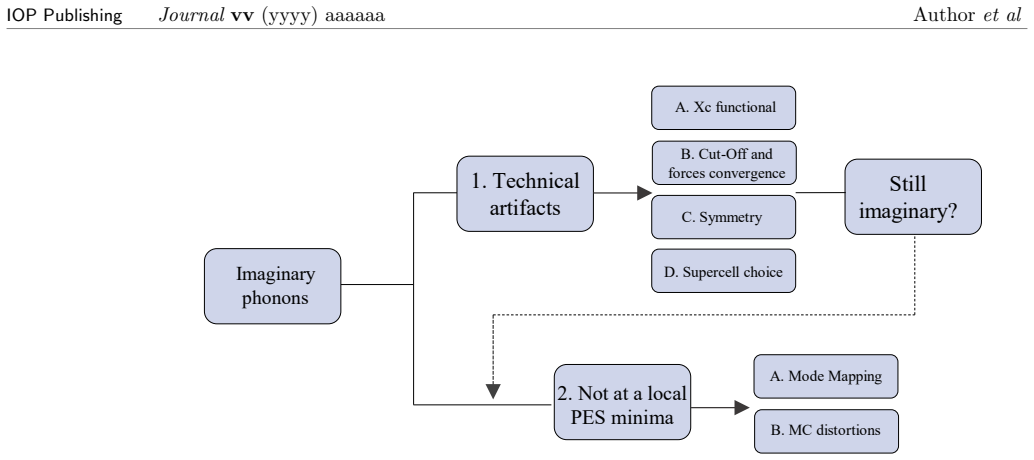
Imaginary phonon modes in MOF-5 can be produced by insufficient force convergence, coarse real-space grids, inconsistent symmetry handling, or alternative unit-cell choices. A finite-displacement workflow isolates these artifacts by controlled variation of the settings; once they are excluded, any leftover imaginary modes are investigated with mode mapping or Monte Carlo symmetry-breaking distortions to identify lower-energy structures and thereby assess genuine dynamical stability.
What carries the argument
finite-displacement workflow that systematically varies numerical parameters to separate calculation artifacts from true lattice instabilities
If this is right
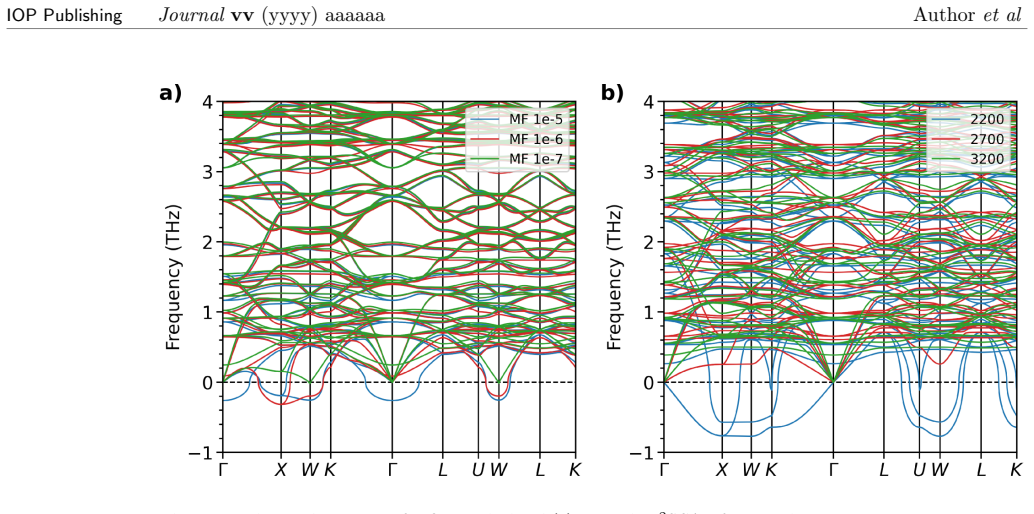
- Many reported imaginary modes in MOF-5 disappear once force convergence and grid resolution are improved.
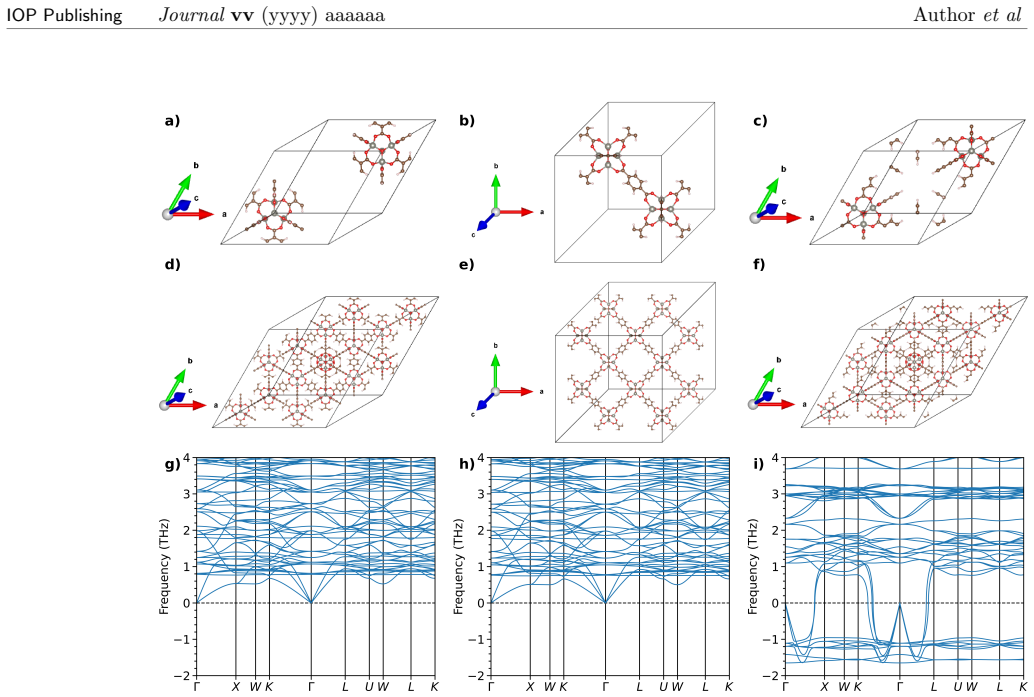
- Symmetry-standardization choices and alternative unit-cell descriptions can reverse a stability prediction.
- Mode mapping after numerical cleanup reveals whether an imaginary mode points to a nearby stable structure.
- Stochastic Monte Carlo symmetry breaking locates lower-energy minima once numerical noise is removed.
Where Pith is reading between the lines
- The same workflow could be tested on other large flexible frameworks where phonon results have been reported as unstable.
- Some previously dismissed MOF structures might regain candidate status if re-run with tighter numerical controls.
- Standardized numerical protocols might be needed before computational screening of MOFs can be considered reliable.
Load-bearing premise
Imaginary modes that survive after all numerical settings have been tightened still indicate real dynamical instability rather than some other hidden computational problem.
What would settle it
A set of MOF-5 phonon calculations that progressively tightens force thresholds and grid spacing until all imaginary modes disappear, or that finds a lower-energy minimum via Monte Carlo whose displacement pattern matches the original imaginary mode.
Figures
read the original abstract
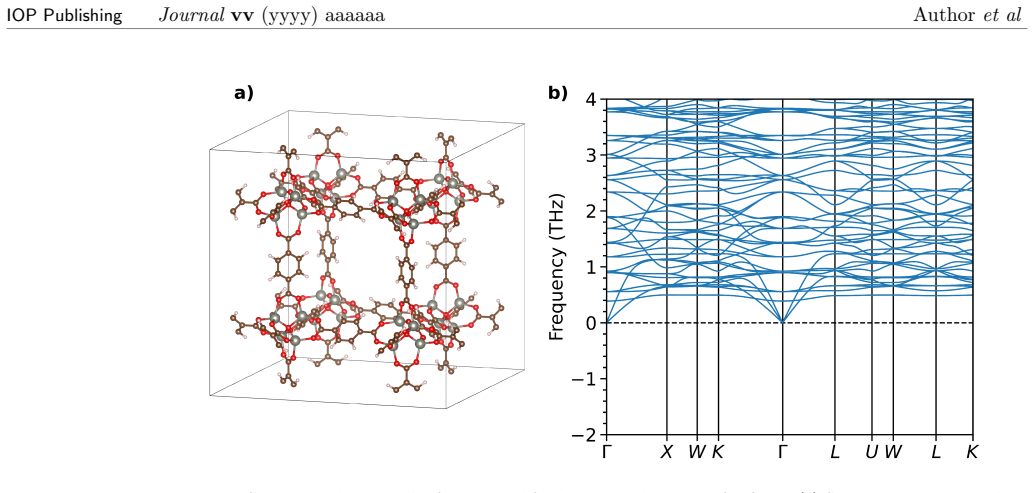
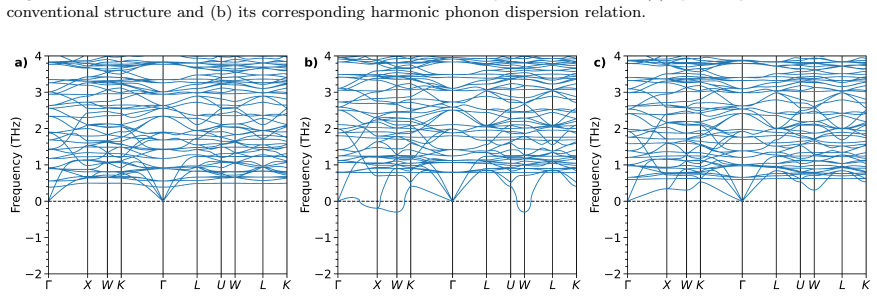
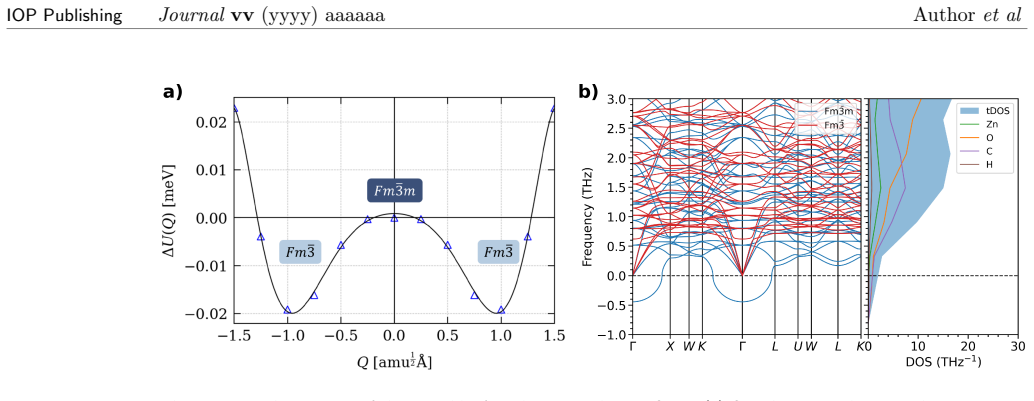
Assessing the dynamical stability of computationally predicted metal--organic frameworks (MOFs) is essential to distinguish synthetically feasible structures from dynamically unstable ones. However, reliable first-principles phonon calculations on these systems remain challenging: their large, flexible unit cells and soft collective modes make the vibrational spectrum highly sensitive to the numerical settings. Using MOF-5 as a representative case study, we establish a finite-displacement workflow to identify and isolate the origins of imaginary phonon modes. We demonstrate how numerical force convergence thresholds, real-space grid resolutions, symmetry-standardization protocols, and alternative unit-cell representations can qualitatively and spuriously alter the predicted lattice stability. Once numerical noise is confidently excluded, the remaining imaginary modes can be analyzed through mode mapping or stochastic Monte Carlo symmetry-breaking distortions to locate lower-energy local minima. This protocol provides a robust, transferable strategy for the reliable assessment of dynamical stability and lattice vibrations in flexible porous frameworks.
Editorial analysis
A structured set of objections, weighed in public.
Referee Report
Summary. The manuscript presents a finite-displacement workflow for diagnosing imaginary phonon modes in metal-organic frameworks, using MOF-5 as a case study. It claims that numerical settings including force convergence thresholds, real-space grid resolutions, symmetry-standardization protocols, and unit-cell representations can qualitatively induce spurious imaginary modes, and that once these are excluded, remaining modes indicate genuine dynamical instability that can be resolved by mode mapping or stochastic Monte Carlo symmetry-breaking distortions to locate lower-energy, dynamically stable minima. The abstract frames this as a robust, transferable protocol but supplies no quantitative results, convergence tests, or validation spectra.
Significance. A validated, practical guide for handling numerical artifacts in phonon calculations on large, flexible MOFs would address a recurring practical barrier in the field and improve reliability of dynamical stability assessments. The manuscript correctly identifies that standard methods are sensitive to settings in these systems, but the absence of any demonstrated before/after phonon spectra, energy comparisons, or confirmation that mapped/MC structures are free of imaginary modes under the same converged settings means the central claim of a reliable resolution protocol cannot yet be evaluated.
major comments (2)
- [Abstract] Abstract, final paragraph: the assertion that 'remaining imaginary modes can be analyzed through mode mapping or stochastic Monte Carlo symmetry-breaking distortions to locate lower-energy local minima' is load-bearing for the claimed protocol, yet no explicit validation is supplied (e.g., phonon spectra of the resulting structures showing absence of imaginary modes, or energy lowering relative to the original cell under identical converged settings).
- [Abstract] Abstract: the central claim that the workflow provides a 'robust, transferable strategy' rests on demonstrations that numerical settings 'can qualitatively and spuriously alter the predicted lattice stability,' but the text contains no quantitative data, convergence thresholds tested, or specific examples of how modes change with grid resolution, force tolerance, or cell choice.
Simulated Author's Rebuttal
We thank the referee for the constructive feedback. We address the major comments point-by-point below, clarifying the content of the full manuscript while agreeing to strengthen the abstract and add explicit quantitative summaries where helpful.
read point-by-point responses
-
Referee: [Abstract] Abstract, final paragraph: the assertion that 'remaining imaginary modes can be analyzed through mode mapping or stochastic Monte Carlo symmetry-breaking distortions to locate lower-energy local minima' is load-bearing for the claimed protocol, yet no explicit validation is supplied (e.g., phonon spectra of the resulting structures showing absence of imaginary modes, or energy lowering relative to the original cell under identical converged settings).
Authors: The full manuscript (Sections 3–4 and associated figures) already presents the phonon spectra of the mapped and Monte Carlo-distorted structures, confirming the absence of imaginary modes under the same converged settings, together with the computed energy lowerings relative to the original cell. The abstract is necessarily concise and does not repeat these details; we will revise the final paragraph to explicitly reference these validations. revision: yes
-
Referee: [Abstract] Abstract: the central claim that the workflow provides a 'robust, transferable strategy' rests on demonstrations that numerical settings 'can qualitatively and spuriously alter the predicted lattice stability,' but the text contains no quantitative data, convergence thresholds tested, or specific examples of how modes change with grid resolution, force tolerance, or cell choice.
Authors: The body of the manuscript supplies the requested demonstrations through explicit examples and figures showing the appearance or disappearance of imaginary modes as a function of force convergence threshold, real-space grid spacing, symmetry standardization, and choice of unit-cell representation. To make these quantitative aspects more immediately visible, we will add a concise summary table of the tested settings and their effects on the phonon spectrum. revision: yes
Circularity Check
No circularity: workflow applies standard finite-displacement phonon methods with external numerical benchmarks
full rationale
The paper describes a finite-displacement workflow to diagnose imaginary modes in MOF-5 phonons by varying force convergence, grid resolution, symmetry protocols, and unit-cell choices. These are presented as empirical demonstrations on external DFT calculations rather than any derivation, fitted parameter, or self-citation that reduces the central claim to its own inputs by construction. No equations or steps equate a 'prediction' to a fitted input, and the resolution suggestions (mode mapping, MC distortions) are framed as practical next steps without load-bearing self-referential definitions.
Axiom & Free-Parameter Ledger
axioms (2)
- domain assumption Density functional theory provides accurate forces for finite-displacement phonon calculations when numerical parameters are converged
- domain assumption Symmetry standardization and unit-cell choice do not alter the underlying physical stability when properly handled
Reference graph
Works this paper leans on
-
[1]
Yaghi O M, O’Keeffe M, Ockwig N W, Chae H K, Eddaoudi M and Kim J 2003Nature423 705–714 URLhttps://doi.org/10.1038/nature01650
-
[2]
Adv.4eaat9180 URL https://doi.org/10.1126/sciadv.aat9180
Kalmutzki M J, Hanikel N and Yaghi O M 2018Sci. Adv.4eaat9180 URL https://doi.org/10.1126/sciadv.aat9180
-
[3]
Chen Z, Kirlikovali K O, Li P and Farha O K 2022Acc. Chem. Res.55579–591 URL https://doi.org/10.1021/acs.accounts.1c00707
-
[4]
Rev.112724–781 URLhttps://doi.org/10.1021/cr2003272
Sumida K, Rogow D L, Mason J A, McDonald T M, Bloch E D, Herm Z R, Bae T H and Long J R 2012Chem. Rev.112724–781 URLhttps://doi.org/10.1021/cr2003272
-
[5]
Nanotechnol.17911–923 URL https://doi.org/10.1038/s41565-022-01168-3
Knebel A and Caro J 2022Nat. Nanotechnol.17911–923 URL https://doi.org/10.1038/s41565-022-01168-3
-
[6]
Li H, Eddaoudi M, O’Keeffe M and Yaghi O M 1999Nature402276–279 ISSN 1476-4687 URLhttps://doi.org/10.1038/46248
-
[7]
Eddaoudi M, Li H and Yaghi O M 2000J. Am. Chem. Soc.1221391–1397 URL https://doi.org/10.1021/ja9933386
-
[8]
Lock N, Christensen M, Wu Y, Peterson V K, Thomsen M K, Piltz R O, Ramirez-Cuesta A J, McIntyre G J, Nor´ en K, Kutteh R, Kepert C J, Kearley G J and Iversen B B 2013 Dalton Trans.421996–2007 URLhttps://doi.org/10.1039/C2DT31491F
-
[9]
Rimmer L H N, Dove M T, Goodwin A L and Palmer D C 2014Phys. Chem. Chem. Phys.16 21144–21152 URLhttps://doi.org/10.1039/C4CP01701C
-
[10]
Theory Simul.21900093 URL https://doi.org/10.1002/adts.201900093
Ryder M R, Maul J, Civalleri B and Erba A 2019Adv. Theory Simul.21900093 URL https://doi.org/10.1002/adts.201900093
-
[11]
Edzards J, Santana-Andreo J, Saßnick H D and Cocchi C 2025J. Chem. Theory. Comput.21 7062–7074 pMID: 40653644 URLhttps://doi.org/10.1021/acs.jctc.5c00399
-
[12]
Andreeva A B, Le K N, Chen L, Kellman M E, Hendon C H and Brozek C K 2020 J. Am. Chem. Soc.14219291–19299 URLhttps://doi.org/10.1021/jacs.0c09499
-
[13]
Dubbeldam D, Walton K S, Ellis D E and Snurr R Q 2007Angew. Chem. Int. Ed.46 4496–4499 URLhttps://doi.org/10.1002/anie.200700218
-
[14]
Baroni S, de Gironcoli S, Dal Corso A and Giannozzi P 2001Rev. Mod. Phys.73515–562 URLhttps://doi.org/10.1103/RevModPhys.73.515
-
[15]
Struct.4033002 URL https://doi.org/10.1088/2516-1075/ac78b3
Pallikara I, Kayastha P, Skelton J M and Whalley L D 2022Electron. Struct.4033002 URL https://doi.org/10.1088/2516-1075/ac78b3
-
[16]
Kamath P D and Persson K A 2026arXiv preprint arXiv:2602.07295URL https://arxiv.org/abs/2602.07295
-
[17]
Togo A 2023J. Phys. Soc. Jpn.92012001 URLhttps://doi.org/10.7566/JPSJ.92.012001 12 IOP PublishingJournalvv(yyyy) aaaaaa Authoret al
-
[18]
Mater.10258 URLhttps://doi.org/10.1038/s41524-024-01437-w
Zhu Z, Park J, Sahasrabuddhe H, Ganose A M, Chang R, Lawson J W and Jain A 2024 npj Comp. Mater.10258 URLhttps://doi.org/10.1038/s41524-024-01437-w
-
[19]
Hohenberg P and Kohn W 1964Phys. Rev.136(3B) B864–B871 URL https://link.aps.org/doi/10.1103/PhysRev.136.B864
-
[20]
Self-consistent equations including exchange and correlation effects,
Kohn W and Sham L J 1965Phys. Rev.140(4A) A1133–A1138 URL https://link.aps.org/doi/10.1103/PhysRev.140.A1133
-
[21]
Perdew J P, Burke K and Ernzerhof M 1996Phys. Rev. Lett.77(18) 3865–3868 URL https://doi.org/10.1103/PhysRevLett.77.3865
-
[22]
Furness J W, Kaplan A D, Ning J, Perdew J P and Sun J 2020J. Phys. Chem. Lett.11 8208–8215 URLhttps://doi.org/10.1021/acs.jpclett.0c02405
-
[23]
Grimme S, Antony J, Ehrlich S and Krieg H 2010J. Chem. Phys.132154104 ISSN 0021-9606 URLhttps://doi.org/10.1063/1.3382344
-
[24]
Born M and Huang K 1954Dynamical Theory of Crystal Lattices(Oxford: Clarendon Press) URLhttps://doi.org/10.1093/oso/9780192670083.001.0001
-
[25]
Togo A and Tanaka I 2015Scripta Mater.1081–5 URL https://doi.org/10.1016/j.scriptamat.2015.07.021
-
[26]
Parlinski K, Li Z Q and Kawazoe Y 1997Phys. Rev. Lett.784063–4066 URL https://doi.org/10.1103/PhysRevLett.78.4063
-
[27]
Hoffman A E J, Senkovska I, Wieme J, Krylov A, Kaskel S and Van Speybroeck V 2022 J. Mater. Chem. A1017254–17266 URLhttps://doi.org/10.1039/D2TA01678H
-
[28]
Phys.234513–527 URL https://doi.org/10.1515/zkri-2018-2152
Kuchta B, Formalik F, Rogacka J, Neimark A V and Firlej L 2019Z. Phys.234513–527 URL https://doi.org/10.1515/zkri-2018-2152
-
[29]
K¨ uhne T D, Iannuzzi M, Del Ben M, Rybkin V V, Hutter Jet al.2020J. Chem. Phys.152 194103 URLhttps://doi.org/10.1063/5.0007045
-
[30]
Goedecker S, Teter M and Hutter J 1996Phys. Rev. B54(3) 1703–1710 URL https://link.aps.org/doi/10.1103/PhysRevB.54.1703
-
[31]
VandeVondele J and Hutter J 2007J. Chem. Phys.127114105 ISSN 0021-9606 (Preprint https://pubs.aip.org/aip/jcp/article-pdf/doi/10.1063/1.2770708/14787836/ 114105_1_online.pdf) URLhttps://doi.org/10.1063/1.2770708
-
[32]
Lippert G, Hutter J and Parrinello M 1997Mol. Phys.92477–488 URL https://doi.org/10.1080/002689797170220
-
[33]
VandeVondele J, Krack M, Mohamed F, Parrinello M, Chassaing T and Hutter J 2005 Comput. Phys. Commun.167103–128 URLhttps://doi.org/10.1016/j.cpc.2004.12.014
-
[34]
Skelton J M 2017 Modemaphttps://github.com/JMSkelton/ModeMapaccessed: 2026-04-26 URLhttps://github.com/JMSkelton/ModeMap
2017
-
[35]
Setyawan W and Curtarolo S 2010Comp. Mater. Sci.49299–312 URL https://doi.org/10.1016/j.commatsci.2010.05.010
-
[36]
Saßnick H D, Edzards J, Reents T and Cocchi C 2026arXiv preprint arXiv:2604.26551URL https://arxiv.org/abs/2604.26551
-
[37]
Adamo C and Barone V 1999J. Chem. Phys.1106158–6170 ISSN 0021-9606 (Preprint https: //pubs.aip.org/aip/jcp/article-pdf/110/13/6158/19068890/6158_1_online.pdf) URL https://doi.org/10.1063/1.478522
-
[38]
Sun J, Ruzsinszky A and Perdew J P 2015Phys. Rev. Lett.115036402 URL https://doi.org/10.1103/PhysRevLett.115.036402 13 IOP PublishingJournalvv(yyyy) aaaaaa Authoret al
-
[39]
Ning J, Kothakonda M, Furness J W, Kaplan A D, Ehlert S, Brandenburg J G, Perdew J P and Sun J 2022Phys. Rev. B106(7) 075422 URL https://link.aps.org/doi/10.1103/PhysRevB.106.075422
-
[40]
Tan J C and Cheetham A K 2011Chem. Soc. Rev.401059–1080 URL https://doi.org/10.1039/C0CS00163E
-
[41]
Sci.1010666–10679 URL https://doi.org/10.1039/C9SC04249K
Redfern L R and Farha O K 2019Chem. Sci.1010666–10679 URL https://doi.org/10.1039/C9SC04249K
-
[42]
Krause S, Hosono N and Kitagawa S 2020Angew. Chem. Int. Ed.5915325–15341 URL https://doi.org/10.1002/anie.202004535
-
[43]
Togo A, Shinohara K and Tanaka I 2024Sci. Technol. Adv. Mater. Meth.42384822–2384836 URLhttps://doi.org/10.1080/27660400.2024.2384822
-
[44]
Skelton J M, Burton L A, Parker S C, Walsh A, Kim C E, Soon A, Buckeridge J, Sokol A A, Catlow C R A, Togo A and Tanaka I 2016Phys. Rev. Lett.117075502 URL https://doi.org/10.1103/PhysRevLett.117.075502
-
[45]
Whalley L D, Skelton J M, Frost J M and Walsh A 2016Phys. Rev. B94220301 URL https://doi.org/10.1103/PhysRevB.94.220301
-
[46]
Theory Simul.21800184 URL https://doi.org/10.1002/adts.201800184
Eriksson F, Fransson E and Erhart P 2019Adv. Theory Simul.21800184 URL https://doi.org/10.1002/adts.201800184
-
[47]
Mater.11125 URLhttps://doi.org/10.1038/s41524-025-01611-8 14
Elena A M, Kamath P D, Jaffrelot Inizan T, Rosen A S, Zanca Fet al.2025 npj Comp. Mater.11125 URLhttps://doi.org/10.1038/s41524-025-01611-8 14
discussion (0)
Sign in with ORCID, Apple, or X to comment. Anyone can read and Pith papers without signing in.