Entanglement distribution protocols under imperfect fidelity and quantum memory conditions
Pith reviewed 2026-06-28 22:16 UTC · model grok-4.3
The pith
Shortening execution time in an entanglement distribution protocol increases link success probability under imperfect fidelity and memory conditions.
A machine-rendered reading of the paper's core claim, the machinery that carries it, and where it could break.
Core claim
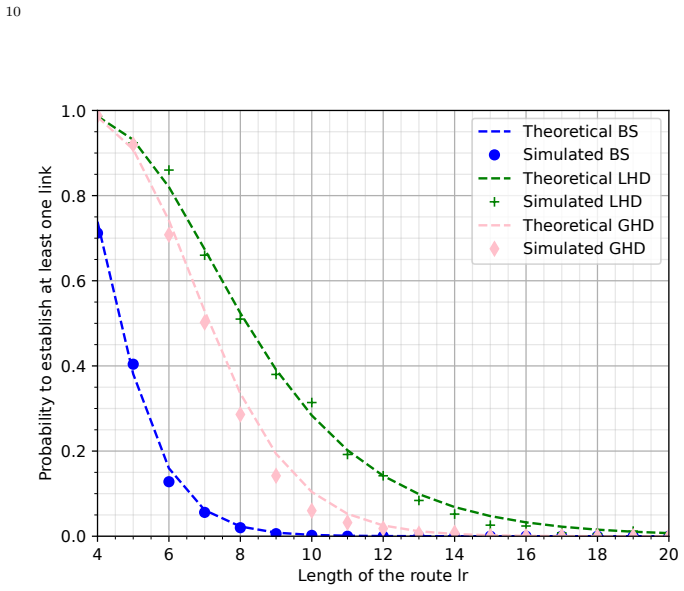
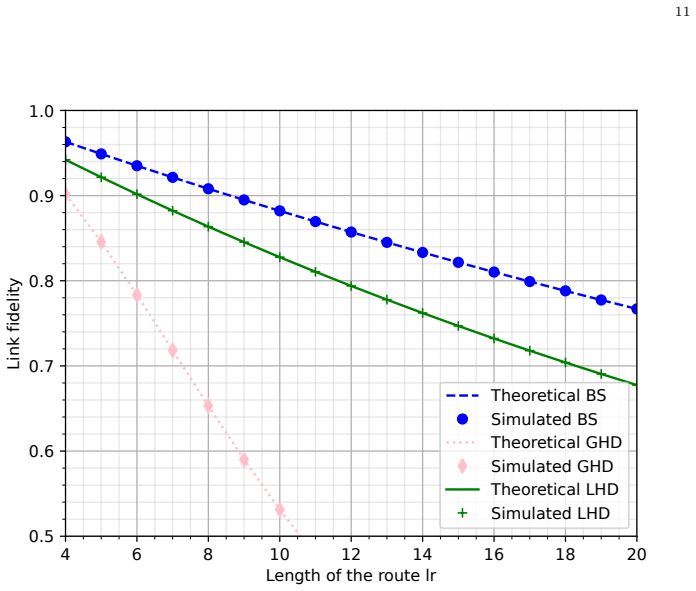
The authors develop an existing protocol taking account of fidelity and imperfect memories, shorten the execution time to increase its link success probability, creating the Locally Heralded Distribution (LHD) protocol that outperforms some previous protocols when benchmarked through simulation using a blind entanglement protocol as a baseline.
What carries the argument
Locally Heralded Distribution (LHD) protocol, which shortens execution time to increase link success probability while accounting for fidelity and imperfect memories.
If this is right
- The LHD protocol achieves higher link success probabilities than some earlier protocols.
- Simulation results provide performance benchmarks for the considered protocols under the modeled conditions.
- Accounting for imperfect fidelity and memory leads to more realistic protocol designs for quantum networks.
Where Pith is reading between the lines
- If the simulation parameters reflect hardware, LHD could be implemented to improve quantum link reliability.
- The time-shortening strategy might apply to other quantum communication protocols facing similar decoherence issues.
- Further analysis could explore optimal shortening thresholds for different hardware parameters.
Load-bearing premise
The assumption that shortening execution time directly increases link success probability under the modeled imperfect fidelity and memory conditions, and that the simulation parameters accurately capture real quantum hardware behavior.
What would settle it
An experiment or simulation where the LHD protocol shows equal or lower link success probability compared to the baseline under identical imperfect conditions would falsify the performance claim.
Figures
read the original abstract
The rapid development of quantum computers and sensors urges for the development of a quantum Internet capable of transmitting quantum bits over long distances. Photons used for quantum data transfer are fragile over time and sensitive to their environment, so that they cannot be directly used over long distances. To remedy this problem, long distance paths are segmented into shorter links and entangled pairs of photons are distributed over these links and swapped to create end-to-end entangled pairs over long distances, eventually used for teleportation. In this paper, we develop an existing protocol taking account of fidelity and imperfect memories. We shorten the execution time and thus increase its link success probability creating the so-called Locally Heralded Distribution (LHD). It turns out that the proposed protocol outperforms some previous protocols. We benchmark through simulation the performances of protocols considered in this paper by using a blind entanglement protocol as a baseline.
Editorial analysis
A structured set of objections, weighed in public.
Referee Report
Summary. The manuscript proposes the Locally Heralded Distribution (LHD) protocol obtained by shortening execution time in an existing entanglement distribution scheme while incorporating models of imperfect fidelity and quantum memory decoherence. Simulation benchmarks are used to show that LHD outperforms selected prior protocols relative to a blind entanglement protocol baseline.
Significance. If the reported simulation results hold under the modeled conditions, the work supplies a concrete, empirically tested improvement to entanglement distribution that could aid practical quantum network design. The explicit use of a baseline protocol and simulation-based comparison is a strength that supports reproducibility and direct assessment of the claimed gains.
minor comments (3)
- Abstract: the statement that the protocol 'outperforms some previous protocols' is imprecise; the introduction or results section should explicitly name the compared protocols and the quantitative metric (e.g., success probability or rate) used for the comparison.
- Simulation results section: performance curves would benefit from explicit statement of the number of Monte Carlo trials and any statistical error bars or confidence intervals to allow readers to assess the robustness of the outperformance claim.
- Notation: ensure that fidelity and memory decoherence parameters are defined with consistent symbols and units across the protocol description and simulation setup.
Simulated Author's Rebuttal
We thank the referee for the positive summary of our work on the Locally Heralded Distribution (LHD) protocol, the acknowledgment of its simulation-based benchmarking against prior protocols and a blind entanglement baseline, and the recommendation for minor revision. No major comments were provided in the report.
Circularity Check
No significant circularity
full rationale
The paper modifies an existing entanglement distribution protocol by shortening execution time to create the Locally Heralded Distribution (LHD) variant, then evaluates it via simulation against an external blind entanglement baseline under explicit models of imperfect fidelity and memory decoherence. All performance claims are presented as empirical simulation outputs rather than analytical identities or fitted parameters renamed as predictions. No self-citation is invoked as a load-bearing uniqueness theorem, no ansatz is smuggled via prior work by the same authors, and the central result does not reduce by construction to the paper's own inputs. The derivation chain is therefore self-contained against external benchmarks.
Axiom & Free-Parameter Ledger
Reference graph
Works this paper leans on
-
[1]
P. K´ om´ ar, E. M. Kessler, M. Bishof, L. Jiang, A. S. Sørensen, J. Ye, and M. D. Lukin, “A quantum network of clocks,”Nature Physics, vol. 10, no. 8, p. 582–587, 6 2014. [Online]. Available: http://dx.doi.org/10.1038/nphys3000
-
[2]
OSI Stack Redesign for Quantum Networks: Requirements, Technologies, Challenges, and Future Directions,
S. Ahmed, M. K. Saeed, and A. Khokhar, “OSI Stack Redesign for Quantum Networks: Requirements, Technologies, Challenges, and Future Directions,” 6 2025
2025
-
[3]
Quantum internet: A vision for the road ahead,
S. Wehner, D. Elkouss, and R. Hanson, “Quantum internet: A vision for the road ahead,”Science, vol. 362, no. 6412, p. eaam9288, 2018. [Online]. Available: https://www.science.org/doi/abs/10.1126/science.aam9288
-
[4]
A modular quantum network architecture for integrating network scheduling with local program execution,
T. R. Beauchamp, H. Jirovsk´ a, and S. Gauthier, “A modular quantum network architecture for integrating network scheduling with local program execution,”arXiv, 3 2025
2025
-
[5]
A resource-centric, task-based approach to quantum network control,
A. Pirker, B. Munoz, and W. D¨ ur, “A resource-centric, task-based approach to quantum network control,” 2025. [Online]. Available: https://arxiv.org/abs/2507.12030
arXiv 2025
-
[6]
Entanglement routing in quantum networks: A comprehensive survey,
A. Abane, M. Cubeddu, V. Mai, and A. Battou, “Entanglement routing in quantum networks: A comprehensive survey,”IEEE Transactions on Quantum Engineering, vol. PP, pp. 1–36, 01 2025
2025
-
[7]
Fundamental limits of repeaterless quantum communications,
S. Pirandola, R. Laurenza, C. Ottaviani, and L. Banchi, “Fundamental limits of repeaterless quantum communications,”Nature Communications, vol. 8, no. 1, 4 2017. [Online]. Available: http://dx.doi.org/10.1038/ncomms15043
-
[8]
Modeling and designing routing protocols in quantum networks,
S. Shi and C. Qian, “Modeling and designing routing protocols in quantum networks,” 2019. [Online]. Available: https://arxiv.org/abs/1909.09329
arXiv 2019
-
[9]
Efficient routing design based on entanglement flow loss effect in quantum networks,
Z. Wang, J. Li, Z. Li, L. Chen, N. Yu, Q. Sun, and J. Lu, “Efficient routing design based on entanglement flow loss effect in quantum networks,” in2024 International Conference on Quantum Communications, Networking, and Computing (QCNC), 2024, pp. 9–16. 12
2024
-
[10]
Quantum repeaters based on entanglement purification,
W. Duer, H.-J. Briegel, J. I. Cirac, and P. Zoller, “Quantum repeaters based on entanglement purification,”Phys. Rev. A, vol. 59, pp. 169–181, 1 1999. [Online]. Available: https://link.aps.org/doi/10.1103/PhysRevA.59.169
-
[11]
Entanglement distribution in quantum repeater with purification and optimized buffer time,
A. Zang, X. Chen, A. Kolar, J. Chung, M. Suchara, T. Zhong, and R. Kettimuthu, “Entanglement distribution in quantum repeater with purification and optimized buffer time,” inIEEE INFOCOM 2023 - IEEE Conference on Computer Communications Workshops (INFOCOM WKSHPS). IEEE, May 2023, p. 1–6. [Online]. Available: http://dx.doi.org/10.1109/INFOCOMWKSHPS57453.20...
-
[12]
Entanglement distribution in a quantum network: A multicommodity flow-based approach,
K. Chakraborty, D. Elkouss, B. Rijsman, and S. Wehner, “Entanglement distribution in a quantum network: A multicommodity flow-based approach,”IEEE Transactions on Quantum Engineering, vol. 1, p. 1–21, 2020. [Online]. Available: http://dx.doi.org/10.1109 /TQE.2020.3028172
arXiv 2020
-
[13]
A compact framework for analyzing asynchronous entanglement distribution in quantum networks,
E. Hughes, W. Munizzi, and P. Narang, “A compact framework for analyzing asynchronous entanglement distribution in quantum networks,” 7 2025
2025
-
[14]
Routing protocols for quantum networks: Overview and challenges,
B. Kar and P. Kumar, “Routing protocols for quantum networks: Overview and challenges,”
-
[15]
Available: https://arxiv.org/abs/2305.00708
[Online]. Available: https://arxiv.org/abs/2305.00708
-
[16]
A survey of quantum entanglement routing protocols—challenges for wide-area networks,
F. Dupuy, C. Goursaud, and F. Guillemin, “A survey of quantum entanglement routing protocols—challenges for wide-area networks,”Advanced Quantum Technologies, vol. 6, p. 2200180, 03 2023
2023
-
[17]
Distributed routing in a quantum internet,
K. Chakraborty, F. Rozpedek, A. Dahlberg, and S. Wehner, “Distributed routing in a quantum internet,” 2019. [Online]. Available: https://arxiv.org/abs/1907.11630
Pith/arXiv arXiv 2019
-
[18]
Adaptive routing for quantum memory failures in the quantum internet,
L. Gyongyosi and S. Imre, “Adaptive routing for quantum memory failures in the quantum internet,”Quantum Information Processing, vol. 18, no. 2, Jan. 2019. [Online]. Available: http://dx.doi.org/10.1007/s11128-018-2153-x
-
[19]
Decentralized base-graph routing for the quantum internet,
——, “Decentralized base-graph routing for the quantum internet,”Physical Review A, vol. 98, no. 2, Aug. 2018. [Online]. Available: http://dx.doi.org/10.1103/PhysRevA.98.022 310
-
[20]
Entanglement-gradient routing for quantum networks,
——, “Entanglement-gradient routing for quantum networks,”Scientific Reports, vol. 7, no. 1, Oct. 2017. [Online]. Available: http://dx.doi.org/10.1038/s41598-017-14394-w
-
[21]
Concurrent entanglement routing for quantum networks: Model and designs,
S. Shi, X. Zhang, and C. Qian, “Concurrent entanglement routing for quantum networks: Model and designs,”IEEE/ACM Transactions on Networking, vol. PP, pp. 1–16, 06 2024
2024
-
[22]
Routing in quantum networks with end-to-end knowledge,
V. Kumar, C. Cicconetti, M. Conti, and A. Passarella, “Routing in quantum networks with end-to-end knowledge,” 2025. [Online]. Available: https://arxiv.org/abs/2407.14407
Pith/arXiv arXiv 2025
-
[23]
Fidelity-guarantee entanglement routing in quantum networks,
J. Li, M. Wang, K. Xue, R. Li, N. Yu, Q. Sun, and J. Lu, “Fidelity-guarantee entanglement routing in quantum networks,”IEEE Transactions on Communications, vol. 70, no. 10, pp. 6748–6763, 2022
2022
-
[24]
E2EFidelityAwareRoutingandPurificationfor Throughput Maximization in Quantum Networks,
Y. Zhao, G. Zhao, and C. Qiao, “E2e fidelity aware routing and purification for throughput maximization in quantum networks,” inIEEE INFOCOM 2022 - IEEE Conference on Computer Communications. IEEE Press, 2022, p. 480–489. [Online]. Available: https://doi.org/10.1109/INFOCOM48880.2022.9796814
-
[25]
Entanglement routing using quantum error correction for distillation,
A. Patil, M. Pacenti, B. Vasi´ c, S. Guha, and N. Rengaswamy, “Entanglement routing using quantum error correction for distillation,” 2024. [Online]. Available: https://arxiv.org/abs/2405.00849
arXiv 2024
-
[26]
Tools for the design of quantum repeater networks,
T. J. Coopmans, “Tools for the design of quantum repeater networks,” Doctoral thesis, TU Delft - QID/Elkouss Group, 2021
2021
-
[27]
Zbr: Zone-based routing in quantum networks with efficient entanglement distribution,
P. Kumar and B. Kar, “Zbr: Zone-based routing in quantum networks with efficient entanglement distribution,”Journal of Network and Computer Applications, vol. 238, p. 104156, 2025. [Online]. Available: https://www.sciencedirect.com/science/article/pii/S108 4804525000530
2025
-
[28]
Optimal entanglement distribution policies in homogeneous repeater chains with cutoffs,
A. G. I˜ nesta, G. Vardoyan, L. Scavuzzo, and S. Wehner, “Optimal entanglement distribution policies in homogeneous repeater chains with cutoffs,”npj Quantum Information, vol. 9, no. 1, 5 2023. [Online]. Available: http://dx.doi.org/10.1038/s41534-023-00713-9
-
[29]
Quantum cryptography integrating an optical quantum memory,
H. Mamann, T. Nieddu, F. Hoffet, M. Bozzio, F. G. de Loubresse, I. Kerenidis, E. Diamanti, A. Urvoy, and J. Laurat, “Quantum cryptography integrating an optical quantum memory,”Science Advances, vol. 11, no. 38, p. eadx3223, 2025. [Online]. Available: https://www.science.org/doi/abs/10.1126/sciadv.adx3223
-
[30]
Bell-state measurement exceeding 50% success probability with linear optics,
M. J. Bayerbach, S. E. D’Aurelio, P. van Loock, and S. Barz, “Bell-state measurement exceeding 50% success probability with linear optics,”Science Advances, vol. 9, no. 32, p. 13 eadf4080, 2023. [Online]. Available: https://www.science.org/doi/abs/10.1126/sciadv.adf40 80
-
[31]
T. Kilmer and S. Guha, “Boosting linear-optical bell measurement success probability with predetection squeezing and imperfect photon-number-resolving detectors,”Physical Review A, vol. 99, no. 3, 3 2019. [Online]. Available: http://dx.doi.org/10.1103/PhysRevA.99.032302
-
[32]
3/4-efficient bell measurement with passive linear optics and unentangled ancillae,
F. Ewert and P. van Loock, “3/4-efficient bell measurement with passive linear optics and unentangled ancillae,”Physical Review Letters, vol. 113, no. 14, 9 2014. [Online]. Available: http://dx.doi.org/10.1103/PhysRevLett.113.140403
-
[33]
Entanglement-assisted logical bell state measurement with linear optics,
J. Qi, C.-Q. Yu, R.-Y. Yuan, Z. Yang, and B.-C. Ren, “Entanglement-assisted logical bell state measurement with linear optics,”Opt. Laser Tech., vol. 192, p. 113385, 2025
2025
-
[34]
Inside quantum repeaters,
W. J. Munro, K. Azuma, K. Tamaki, and K. Nemoto, “Inside quantum repeaters,”IEEE Journal of Selected Topics in Quantum Electronics, vol. 21, no. 3, pp. 78–90, 2015. (Claire Mesny)Orange Innovation Current address: 2, Avenue Pierre Marzin, F-22300 Lannion Email address:claire.mesny@orange.com (Fabrice Guillemin)Orange Innovation Current address: 2, Avenue ...
2015
discussion (0)
Sign in with ORCID, Apple, or X to comment. Anyone can read and Pith papers without signing in.