HypoAgent: An Agentic Framework for Interactive Abductive Hypothesis Generation over Knowledge Graphs
Pith reviewed 2026-06-28 22:13 UTC · model grok-4.3
The pith
HypoAgent uses three agents to support interactive abductive hypothesis generation over knowledge graphs by grounding intents and diagnosing failures.
A machine-rendered reading of the paper's core claim, the machinery that carries it, and where it could break.
Core claim
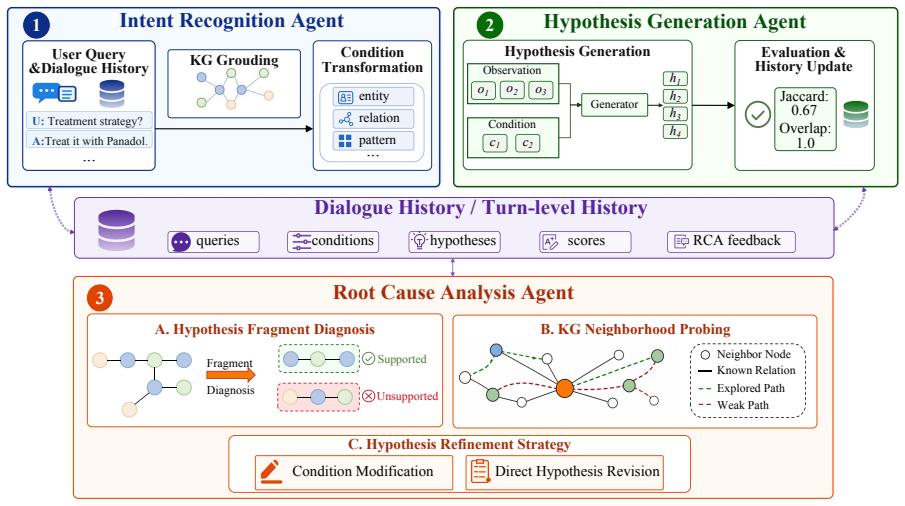
HypoAgent is an agentic framework that combines an Intent Recognition Agent, a Hypothesis Generation Agent, and a Root Cause Analysis Agent to overcome limitations in existing controllable hypothesis generation methods for multi-turn interactive settings over knowledge graphs.
What carries the argument
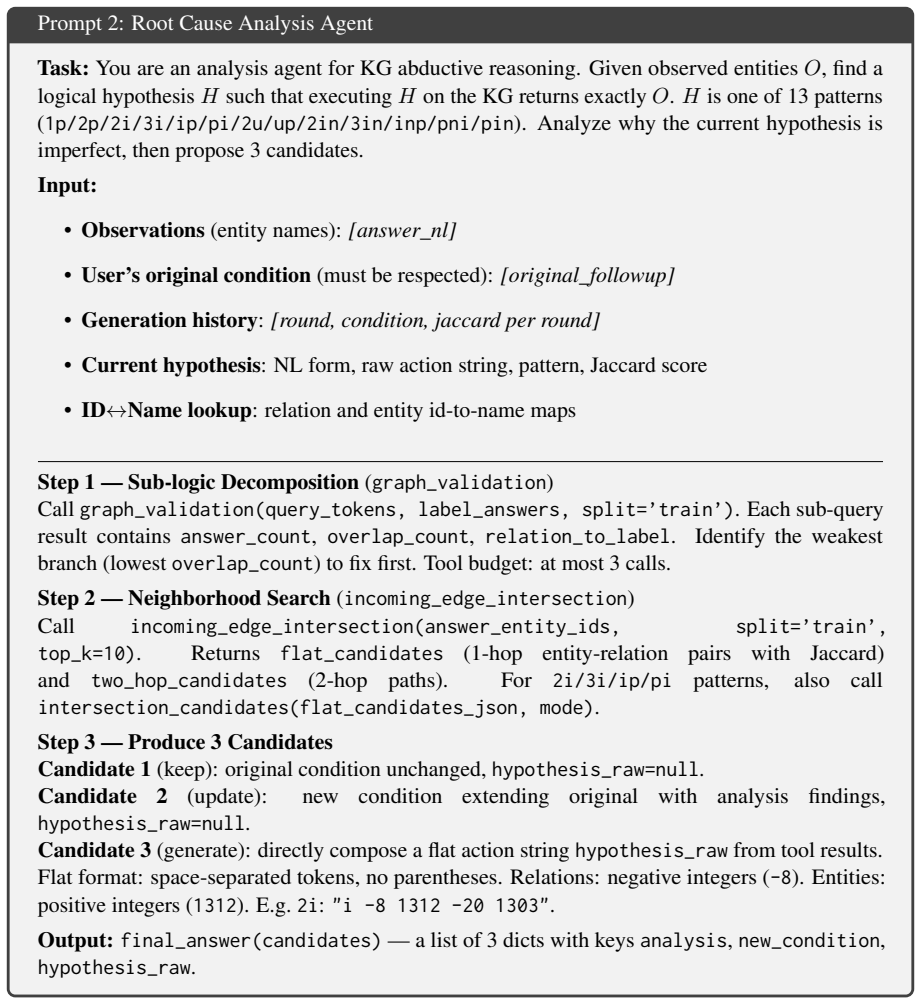
The three-agent system that grounds user utterances into executable KG conditions, generates hypotheses accordingly, and diagnoses unreliable fragments using KG neighborhood probing.
If this is right
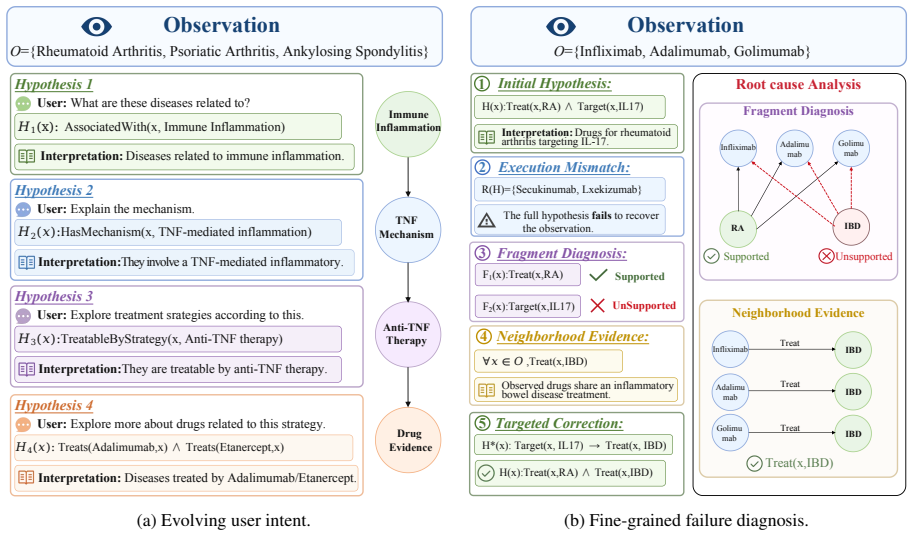
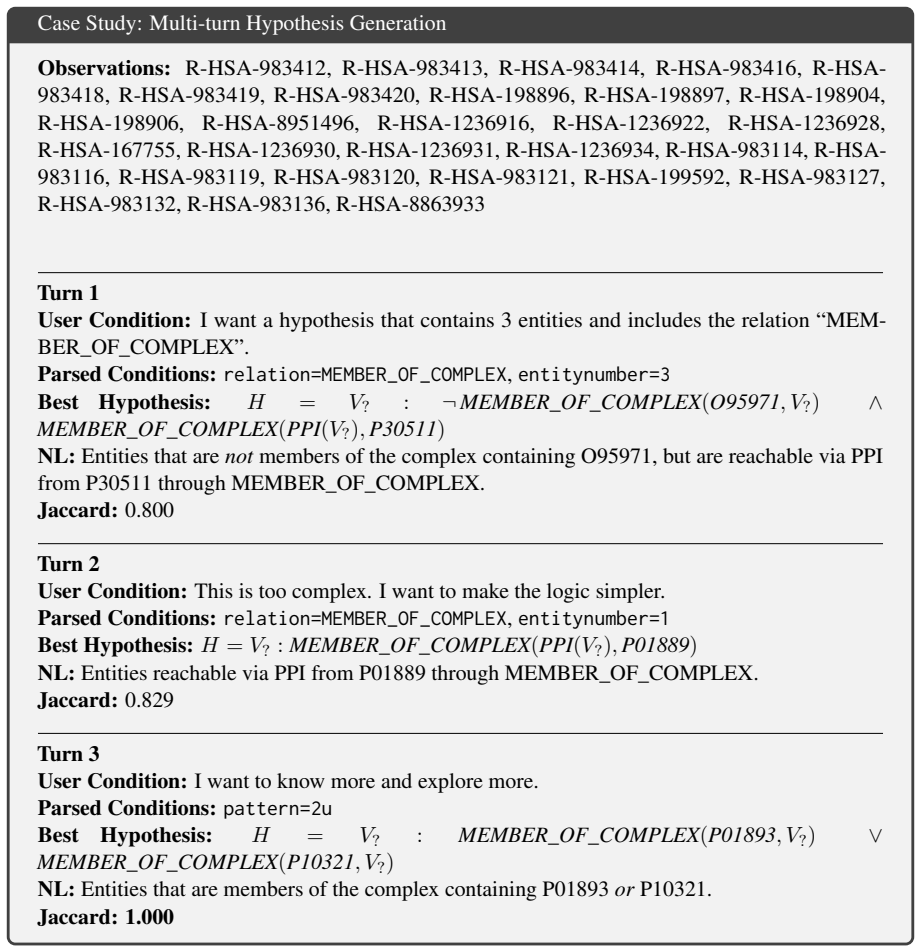
- Users can provide guidance through natural language across multiple dialogue turns instead of fixed explicit conditions.
- Hypothesis failures can be diagnosed at a fine-grained level and refined with support from the knowledge graph structure.
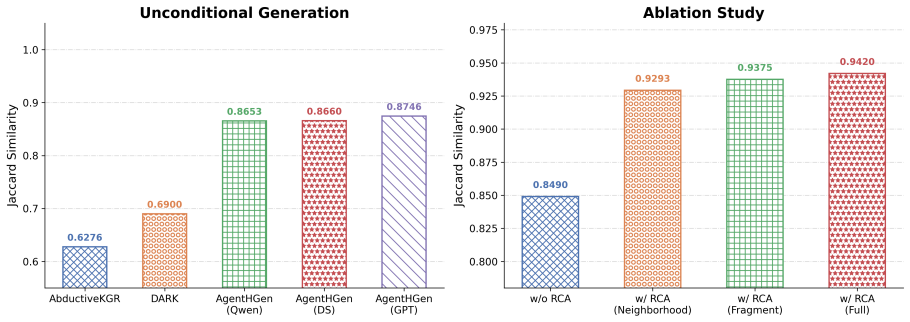
- Semantic similarity to ground truth improves under single-turn, multi-turn, and unconditional evaluation settings.
- The approach works for both general commonsense graphs and specialized biomedical graphs.
Where Pith is reading between the lines
- Dividing reasoning into intent tracking, generation, and diagnosis agents may help in other tasks involving evolving user goals.
- Using graph neighborhood probing for diagnosis could be tested in non-knowledge-graph structured data settings.
- The framework's performance suggests potential for deployment in domains requiring iterative hypothesis refinement like scientific discovery.
Load-bearing premise
That the three-agent architecture can reliably ground evolving natural-language intents across multi-turn dialogues and provide fine-grained diagnosis of hypothesis failures via KG neighborhood probing.
What would settle it
Observing no gain in semantic similarity scores when using the full HypoAgent compared to a single model baseline in multi-turn experiments on the tested knowledge graphs would falsify the benefit of the agent split.
Figures
read the original abstract
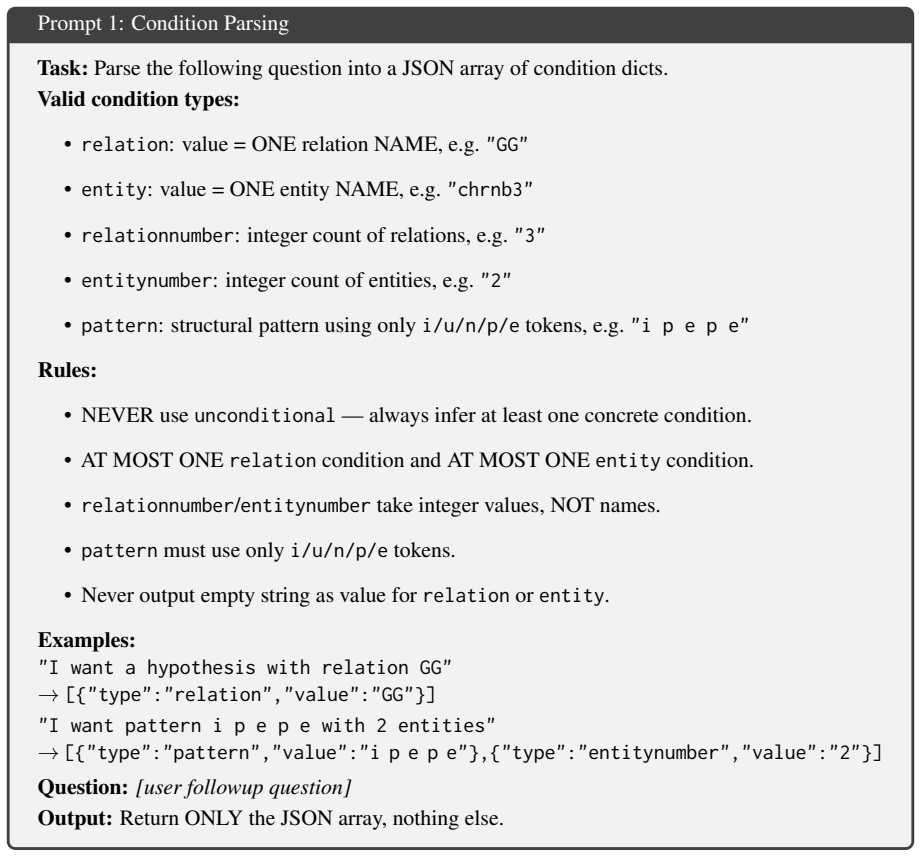
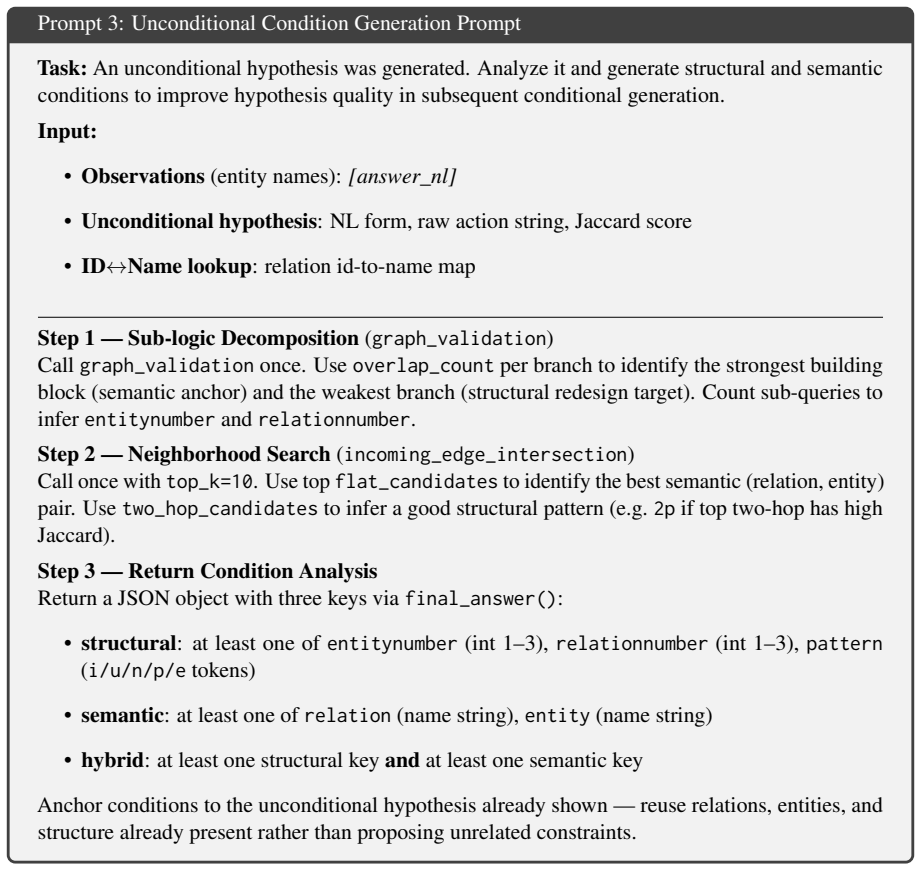
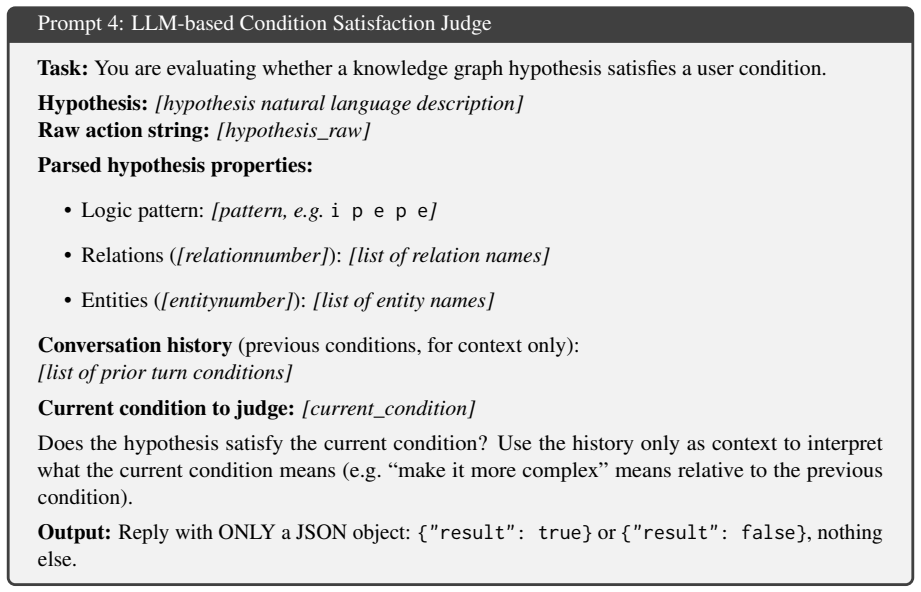
Abductive reasoning over knowledge graphs aims to generate logical hypotheses that explain observed entities or facts. Existing controllable hypothesis generation methods allow users to guide this process with explicit conditions, but they remain limited in interactive settings: they struggle to ground evolving natural-language intents across multi-turn dialogues and provide little fine-grained diagnosis when generated hypotheses fail. To address these limitations, we propose HypoAgent, an Agentic framework for interactive abductive Hypothesis Generation over knowledge graphs. HypoAgent integrates three agents: an Intent Recognition Agent that grounds user utterances and dialogue history into executable KG conditions, a Hypothesis Generation Agent that performs controllable hypothesis generation according to the extracted user intention, and a Root Cause Analysis Agent that diagnoses unreliable hypothesis fragments and leverages KG neighborhood probing to identify supported refinements. Experiments on commonsense and biomedical domain-specific knowledge graphs demonstrate that HypoAgent achieves state-of-the-art semantic similarity under single-turn, multi-turn, and unconditional settings. Our code is available at https://github.com/HKUST-KnowComp/HypoAgent.
Editorial analysis
A structured set of objections, weighed in public.
Referee Report
Summary. The paper proposes HypoAgent, a three-agent framework (Intent Recognition Agent, Hypothesis Generation Agent, Root Cause Analysis Agent) for interactive abductive hypothesis generation over knowledge graphs. It addresses limitations in grounding evolving natural-language intents across multi-turn dialogues and providing fine-grained diagnosis of hypothesis failures via KG neighborhood probing. Experiments on commonsense and biomedical KGs report state-of-the-art semantic similarity under single-turn, multi-turn, and unconditional settings, with public code released.
Significance. If the experimental results hold under rigorous controls, the work is significant for advancing agentic methods in abductive KG reasoning. It directly targets interactive usability gaps in prior controllable generation approaches. The public code release supports reproducibility and is a clear strength.
minor comments (2)
- The abstract mentions 'commonsense and biomedical domain-specific knowledge graphs' but does not name the specific graphs (e.g., ConceptNet, UMLS) or their sizes; this should be stated explicitly in the introduction or experimental setup for clarity.
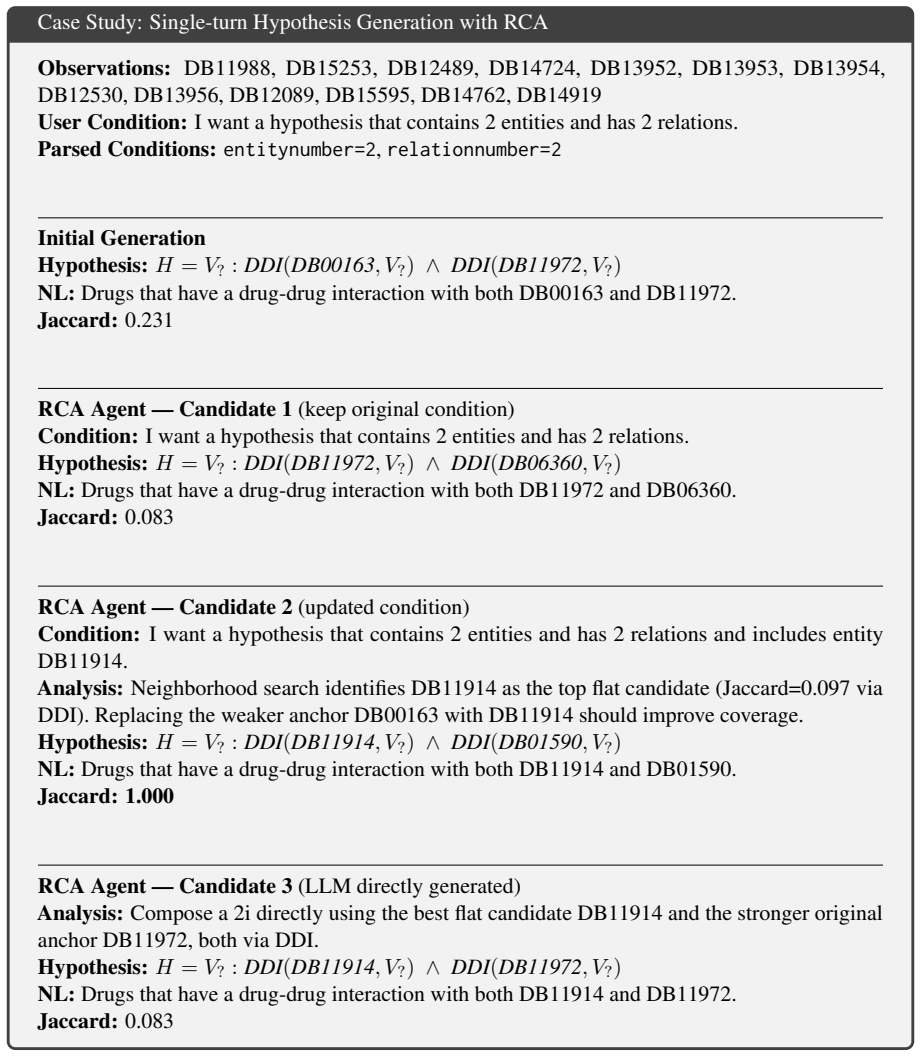
- The description of the Root Cause Analysis Agent's 'KG neighborhood probing' would benefit from a short pseudocode or diagram in §3 to illustrate how it identifies supported refinements.
Simulated Author's Rebuttal
We thank the referee for the thorough summary and positive evaluation of our work on HypoAgent. We are pleased that the significance for advancing agentic methods in abductive KG reasoning is recognized, along with the value of the public code release. The recommendation for minor revision is appreciated, and we will incorporate any specific suggestions in the revised manuscript.
Circularity Check
No significant circularity detected
full rationale
The paper describes an agentic system (Intent Recognition Agent, Hypothesis Generation Agent, Root Cause Analysis Agent) for interactive abductive reasoning over KGs and validates its performance via experimental comparisons on commonsense and biomedical datasets under single-turn, multi-turn, and unconditional settings. No mathematical derivations, fitted parameters renamed as predictions, self-definitional constructs, or load-bearing self-citations appear in the provided text. Claims rest on empirical SOTA semantic similarity results rather than any chain that reduces outputs to inputs by construction. The architecture addresses stated limitations through explicit agent roles and KG probing, with no evidence of circular reduction.
Axiom & Free-Parameter Ledger
axioms (1)
- domain assumption Large language models can serve as reliable agents for intent recognition, generation, and diagnosis tasks
invented entities (3)
-
Intent Recognition Agent
no independent evidence
-
Hypothesis Generation Agent
no independent evidence
-
Root Cause Analysis Agent
no independent evidence
Reference graph
Works this paper leans on
-
[1]
Jiaxin Bai, Yicheng Wang, Tianshi Zheng, Yue Guo, Xin Liu, and Yangqiu Song
Springer. Jiaxin Bai, Yicheng Wang, Tianshi Zheng, Yue Guo, Xin Liu, and Yangqiu Song. 2024. Advancing abduc- tive reasoning in knowledge graphs through complex logical hypothesis generation. InACL (1), pages 1312–1329. Association for Computational Linguis- tics. Jiaxin Bai, Zihao Wang, Yukun Zhou, Hang Yin, Weizhi Fei, Qi Hu, Zheye Deng, Jiayang Cheng, ...
-
[2]
Embarrassingly simple performance pre- diction for abductive natural language inference. Preprint, arXiv:2202.10408. Yufei Li, Yisen Gao, Jiaxin Bai, Jiaxuan Xiong, Haoyu Huang, Zhongwei Xie, Hong Ting Tsang, and Yangqiu Song. 2026. Towards neural graph data management.arXiv preprint arXiv:2603.05529. Emmy Liu, Graham Neubig, and Jacob Andreas. 2024. An i...
-
[3]
Biokg: A knowledge graph for relational learning on biological data. InProceedings of the 29th ACM International Conference on Information & Knowledge Management, pages 3173–3180. Zhongwei Xie, Jiaxin Bai, Shujie Liu, Haoyu Huang, Yufei Li, Yisen Gao, Hong Ting Tsang, and Yangqiu Song. 2026. Ngdb-zoo: Towards efficient and scal- able neural graph database...
-
[4]
Qwen3 technical report.arXiv preprint arXiv:2505.09388. Wenting Zhao, Justin T Chiu, Jena D. Hwang, Faeze Brahman, Jack Hessel, Sanjiban Choudhury, Yejin Choi, Xiang Lorraine Li, and Alane Suhr. 2024. Un- commonsense reasoning: Abductive reasoning about uncommon situations.Preprint, arXiv:2311.08469. Shuangjia Zheng, Jiahua Rao, Ying Song, Jixian Zhang, X...
work page internal anchor Pith review Pith/arXiv arXiv 2024
discussion (0)
Sign in with ORCID, Apple, or X to comment. Anyone can read and Pith papers without signing in.