Development of a Multi-Purpose Optical TPC for Neutron-Induced Reaction Studies at SARAF
Pith reviewed 2026-06-28 19:52 UTC · model grok-4.3
The pith
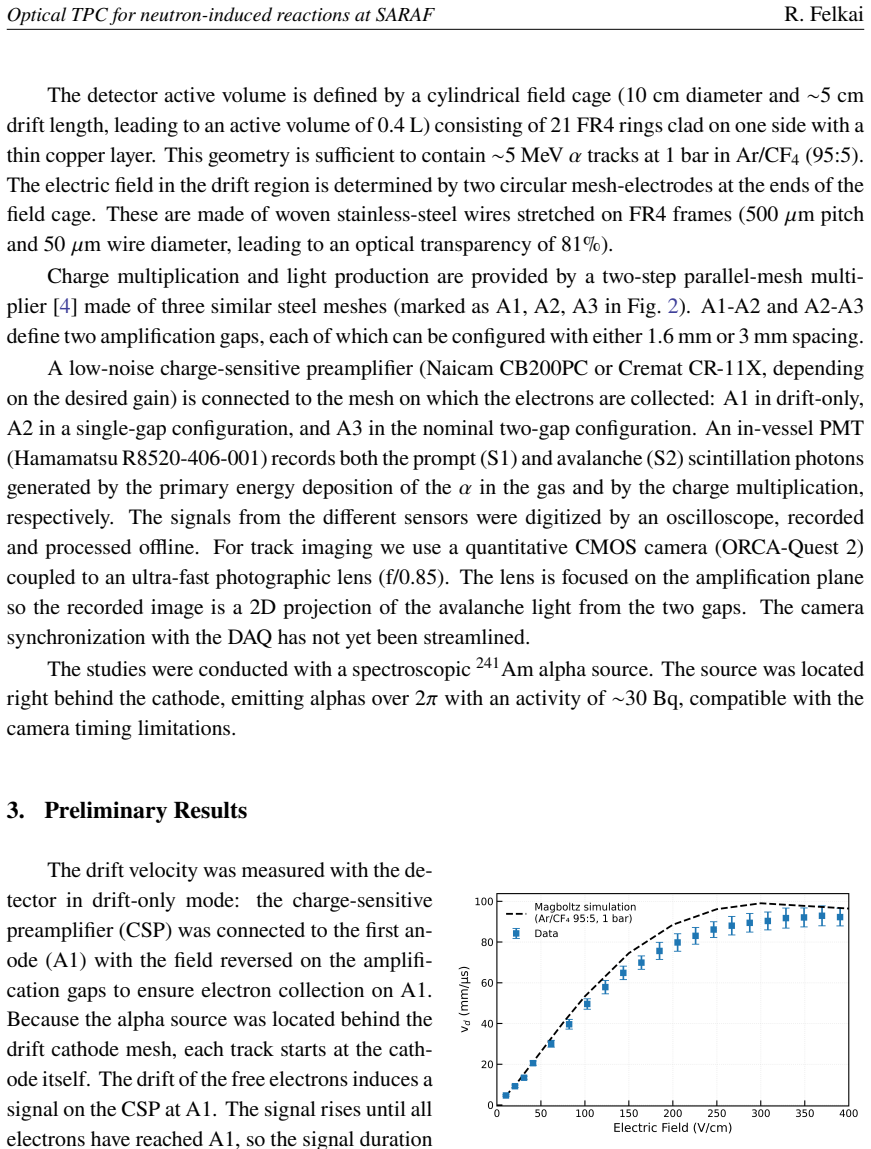
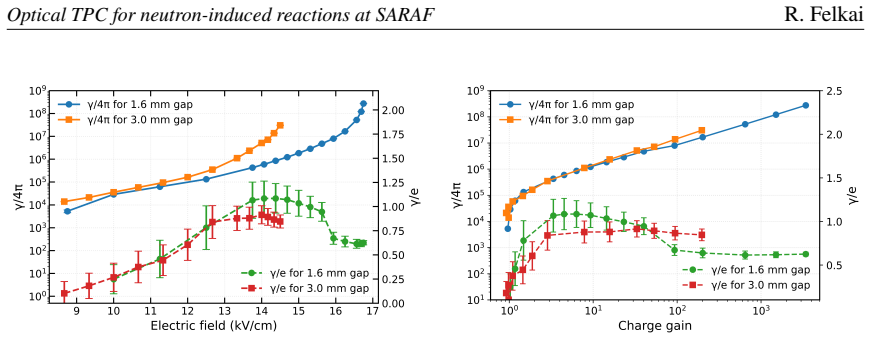
A tested prototype optical TPC characterizes electron drift velocity, amplification, and alpha track imaging in Ar/CF4 gas.
A machine-rendered reading of the paper's core claim, the machinery that carries it, and where it could break.
Core claim
A prototype OTPC system has been assembled and tested, enabling systematic characterization of electron drift velocity, charge and light amplification, and 2D optical imaging of alpha-particle tracks in an Ar/CF4 gas mixture to guide the design of a larger, fully integrated OTPC for 3D reconstruction of charged-particle tracks under SARAF neutron beam conditions.
What carries the argument
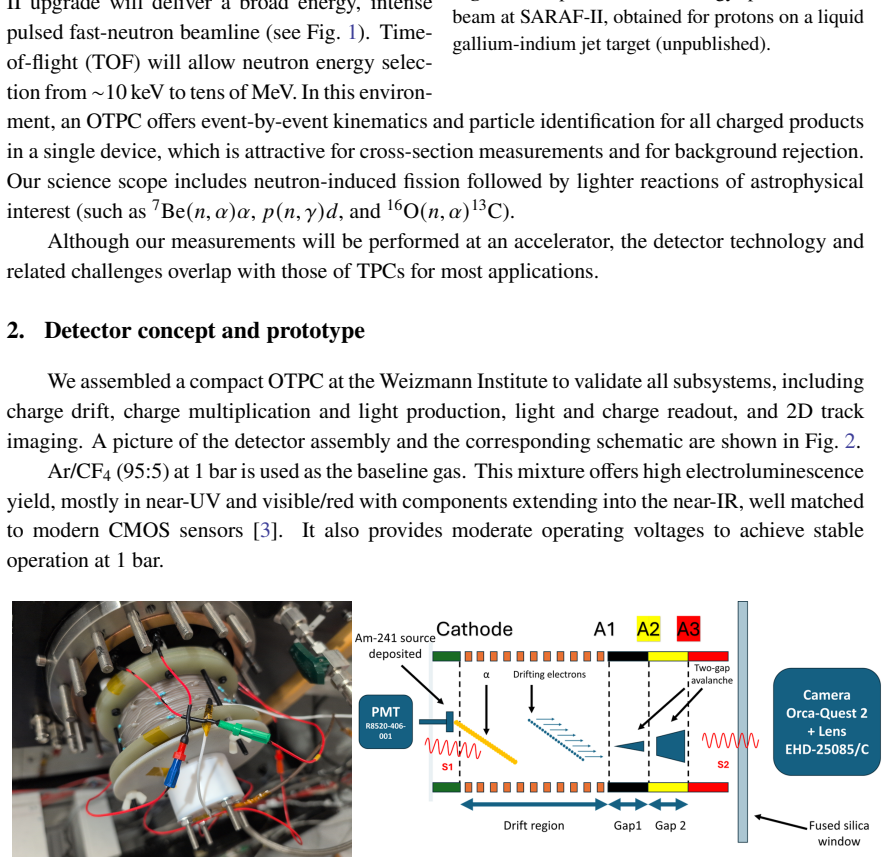
The optical time projection chamber that uses CF4-based scintillating gas mixtures, fast photodetectors for prompt scintillation, and high-speed optical readout of avalanche-induced secondary scintillation for track reconstruction.
If this is right
- The prototype data directly informs design choices for the larger OTPC system.
- The full system is intended to deliver 3D charged-particle track reconstruction for neutron reaction studies.
- Advanced image sensors are under exploration to increase tracking resolution.
- The detector is optimized for operation at the high-intensity time-of-flight neutron beam at SARAF.
Where Pith is reading between the lines
- If the full system performs as projected, it could supply new cross-section data to refine stellar and Big Bang nucleosynthesis calculations.
- The same optical readout approach might be adapted for track imaging in other gas-based detectors at different neutron facilities.
- Beam-time tests with actual neutrons will be required to confirm whether prototype results hold under realistic background and rate conditions.
Load-bearing premise
Performance measured with the small Ar/CF4 prototype will scale without major surprises to the full-size OTPC under actual SARAF neutron beam conditions with CF4-based mixtures.
What would settle it
A measurement showing substantially different drift velocity, gain, or track imaging quality in the full-size detector under neutron beam exposure compared with prototype results would falsify the scaling assumption.
Figures
read the original abstract
Neutron-induced reactions play a central role in stellar and Big Bang nucleosynthesis models. Yet many of the cross sections remain poorly constrained at astrophysically relevant energies. To address these needs, we are developing a multi-purpose Optical Time Projection Chamber (OTPC) optimized for precision neutron-reaction studies at the Soreq Applied Research Accelerator Facility (SARAF) upcoming high-intensity, time-of-flight neutron beam. The detector combines a drift chamber filled with CF4-based scintillating gas mixtures, fast photodetectors for prompt scintillation detection, and high-speed optical readout of avalanche-induced secondary scintillation to enable full 3D reconstruction of charged-particle tracks. A prototype system has been assembled and tested. This has enabled systematic characterization of electron drift velocity, charge and light amplification, and 2D optical imaging of alpha-particle tracks in an Ar/CF4 gas mixture. These studies guide the design of a larger, fully integrated OTPC system intended for operation at SARAF. In parallel, we are exploring advanced image sensors to further enhance tracking resolution. We report on recent progress with the prototype and outline the next steps toward commissioning the full system.
Editorial analysis
A structured set of objections, weighed in public.
Referee Report
Summary. The paper describes the development of a multi-purpose Optical Time Projection Chamber (OTPC) for neutron-induced reaction studies at SARAF. The design integrates a drift chamber with CF4-based scintillating gases, fast photodetectors for prompt scintillation, and high-speed optical readout of secondary scintillation for 3D charged-particle track reconstruction. A prototype has been assembled and tested in an Ar/CF4 mixture, enabling characterization of electron drift velocity, charge and light amplification, and 2D optical imaging of alpha-particle tracks; these results are used to guide the larger OTPC design, with parallel exploration of advanced image sensors.
Significance. If the reported prototype characterizations hold and prove reproducible, the work supplies practical design guidance and performance benchmarks for an OTPC optimized for high-intensity, time-of-flight neutron beams, potentially enabling improved precision on neutron-reaction cross sections relevant to stellar and Big Bang nucleosynthesis.
major comments (1)
- [Abstract / prototype testing description] Abstract (prototype testing paragraph): the claim that prototype testing 'has enabled systematic characterization' of drift velocity, charge/light amplification, and 2D alpha-track imaging is load-bearing for the central experimental contribution, yet the manuscript provides no quantitative values, error bars, plots, or detailed methods, preventing verification of the asserted performance.
Simulated Author's Rebuttal
We thank the referee for this constructive comment. We agree that the abstract's claim requires supporting quantitative evidence and will revise the manuscript to include the necessary data, plots, and methods.
read point-by-point responses
-
Referee: [Abstract / prototype testing description] Abstract (prototype testing paragraph): the claim that prototype testing 'has enabled systematic characterization' of drift velocity, charge/light amplification, and 2D alpha-track imaging is load-bearing for the central experimental contribution, yet the manuscript provides no quantitative values, error bars, plots, or detailed methods, preventing verification of the asserted performance.
Authors: We acknowledge that the current manuscript text does not provide the quantitative values, error bars, plots or methods details needed to substantiate the characterization claims in the abstract. In the revised version we will add these elements (including measured drift velocities with uncertainties, gain curves for charge and light amplification, and track imaging resolution metrics with example images) drawn from the prototype data, along with a concise methods summary, so that the abstract claim is properly supported. revision: yes
Circularity Check
No significant circularity; experimental prototype report
full rationale
The manuscript is a standard instrumentation progress report describing assembly, testing, and characterization of a hardware prototype OTPC. No derivations, equations, fitted predictions, or self-referential claims appear in the provided text or abstract. The central results rest on direct experimental measurements of drift velocity, amplification, and imaging in Ar/CF4, which are self-contained against external benchmarks and do not reduce to any input by construction. No self-citation chains or ansatzes are invoked as load-bearing steps. This is the expected outcome for a purely experimental instrumentation paper.
Axiom & Free-Parameter Ledger
axioms (1)
- domain assumption Electron drift velocity and scintillation yield in Ar/CF4 mixtures follow established physical models under the tested conditions.
Reference graph
Works this paper leans on
-
[1]
M. Gai et al.,Time Projection Chamber (TPC) detectors for nuclear astrophysics stud- ies with gamma beams, Nucl. Instrum. Methods Phys. Res. A 954 (2020) 161779. doi:10.1016/j.nima.2019.01.006
-
[2]
I.Mardoretal.,TheSoreqAppliedResearchAcceleratorFacility(SARAF):Overview,research programs and future plans, Eur. Phys. J. A 54 (2018) 91. doi:10.1140/epja/i2018-12526-2
-
[3]
P. Amedo et al.,Observation of strong wavelength-shifting in the argon– tetrafluoromethane system, Frontiers in Detector Science and Technology 1 (2023) 1282854. doi:10.3389/fdest.2023.1282854
-
[4]
A. Breskin et al.,A highly efficient low-pressure UV-rich detector with optical avalanche recording, Nucl. Instrum. Methods Phys. Res. A 273 (1988) 798–804. doi:10.1016/0168- 9002(88)90099-X
-
[5]
S. F. Biagi,Monte Carlo simulation of electron drift and diffusion in counting gases under theinfluenceofelectricandmagneticfields,Nucl.Instrum.MethodsPhys.Res.A421(1999) 234–240. doi:10.1016/S0168-9002(98)01233-9
-
[6]
thesis, July 2018
F.M.Brunbauer,ApplicationsofgasscintillationpropertiesinopticallyreadoutGEM-based detectors, PhD. thesis, July 2018
2018
-
[7]
F. M. Brunbauer et al.,Primary and secondary scintillation of CF4-based mixtures in low- pressure gaseous detectors, Frontiers in Detector Science and Technology 3 (2025) 1561739. doi:10.3389/fdest.2025.1561739
-
[8]
K.Mierniketal.,OpticalTimeProjectionChamberforimagingnucleardecays,Nucl.Instrum. Methods Phys. Res. A 581 (2007) 194–197. doi:10.1016/j.nima.2007.07.076
-
[9]
L. M. S. Margato et al.,Effect of gas contamination on CF 4 primary and sec- ondary scintillation, Nucl. Instrum. Methods Phys. Res. A 695 (2012) 425–428. doi:10.1016/j.nima.2011.10.033
-
[10]
S.Agostinellietal.,GEANT4-asimulationtoolkit,Nucl.Instrum.MethodsPhys.Res.A506 (2003) 250–303. doi:10.1016/S0168-9002(03)01368-8. 6 Optical TPC for neutron-induced reactions at SARAFR. Felkai
-
[11]
Allison et al.,Recent developments in Geant4, Nucl
J. Allison et al.,Recent developments in Geant4, Nucl. Instrum. Methods Phys. Res. A 835 (2016) 186–225. doi:10.1016/j.nima.2016.06.125
-
[12]
A. Roberts et al.,First demonstration of 3D optical readout of a TPC using a single- photon-sensitive Timepix3-based camera, J. Instrum. 14 (2019) P06001. doi:10.1088/1748- 0221/14/06/P06001. 7
discussion (0)
Sign in with ORCID, Apple, or X to comment. Anyone can read and Pith papers without signing in.