Fidelity bounds for spin-dependent kicks with pulsed lasers
Pith reviewed 2026-06-28 22:12 UTC · model grok-4.3
The pith
Finite pulse duration dominates error in nanosecond spin-dependent kicks for trapped ions, allowing infidelities below 10^{-3} with 10 or more pulses.
A machine-rendered reading of the paper's core claim, the machinery that carries it, and where it could break.
Core claim
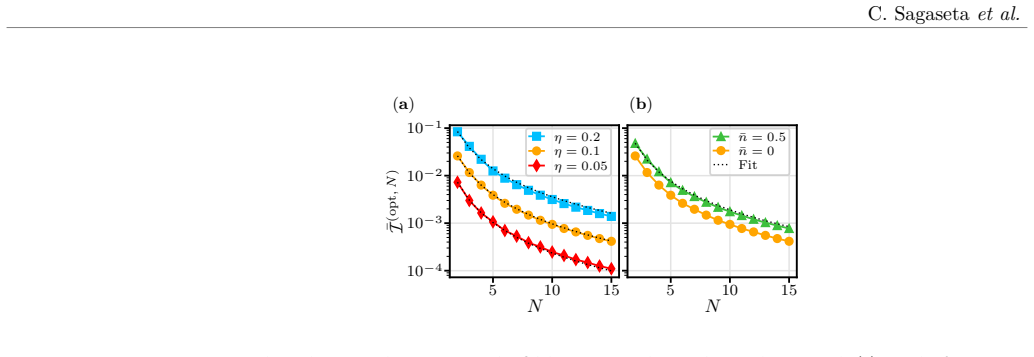
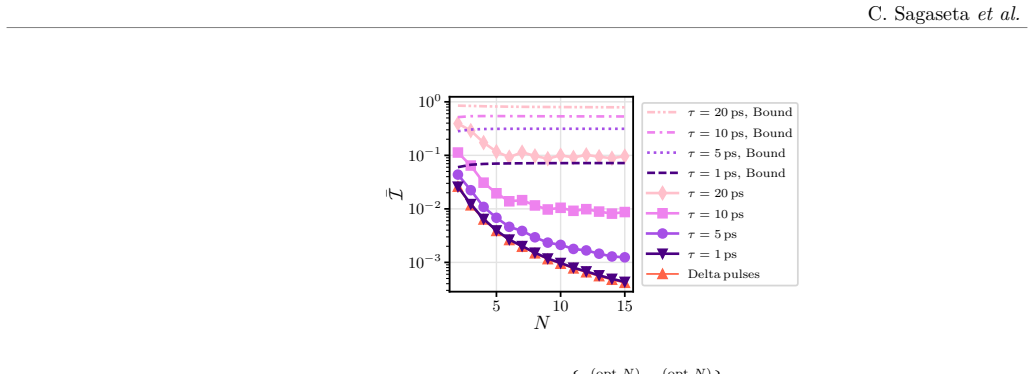
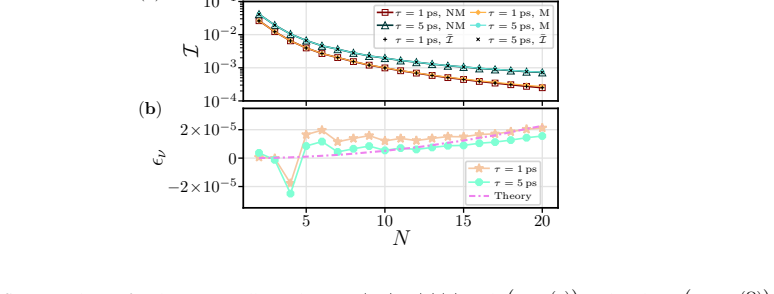
Within the model commonly used for infidelity optimization, finite pulse duration is the dominant source of error, exceeding the contribution of secular motion by orders of magnitude for nanosecond-scale SDKs. Low infidelities below 10^{-3} for schemes with ≳10 fixed-amplitude, equispaced, picosecond pulses are achievable in SDK times on the order of nanoseconds.
What carries the argument
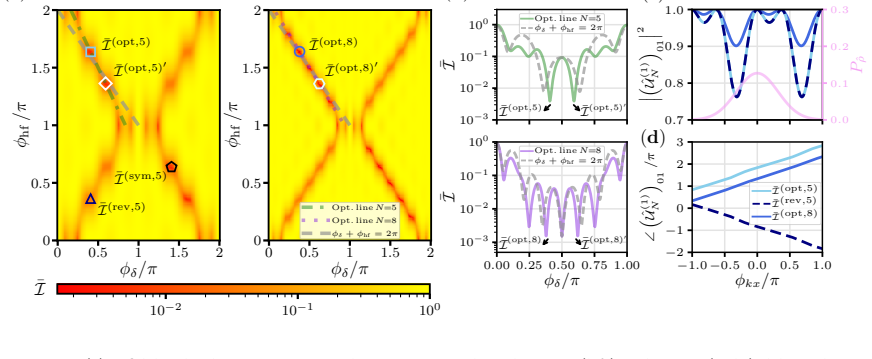
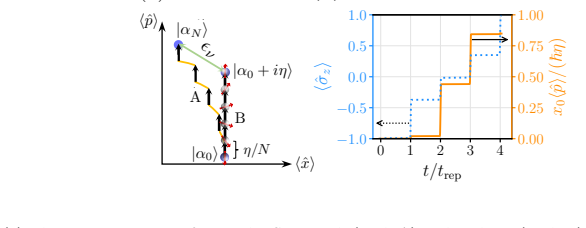
Analytical methods and numerical simulations tracking the effects of Raman frequency difference, pulse arrival times, Lamb-Dicke parameter, temperature, pulse width, and SDK time on single-ion SDK fidelity.
If this is right
- Competitive SDK fidelities become reachable with existing pulsed-laser technology.
- Sub-microsecond trapped-ion entangling gates can be constructed from these high-fidelity SDK building blocks.
- Explicit quantitative rules now exist for choosing Raman frequency difference, pulse times, and pulse width to meet target fidelities.
Where Pith is reading between the lines
- The same pulse-parameter bounds could guide design of multi-ion entangling gates if the single-ion model extends without new dominant errors.
- Direct comparison of measured versus predicted infidelity versus pulse width in an actual trap would test whether unmodeled effects remain negligible.
Load-bearing premise
The standard infidelity optimization model accurately captures the dominant physical errors for the small number of fast pulses considered and the listed control parameters stay within ranges compatible with performed experiments.
What would settle it
An experiment that measures SDK infidelity while varying only pulse width across the nanosecond regime; if infidelity fails to scale with pulse duration as the model predicts, the dominance claim is falsified.
Figures
read the original abstract
Excitation of trapped-ion hyperfine qubits with fast optical Raman pulses enables faster-than-trap-period entangling gates with qubits of long coherence time for practical quantum computation. Achieving high-fidelity fast two-qubit gates requires high-quality spin-dependent kicks (SDKs), which form their fundamental building blocks. Here, we characterize the control parameters (including Raman frequency difference, pulse arrival times, Lamb--Dicke parameter, temperature, pulse width, and SDK time) that maximize the performance of single-ion SDKs for protocols compatible with performed experiments involving a small number of fast pulses. We demonstrate through analytical methods and numerical simulations that, within the model commonly used for infidelity optimization, finite pulse duration is the dominant source of error, exceeding the contribution of secular motion by orders of magnitude for nanosecond-scale SDKs. Low infidelities -- below $10^{-3}$ for schemes with $\gtrsim10$ fixed-amplitude, equispaced, picosecond pulses -- are achievable in SDK times on the order of nanoseconds. These results provide quantitative design rules for achieving competitive SDK fidelities with current pulsed-laser technology, laying the foundation for sub-microsecond trapped-ion quantum entangling operations.
Editorial analysis
A structured set of objections, weighed in public.
Referee Report
Summary. The manuscript analyzes fidelity bounds for single-ion spin-dependent kicks (SDKs) realized with pulsed Raman lasers in trapped ions. It claims that, within the standard infidelity optimization model, finite pulse duration dominates secular-motion errors by orders of magnitude for nanosecond-scale SDKs, and that infidelities below 10^{-3} are achievable for protocols using ≳10 fixed-amplitude, equispaced picosecond pulses with SDK times of a few nanoseconds. The analysis is performed via analytical approximations and numerical simulations over the control parameters (Raman detuning, pulse arrival times, Lamb-Dicke parameter, temperature, pulse width, and total SDK duration) and is scoped to parameter ranges compatible with existing experiments.
Significance. If the quantitative dominance result and infidelity targets hold within the stated model, the work supplies concrete design rules that directly inform the error budget for fast two-qubit gates. This is relevant for sub-microsecond trapped-ion entangling operations and therefore contributes to the practical roadmap for scalable quantum computation with long-coherence hyperfine qubits.
major comments (2)
- [§3] §3 (model definition): the infidelity expression used for the dominance claim is introduced only after the abstract and introduction have already asserted that finite pulse duration exceeds secular motion by “orders of magnitude.” The explicit reduction of the infidelity to the listed control parameters (including the precise form of the pulse-shape integral and the secular-motion term) should be shown before the numerical results are presented, so that the orders-of-magnitude statement can be verified directly from the equations.
- [Figs. 4–6] Numerical results (Figs. 4–6 and associated text): the simulations supporting the <10^{-3} infidelity target and the dominance statement do not report statistical error bars, convergence criteria with respect to time-step or basis size, or the precise data-exclusion rules applied when temperature or Lamb-Dicke parameter are varied. Because these quantities are central to the quantitative claims, the absence of such diagnostics leaves the robustness of the reported bounds unquantified.
minor comments (2)
- [Abstract] The abstract states that the results are “compatible with performed experiments,” yet no explicit comparison table or citation to the experimental pulse parameters (width, amplitude stability, timing jitter) is provided in the main text.
- [§2] Notation for the Raman frequency difference and the effective Lamb-Dicke parameter is introduced without a dedicated symbol table; consistent use of subscripts (e.g., Δ_R vs. δ) would improve readability.
Simulated Author's Rebuttal
We thank the referee for the positive assessment and constructive comments, which will improve the clarity and rigor of the manuscript. We address each major comment below.
read point-by-point responses
-
Referee: [§3] §3 (model definition): the infidelity expression used for the dominance claim is introduced only after the abstract and introduction have already asserted that finite pulse duration exceeds secular motion by “orders of magnitude.” The explicit reduction of the infidelity to the listed control parameters (including the precise form of the pulse-shape integral and the secular-motion term) should be shown before the numerical results are presented, so that the orders-of-magnitude statement can be verified directly from the equations.
Authors: We agree that the logical order should allow direct verification of the dominance claim from the equations. In the revised manuscript we will move the full derivation of the infidelity expression (including the pulse-shape integral and secular-motion term) to an earlier position in §3, before any numerical results, so that the orders-of-magnitude statement can be checked analytically. revision: yes
-
Referee: [Figs. 4–6] Numerical results (Figs. 4–6 and associated text): the simulations supporting the <10^{-3} infidelity target and the dominance statement do not report statistical error bars, convergence criteria with respect to time-step or basis size, or the precise data-exclusion rules applied when temperature or Lamb-Dicke parameter are varied. Because these quantities are central to the quantitative claims, the absence of such diagnostics leaves the robustness of the reported bounds unquantified.
Authors: We acknowledge that explicit numerical diagnostics strengthen the quantitative claims. In the revision we will add a dedicated methods paragraph specifying convergence criteria for time-step and basis size, the precise data-exclusion rules used when scanning temperature or Lamb-Dicke parameter, and error bars (or numerical precision) on all plotted quantities. revision: yes
Circularity Check
No significant circularity; claims scoped to standard model
full rationale
The paper's central results are explicitly framed as demonstrations 'within the model commonly used for infidelity optimization' using analytical methods and numerical simulations on listed control parameters. No load-bearing derivation step reduces by construction to a fitted input renamed as prediction, self-citation chain, or self-definitional loop. The analysis compares error sources (finite pulse duration vs. secular motion) inside the model's assumptions without importing uniqueness theorems or ansatzes from prior self-work as external facts. This is the common case of a self-contained scoped study.
Axiom & Free-Parameter Ledger
axioms (1)
- domain assumption The model commonly used for infidelity optimization accurately represents the dominant physical errors for the considered pulse sequences.
Reference graph
Works this paper leans on
- [1]
-
[2]
Wang P, Luan C Y, Qiao M, Um M, Zhang J, Wang Y, Yuan X, Gu M, Zhang J and Kim K 2021Nature Communications12233 ISSN 2041-1723
2041
-
[3]
Harty T P, Allcock D T C, Ballance C J, Guidoni L, Janacek H A, Linke N M, Stacey D N and Lucas D M 2014Physical Review Letters113220501
-
[4]
Blatt R and Wineland D 2008Nature4531008–1015 ISSN 1476-4687
-
[5]
An F A, Ransford A, Schaffer A, Sletten L R, Gaebler J, Hostetter J and Vittorini G 2022 Physical Review Letters129130501
2022
-
[6]
Smith M C, Leu A D, Miyanishi K, Gely M F and Lucas D M 2025Physical Review Letters 134230601
-
[7]
Löschnauer C, Mosca Toba J, Hughes A, King S, Weber M, Srinivas R, Matt R, Nourshargh R, Allcock D, Ballance C, Matthiesen C, Malinowski M and Harty T 2025PRX Quantum6 040313
-
[8]
Clark C R, Tinkey H N, Sawyer B C, Meier A M, Burkhardt K A, Seck C M, Shappert C M, Guise N D, Volin C E, Fallek S D, Hayden H T, Rellergert W G and Brown K R 2021Physical Review Letters127130505 ISSN 0031-9007, 1079-7114
-
[9]
Zhang S, Lu Y, Zhang K, Chen W, Li Y, Zhang J N and Kim K 2020Nature Communications 11587 ISSN 2041-1723
2041
-
[10]
Egan L, Debroy D M, Noel C, Risinger A, Zhu D, Biswas D, Newman M, Li M, Brown K R, Cetina M and Monroe C 2021Nature598281–286 ISSN 1476-4687
-
[11]
Ryan-Anderson C, Bohnet J G, Lee K, Gresh D, Hankin A, Gaebler J P, Francois D, Chernoguzov A, Lucchetti D, Brown N C, Gatterman T M, Halit S K, Gilmore K, Gerber J A, Neyenhuis B, Hayes D and Stutz R P 2021Physical Review X11041058
- [12]
-
[13]
Postler L, Butt F, Pogorelov I, Marciniak C D, Heußen S, Blatt R, Schindler P, Rispler M, Müller M and Monz T 2024PRX Quantum5030326
-
[14]
Monz T, Nigg D, Martinez E A, Brandl M F, Schindler P, Rines R, Wang S X, Chuang I L and Blatt R 2016Science (1880 to 2025)3511068–1070 ISSN 0036-8075
2025
-
[15]
Debnath S, Linke N M, Figgatt C, Landsman K A, Wright K and Monroe C 2016Nature536 63–66 ISSN 1476-4687
-
[16]
Hempel C, Maier C, Romero J, McClean J, Monz T, Shen H, Jurcevic P, Lanyon B P, Love P, Babbush R, Aspuru-Guzik A, Blatt R and Roos C F 2018Physical Review X8031022
-
[17]
Liu M, Shaydulin R, Niroula P, DeCross M, Hung S H, Kon W Y, Cervero-Martín E, Chakraborty K, Amer O, Aaronson S, Acharya A, Alexeev Y, Berg K J, Chakrabarti S, Curchod F J, Dreiling J M, Erickson N, Foltz C, Foss-Feig M, Hayes D, Humble T S, Kumar N, Larson J, Lykov D, Mills M, Moses S A, Neyenhuis B, Eloul S, Siegfried P, Walker J, Lim C and Pistoia M 2...
-
[18]
Figgatt C, Maslov D, Landsman K A, Linke N M, Debnath S and Monroe C 2017Nature Communications81918 ISSN 2041-1723
2041
-
[19]
Mølmer K and Sørensen A 1999Physical Review Letters821835–1838
-
[20]
Leung P H and Brown K R 2018Physical Review A98032318 ISSN 2469-9926, 2469-9934 (Preprint1808.02555)
work page internal anchor Pith review Pith/arXiv arXiv
-
[21]
Mai X, Zhang L, Yu Q, Zhang J and Lu Y 2025 Scalable entangling gates on ion qubits via structured light addressing (Preprint2506.19535) 13 C. Sagasetaet al
-
[22]
Choi T, Debnath S, Manning T A, Figgatt C, Gong Z X, Duan L M and Monroe C 2014 Physical Review Letters112190502
2014
-
[23]
Kielpinski D, Monroe C and Wineland D J 2002Nature417709–711 ISSN 1476-4687
-
[24]
Akhtar M, Bonus F, Lebrun-Gallagher F R, Johnson N I, Siegele-Brown M, Hong S, Hile S J, Kulmiya S A, Weidt S and Hensinger W K 2023Nature Communications14531 ISSN 2041-1723
2041
-
[25]
Moses S A, Baldwin C H, Allman M S, Ancona R, Ascarrunz L, Barnes C, Bartolotta J, Bjork B, Blanchard P, Bohn M, Bohnet J G, Brown N C, Burdick N Q, Burton W C, Campbell S L, Campora J P, Carron C, Chambers J, Chan J W, Chen Y H, Chernoguzov A, Chertkov E, Colina J, Curtis J P, Daniel R, DeCross M, Deen D, Delaney C, Dreiling J M, Ertsgaard C T, Esposito ...
2023
-
[26]
Sterk J D, Coakley H, Goldberg J, Hietala V, Lechtenberg J, McGuinness H, McMurtrey D, Parazzoli L P, Van Der Wall J and Stick D 2022npj Quantum Information868 ISSN 2056-6387
2056
- [27]
-
[28]
Main D, Drmota P, Nadlinger D P, Ainley E M, Agrawal A, Nichol B C, Srinivas R, Araneda G and Lucas D M 2025Nature638383–388 ISSN 1476-4687
-
[29]
Monroe C, Raussendorf R, Ruthven A, Brown K R, Maunz P, Duan L M and Kim J 2014 Physical Review A89022317 ISSN 1050-2947, 1094-1622 (Preprint1208.0391)
work page internal anchor Pith review Pith/arXiv arXiv 2014
- [30]
-
[31]
O’Reilly J, Toh G, Goetting I, Saha S, Shalaev M, Carter A L, Risinger A, Kalakuntla A, Li T, Verma A and Monroe C 2024Physical Review Letters133090802
-
[32]
Stephenson L J, Nadlinger D P, Nichol B C, An S, Drmota P, Ballance T G, Thirumalai K, Goodwin J F, Lucas D M and Ballance C J 2020Physical Review Letters124110501
-
[33]
Drmota P, Main D, Nadlinger D P, Nichol B C, Weber M A, Ainley E M, Agrawal A, Srinivas R, Araneda G, Ballance C J and Lucas D M 2023Physical Review Letters130090803
-
[34]
Pino J M, Dreiling J M, Figgatt C, Gaebler J P, Moses S A, Allman M S, Baldwin C H, Foss-Feig M, Hayes D, Mayer K, Ryan-Anderson C and Neyenhuis B 2021Nature592209–213 ISSN 1476-4687
-
[35]
García-Ripoll J J, Zoller P and Cirac J I 2003Physical Review Letters91157901
-
[36]
García-Ripoll J J, Zoller P and Cirac J I 2005Physical Review A71062309
-
[37]
Duan L M 2004Physical Review Letters93100502
-
[38]
Mizrahi J, Senko C, Neyenhuis B, Johnson K G, Campbell W C, Conover C W S and Monroe C 2013Physical Review Letters110203001
-
[39]
Sagasetaet al
Johnson K G, Neyenhuis B, Mizrahi J, Wong-Campos J D and Monroe C 2015Physical Review Letters115213001 14 C. Sagasetaet al
-
[40]
Mizrahi J, Neyenhuis B, Johnson K G, Campbell W C, Senko C, Hayes D and Monroe C 2014 Applied Physics B11445–61 ISSN 1432-0649
2014
-
[41]
Bentley C D B, Carvalho A R R and Hope J J 2015New Journal of Physics17103025 ISSN 1367-2630
-
[42]
Ratcliffe A K, Taylor R L, Hope J J and Carvalho A R R 2018Physical Review Letters120 220501
-
[43]
Mehdi Z, Ratcliffe A K and Hope J J 2021Physical Review Research3013026 ISSN 2643-1564
- [44]
-
[45]
Savill-Brown I, Hope J J, Ratcliffe A K, Vaidya V D, Liu H, Haine S A, Viteri C R and Mehdi Z 2026Phys. Rev. Lett
-
[46]
Savill-Brown I, Mehdi Z, Ratcliffe A K, Vaidya V D, Liu H, Haine S A, Viteri C R and Hope J J 2026Phys. Rev. A113(5) 052610 URLhttps://link.aps.org/doi/10.1103/4thn-7wyf
-
[47]
Wong-Campos J D, Moses S A, Johnson K G and Monroe C 2017Physical Review Letters119 230501
-
[48]
Campbell W C, Mizrahi J, Quraishi Q, Senko C, Hayes D, Hucul D, Matsukevich D N, Maunz P and Monroe C 2010Physical Review Letters105090502 ISSN 0031-9007, 1079-7114
- [49]
-
[50]
Johnson K G, Wong-Campos J D, Neyenhuis B, Mizrahi J and Monroe C 2017Nature Communications8697 ISSN 2041-1723
2041
-
[51]
Metcalf H J and Van Der Straten P 1999Laser Cooling and TrappingGraduate Texts in Contemporary Physics (New York, NY: Springer) ISBN 978-0-387-98728-6 978-1-4612-1470-0
-
[52]
Hussain M, Heinrich D, Guevara-Bertsch M, Torrontegui E, García-Ripoll J, Roos C and Blatt R 2021Physical Review Applied15024054
-
[53]
National Academies of Sciences, Engineering, and Medicine 2019 Chapter b: Trapped-ion quantum computersQuantum Computing: Progress and Prospects(Washington, DC: The National Academies Press)
2019
-
[54]
Liu H, Vaidya V D, Galan M G, Ratcliffe A K, Poudel A and Viteri C R 2026Phys. Rev. A 113(4) 043731 URLhttps://link.aps.org/doi/10.1103/972s-wd2q
-
[55]
Torrontegui E, Heinrich D, Hussain M I, Blatt R and García-Ripoll J J 2020New Journal of Physics22103024 URLhttps://doi.org/10.1088/1367-2630/abbab6 15
discussion (0)
Sign in with ORCID, Apple, or X to comment. Anyone can read and Pith papers without signing in.