REVIEW 2 major objections 2 minor 31 references
Fixed Universal Transformers
T0 review · 2 major / 2 minor · reviewed 2026-06-28 · grok-4.3
Pith's one-line read Fixed transformers can simulate any transformer in a class by encoding its description in the input embedding.
desk verdict Fixed transformers become universal by encoding target models in the input embedding, via explicit sparse constructions when dim is large enough plus an almost-sure result for random weights. read the letter →
The pith
A machine-rendered reading of the paper's core claim, the machinery that carries it, and where it could break.
The reading
What carries the argument
The input embedding that encodes a description of the target transformer, allowing the fixed transformer to simulate it.
What would settle it
A concrete class of transformers for which no fixed transformer succeeds in simulating every member when given only an input embedding that describes the target.
Extended reading notes
Core claim
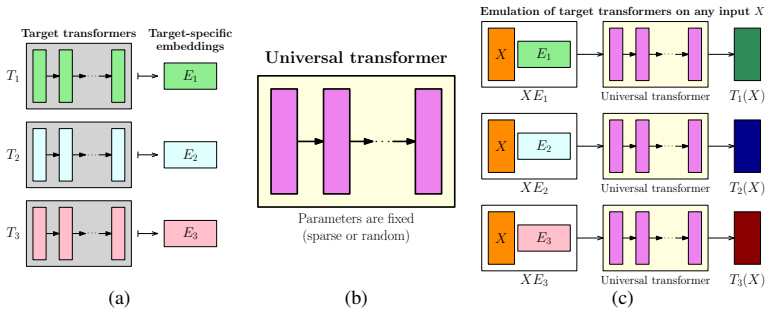
We introduce universal transformers: fixed transformers that can simulate any transformer in a given class via a suitable input embedding. Analogous to a universal Turing machine, the input embedding encodes a description of the target model while all internal parameters remain fixed. We provide explicit sparse constructions achieving universality when the embedding dimension is sufficiently large, and further show that universality is generic: randomly initialized transformers are universal almost surely, which aligns with recent empirical results of Zhong and Andreas (2024). We empirically validate our theory on the algorithmic tasks of parenthesis balancing and multi-hop reasoning. Our re
Load-bearing premise
The embedding dimension is large enough to encode a description of the target transformer.
Editorial extensions
If this is right
- Explicit sparse constructions achieve universality whenever the embedding dimension is large enough.
- Randomly initialized transformers are universal almost surely.
- Expressive power largely resides in the input representation rather than the learned weights.
- The construction is validated on parenthesis balancing and multi-hop reasoning tasks.
Reading between the lines
- Training might shift focus toward learning effective input encodings for a fixed computational core.
- The result offers one explanation for why prompt engineering can elicit new behaviors without weight changes.
- One could test whether a single randomly initialized fixed transformer handles many distinct tasks when supplied with appropriate input descriptions.
Editorial analysis
A structured set of objections, weighed in public.
Referee Report
Summary. The paper introduces universal transformers: fixed-parameter transformers that simulate any transformer from a given class by encoding a description of the target model in a suitable input embedding, analogous to a universal Turing machine. It provides explicit sparse constructions achieving this when the embedding dimension is large enough to encode the target description, and proves that universality holds generically (randomly initialized transformers are universal almost surely). The claims are supported by empirical validation on parenthesis balancing and multi-hop reasoning tasks.
Significance. If the constructions and almost-sure universality argument hold, the result is significant: it provides a theoretical basis for the idea that much of a transformer's power resides in input representations rather than learned weights, aligning with and explaining recent empirical observations. The explicit sparse constructions and generic (parameter-free) almost-sure result are notable strengths that could influence how expressivity is analyzed in sequence models.
major comments (2)
- [Abstract / Constructions section] The abstract states that explicit sparse constructions exist when embedding dimension suffices to encode the target; the full manuscript must include the precise construction (e.g., how the embedding encodes weights and architecture) and the proof that the fixed transformer simulates the target, as this is load-bearing for the central universality claim.
- [Generic universality argument] The generic universality result (random weights yield universality a.s.) is stated as aligning with Zhong and Andreas (2024); the manuscript should specify the probability space and measure under which 'almost surely' holds, and confirm it does not rely on any hidden parameter tuning.
minor comments (2)
- [Empirical validation] The empirical section should report quantitative metrics (accuracy, number of examples, comparison to non-universal baselines) rather than only stating that validation was performed on the two tasks.
- Ensure the reference to Zhong and Andreas (2024) appears in the bibliography with full citation details.
Simulated Author's Rebuttal
We thank the referee for the positive review and constructive feedback. We address each major comment below and will incorporate clarifications in the revised manuscript.
read point-by-point responses
-
Referee: [Abstract / Constructions section] The abstract states that explicit sparse constructions exist when embedding dimension suffices to encode the target; the full manuscript must include the precise construction (e.g., how the embedding encodes weights and architecture) and the proof that the fixed transformer simulates the target, as this is load-bearing for the central universality claim.
Authors: We agree that the explicit construction and simulation proof are central. Section 3 of the manuscript already provides the sparse construction, including how the input embedding encodes the target transformer's weights and architecture via a fixed sparse attention pattern that routes information according to the encoded description. The proof that the fixed transformer simulates the target appears in Theorem 3.1. To address the comment, we will expand this section with a fully worked example (including explicit embedding vectors for a small target model) and a more detailed proof sketch in the revision. revision: yes
-
Referee: [Generic universality argument] The generic universality result (random weights yield universality a.s.) is stated as aligning with Zhong and Andreas (2024); the manuscript should specify the probability space and measure under which 'almost surely' holds, and confirm it does not rely on any hidden parameter tuning.
Authors: We will revise the relevant section (currently Section 4) to explicitly define the probability space as the product measure over independent continuous distributions (standard Gaussian) on each entry of the fixed transformer's parameter matrices. Under this measure, the set of parameter values for which universality fails has Lebesgue measure zero. The argument uses no hidden parameter tuning: the fixed parameters are drawn once from this distribution and then held constant, with universality holding for almost all such draws. This aligns with the measure-theoretic argument in Zhong and Andreas (2024) but is self-contained. revision: yes
Circularity Check
No significant circularity in derivation chain
full rationale
The paper states explicit sparse constructions for universality conditioned on embedding dimension being large enough to encode a target transformer description, plus a generic almost-sure result for random weights. These are presented as holding under the stated assumptions with no reduction of claims to fitted parameters, self-definitions, or load-bearing self-citations. The single external citation (Zhong and Andreas 2024) is not used to justify the core constructions or uniqueness. The argument chain is self-contained against external benchmarks.
Assumptions & free parameters
Cite this review
Pith. "Pith review of Fixed Universal Transformers." pith.science (2026). https://pith.science/paper/NID7CIB7
@misc{pith2026260531423,
  author       = {Pith},
  title        = {Pith review of: Fixed Universal Transformers},
  year         = {2026},
  howpublished = {\url{https://pith.science/paper/NID7CIB7}},
  note         = {Machine review of arXiv:2605.31423}
}
read the original abstract
We introduce \emph{universal transformers}: fixed transformers that can simulate any transformer in a given class via a suitable input embedding. Analogous to a universal Turing machine, the input embedding encodes a description of the target model while all internal parameters remain fixed. We provide explicit sparse constructions achieving universality when the embedding dimension is sufficiently large, and further show that universality is generic: randomly initialized transformers are universal almost surely, which aligns with recent empirical results of Zhong and Andreas (2024). We empirically validate our theory on the algorithmic tasks of parenthesis balancing and multi-hop reasoning. Our results suggest that much of a transformer's expressive power may reside in its input representation rather than its learned weights.
Figures


Reference graph
Works this paper leans on
-
[1]
On scram- bling phenomena for randomly initialized recurrent networks.Advances in Neural Information Processing Systems, 35:18501–18513, 2022
Vaggos Chatziafratis, Ioannis Panageas, Clayton Sanford, and Stelios Stavroulakis. On scram- bling phenomena for randomly initialized recurrent networks.Advances in Neural Information Processing Systems, 35:18501–18513, 2022
2022
-
[2]
Model reprogramming: Resource-efficient cross-domain machine learning
Pin-Yu Chen. Model reprogramming: Resource-efficient cross-domain machine learning. In Proceedings of the AAAI Conference on Artificial Intelligence, pages 22584–22591, 2024
2024
-
[3]
The lottery ticket hypothesis for pre-trained bert networks
Tianlong Chen, Jonathan Frankle, Shiyu Chang, Sijia Liu, Yang Zhang, Zhangyang Wang, and Michael Carbin. The lottery ticket hypothesis for pre-trained bert networks. InAdvances in Neural Information Processing Systems 33, pages 15834–15846, 2020
2020
-
[4]
Schützenberger
Noam Chomsky and Marcel P. Schützenberger. The algebraic theory of context-free languages. Studies in Logic and the Foundations of Mathematics, 35:118–161, 1963
1963
-
[5]
Turing completeness of bounded-precision recurrent neural networks
Stephen Chung and Hava Siegelmann. Turing completeness of bounded-precision recurrent neural networks. InAdvances in Neural Information Processing Systems 34, pages 28431–28441, 2021
2021
-
[6]
Approximation by superpositions of a sigmoidal function.Mathematics of Control, Signals and Systems, 2(4):303–314, 1989
George Cybenko. Approximation by superpositions of a sigmoidal function.Mathematics of Control, Signals and Systems, 2(4):303–314, 1989
1989
-
[7]
Uni- versal transformers
Mostafa Dehghani, Stephan Gouws, Oriol Vinyals, Jakob Uszkoreit, and Lukasz Kaiser. Uni- versal transformers. InInternational Conference on Learning Representations, 2019
2019
-
[8]
arXiv preprint arXiv:2506.01115 , year=
Yihe Dong, Lorenzo Noci, Mikhail Khodak, and Mufan Li. Is random attention sufficient for sequence modeling? disentangling trainable components in the transformer.arXiv preprint arXiv:2506.01115, 2025
Show all 31 references
-
[9]
A mathematical framework for transformer circuits.Transformer Circuits Thread,
Nelson Elhage, Neel Nanda, Catherine Olsson, Tom Henighan, Nicholas Joseph, Ben Mann, Amanda Askell, Yuntao Bai, Anna Chen, Tom Conerly, Nova DasSarma, Dawn Drain, Deep Ganguli, Zac Hatfield-Dodds, Danny Hernandez, Andy Jones, Jackson Kernion, Liane Lovitt, Kamal Ndousse, Dari...
-
[10]
https://transformer-circuits.pub/2021/framework/index.html
2021
-
[11]
The lottery ticket hypothesis: Finding sparse, trainable neural networks
Jonathan Frankle and Michael Carbin. The lottery ticket hypothesis: Finding sparse, trainable neural networks. InInternational Conference on Learning Representations, 2019
2019
-
[12]
On the approximate realization of continuous mappings by neural networks
Ken-Ichi Funahashi. On the approximate realization of continuous mappings by neural networks. Neural Networks, 2(3):183–192, 1989. 10
1989
-
[13]
Looped transformers as programmable computers
Angeliki Giannou, Shashank Rajput, Jy-yong Sohn, Kangwook Lee, Jason D Lee, and Dimitris Papailiopoulos. Looped transformers as programmable computers. InInternational Conference on Machine Learning, 2023
2023
-
[14]
Multilayer feedforward networks are universal approximators.Neural Networks, 2(5):359–366, 1989
Kurt Hornik, Maxwell Stinchcombe, and Halbert White. Multilayer feedforward networks are universal approximators.Neural Networks, 2(5):359–366, 1989
1989
-
[15]
Neural tangent kernel: Convergence and generalization in neural networks
Arthur Jacot, Franck Gabriel, and Clément Hongler. Neural tangent kernel: Convergence and generalization in neural networks. InAdvances in Neural Information Processing Systems 31, 2018
2018
-
[16]
echo state
Herbert Jaeger. The "echo state" approach to analysing and training recurrent neural networks. GMD Report 148, GMD - German National Research Institute for Computer Science, 2001
2001
-
[17]
Real-time computing without stable states: A new framework for neural computation based on perturbations.Neural compu- tation, 14(11):2531–2560, 2002
Wolfgang Maass, Thomas Natschläger, and Henry Markram. Real-time computing without stable states: A new framework for neural computation based on perturbations.Neural compu- tation, 14(11):2531–2560, 2002
2002
-
[18]
Priors for infinite networks
Radford M Neal. Priors for infinite networks. InBayesian learning for neural networks, pages 29–53. Springer, 1996
1996
-
[19]
In-context learning and induction heads.Transformer Circuits Thread, 2022
Catherine Olsson, Nelson Elhage, Neel Nanda, Nicholas Joseph, Nova DasSarma, Tom Henighan, Ben Mann, Amanda Askell, Yuntao Bai, Anna Chen, Tom Conerly, Dawn Drain, Deep Ganguli, Zac Hatfield-Dodds, Danny Hernandez, Scott Johnston, Andy Jones, Jackson Kernion, Liane Lovitt, Kam...
2022
-
[20]
The strong lottery ticket hypothesis for multi-head attention mechanisms
Hikari Otsuka, Daiki Chijiwa, Yasuyuki Okoshi, Daichi Fujiki, Susumu Takeuchi, and Masato Motomura. The strong lottery ticket hypothesis for multi-head attention mechanisms. In Proceedings of the AAAI Conference on Artificial Intelligence, volume 40, pages 24639–24647, 2026
2026
-
[21]
Random features for large-scale kernel machines
Ali Rahimi and Benjamin Recht. Random features for large-scale kernel machines. InAdvances in Neural Information Processing Systems 20, 2007
2007
-
[22]
Transformers, parallel computation, and logarithmic depth
Clayton Sanford, Daniel Hsu, and Matus Telgarsky. Transformers, parallel computation, and logarithmic depth. InProceedings of the 41st International Conference on Machine Learning, ICML’24. JMLR.org, 2024
2024
-
[23]
On the computational power of neural nets
Hava T Siegelmann and Eduardo D Sontag. On the computational power of neural nets. InFifth Annual ACM Conference on Computational Learning Theory, pages 440–449, 1992
1992
-
[24]
Alan M. Turing. On computable numbers, with an application to the Entscheidungsproblem. Proceedings of the London Mathematical Society, 2(42):230–265, 1936
1936
-
[25]
Universal circuits (preliminary report)
Leslie G Valiant. Universal circuits (preliminary report). InProceedings of the eighth annual ACM symposium on Theory of computing, pages 196–203, 1976
1976
-
[26]
Statistically meaningful approximation: a case study on approximating turing machines with transformers.Advances in Neural Information Processing Systems, 35:12071–12083, 2022
Colin Wei, Yining Chen, and Tengyu Ma. Statistically meaningful approximation: a case study on approximating turing machines with transformers.Advances in Neural Information Processing Systems, 35:12071–12083, 2022
2022
-
[27]
V oice2series: Reprogramming acoustic models for time series classification
Chao-Han Huck Yang, Yun-Yun Tsai, and Pin-Yu Chen. V oice2series: Reprogramming acoustic models for time series classification. InInternational conference on machine learning, pages 11808–11819. PMLR, 2021
2021
-
[28]
Self-attention networks can process bounded hierarchical languages
Shunyu Yao, Binghui Peng, Christos Papadimitriou, and Karthik Narasimhan. Self-attention networks can process bounded hierarchical languages. In Chengqing Zong, Fei Xia, Wen- jie Li, and Roberto Navigli, editors,Proceedings of the 59th Annual Meeting of the Asso- ciation for C...
-
[29]
doi: 10.18653/v1/2021.acl-long.292
Association for Computational Linguistics. doi: 10.18653/v1/2021.acl-long.292. URL https://aclanthology.org/2021.acl-long.292/
2021 doi
-
[30]
Are transformers universal approximators of sequence-to-sequence functions? InInternational Conference on Learning Representations, 2020
Chulhee Yun, Srinadh Bhojanapalli, Ankit Singh Rawat, Sashank J Reddi, and Sanjiv Kumar. Are transformers universal approximators of sequence-to-sequence functions? InInternational Conference on Learning Representations, 2020. 11
2020
-
[31]
?” followed by the target answer token. The answer is “)
Ziqian Zhong and Jacob Andreas. Algorithmic capabilities of random transformers. InAdvances in Neural Information Processing Systems 37, 2024. 12 A Proof of Theorem 3.1 (universal transformer) Given an input X0, let Y :=X L denote the output of the target transformer, and Z :=...
2024
Reviewed June 28, 2026 · model on record in the stance chip above.
Discussion (0). Sign in to comment.