Mixed-Precision GPU Acceleration for Large-Scale Minimum Enclosing Ball Problems
Pith reviewed 2026-06-28 21:36 UTC · model grok-4.3
The pith
A mixed-precision GPU framework solves large minimum enclosing ball problems faster than CPU solvers while keeping high accuracy.
A machine-rendered reading of the paper's core claim, the machinery that carries it, and where it could break.
Core claim
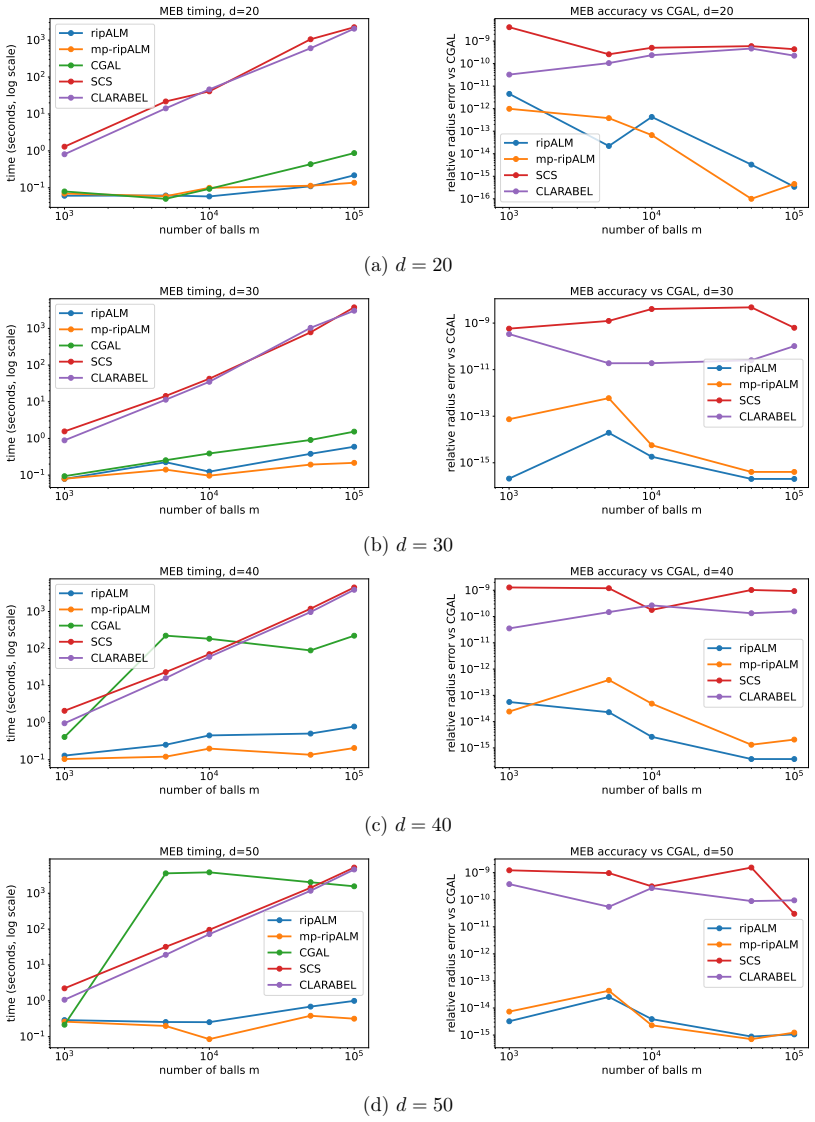
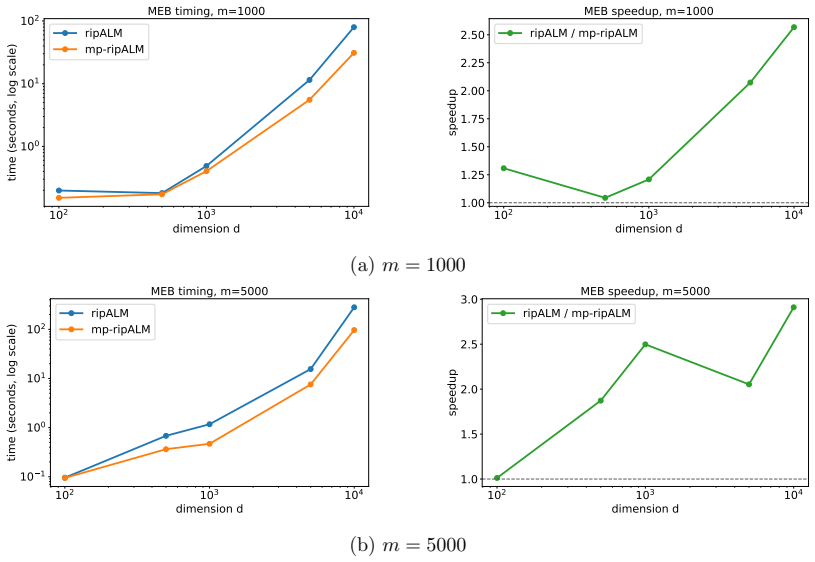
The central claim is that ripALM and mixed-precision ripALM achieve high accuracy and are substantially faster than the tested CPU-based geometric software and general-purpose conic solvers on large-scale instances.
What carries the argument
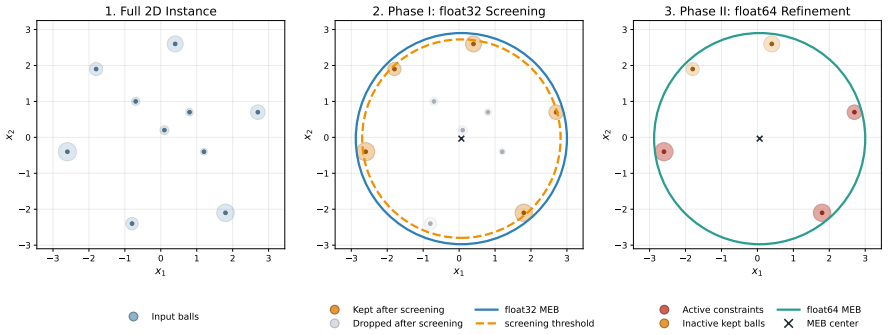
A relative-type inexact proximal augmented Lagrangian method (ripALM) equipped with a mixed-precision reduction that screens with low precision, refines the reduced problem at high precision, and applies an a-posteriori feasibility check on the original data.
If this is right
- The separable structure of the proximal augmented Lagrangian permits efficient parallel GPU maps followed by reductions.
- Low precision is used only for screening and warm-starting while final feasibility is enforced on the original problem.
- The method reaches high accuracy on large instances.
- It runs substantially faster than CPU geometric software and general conic solvers.
Where Pith is reading between the lines
- The same screening-plus-refinement pattern could be tried on other large convex problems whose constraints separate across data points.
- Memory savings from discarding most balls early may become useful when the input set exceeds GPU memory limits.
- One could test whether the number of reintroduced balls stays small across different distributions of input ball radii and centers.
Load-bearing premise
The low-precision screening step can reliably identify balls near the approximate boundary so that the subsequent high-precision solve on the reduced set plus a posteriori feasibility check recovers a valid solution to the original problem without excessive reintroductions.
What would settle it
On a large test instance the mixed-precision run produces a final ball that leaves many originally discarded balls outside after the feasibility check, or the reported accuracy drops below the claimed level.
Figures
read the original abstract
A mixed-precision GPU-oriented optimization framework is developed for computing the minimum enclosing ball of a collection of balls. The approach is built on an equivalent second-order cone programming reformulation and a relative-type inexact proximal augmented Lagrangian method (ripALM), which provides a high-accuracy optimization backbone while solving the inner subproblems only to a progress-dependent relative accuracy. The proximal augmented Lagrangian inherits a constraint-wise separable structure: its objective, gradient, generalized Hessian, and multiplier updates can be efficiently evaluated on GPUs as parallel maps over the input balls followed by reductions. To further improve efficiency, a mixed-precision reduction strategy is introduced. A low-precision ripALM run identifies balls near the approximate boundary, a high-precision ripALM run refines the reduced problem, and a full a posteriori feasibility check detects and reintroduces any violated discarded balls. Thus, low precision is used only for screening and warm starting, while the final feasibility is enforced against the original problem. Numerical experiments show that ripALM and mixed-precision ripALM achieve high accuracy and are substantially faster than the tested CPU-based geometric software and general-purpose conic solvers on large-scale instances.
Editorial analysis
A structured set of objections, weighed in public.
Referee Report
Summary. The manuscript develops a mixed-precision GPU-oriented optimization framework for the minimum enclosing ball problem over a collection of balls. It reformulates the problem as an equivalent second-order cone program and solves it via a relative inexact proximal augmented Lagrangian method (ripALM) whose inner subproblems are solved only to a progress-dependent relative accuracy. The proximal augmented Lagrangian admits a constraint-wise separable structure that permits efficient parallel GPU evaluation of the objective, gradient, generalized Hessian, and multiplier updates. A mixed-precision reduction strategy is introduced in which a low-precision ripALM run screens for balls near the approximate boundary, a high-precision ripALM run refines the reduced problem, and an a-posteriori feasibility check on the original instance detects and reintroduces any violated discarded balls. Numerical experiments are reported to show that both ripALM and its mixed-precision variant attain high accuracy while delivering substantial speedups relative to CPU-based geometric software and general-purpose conic solvers on large-scale instances.
Significance. If the reported performance and accuracy claims are substantiated by detailed, reproducible experiments, the work would constitute a meaningful practical advance for large-scale minimum-enclosing-ball computations. The combination of an SOCP reformulation, relative inexact proximal ALM, GPU-friendly separability, and a controlled mixed-precision screening strategy offers a concrete route to scaling beyond the reach of existing CPU geometric and conic solvers. The absence of free parameters or self-referential definitions in the algorithmic construction is a positive feature.
major comments (2)
- [Abstract and Numerical Experiments] Abstract and Numerical Experiments section: the central claim that ripALM and mixed-precision ripALM achieve high accuracy and are substantially faster than the tested baselines rests on numerical experiments, yet the manuscript supplies no information on the dimensions and cardinalities of the test instances, the precise error metrics employed, the implementation details or versions of the CPU-based geometric software and conic solvers used as baselines, or any statistical controls (multiple runs, variance, or timing methodology). This omission leaves the performance assertions with limited verifiable support.
- [Mixed-precision reduction strategy] Mixed-precision reduction strategy (described in the abstract and the algorithmic development): the reliability of the low-precision screening step in correctly identifying balls near the approximate boundary, such that the subsequent high-precision solve plus a-posteriori feasibility check recovers a valid solution without excessive reintroductions, is load-bearing for the claimed efficiency gains. The manuscript provides no quantitative characterization of how often or under what conditions the check triggers reintroductions, nor any worst-case or probabilistic guarantee on the screening quality.
Simulated Author's Rebuttal
We thank the referee for the constructive comments and positive overall assessment. We address the two major comments below and will revise the manuscript accordingly to improve clarity and verifiability.
read point-by-point responses
-
Referee: [Abstract and Numerical Experiments] Abstract and Numerical Experiments section: the central claim that ripALM and mixed-precision ripALM achieve high accuracy and are substantially faster than the tested baselines rests on numerical experiments, yet the manuscript supplies no information on the dimensions and cardinalities of the test instances, the precise error metrics employed, the implementation details or versions of the CPU-based geometric software and conic solvers used as baselines, or any statistical controls (multiple runs, variance, or timing methodology). This omission leaves the performance assertions with limited verifiable support.
Authors: We agree that the manuscript currently lacks these experimental details, which limits the ability to fully verify the claims. In the revised version we will expand the Numerical Experiments section (and update the abstract if needed) to explicitly report: the dimensions and cardinalities of all test instances; the precise error metrics (e.g., relative duality gap, feasibility violation, and accuracy tolerances); the exact versions, configurations, and implementation details of all baseline solvers; and the statistical protocol including number of runs, variance reporting, and timing methodology. revision: yes
-
Referee: [Mixed-precision reduction strategy] Mixed-precision reduction strategy (described in the abstract and the algorithmic development): the reliability of the low-precision screening step in correctly identifying balls near the approximate boundary, such that the subsequent high-precision solve plus a-posteriori feasibility check recovers a valid solution without excessive reintroductions, is load-bearing for the claimed efficiency gains. The manuscript provides no quantitative characterization of how often or under what conditions the check triggers reintroductions, nor any worst-case or probabilistic guarantee on the screening quality.
Authors: The a-posteriori feasibility check on the original instance is intended to guarantee that any discarded balls violating the approximate solution are reintroduced, thereby ensuring correctness independent of screening quality. We acknowledge that the current manuscript does not provide quantitative data on reintroduction frequency or conditions. In the revision we will add empirical statistics from the reported experiments (e.g., average and maximum number of reintroductions per instance class) and discuss observed conditions under which the screening performs well. We do not provide worst-case or probabilistic guarantees, as the screening step is a practical heuristic; the check serves as the correctness safeguard. revision: yes
Circularity Check
No significant circularity; derivation is self-contained algorithmic construction
full rationale
The paper describes an optimization algorithm built on a standard SOCP reformulation of the minimum enclosing ball problem, an inexact proximal augmented Lagrangian method (ripALM) with separable structure for GPU parallelism, and a mixed-precision screening/refinement strategy with a posteriori feasibility check. No equations or claims reduce a 'prediction' or central result to a fitted parameter, self-definition, or self-citation chain by construction. Performance claims rest on external numerical comparisons to CPU solvers and conic solvers rather than internal tautologies. The derivation chain is independent of the target results.
Axiom & Free-Parameter Ledger
axioms (1)
- domain assumption The minimum enclosing ball problem admits an equivalent second-order cone programming reformulation
Reference graph
Works this paper leans on
-
[1]
P. K. Agarwal, S. Har-Peled, and K. R. Varadarajan. Approximating extent measures of points.Journal of the ACM, 51(4):606–635, 2004
2004
-
[2]
P. K. Agarwal, S. Har-Peled, and K. R. Varadarajan. Geometric approximation via coresets. InCombinatorial and Computational Geometry, volume 52 ofMSRI Publications, pages 1–30. Cambridge University Press, Cambridge, 2005
2005
-
[3]
B˘ adoiu and K
M. B˘ adoiu and K. L. Clarkson. Smaller core-sets for balls. InProceedings of the Fourteenth Annual ACM-SIAM Symposium on Discrete Algorithms, pages 801–802, Baltimore, MD, 2003. SIAM
2003
-
[4]
Beck.First-Order Methods in Optimization
A. Beck.First-Order Methods in Optimization. SIAM, Philadelphia, PA, 2017
2017
-
[5]
Boyd and L
S. Boyd and L. Vandenberghe.Convex Optimization. Cambridge University Press, Cambridge, 2004
2004
-
[6]
X. D. Chen, D. F. Sun, and J. Sun. Complementarity functions and numerical experiments on some smoothing Newton methods for second-order-cone complementarity problems.Com- putational Optimization and Applications, 25(1–3):39–56, 2003. 16
2003
-
[7]
F. H. Clarke.Optimization and Nonsmooth Analysis. SIAM, Philadelphia, PA, 1990
1990
-
[8]
K. L. Clarkson. Coresets, sparse greedy approximation, and the Frank–Wolfe algorithm.ACM Transactions on Algorithms, 6(4), 2010
2010
-
[9]
Domahidi, E
A. Domahidi, E. Chu, and S. Boyd. ECOS: An SOCP solver for embedded systems. In European Control Conference, pages 3071–3076, 2013
2013
-
[10]
Drezner and H
Z. Drezner and H. W. Hamacher, editors.Facility Location: Applications and Theory. Springer, Berlin, Heidelberg, 2002
2002
-
[11]
Feldman and M
D. Feldman and M. Langberg. A unified framework for approximating and clustering data. InProceedings of the Forty-Third Annual ACM Symposium on Theory of Computing, pages 569–578, San Jose, CA, 2011. ACM
2011
-
[12]
Fischer, B
K. Fischer, B. G¨ artner, and M. Kutz. Fast smallest-enclosing-ball computation in high dimen- sions. InAlgorithms – ESA 2003, volume 2832 ofLecture Notes in Computer Science, pages 630–641. Springer, Berlin, Heidelberg, 2003
2003
-
[13]
G¨ artner
B. G¨ artner. Fast and robust smallest enclosing balls. InAlgorithms – ESA 1999, volume 1643 ofLecture Notes in Computer Science, pages 325–338. Springer, Berlin, Heidelberg, 1999
1999
- [14]
-
[15]
K¨ allberg and T
L. K¨ allberg and T. Larsson. Accelerated computation of minimum enclosing balls by GPU parallelization and distance filtering. InProceedings of SIGRAD 2014: Visual Computing, volume 106 ofLink¨ oping Electronic Conference Proceedings, pages 57–65, Link¨ oping, Sweden,
2014
-
[16]
Link¨ oping University Electronic Press
-
[17]
Kumar, J
P. Kumar, J. S. B. Mitchell, and E. A. Yildirim. Approximate minimum enclosing balls in high dimensions using core-sets.ACM Journal of Experimental Algorithmics, 8:1.1 – es, 2003
2003
-
[18]
Liang, D
L. Liang, D. F. Sun, and K.-C. Toh. An inexact augmented Lagrangian method for second- order cone programming with applications.SIAM Journal on Optimization, 31(3):1748–1773, 2021
2021
-
[19]
N. Megiddo. Linear-time algorithms for linear programming inR 3 and related problems.SIAM Journal on Computing, 12(4):759–776, 1983
1983
-
[20]
Nesterov and A
Y. Nesterov and A. Nemirovskii.Interior-Point Polynomial Algorithms in Convex Program- ming. SIAM, Philadelphia, PA, 1994
1994
-
[21]
O’Donoghue, E
B. O’Donoghue, E. Chu, N. Parikh, and S. Boyd. Conic optimization via operator splitting and homogeneous self-dual embedding.Journal of Optimization Theory and Applications, 169 (3):1042–1068, 2016
2016
-
[22]
R. T. Rockafellar and R. J.-B. Wets.Variational Analysis. Springer, Berlin, Heidelberg, 1998
1998
-
[23]
J. F. Sturm. Using SeDuMi 1.02, a MATLAB toolbox for optimization over symmetric cones. Optimization Methods and Software, 11(1–4):625–653, 1999
1999
-
[24]
D. M. J. Tax and R. P. W. Duin. Support vector data description.Machine Learning, 54: 45–66, 2004. 17
2004
-
[25]
CGAL Editorial Board, 6.1.1 edition,
The CGAL Project.CGAL User and Reference Manual. CGAL Editorial Board, 6.1.1 edition,
-
[26]
URLhttps://doc.cgal.org/6.1.1/Manual/packages.html
-
[27]
K.-C. Toh, M. J. Todd, and R. H. T¨ ut¨ unc¨ u. SDPT3: A MATLAB software package for semidefinite programming, version 1.3.Optimization Methods and Software, 11(1–4):545–581, 1999
1999
-
[28]
I. W. Tsang, J. T. Kwok, and P.-M. Cheung. Core vector machines: Fast SVM training on very large data sets.Journal of Machine Learning Research, 6:363–392, 2005
2005
-
[29]
Y. Wang, Y. Li, and K.-L. Tan. Coresets for minimum enclosing balls over sliding windows. InProceedings of the 25th ACM SIGKDD International Conference on Knowledge Discovery and Data Mining, pages 314–323, Anchorage, AK, 2019. ACM
2019
-
[30]
E. Welzl. Smallest enclosing disks (balls and ellipsoids). InNew Results and New Trends in Computer Science, volume 555 ofLecture Notes in Computer Science, pages 359–370. Springer, Berlin, Heidelberg, 1991
1991
- [31]
-
[32]
E. A. Yildirim. Two algorithms for the minimum enclosing ball problem.SIAM Journal on Optimization, 19(3):1368–1391, 2008
2008
-
[33]
X.-Y. Zhao, D. F. Sun, and K.-C. Toh. A Newton–CG augmented Lagrangian method for semidefinite programming.SIAM Journal on Optimization, 20(4):1737–1765, 2010
2010
-
[34]
Zhou, K.-C
G. Zhou, K.-C. Toh, and J. Sun. Efficient algorithms for the smallest enclosing ball problem. Computational Optimization and Applications, 30(2):147–160, 2005
2005
-
[35]
J. Zhu, L. Liang, L. Yang, and K.-C. Toh. ripALM: A relative-type inexact proximal aug- mented Lagrangian method for linearly constrained convex optimization.arXiv preprint arXiv:2411.13267, 2024
work page internal anchor Pith review Pith/arXiv arXiv 2024
- [36]
discussion (0)
Sign in with ORCID, Apple, or X to comment. Anyone can read and Pith papers without signing in.