REVIEW 1 major objections 44 references
DG-CoLearn: An Efficient Collaborative Learning Framework for Dynamic Graphs
T0 review · 1 major / 0 minor · reviewed 2026-06-28 · grok-4.3
Pith's one-line read DG-CoLearn uses incremental snapshot processing and server-mediated embedding exchanges to enable efficient, privacy-preserving collaborative learning on dynamic graphs.
desk verdict DG-CoLearn frames a client-oblivious incremental pipeline with server embedding exchange for private collaborative dynamic graphs, but the headline speedups and accuracy gains rest on an unverified claim that the exchange preserves full multi-hop accuracy. read the letter →
The pith
A machine-rendered reading of the paper's core claim, the machinery that carries it, and where it could break.
The reading
What carries the argument
Incremental graph snapshot processing combined with server-mediated embedding exchange for client-oblivious multi-hop message passing
What would settle it
A controlled test on a partitioned dynamic graph where cross-partition edges are known to be critical for prediction, measuring whether DG-CoLearn's accuracy matches a full-information baseline or drops when only server-mediated embeddings are used.
Extended reading notes
Core claim
DG-CoLearn is a client-oblivious collaborative dynamic graph learning framework built on incremental graph snapshot processing that focuses computation on regions affected by temporal updates, preserves historical information through temporal modelling, and uses a server-mediated embedding exchange mechanism to enable accurate multi-hop message passing without exposing raw cross-client structural information.
Load-bearing premise
The incremental snapshot processing and server-mediated embedding exchange preserve multi-hop message passing accuracy and historical information without exposing cross-partition edges.
Editorial extensions
If this is right
- Training time is reduced by up to 33.8 times relative to repeated full-snapshot retraining.
- Communication overhead drops by up to 27.4 times through embedding-only exchanges.
- Node classification F1 improves by up to 13.36 percent.
- Link prediction MAP improves by up to 8.27 percent.
Reading between the lines
- The same incremental focus on changed regions could cut retraining costs even when data is not partitioned across clients.
- Server mediation may create a scalability limit once the number of clients grows large enough to saturate a single server.
- The client-oblivious design offers a template for other temporal data types where direct structure sharing is restricted.
Editorial analysis
A structured set of objections, weighed in public.
Referee Report
Summary. The paper proposes DG-CoLearn, a client-oblivious collaborative framework for dynamic graph learning. It processes graph snapshots incrementally to focus computation on temporal updates, uses temporal modelling to retain history, and employs server-mediated embedding exchange to support multi-hop message passing across partitions without exposing raw cross-client edges. Experiments are reported to show up to 33.8× training speedup, 27.4× communication reduction, and gains of up to 13.36% F1 (node classification) and 8.27% MAP (link prediction).
Significance. If the incremental design and embedding-exchange mechanism deliver accuracy equivalent to full-graph retraining while preserving privacy, the work would meaningfully advance efficient, privacy-aware collaborative learning on evolving graphs, a setting where repeated full retraining and direct edge sharing are prohibitive.
major comments (1)
- [Abstract] Abstract: the headline claims of 33.8× speedup and accuracy improvements rest on the assertion that server-mediated embedding exchange 'enables accurate multi-hop message passing' without raw edges; no mechanism, equivalence argument, or ablation is supplied in the provided text to show that neighborhood aggregation and temporal history are preserved rather than approximated, making the performance numbers unverifiable from the given description.
Simulated Author's Rebuttal
We thank the referee for highlighting the need for clearer justification of the embedding exchange mechanism in the abstract. We address this point below and propose revisions to improve verifiability of the headline claims.
read point-by-point responses
-
Referee: [Abstract] Abstract: the headline claims of 33.8× speedup and accuracy improvements rest on the assertion that server-mediated embedding exchange 'enables accurate multi-hop message passing' without raw edges; no mechanism, equivalence argument, or ablation is supplied in the provided text to show that neighborhood aggregation and temporal history are preserved rather than approximated, making the performance numbers unverifiable from the given description.
Authors: We agree the abstract is concise and does not itself contain the mechanism details, equivalence proof, or ablation results. The full manuscript supplies these in Section 3.2 (server-mediated embedding exchange protocol), Section 3.3 (proof that exchanged embeddings preserve exact multi-hop aggregation and temporal state under the incremental update rule), and Section 5.3 (ablation removing the exchange and showing accuracy drop). The abstract therefore summarizes rather than demonstrates the claim. To address the concern, we will revise the abstract to briefly reference the mechanism and point readers to the relevant sections, while retaining the quantitative results. revision: yes
Circularity Check
No circularity; claims rest on empirical validation of proposed framework
full rationale
The paper introduces DG-CoLearn, a client-oblivious collaborative framework for dynamic graphs that uses incremental snapshot processing and server-mediated embedding exchange. All headline metrics (33.8× training speedup, 27.4× communication reduction, 13.36% F1 gain, 8.27% MAP gain) are presented as outcomes of extensive experiments rather than any derivation, equation, or fitted parameter. No self-definitional steps, fitted-input predictions, or load-bearing self-citations appear in the provided text; the central claims remain independent of the mechanism descriptions and are externally falsifiable via the reported benchmarks.
Assumptions & free parameters
Cite this review
Pith. "Pith review of DG-CoLearn: An Efficient Collaborative Learning Framework for Dynamic Graphs." pith.science (2026). https://pith.science/paper/7KOE4W4L
@misc{pith2026260531427,
  author       = {Pith},
  title        = {Pith review of: DG-CoLearn: An Efficient Collaborative Learning Framework for Dynamic Graphs},
  year         = {2026},
  howpublished = {\url{https://pith.science/paper/7KOE4W4L}},
  note         = {Machine review of arXiv:2605.31427}
}
abstract
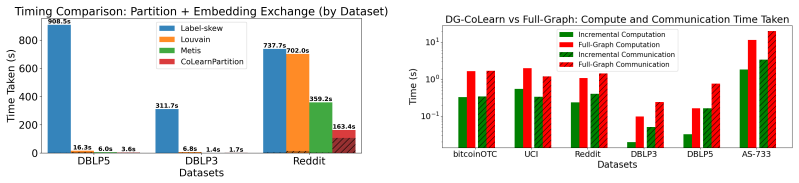
Dynamic graph learning (DGL) is essential for modelling evolving graph data, but existing methods suffer from significant computational overhead due to repeated full-snapshot retraining and are not well-suited for collaborative settings with partitioned data. In realistic graph systems, cross-partition edges are unavoidable, but direct sharing of graph structure between clients may violate privacy constraints. We propose DG-CoLearn, a client-oblivious collaborative dynamic graph learning framework built on incremental graph snapshot processing, which focuses computation on graph regions affected by temporal updates while preserving historical information through temporal modelling. This incremental design is consistently applied across the entire graph processing pipeline, including a server-mediated embedding exchange mechanism to enable accurate multi-hop message passing without exposing raw cross-client structural information. Extensive experiments demonstrate that DG-CoLearn achieves up to 33.8$\times$ speedup in training time and 27.4$\times$ reduction in communication overhead, while consistently improving predictive performance on both node classification (up to 13.36% F1 improvement) and link prediction (up to 8.27% MAP improvement) tasks. These results highlight the effectiveness of DG-CoLearn in bridging efficiency, scalability, and client-to-client structural privacy in collaborative dynamic graph learning.
Figures


Figures from the paper (10 more)


Reference graph
Works this paper leans on
-
[1]
Carletti, P
V . Carletti, P. Foggia, C. Mazzocca, G. Parrella, and M. Vento. {SoK}: Gradient inversion attacks in federated learning. In34th USENIX Security Symposium (USENIX Security 25), pages 6439–6459, 2025
2025
-
[2]
V . T. Chakaravarthy, S. S. Pandian, S. Raje, Y . Sabharwal, T. Suzumura, and S. Ubaru. Efficient scaling of dynamic graph neural networks. InProceedings of the International Conference for High Performance Computing, Networking, Storage and Analysis, SC ’21, 2021
2021
-
[3]
Chaudhry, M
A. Chaudhry, M. Rohrbach, M. Elhoseiny, T. Ajanthan, P. Dokania, P. Torr, and M. Ranzato. Continual learning with tiny episodic memories. InWorkshop on Multi-Task and Lifelong Reinforcement Learning, 2019
2019
-
[4]
F. Chen, P. Li, T. Miyazaki, and C. Wu. Fedgraph: Federated graph learning with intelligent sampling. IEEE Transactions on Parallel and Distributed Systems, 33(8):1775–1786, 2021
2021
-
[5]
Z. Chen, K. Liang, L. Yuan, W. Zhang, and Z. Yang. Recent advances in efficient dynamic graph processing. Applied Sciences, 15(11):6003, 2025
2025
-
[6]
C. Dai, Q. Tang, and H. Ding. Tgat: temporal graph attention network for blockchain phishing scams detection. In2024 International Conference on Computer, Information and Telecommunication Systems (CITS), pages 1–7. IEEE, 2024
2024
-
[7]
Dai and Y
J. Dai and Y . Lu. Graph-level label-only membership inference attack against graph neural networks. Applied Sciences, 15(9):5086, 2025
2025
-
[8]
K. Fu, Q. Chen, Y . Yang, J. Shi, C. Li, and M. Guo. Blad: Adaptive load balanced scheduling and operator overlap pipeline for accelerating the dynamic gnn training. InProceedings of the International Conference for High Performance Computing, Networking, Storage and Analysis, SC ’23, 2023
2023
Show all 44 references
-
[9]
Gastinger, S
J. Gastinger, S. Huang, M. Galkin, E. Loghmani, A. Parviz, F. Poursafaei, J. Danovitch, E. Rossi, I. Koutis, H. Stuckenschmidt, R. Rabbany, and G. Rabusseau. Tgb 2.0: A benchmark for learning on temporal knowledge graphs and heterogeneous graphs.Advances in Neural Information ...
2024
-
[10]
Gauthier, V
F. Gauthier, V . C. Gogineni, S. Werner, Y .-F. Huang, and A. Kuh. Personalized graph federated learning with differential privacy.IEEE Transactions on Signal and Information Processing over Networks, 9:736–749, 2023
2023
-
[11]
F. Guan, T. Zhu, H. Tong, and W. Zhou. Attention-based membership inference attacks on graph neural network through topological features.IEEE Transactions on Dependable and Secure Computing, 2025
2025
-
[12]
Y . Hu, H. Ren, C. Hu, Y . Li, J. Deng, and X. Xie. Gradients stand-in for defending deep leakage in federated learning. In2024 International Conference on Computing in Natural Sciences, Biomedicine and Engineering (COMCONF), pages 53–64. IEEE, 2024
2024
-
[13]
S. Kim, S. Yun, and J. Kang. Dygrain: An incremental learning framework for dynamic graphs. InIJCAI, pages 3157–3163, 2022
2022
-
[14]
Kumar, W
S. Kumar, W. L. Hamilton, J. Leskovec, and D. Jurafsky. Community interaction and conflict on the web. WWW ’18, page 933–943, 2018
2018
-
[15]
Kumar, B
S. Kumar, B. Hooi, D. Makhija, M. Kumar, C. Faloutsos, and V . Subrahmanian. Rev2: Fraudulent user prediction in rating platforms. InProceedings of the Eleventh ACM International Conference on Web Search and Data Mining, page 333–341, 2018
2018
-
[16]
Leskovec, J
J. Leskovec, J. Kleinberg, and C. Faloutsos. Graphs over time: densification laws, shrinking diameters and possible explanations. InProceedings of the Eleventh ACM SIGKDD International Conference on Knowledge Discovery in Data Mining, KDD ’05, page 177–187, New York, NY , USA,...
2005
-
[17]
H. Liu, P. Xiong, T. Zhu, and P. S. Yu. A survey on machine unlearning: Techniques and new emerged privacy risks.Journal of Information Security and Applications, 90:104010, 2025
2025
-
[18]
H. Liu, Y . Yang, and X. Wang. Overcoming catastrophic forgetting in graph neural networks. InProceedings of the AAAI conference on artificial intelligence, volume 35, pages 8653–8661, 2021
2021
-
[19]
Y . Liu, Y . Zhang, P. He, and S. Fang. Fedgnnldp: Federated graph neural network with locally differential privacy.Computers & Security, page 104757, 2025. 10
2025
-
[20]
X. Luo, Y . Luo, G. Xin, X. Gui, J. Wang, and C. Guo. Practical and high-quality partitioning algorithm for large-scale and time-evolving graphs.Knowledge-Based Systems, 227:107211, 2021
2021
-
[21]
I. E. Olatunji, W. Nejdl, and M. Khosla. Membership inference attack on graph neural networks. In 2021 Third IEEE International Conference on Trust, Privacy and Security in Intelligent Systems and Applications (TPS-ISA), pages 11–20. IEEE, 2021
2021
-
[22]
S. Pang, Y . Xue, Z. Yan, W. Huang, and J. Feng. Dynamic and multi-channel graph convolutional networks for aspect-based sentiment analysis. InFindings of the association for computational linguistics: ACL-IJCNLP 2021, pages 2627–2636, 2021
2021
-
[23]
Panzarasa, T
P. Panzarasa, T. Opsahl, and K. M. Carley. Patterns and dynamics of users’ behavior and interaction: Network analysis of an online community.J. Am. Soc. Inf. Sci. Technol., 60(5):911–932, 2009
2009
-
[24]
Pareja, G
A. Pareja, G. Domeniconi, J. Chen, T. Ma, T. Suzumura, H. Kanezashi, T. Kaler, T. Schardl, and C. Leiser- son. Evolvegcn: Evolving graph convolutional networks for dynamic graphs. InProceedings of the AAAI conference on artificial intelligence, volume 34, pages 5363–5370, 2020
2020
-
[25]
Pawelczyk, J
M. Pawelczyk, J. Z. Di, Y . Lu, G. Kamath, A. Sekhari, and S. Neel. Machine unlearning fails to remove data poisoning attacks. InThe Thirteenth International Conference on Learning Representations, 2026
2026
-
[26]
Ramezani, W
M. Ramezani, W. Cong, M. Mahdavi, M. T. Kandemir, and A. Sivasubramaniam. Learn locally, correct globally: A distributed algorithm for training graph neural networks. In10th International Conference on Learning Representations, ICLR, 2022
2022
-
[27]
Rossi, B
E. Rossi, B. Chamberlain, F. Frasca, D. Eynard, F. Monti, and M. Bronstein. Temporal graph networks for deep learning on dynamic graphs.arXiv preprint arXiv:2006.10637, 2020
2006 arXiv
-
[28]
J. Su, D. Zou, Z. Zhang, and C. Wu. Towards robust graph incremental learning on evolving graphs. In A. Krause, E. Brunskill, K. Cho, B. Engelhardt, S. Sabato, and J. Scarlett, editors,Proceedings of the 40th International Conference on Machine Learning, volume 202 ofProceedin...
2023
-
[29]
J. Tang, J. Zhang, L. Yao, J. Li, L. Zhang, and Z. Su. Arnetminer: extraction and mining of academic social networks. InProceedings of the 14th ACM SIGKDD International Conference on Knowledge Discovery and Data Mining, KDD ’08, page 990–998, 2008
2008
-
[30]
Wang and W
X. Wang and W. H. Wang. Subgraph structure membership inference attacks against graph neural networks. Proceedings on Privacy Enhancing Technologies, 2024
2024
-
[31]
Z. Wang, W. Kuang, Y . Xie, L. Yao, Y . Li, B. Ding, and J. Zhou. Federatedscope-gnn: Towards a unified, comprehensive and efficient package for federated graph learning. InProceedings of the 28th ACM SIGKDD Conference on Knowledge Discovery and Data Mining, KDD ’22, page 4110...
2022
-
[32]
Z. Xie, L. Likun, X. Chen, H. Yu, and Q. Huang. FedDGL: Federated dynamic graph learning for temporal evolution and data heterogeneity. InProceedings of the 16th Asian Conference on Machine Learning, volume 260, pages 463–478, 05–08 Dec 2025
2025
-
[33]
Y . Yao, W. Jin, S. Ravi, and C. Joe-Wong. Fedgcn: convergence-communication tradeoffs in federated training of graph convolutional networks.Advances in neural information processing systems, 36:79748– 79760, 2023
2023
-
[34]
J. You, T. Du, and J. Leskovec. Roland: graph learning framework for dynamic graphs. InProceedings of the 28th ACM SIGKDD Conference on Knowledge Discovery and Data Mining, pages 2358–2366, 2022
2022
-
[35]
L. Yu, L. Sun, B. Du, and W. Lv. Towards better dynamic graph learning: New architecture and unified library.Advances in Neural Information Processing Systems, 36:67686–67700, 2023
2023
-
[36]
ZHANG, C
K. ZHANG, C. Yang, X. Li, L. Sun, and S. M. Yiu. Subgraph federated learning with missing neighbor generation. In A. Beygelzimer, Y . Dauphin, P. Liang, and J. W. Vaughan, editors,Advances in Neural Information Processing Systems, 2021
2021
-
[37]
Zhang, C
T. Zhang, C. Mai, Y . Chang, C. Chen, L. Shu, and Z. Zheng. Fedego: Privacy-preserving personalized federated graph learning with ego-graphs.ACM Trans. Knowl. Discov. Data, 18(2), Nov. 2023
2023
-
[38]
Zhou and C
F. Zhou and C. Cao. Overcoming catastrophic forgetting in graph neural networks with experience replay. InProceedings of the AAAI conference on artificial intelligence, volume 35, pages 4714–4722, 2021. 11 Figure 6: Overall Procedure of CoLearnPartition splitting a graph into ...
2021
-
[39]
L. Zhu, Z. Liu, and S. Han. Deep leakage from gradients.Advances in neural information processing systems, 32, 2019
2019
-
[40]
R. Zhu, K. Zhao, H. Yang, W. Lin, C. Zhou, B. Ai, Y . Li, and J. Zhou. Aligraph: a comprehensive graph neural network platform.Proc. VLDB Endow., 12(12):2094–2105, 2019. A Additional Details of CoLearnPartition A.1 Overall Flow of CoLearnPartition Figure 6 shows the complete p...
-
[41]
Primary:Minimize Cut Edges;Secondary:Edge Size Balance and Node Label Diversity [MinCut_First]
-
[42]
Primary:Edge Size Balance;Secondary:Minimize Cut Edges and Node Label Diversity [Balance_First]
-
[43]
Primary:Node Label Diversity;Secondary:Minimize Cut Edges and Edge Size Balance [Label_First] 13 Algorithm 1CoLearnPartition (without existing valid partition) Require:SnapshotG t = (Vt, Et) 1:SelectMseed nodes that are maximally distant 2:Grow provisional partitions via BFS f...
1997
-
[44]
In summary, these rely on comparing model states before and after data removal
also shows that even if an MIA suggests a datapoint was successfully unlearned, residual traces may remain, allowing adversaries to recover sensitive information through data poisoning vectors. In summary, these rely on comparing model states before and after data removal. How...
Reviewed June 28, 2026 · model on record in the stance chip above.
Discussion (0). Sign in to comment.