An efficient Progressive Swapping to the Middle distribution protocol adapted to imperfect quantum memories in quantum networks
Pith reviewed 2026-06-28 21:50 UTC · model grok-4.3
The pith
Progressive Swapping to the Middle raises link probability over standard Progressive Swapping while using fewer resources in networks with imperfect memories.
A machine-rendered reading of the paper's core claim, the machinery that carries it, and where it could break.
Core claim
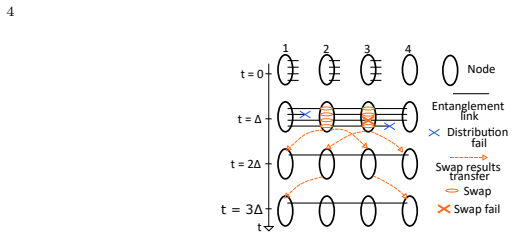
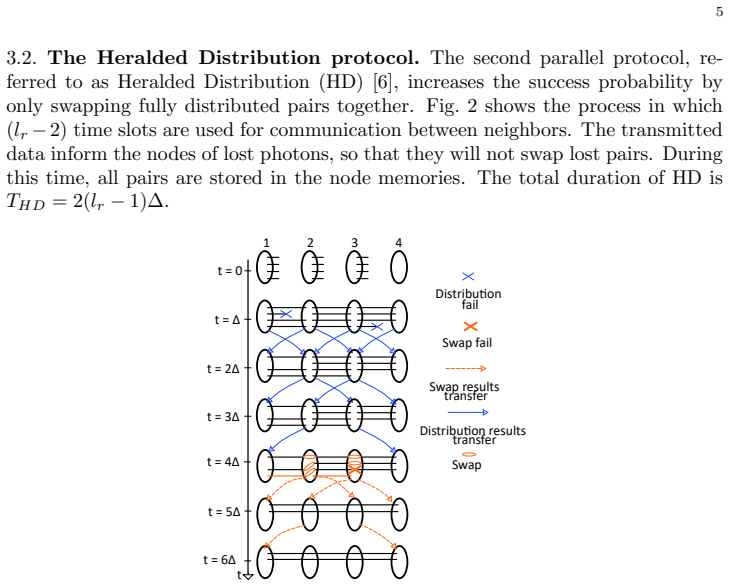
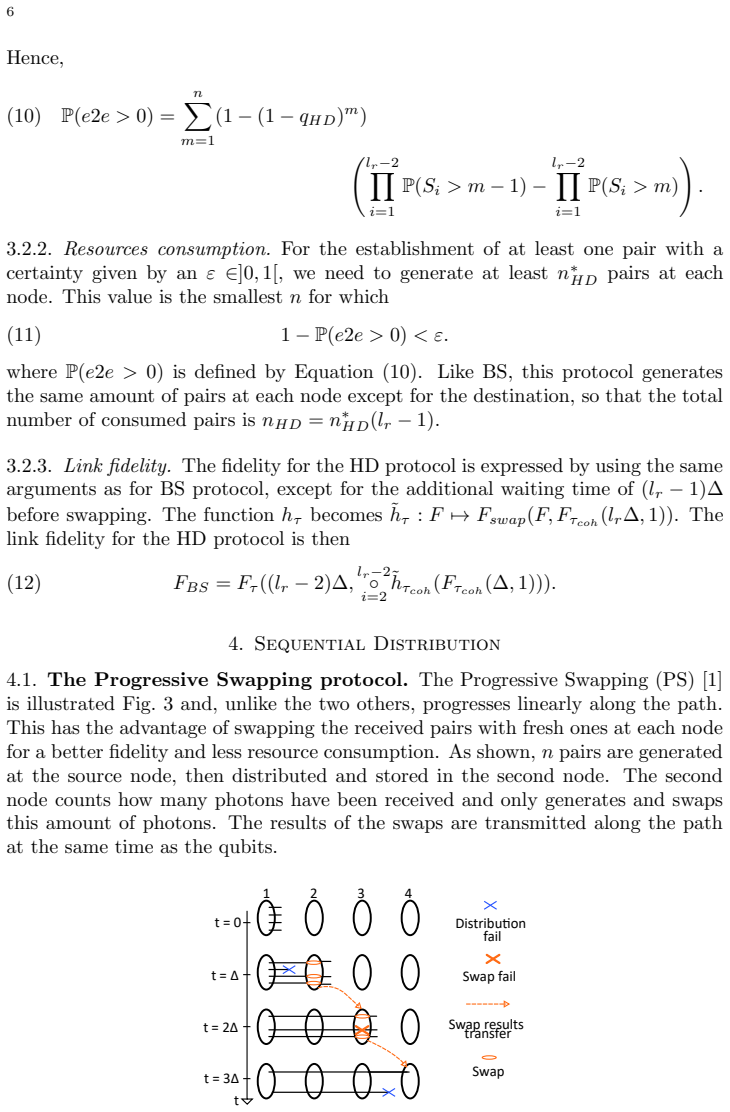
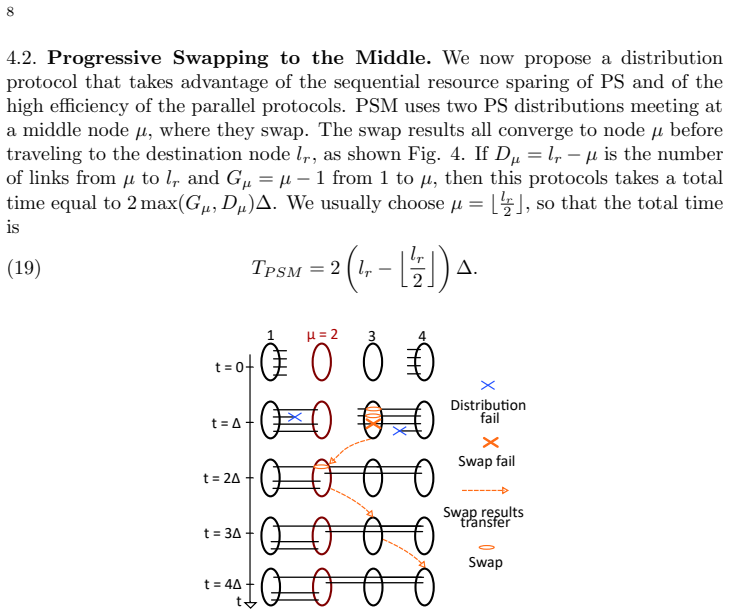
Progressive Swapping to the Middle combines Progressive Swapping initiated from both extremities of a path so that the two fronts meet in the middle and swap the pairs they have received; when memories are imperfect and fidelity degrades, this yields higher link probability than Progressive Swapping alone, maintains reasonable fidelity, and consumes fewer resources than parallel or standard sequential protocols.
What carries the argument
Progressive Swapping to the Middle (PSM), the mechanism that merges two Progressive Swapping processes from opposite ends of the path at a central meeting point.
If this is right
- PSM produces higher end-to-end link probability than Progressive Swapping on the same path.
- Fidelity stays within acceptable bounds despite memory decay.
- Fewer intermediate entangled pairs are required than in parallel distribution schemes.
- The protocol remains viable when memory holding times are limited.
Where Pith is reading between the lines
- The meeting-in-the-middle pattern may reduce the total time entangled pairs must be stored on long paths.
- Resource savings could become larger as path length increases.
- The same bilateral approach might be tested on other sequential entanglement protocols.
Load-bearing premise
The modeled degradation of fidelity in imperfect memories fully captures the losses that occur when the two Progressive Swapping fronts meet and swap.
What would settle it
A direct comparison, under the same memory lifetime and decoherence parameters, that finds PSM link probability no higher than that of standard Progressive Swapping would falsify the performance claim.
Figures
read the original abstract
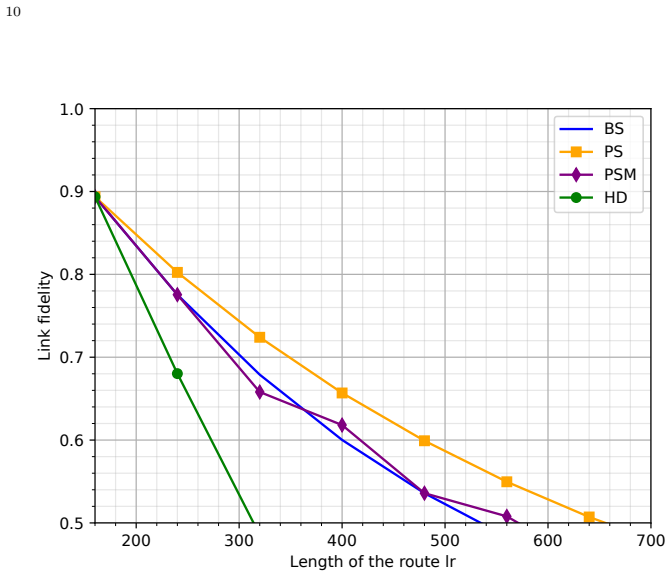
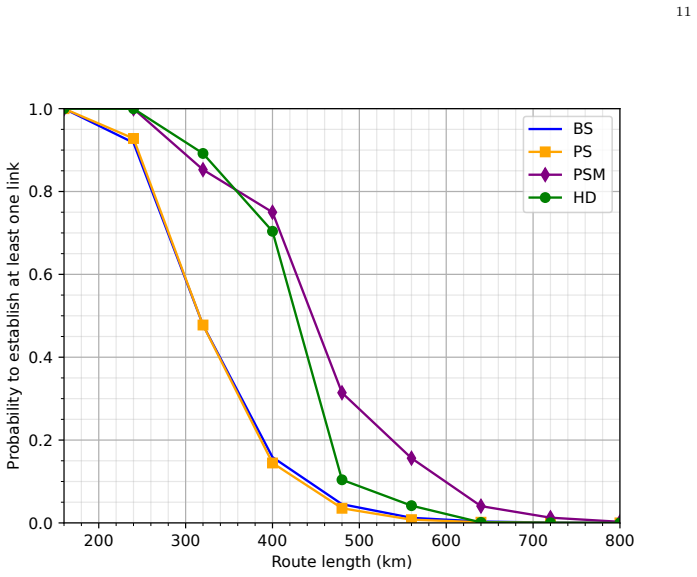
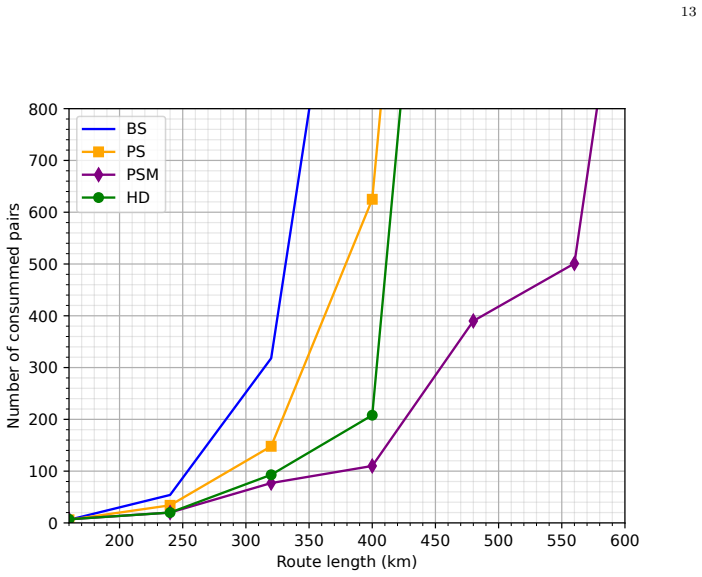
The distribution of entangled pairs of photons on the links composing a quantum network, combined with Bell state measurements and teleportation, is the basic apparatus to transfer quantum bits (qubits) over long distances. Entanglement distribution establishes an end-to-end entangled pair while consuming intermediate pairs on links and holding them for a certain time period. The technical literature identifies two main kinds of protocols, parallel and sequential ones, the latter having an advantage in resource consumption over the former. In this paper, we introduce an efficient swapping protocol called Progressive Swapping to the Middle (PSM) as it combines the existing Progressive Swapping (PS) protocol from both extremities of a path that meet in the middle where the received pairs are swapped. We compare PSM with two parallel protocols and PS; in our evaluation, we take into account imperfect memories and fidelity degradation. We demonstrate that PSM yields a much better link probability than PS while keeping a reasonable link fidelity, and shows an advantage in resource consumption over other protocols.
Editorial analysis
A structured set of objections, weighed in public.
Referee Report
Summary. The manuscript introduces the Progressive Swapping to the Middle (PSM) protocol for entanglement distribution over paths in quantum networks. PSM performs progressive swapping from both path extremities, with the resulting pairs meeting and being swapped in the middle. The work compares PSM against two parallel protocols and the existing Progressive Swapping (PS) protocol while modeling imperfect memories and fidelity degradation over time. The central claim is that PSM achieves substantially higher link probability than PS at acceptable fidelity and consumes fewer resources than the parallel alternatives.
Significance. If the quantitative evaluation holds, PSM would constitute a practical improvement for entanglement distribution under realistic memory decoherence, offering a middle ground between the resource efficiency of sequential protocols and the speed of parallel ones. The explicit treatment of imperfect memories is a strength relative to idealized models common in the literature.
major comments (2)
- [Abstract] Abstract: the claims that PSM 'yields a much better link probability than PS' and 'shows an advantage in resource consumption over other protocols' are asserted without any numerical results, simulation parameters, memory decoherence model, fidelity equations, or comparison tables. Because the central performance advantage is the paper's main contribution, the absence of supporting data or derivations in the supplied text renders the claim unverifiable.
- [Abstract] The protocol description implicitly assumes that the meeting-in-the-middle swap does not introduce additional fidelity loss or synchronization overhead beyond the modeled memory decay; no analysis or bound is supplied to justify this assumption, which is load-bearing for the fidelity claim.
Simulated Author's Rebuttal
We thank the referee for the constructive feedback on our manuscript. We address each major comment below and indicate the revisions planned.
read point-by-point responses
-
Referee: [Abstract] Abstract: the claims that PSM 'yields a much better link probability than PS' and 'shows an advantage in resource consumption over other protocols' are asserted without any numerical results, simulation parameters, memory decoherence model, fidelity equations, or comparison tables. Because the central performance advantage is the paper's main contribution, the absence of supporting data or derivations in the supplied text renders the claim unverifiable.
Authors: The abstract summarizes results whose supporting details (numerical link probabilities, resource comparisons, simulation parameters, decoherence model, fidelity equations, and tables) appear in the evaluation sections of the full manuscript. To improve direct verifiability from the abstract itself, we will add brief quantitative highlights of the observed improvements. revision: partial
-
Referee: [Abstract] The protocol description implicitly assumes that the meeting-in-the-middle swap does not introduce additional fidelity loss or synchronization overhead beyond the modeled memory decay; no analysis or bound is supplied to justify this assumption, which is load-bearing for the fidelity claim.
Authors: We agree that the assumption requires explicit support. In the revision we will insert a short analysis or bound quantifying the additional fidelity impact and synchronization considerations of the middle swap, showing that they remain within the modeled memory decay under the protocol parameters. revision: yes
Circularity Check
No significant circularity
full rationale
The provided abstract and context contain no equations, derivations, fitted parameters, or self-citations that could reduce a claimed result to its inputs by construction. The paper introduces a protocol (PSM) and reports comparative performance from evaluation under modeled imperfect memories; these are empirical simulation outcomes rather than first-principles predictions that loop back to definitions or prior self-citations. No load-bearing steps of the enumerated kinds are identifiable from the given text, satisfying the requirement to quote specific reductions before flagging circularity. The work is therefore self-contained at the level of protocol description and benchmarking.
Axiom & Free-Parameter Ledger
Reference graph
Works this paper leans on
-
[1]
Efficient routing design based on entanglement flow loss effect in quantum networks,
Z. Wang, J. Li, Z. Li, L. Chen, N. Yu, Q. Sun, and J. Lu, “Efficient routing design based on entanglement flow loss effect in quantum networks,” in2024 International Conference on Quantum Communications, Networking, and Computing (QCNC), 2024, pp. 9–16
2024
-
[2]
Analysis of asynchronous protocols for entanglement distribution in quantum networks,
S. Pouryousef, H. Shapourian, and D. Towsley, “Analysis of asynchronous protocols for entanglement distribution in quantum networks,”ArXiv, vol. abs/2405.02406, 2024. [Online]. Available: https://api.semanticscholar.org/CorpusID:269605963
arXiv 2024
-
[3]
A compact framework for analyzing asynchronous entanglement distribution in quantum networks,
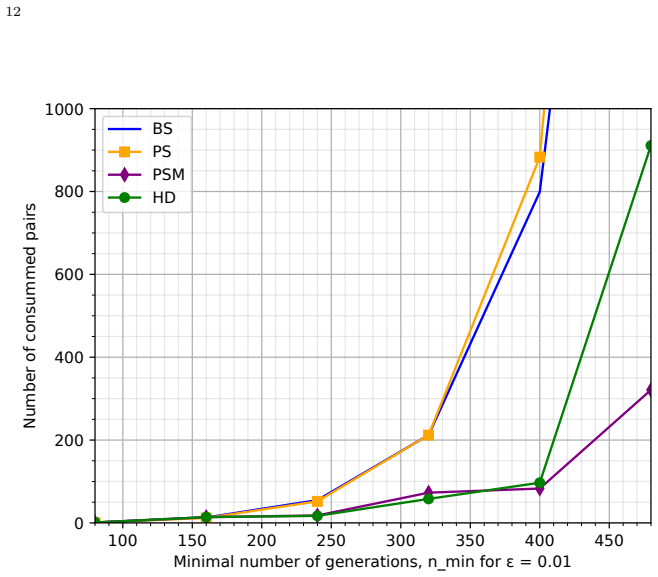
E. Hughes, W. Munizzi, and P. Narang, “A compact framework for analyzing asynchronous entanglement distribution in quantum networks,” 7 2025. 12 100 150 200 250 300 350 400 450 Minimal number of generations, n_min for ε = 0.01 0 200 400 600 800 1000Number of consummed pairs BS PS PSM HD Figure 7.Minimal numbern ∗ of generations per node or at the start no...
2025
-
[4]
Entanglement distribution in a quantum network: A multicommodity flow-based approach,
K. Chakraborty, D. Elkouss, B. Rijsman, and S. Wehner, “Entanglement distribution in a quantum network: A multicommodity flow-based approach,”IEEE Transactions on Quantum Engineering, vol. 1, p. 1–21, 2020. [Online]. Available: http://dx.doi.org/10.1109 /TQE.2020.3028172
arXiv 2020
-
[5]
Quantum repeaters based on entanglement purification,
W. Duer, H.-J. Briegel, J. I. Cirac, and P. Zoller, “Quantum repeaters based on entanglement purification,”Phys. Rev. A, vol. 59, pp. 169–181, 1 1999. [Online]. Available: https://link.aps.org/doi/10.1103/PhysRevA.59.169
-
[6]
Entanglement routing in quantum networks: A comprehensive survey,
A. Abane, M. Cubeddu, V. Mai, and A. Battou, “Entanglement routing in quantum networks: A comprehensive survey,”IEEE Transactions on Quantum Engineering, vol. PP, pp. 1–36, 01 2025
2025
-
[7]
Narrowgap: Reducing bottle- necks for end-to-end entanglement distribution in quantum networks,
Z. Li, J. Li, K. Xue, L. Chen, N. Yu, Q. Sun, and J. Lu, “Narrowgap: Reducing bottle- necks for end-to-end entanglement distribution in quantum networks,”IEEE Transactions on Networking, vol. 33, no. 1, pp. 162–177, 2025
2025
-
[8]
Fidelity-guarantee entanglement routing in quantum networks,
J. Li, M. Wang, K. Xue, R. Li, N. Yu, Q. Sun, and J. Lu, “Fidelity-guarantee entanglement routing in quantum networks,”IEEE Transactions on Communications, vol. 70, no. 10, pp. 6748–6763, 2022
2022
-
[9]
Swappingboost: Optimizing entangle- ment routing by mitigating bottlenecks in quantum networks,
B. Yang, Z. Li, K. Xue, L. Chen, Q. Sun, and J. Lu, “Swappingboost: Optimizing entangle- ment routing by mitigating bottlenecks in quantum networks,” in2025 International Wireless Communications and Mobile Computing (IWCMC), 2025, pp. 1–6
2025
-
[10]
Entanglement distribution in quantum repeater with purification and optimized buffer time,
A. Zang, X. Chen, A. Kolar, J. Chung, M. Suchara, T. Zhong, and R. Kettimuthu, “Entanglement distribution in quantum repeater with purification and optimized buffer time,” inIEEE INFOCOM 2023 - IEEE Conference on Computer Communications Workshops (INFOCOM WKSHPS). IEEE, May 2023, p. 1–6. [Online]. Available: http://dx.doi.org/10.1109/INFOCOMWKSHPS57453.20...
-
[11]
Q-ddca: Decentralized dynamic congestion avoid routing in large-scale quantum networks,
L. Chen, K. Xue, J. Li, R. Li, N. Yu, Q. Sun, and J. Lu, “Q-ddca: Decentralized dynamic congestion avoid routing in large-scale quantum networks,”IEEE/ACM Transactions on Networking, vol. 32, no. 1, pp. 368–381, 2024
2024
-
[12]
A survey of quantum entanglement routing protocols—challenges for wide-area networks,
F. Dupuy, C. Goursaud, and F. Guillemin, “A survey of quantum entanglement routing protocols—challenges for wide-area networks,”Advanced Quantum Technologies, vol. 6, p. 2200180, 03 2023
2023
-
[13]
T. Kilmer and S. Guha, “Boosting linear-optical bell measurement success probability with predetection squeezing and imperfect photon-number-resolving detectors,”Physical Review A, vol. 99, no. 3, 3 2019. [Online]. Available: http://dx.doi.org/10.1103/PhysRevA.99.032302
-
[14]
E. Arensk¨ otter, S. Kucera, O. Elshehy, M. Bergerhoff, M. Kreis, L. Brunel, and J. Eschner, “Full bell-basis measurement of an atom-photon 2-qubit state and its application for quantum networks,”Phys. Rev. Res., vol. 6, p. 023061, Apr 2024. [Online]. Available: https://link.aps.org/doi/10.1103/PhysRevResearch.6.023061
-
[15]
Deterministic bell state measurement with a single quantum memory,
A. Kamimaki, K. Wakamatsu, K. Mikata, Y. Sekiguchi, and H. Kosaka, “Deterministic bell state measurement with a single quantum memory,”npj Quantum Inf., vol. 9, no. 1, p. 101, 2023
2023
-
[16]
Inside quantum repeaters,
W. J. Munro, K. Azuma, K. Tamaki, and K. Nemoto, “Inside quantum repeaters,”IEEE Journal of Selected Topics in Quantum Electronics, vol. 21, no. 3, pp. 78–90, 2015
2015
-
[17]
Modeling and designing routing protocols in quantum networks,
S. Shi and C. Qian, “Modeling and designing routing protocols in quantum networks,” 2019. [Online]. Available: https://arxiv.org/abs/1909.09329
arXiv 2019
-
[18]
2d transmons 14 with lifetimes and coherence times exceeding 1 millisecond,
M. P. Bland, F. Bahrami, J. G. C. Martinez, P. H. Prestegaard, B. M. Smitham, A. Joshi, E. Hedrick, A. Pakpour-Tabrizi, S. Kumar, A. Jindal, R. D. Chang, A. Yang, G. Cheng, N. Yao, R. J. Cava, N. P. de Leon, and A. A. Houck, “2d transmons 14 with lifetimes and coherence times exceeding 1 millisecond,” 2025. [Online]. Available: https://arxiv.org/abs/2503.14798
arXiv 2025
-
[19]
A tweezer array with 6,100 highly coherent atomic qubits,
H. J. Manetsch, G. Nomura, E. Bataille, X. Lv, K. H. Leung, and M. Endres, “A tweezer array with 6,100 highly coherent atomic qubits,”Nature, vol. 647, no. 8088, p. 60–67, Sep
-
[20]
doi: 10.1038/s41586-025-09641-4
[Online]. Available: http://dx.doi.org/10.1038/s41586-025-09641-4
-
[21]
Telecom-band-integrated multimode photonic quantum memory,
X. Zhang, B. Zhang, S. Wei, H. Li, J. Liao, C. Li, D. Guangwei, Y. Wang, H.-Z. Song, L. You, B. Jing, F. Chen, G. Guo, and Q. Zhou, “Telecom-band-integrated multimode photonic quantum memory,”Science advances, vol. 9, p. eadf4587, 07 2023
2023
-
[22]
Entanglement purification on quantum networks,
M. Victora, S. Tserkis, S. Krastanov, A. S. de la Cerda, S. Willis, and P. Narang, “Entanglement purification on quantum networks,”Phys. Rev. Res., vol. 5, p. 033171, Sep
-
[23]
Available: https://link.aps.org/doi/10.1103/PhysRevResearch.5.033171
[Online]. Available: https://link.aps.org/doi/10.1103/PhysRevResearch.5.033171
-
[24]
Effective routing design for remote entanglement generation on quantum networks,
C. Li, T. Li, Y.-X. Liu, and P. Cappellaro, “Effective routing design for remote entanglement generation on quantum networks,” 2020. [Online]. Available: https: //arxiv.org/abs/2001.02204 (Claire Mesny)Orange Innovation Current address: 2, Avenue Pierre Marzin, F-22300 Lannion Email address:claire.mesny@orange.com (Fabrice Guillemin)Orange Innovation Curr...
arXiv 2020
discussion (0)
Sign in with ORCID, Apple, or X to comment. Anyone can read and Pith papers without signing in.