Kohn-Luttinger Superconductivity of Weyl Fermi Arcs in PtBi₂
Pith reviewed 2026-06-28 19:59 UTC · model grok-4.3
The pith
Electronically mediated pairing on Weyl Fermi arcs in PtBi₂ selects an i-wave superconducting state with an intra-arc node.
A machine-rendered reading of the paper's core claim, the machinery that carries it, and where it could break.
Core claim
In a model of the surface states of the Weyl semimetal PtBi₂, the Kohn-Luttinger pairing interaction leads to a leading superconducting instability with i-wave symmetry that features a node at the center of each Fermi arc, and this state remains the leading one over a wide range of interaction parameters and chemical potentials.
What carries the argument
Kohn-Luttinger calculation of the momentum-dependent pairing interaction restricted to the Weyl Fermi arc surface states.
If this is right
- The i-wave state remains the leading instability across a wide range of electronic interaction parameters and chemical potentials.
- The mechanism supplies a possible explanation for the observed topological superconductivity with intra-arc nodes on the PtBi₂ surface.
- Repulsive interactions on the surfaces of other Weyl semimetals can generate analogous arc-hosted superconducting instabilities.
Where Pith is reading between the lines
- The same surface-state approach could be used to predict pairing symmetries on the arcs of related noncentrosymmetric Weyl materials.
- Tunneling or thermal transport experiments that resolve the gap along individual arcs would directly test the intra-arc node location.
- If phonon contributions prove comparable in magnitude, the competition between channels would shift the phase diagram boundaries.
Load-bearing premise
The electronically mediated pairing interaction on the Fermi arcs is accurately captured by the Kohn-Luttinger approach applied to a model of the surface states, with no dominant contributions from phonons, disorder, or bulk states.
What would settle it
Surface-sensitive measurements on PtBi₂ that find either a nodeless gap at the arc center or a leading pairing symmetry other than i-wave.
Figures
read the original abstract
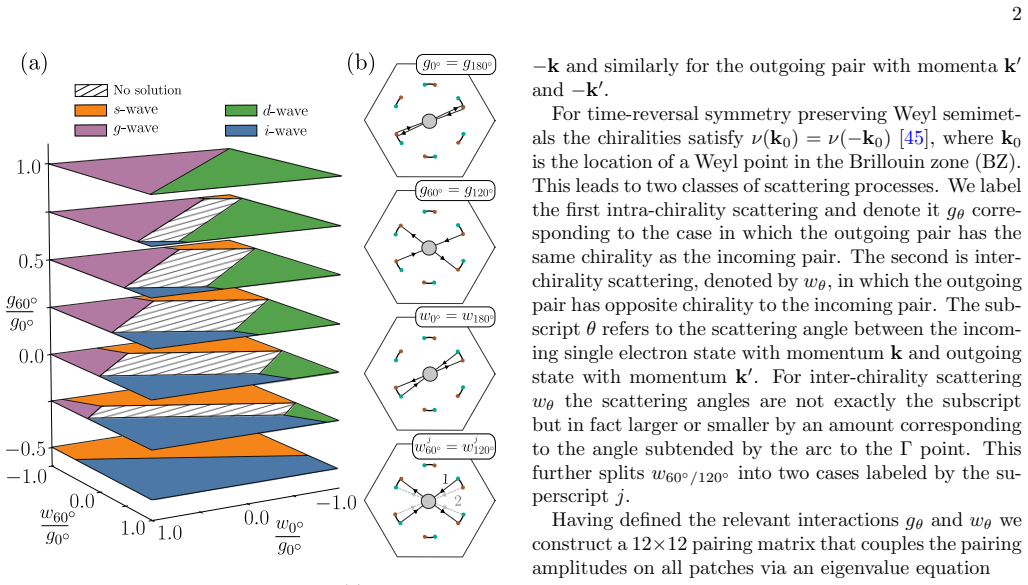
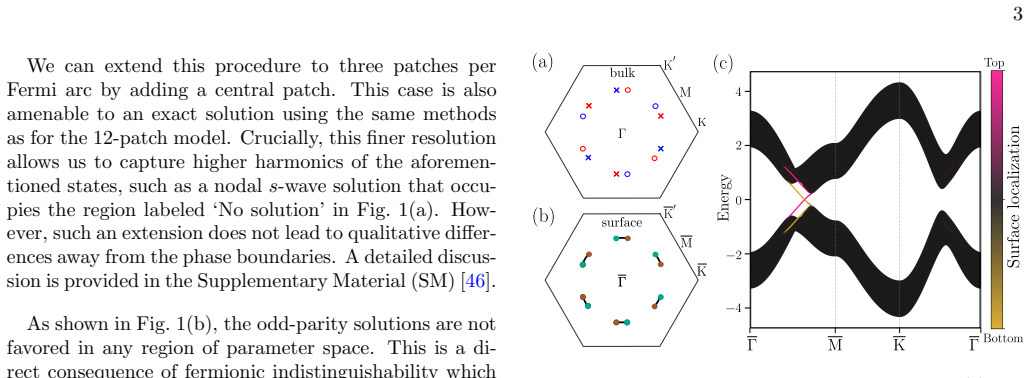
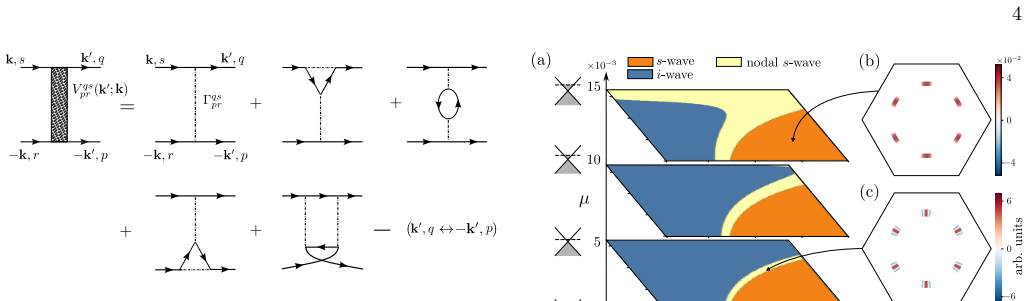
Recent experimental observations in the noncentrosymmetric Weyl semimetal PtBi$_2$ indicate unconventional superconductivity hosted by topological surface states -- Weyl Fermi arcs -- with a node at the center of each arc. Focusing on these Fermi arcs, we calculate the electronically mediated pairing interaction using a Kohn-Luttinger approach and find that, in a large region of the phase diagram, the leading superconducting instability has an $i$-wave symmetry featuring precisely such an intra-arc node. We study the dependence of the leading superconducting instabilities on electronic interaction parameters and chemical potential and show that the $i$-wave state is robust to changes in the model parameters. Our results provide a possible mechanism for the observation of topological $i$-wave superconductivity on the surface of PtBi$_2$ and may have implications for the broader landscape of superconducting instabilities arising from repulsive interactions on the surfaces of Weyl semimetals.
Editorial analysis
A structured set of objections, weighed in public.
Referee Report
Summary. The manuscript applies the Kohn-Luttinger formalism to an effective model of the Weyl Fermi arcs in the noncentrosymmetric Weyl semimetal PtBi₂. It reports that, over a substantial region of interaction-parameter and chemical-potential space, the leading superconducting instability is an i-wave state whose gap function exhibits a node at the center of each arc, thereby providing a possible electronic mechanism for the nodal surface superconductivity observed in experiment.
Significance. If the surface-only approximation is justified, the work supplies a concrete, parameter-robust microscopic route to higher-angular-momentum pairing on topological Fermi arcs and thereby enlarges the set of known instabilities that can arise from repulsive interactions on the surfaces of Weyl semimetals. The explicit mapping of the phase diagram with respect to interaction strength and doping constitutes a falsifiable prediction that can be tested by future surface-sensitive probes.
major comments (1)
- [§3, Appendix A] §3 and Appendix A: The effective 2D Hamiltonian for the arcs is derived and the Kohn-Luttinger bubble diagram is evaluated with a momentum-independent or short-range repulsion, yielding an i-wave eigenvector. No quantitative estimate, cutoff, or scaling argument is supplied for the relative magnitude of pairing mediated by bulk Weyl cones or by acoustic/optical phonons. Because the reported i-wave state is claimed to be the leading instability, an explicit comparison showing that these additional channels remain sub-dominant is required; without it the central claim rests on an unverified assumption.
minor comments (1)
- The notation for the arc-centered node in the gap function could be made more explicit in the figure captions to facilitate direct comparison with the experimental reports cited in the introduction.
Simulated Author's Rebuttal
We thank the referee for the careful reading of the manuscript and the positive evaluation of its significance. We address the single major comment below.
read point-by-point responses
-
Referee: [§3, Appendix A] §3 and Appendix A: The effective 2D Hamiltonian for the arcs is derived and the Kohn-Luttinger bubble diagram is evaluated with a momentum-independent or short-range repulsion, yielding an i-wave eigenvector. No quantitative estimate, cutoff, or scaling argument is supplied for the relative magnitude of pairing mediated by bulk Weyl cones or by acoustic/optical phonons. Because the reported i-wave state is claimed to be the leading instability, an explicit comparison showing that these additional channels remain sub-dominant is required; without it the central claim rests on an unverified assumption.
Authors: We agree that the surface-only approximation underlying the central claim merits explicit justification. The manuscript calculates the leading instability strictly within the effective 2D model of the Weyl Fermi arcs; the i-wave state is shown to be leading over a substantial region of interaction and doping parameters inside that model. The experimental reports of surface superconductivity with the matching nodal structure provide phenomenological support for focusing on arc-mediated pairing. In the revised manuscript we will insert a new paragraph (in §3) that supplies scaling arguments: (i) the bulk Weyl cones project to a gapped continuum on the surface and their contribution to arc pairing is suppressed by the finite penetration depth of the arc wavefunctions; (ii) long-wavelength acoustic phonons generate an essentially momentum-independent attraction that would favor s-wave pairing, inconsistent with the observed intra-arc nodes. While a fully quantitative comparison would require a microscopic 3D calculation including specific electron-phonon matrix elements (outside the present scope), the added discussion will make the assumptions and their justification transparent. We view this as a partial revision that strengthens the presentation without changing the reported results. revision: partial
Circularity Check
No significant circularity; derivation is model-driven calculation
full rationale
The paper constructs an effective surface Hamiltonian for the Weyl arcs, computes the pairing interaction via the standard Kohn-Luttinger bubble diagram (second-order perturbation in the interaction), and solves the resulting eigenvalue problem for the leading instability. The i-wave eigenvector with intra-arc node emerges from this procedure applied to the model parameters and chemical potential; it is not equivalent to the inputs by definition, nor obtained by fitting a subset of data and relabeling the output as a prediction. No load-bearing self-citations, uniqueness theorems from the same authors, or ansatzes smuggled via prior work are described. The central claim remains a direct (if approximate) consequence of the stated microscopic model and remains falsifiable by comparison to other channels or experiments.
Axiom & Free-Parameter Ledger
free parameters (2)
- electronic interaction parameters
- chemical potential
axioms (1)
- domain assumption Kohn-Luttinger approach accurately computes the effective pairing interaction from repulsive forces on Weyl Fermi arcs
Reference graph
Works this paper leans on
-
[1]
K. v. Klitzing, G. Dorda, and M. Pepper, New Method for High-Accuracy Determination of the Fine-Structure Con- stant Based on Quantized Hall Resistance, Phys. Rev. Lett.45, 494 (1980)
1980
-
[2]
D. C. Tsui, H. L. Stormer, and A. C. Gossard, Two- Dimensional Magnetotransport in the Extreme Quantum Limit, Phys. Rev. Lett.48, 1559 (1982)
1982
-
[3]
K. S. Novoselov, A. K. Geim, S. V. Morozov, D. Jiang, M. I. Katsnelson, I. V. Grigorieva, S. V. Dubonos, and A. A. Firsov, Two-dimensional gas of massless Dirac fermions in graphene, Nature438, 197–200 (2005)
2005
-
[4]
Parity Anomaly
F. D. M. Haldane, Model for a Quantum Hall Effect with- out Landau Levels: Condensed-Matter Realization of the “Parity Anomaly”, Phys. Rev. Lett.61, 2015 (1988)
2015
-
[5]
G. W. Semenoff, Condensed-Matter Simulation of a Three-Dimensional Anomaly, Phys. Rev. Lett.53, 2449 (1984)
1984
-
[6]
R. B. Laughlin, Anomalous Quantum Hall Effect: An In- compressible Quantum Fluid with Fractionally Charged Excitations, Phys. Rev. Lett.50, 1395 (1983)
1983
-
[7]
Arovas, J
D. Arovas, J. R. Schrieffer, and F. Wilczek, Fractional Statistics and the Quantum Hall Effect, Phys. Rev. Lett. 53, 722 (1984)
1984
-
[8]
Castelnovo, R
C. Castelnovo, R. Moessner, and S. L. Sondhi, Magnetic monopoles in spin ice, Nature451, 42–45 (2008)
2008
-
[9]
X. Wan, A. M. Turner, A. Vishwanath, and S. Y. Savrasov, Topological semimetal and fermi-arc surface states in the electronic structure of pyrochlore iridates, Phys. Rev. B83, 205101 (2011)
2011
-
[10]
B. Q. Lv, H. M. Weng, B. B. Fu, X. P. Wang, H. Miao, J. Ma, P. Richard, X. C. Huang, L. X. Zhao, G. F. Chen, 6 Z. Fang, X. Dai, T. Qian, and H. Ding, Experimental Dis- covery of Weyl Semimetal TaAs, Phys. Rev. X5, 031013 (2015)
2015
-
[11]
S.-Y. Xu, I. Belopolski, N. Alidoust, M. Neupane, G. Bian, C. Zhang, R. Sankar, G. Chang, Z. Yuan, C.- C. Lee, S.-M. Huang, H. Zheng, J. Ma, D. S. Sanchez, B. Wang, A. Bansil, F. Chou, P. P. Shibayev, H. Lin, S. Jia, and M. Z. Hasan, Discovery of a Weyl fermion semimetal and topological Fermi arcs, Science349, 613 (2015)
2015
-
[12]
Morimoto and A
T. Morimoto and A. Furusaki, Weyl and Dirac semimet- als withZ 2 topological charge, Phys. Rev. B89, 235127 (2014)
2014
-
[13]
A. A. Burkov and L. Balents, Weyl Semimetal in a Topo- logical Insulator Multilayer, Phys. Rev. Lett.107, 127205 (2011)
2011
-
[14]
N. P. Armitage, E. J. Mele, and A. Vishwanath, Weyl and Dirac semimetals in three-dimensional solids, Rev. Mod. Phys.90, 015001 (2018)
2018
-
[15]
Nielsen and M
H. Nielsen and M. Ninomiya, Absence of neutrinos on a lattice: (II). Intuitive topological proof, Nuclear Physics B193, 173 (1981)
1981
-
[16]
D. T. Son and B. Z. Spivak, Chiral anomaly and classical negative magnetoresistance of Weyl metals, Phys. Rev. B 88, 104412 (2013)
2013
-
[17]
Zhang, S.-Y
C.-L. Zhang, S.-Y. Xu, I. Belopolski, Z. Yuan, Z. Lin, B. Tong, G. Bian, N. Alidoust, C.-C. Lee, S.-M. Huang, T.-R. Chang, G. Chang, C.-H. Hsu, H.-T. Jeng, M. Neupane, D. S. Sanchez, H. Zheng, J. Wang, H. Lin, C. Zhang, H.-Z. Lu, S.-Q. Shen, T. Neu- pert, M. Zahid Hasan, and S. Jia, Signatures of the Adler–Bell–Jackiw chiral anomaly in a Weyl fermion semi...
2016
-
[18]
A. C. Potter, I. Kimchi, and A. Vishwanath, Quan- tum oscillations from surface Fermi arcs in Weyl and Dirac semimetals, Nature Communications5, 10.1038/ncomms6161 (2014)
-
[19]
P. J. W. Moll, N. L. Nair, T. Helm, A. C. Potter, I. Kim- chi, A. Vishwanath, and J. G. Analytis, Transport ev- idence for Fermi-arc-mediated chirality transfer in the Dirac semimetal Cd 3As2, Nature535, 266–270 (2016)
2016
-
[20]
Meng and L
T. Meng and L. Balents, Weyl superconductors, Phys. Rev. B86, 054504 (2012)
2012
-
[21]
J. C. Y. Teo and C. L. Kane, Topological defects and gapless modes in insulators and superconductors, Phys. Rev. B82, 115120 (2010)
2010
-
[22]
Nomani and P
A. Nomani and P. Hosur, Intrinsic surface superconduct- ing instability in type-I Weyl semimetals, Phys. Rev. B 108, 165144 (2023)
2023
-
[23]
S. Schimmel, Y. Fasano, S. Hoffmann, J. Besproswanny, L. T. Corredor Bohorquez, J. Puig, B.-C. Elshalem, B. Kalisky, G. Shipunov, D. Baumann, S. Aswartham, B. B¨ uchner, and C. Hess, Surface superconductivity in the topological Weyl semimetal t-PtBi 2, Nature Com- munications15, 10.1038/s41467-024-54389-6 (2024)
-
[24]
Kuibarov, O
A. Kuibarov, O. Suvorov, R. Vocaturo, A. Fedorov, R. Lou, L. Merkwitz, V. Voroshnin, J. I. Facio, K. Koepernik, A. Yaresko, G. Shipunov, S. Aswartham, J. v. d. Brink, B. B¨ uchner, and S. Borisenko, Evidence of superconducting Fermi arcs, Nature626, 294 (2024)
2024
-
[25]
Changdar, O
S. Changdar, O. Suvorov, A. Kuibarov, S. Thirupatha- iah, G. Shipunov, S. Aswartham, S. Wurmehl, I. Ko- valchuk, K. Koepernik, C. Timm, B. B¨ uchner, I. C. Fulga, S. Borisenko, and J. van den Brink, Topologi- cal nodal i-wave superconductivity in PtBi2, Nature647, 613–618 (2025)
2025
-
[26]
Shipunov, I
G. Shipunov, I. Kovalchuk, B. R. Piening, V. Labracherie, A. Veyrat, D. Wolf, A. Lubk, S. Subakti, R. Giraud, J. Dufouleur, S. Shokri, F. Caglieris, C. Hess, D. V. Efremov, B. B¨ uchner, and S. Aswartham, Poly- morphic PtBi2: Growth, structure, and superconducting properties, Phys. Rev. Mater.4, 124202 (2020)
2020
-
[27]
Zhang, H
H. Zhang, H. Chen, Z. Huang, Z.-A. Wang, G. Han, R. Ma, X. Zhu, W. Ning, C. Shen, Q. Huan, and H.-J. Gao, Atomic Visualization of Bulk and Surface Supercon- ductivity in Weyl Semimetalγ-PtBi 2, Chin. Phys. Lett. 42, 120708 (2025)
2025
-
[28]
A. Veyrat, V. Labracherie, D. L. Bashlakov, F. Caglieris, J. I. Facio, G. Shipunov, T. Charvin, R. Acharya, Y. Naidyuk, R. Giraud, J. van den Brink, B. B¨ uchner, C. Hess, S. Aswartham, and J. Dufouleur, Berezin- skii–Kosterlitz–Thouless Transition in the Type-I Weyl Semimetal PtBi 2, Nano Letters23, 1229 (2023), pMID: 36720048, https://doi.org/10.1021/ac...
-
[29]
Hoffmann, S
S. Hoffmann, S. Schimmel, R. Vocaturo, J. Puig, G. Shipunov, O. Janson, S. Aswartham, D. Baumann, B. B¨ uchner, J. van den Brink, Y. Fasano, J. I. Facio, and C. Hess, Fermi Arcs Dominating the Electronic Surface Properties of Trigonal PtBi2, Adv. Phys. Res.4, 2400150 (2025)
2025
-
[30]
O’Leary, Z
E. O’Leary, Z. Li, L.-L. Wang, B. Schrunk, A. Eaton, P. C. Canfield, and A. Kaminski, Topography of Fermi arcs int-PtBi 2 using high-resolution angle-resolved pho- toemission spectroscopy, Phys. Rev. B112, 085154 (2025)
2025
-
[31]
Mæland, M
K. Mæland, M. Bahari, and B. Trauzettel, Phonon- mediated intrinsic topological superconductivity in Fermi arcs, Phys. Rev. B112, 104507 (2025)
2025
-
[32]
Mechanism for Nodal Topological Superconductivity on PtBi$_2$ Surface
K. Mæland, G. Sangiovanni, and B. Trauzettel, Mecha- nism for Nodal Topological Superconductivity on PtBi 2 Surface, arXiv:2512.09994 (2025)
work page internal anchor Pith review Pith/arXiv arXiv 2025
-
[33]
J. A. Moreno, P. Garc´ ıa Talavera, E. Herrera, S. L´ opez Valle, Z. Li, L.-L. Wang, S. Bud’ko, A. I. Buzdin, I. Guil- lam´ on, P. C. Canfield, and H. Suderow, Robust two- dimensional surface superconductivity and vortex lat- tice in the Weyl semimetalγ-PtBi 2, arXiv:2508.04867 (2025)
- [34]
- [35]
-
[36]
X. Bai, W. LiMing, and T. Zhou, Superconductivity in Weyl semimetals with time reversal symmetry, New J. Phys.27, 013003 (2025)
2025
-
[37]
Trama, V
M. Trama, V. K¨ onye, I. C. Fulga, and J. van den Brink, Self-consistent surface superconductivity in time-reversal symmetric Weyl semimetals, Phys. Rev. B112, 064514 (2025)
2025
-
[38]
Naidyuk, O
Y. Naidyuk, O. Kvitnitskaya, D. Bashlakov, S. Aswartham, I. Morozov, I. Chernyavskii, G. Fuchs, S.-L. Drechsler, R. H¨ uhne, K. Nielsch, B. B¨ uchner, and D. Efremov, Surface superconductivity in the 7 Weyl semimetal MoTe 2 detected by point contact spectroscopy, 2D Mater.5, 045014 (2018)
2018
-
[39]
Y. Xing, Z. Shao, J. Ge, J. Luo, J. Wang, Z. Zhu, J. Liu, Y. Wang, Z. Zhao, J. Yan, D. Mandrus, B. Yan, X.-J. Liu, M. Pan, and J. Wang, Surface superconductivity in the type II Weyl semimetal TaIrTe 4, Natl. Sci. Rev.7, 579 (2020)
2020
-
[40]
Kohn and J
W. Kohn and J. M. Luttinger, New Mechanism for Su- perconductivity, Phys. Rev. Lett.15, 524 (1965)
1965
-
[41]
Maiti and A
S. Maiti and A. V. Chubukov, Superconductivity from re- pulsive interaction, inAIP Conference Proceedings(AIP, 2013)
2013
-
[42]
Raghu and S
S. Raghu and S. A. Kivelson, Superconductivity from re- pulsive interactions in the two-dimensional electron gas, Phys. Rev. B83, 094518 (2011)
2011
-
[43]
Vocaturo, K
R. Vocaturo, K. Koepernik, J. I. Facio, C. Timm, I. C. Fulga, O. Janson, and J. van den Brink, Electronic structure of the surface-superconducting Weyl semimetal PtBi2, Phys. Rev. B110, 054504 (2024)
2024
-
[44]
L. N. Cooper, Bound Electron Pairs in a Degenerate Fermi Gas, Phys. Rev.104, 1189 (1956)
1956
-
[45]
Vanderbilt,Berry Phases in Electronic Structure Theory: Electric Polarization, Orbital Magnetization and Topological Insulators(Cambridge University Press, 2018)
D. Vanderbilt,Berry Phases in Electronic Structure Theory: Electric Polarization, Orbital Magnetization and Topological Insulators(Cambridge University Press, 2018)
2018
-
[46]
See Supplementary Material, available at
-
[47]
Sigrist and K
M. Sigrist and K. Ueda, Phenomenological theory of un- conventional superconductivity, Rev. Mod. Phys.63, 239 (1991)
1991
-
[48]
Nandkishore, L
R. Nandkishore, L. S. Levitov, and A. V. Chubukov, Chiral superconductivity from repulsive interactions in doped graphene, Nature Physics8, 158 (2012)
2012
-
[49]
K. V. Samokhin, Symmetry and topology of two- dimensional noncentrosymmetric superconductors, Phys. Rev. B92, 174517 (2015)
2015
-
[50]
K. V. Samokhin, Noncentrosymmetric superconductors in one dimension, Phys. Rev. B95, 064504 (2017)
2017
-
[51]
K. V. Samokhin and V. P. Mineev, Gap structure in noncentrosymmetric superconductors, Phys. Rev. B77, 104520 (2008)
2008
-
[52]
P. W. Anderson, Structure of “triplet” superconducting energy gaps, Phys. Rev. B30, 4000 (1984)
1984
-
[53]
M. Sigrist, Introduction to unconventional superconduc- tivity in non-centrosymmetric metals, AIP Conference Proceedings1162, 10.1063/1.3225489 (2009)
-
[54]
A. Georges, L. de’ Medici, and J. Mravlje, Strong Correlations from Hund’s Coupling, Annual Re- view of Condensed Matter Physics4, 137 (2013), https://doi.org/10.1146/annurev-conmatphys-020911- 125045
-
[55]
H. Waje, F. Jakubczyk, J. van den Brink, and C. Timm, Ginzburg-Landau theory for unconventional surface su- perconductivity in PtBi 2, Phys. Rev. B112, 144519 (2025). END MATTER Tight binding model for PtBi 2.The minimal tight- binding model describing the bulk electronic structure consisting of 12 Weyl nodes, as constructed in Ref. [43] m α β γ λ 0.4 -0....
2025
discussion (0)
Sign in with ORCID, Apple, or X to comment. Anyone can read and Pith papers without signing in.