Multiplet-Selective Photoelectron Diffraction from an Altermagnet
Pith reviewed 2026-06-28 21:49 UTC · model grok-4.3
The pith
Multiplet-selective photoelectron diffraction from Cr 3p multiplets detects altermagnetic domains in CrSb.
A machine-rendered reading of the paper's core claim, the machinery that carries it, and where it could break.
Core claim
Using multiple-scattering calculations for the metallic altermagnet candidate CrSb, selected Cr 3p multiplet features with predominantly Y_1^{+1} and Y_1^{-1} character generate robust diffraction asymmetries sensitive to altermagnetic domains. Both circularly and linearly polarized light provide access to the effect, while suitable combinations of domains, light polarizations, and multiplet-energy windows suppress nonmagnetic diffraction backgrounds. The proposed approach can be implemented using standard momentum-resolved photoemission instrumentation and establishes core-level PED as a practical route toward domain-resolved studies of altermagnets.
What carries the argument
Multiplet-selective photoelectron diffraction, in which different regions of a transition-metal core-level multiplet act as distinct photoemission source waves with specific angular character to generate domain-sensitive diffraction patterns.
If this is right
- Selected Cr 3p multiplet features produce robust diffraction asymmetries sensitive to altermagnetic domains.
- Both circular and linear polarized light provide access to the asymmetries.
- Suitable combinations of domains, polarizations, and multiplet energy windows suppress nonmagnetic backgrounds.
- The method can be implemented with standard momentum-resolved photoemission instrumentation.
Where Pith is reading between the lines
- The multiplet selection principle could apply to other transition-metal altermagnets.
- Domain imaging with this approach would complement existing momentum-space measurements of altermagnetic order.
Load-bearing premise
The multiple-scattering calculations accurately capture the photoemission source waves and scattering in real CrSb samples, including the precise multiplet character and the suppression of nonmagnetic backgrounds under chosen polarization and energy windows.
What would settle it
Momentum-resolved photoemission measurements on CrSb that fail to detect the predicted domain-dependent diffraction asymmetries within the selected Cr 3p multiplet energy windows under the appropriate light polarizations would falsify the method.
Figures
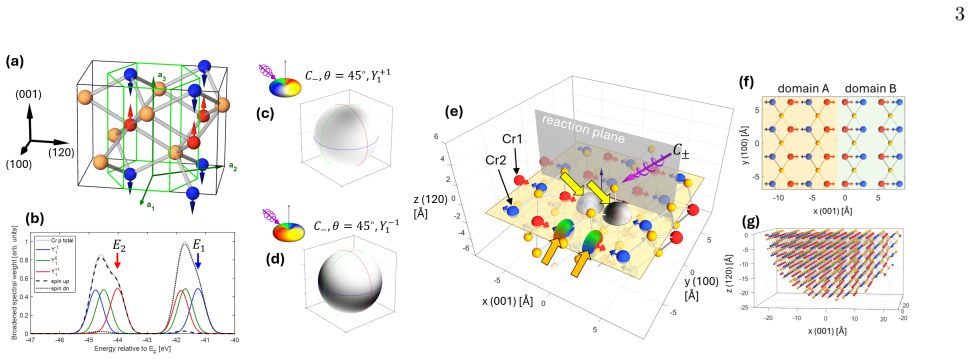
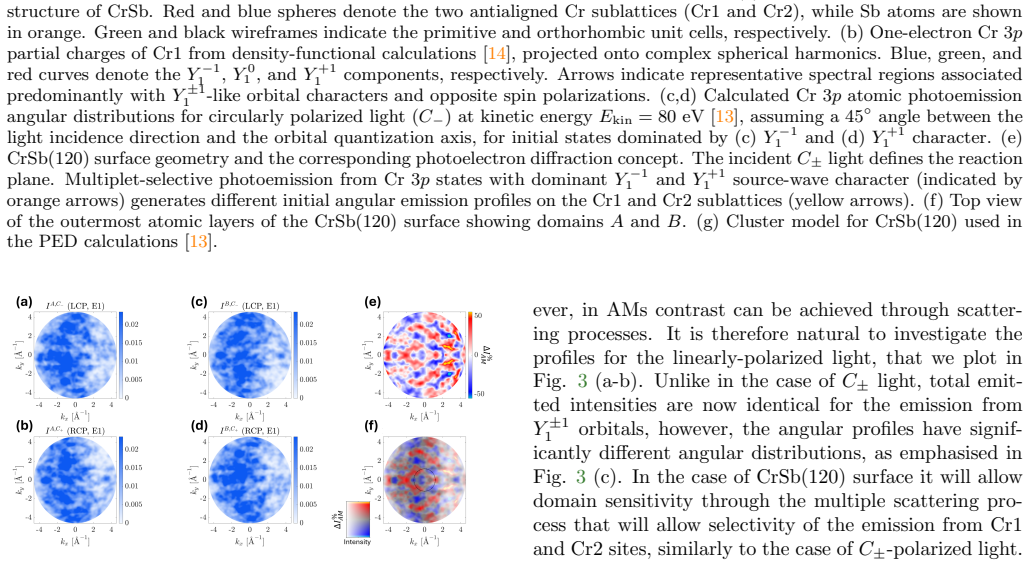
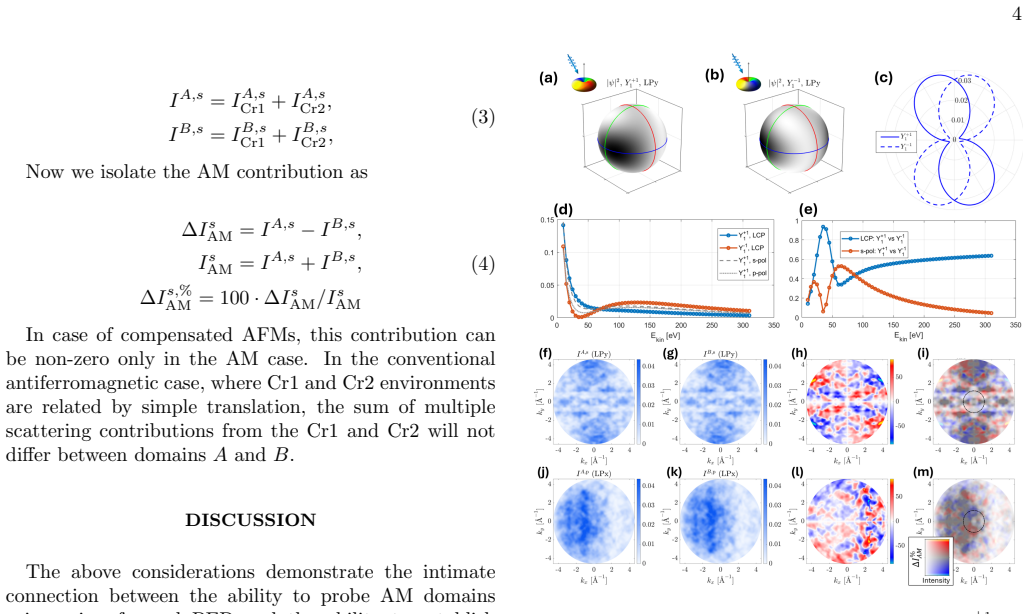
read the original abstract
Direct real-space probes of altermagnetic order remain scarce. Here we introduce multiplet-selective photoelectron diffraction (PED), a methodology in which different regions of a transition-metal core-level multiplet act as distinct photoemission source waves. Using multiple-scattering calculations for the metallic altermagnet candidate CrSb, we show that selected Cr $3p$ multiplet features with predominantly $Y_1^{+1}$ and $Y_1^{-1}$ character generate robust diffraction asymmetries sensitive to altermagnetic domains. We demonstrate that both circularly and linearly polarized light provide access to the effect, while suitable combinations of domains, light polarizations, and multiplet-energy windows suppress nonmagnetic diffraction backgrounds. The proposed approach can be implemented using standard momentum-resolved photoemission instrumentation and establishes core-level PED as a practical route toward domain-resolved studies of altermagnets.
Editorial analysis
A structured set of objections, weighed in public.
Referee Report
Summary. The paper proposes multiplet-selective photoelectron diffraction (PED) as a real-space probe of altermagnetic domains. Using multiple-scattering calculations on CrSb, it claims that selected Cr 3p multiplet components with predominantly Y_1^{+1} and Y_1^{-1} character produce robust diffraction asymmetries sensitive to altermagnetic domains; both circular and linear polarization can access the effect, and suitable domain/polarization/energy-window combinations suppress nonmagnetic backgrounds. The method is presented as implementable with standard momentum-resolved photoemission instrumentation.
Significance. If the multiple-scattering results hold, the work offers a practical, domain-resolved probe for altermagnets that leverages existing core-level photoemission setups, addressing the scarcity of direct real-space techniques. The approach is grounded in standard computational methods applied to a known crystal structure and does not introduce new free parameters or ad-hoc entities.
major comments (2)
- [computational methods] The central claim that selected Cr 3p multiplet features carry predominantly Y_1^{+1}/Y_1^{-1} character and generate domain-sensitive asymmetries rests entirely on the fidelity of the multiple-scattering calculations, yet the manuscript provides no details on the atomic multiplet modeling, solid-state hybridization, scattering potentials, or convergence criteria (see the computational methods section).
- [results] No quantitative comparison to measured photoemission data, no error analysis on the predicted asymmetries, and no sensitivity tests to variations in the source-wave or potential parameters are reported, which directly affects the asserted robustness and background suppression (see results section on diffraction asymmetries).
minor comments (2)
- [introduction] The spherical-harmonic notation Y_1^{+1} and Y_1^{-1} is used without an explicit definition or reference in the introduction; a brief clarification would improve accessibility.
- [figures] Figure captions for the calculated diffraction patterns should explicitly state the photon energy, polarization, and energy window used for each panel to allow direct reproduction.
Simulated Author's Rebuttal
We thank the referee for the positive assessment of the significance of our work and for the constructive comments. We address the major comments below.
read point-by-point responses
-
Referee: [computational methods] The central claim that selected Cr 3p multiplet features carry predominantly Y_1^{+1}/Y_1^{-1} character and generate domain-sensitive asymmetries rests entirely on the fidelity of the multiple-scattering calculations, yet the manuscript provides no details on the atomic multiplet modeling, solid-state hybridization, scattering potentials, or convergence criteria (see the computational methods section).
Authors: We agree with the referee that additional details on the computational methods are necessary to support the claims. In the revised manuscript, we will include a dedicated subsection detailing the atomic multiplet modeling, the treatment of solid-state hybridization, the scattering potentials employed, and the convergence criteria used in the multiple-scattering calculations. revision: yes
-
Referee: [results] No quantitative comparison to measured photoemission data, no error analysis on the predicted asymmetries, and no sensitivity tests to variations in the source-wave or potential parameters are reported, which directly affects the asserted robustness and background suppression (see results section on diffraction asymmetries).
Authors: The manuscript presents a theoretical proposal based on multiple-scattering calculations rather than experimental measurements. Therefore, a quantitative comparison to measured data is not applicable at this stage. However, to address concerns about robustness, we will incorporate an error analysis on the predicted asymmetries and perform sensitivity tests to variations in the source-wave and potential parameters in the revised version. revision: partial
Circularity Check
No circularity: results are outputs of standard multiple-scattering calculations on known CrSb structure
full rationale
The paper's central claim rests on multiple-scattering calculations that take the known crystal structure, atomic multiplet character, and polarization as inputs and produce diffraction asymmetries as outputs. No step reduces a prediction to a fitted parameter by construction, no self-citation chain bears the load of the uniqueness or selectivity claim, and no ansatz is smuggled in. The derivation is self-contained against external benchmarks (standard PED theory and CrSb structure).
Axiom & Free-Parameter Ledger
Reference graph
Works this paper leans on
-
[1]
Emerging research landscape of altermagnetism
L. ˇSmejkal, J. Sinova, and T. Jungwirth, Physical Review X12, 10.1103/physrevx.12.040501 (2022)
-
[2]
Krempask´ y, L
J. Krempask´ y, L. ˇSmejkal, S. W. D’Souza, M. Ha- jlaoui, G. Springholz, K. Uhl´ ıˇ rov´ a, F. Alarab, P. C. Constantinou, V. Strocov, D. Usanov, W. R. Pudelko, R. Gonz´ alez-Hern´ andez, A. Birk Hellenes, Z. Jansa, H. Reichlov´ a, Z. ˇSob´ aˇ n, R. D. Gonzalez Betancourt, P. Wadley, J. Sinova, D. Kriegner, J. Min´ ar, J. H. Dil, and T. Jungwirth, Nature...
2024
-
[3]
M. Hajlaoui, S. Wilfred D’Souza, L. ˇSmejkal, D. Krieg- ner, G. Krizman, T. Zakusylo, N. Olszowska, O. Caha, J. Michaliˇ cka, J. S´ anchez-Barriga, A. Marmodoro, K. V´ yborn´ y, A. Ernst, M. Cinchetti, J. Minar, T. Jung- wirth, and G. Springholz, Advanced Materials36, 10.1002/adma.202314076 (2024)
-
[4]
J. Ding, Z. Jiang, X. Chen, Z. Tao, Z. Liu, T. Li, J. Liu, J. Sun, J. Cheng, J. Liu, Y. Yang, R. Zhang, L. Deng, W. Jing, Y. Huang, Y. Shi, M. Ye, S. Qiao, Y. Wang, Y. Guo, D. Feng, and D. Shen, Phys. Rev. Lett.133, 206401 (2024)
2024
-
[5]
C. Li, M. Hu, Z. Li, Y. Wang, W. Chen, B. Thiagarajan, M. Leandersson, C. Polley, T. Kim, H. Liu, C. Fulga, M. G. Vergniory, O. Janson, O. Tjernberg, and J. van den Brink, Communications Physics8, 10.1038/s42005-025- 02232-9 (2025)
-
[6]
Daimon, T
H. Daimon, T. Nakatani, S. Imada, S. Suga, Y. Kagoshima, and T. Miyahara, Japanese Journal of Applied Physics32, L1480 (1993)
1993
-
[7]
Sinkovi´ c, B
B. Sinkovi´ c, B. Hermsmeier, and C. S. Fadley, Phys. Rev. Lett.55, 1227 (1985)
1985
-
[8]
Fadley, Y
C. Fadley, Y. Chen, R. Couch, H. Daimon, R. Denecke, J. Denlinger, H. Galloway, Z. Hussain, A. Kaduwela, Y. Kim, P. Len, J. Liesegang, J. Menchero, J. Morais, J. Palomares, S. Ruebush, E. Rotenberg, M. Salmeron, R. Scalettar, W. Schattke, R. Singh, S. Thevuthasan, E. Tober, M. Van Hove, Z. Wang, and R. Ynzunza, Progress in Surface Science54, 341–386 (1997)
1997
-
[9]
Kr¨ uger, Phys
P. Kr¨ uger, Phys. Rev. Lett.135, 196703 (2025)
2025
-
[10]
L. Plucinski, G. Bihlmayer, Y. Mokrousov, Y. Zhou, Y. Su, J. D. Denlinger, A. Bostwick, C. Jozwiak, 6 E. Rotenberg, D. Usachov, and C. M. Schneider, Na- ture Communications17, 10.1038/s41467-026-71924-9 (2026)
-
[11]
Kachel, C
T. Kachel, C. Carbone, and W. Gudat, Phys. Rev. B47, 15391 (1993)
1993
-
[12]
J. Henk, A. M. N. Niklasson, and B. Johansson, Phys. Rev. B59, 13986 (1999)
1999
-
[13]
F. J. Garc´ ıa de Abajo, M. A. Van Hove, and C. S. Fadley, Phys. Rev. B63, 075404 (2001)
2001
-
[14]
P. Blaha, K. Schwarz, F. Tran, R. Laskowski, G. K. H. Madsen, and L. D. Marks, The Journal of Chemical Physics152, 074101 (2020), https://pubs.aip.org/aip/jcp/article- pdf/doi/10.1063/1.5143061/16727313/074101 1 online.pdf
-
[15]
F. d. Groot, Coordination Chemistry Reviews249, 31–63 (2005)
2005
-
[16]
Bethke, E
C. Bethke, E. Kisker, N. B. Weber, and F. U. Hillebrecht, Phys. Rev. B71, 024413 (2005)
2005
-
[17]
See Supplemental Material at [url] for the details of ex- perimental and theoretical methods
-
[18]
R. M. Sattigeri, G. Cuono, and C. Autieri, Nanoscale15, 16998–17005 (2023)
2023
-
[19]
Goldberg, C
S. Goldberg, C. Fadley, and S. Kono, Journal of Electron Spectroscopy and Related Phenomena21, 285 (1981)
1981
-
[20]
F. U. Hillebrecht, C. Roth, H. B. Rose, M. Finazzi, and L. Braicovich, Phys. Rev. B51, 9333 (1995)
1995
-
[21]
H. B. Rose, T. Kinoshita, C. Roth, and F. U. Hillebrecht, Photoelectron diffraction in spin-resolved photoemission and magnetic linear dichroism, inSpin—Orbit-Influenced Spectroscopies of Magnetic Solids(Springer Berlin Hei- delberg, 1996) p. 105–124
1996
-
[22]
Sacchi, G
M. Sacchi, G. Panaccione, J. Vogel, A. Mirone, and G. v. d. Laan, Phys. Rev. B58, 3750 (1998)
1998
-
[23]
A. D. Din, D. A. Usanov, L. ˇSmejkal, S. W. D’Souza, F. Guo, O. J. Amin, E. M. Dawa, R. P. Campion, K. W. Edmonds, B. Kiraly, A. W. Rushforth, C. Polley, M. Le- andersson, E. Golias, Y. Niu, S. Telkamp, F. Krizek, A. B. Hellenes, J. Priessnitz, W. H. Campos, J. Krem- pask´ y, J. Min´ ar, T. Jungwirth, J. H. Dil, and P. Wadley, Unconventional relativistic ...
arXiv 2025
-
[24]
M. G. Fischer, L. Odenbreit, O. Gomonay, J. Sinova, T. Denneulin, J. V. Vaz, R. E. Dunin-Borkowski, T. Kotte, T. Helm, M. Kl¨ aui, and M. Jourdan, Engineer- ing altermagnetic symmetry to enable anomalous hall response in cr 1−xmnxsb (2026), arXiv:2602.06173 [cond- mat.mtrl-sci]
arXiv 2026
-
[25]
Clementi and C
E. Clementi and C. Roetti, Atomic Data and Nuclear Data Tables14, 177–478 (1974)
1974
-
[26]
Yeh and I
J. Yeh and I. Lindau, Atomic Data and Nuclear Data Tables32, 1 (1985)
1985
-
[27]
De Giovannini, H
U. De Giovannini, H. H¨ ubener, and A. Rubio, Journal of Chemical Theory and Computation13, 265–273 (2016)
2016
-
[28]
Breit and H
G. Breit and H. A. Bethe, Phys. Rev.93, 888 (1954)
1954
-
[29]
P. Kr¨ uger, Journal of the Physical Society of Japan87, 061007 (2018), https://doi.org/10.7566/JPSJ.87.061007
-
[30]
J. Henk, W. Schattke, H. Cartensen, R. Manzke, and M. Skibowski, Phys. Rev. B47, 2251 (1993)
1993
-
[31]
Braun, Reports on Progress in Physics59, 1267–1338 (1996)
J. Braun, Reports on Progress in Physics59, 1267–1338 (1996). 7 SUPPLEMENT AR Y INFORMA TION: MUL TIPLET-SELECTIVE PHOTOELECTRON DIFFRACTION FROM AN AL TERMAGNET Low index CrSb surfaces It is important to take into account that the magnetic order on the surface of an altermagnetic material needs to be analyzed for each surface separately, together with co...
1996
-
[32]
features of the 3pregion carry different spin character and exhibit different photoelectron angular distributions [11]
maps calculated atE kin = 1 keV, part of which is also shown as a section of the emission hemisphere. features of the 3pregion carry different spin character and exhibit different photoelectron angular distributions [11]. These effects can be understood qualitatively using simplified methods [11, 16] or numerically [15]. In the present work, we adopt a si...
discussion (0)
Sign in with ORCID, Apple, or X to comment. Anyone can read and Pith papers without signing in.