More efficient Clifford+T synthesis for small-angle rotations and application to Trotterization
Pith reviewed 2026-06-28 21:39 UTC · model grok-4.3
The pith
Clifford+T synthesis for small-angle rotations reduces T cost to order theta squared over delta.
A machine-rendered reading of the paper's core claim, the machinery that carries it, and where it could break.
Core claim
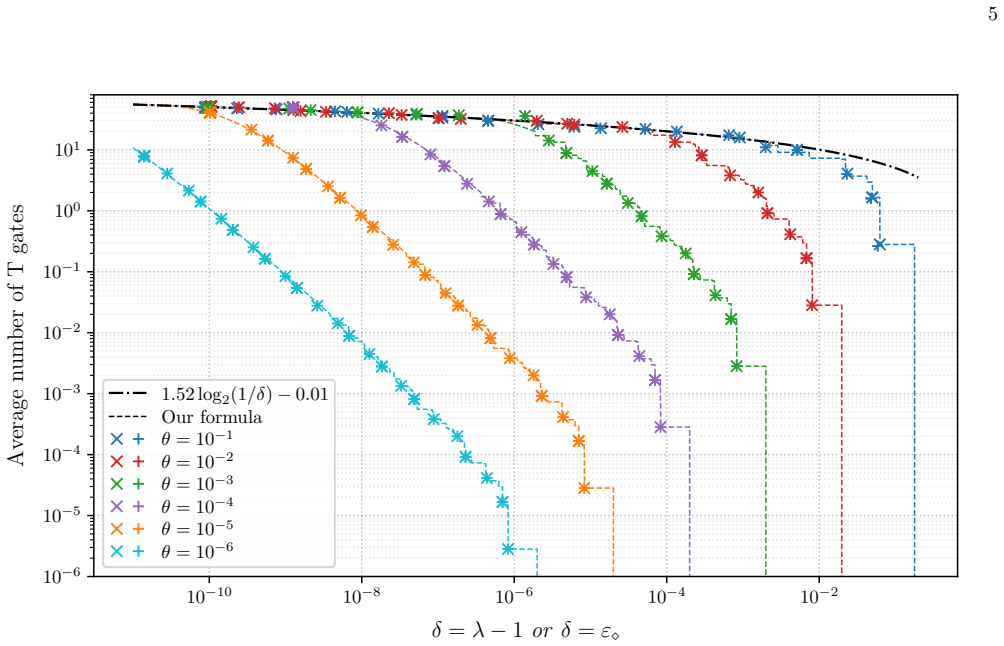
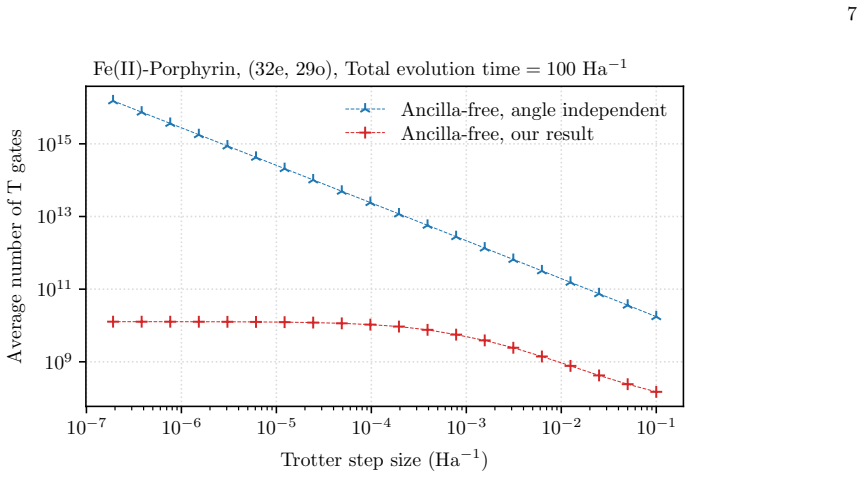
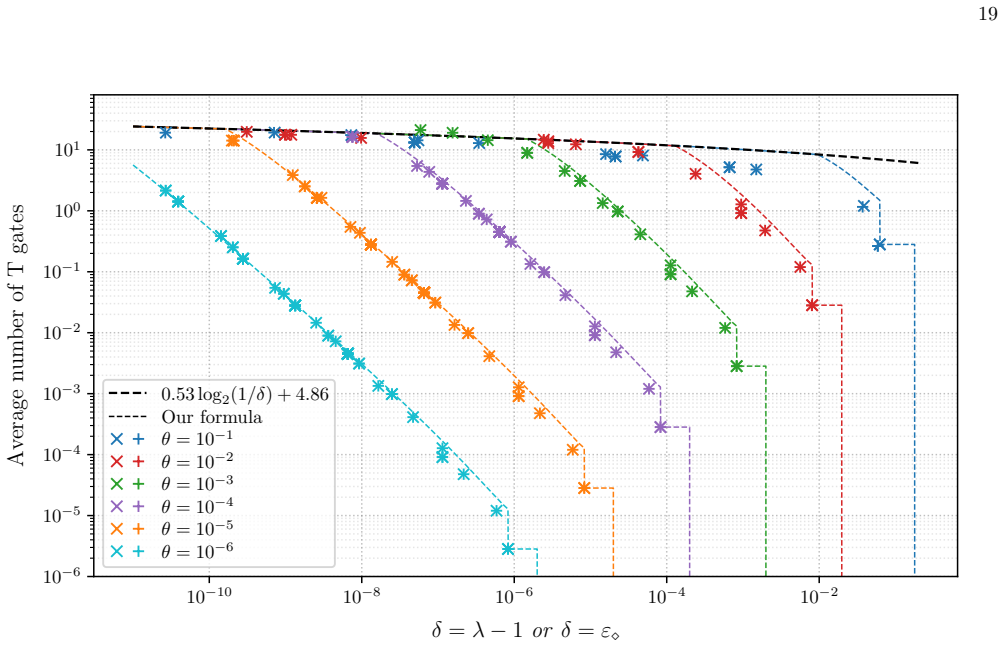
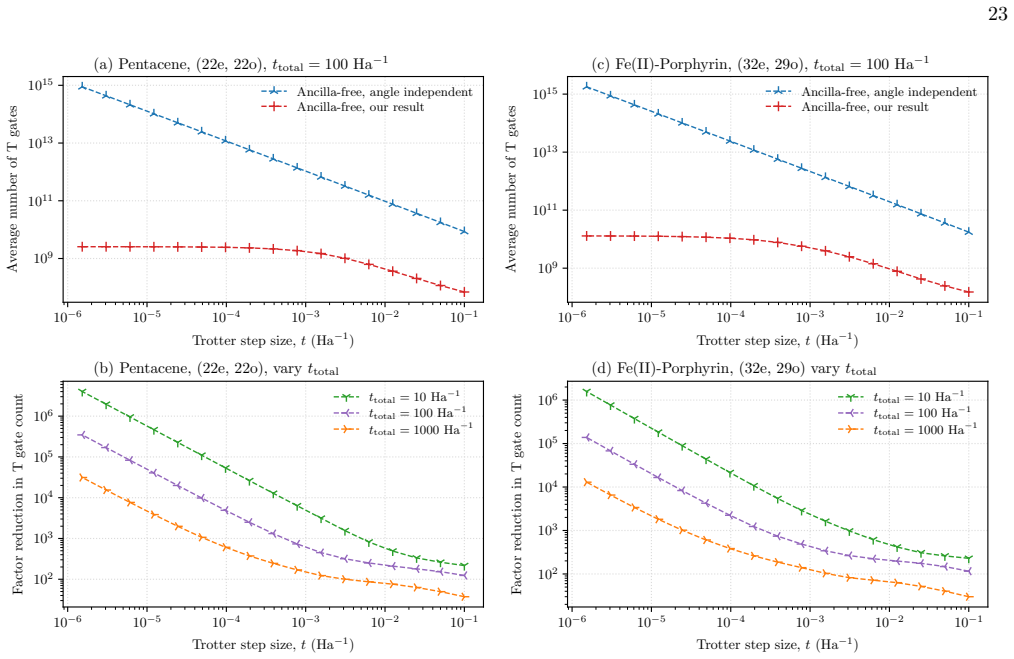
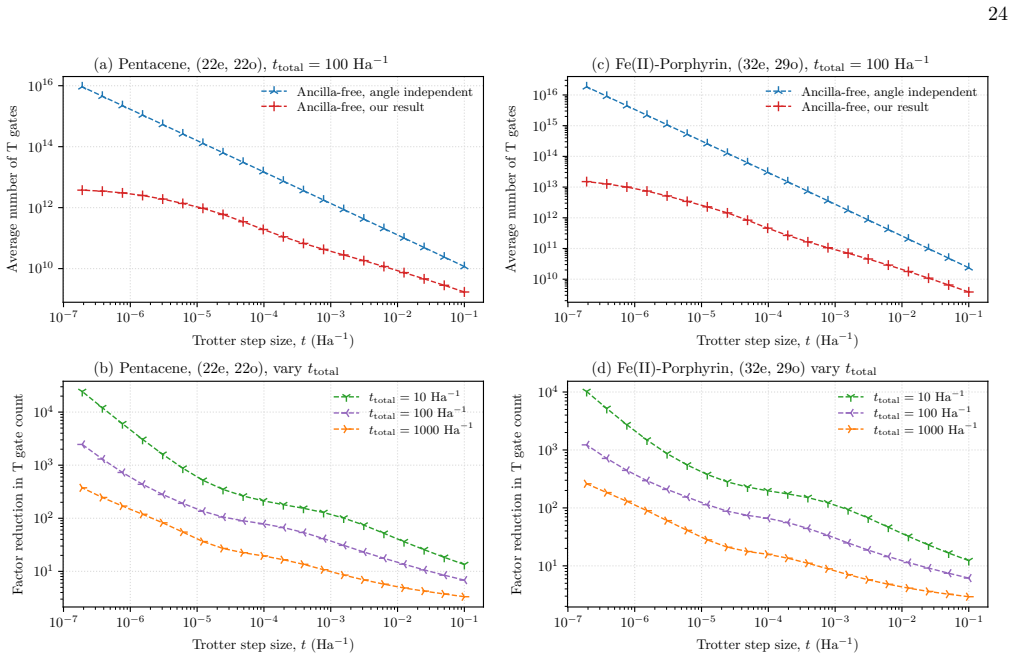
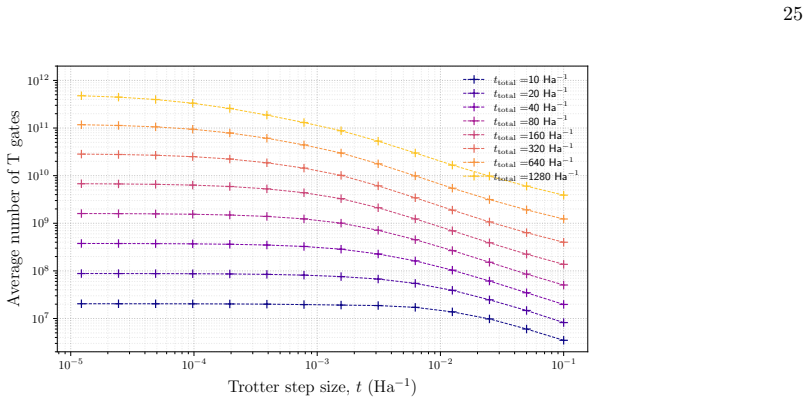
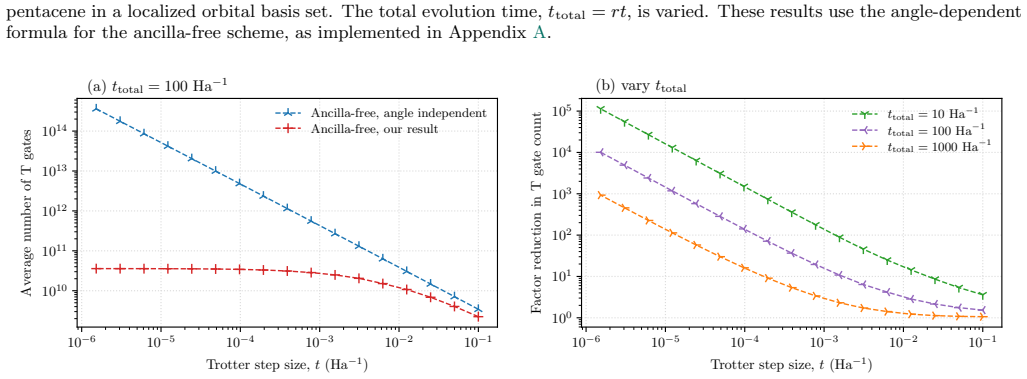
We show that it is possible to do much better for small angles, reducing the T cost to tilde O(theta squared over delta), and returning to existing O(log 1/delta) results in the worst case. We also develop a scheme based on quasi-probability mixtures of Clifford+T fallback channels. We derive new theta-dependent formulas that can be used for resource estimation of fault-tolerant quantum algorithms. As an application of our results, we show that the gate cost of Trotterization circuits compiled to a Clifford+T gate set is constant in the small Trotter step size limit, and can be reduced by orders of magnitude even for large step sizes.
What carries the argument
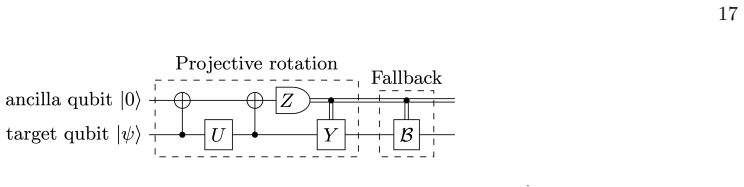
Quasi-probability mixtures of Clifford+T fallback channels that produce theta-dependent T-cost formulas for rotation synthesis.
If this is right
- T cost for rotation synthesis scales as tilde O(theta squared over delta) when theta is small.
- Compiled Trotterization circuits have gate cost that is constant as Trotter step size approaches zero.
- Quasi-probability mixtures reduce total T cost across large circuits by orders of magnitude with only small extra sampling.
- New theta-dependent resource formulas replace the previous theta-independent estimates for fault-tolerant algorithms.
- The longstanding claim that Clifford+T rotation synthesis always has high cost independent of theta no longer holds.
Where Pith is reading between the lines
- Algorithms other than Trotterization that are dominated by small rotations will likely see comparable resource savings once the new synthesis is applied.
- Early fault-tolerant devices may become viable for more tasks because the required number of magic states drops sharply.
- Re-deriving resource estimates for standard quantum algorithms using the new formulas would quantify the practical improvement.
- Implementation inside an automated compiler would allow direct measurement of the sample-complexity overhead on realistic circuit sizes.
Load-bearing premise
The quasi-probability mixtures of Clifford+T fallback channels achieve the stated cost reductions with only a small overhead in sample complexity even for large circuits.
What would settle it
An explicit count or optimization of the minimal number of T gates needed to synthesize a rotation by a chosen small theta (for example 0.01 radians) to precision delta, to verify whether the count follows the predicted theta squared scaling.
Figures
read the original abstract
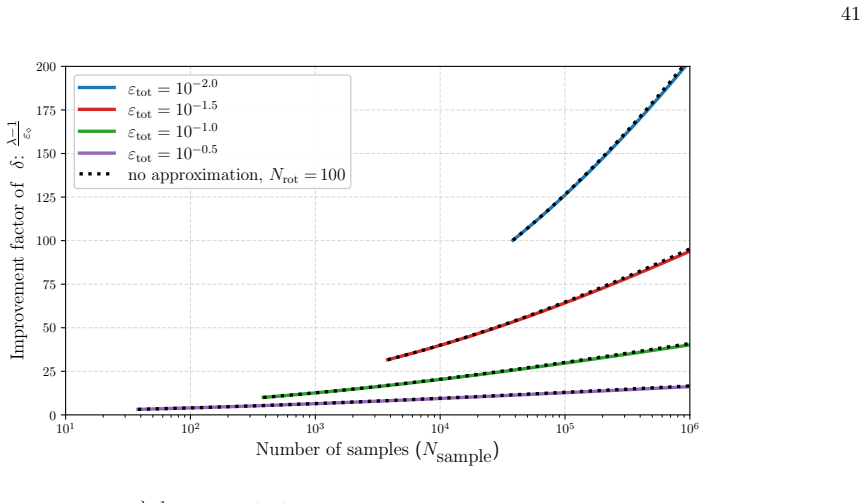
Clifford+T synthesis of rotation gates is an important routine in fault-tolerant quantum compilation. While Clifford+T synthesis is scalable, it has a high overhead of tens of T gates per rotation in practice, translating to high resource estimates for many fault-tolerant algorithms. However, these well-known results, including those using probabilistic mixtures [Quantum 7, 1208 (2023)], are independent of the rotation angle $\theta$, requiring $O(\log 1/\delta)$ T gates. We show that it is possible to do much better for small angles, reducing the T cost to $\tilde{O}(\theta^2/\delta)$, and returning to existing $O(\log1/\delta)$ results in the worst case. This is particularly important since many algorithms, such as Trotterization, are dominated by small-angle rotations. Further, we perform a detailed theoretical and numerical study of quasi-probabilities, which can further reduce the total T cost of large circuits by orders of magnitude with only a small overhead in sample complexity. We also develop a scheme based on quasi-probability mixtures of Clifford+T fallback channels. We derive new $\theta$-dependent formulas that can be used for resource estimation of fault-tolerant quantum algorithms. As an application of our results, we show that the gate cost of Trotterization circuits compiled to a Clifford+T gate set is constant in the small Trotter step size limit, and can be reduced by orders of magnitude even for large step sizes. The cost of fault-tolerant Trotterization for a variety of applications should be re-examined in light of these results. Our work dispels the widely-stated claim that Clifford+T rotation synthesis has a high cost independent of $\theta$, and further develops a scalable quasi-probability method for rotation synthesis. We also expect our results to bring forward useful early fault-tolerant quantum computing by reducing required magic state resources.
Editorial analysis
A structured set of objections, weighed in public.
Referee Report
Summary. The manuscript claims improved Clifford+T synthesis for small-angle rotations achieving T-cost scaling Õ(θ²/δ) (versus standard O(log 1/δ)), with fallback to conventional scaling at larger angles. It develops quasi-probability mixtures of Clifford+T fallback channels, derives θ-dependent resource formulas, performs theoretical/numerical analysis showing orders-of-magnitude T-cost reduction for large circuits with only small sample-complexity overhead, and applies the results to prove that Trotterization compiled to Clifford+T has constant gate cost in the small-step-size limit.
Significance. If the scaling and overhead claims hold, the work would substantially lower resource estimates for fault-tolerant algorithms dominated by small rotations, particularly Trotterization, and could accelerate early fault-tolerant quantum computing by reducing magic-state requirements. The combination of angle-dependent analytic formulas, quasi-probability techniques, and the explicit Trotterization application constitutes a concrete advance over angle-independent bounds.
major comments (2)
- [Abstract and quasi-probability mixtures section] Abstract and the section developing the quasi-probability scheme: the central claim that quasi-probability mixtures incur 'only a small overhead in sample complexity' even for large Trotter circuits (Θ(1/h) independent rotations as h→0) is load-bearing for the constant-cost Trotterization result. The manuscript must explicitly bound the growth of the composite L1 norm of the signed measure; without such a bound the total sample overhead may scale linearly with circuit size and erase the reported savings.
- [Trotterization application] The application to Trotterization: the proof that total gate cost remains constant as the Trotter step size h→0 relies on the per-rotation T-cost scaling as Õ(h²) being multiplied by 1/h rotations without an accumulating sample-complexity factor. This step should be isolated and shown to be independent of the number of rotations.
minor comments (2)
- [Abstract] Notation for the Õ(θ²/δ) scaling should be defined explicitly (including the precise dependence on δ and any polylog factors) when first introduced.
- [Numerical study section] The numerical study of quasi-probabilities would benefit from explicit reporting of the number of trials, error bars, and data-exclusion criteria to allow reproduction of the 'orders of magnitude' reduction claim.
Simulated Author's Rebuttal
We thank the referee for the careful and constructive review. The comments correctly identify two load-bearing aspects of the quasi-probability analysis and the Trotterization claim. We have revised the manuscript to supply the requested explicit bound on the composite L1 norm and to isolate the independence argument. Point-by-point responses follow.
read point-by-point responses
-
Referee: [Abstract and quasi-probability mixtures section] Abstract and the section developing the quasi-probability scheme: the central claim that quasi-probability mixtures incur 'only a small overhead in sample complexity' even for large Trotter circuits (Θ(1/h) independent rotations as h→0) is load-bearing for the constant-cost Trotterization result. The manuscript must explicitly bound the growth of the composite L1 norm of the signed measure; without such a bound the total sample overhead may scale linearly with circuit size and erase the reported savings.
Authors: We agree that an explicit bound on the composite L1 norm is necessary. The original manuscript supplied per-rotation L1 formulas and numerical evidence but left the product bound implicit. In the revision we have inserted Theorem 3, which states that for independent rotations the composite L1 norm satisfies ||μ||_1 ≤ exp(O(∑ θ_i²/δ)). For Trotterization, ∑ θ_i² remains O(1) as h→0, so the overhead factor is bounded by a constant independent of the number of rotations. The theorem, its short proof, and the resulting constant-overhead statement have been added to Section IV; the abstract has been updated to reference the bounded overhead. revision: yes
-
Referee: [Trotterization application] The application to Trotterization: the proof that total gate cost remains constant as the Trotter step size h→0 relies on the per-rotation T-cost scaling as Õ(h²) being multiplied by 1/h rotations without an accumulating sample-complexity factor. This step should be isolated and shown to be independent of the number of rotations.
Authors: We concur that isolating this step improves rigor. We have added a new subsection (V.B) titled “Independence of total cost from rotation count.” It explicitly factors the total cost as (number of rotations) × (per-rotation T-cost) × (composite L1 norm) and shows that the product of the first two factors is O(1) while the third factor remains O(1) by Theorem 3, independent of the explicit value of 1/h. A self-contained proof sketch is provided that uses only the bounded sum of squares of the angles and does not invoke any further dependence on circuit length. revision: yes
Circularity Check
No significant circularity; derivations are self-contained
full rationale
The paper's core results on Õ(θ²/δ) T-cost scaling for small-angle rotations and constant Trotterization cost in the h→0 limit are obtained via explicit analysis of quasi-probability mixtures and Clifford+T fallback channels, together with new θ-dependent formulas derived from that analysis. No step reduces by construction to a fitted parameter, self-citation chain, or ansatz imported from the authors' prior work; the scaling claims are presented as outputs of the theoretical/numerical study rather than inputs. The Trotterization application follows directly from substituting the per-rotation cost into the circuit structure without circular redefinition. This is the normal case of an independent derivation.
Axiom & Free-Parameter Ledger
Forward citations
Cited by 3 Pith papers
-
Fast and Parallel High-Rate STAR Architecture for Megaquop Quantum Simulation
A symmetry-co-designed high-rate QEC architecture with parallel STAR injection on bivariate bicycle codes achieves ~5.5x space savings for TFIM and Fermi-Hubbard simulations versus surface-code STAR.
-
Structure-Aware Variance Reduction for Unbiased Randomized Hamiltonian Simulation
Continuous TE-PAI provides an unbiased randomized protocol for Hamiltonian simulation free of Trotter error at finite circuit depth, combined with structure-aware variance reduction that achieves up to 96% sampling-co...
-
Nanostructure modelling with early fault tolerant quantum computers
Quantum simulation framework for ground-state energies of 4- and 8-electron double quantum dots on surface-code fault-tolerant hardware, with resource estimates of 226k-314k physical qubits and 24 hours to 3.4 days ru...
Reference graph
Works this paper leans on
-
[1]
Horsman, A
D. Horsman, A. G. Fowler, S. Devitt, and R. V. Meter, Surface code quantum computing by lattice surgery, New Journal of Physics14, 123011 (2012)
2012
- [2]
-
[3]
Litinski, A game of surface codes: Large-scale quantum computing with lattice surgery, Quantum3, 128 (2019)
D. Litinski, A game of surface codes: Large-scale quantum computing with lattice surgery, Quantum3, 128 (2019)
2019
-
[4]
Chamberland and E
C. Chamberland and E. T. Campbell, Circuit-level protocol and analysis for twist-based lattice surgery, Physical Review Research4, 023090 (2022)
2022
-
[5]
Gottesman and I
D. Gottesman and I. L. Chuang, Demonstrating the viability of universal quantum computation using teleportation and single-qubit operations, Nature402, 390 (1999)
1999
-
[6]
Bravyi and A
S. Bravyi and A. Kitaev, Universal quantum computation with ideal clifford gates and noisy ancillas, Physical Review A—Atomic, Molecular, and Optical Physics71, 022316 (2005)
2005
-
[7]
Bravyi and J
S. Bravyi and J. Haah, Magic-state distillation with low overhead, Physical Review A—Atomic, Molecular, and Optical Physics86, 052329 (2012)
2012
-
[8]
Chamberland and K
C. Chamberland and K. Noh, Very low overhead fault-tolerant magic state preparation using redundant ancilla encoding and flag qubits, npj Quantum Information6, 91 (2020)
2020
-
[9]
Magic state cultivation: growing T states as cheap as CNOT gates
C. Gidney, N. Shutty, and C. Jones, Magic state cultivation: growing t states as cheap as cnot gates, arXiv preprint arXiv:2409.17595 (2024)
work page internal anchor Pith review Pith/arXiv arXiv 2024
-
[10]
A. W. Harrow, B. Recht, and I. L. Chuang, Efficient discrete approximations of quantum gates, Journal of Mathematical Physics43, 4445 (2002)
2002
-
[11]
N. J. Ross and P. Selinger, Optimal ancilla-free clifford+ t approximation of z-rotations., Quantum Inf. Comput.16, 901 (2016)
2016
-
[12]
Campbell, Shorter gate sequences for quantum computing by mixing unitaries, Phys
E. Campbell, Shorter gate sequences for quantum computing by mixing unitaries, Phys. Rev. A95, 042306 (2017)
2017
-
[13]
M. B. Hastings, Turning gate synthesis errors into incoherent errors, Quantum Info. Comput.17, 488–494 (2017)
2017
-
[14]
Lloyd, Universal quantum simulators, Science273, 1073 (1996)
S. Lloyd, Universal quantum simulators, Science273, 1073 (1996)
1996
-
[15]
A. M. Childs, Y. Su, M. C. Tran, N. Wiebe, and S. Zhu, Theory of trotter error with commutator scaling, Physical Review X11, 011020 (2021)
2021
-
[16]
M. Reiher, N. Wiebe, K. M. Svore, D. Wecker, and M. Troyer, Elucidating reaction mechanisms on quantum computers, Pro- ceedings of the National Academy of Sciences114, 7555 (2017), https://www.pnas.org/doi/pdf/10.1073/pnas.1619152114
-
[17]
J. Lee, D. W. Berry, C. Gidney, W. J. Huggins, J. R. McClean, N. Wiebe, and R. Babbush, Even more efficient quantum computations of chemistry through tensor hypercontraction, PRX Quantum2, 030305 (2021)
2021
-
[18]
N. S. Blunt, J. Camps, O. Crawford, R. Izs´ ak, S. Leontica, A. Mirani, A. E. Moylett, S. A. Scivier, C. S¨ under- hauf, P. Schopf, J. M. Taylor, and N. Holzmann, Perspective on the current state-of-the-art of quantum comput- ing for drug discovery applications, Journal of Chemical Theory and Computation18, 7001 (2022), pMID: 36355616, https://doi.org/10....
-
[19]
Kliuchnikov, K
V. Kliuchnikov, K. Lauter, R. Minko, A. Paetznick, and C. Petit, Shorter quantum circuits via single-qubit gate approxi- mation, Quantum7, 1208 (2023)
2023
-
[20]
Koczor, Sparse probabilistic synthesis of quantum operations, PRX Quantum5, 040352 (2024)
B. Koczor, Sparse probabilistic synthesis of quantum operations, PRX Quantum5, 040352 (2024)
2024
-
[21]
Khitrin, K
D. Khitrin, K. R. Brown, and A. Anand, Unbiased observable estimation with approximate channels in fault-tolerant quantum computation, Quantum Science and Technology11, 015034 (2026)
2026
-
[22]
Su, H.-Y
Y. Su, H.-Y. Huang, and E. T. Campbell, Nearly tight Trotterization of interacting electrons, Quantum5, 495 (2021)
2021
-
[23]
Q. Zhao, Y. Zhou, A. F. Shaw, T. Li, and A. M. Childs, Hamiltonian simulation with random inputs, Phys. Rev. Lett. 129, 270502 (2022)
2022
-
[24]
Yi and E
C. Yi and E. Crosson, Spectral analysis of product formulas for quantum simulation, npj Quantum Inf.8, 37 (2022)
2022
-
[25]
Mizuta and T
K. Mizuta and T. Kuwahara, Trotterization is substantially efficient for low-energy states, Phys. Rev. Lett.135, 130602 (2025)
2025
- [26]
-
[27]
A. J. Bay-Smidt, N. Glaser, M. D. Fabian, E. T. Campbell, N. S. Blunt, and G. C. Solomon, Quantum simulation of nanographenes and trotter error cancellation (2026), arXiv:2605.00745 [quant-ph]
work page internal anchor Pith review Pith/arXiv arXiv 2026
-
[28]
Akahoshi, K
Y. Akahoshi, K. Maruyama, H. Oshima, S. Sato, and K. Fujii, Partially fault-tolerant quantum computing architecture with error-corrected clifford gates and space-time efficient analog rotations, PRX Quantum5, 010337 (2024)
2024
-
[29]
Akahoshi, R
Y. Akahoshi, R. Toshio, J. Fujisaki, H. Oshima, S. Sato, and K. Fujii, Compilation of trotter-based time evolution for partially fault-tolerant quantum computing architecture, PRX Quantum6, 040319 (2025)
2025
-
[30]
M.-Z. Chung, A. H. Z. Kavaki, A. Scherer, A. Khalid, X. Kong, T. Kawakubo, N. Anand, G. A. Dagnew, Z. Webb, A. Silva, G. Gyawali, T. Yan, K. Fujii, A. Ho, M. Mohseni, P. Ronagh, and J. Martinis, Partially fault-tolerant quantum 28 computation for megaquop applications (2026), arXiv:2603.13093 [quant-ph]
-
[31]
S. Kanasugi, R. Toshio, K. Maruyama, and H. Oshima, Enabling chemically accurate quantum phase estimation in the early fault-tolerant regime (2026), arXiv:2603.22778 [quant-ph]
- [32]
-
[33]
Campbell, Random compiler for fast hamiltonian simulation, Phys
E. Campbell, Random compiler for fast hamiltonian simulation, Phys. Rev. Lett.123, 070503 (2019)
2019
-
[34]
Phase estimation with partially randomized time evolution
J. G¨ unther, F. Witteveen, A. Schmidhuber, M. Miller, M. Christandl, and A. Harrow, Phase estimation with partially randomized time evolution (2025), arXiv:2503.05647 [quant-ph]
work page internal anchor Pith review Pith/arXiv arXiv 2025
-
[35]
Kiumi and B
C. Kiumi and B. Koczor, Te-pai: exact time evolution by sampling random circuits, Quantum Science and Technology10, 045071 (2025)
2025
-
[36]
Luthra, A
S. Luthra, A. E. Moylett, D. E. Browne, and E. T. Campbell, Unlocking early fault-tolerant quantum computing with mitigated magic dilution, Quantum Science and Technology10, 045066 (2025)
2025
-
[37]
Watrous,The theory of quantum information(Cambridge university press, 2018)
J. Watrous,The theory of quantum information(Cambridge university press, 2018)
2018
-
[38]
quantum-programming/pygridsynth (2026), original-date: 2024-11-27T09:42:35Z
2026
-
[39]
pygridsynth: A fast numerical tool for ancilla-free Clifford+T synthesis
S. Yamamoto and N. Yoshioka, pygridsynth: A fast numerical tool for ancilla-free clifford+t synthesis (2026), arXiv:2604.21333 [quant-ph]
work page internal anchor Pith review Pith/arXiv arXiv 2026
-
[40]
Remarks on Matsumoto and Amano's normal form for single-qubit Clifford+T operators
B. Giles and P. Selinger, Remarks on matsumoto and amano’s normal form for single-qubit clifford+t operators (2019), arXiv:1312.6584 [quant-ph]
work page internal anchor Pith review Pith/arXiv arXiv 2019
-
[41]
Fast and efficient exact synthesis of single qubit unitaries generated by Clifford and T gates
V. Kliuchnikov, D. Maslov, and M. Mosca, Fast and efficient exact synthesis of single qubit unitaries generated by Clifford and T gates (2013), arXiv:1206.5236 [quant-ph]
work page internal anchor Pith review Pith/arXiv arXiv 2013
-
[42]
I. D. Kivlichan, C. Gidney, D. W. Berry, N. Wiebe, J. McClean, W. Sun, Z. Jiang, N. Rubin, A. Fowler, A. Aspuru- Guzik, H. Neven, and R. Babbush, Improved fault-tolerant quantum simulation of condensed-phase correlated electrons via trotterization, Quantum4, 296 (2020)
2020
-
[43]
E. T. Campbell, Early fault-tolerant simulations of the hubbard model, Quantum Sci. Technol.7, 015007 (2021)
2021
-
[44]
A. J. Bay-Smidt, F. R. Klausen, C. S¨ underhauf, R. Izs´ ak, G. C. Solomon, and N. S. Blunt, Fault-tolerant quantum simulation of generalized hubbard models, PRX Quantum6, 030348 (2025)
2025
-
[45]
N. S. Blunt, Fixed- and partial-node approximations in slater determinant space for molecules, Journal of Chemical Theory and Computation17, 6092 (2021), pMID: 34549947, https://doi.org/10.1021/acs.jctc.1c00500
-
[46]
J. E. T. Smith, B. Mussard, A. A. Holmes, and S. Sharma, Cheap and near exact casscf with large active spaces, Journal of Chemical Theory and Computation13, 5468 (2017), pMID: 28968097, https://doi.org/10.1021/acs.jctc.7b00900
-
[47]
cheap and near exact casscf with large active spaces
J. E. T. Smith, B. Mussard, A. A. Holmes, and S. Sharma, Github for “cheap and near exact casscf with large active spaces”’ (2026)
2026
-
[48]
G. Li Manni, S. D. Smart, and A. Alavi, Combining the complete active space self-consistent field method and the full con- figuration interaction quantum monte carlo within a super-ci framework, with application to challenging metal-porphyrins, Journal of Chemical Theory and Computation12, 1245 (2016), pMID: 26808894, https://doi.org/10.1021/acs.jctc.5b01190
-
[49]
Q. Sun, T. C. Berkelbach, N. S. Blunt, G. H. Booth, S. Guo, Z. Li, J. Liu, J. D. McClain, E. R. Sayfutyarova, S. Sharma, S. Wouters, and G. K.-L. Chan, Pyscf: the python-based simulations of chemistry framework, WIREs Computational Molecular Science8, e1340 (2018), https://wires.onlinelibrary.wiley.com/doi/pdf/10.1002/wcms.1340
-
[50]
Q. Sun, X. Zhang, S. Banerjee, P. Bao, M. Barbry, N. S. Blunt, N. A. Bogdanov, G. H. Booth, J. Chen, Z.-H. Cui, J. J. Eriksen, Y. Gao, S. Guo, J. Hermann, M. R. Hermes, K. Koh, P. Koval, S. Lehtola, Z. Li, J. Liu, N. Mardirossian, J. D. McClain, M. Motta, B. Mussard, H. Q. Pham, A. Pulkin, W. Purwanto, P. J. Robinson, E. Ronca, E. R. Sayfutyarova, M. Sche...
2020
-
[51]
J. R. McClean, N. C. Rubin, K. J. Sung, I. D. Kivlichan, X. Bonet-Monroig, Y. Cao, C. Dai, E. S. Fried, C. Gidney, B. Gimby, P. Gokhale, T. H¨ aner, T. Hardikar, V. Havl´ ıˇ cek, O. Higgott, C. Huang, J. Izaac, Z. Jiang, X. Liu, S. McArdle, M. Neeley, T. O’Brien, B. O’Gorman, I. Ozfidan, M. D. Radin, J. Romero, N. P. D. Sawaya, B. Senjean, K. Setia, S. Si...
2020
-
[52]
Lin and Y
L. Lin and Y. Tong, Heisenberg-limited ground-state energy estimation for early fault-tolerant quantum computers, PRX Quantum3, 010318 (2022)
2022
-
[53]
K. Wan, M. Berta, and E. T. Campbell, Randomized quantum algorithm for statistical phase estimation, Phys. Rev. Lett. 129, 030503 (2022)
2022
-
[54]
Dutkiewicz, B
A. Dutkiewicz, B. M. Terhal, and T. E. O’Brien, Heisenberg-limited quantum phase estimation of multiple eigenvalues with few control qubits, Quantum6, 830 (2022)
2022
-
[55]
G. Wang, D. S. Fran¸ ca, R. Zhang, S. Zhu, and P. D. Johnson, Quantum algorithm for ground state energy estimation using circuit depth with exponentially improved dependence on precision, Quantum7, 1167 (2023)
2023
-
[56]
N. S. Blunt, L. Caune, R. Izs´ ak, E. T. Campbell, and N. Holzmann, Statistical phase estimation and error mitigation on a superconducting quantum processor, PRX Quantum4, 040341 (2023)
2023
-
[57]
Ding and L
Z. Ding and L. Lin, Even shorter quantum circuit for phase estimation on early fault-tolerant quantum computers with applications to ground-state energy estimation, PRX Quantum4, 020331 (2023)
2023
-
[58]
Diamond and S
S. Diamond and S. Boyd, CVXPY: A Python-embedded modeling language for convex optimization, Journal of Machine Learning Research17, 1 (2016). 29
2016
-
[59]
Agrawal, R
A. Agrawal, R. Verschueren, S. Diamond, and S. Boyd, A rewriting system for convex optimization problems, Journal of Control and Decision5, 42 (2018)
2018
-
[60]
E. Granet and H. Dreyer, Hamiltonian dynamics on digital quantum computers without discretization error, npj Quantum Information10, 82 (2024). Appendix A: Script for resource estimation In this appendix, we provide a simple Python script to run our costing formula for the ancilla-free synthesis method. The script is also downloadable on this paper’s arXiv...
-
[61]
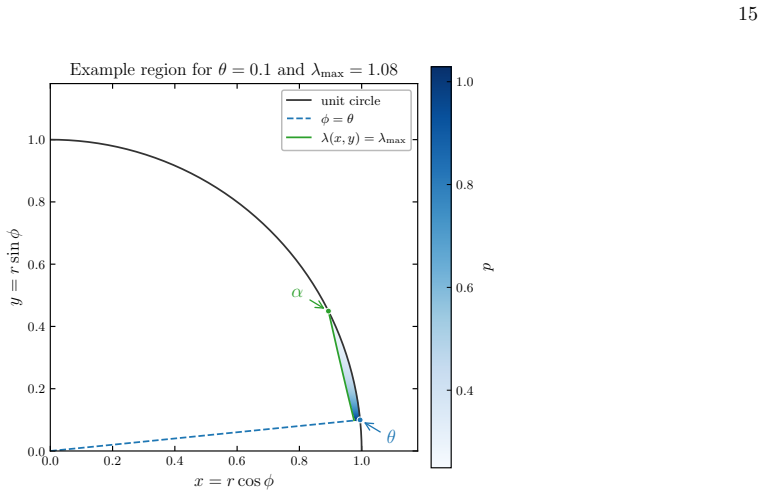
Region for over-rotation In Section V B, Eq. (51) we have seen that we are searching for over-rotations whose top-left entryu=x+iy=re iφ lies in the region {(x, y)∈C, λ(x, y) = 1−x 2 xy sin 2θ+ cos 2θ≤λ max} ∪ {re iφ ∈C,0< r≤1, θ < φ < π/4}.(D1) The region is implemented by a new child class in pygridsynth inheritingConvexSet. It must implement 3 interfac...
-
[62]
Approximation up to a phase
Impact of phase All Clifford+T unitaries may be generated by X, Y, Z, H= 1√ 2 1 1 1−1 , S= 1 0 0i , T= 1 0 0ω ,whereω=e iπ/4.(D18) Every such unitary has the form U= u−t †ωℓ t u †ωℓ , u, t∈Z[1/ √ 2, i], ℓ∈Z, u †u+v †v= 1,⇒detU=ω ℓ,(D19) (see [11, Eq. 11]). Our approach, and that of [19], requires detU= 1 in order to apply the twirling proposition (see Sec...
-
[63]
On this occasion theθdependence has been simply bounded as|cosθ|,|sinθ| ≤1
=O(∆p ε ⋄).(F41) The second (F38) and third (F39) correction terms are even smaller as sinδi ≈ √ε⋄. On this occasion theθdependence has been simply bounded as|cosθ|,|sinθ| ≤1. A similar calculation gives qZ = sin2 θq′ 1 + cos2 θq′ Z +O(ε ⋄∆p) (F42) qX =q ′ X +O(ε ⋄∆p) (F43) Altogether, we therefore have the maximal difference |(λ−1)−ε ⋄|= |p1|+|p 2|| {z }...
discussion (0)
Sign in with ORCID, Apple, or X to comment. Anyone can read and Pith papers without signing in.