Variational theory of Cosserat arches and affine tensors
Pith reviewed 2026-06-28 19:50 UTC · model grok-4.3
The pith
The Euler-Poincaré equation corresponds to parallel transport of the momentum tensor in affine frame geometry.
A machine-rendered reading of the paper's core claim, the machinery that carries it, and where it could break.
Core claim
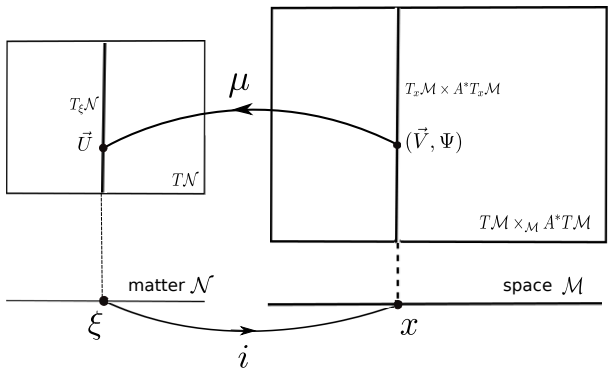
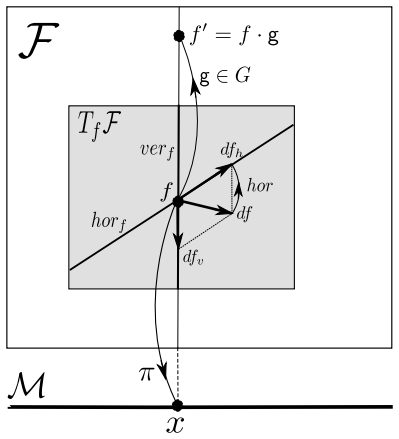
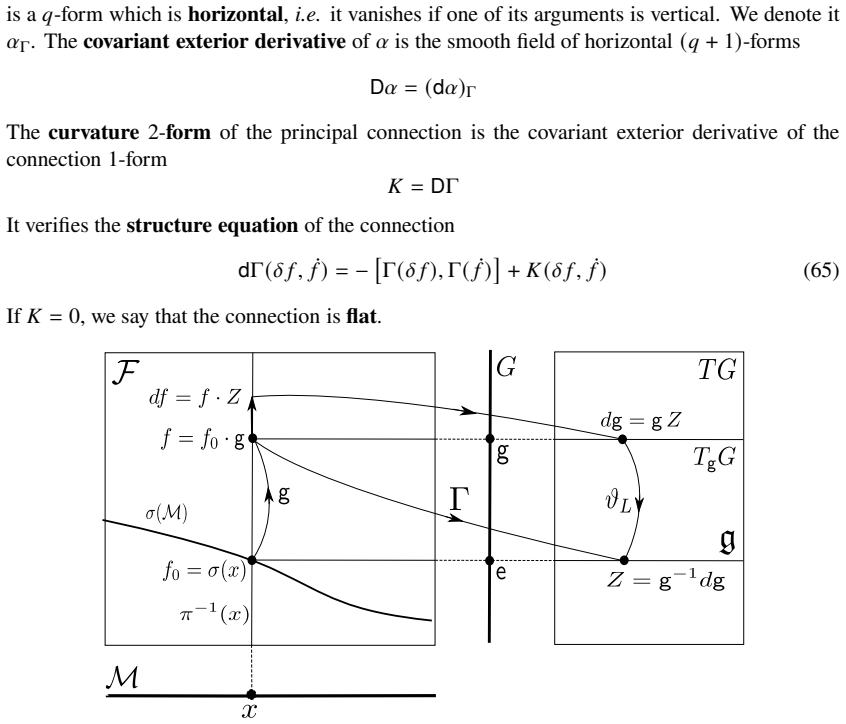
Using the framework of Ehresmann connections on the principal bundle of affine frames, we show that the Euler-Poincaré equation means that the momentum tensor is parallel-transported.
What carries the argument
Ehresmann connections on the principal bundle of affine frames, which interpret the Euler-Poincaré equation as the parallel transport of the momentum tensor.
If this is right
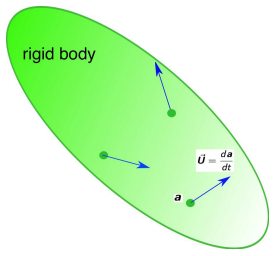
- The formalism applies to the motion of rigid bodies.
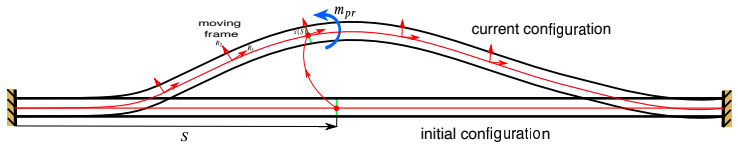
- It covers the statics and dynamics of Cosserat arches.
- The approach reinterprets screw theory in terms of affine tensors.
- Co-momentum and momentum tensors are introduced as central objects.
Where Pith is reading between the lines
- This geometric interpretation could lead to new conserved quantities in arch mechanics.
- Similar connections might apply to other variational problems in mechanics.
- Computational models of Cosserat structures may use parallel transport for efficiency.
Load-bearing premise
The affine tensor formalism together with Ehresmann connections on the principal bundle of affine frames is a suitable framework for these mechanical models.
What would settle it
A direct calculation for the rigid body showing that the Euler-Poincaré equation does not result in parallel transport of the momentum tensor.
Figures

read the original abstract
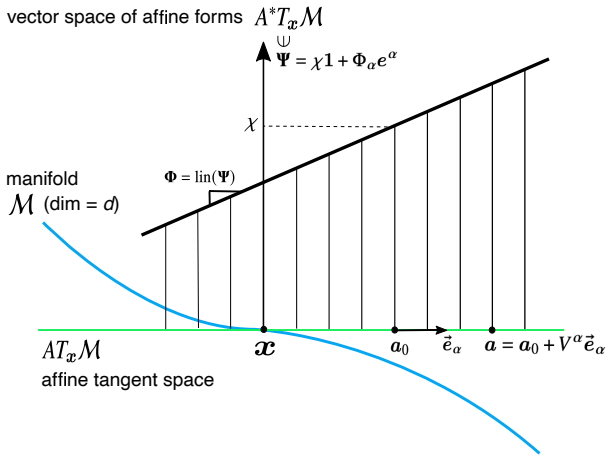
Our purpose is to revisit the screw theory in light of the affine tensor formalism, introducing the co-momentum and momentum tensors. Our target-applications of the Euler-Poincar\'e equation are problems of mechanics such as the motion of the rigid body or the statics and the dynamics of Cosserat arches, in relation to the concept of momentum tensor. Using the framework of Ehresmann connections on the principal bundle of affine frames, we show that the Euler-Poincar\'e equation means that the momentum tensor is parallel-transported.
Editorial analysis
A structured set of objections, weighed in public.
Referee Report
Summary. The manuscript proposes revisiting screw theory via affine tensor formalism by introducing co-momentum and momentum tensors. Its target applications are the motion of rigid bodies and the statics/dynamics of Cosserat arches. The central claim is that, within the framework of Ehresmann connections on the principal bundle of affine frames, the Euler-Poincaré equation is equivalent to parallel transport of the momentum tensor.
Significance. If the claimed equivalence were established with explicit definitions and derivations, the work could supply a geometric bridge between variational mechanics and affine geometry for Cosserat and rigid-body problems. No such derivation or supporting evidence is supplied, so significance cannot be assessed.
major comments (1)
- [Abstract] Abstract: the statement that 'we show that the Euler-Poincaré equation means that the momentum tensor is parallel-transported' is presented without any definition of the momentum tensor, without specification of the Ehresmann connection, and without any derivation or intermediate steps. This absence renders the central claim unverifiable and load-bearing for the entire purpose of the paper.
Simulated Author's Rebuttal
We thank the referee for reviewing our manuscript. The central result is indeed that the Euler-Poincaré equation is equivalent to parallel transport of the momentum tensor within the Ehresmann connection framework on the affine frame bundle; we address the concern that this is not supported below.
read point-by-point responses
-
Referee: [Abstract] Abstract: the statement that 'we show that the Euler-Poincaré equation means that the momentum tensor is parallel-transported' is presented without any definition of the momentum tensor, without specification of the Ehresmann connection, and without any derivation or intermediate steps. This absence renders the central claim unverifiable and load-bearing for the entire purpose of the paper.
Authors: The abstract serves as a concise summary. The co-momentum and momentum tensors are defined in the sections introducing the affine tensor formalism and screw theory. The Ehresmann connection on the principal bundle of affine frames is specified in the geometric setup, and the equivalence to parallel transport is derived step-by-step in the variational analysis leading to the Euler-Poincaré equation, with explicit application to rigid-body motion and Cosserat arches. These elements are present in the body of the manuscript and support the claim. revision: no
Circularity Check
No circularity detectable; only abstract available
full rationale
The provided document contains solely the abstract, which announces the introduction of co-momentum and momentum tensors and states that the Euler-Poincaré equation implies parallel transport of the momentum tensor via Ehresmann connections. No equations, definitions of the momentum tensor, explicit steps of the derivation, or self-citations are present. Consequently, no load-bearing step can be quoted or shown to reduce by construction to its inputs, satisfying the requirement that circularity claims must rest on specific textual reductions rather than absence of information.
Axiom & Free-Parameter Ledger
axioms (1)
- domain assumption The framework of Ehresmann connections on the principal bundle of affine frames applies to the mechanics of Cosserat arches.
invented entities (2)
-
co-momentum tensor
no independent evidence
-
momentum tensor
no independent evidence
Reference graph
Works this paper leans on
-
[1]
S., The theory of screws: A study in the dynamics o f a rigid body
Ball, R. S., The theory of screws: A study in the dynamics o f a rigid body. Hodges, Foster (1876)
-
[2]
Castrill ´on L ´opez, T
M. Castrill ´on L ´opez, T. Ratiu, S. Shkoller, Reduction in principal fiber bun dles: covariant Euler-Poincar´e equations, Proceedings of the American Mathematical Society , Vol. 128, No. 7, 2155-2164 (2000)
2000
-
[3]
Bulletin des Sciences par la Soci ´et´e Philomathique, 9-13 (1823)
Cauchy, A.-L., Recherches sur l’ ´equilibre et le mouvement int ´erieur des corps solides ou fluides, ´elastiques ou non ´elastiques. Bulletin des Sciences par la Soci ´et´e Philomathique, 9-13 (1823)
-
[4]
Exercices de math´ematiques, 2, 42-56 (1827)
Cauchy, A.-L., De la pression ou tension dans un corps sol ide. Exercices de math´ematiques, 2, 42-56 (1827)
-
[5]
Special Relativity, Symmetry, 16, 214 (2024)
Cardall, C.Y ., A Unified Perspective on Poincar´e and Galilei Relativity: I. Special Relativity, Symmetry, 16, 214 (2024)
2024
-
[6]
Non- linear Sci., doi 10.1007/s00332-009-9050-5 (2009)
Boyer, F., Porez, M., Leroyer, A., Poincar ´e–Cosserat Equations for the Lighthill Three- dimensional Large Amplitude Elongated Body Theory: Applic ation to Robotics, J. Non- linear Sci., doi 10.1007/s00332-009-9050-5 (2009)
-
[7]
Boyer, F., Renda, F., Poincar ´e’s Equations for Cosserat Media: Application to Shells, J. Nonlinear Sci., Vol. 27, 1-44 doi 10.1007/s00332-016-9324-7 (2017). 30
-
[8]
Boyer, F., Lebastard, V ., Candelier, F., Renda, F., Extended Hamilton’s principle applied to geometrically exact Kirchhoff sliding rods, Journal of Sound and Vibration , 516, 116511 (2022)
2022
-
[9]
and F., Sur la m ´ecanique g ´en´erale, C
Cosserat, E. and F., Sur la m ´ecanique g ´en´erale, C. R. Acad. Sci. Paris , 145, 1139-1142 (1907)
1907
-
[10]
and F., Th ´eorie des corps d ´eformables, Hermann (1909)
Cosserat, E. and F., Th ´eorie des corps d ´eformables, Hermann (1909)
1909
-
[11]
Journal of Theoretical and Applied Mechanics, 41, 3, 593-621 (2003)
de Saxc ´e, G., Vall´ee, C., Affine Tensors in Shell Theory. Journal of Theoretical and Applied Mechanics, 41, 3, 593-621 (2003)
2003
-
[12]
Mathematics and Mechanics of Solid Journal , 17(4), 413-430 (2011)
de Saxc ´e, G., Vall´ee, C., Affine Tensors in Mechanics of Freely Falling Particle s and Rigid Bodies. Mathematics and Mechanics of Solid Journal , 17(4), 413-430 (2011)
2011
-
[13]
de Saxc ´e, G., Vall ´ee, C., Galilean Mechanics and Thermodynamics of Continua, Wiley- ISTE (2016), London
2016
-
[14]
de Saxc ´e, G., Euler-Poincar´e equation for Lie groups with non null symplectic cohomology, application to the mechanics, Proc. 4th Int. Conf. Geometri c Science of Information (GSI), Toulouse, France, August 27-29, Page 66-74 (2019)
2019
-
[15]
de Saxc ´e, G., ´El´ements de M ´ecanique galil ´eenne, une approche g ´eom´etrique, Collection M´ecanique th´eorique, C ´epadu`es (2019)
2019
-
[16]
de Saxc ´e, G., Cosserat media in dynamics, International Journal of Engineering Science 217 (2025) 104368
2025
-
[17]
A V-differential geometry: Poisson and Jacobi structures
Grabowska, K., Grabowski, J., Urba ˜nski, P. A V-differential geometry: Poisson and Jacobi structures. Journal of Geometry and Physics , 52, 398-446 (2004)
2004
-
[18]
Hamel, G., Die Lagrange–Eulersche gleichungen der mec hanik, Z. Math. Phys. 50, 1-57 (1904)
1904
-
[19]
Holm, D.D., Marsden, J.E., Ratiu, T., The Euler-Poinca r´e Equations and Semidirect Prod- ucts with Applications to Continuum Theories, Advances in Mathematics, 137, 1-81 (1998)
1998
-
[20]
M., Cartan for Beginners: Diff erential Geometry Via Moving Frames and Exterior Differential Systems, Graduate Studies in Mathematics 61, AMS (2003)
Ivey, T.A., Landsberg, J. M., Cartan for Beginners: Diff erential Geometry Via Moving Frames and Exterior Differential Systems, Graduate Studies in Mathematics 61, AMS (2003)
2003
-
[21]
1, New Y ork: J
Kobayashi, S., Nomizu, K., Foundations of differential geometry, Vol. 1, New Y ork: J. Wiley & Sons, 1963
1963
-
[22]
Marle, C.M., On Henri Poincar ´e’s Note ”Sur une forme nouvelle des ´equations de la M´ecanique”, J. Geom. Symmetry Phys. , 29, 1-38, doi:10.7546/jgsp-29-2013-1-38 (2013)
-
[23]
P ´er`es, J., M ´ecanique g´en´erale, Masson, Paris, 1953. 31
1953
-
[24]
Compte Rendu de l’Acad´emie des Sciences de Paris 132, 369–371 (1901)
Poincar ´e, H., Sur une forme nouvelle des ´equations de la m ´ecanique. Compte Rendu de l’Acad´emie des Sciences de Paris 132, 369–371 (1901)
1901
-
[25]
Mathematische Annalen, 54, 125-137 (1901)
Ricci-Curbasto, G., Levi-Civita, T., M ´ethodes de calcul diff ´erentiel absolu et leurs applica- tions. Mathematische Annalen, 54, 125-137 (1901)
1901
-
[26]
B., Zenkov, D
Shi, D., Kogan, Y . B., Zenkov, D. V ., Bloch, A. M., Hamel’ s formalism for infinite- dimensional mechanical systems, J. Nonlinear Sci., 27, 241–283 (2017)
2017
-
[27]
the three -dimensional dynamic problem
Simo, J.C., A Finite strain beam formulation. the three -dimensional dynamic problem. Part I. Computer methods in applied mechanics and engineering , Vol 49: 55–70 (1985)
1985
-
[28]
Souriau, Milieux continus de dimension 1, 2 ou 3 : s tatique et dynamique, actes du 13`eme Congr `es Franc ¸ais de M´ecanique, Poitiers-Futuroscope 41-53 (1997)
J.-M. Souriau, Milieux continus de dimension 1, 2 ou 3 : s tatique et dynamique, actes du 13`eme Congr `es Franc ¸ais de M´ecanique, Poitiers-Futuroscope 41-53 (1997)
1997
-
[29]
Atti della Reale Accademia delle Scienze di Torino , 122, 66-72 (1988)
Tulczyjew, W ., Urba ˜nski, P., Grabowski, J, A pseudocategory of principal bundl es. Atti della Reale Accademia delle Scienze di Torino , 122, 66-72 (1988)
1988
-
[30]
Methods Appl
Vu-Quoc, L., Li, S., Dynamics of sliding geometrically -exact beams: large angle maneuver and parametric resonance, Comput. Methods Appl. Mech. Engrg. 120 (4) (1995) 65–118. 32
1995
discussion (0)
Sign in with ORCID, Apple, or X to comment. Anyone can read and Pith papers without signing in.