REVIEW 4 major objections 6 minor 1 cited by
Shu Dao: A Calligraphy Score Framework Linking Calligraphy, Music, and Performance
T0 review · 4 major / 6 minor · reviewed 2026-07-13 · grok-4.5
Pith's one-line read East Asian calligraphy can be written as a multi-level performable score that encodes stroke order, rhythm, and expression the way music notation does.
desk verdict Coherent multi-level score schema for calligraphy with inspectable JSON demos, but the 'computational foundation' claim outruns an unvalidated illustrative pipeline. read the letter →
The pith
A machine-rendered reading of the paper's core claim, the machinery that carries it, and where it could break.
The reading
What carries the argument
Calligraphy Writing Score Representation (CWSR): a hierarchical, machine-readable score (illustrated as Score JSON) that simultaneously encodes rhythm, calligraphic actions, and artistic performance across preparatory, whole-work, line (zhangfa), character, and stroke layers, serving as the symbolic intermediary between static form and embodied or computational execution.
What would settle it
Have expert calligraphers and traditional aesthetic criteria score multiple human and AI realizations of the same CWSR score against both the original score and against strong stroke-trajectory baselines; if the score realizations systematically lose structural integrity, rhythmic coherence or recognized style, the central claim fails.
Extended reading notes
Core claim
Calligraphy Writing Score Representation (CWSR) is a multi-level symbolic score that turns East Asian calligraphy into ordered, executable actions: strokes carry type, order, grid coordinates, trajectory and dynamic attributes; characters and lines carry structural relations and zhangfa; the whole is embedded in preparatory and artistic context. This score is the operational core of Shu Dao, a framework that models calligraphy as structured performance analogous to musical notation and embodied practices such as Chadao, thereby supplying a computational foundation for analysis, visualization, and generation by AI calligraphic agents.
Load-bearing premise
That a discrete grid-based encoding of stroke types, order, coordinates and loosely specified dynamic hints is enough to keep calligraphic structure and performative meaning intact for genuine human–AI co-creation and aesthetic judgment.
Editorial extensions
If this is right
- The same calligraphy score can yield multiple stylistically distinct yet structurally valid realizations by different human or AI performers.
- AI agents can generate and optimize at the score level rather than only at the pixel or vector-outline level, making generation inspectable and reproducible.
- Pedagogy and digital preservation can transmit stroke order, rhythm and embodied cues that static images omit.
- Quantitative analysis of balance, connectivity and temporal flow becomes possible directly on the score.
- Interactive or robotic systems can execute calligraphy scores in real time for performance or teaching.
Reading between the lines
- If the score is truly intermediate, hybrid pipelines become natural: human masters author or correct scores, AI agents propose variants, and both share the same editable object.
- Score-level similarity metrics could later rank works by execution structure rather than image resemblance alone, offering a new evaluation axis for generative models.
- The same layered notation pattern could be tried on other time-based graphic practices (cursive handwriting, ritual drawing) once the calligraphy case is stress-tested.
- Partial use of dynamic fields in the current renderer suggests an immediate next experiment: full pressure, timing and ink simulation versus expert preference ratings.
Editorial analysis
A structured set of objections, weighed in public.
Referee Report
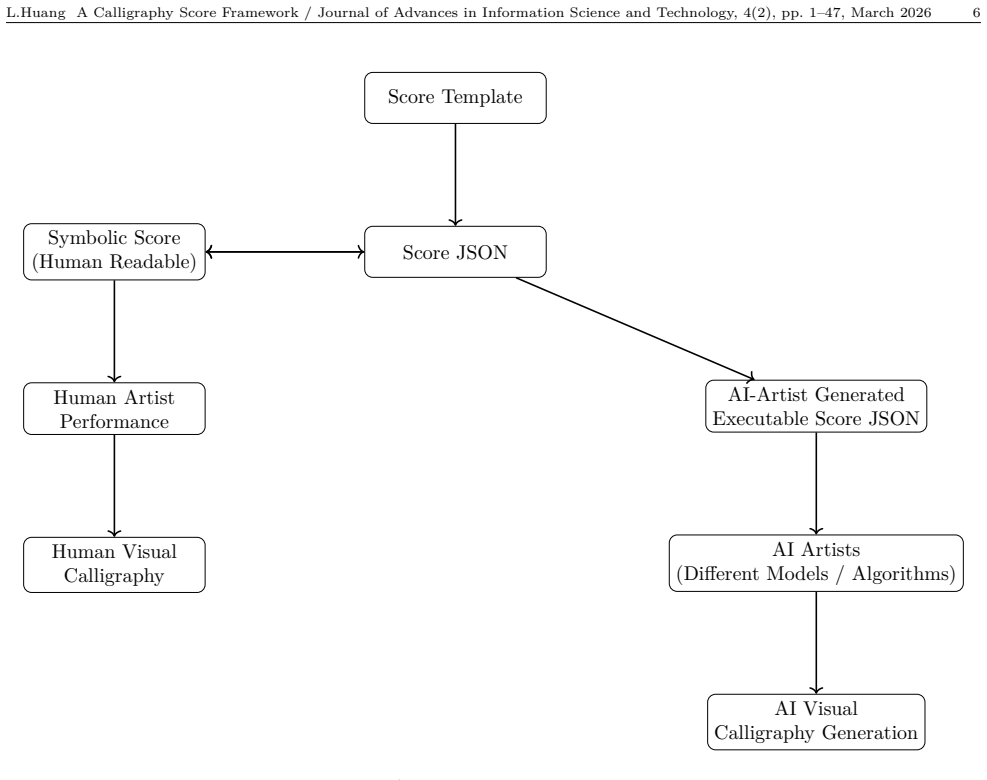
Summary. The paper proposes Calligraphy Writing Score Representation (CWSR) and the Shu Dao framework, which treat East Asian calligraphy as a time-based, score-mediated performance analogous to musical notation and practices such as Chadao/Shodō. CWSR encodes multi-level structure—stroke type/order/trajectory, character relations, line-level zhangfa, and dynamic attributes (pressure, pacing, gesture)—in a hierarchical, primarily JSON score rather than static images. Three contributions are claimed: (1) CWSR as a multi-level notation, (2) Shu Dao as a score-based conceptual paradigm, and (3) a computational foundation for analysis, visualization, and executable generation by AI calligraphic agents. A pipeline (score template → Score JSON → symbolic score / AI-filled executable JSON → SVG rendering) is illustrated with a short phrase in a Wang Xizhi–inspired style, including large appendix examples and partial rendering code.
Significance. If the representation is sound and usable, the work would be a useful conceptual and engineering contribution to computational calligraphy and digital humanities: it elevates stroke order, rhythm, and performative parameters to first-class, inspectable objects and cleanly separates structural score from human or AI interpretation. The music/Chadao analogy and the explicit multi-layer design (preparatory, whole/art, line, character, stroke) are thoughtful and well motivated relative to image-only or pure style-transfer approaches. Strengths include a fully specified machine-readable example, a dual human/AI interpretation path, and open discussion of grid resolution and applications. Significance is currently limited by the absence of systematic validation, baselines, or expert aesthetic evaluation; the paper is stronger as a framework/position piece than as a demonstrated computational foundation.
major comments (4)
- Contribution 3 and §§IV–V claim that CWSR “establishes a computational foundation” for analysis, visualization, and executable generation by AI calligraphic agents. The only empirical support is the §V demo and Appendices A.3–A.4: three agents fill numeric fields (pressure_curve, width_variation, ink wetness/feibai, step) into a hand-authored skeleton, and a partial SVG renderer (explicitly “primarily” grid geometry; dynamics “only partially utilized or currently omitted”) produces legible glyphs. There are no expert calligrapher ratings, traditional aesthetic criteria (balance, qi, feibai fidelity, zhangfa flow), ablation of dynamic fields, or comparison to prior stroke/trajectory systems. Without such evidence the “foundation” claim is asserted rather than shown; either add validation or substantially moderate Contribution 3 and related abstract/conclusion language.
- §V.C–D and Appendix A.3 present “AI-artist-generated executable Score JSON” as generative interpretation at the score level. In the provided A.3 example, stroke types, order, start/end coordinates, segments, Structure.connections, and most hierarchical layout remain essentially those of the hand-authored A.1 score; the agent mainly injects continuous parameters. This undercuts the claim that AI artists “select stroke features, determine execution order, [and] assign spatial relations” and risks circular self-demonstration (fill dynamics → render → claim success of the framework). Clarify what is authored vs. generated, and either show true structural variation under constraints or reframe the demo as parameter enrichment of a fixed score.
- §III.C and §VI.B assert that adjacency/connectivity, layering, proportionality, and a configurable grid (e.g., 9×9) preserve character integrity and structural logic under expressive variation. The manuscript never tests this: no integrity metrics, no stress tests under large pressure/pacing deviations, and no comparison of grid resolutions. Given that the skeptic’s weakest assumption is precisely the sufficiency of discrete grid-JSON plus loose hints, a minimal integrity check (e.g., connectivity violations, legibility under controlled noise, or expert structural ratings) is load-bearing for the central representation claim.
- §II surveys Chiang, Cook, Plamondon & Srihari, Wang et al. (stroke/haptic), and Xu et al. (artistic generation) but does not position CWSR against them with concrete differences in what is encoded, what is executable, or what becomes newly measurable. For a cs.HC / computational-creativity audience, a short comparison table or explicit “what prior systems omit that CWSR adds (and what they already provide)” is needed so the novelty of the score intermediary is not only philosophical.
minor comments (6)
- Throughout the PDF text, many Chinese characters and some Japanese terms appear as mojibake or replacement glyphs (e.g., “Shodō”, character examples, structure comments). Fix encoding so that “永和九年”, stroke names, and zhangfa comments are readable in the published version.
- Figure 1 is clear conceptually; Figure 2’s description of three agents and directory layout is hard to verify from the text alone—ensure the figure actually shows distinct stylistic differences and label which dynamic fields were used in each rendering.
- §I and abstract use “isuch as” / “icollapse” style artifacts (likely OCR or conversion errors). Clean copyediting pass needed.
- The human-readable symbolic score (A.2) is dense and uses ad-hoc symbols without a legend; add a short key mapping symbols to rhythm, pressure, and connection types so practitioners can actually read it as claimed.
- VIII declares ChatGPT use for draft preparation; ensure that the large JSON appendices and rendering code are author-verified for consistency with the prose claims about dynamics.
- Keywords and title use “Shu Dao” while related work discusses Shodō; a one-sentence clarification of naming (computational reinterpretation vs. traditional term) would reduce confusion for non-specialists.
Circularity Check
Mild definitional demo circularity only: the framework is stipulated as a multi-level score encoding, and the §V experiment simply authors then renders that encoding (with AI filling numeric dynamics), so ‘executable generation’ succeeds by construction of the representation and partial SVG plotter.
-
self definitional
[§V.A–D and Appendix A.1–A.4 (demo pipeline)]
"No reference images were used; the final visual forms emerge entirely from the score description encoded in the CWSR representation. ... Three independent AI agents were used to generate executable CWSR scores from the same initial Score JSON. ... This demonstration highlights three key capabilities of CWSR: Reproducibility ... Interpretability ... Generativity"
The Score JSON is manually authored with the exact stroke types, ordered segments, and 9×9 grid start/end points that already constitute the target characters (永和九年). Rendering (and AI filling of secondary numeric fields) therefore produces those characters by construction of the input encoding; the claimed ‘executable generation’ and ‘computational foundation’ reduce to visualizing the stipulated representation rather than deriving new structure or performance from independent principles.
full rationale
The paper is a conceptual framework proposal plus a hand-authored JSON demo; it contains no equations, no parameter fits to external data, no uniqueness theorems, and no self-citations of prior results by the same author. The three claimed contributions (CWSR notation, Shu Dao performance framing, computational foundation for AI agents) are definitional stipulations of a hierarchical score schema (stroke type/order/grid coords + Structure connections + Zhangfa + optional pressure/rhythm hints). Section V and Appendices A.1–A.4 then instantiate that schema for four characters, let three AI agents populate numeric fields (pressure_curve, width_variation, etc.), and render primarily the geometry via SVG. Legible glyphs therefore appear because the input already encodes the stroke skeleton of those characters; the rendering step does not independently discover or predict structure. This is ordinary ‘show the format works’ circularity of a representation paper, not a load-bearing reduction of a scientific prediction to its own fitted inputs. No stronger circular patterns (self-definitional derivation of a claimed first-principles result, fitted-input-as-prediction, uniqueness imported from authors, ansatz smuggled via self-citation) are present. Score remains low (2) because the demo is self-contained against its own construction and does not masquerade as external validation or prediction.
Assumptions & free parameters
free parameters (4)
- character grid resolution (e.g., 9×9)
- AI-filled pressure_curve / width_variation / ink wetness-feibai / step values
- self_rhythm_time and rhythm_beats
- brush size and material metadata
assumptions (4)
- domain assumption East Asian calligraphy is fundamentally a temporal, embodied performance whose meaning is not fully captured by static visual form.
- domain assumption Musical notation and Chadao-like ritual sequences are apt structural analogies for encoding calligraphy as ordered actions with room for expressive variation.
- domain assumption Canonical stroke types (dian, heng, shu, pie, na, compound strokes) plus relational constraints (adjacency, layering, balance) suffice as structural primitives for character integrity.
- ad hoc to paper A machine-readable hierarchical JSON score is an adequate intermediate for both human symbolic reading and AI executable generation.
invented entities (3)
-
Calligraphy Writing Score Representation (CWSR)
-
Shu Dao (computational score-mediated framework)
-
AI-based calligraphic agents operating at score level
Cite this review
Pith. "Pith review of Shu Dao: A Calligraphy Score Framework Linking Calligraphy, Music, and Performance." pith.science (2026). https://pith.science/paper/LSYI5KTF
@misc{pith2026260600001,
  author       = {Pith},
  title        = {Pith review of: Shu Dao: A Calligraphy Score Framework Linking Calligraphy, Music, and Performance},
  year         = {2026},
  howpublished = {\url{https://pith.science/paper/LSYI5KTF}},
  note         = {Machine review of arXiv:2606.00001}
}
read the original abstract
This paper introduces Calligraphy Writing Score Representation (CWSR) and proposes Shu Dao as a framework that interprets East Asian calligraphy as a performative art rather than a static visual artifact. Inspired by traditions such as Japanese Shod\=o and embodied cultural practices such as Chadao , the framework models calligraphy as a structured performance analogous to musical notation. Instead of representing characters as fixed images, the proposed approach encodes each brush stroke as an ordered and executable action, forming a calligraphy score. Characters are organized within a structured spatial grid, and strokes are annotated with attributes including stroke type, execution order, spatial coordinates, trajectory, compositional role, and dynamic properties such as brush pressure and pacing. This representation captures temporal and expressive aspects of calligraphic writing that are typically absent from image-based representations. The paper makes three main contributions. First, it introduces CWSR as a structured notation system for representing calligraphy across multiple levels, including strokes, character structures, and compositional organization (e.g., layout and zhangfa), together with their rhythmic and performative dynamics. Second, it conceptualizes Shu Dao as a score-mediated framework that models calligraphy as structured performance. Third, it establishes a computational foundation for the analysis, visualization, and executable generation of calligraphic works by AI-based calligraphic agents. Together, these contributions bridge calligraphy, musical notation, and performative cultural practices, supporting human--AI co-creation in computational calligraphy and digital humanities research.
Figures

Forward citations
Cited by 1 Pith paper
-
Entropy-based Code Adversarial Translation for Real-world Repository Migration
ECAT migrates Android repositories to HarmonyOS through an LLM generator-discriminator loop that minimizes a Code Entropy proxy, scoring 74.7% on a new 50K-300K LOC benchmark.
Reference graph
Works this paper leans on
-
[1]
Chinese calligraphy: An introduction to its aesthetic and technique
Yee Chiang. Chinese calligraphy: An introduction to its aesthetic and technique . Harvard University Press, 1974
1974
-
[2]
Beyond the score: Music as perfor- mance
Nicholas Cook. Beyond the score: Music as perfor- mance. Academic, 2013
2013
-
[3]
Plamondon and S.N
R. Plamondon and S.N. Srihari. Online and off-line handwriting recognition: a comprehensive survey. IEEE Transactions on Pattern Analysis and Ma- chine Intelligence , 22(1):63–84, 2000
2000
-
[4]
Cha dao: The way of tea, tea as a way of life
Solala Towler. Cha dao: The way of tea, tea as a way of life . Singing Dragon, 2010
2010
-
[5]
Stroke- based modeling and haptic skill display for chi- nese calligraphy simulation system
Daniel Wang, Yuru Zhang, and Chong Yao. Stroke- based modeling and haptic skill display for chi- nese calligraphy simulation system. Virtual Reality, 9(2):118–132, 2006
2006
-
[6]
The japanese tea ceremony and pan- cultural definitions of art
Daniel Wilson. The japanese tea ceremony and pan- cultural definitions of art. The Journal of Aesthetics and Art Criticism , 76(1):33–44, 2018
2018
-
[7]
descriptive
Songhua Xu, Francis CM Lau, William K Cheung, and Yunhe Pan. Automatic generation of artis- tic chinese calligraphy. IEEE Intelligent Systems , 20(3):32–39, 2005. A. EXAMPLE CALLIGRAPHY WRITING SCORE REPRESENT A TION (CWSR) This appendix presents a complete example of a Calligraphy Writing Score Representation (CWSR) in both machine-readable and human-rea...
2005
Reviewed July 13, 2026 · model on record in the stance chip above.
Discussion (0). Continue with ORCID to comment.