REVIEW 2 major objections 4 minor 22 references
Position Paper: Post-Solve Robustness in Decision Engines: Feasible Regions and Smoothness Under Perturbations
T0 review · 2 major / 4 minor · reviewed 2026-07-13 · grok-4.5
Pith's one-line read MILP decision engines should return not only a nominally optimal plan but a post-solve robustness report that certifies how far that plan can be trusted under perturbations.
desk verdict Clean position paper that packages known MILP robustness pieces into a budgeted post-solve report; useful agenda, no new theorems or evidence that the hard objects are tractable under industrial latency. read the letter →
The pith
A machine-rendered reading of the paper's core claim, the machinery that carries it, and where it could break.
The reading
What carries the argument
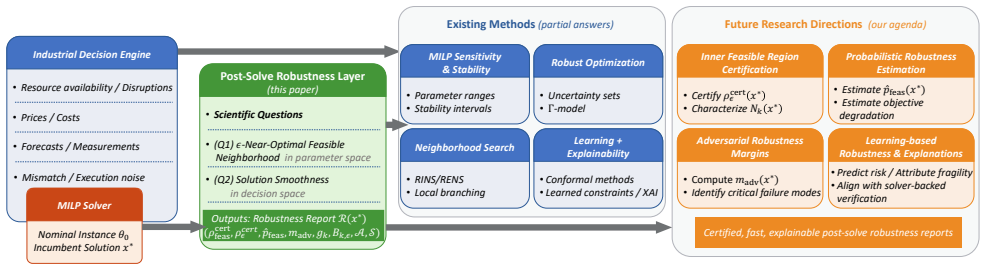
The pair of formal objects (i) the ε-near-optimal feasible neighborhood U_ε(x*) with certified radii ρ_cert_feas and ρ_cert_ε in parameter space, and (ii) solution smoothness via local backup gap g_k and backup count B_k,ε in decision space; these are packaged into the report R(x*) that turns partial sensitivity, neighborhood-search, and adversarial tools into a standardized deployment-facing output.
What would settle it
On a suite of industrial MILPs, check whether any post-solve procedure under a fixed latency budget returns certified radii or adversarial margins whose predicted coverage matches observed feasibility retention under realistic perturbations, and whether the report improves deployment decisions over returning the nominal incumbent alone; if no budgeted method improves calibration or actionability, the agenda fails.
Extended reading notes
Core claim
Post-solve robustness is a missing layer that should sit after a MILP solve: given a nominal incumbent, the engine must return a structured report that certifies an ε-near-optimal feasible neighborhood in parameter space and measures solution smoothness in decision space, under an explicit latency budget, so operators know how far the solution can be trusted and what nearby backups exist.
Load-bearing premise
The hard objects that define the report—certified radii, adversarial margins, and local backup metrics—can be approximated well enough, under a realistic post-solve time budget, to be useful on industrial-scale mixed-integer problems.
Editorial extensions
If this is right
- Decision engines would expose a tiered report—certified tolerance, calibrated risk, breaking scenario, and limited-change fallbacks—alongside every incumbent.
- Evaluation of learning-enabled decision systems would treat post-solve trustworthiness as a first-class dimension under a stated time budget.
- Certified inner approximations, probabilistic estimates, adversarial margins, and verified learning-based explanations would become routine post-solve services rather than separate research silos.
- Operators in logistics, energy, manufacturing, and finance could decide whether to execute, repair, or re-optimize from solver-backed evidence instead of informal judgment.
Reading between the lines
- If membership in the near-optimal neighborhood can be approximated under realistic latency, commercial solvers would likely ship a trust report the way they already ship duals and basis ranges for linear programs.
- The same report structure could serve as an evaluation harness for predict-then-optimize and learned-constraint pipelines, measuring whether learned pieces preserve local smoothness.
- A shared core metric layer plus domain-specific policy thresholds would enable cross-industry benchmarks of brittleness without erasing safety differences across logistics, energy, and finance.
Editorial analysis
A structured set of objections, weighed in public.
Referee Report
Summary. This position paper argues that MILP decision engines should attach a post-solve robustness layer to every returned incumbent x*, rather than treating robustness as an informal afterthought or solely as a pre-solve modeling choice. It formalizes two objects: (i) an ε-near-optimal feasible neighborhood in parameter space (U_feas / U_ε and the certified radii ρ_cert_feas, ρ_cert_ε in Definitions 1 and Eqs. 5–6) and (ii) solution smoothness in decision space (local backup gap g_k and backup count B_k,ε in Definition 2 and Eqs. 8–9). These are packaged into a structured report R(x*) under an explicit post-solve latency budget τ_post, with a three-tier presentation and an evaluation protocol. The paper synthesizes partial answers from MILP sensitivity/stability analysis, robust optimization, neighborhood search, adversarial testing, and learning-based methods, positions the layer as complementary to RO and classical sensitivity, and outlines four research directions (inner certification, probabilistic estimation, adversarial margins, learning-based prediction/explanation) plus industrial use cases.
Significance. If the agenda is adopted, robustness would become a first-class, standardized solver output rather than a scattered collection of post-hoc diagnostics. The formalization cleanly separates parameter-space trust regions from decision-space fallback smoothness, and the tiered report plus evaluation protocol (effectiveness, calibration, efficiency, actionability) give the community a concrete interface that logistics, energy, manufacturing, and finance could share. The literature synthesis is accurate and the complementarity claim versus RO is carefully drawn. As a pure position paper there are no machine-checked proofs, code, or empirical results to credit; the contribution is definitional and agenda-setting. Its value hinges on whether the hard objects it defines can be approximated usefully under realistic post-solve budgets—an open question the paper itself flags.
major comments (2)
- [Section II / Section IV] Section II (after Definition 2 and the report template R(x*)) correctly notes that even membership in U_0(x*) is hard and that estimating g_k / B_k,ε may require auxiliary restricted solves. The entire agenda, however, rests on these quantities becoming routine, budgeted solver outputs for industrial-scale MILPs. The four directions in Section IV remain high-level; the manuscript would be substantially stronger if it supplied at least one concrete, latency-bounded sketch (e.g., a slack-based lower bound for ρ_cert_feas, a local-branching procedure with explicit k and time limit for g_k / B_k,ε, or a restricted adversarial LP/MILP for m_adv) that demonstrates how a Tier-1 report could be produced under a realistic τ_post. Without such a sketch the central claim that the layer can be attached to existing solvers remains aspirational rather than operational.
- [Section III-G / III-H] Section III-G and III-H propose a core metric layer and an evaluation protocol, yet no baseline numbers, toy instances, or even synthetic coverage experiments are given. For a position paper this is not fatal, but a short illustrative example (e.g., a small knapsack or unit-commitment instance showing how ρ_cert_feas, p̂_feas, m_adv and a fallback S_top are computed and how they change under a stated D) would make the reporting template and the four evaluation dimensions falsifiable rather than purely schematic. Adding such an example would also clarify the intended trade-off between certificate strength and latency.
minor comments (4)
- [Figure 1] Figure 1 is dense; the four future-direction boxes and the report fields are hard to parse at typical column width. A simplified schematic that isolates the two scientific questions (Q1, Q2) and the Tier-1 outputs would improve readability.
- [Section II / IV-C] Notation for the adversarial margin switches between m_adv (Eq. 12) and the later m_feas_adv / m_ε_adv (Eqs. 13–14). A single consistent symbol with a subscript for the ε-case would reduce confusion.
- [Section III-E / V] Several recent self-citations (FFCG, iScheduler, dual-decomposition neural constraints) appear in the learning and industrial sections; they are legitimate prior work but are only loosely connected to post-solve robustness. A sentence clarifying the precise link (or moving them to a broader related-work footnote) would tighten the narrative.
- [Abstract / Introduction] The abstract and introduction use both “ε-near-optimal feasible neighborhood” and “ε-near-optimal feasible neighborhood in parameter space”; pick one phrase and use it consistently.
Circularity Check
No circularity: position paper formalizes definitions and an agenda without deriving claims from themselves or load-bearing self-citations.
full rationale
This is a position paper that defines two objects (ε-near-optimal feasible neighborhood U_ε(x*) and decision-space smoothness metrics g_k / B_k,ε), packages them into a report template R(x*), synthesizes existing partial answers from the literature, and proposes a research agenda. There is no derivation chain claiming a first-principles prediction, no parameter fitted to data and then re-presented as a prediction, and no uniqueness or ansatz result whose only support is a self-citation that encodes the target claim. The few author self-citations (e.g., column generation and scheduling work) appear as ordinary related prior work and are not used as hidden premises for Definitions 1–2 or the report template. The paper itself flags the computational hardness of the defined objects rather than claiming they are already obtained by construction. The central claim is therefore agenda-setting and definitional, not circular.
Assumptions & free parameters
assumptions (4)
- standard math A parametric MILP is written z(θ)=min{f(x;θ):x∈F(θ)∩X} with θ collecting all perturbable data (Section II).
- domain assumption Post-solve robustness complements rather than replaces robust optimization or stochastic programming (Introduction and §III-B).
- domain assumption Operators need four simultaneous outputs—trust-region size, failure risk, critical failure modes, and actionable backups—under an explicit latency budget τ_post (§III-G).
- domain assumption Distance functions d_θ on parameters and d_x (e.g., Hamming) on decisions are available and meaningful for the application (Definitions 1–2).
invented entities (4)
-
post-solve robustness layer
-
ε-near-optimal feasible neighborhood U_ε(x*) and certified radii ρ_cert_feas / ρ_cert_ε
-
solution-smoothness metrics g_k(x*) and B_k,ε(x*)
-
robustness report R(x*) and its three-tier presentation
Cite this review
Pith. "Pith review of Position Paper: Post-Solve Robustness in Decision Engines: Feasible Regions and Smoothness Under Perturbations." pith.science (2026). https://pith.science/paper/T67S5MB3
@misc{pith2026260600002,
  author       = {Pith},
  title        = {Pith review of: Position Paper: Post-Solve Robustness in Decision Engines: Feasible Regions and Smoothness Under Perturbations},
  year         = {2026},
  howpublished = {\url{https://pith.science/paper/T67S5MB3}},
  note         = {Machine review of arXiv:2606.00002}
}
abstract
Mixed-Integer Linear Programming (MILP) decision engines routinely output nominally optimal plans for high-stakes industrial systems. Yet deployment rarely matches solve-time assumptions: small perturbations in costs, demands, or resource availability can invalidate feasibility or trigger discontinuous shifts to qualitatively different solutions. We argue that this post-solve robustness gap is a missing layer in today's optimization pipelines and a missing evaluation dimension for learning-enabled decision systems. Rather than replacing robust optimization or stochastic programming, the proposed layer audits a solved incumbent and returns solver-backed evidence about how far that solution can be trusted. We formalize two central objects: (i) an $\epsilon$-near-optimal feasible neighborhood in parameter space, capturing when an incumbent remains feasible and near-optimal under perturbations, and (ii) solution smoothness in decision space, capturing whether nearby alternatives with small combinatorial edits remain competitive. We then synthesize the most relevant partial answers from sensitivity and stability analysis, robust optimization, neighborhood search, adversarial testing, and learning-based enhancements, and articulate an agenda for a unified post-solve robustness layer. Concretely, we call for certified inner approximations around the incumbent, probabilistic robustness estimation with calibrated uncertainty, adversarial robustness margins, and learning-based prediction and explanation aligned with solver-backed verification. We conclude with a compact reporting template and evaluation protocol that would make robustness a first-class output of decision engines.
Figures
Reference graph
Works this paper leans on
-
[1]
Sensitivity analysis for branch and bound integer programming,
L. Schrage and L. Wolsey, “Sensitivity analysis for branch and bound integer programming,”Operations Research, vol. 33, no. 5, pp. 1008– 1023, 1985
1985
-
[2]
Inference-based sensitivity analysis for mixed integer/linear programming,
M. Dawande and J. N. Hooker, “Inference-based sensitivity analysis for mixed integer/linear programming,”Operations Research, vol. 48, no. 4, pp. 623–634, 2000
2000
-
[3]
Mixed-integer linear programming–based sensitivity analysis in optimization of temporary haul road layout design for earthmoving operations,
C. Yi and M. Lu, “Mixed-integer linear programming–based sensitivity analysis in optimization of temporary haul road layout design for earthmoving operations,”Journal of Computing in Civil Engineering, vol. 33, no. 3, p. 04019021, 2019
2019
-
[4]
Local branching,
M. Fischetti and A. Lodi, “Local branching,”Mathematical program- ming, vol. 98, no. 1, pp. 23–47, 2003
2003
-
[5]
The radius of robust feasibility of uncertain mathematical programs: a survey and recent developments,
M. A. Goberna, V . Jeyakumar, G. Li, and J. Vicente-P ´erez, “The radius of robust feasibility of uncertain mathematical programs: a survey and recent developments,”European Journal of Operational Research, vol. 296, no. 3, pp. 749–763, 2022
2022
-
[6]
The price of robustness,
D. Bertsimas and M. Sim, “The price of robustness,”Operations research, vol. 52, no. 1, pp. 35–53, 2004
2004
-
[7]
Robust optimization,
A. Ben-Tal, A. Nemirovski, and L. El Ghaoui, “Robust optimization,” 2009
2009
-
[8]
Exploring relaxation induced neighborhoods to improve mip solutions,
E. Danna, E. Rothberg, and C. L. Pape, “Exploring relaxation induced neighborhoods to improve mip solutions,”Mathematical Programming, vol. 102, no. 1, pp. 71–90, 2005
2005
Show all 22 references
-
[9]
Rens-relaxation enforced neighborhood search,
T. Berthold, “Rens-relaxation enforced neighborhood search,” 2007
2007
-
[10]
Heuristics in mixed integer programming,
M. Fischetti, A. Lodiet al., “Heuristics in mixed integer programming,” Wiley Encyclopedia of Operations Research and Management Science. John Wiley & Sons, Inc, pp. 2–23, 2010
2010
-
[11]
Adaptive robust optimization for the security constrained unit commitment prob- lem,
D. Bertsimas, E. Litvinov, X. A. Sun, J. Zhao, and T. Zheng, “Adaptive robust optimization for the security constrained unit commitment prob- lem,”IEEE transactions on power systems, vol. 28, no. 1, pp. 52–63, 2012
2012
-
[12]
Optimization with constraint learning: A framework and survey,
A. O. Fajemisin, D. Maragno, and D. den Hertog, “Optimization with constraint learning: A framework and survey,”European Journal of Operational Research, vol. 314, no. 1, pp. 1–14, 2024
2024
-
[13]
Conformal mixed-integer constraint learning with feasibility guarantees,
D. Ovalle, L. T. Biegler, I. E. Grossmann, C. D. Laird, and M. D. Rubio, “Conformal mixed-integer constraint learning with feasibility guarantees,”arXiv preprint arXiv:2506.03531, 2025
2025 arXiv
-
[14]
Scalable mixed- integer optimization with neural constraints via dual decomposition,
S. Zeng, S. Zhang, F. Wu, S. Tang, and X. Li, “Scalable mixed- integer optimization with neural constraints via dual decomposition,” in Proceedings of the AAAI Conference on Artificial Intelligence, vol. 40, no. 17, 2026, pp. 14 388–14 396
2026
-
[15]
Ffcg: Effective and fast family column generation for solving large-scale linear program,
Y .-X. Hu, F. Wu, S. Li, Y . Zhao, and X.-Y . Li, “Ffcg: Effective and fast family column generation for solving large-scale linear program,” Proceedings of the AAAI Conference on Artificial Intelligence, vol. 39, no. 11, pp. 11 238–11 245, Apr. 2025
2025
-
[16]
Optichat: Bridging optimization models and practitioners with large language models,
H. Chen, G. E. Constante-Flores, K. S. I. Mantri, S. M. Kompalli, A. S. Ahluwalia, and C. Li, “Optichat: Bridging optimization models and practitioners with large language models,”INFORMS Journal on Data Science, 2025
2025
-
[17]
Exploiting constraint reasoning to build graphical explanations for mixed-integer linear programming,
R. X. Lera-Leri, F. Bistaffa, A. Georgara, and J. A. Rodr ´ıguez-Aguilar, “Exploiting constraint reasoning to build graphical explanations for mixed-integer linear programming,” inInternational Workshop on Ex- plainable, Trustworthy, and Responsible AI and Multi-Agent Systems....
2025
-
[18]
Toward trans- parent optimization: A systematic review of explainable ai in decision- making systems,
K. Danach, W. H. F. Aly, A. Tarhini, and S. Laouadi, “Toward trans- parent optimization: A systematic review of explainable ai in decision- making systems,”European Journal of Pure and Applied Mathematics, vol. 18, no. 4, pp. 6707–6707, 2025
2025
-
[19]
Two-stage predict+ optimize for milps with unknown parameters in constraints,
X. Hu, J. Lee, and J. Lee, “Two-stage predict+ optimize for milps with unknown parameters in constraints,”Advances in neural information processing systems, vol. 36, pp. 14 247–14 272, 2023
2023
-
[20]
Robust scheduling for multi-product pipelines under demand uncertainty,
S. Moradi and S. MirHassani, “Robust scheduling for multi-product pipelines under demand uncertainty,”The International Journal of Advanced Manufacturing Technology, vol. 87, no. 9, pp. 2541–2549, 2016
2016
-
[21]
Robust opti- mization for electricity generation,
H. Yang, D. P. Morton, C. Bandi, and K. Dvijotham, “Robust opti- mization for electricity generation,”INFORMS Journal on Computing, vol. 33, no. 1, pp. 336–351, 2021
2021
-
[22]
ischeduler: Reinforcement learning-driven continual optimization for large-scale resource investment problems,
Y .-X. Hu, Y . Wang, F. Wu, Z. Huang, S. Zeng, and X.-Y . Li, “ischeduler: Reinforcement learning-driven continual optimization for large-scale resource investment problems,”arXiv preprint arXiv:2602.06064, 2026
2026
Reviewed July 13, 2026 · model on record in the stance chip above.
Discussion (0). Sign in to comment.