Metaverse in Smart Cities: Transforming Urban Life and Governance
Pith reviewed 2026-07-05 09:46 UTC · model glm-5.2
The pith
Mapping the Metaverse onto Six City Pillars
A machine-rendered reading of the paper's core claim, the machinery that carries it, and where it could break.
Core claim
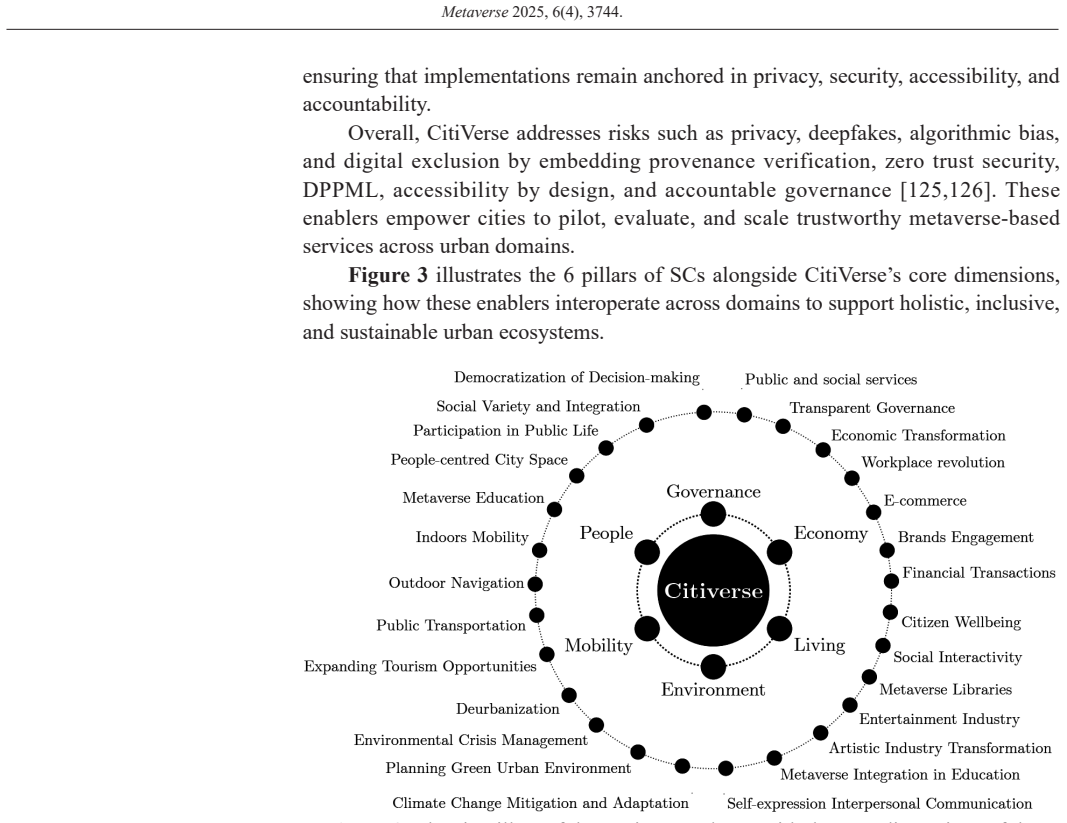
The paper's central contribution is the CitiVerse framework itself: a mapping that takes core metaverse capabilities — simulation, immersion, co-creation, and data-driven services — and aligns them with Giffinger's six smart-city pillars. This alignment is presented as a bridge between two domains previously treated separately in the literature. The paper claims that by using this mapping, cities can identify where immersive technologies create concrete public value (participatory planning, accessible remote services, simulation-driven optimization of mobility and environment) and where safeguards are essential (privacy, data sovereignty, digital inclusion, cybersecurity). The comparative案例s
What carries the argument
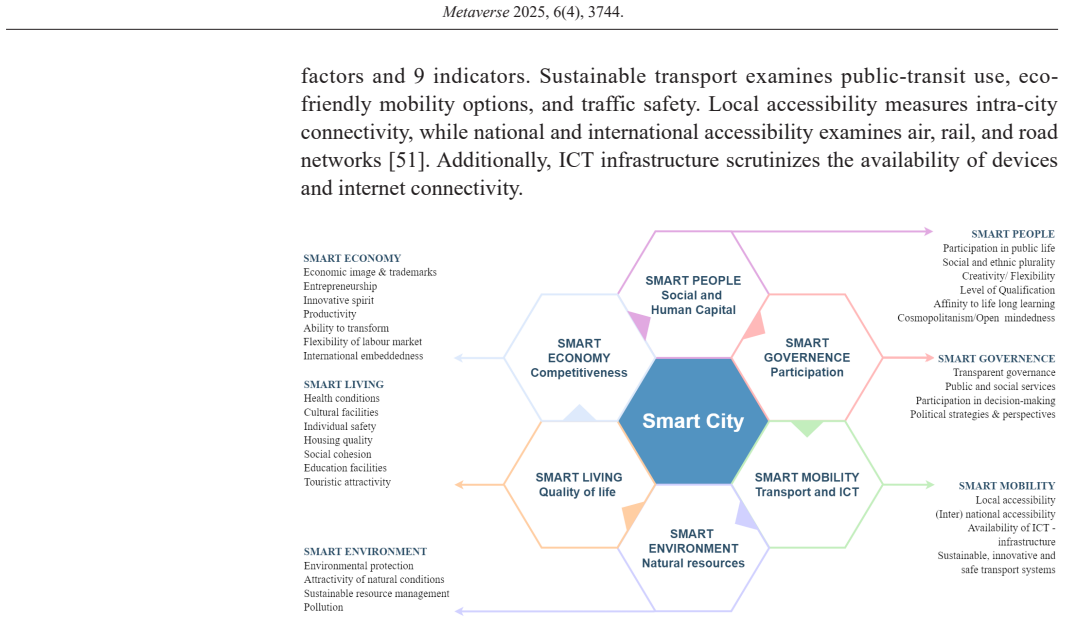
CitiVerse — a citizen-centric metaverse framework defined as a subcategory of the metaverse focused on 'virtual worlds for citizens,' operating on three principles: people-centricity, a broad portfolio of innovative virtual services, and avatar-based representation for all city stakeholders. It is mapped onto Giffinger's six-dimensional smart-city model (smart economy, smart people, smart governance, smart mobility, smart environment, smart living), which provides 31 factors and 74 indicators for assessing urban performance.
If this is right
- If the CitiVerse mapping is useful, cities adopting metaverse technologies could use it as a checklist to ensure pilots address all six urban dimensions rather than focusing narrowly on economy or governance, reducing blind spots in deployment.
- The challenges-risks-countermeasures matrix could serve as a pre-deployment risk assessment tool for municipal metaverse projects, forcing planners to address privacy, accessibility, and cybersecurity before launch rather than retrofitting safeguards.
- The framework could enable comparative benchmarking across cities: if two cities report metaverse deployments under the same pillar, the Giffinger indicators provide a common language for evaluating which approach produced better outcomes.
- The ITU's engagement with CitiVerse through its Focus Groups suggests the framework could become a basis for international standards on metaverse-in-cities interoperability, accessibility, and data governance.
Where Pith is reading between the lines
- The paper assumes Giffinger's model — designed for performance assessment via indicators like R&D expenditure and library circulation — is the right scaffold for organizing capabilities that are fundamentally about immersive interaction and simulation. Whether these two domains align naturally or whether the mapping forces a fit is not tested; the paper asserts the fit through illustration rather
- The case studies are drawn from cities that are already leaders in digital deployment (Seoul, Singapore, Dubai, Shanghai). If the framework were applied to smaller or less digitally mature cities, the balance of opportunities and risks might shift substantially — the paper acknowledges this limitation but does not explore how the framework would need to adapt.
- The paper treats 'metaverse' as a coherent technology category, but the deployments it describes range from digital twins (Virtual Singapore, 2014) to blockchain-based cultural platforms (CatVers) to AR navigation tools. Whether these share enough common infrastructure to be governed by a single framework is an open question the paper does not address.
- The countermeasures proposed (DIDs, DPPML, zero-trust architectures, DPIAs) are technically sophisticated and resource-intensive. Their feasibility for the same under-resourced cities that the paper identifies as most at risk of digital exclusion is not examined.
Load-bearing premise
The paper assumes that Giffinger's six-dimension smart-city model — originally built to assess city performance through indicators like R&D spending, patent counts, and library borrowing rates — is the right organizing scaffold for metaverse capabilities, which are primarily about immersive interaction, simulation, and digital identity. This choice is asserted and illustrated but never justified against alternative frameworks or tested empirically.
What would settle it
If a city adopted the CitiVerse mapping and found that metaverse capabilities did not align cleanly with the six pillars — for example, if most real deployments clustered in only two or three dimensions, or if key metaverse functions (like avatar-based identity or persistent virtual worlds) cut across all six dimensions without fitting neatly into any single one — the framework's claim to be a comprehensive organizing model would be weakened.
Figures
read the original abstract
The integration of metaverse technologies within Smart Cities is transforming urban governance and citizen engagement. Despite the increasing academic and industry interest, research on the practical applications of the metaverse in SCs remains fragmented. This study addresses this gap through a systematic literature review on how metaverse-driven solutions impact economic transformation, governance, mobility, sustainability, and social interactions in urban environments. The study synthesizes findings from existing applications and case studies, such as Metaverse Seoul, Dubai's Metaverse Strategy, Virtual Helsinki, and Tampere's CitiVerse initiative, to illustrate the diverse ways in which cities are leveraging metaverse technologies. These applications demonstrate the metaverse's potential in digital governance, Artificial Intelligence (AI)-driven urban planning, e-participation, transportation optimization, and climate resilience strategies. This research contributes to the field by providing a comprehensive framework for understanding the benefits and challenges of metaverse-driven SC models. The findings suggest that while metaverse adoption in SCs presents significant advantages in efficiency, participation, and innovation, it also entails challenges related to technological accessibility, governance frameworks, and security measures that must be addressed for broad uptake. The study's impact extends to policymakers, urban planners, and technology developers by offering strategic insights for responsible and inclusive metaverse adoption. Ultimately, this study provides a structured roadmap for integrating metaverse technologies into smart urban ecosystems, ensuring their long-term viability, accessibility, and effectiveness in shaping the cities of the future.
Editorial analysis
A structured set of objections, weighed in public.
Referee Report
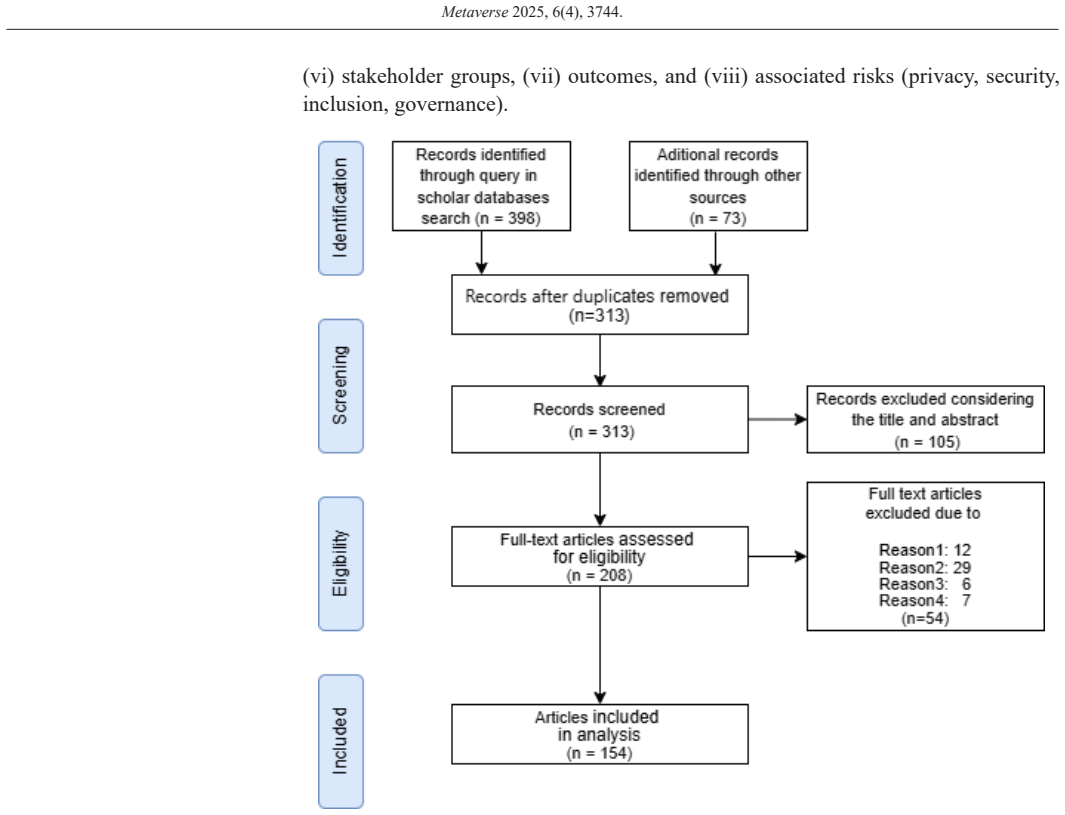
Summary. This manuscript presents a systematic literature review (PRISMA 2020) examining how metaverse technologies integrate with Smart Cities (SCs) across Giffinger's six-dimensional SC model. It introduces the 'CitiVerse' framework—attributed to ITU sources—as an operational layer mapping metaverse capabilities (simulation, immersion, co-creation, data-driven services) onto the six SC pillars. The review synthesizes 154 studies and supplements them with comparative case studies of eleven city deployments (Seoul, Dubai, Tampere, Helsinki, Catalonia, London, New York, Shanghai, Singapore, Barbados, Boston). The paper identifies opportunities (economic diversification, participatory governance, sustainability simulation) and challenges (digital divide, cybersecurity, regulatory ambiguity) across the six pillars, culminating in a SWOT analysis and a set of CitiVerse enablers for practitioners.
Significance. The manuscript addresses a genuine gap at the intersection of metaverse technologies and urban governance, an area where academic literature remains fragmented. The PRISMA-based methodology is described with reasonable transparency (search terms, databases, inclusion/exclusion criteria, flow diagram). The comparative case studies across eleven cities provide a useful empirical anchor that goes beyond purely conceptual treatments. The CitiVerse concept is properly attributed to ITU sources rather than claimed as a novel invention. The mapping of cybersecurity countermeasures (DIDs, DPPML, zero-trust, SLAM minimization) to specific SC domains in Table 4 is a practical contribution for policymakers. However, the central claim that this mapping constitutes a 'comprehensive framework' and 'reusable reference model' is only partially supported, as detailed below.
major comments (3)
- §2.2 vs. §4.1.1–§4.1.6: The paper describes Giffinger's model in full operational detail in §2.2—6 dimensions, 31 factors, 74 indicators (e.g., R&D expenditure as % of GDP, library circulation rates, air traffic volume, crime rates). However, the six pillar sections in §4.1.1–§4.1.6 never reference, adapt, or operationalize any of these factors or indicators. For example, §4.1.1 (Smart Economy) discusses e-commerce, NFTs, and virtual workplaces, none of which connect to Giffinger's actual Smart Economy factors (innovation, entrepreneurship, labor market flexibility, international integration, economic branding). §4.1.2 (Smart People) discusses urban planning and interactive learning rather than Giffinger's indicators (book-borrowing rates, lifelong learning participation, migrant integration). This pattern repeats across all six pillars. The mapping uses Giffinger's dimension labels as a
- §3, PRISMA methodology: The search is limited to Google Scholar and Web of Science. For a topic spanning immersive technologies, urban computing, and digital governance, the omission of IEEE Xplore, ACM Digital Library, and Scopus risks systematic exclusion of relevant engineering and HCI literature. Additionally, the paper does not report inter-rater reliability (e.g., Cohen's kappa) for the screening and eligibility stages, which is standard practice for PRISMA-based reviews with multiple reviewers. The author contributions statement lists three authors, so screening was presumably divided; without a reliability metric, the reproducibility of the 313→208→154 funnel cannot be assessed. This is load-bearing for the review's claim to methodological rigor.
- §5.3 and Abstract: The claim that the study provides 'a reusable reference model' and 'a structured roadmap' is not substantiated by a concrete, operational artifact. §5.3 lists conceptual, methodological, empirical, and novelty contributions but does not point to a formalized model—e.g., a set of assessment criteria, a maturity model, or decision rules—that a practitioner could apply. The CitiVerse enablers in §5.1 (active citizen participation, use of avatars, innovative service delivery, etc.) are high-level principles, not an operational reference model. If the intent is a thematic organizing framework, the language should be scaled accordingly; if a reference model is claimed, the manuscript should include or reference a formalized artifact.
minor comments (10)
- §2.2, Figure 1: The figure caption states 'adapted by the author' but the source of the adaptation is unclear. If this reproduces Giffinger et al. [24] directly, a citation in the caption is needed; if modified, the modifications should be specified.
- §3: The Boolean search string contains a missing Boolean operator between 'cognitive city' and 'smart sustainable city'—the string reads 'cognitive city' 'smart sustainable city' without an intervening OR. This should be corrected.
- §4.1.1: The reference '[59,79,89,90,91]' appears to contain a formatting inconsistency (extra comma or missing space). Please verify against the reference list.
- Table 3: Several city entries reference official websites (e.g., Seoul, Dubai, Tampere, Helsinki, Catalonia, London, NYC, Shanghai, Singapore, Barbados, Boston) with URLs embedded in the table text. These should be formatted as footnotes or a separate 'Data Sources' column for consistency and to ensure they render properly in the published version.
- Table 4: The 'Computing and Immersive Technology' row appears as a seventh domain alongside the six Giffinger pillars. This is a reasonable addition but should be explicitly flagged as an extension beyond Giffinger's model, with a brief justification for why it is included as a separate row rather than distributed across the six pillars.
- §5.1: The paragraph beginning 'Cybersecurity and data sovereignty' is very long (approximately 800 words) and covers multiple distinct topics (risk domains, attack vectors, countermeasures, city-level examples). Breaking it into subsections (e.g., '5.1.1 Risk domains,' '5.1.2 Attack vectors,' '5.1.3 Countermeasures') would improve readability.
- §5.2, Table 5 (SWOT): The 'City micro-cases' entries under each SWOT quadrant are a useful addition but are formatted inconsistently—some use bracketed citations, others do not. Standardize the format.
- §6: The limitation that 'Self-reported municipal data may also introduce optimism or selection bias' is acknowledged but could be strengthened by noting which specific case-study claims are most vulnerable to this bias (e.g., Dubai's job-creation targets, Shanghai's $52 billion industry projection).
- References: Several arXiv preprints and technical reports are cited (e.g., [126], [141]). Ensure that all have been updated to the latest published versions where applicable, and that access dates are consistently reported for all URLs.
- Author contributions: 'P. Toutsa' appears in the writing—review and editing line; this should likely be 'P. Tsoutsa.' Please verify.
Simulated Author's Rebuttal
We thank the referee for a careful and constructive report. The three major comments identify genuine gaps between what the manuscript claims and what it currently delivers. We agree with all three points and will revise accordingly: (1) the Giffinger factors/indicators will be explicitly connected to the pillar-level discussion in Section 4, (2) the PRISMA methodology will be strengthened by adding IEEE Xplore, ACM Digital Library, and Scopus to the search and by reporting inter-rater reliability, and (3) the language around 'reference model' and 'roadmap' will be either substantiated with a more formalized artifact or scaled back to match what the paper actually provides.
read point-by-point responses
-
Referee: §2.2 vs. §4.1.1–§4.1.6: Giffinger's factors and indicators are described in detail in §2.2 but never referenced or operationalized in the six pillar sections. The mapping uses Giffinger's dimension labels but not the underlying factors or indicators.
Authors: The referee is correct. Section 2.2 describes Giffinger's 31 factors and 74 indicators in operational detail, but Sections 4.1.1–4.1.6 do not connect the metaverse applications discussed back to those specific factors and indicators. This is a genuine gap between the paper's stated framework and its analysis. We will revise each of the six pillar sections to explicitly reference the relevant Giffinger factors and, where the literature supports it, the specific indicators. For example, in §4.1.1 (Smart Economy), we will connect the discussion of NFTs and virtual workplaces to Giffinger's factors of entrepreneurship, international integration, and economic branding, and note where metaverse applications create new measurement challenges for indicators such as R&D expenditure share and trade volume. In §4.1.2 (Smart People), we will link the discussion of interactive learning and citizen engagement to the factors of education/lifelong learning, openness/participation, and social/ethnic diversity, including the specific indicators (library circulation, lifelong learning participation, migrant integration). We will apply this pattern across all six pillars. Where the metaverse literature does not yet address a Giffinger indicator, we will state this explicitly as a gap rather than silently omitting it. This revision will make the use of Giffinger's model substantive rather than merely structural. revision: yes
-
Referee: §3, PRISMA methodology: Search limited to Google Scholar and Web of Science; omission of IEEE Xplore, ACM Digital Library, and Scopus risks systematic exclusion of engineering and HCI literature. No inter-rater reliability (e.g., Cohen's kappa) reported for screening and eligibility stages.
Authors: We agree with both points. The omission of IEEE Xplore, ACM Digital Library, and Scopus is a legitimate concern for a topic that spans immersive technologies, urban computing, and HCI. We will expand the search to include these three databases and re-run the identification and screening stages. We will update the PRISMA flow diagram and the reported counts accordingly. If the expanded search yields additional studies that materially affect the synthesis, we will incorporate them into the relevant sections. Regarding inter-rater reliability: the author contributions statement lists three authors, and screening was indeed divided among them. We will report Cohen's kappa (or an equivalent agreement metric) for the screening and eligibility stages. If the original screening records allow retrospective calculation, we will report the actual values; if not, we will conduct a re-screening of a sample of records to establish reliability and report that process transparently. Either way, the revised manuscript will include an inter-rater reliability metric. revision: yes
-
Referee: §5.3 and Abstract: The claim that the study provides 'a reusable reference model' and 'a structured roadmap' is not substantiated by a concrete, operational artifact. The CitiVerse enablers are high-level principles, not an operational reference model.
Authors: The referee is correct that the current manuscript does not deliver a formalized artifact—such as a maturity model, assessment criteria, or decision rules—that would justify the term 'reference model.' The CitiVerse enablers in §5.1 are indeed high-level principles rather than an operational tool. We see two options and will pursue the one that best serves the paper's contribution. First, we can scale back the language to match what the paper actually provides: a thematic organizing framework and a synthesis of evidence, not a formal reference model. This would involve revising the abstract, §5.3, and related claims throughout to use terms such as 'organizing framework' and 'evidence-informed guidance' rather than 'reusable reference model' and 'structured roadmap.' Alternatively, we can add a concrete artifact—for example, a preliminary assessment checklist or maturity indicators mapped to the six pillars—that a practitioner could apply. Given the scope of the paper and the strength of the evidence currently assembled, we are inclined toward the first option (scaling back the language) while adding a brief assessment-oriented table that maps each pillar to a small set of actionable evaluation questions derived from the synthesis. This would make the paper's claims honest without overpromising. We will implement whichever approach the editor and referee prefer. revision: yes
Circularity Check
No circularity found; self-citations are contextual, not load-bearing
full rationale
This is a systematic literature review, not a derivation chain. The paper's central framework—mapping metaverse capabilities onto Giffinger's six smart-city pillars—uses an externally cited model (Giffinger et al. [24]) and attributes the CitiVerse concept to ITU sources [57, 58, 141], not to the authors' own prior work. Self-citations ([31], [33], [51], [77], [83]) appear in related-work contexts (e.g., '[77]' is cited in §4.1.1 for the general claim that metaverse convergence broadens economic opportunities) but do not define the framework's core claims or serve as uniqueness theorems. No step in the paper reduces by construction to its own inputs: there is no fitted parameter renamed as prediction, no self-definitional loop, and no ansatz smuggled through self-citation. The skeptic's concern that the mapping uses Giffinger's dimension names as thematic buckets without operationalizing the model's 31 factors or 74 indicators is a valid depth/correctness concern, but it is not circularity—the paper does not claim to derive results from the mapping that are equivalent to the mapping's inputs. Score 1 reflects the presence of minor self-citations that are non-load-bearing.
Axiom & Free-Parameter Ledger
axioms (3)
- domain assumption Giffinger's six-dimension smart-city model is the appropriate framework for organizing metaverse capabilities in cities.
- domain assumption Secondary literature and municipal reports accurately reflect real-world metaverse deployments in cities.
- domain assumption PRISMA 2020 guidelines are applicable to a review combining systematic literature search with non-systematic case-study selection.
invented entities (1)
-
CitiVerse framework (as a mapping of metaverse capabilities to Giffinger's six pillars)
no independent evidence
Reference graph
Works this paper leans on
-
[2]
Covid-19 sentiments in smart cities: The role of technology anxiety before and during the pandemic
Troisi O, Fenza G, Grimaldi M. Covid-19 sentiments in smart cities: The role of technology anxiety before and during the pandemic. Computers in Human Behavior. 2022, 126, 106986. doi:10.1016/j.chb.2021.106986
-
[3]
Allam Z, Sharifi A, Bibri SE, et al. The metaverse as a virtual form of smart cities: Opportunities and challenges for environmental, economic, and social sustainability in urban futures. Smart Cities. 2022, 5(3): 771–801. doi: 10.3390/ smartcities5030040
work page 2022
-
[4]
Bibri SE, Jagatheesaperumal SK. Harnessing the potential of the metaverse and artificial intelligence for the internet of city things: Cost-effective XReality and synergistic AIoT technologies. Smart Cities. 2023, 6(5): 2397–2429. doi: 10.3390/ smartcities6050109
work page 2023
-
[5]
Kuru K, Kuru K. Blockchain-based decentralised privacy-preserving machine learning authentication and verification with immersive devices in the urban metaverse ecosystem. In: Proceedings of the 20th IEEE/ASME International Conference on Mechatronic and Embedded Systems and Applications (MESA); 2–4 September 2024; Genova, Italy. doi: 10.1109/ MESA61532.20...
-
[6]
Bibri SE, Allam Z, Krogstie J. The Metaverse as a virtual form of data-driven smart urbanism: platformization and its underlying processes, institutional dimensions, and disruptive impacts. Computational Urban Science. 2022, 2(1), 24. doi: 10.1007/s43762-022-00051-0
-
[7]
Dwivedi YK, Hughes L, Baabdullah AM, et al. Metaverse beyond the hype: Multidisciplinary perspectives on emerging challenges, opportunities, and agenda for research, practice and policy. International Journal of Information Management. 2022, 66, 102542. doi: 10.1016/j.ijinfomgt.2022.102542
-
[8]
A first bibliometric literature review on Metaverse
Abbate S, Centobelli P, Cerchione R, et al. A first bibliometric literature review on Metaverse. In: Proceeding of the 2022 IEEE Technology and Engineering Management Conference (TEMSCON EUROPE); 25–29 April 2022; Bergamo, Italy. pp. Metaverse 2025, 6(4), 3744. 36 254–260. doi: 10.1109/TEMSCONEUROPE54743.2022.9802015
-
[9]
The microverse: A task-oriented edge-scale metaverse
Qu Q, Hatami M, Xu R, et al. The microverse: A task-oriented edge-scale metaverse. Future Internet, 2024, 16(2), 60. doi: 10.3390/fi16020060
-
[10]
Lee LH, Braud T, Zhou P, et al. All one needs to know about metaverse: A complete survey on technological singularity, virtual ecosystem, and research agenda. Foundations and trends® in human-computer interaction. 2024, 18(2–3), 100–337. doi: 10.1561/1100000095
-
[11]
A survey on the metaverse: The state-of-the-art, technologies, applications, and challenges
Wang H, Ning H, Lin Y , et al. A survey on the metaverse: The state-of-the-art, technologies, applications, and challenges. IEEE Internet of Things Journal. 2023, 10(16): 14671–14688. doi: 10.1109/JIOT.2023.3278329
-
[12]
Cities and territorial brand in the metaverse: The metaverse Seoul case
de Almeida GG. Cities and territorial brand in the metaverse: The metaverse Seoul case. Sustainability. 2023, 15(13), 10116. doi: 10.3390/su151310116
-
[13]
Design of three-dimensional visualization indoor navigation system in smart city construction
Guo C, Liu C, Wei E. Design of three-dimensional visualization indoor navigation system in smart city construction. In: Proceedings of the E3S Web of Conferences, EDP Sciences, 3rd International Conference on Civil, Architecture and Urban Engineering (ICCAUE 2021); 7 July 2021. V ol. 283, p. 02025. doi: 10.1051/e3sconf/202128302025
-
[14]
The rising trend of Metaverse in education: Challenges, opportunities, and ethical considerations
Kaddoura S, Al Husseiny F. The rising trend of Metaverse in education: Challenges, opportunities, and ethical considerations. PeerJ Computer Science. 2023, 9: e1252. doi: 10.7717/peerj-cs.1252
-
[15]
Metaverse in education: Vision, opportunities, and challenges
Lin H, Wan S, Gan W, et al. Metaverse in education: Vision, opportunities, and challenges. In: Proceedings of the 2022 IEEE International Conference on Big Data (Big Data); 17–20 December 2022; Osaka, Japan. pp. 2857–2866. doi: 10.1109/ BigData55660.2022.10021004
-
[16]
Bibri SE. The social shaping of the metaverse as an alternative to the imaginaries of data-driven smart Cities: A study in science, technology, and society. Smart Cities. 2022, 5(3): 832–874. doi: 10.3390/smartcities5030043
-
[17]
A review of metaverse and cybersecurity in the digital era
Jaipong P, Siripipattanakul S, Sriboonruang P, et al. A review of metaverse and cybersecurity in the digital era. International Journal of Computing Sciences Research. 2023, 7: 1125–1132. doi: 10.25147/ijcsr.2017.001.1.122
-
[18]
Research on Metaverse Security and Forensics
Liang G, Xin J, Wang Q, et al. Research on Metaverse Security and Forensics. Computers, Materials & Continua. 2023, 77(1). doi: 10.32604/cmc.2023.038403
-
[19]
A scoping review of metaverse in emergency medicine
Wu TC, Ho CT. A scoping review of metaverse in emergency medicine. Australasian emergency care. 2023, 26(1): 75–83. doi: 10.1016/j.auec.2022.08.002
-
[20]
Metaverse in the urban destinations in China: some insights for the tourism players
Zhang J, Quoquab F. Metaverse in the urban destinations in China: some insights for the tourism players. International Journal of Tourism Cities. 2023, 9(4): 1016–1024. doi: 10.1108/IJTC-04-2023-0062
-
[21]
Shen B, Tan W, Guo J, et al. How to promote user purchase in metaverse? A systematic literature review on consumer behavior research and virtual commerce application design. Applied Sciences. 2021, 11(23), 11087. doi: 10.3390/ app112311087
work page 2021
-
[22]
Metaverse marketing: How the metaverse will shape the future of consumer research and practice
Dwivedi YK, Hughes L, Wang Y , et al. Metaverse marketing: How the metaverse will shape the future of consumer research and practice. Psychology & Marketing. 2023, 40(4): 750–776. doi: 10.1002/mar.21767
-
[23]
Perceptions and drivers of the metaverse adoption: a mixed‐methods study
Adhini NV , Prasad CV . Perceptions and drivers of the metaverse adoption: a mixed‐methods study. International Journal of Consumer Studies. 2024, 48(4): e13069. doi: 10.1111/ijcs.13069
-
[24]
City-ranking of European medium-sized cities
Giffinger R, Fertner C, Kramar H, et al. City-ranking of European medium-sized cities. Cent. Reg. Sci. Vienna UT. 2007, 9(1): 1–12
work page 2007
-
[25]
Reappropriating, reconfiguring and augmenting the smart city through play
Leorke D. Reappropriating, reconfiguring and augmenting the smart city through play. In: Nijholt A (editor). Making Smart Cities More Playable: Exploring Playable Cities. Springer Nature Singapore Pte Ltd; 2020. pp. 51–70. doi: 10.1007/978-981- 13-9765-3
-
[26]
Soeiro D. Smart cities and innovative governance systems: A reflection on urban living labs and action research. Fennia- International Journal of Geography. 2021, 199(1): 104–112. doi: 10.11143/fennia.97054
-
[28]
Simonofski A, Vallé T, Serral E, et al. Investigating context factors in citizen participation strategies: A comparative analysis of Swedish and Belgian smart cities. International Journal of Information Management. 2021, 56, 102011. doi: 10.1016/ j.ijinfomgt.2019.09.007
work page 2021
-
[29]
Buzzword or fuzzword: an event study of the metaverse in the Chinese stock market
Xu Y , Liu W, He T, et al. Buzzword or fuzzword: an event study of the metaverse in the Chinese stock market. Internet Metaverse 2025, 6(4), 3744. 37 Research. 2024, 34(1): 174–194. doi: 10.1108/INTR-07-2022-0526
-
[30]
OECD (2021). Measuring smart city performance in COVID-19 times: Lessons from Korea and OECD countries, Proceedings from the 2nd OECD, 2021, Roundtable on Smart Cities and Inclusive Growth. Available online: https:// www.oecd.org/en/publications/measuring-smart-city-performance-in-covid-19-times-lessons-from-korea-and-oecd- countries_72a4e7db-en.html (acc...
work page 2021
-
[31]
How Do Citizens Want to Participate in Smart City Programs? Some Answers from Greece
Fitsilis P, Tsoutsa P, Damasiotis V , et al. How Do Citizens Want to Participate in Smart City Programs? Some Answers from Greece. In: Sustainable, Innovative and Intelligent Societies and Cities. Springer International Publishing; 2023. pp. 135–154. doi: 10.1007/978-3-031-30514-6
-
[32]
Towards eco-centric interaction: urban playful interventions in the anthropocene
Nisi V , Prandi C, Nunes NJ. Towards eco-centric interaction: urban playful interventions in the anthropocene. In: Nijholt A (editor). Making Smart Cities More Playable: Exploring Playable Cities. Springer Nature Singapore Pte Ltd; 2020: pp. 235–
work page 2020
-
[33]
doi: 10.1007/978-981-13-9765-3
-
[34]
A framework for developing teamwork enabled services in smart city domains
Tsoutsa P, Iatrellis O, Ragos O, et al. A framework for developing teamwork enabled services in smart city domains. In: Proceedings of the 2021 4th International Conference on Computers in Management and Business; 29–31 January 2021; Singapore. pp. 26–32. doi: 10.1145/3450588.3450595
-
[35]
Smart city as urban innovation: Focusing on management, policy, and context
Nam T, Pardo TA. Smart city as urban innovation: Focusing on management, policy, and context. In: Proceedings of the 5th international conference on theory and practice of electronic governance; 26–28 September 2011; Tallinn, Estonia. pp. 185–
work page 2011
-
[36]
doi: 10.1145/2072069.2072100
-
[37]
The triple-helix model of smart cities: A neo-evolutionary perspective
Leydesdorff L, Deakin M. The triple-helix model of smart cities: A neo-evolutionary perspective. Journal of urban technology. 2011, 18(2): 53–63. doi: 10.1080/10630732.2011.601111
-
[38]
The quadruple helix model as a smart city design principle
Kuzior A, Kuzior P. The quadruple helix model as a smart city design principle. Virtual Economics. 2020, 3(1): 39–57. doi: 10.34021/ve.2020.03.01(2)
-
[39]
Democratising smart cities? Penta-helix multistakeholder social innovation framework
Calzada I. Democratising smart cities? Penta-helix multistakeholder social innovation framework. Smart cities. 2020, 3(4): 1145–1173. doi: 10.3390/smartcities3040057
-
[40]
The triple-helix model of smart cities: A neo-evolutionary perspective
Caragliu A, Del Bo C, Nijkamp P. Smart cities in Europe. In: Creating Smart-er Cities, 1st ed. Routledge; 2013. pp. 65–82. doi: 10.1080/10630732.2011.601117
-
[41]
Towards a working model of e-participation in smart cities: What the research suggests
Benton M, Cropf RA. Towards a working model of e-participation in smart cities: What the research suggests. In: Rodríguez Bolívar MP, Alcaide Muñoz L (editors). E-Participation in Smart Cities: Technologies and Models of Governance for Citizen Engagement. Springer International Publishing; 2018. pp. 99–121. doi: 10.1007/978-3-319-89474-4
-
[42]
Smart City Indicators Model: A Literature Review
Napitupulu D, Syafrullah M, Abdullah D, et al. Smart City Indicators Model: A Literature Review. In: Proceedings of The 2nd International Conference On Advance And Scientific Innovation, ICASI 2019; 18–19 July 2019; Banda Aceh, Indonesia. doi: 10.4108/eai.18-7-2019.2288553
-
[43]
Ooms W, Caniëls MC, Roijakkers N, et al. Ecosystems for smart cities: tracing the evolution of governance structures in a dutch smart city initiative. International Entrepreneurship and Management Journal. 2020, 16:1225–1258. doi: 10.1007/ s11365-020-00640-7
work page 2020
-
[44]
Gohari S, Baer D, Nielsen BF, et al. Prevailing approaches and practices of citizen participation in smart city projects: Lessons from Trondheim, Norway. Infrastructures. 2020, 5(4): 36. doi: 10.3390/infrastructures5040036
-
[45]
Smart cities, playable cities, and cybersecurity: a systematic review
Verhulsdonck G, Weible JL, Helser S, et al. Smart cities, playable cities, and cybersecurity: a systematic review. International Journal of Human-Computer Interaction. 2023, 39(2): 378–390. doi: 10.1080/10447318.2021.2012381
-
[46]
The government metaverse: charting the coordinates of citizen acceptance
Al-Adwan AS. The government metaverse: charting the coordinates of citizen acceptance. Telematics and Informatics. 2024, 88: 102109. doi:.10.1016/j.tele.2024.102109
-
[47]
Jobe PS, Yilmaz M, Tüfekci A, et al. Exploring Metaverse-based digital governance of Gambia: Obstacles, citizen perspectives, and key factors for success. In: Proceeding of the European Conference on Software Process Improvement; Springer Nature Switzerland; 30 August 2023. pp. 72–83. doi: 10.1007/978-3-031-42307-9_6
-
[48]
Citizen Engagement and Participatory Governance in Smart Cities
Potter K, Favour O. Citizen Engagement and Participatory Governance in Smart Cities. 2024, 13662. EasyChair
work page 2024
-
[49]
Some Considerations on Metaverse Empowering Business Innovation
Wan J, Wang Y , Zhou L. Some Considerations on Metaverse Empowering Business Innovation. In: Proceedings of the 23rd Wuhan International Conference on E-business, WHICEB 2024; 24–26 May 2024; Wuhan, China. Springer Nature Switzerland. pp. 178–188. doi: 10.1007/978-3-031-60260-3
-
[50]
Indicators and rating systems for sustainable smart cities
Dall’O’ G. Indicators and rating systems for sustainable smart cities. In: Dall’O’ G (editor). Green Planning for Cities and Communities: Novel Incisive Approaches to Sustainability, Springer Nature Switzerland AG; 2020. pp. 367–382. doi: Metaverse 2025, 6(4), 3744. 38 10.1007/978-3-030-41072-8
-
[51]
Impacts of Smart City Development: Experience of South Korea [PhD thesis]
Lim Y . Impacts of Smart City Development: Experience of South Korea [PhD thesis]. Erasmus University Rotterdam; 11 March 2021. Available online: https://repub.eur.nl/pub/135359/03022021-thesis-y-lim-final.pdf
work page 2021
-
[52]
Smart City implementation and discourses: An integrated conceptual model
Fernandez-Anez V , Fernández-Güell JM, Giffinger R. Smart City implementation and discourses: An integrated conceptual model. The case of Vienna. Cities. 2018, 78: 4–16. doi: 10.1016/j.cities.2017.12.004
-
[53]
Teamwork behavior in smart and sustainable cities ecosystems
Fitsilis P, Tsoutsa P, Anthopoulos L, et al. Teamwork behavior in smart and sustainable cities ecosystems. In: Proceeding of The Eighth International Conference on Advanced Collaborative Networks, Systems and Applications; 24–28 June 2018; Venice, Italy
work page 2018
-
[54]
Dynamics in the governance of smart cities: Insights from South Korean smart cities
Lim Y , Edelenbos J, Gianoli A. Dynamics in the governance of smart cities: Insights from South Korean smart cities. International Journal of Urban Sciences. 2023, 27(sup1): 183–205. doi: 10.1080/12265934.2022.2063158
- [55]
-
[56]
Kim JH, Kim M, Park M, et al. Immersive interactive technologies and virtual shopping experiences: Differences in consumer perceptions between augmented reality (AR) and virtual reality (VR). Telematics and Informatics. 2023, 77, 101936. doi: 10.1016/j.tele.2022.101936
-
[57]
Mystakidis S. Metaverse. Encyclopedia. 2022, 2:486–497. doi: 10.3390/encyclopedia2010031
-
[58]
Metaomnicity: Toward immersive urban metaverse cyberspaces using smart city digital twins
Kuru K. Metaomnicity: Toward immersive urban metaverse cyberspaces using smart city digital twins. IEEE Access. 2023, 11: 43844–43868. doi: 10.1109/ACCESS.2023.3272890
-
[59]
ITU FG-MV Technical Report D.WG1-01. Available online: https://www.itu.int/dms_pub/itu-t/opb/fg/T-FG-MV-2023- PDF-E.pdf (accessed on July 2023)
work page 2023
-
[60]
ITU FGMV-02, Technical Report. Available online: https://www.ietf.org/lib/dt/documents/LIAISON/liaison-2024-04-17-itu- t-fg-mv-ietf-ls-on-definition-of-citiverse-attachment-1.pdf (accessed on June 2024)
work page 2024
-
[61]
The matrix of privacy: data infrastructure in the AI-Powered Metaverse
Anidjar L, Packin NG, Panezi A. The matrix of privacy: data infrastructure in the AI-Powered Metaverse. Harvard Low & Policy Review. 2023, 18, 59
work page 2023
-
[62]
Industrial Metaverse Towards Human-Centric Smart Manufacturing
Mourtzis D. Industrial Metaverse Towards Human-Centric Smart Manufacturing. In: Human-Centric Smart Manufacturing Towards Industry 5.0. Springer Nature Switzerland; 2025. pp. 3–44. doi: 10.1007/978-3-031-82170-7
-
[63]
Schuijers R. Governance in virtual space: institutional foundations for virtual environments in the metaverse [PhD thessis]. University of Groningen, the Netherlands, Faculty of Spatial Sciences; 17 January 2023. Available online: https://online. fliphtml5.com/gnel/spkp/#p=1
work page 2023
-
[64]
Metaverse in Education: a systematic review
López-Belmonte J, Pozo-Sánchez S, Moreno-Guerrero AJ, et al. Metaverse in Education: a systematic review. Revista de Educación a Distancia (RED). 2023, 23(73). doi: 10.6018/red.511421
-
[65]
Incoming metaverses: Digital mirrors for urban planning
Hudson-Smith A. Incoming metaverses: Digital mirrors for urban planning. Urban planning. 2022, 7(2): 343–354. doi: 10.17645/up.v7i2.5193
-
[66]
Philosophy of digital technology
Loiko AI. Philosophy of digital technology. Belarusian National Technical University (BNTU); 2022. Available online: https://rep.bntu.by/bitstream/handle/data/109830/Philosophy_of_digital_technology.pdf?sequence=1
work page 2022
-
[67]
Bibri SE, Allam Z. The Metaverse as a virtual form of data-driven smart cities: The ethics of the hyper-connectivity, datafication, algorithmization, and platformization of urban society. Computational Urban Science. 2022, 2(1): 22. doi: 10.1007/s43762-022-00050-1
-
[68]
Lv Z, Shang WL, Guizani M. Impact of digital twins and metaverse on cities: history, current situation, and application perspectives. Applied Sciences. 2022, 12(24), 12820. doi: 10.3390/app122412820
-
[69]
Digital twins for the real world
Mayer I. Digital twins for the real world. Tilburg University, the Netherlands; 2022. doi: 10.26116/fv8m-fq41
-
[70]
The Future of Cities in the Metaverse Era: Are Indonesian Cities Ready?
Pamungkas B. The Future of Cities in the Metaverse Era: Are Indonesian Cities Ready?. In: Proceeding of The 4th Open Society Conference (OSC 2022-FHISIP), Perspectives and Impacts of Metaverse on Sustainable Development Goals, Online International Conferences; 7 July 2022; Faculty of Law, Social and Political Sciences, Universitas Terbuka, Indonesia
work page 2022
-
[71]
Yawised K, Apasrawirote D, Boonparn C. From traditional business shifted towards transformation: The emerging business opportunities and challenges in ‘Metaverse’era. Incbaa 2022: 162–175
work page 2022
-
[72]
A Prospective Metaverse Paradigm Based on the Reality-Virtuality Continuum and Digital Twins
Zare A, Jalali A. A Prospective Metaverse Paradigm Based on the Reality-Virtuality Continuum and Digital Twins. Recent Advances in Computer Science and Communications. 2025, 18(1), E080324227827. doi: 10.2174/012666255829412524030 7094426
-
[73]
Improving City Plan Certificate Services Electorally (e KRK) Based on Digital City Spatial Planning
Riau DP. Improving City Plan Certificate Services Electorally (e KRK) Based on Digital City Spatial Planning. Budapest Metaverse 2025, 6(4), 3744. 39 International Research and Critics Institute-Journal (BIRCI-Journal). 2022, 5(3): 26505–26518. doi: 10.33258/birci. v5i3.6696
-
[74]
Global Cities Hub. How can a citiverse help develop people-centered sustainable cities? Available online: https:// globalcitieshub.org/en/how-can-a-citiverse-help-develop-people-centered-sustainable-cities/ (accessed on 24 October 2023)
work page 2023
-
[75]
Metaverse Meets Smart Cities—Applications, Benefits, and Challenges
Maier F, Weinberger M. Metaverse Meets Smart Cities—Applications, Benefits, and Challenges. Future Internet. 2024, 16(4),
work page 2024
-
[76]
doi: 10.3390/fi16040126
-
[77]
Medical Tourism: the use of telemedicine for international patient continuity of care– a review
Al Khatib I, Ndiaye M, Ahmed N. Medical Tourism: the use of telemedicine for international patient continuity of care– a review. In: Proceeding of the 2023 IEEE International Conference on Technology and Entrepreneurship (ICTE); 9–11 October 2023; Tetouan, Morocco. pp. 148–153. doi: 10.1109/ICTE58739.2023.10488635
-
[78]
Metaverse for advancing government: Prospects, challenges and a research agenda
Kshetri N, Dwivedi YK, Janssen M. Metaverse for advancing government: Prospects, challenges and a research agenda. Government Information Quarterly. 2024, 41(2), 101931. doi: 10.1016/j.giq.2024.101931
-
[79]
Page MJ, Moher D, Bossuyt PM, et al. PRISMA 2020 explanation and elaboration: updated guidance and exemplars for reporting systematic reviews. bmj. 2021, 372. doi: 10.1136/bmj.n160
-
[80]
How Metaverse is Affecting Smart Cities Economy
Chatzopoulou I, Tsoutsa P, Fitsilis P. How Metaverse is Affecting Smart Cities Economy. In: Proceedings of the 27th Pan- Hellenic Conference on Progress in Computing and Informatics; 24–26 November 2023; Lamia, Greece. pp. 254–259. doi: 10.1145/3635059.3635099
-
[81]
Research on smart mobility in public transportation and solutions for mobility
Chen L, Wang Y , Qi G, et al. Research on smart mobility in public transportation and solutions for mobility. Highlights in Science, Engineering and Technology. 2023, 56: 498–505. doi: https://doi.org/10.54097/hset.v56i.10719
-
[82]
Hirsch PB. Adventures in the metaverse. Journal of Business Strategy. 2022, 43(5): 332–336. doi: 10.1108/JBS-06-2022- 0101
discussion (0)
Sign in with ORCID, Apple, or X to comment. Anyone can read and Pith papers without signing in.