A Survey on Security with Quantum Computing
Pith reviewed 2026-06-30 18:17 UTC · model grok-4.3
The pith
Quantum computing creates both new security threats to classical systems and new defensive tools, as mapped in this survey.
A machine-rendered reading of the paper's core claim, the machinery that carries it, and where it could break.
Core claim
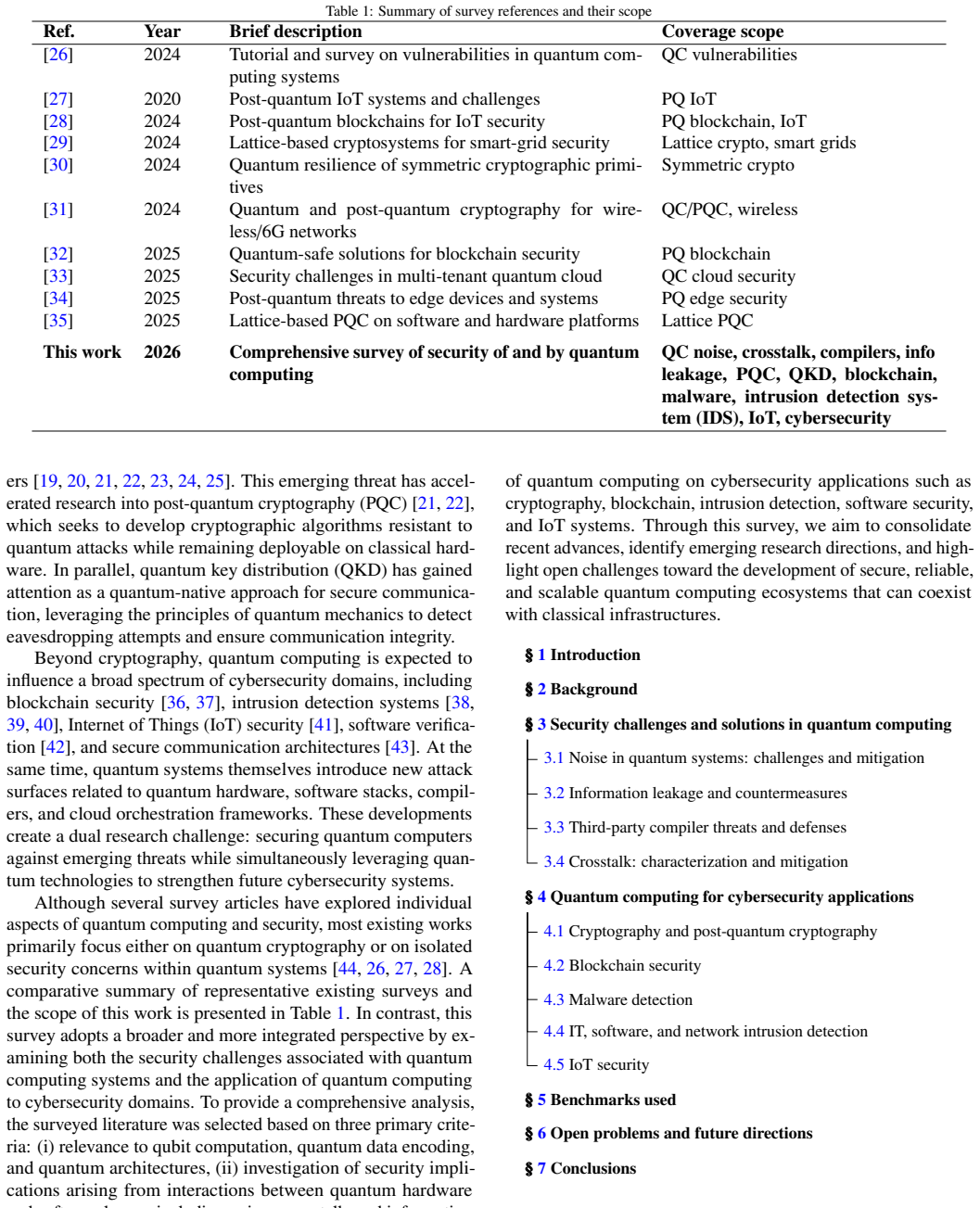
By examining security issues in quantum computers, security threats caused by quantum computers, and security mechanisms developed for quantum systems, the survey reviews hardware and software vulnerabilities, the impact of quantum computing on cryptographic infrastructures, post-quantum cryptography, quantum-safe communication protocols, quantum intrusion detection systems, quantum-aware software engineering, applications in malware and network detection plus IoT security, and quantum error mitigation and fault-tolerance methods, thereby supplying a structured overview that serves as a reference for secure and quantum-ready infrastructures.
What carries the argument
The tripartite division into security issues inside quantum computers, threats quantum computers create for classical systems, and security mechanisms built for or with quantum systems, which structures the review of vulnerabilities, impacts, and solutions.
Load-bearing premise
The papers and topics chosen for review give a complete and unbiased picture of the current state of quantum security research.
What would settle it
Discovery of a major recent advance in quantum hardware vulnerabilities, a widely used post-quantum scheme, or an application in cybersecurity that the survey omits and that changes the overall structure of challenges and mitigations presented.
Figures


read the original abstract
Quantum computing has emerged as a transformative computing paradigm capable of solving problems that remain computationally infeasible for classical systems; however, its rapid advancement also introduces significant security, privacy, and reliability concerns. In this context, this survey presents a comprehensive review of security challenges and mitigation strategies associated with quantum computing, focusing on security issues in quantum computers, security threats caused by quantum computers, and security mechanisms developed for quantum systems. The paper examines vulnerabilities in quantum hardware and software, the impact of quantum computing on existing cryptographic infrastructures and cybersecurity mechanisms, and the development of quantum-resilient solutions such as post-quantum cryptography, quantum-safe communication protocols, quantum intrusion detection systems, and quantum-aware software engineering techniques. In addition, the survey discusses emerging applications of quantum technologies in cybersecurity domains, including malware detection, network intrusion detection, Internet of Things (IoT) security, and secure communication systems. Furthermore, the paper analyzes existing quantum error mitigation and fault-tolerance approaches designed to improve the robustness and trustworthiness of quantum computation under realistic noisy conditions. By consolidating recent advances, open research challenges, and future directions, this survey provides a structured overview of the evolving intersection between quantum computing and cybersecurity, while serving as a reference for researchers and practitioners working toward secure, resilient, and quantum-ready computing infrastructures.
Editorial analysis
A structured set of objections, weighed in public.
Referee Report
Summary. The manuscript is a survey on the intersection of quantum computing and cybersecurity. It reviews security challenges in quantum hardware and software, threats that quantum computers pose to classical cryptographic systems, and mitigation approaches including post-quantum cryptography, quantum-safe protocols, quantum intrusion detection, IoT security applications, and quantum error mitigation/fault tolerance techniques. The paper consolidates recent advances, open challenges, and future directions with the goal of serving as a reference for researchers and practitioners building quantum-resilient infrastructures.
Significance. If the literature selection proves representative, the survey could provide a useful structured overview of an emerging interdisciplinary area. Its potential value lies in mapping hardware vulnerabilities, post-quantum defenses, and quantum-enhanced security tools into one document; however, the absence of explicit selection criteria or coverage metrics limits its immediate utility as a definitive reference.
major comments (1)
- [Abstract] Abstract: the central claim that the survey 'consolidates recent advances' and 'serves as a reference' rests on an unstated assumption of comprehensive, unbiased literature coverage. No inclusion/exclusion criteria, search methodology, or quantitative coverage statistics (e.g., number of papers per sub-topic) are supplied, which directly undermines the assertion of representativeness across hardware threats, post-quantum crypto, IoT, and error mitigation.
Simulated Author's Rebuttal
We thank the referee for their constructive feedback highlighting the need for greater transparency in our literature selection process. We agree this is a valid point that can be addressed through revision and will strengthen the manuscript's value as a reference.
read point-by-point responses
-
Referee: [Abstract] Abstract: the central claim that the survey 'consolidates recent advances' and 'serves as a reference' rests on an unstated assumption of comprehensive, unbiased literature coverage. No inclusion/exclusion criteria, search methodology, or quantitative coverage statistics (e.g., number of papers per sub-topic) are supplied, which directly undermines the assertion of representativeness across hardware threats, post-quantum crypto, IoT, and error mitigation.
Authors: We acknowledge that the abstract's claims would be better supported by explicit methodology details, which are currently absent from the manuscript. While the survey draws from key literature in the field identified through standard academic searches, no formal selection criteria or statistics were documented. In the revised version, we will insert a new 'Survey Methodology' subsection (likely in Section 1 or as an appendix) that specifies: search databases (IEEE Xplore, ACM DL, arXiv, Google Scholar), keywords and time range (2015–2024), inclusion criteria (peer-reviewed works on quantum hardware/software security, post-quantum cryptography, quantum-enhanced security tools, and error mitigation), exclusion criteria (non-English papers, purely theoretical works without security focus), and approximate coverage (e.g., ~X papers on hardware threats, ~Y on PQC). This addition will directly address the concern about representativeness without altering the survey's scope or conclusions. revision: yes
Circularity Check
No circularity: literature survey with no derivations or fitted predictions
full rationale
This is a survey paper whose central claim is that it consolidates recent advances from the literature into a structured overview. No equations, predictions, fitted parameters, or derivation chains appear in the abstract or described content. The patterns of self-definitional claims, fitted inputs renamed as predictions, self-citation load-bearing uniqueness theorems, or ansatz smuggling are absent because the work performs no original derivation that could reduce to its own inputs. The selection of reviewed topics is an editorial choice whose representativeness is an external validity question, not a circular reduction within any claimed derivation. Therefore the paper is self-contained against the circularity criteria and receives score 0.
Axiom & Free-Parameter Ledger
Reference graph
Works this paper leans on
-
[1]
Steffen et al., Quantum computing: An ibm perspec- tive, IBM Journal of Research and Development 55 (5) (2011) 13–1
M. Steffen et al., Quantum computing: An ibm perspec- tive, IBM Journal of Research and Development 55 (5) (2011) 13–1
2011
-
[2]
Courtland, Google aims for quantum computing supremacy [news], IEEE Spectrum 54 (6) (2017) 9–10
R. Courtland, Google aims for quantum computing supremacy [news], IEEE Spectrum 54 (6) (2017) 9–10
2017
-
[3]
Aghaee et al., Interferometric single-shot parity mea- surement in InAs-Al hybrid devices, Nature 638 (8051) (2025) 651–655, epub 2025 Feb 19
M. Aghaee et al., Interferometric single-shot parity mea- surement in InAs-Al hybrid devices, Nature 638 (8051) (2025) 651–655, epub 2025 Feb 19
2025
-
[4]
B. Harper et al., Crosstalk attacks and defence in a shared quantum computing environment, in: arXiv preprint arXiv:2402.02735, 2024, accessed: 2025-06-02
-
[5]
L. Xie et al., Suppressing zz crosstalk of quantum com- puters through pulse and scheduling co-optimization, in: Proceedings of the 27th ACM International Conference on Architectural Support for Programming Languages and Operating Systems, ASPLOS ’22, Association for Computing Machinery, New York, NY , USA, 2022, p. 499–513
2022
-
[6]
Mitigation of Crosstalk Errors in Quantum Measurements
S. Seo et al., Mitigation of crosstalk errors in a quantum measurement and its applications (Dec. 2021). arXiv: 2112.10651
work page internal anchor Pith review Pith/arXiv arXiv 2021
-
[7]
S. Heng et al., Estimating the effect of crosstalk error on circuit fidelity using noisy intermediate-scale quantum devices (2024).arXiv:2402.06952
-
[8]
A. Ash-Saki et al., Analysis of crosstalk in nisq devices and security implications in multi-programming regime, in: Proceedings of the ACM/IEEE International Sympo- sium on Low Power Electronics and Design, ISLPED ’20, Association for Computing Machinery, New York, NY , USA, 2020, p. 25–30
2020
-
[9]
S. Bajpayee et al., Analysis of the effects of crosstalk errors on various quantum circuits, in: 2024 37th Inter- national Conference on VLSI Design and 2024 23rd In- ternational Conference on Embedded Systems (VLSID), 2024, pp. 408–413
2024
-
[10]
H. Perrin et al., Mitigating crosstalk errors by randomized compiling: Simulation of the bcs model on a supercon- ducting quantum computer, Physical Review Research 6 (1) (2024) 013142
2024
-
[11]
Kosen et al., Signal crosstalk in a flip-chip quantum processor, PRX Quantum 5 (3) (2024) 030350
S. Kosen et al., Signal crosstalk in a flip-chip quantum processor, PRX Quantum 5 (3) (2024) 030350
2024
-
[12]
Feng et al., Realization of a crosstalk-avoided quantum network node using dual-type qubits of the same ion species, Nature Communications 15 (1) (2024) 204
L. Feng et al., Realization of a crosstalk-avoided quantum network node using dual-type qubits of the same ion species, Nature Communications 15 (1) (2024) 204
2024
-
[13]
C. Xu et al., Securing nisq quantum computer reset opera- tions against higher energy state attacks, in: Proceedings of the 2023 ACM SIGSAC Conference on Computer and Communications Security, CCS ’23, Association for Computing Machinery, New York, NY , USA, 2023, p. 594–607
2023
-
[14]
C. Xu et al., A thorough study of state leakage mitigation in quantum computing with one-time pad, in: 2024 IEEE International Symposium on Hardware Oriented Security and Trust (HOST), 2024, pp. 55–65
2024
-
[15]
F. Erata et al., Quantum circuit reconstruction from power side-channel attacks on quantum computer controllers, IACR Transactions on Cryptographic Hardware and Em- bedded Systems 2024 (2) (2024) 735–768
2024
-
[16]
Xu et al., Exploration of quantum computer power side-channels (Apr
C. Xu et al., Exploration of quantum computer power side-channels (Apr. 2023).arXiv:2304.03315
-
[18]
A. A. Saki et al., Split compilation for security of quantum circuits, in: 2021 IEEE/ACM International Conference On Computer Aided Design (ICCAD), 2021, pp. 1–7
2021
-
[19]
Mavroeidis et al., The impact of quantum computing on present cryptography, International Journal of Advanced Computer Science and Applications 9 (3) (2018)
V . Mavroeidis et al., The impact of quantum computing on present cryptography, International Journal of Advanced Computer Science and Applications 9 (3) (2018)
2018
-
[20]
N. Suryotrisongko et al., The quantum computer and the security of information systems, in: 2021 International Conference on Recent Advances in Mathematics and In- formatics (ICRAMI), 2021, pp. 1–9. 20
2021
-
[21]
B. Arslan et al., A study on the use of quantum computers, risk assessment and security problems, in: 2018 6th In- ternational Symposium on Digital Forensic and Security (ISDFS), 2018, pp. 1–6
2018
-
[23]
Raheman, The future of cybersecurity in the age of quantum computers, Future Internet 14 (11) (2022)
F. Raheman, The future of cybersecurity in the age of quantum computers, Future Internet 14 (11) (2022)
2022
-
[24]
Chen et al., Report on post-quantum cryptography, Tech
L. Chen et al., Report on post-quantum cryptography, Tech. Rep. NISTIR 8105, National Institute of Standards and Technology (NIST) (April 2016)
2016
-
[25]
Boneh et al., Secure signatures and chosen ciphertext security in a quantum computing world, in: R
D. Boneh et al., Secure signatures and chosen ciphertext security in a quantum computing world, in: R. Canetti et al. (Eds.), Advances in Cryptology – CRYPTO 2013, Springer Berlin Heidelberg, Berlin, Heidelberg, 2013, pp. 361–379
2013
-
[26]
Chen et al., Nisq quantum computing: A security- centric tutorial and survey [feature], IEEE Circuits and Systems Magazine 24 (1) (2024) 14–32
F. Chen et al., Nisq quantum computing: A security- centric tutorial and survey [feature], IEEE Circuits and Systems Magazine 24 (1) (2024) 14–32
2024
-
[27]
T. M. Fernández-Caramés, From pre-quantum to post- quantum iot security: A survey on quantum-resistant cryptosystems for the internet of things, IEEE Internet of Things Journal 7 (7) (2020) 6457–6480
2020
-
[28]
Gharavi et al., Post-quantum blockchain security for the internet of things: Survey and research directions, IEEE Communications Surveys & Tutorials 26 (3) (2024) 1748–1774
H. Gharavi et al., Post-quantum blockchain security for the internet of things: Survey and research directions, IEEE Communications Surveys & Tutorials 26 (3) (2024) 1748–1774
2024
-
[29]
H. Shekhawat et al., A survey on lattice-based security and authentication schemes for smart-grid networks in the post-quantum era, Concurrency and Computation: Practice and Experience 36 (14) (2024) e8080
2024
-
[30]
S. E. Bootsma et al., A survey on the quantum security of block cipher-based cryptography, IEEE Access 12 (2024) 194711–194727
2024
-
[31]
Glisic, Quantum vs post-quantum security for future networks: Survey, Cyber Security and Applications 2 (2024) 100039
S. Glisic, Quantum vs post-quantum security for future networks: Survey, Cyber Security and Applications 2 (2024) 100039
2024
-
[32]
Wicaksana, A survey on quantum-safe blockchain se- curity infrastructure, Computer Science Review 57 (2025) 100752
A. Wicaksana, A survey on quantum-safe blockchain se- curity infrastructure, Computer Science Review 57 (2025) 100752
2025
-
[33]
J. Coupel et al., Security vulnerabilities in quantum cloud systems: A survey on emerging threats (2025). arXiv: 2504.19064
-
[34]
Karakaya et al., A survey on post-quantum based ap- proaches for edge computing security, WIREs Computa- tional Statistics 16 (1) (2024) e1644
A. Karakaya et al., A survey on post-quantum based ap- proaches for edge computing security, WIREs Computa- tional Statistics 16 (1) (2024) e1644
2024
-
[35]
Nguyen et al., Security in post-quantum era: A compre- hensive survey on lattice-based algorithms, IEEE Access 13 (2025) 89003–89024
H. Nguyen et al., Security in post-quantum era: A compre- hensive survey on lattice-based algorithms, IEEE Access 13 (2025) 89003–89024
2025
-
[36]
Stewart et al., Committing to quantum resistance: a slow defence for bitcoin against a fast quantum computing attack, Royal Society Open Science 5 (2018) 180410
I. Stewart et al., Committing to quantum resistance: a slow defence for bitcoin against a fast quantum computing attack, Royal Society Open Science 5 (2018) 180410
2018
-
[37]
A. S. Naik et al., From portfolio optimization to quantum blockchain and security: A systematic review of quantum computing in finance (2025)
2025
-
[38]
Shen et al., An efficient quantum-inspired comput- ing approach for intrusion detection system, in: 2024 IEEE 24th International Conference on Nanotechnology (NANO), IEEE, 2024, pp
J.-Y . Shen et al., An efficient quantum-inspired comput- ing approach for intrusion detection system, in: 2024 IEEE 24th International Conference on Nanotechnology (NANO), IEEE, 2024, pp. 306–310
2024
-
[39]
Abreu et al., Qml-ids: Quantum machine learning intrusion detection system, in: 2024 IEEE Symposium on Computers and Communications (ISCC), IEEE, 2024, pp
D. Abreu et al., Qml-ids: Quantum machine learning intrusion detection system, in: 2024 IEEE Symposium on Computers and Communications (ISCC), IEEE, 2024, pp. 1–6
2024
-
[40]
O. S. Soliman et al., A network intrusions detection sys- tem based on a quantum bio inspired algorithm, arXiv preprint arXiv:1405.1404 (2014)
work page internal anchor Pith review Pith/arXiv arXiv 2014
-
[41]
Schöffel et al., Secure iot in the era of quantum computers—where are the bottlenecks?, Sensors 22 (7) (2022)
M. Schöffel et al., Secure iot in the era of quantum computers—where are the bottlenecks?, Sensors 22 (7) (2022)
2022
-
[42]
S. Issel et al., Towards classical software verification using quantum computers, in: 2025 International Con- ference on Quantum Communications, Networking, and Computing (QCNC), 2025, pp. 598–605
2025
-
[43]
A. P. Umejiaku et al., Rosecliffalgorithm: Making pass- words dynamic, Applied Sciences 14 (2) (2024)
2024
-
[44]
V olya et al., Towards secure classical-quantum sys- tems, in: 2023 IEEE International Symposium on Hard- ware Oriented Security and Trust (HOST), 2023, pp
D. V olya et al., Towards secure classical-quantum sys- tems, in: 2023 IEEE International Symposium on Hard- ware Oriented Security and Trust (HOST), 2023, pp. 283– 292
2023
-
[45]
Rieffel et al., An introduction to quantum computing for non-physicists, ACM Comput
E. Rieffel et al., An introduction to quantum computing for non-physicists, ACM Comput. Surv. 32 (3) (2000) 300–335
2000
-
[46]
Yung, Quantum supremacy: some fundamental concepts, National Science Review 6 (1) (2018) 22–23
M.-H. Yung, Quantum supremacy: some fundamental concepts, National Science Review 6 (1) (2018) 22–23
2018
-
[47]
Horodecki et al., Quantum entanglement, Rev
R. Horodecki et al., Quantum entanglement, Rev. Mod. Phys. 81 (2009) 865–942
2009
-
[48]
˙Zyczkowski et al., Dynamics of quantum entangle- ment, Phys
K. ˙Zyczkowski et al., Dynamics of quantum entangle- ment, Phys. Rev. A 65 (2001) 012101
2001
-
[49]
Mosca, Quantum Algorithms, Springer New York, New York, NY , 2009, pp
M. Mosca, Quantum Algorithms, Springer New York, New York, NY , 2009, pp. 7088–7118
2009
-
[50]
Xu et al., Classification of quantum computer fault injection attacks (2023).arXiv:2309.05478
C. Xu et al., Classification of quantum computer fault injection attacks (2023).arXiv:2309.05478. 21
-
[51]
J. D. Guimarães et al., Towards a layered architecture for error mitigation in quantum computation, in: 2022 IEEE International Conference on Quantum Software (QSW), 2022, pp. 41–51
2022
-
[52]
T. Giurgica-Tiron et al., Digital zero noise extrapolation for quantum error mitigation, in: 2020 IEEE interna- tional conference on quantum computing and engineering (QCE), IEEE, 2020, pp. 306–316
2020
-
[53]
He et al., Zero-noise extrapolation for quantum-gate error mitigation with identity insertions, Physical Review A 102 (1) (2020) 012426
A. He et al., Zero-noise extrapolation for quantum-gate error mitigation with identity insertions, Physical Review A 102 (1) (2020) 012426
2020
-
[54]
P. P. Hofer, Quasi-probability distributions for observ- ables in dynamic systems, Quantum 1 (2017) 32
2017
-
[55]
Ferrie, Quasi-probability representations of quantum theory with applications to quantum information science, Reports on Progress in Physics 74 (11) (2011) 116001
C. Ferrie, Quasi-probability representations of quantum theory with applications to quantum information science, Reports on Progress in Physics 74 (11) (2011) 116001
2011
-
[56]
A. Zhang et al., Demonstrating quantum er- ror mitigation on logical qubits, arXiv preprint arXiv:2401.09079Accessed May 2025 (2025)
-
[57]
Muqeet et al., Quiet: A tool for sampling-based quan- tum noise error mitigation, IEEE SoftwareSpecial Issue on Quantum Software and its Engineering (2024)
A. Muqeet et al., Quiet: A tool for sampling-based quan- tum noise error mitigation, IEEE SoftwareSpecial Issue on Quantum Software and its Engineering (2024)
2024
-
[58]
Liao et al., Noise-agnostic quantum error mitigation with data augmented neural models (Apr
M. Liao et al., Noise-agnostic quantum error mitigation with data augmented neural models (Apr. 2025). arXiv: 2311.01727
-
[59]
T. B. Adeniyi et al., Adaptive neural network for quan- tum error mitigation, Quantum Machine Intelligence. 7 (2025) 01–14, received: 28 March 2024/Accepted: 28 December 2024
2025
-
[60]
Kwon et al., A hybrid quantum-classical approach to mitigating measurement errors in quantum algo- rithms, IEEE Transactions on Computers 70 (9) (2021) 1401–1411
H. Kwon et al., A hybrid quantum-classical approach to mitigating measurement errors in quantum algo- rithms, IEEE Transactions on Computers 70 (9) (2021) 1401–1411
2021
-
[61]
G. Ciaramella et al., Introducing quantum computing in mobile malware detection, in: Proceedings of the 17th International Conference on Availability, Reliability and Security, ARES ’22, Association for Computing Machin- ery, New York, NY , USA, 2022
2022
-
[62]
M. J. Biercuk et al., Optimized dynamical decoupling in a model quantum memory, Nature 458 (7241) (2009) 996–1000
2009
-
[63]
S. Upadhyay et al., Share: Secure hardware allocation and resource efficiency in quantum systems, in: 2024 IEEE International Conference on Quantum Computing and Engineering (QCE), V ol. 1, IEEE, 2024, pp. 1109–1119
2024
-
[64]
A. Hashim et al., Randomized compiling for scalable quantum computing on a noisy superconducting quantum processor, arXiv preprint arXiv:2010.00215 (2020)
-
[65]
Bonet-Monroig et al., Low-cost error mitigation by symmetry verification, Physical Review A 98 (6) (2018) 062339
X. Bonet-Monroig et al., Low-cost error mitigation by symmetry verification, Physical Review A 98 (6) (2018) 062339
2018
-
[66]
Bravyi et al., Mitigating measurement errors in mul- tiqubit experiments, Physical Review A 103 (4) (2021) 042605
S. Bravyi et al., Mitigating measurement errors in mul- tiqubit experiments, Physical Review A 103 (4) (2021) 042605
2021
-
[67]
Funcke et al., Measurement error mitigation in quan- tum computers through classical bit-flip correction, Phys- ical Review A 105 (6) (2022) 062404
L. Funcke et al., Measurement error mitigation in quan- tum computers through classical bit-flip correction, Phys- ical Review A 105 (6) (2022) 062404
2022
-
[68]
Janardan et al., Analytical error analysis of clifford gates by the fault-path tracer method, Quantum Informa- tion Processing 15 (8) (2016) 3065–3079
S. Janardan et al., Analytical error analysis of clifford gates by the fault-path tracer method, Quantum Informa- tion Processing 15 (8) (2016) 3065–3079
2016
-
[69]
Ponsi et al., Mitigation of model error effects in neural network-based structural damage detection, Frontiers in Built Environment 8 (2023) 1109995
F. Ponsi et al., Mitigation of model error effects in neural network-based structural damage detection, Frontiers in Built Environment 8 (2023) 1109995
2023
-
[70]
C.-I. Popîrlan et al., Hybrid quantum-classical networks characteristics and optimization for error correction and noise mitigation, in: 2023 22nd RoEduNet Conference: Networking in Education and Research (RoEduNet), IEEE, 2023, pp. 1–7
2023
-
[71]
G. A. Paz-Silva et al., Optimally combining dynamical de- coupling and quantum error correction, Scientific reports 3 (1) (2013) 1530
2013
-
[72]
Khadirsharbiyani et al., Minimizing coherence errors via dynamic decoupling, in: Proceedings of the 38th ACM International Conference on Supercomputing, 2024, pp
S. Khadirsharbiyani et al., Minimizing coherence errors via dynamic decoupling, in: Proceedings of the 38th ACM International Conference on Supercomputing, 2024, pp. 164–175
2024
-
[73]
B. Goertzel, Efficient quantum-safe homomorphic en- cryption for quantum computer programs, arXiv preprint arXiv:2504.21235 (apr 2025)
-
[74]
S. Upadhyay et al., Quantum quandaries: Unraveling en- coding vulnerabilities in quantum neural networks, arXiv preprint arXiv:2502.01486 (Feb 2025)
- [75]
- [76]
-
[77]
A. Kumar et al., Context switching for secure multi- programming of near-term quantum computers, arXiv preprint arXiv:2504.07048 (Apr 2025)
-
[78]
arXiv preprint arXiv:2502.16065 , year=
A. Rehman et al., Opaque: Obfuscating phase in quan- tum circuit compilation for efficient ip protection, arXiv preprint arXiv:2502.16065 (2025). 22
-
[79]
N. Bartake et al., Obfusqate: Unveiling the first quan- tum program obfuscation framework, arXiv preprint arXiv:2503.23785 (2025)
-
[80]
Blakeley et al., Toward a quantum information system cybersecurity taxonomy and testbed: Exploiting a unique opportunity for early impact (Apr
B. Blakeley et al., Toward a quantum information system cybersecurity taxonomy and testbed: Exploiting a unique opportunity for early impact (Apr. 2024). arXiv:2404. 12465
2024
-
[81]
Das et al., Secure quantum circuit compilation method- ology for untrusted compilers, PreprintResearch Square (2024)
S. Das et al., Secure quantum circuit compilation method- ology for untrusted compilers, PreprintResearch Square (2024)
2024
-
[82]
S. Kundu et al., Stiq: Safeguarding training and inferenc- ing of quantum neural networks from untrusted cloud, arXiv preprint arXiv:2405.18746v2 (nov 2024)
discussion (0)
Sign in with ORCID, Apple, or X to comment. Anyone can read and Pith papers without signing in.