Optical Memory Optimization Across Rubidium Isotopes and Transitions
Pith reviewed 2026-06-28 22:12 UTC · model grok-4.3
The pith
Warm rubidium vapor achieves 44% optical memory efficiency on D1 line for both isotopes.
A machine-rendered reading of the paper's core claim, the machinery that carries it, and where it could break.
Core claim
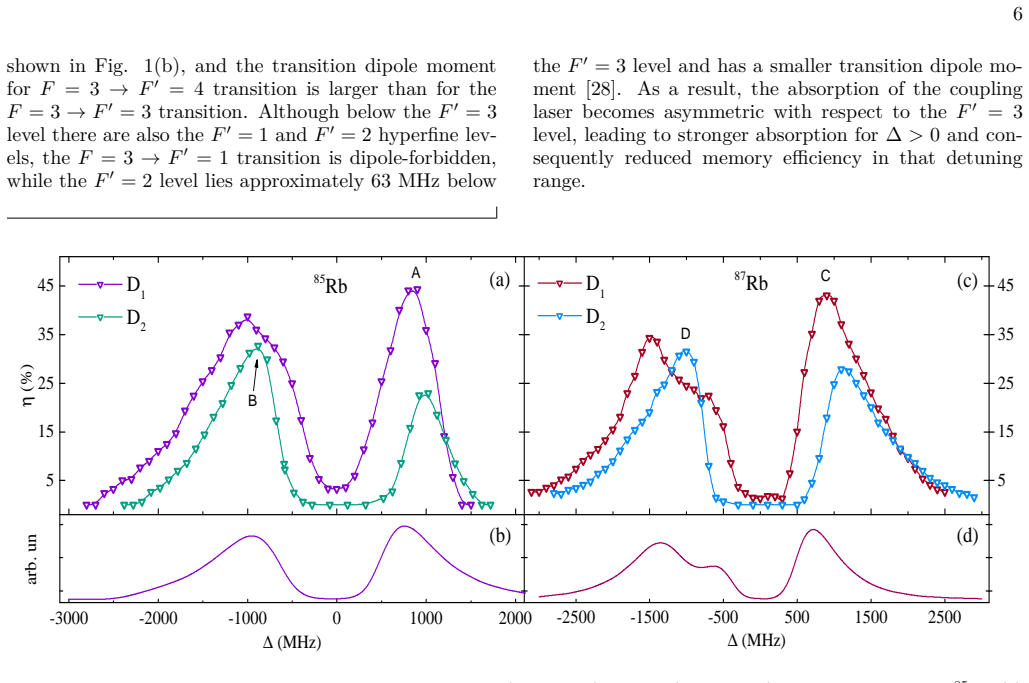
Maximum efficiency of up to 44% was achieved using the D1 line in both isotopes, with up to 1.5 ms storage time. These performance levels are enabled by warm vapor rubidium buffer-gas filled cells, large optical depth, and a near-resonant EIT scheme optimized with respect to the one- and two-photon detuning. The optimization approach of operating at elevated temperatures while identifying the optimal single-photon and two-photon detunings should lead to improved performance of the quantum memory.
What carries the argument
Near-resonant electromagnetically induced transparency (EIT) scheme optimized for one- and two-photon detuning in warm vapor rubidium buffer-gas cells with large optical depth.
If this is right
- Both isotopes perform similarly on the D1 line within 1 sigma.
- Storage time reaches 1.5 ms under these conditions.
- Practical guidelines are provided for simplified experimental configurations of warm rubidium vapor optical memories.
- Improved performance is expected from the described optimization approach at elevated temperatures.
Where Pith is reading between the lines
- The same detuning optimization strategy could be tested on other atomic species to see if similar efficiency gains occur.
- These memories might integrate more easily into quantum networks if the simplified setup reduces technical overhead.
- Further increases in optical depth or different buffer gases might extend storage times beyond 1.5 ms.
Load-bearing premise
The high efficiency and long storage time depend on using warm vapor rubidium buffer-gas filled cells with large optical depth and an optimized near-resonant EIT scheme.
What would settle it
An experiment that optimizes the detunings in the specified cells but measures efficiency significantly below 44% or storage time much less than 1.5 ms on the D1 line would challenge the central claim.
Figures
read the original abstract
We investigate optical memory efficiency and storage time across $^{85}\mathrm{Rb}$ and $^{87}\mathrm{Rb}$ isotopes on both the D$_1$ and D$_2$ transitions. Maximum efficiency of up to $44\%$ was achieved using the D$_1$ line in both isotopes, with up to 1.5 ms storage time. %Maximum efficiencies of $44\%$ were measured for both isotopes on the D$_1$ line, in agreement within $1\sigma$, while the longest storage time reached is $1.5$ ms. These performance levels are enabled by warm vapor rubidium buffer-gas filled cells, large optical depth, and a near-resonant EIT scheme optimized with respect to the one- and two-photon detuning. Our results provide practical guidelines for optimizing the performance of warm rubidium vapor optical memories in simplified experimental configurations. We expect that the optimization approach employed here, specifically operating at elevated temperatures while identifying the optimal single-photon and two-photon detunings, should lead to improved performance of the quantum memory.
Editorial analysis
A structured set of objections, weighed in public.
Referee Report
Summary. The manuscript reports an experimental study of optical memory performance using near-resonant EIT in warm rubidium buffer-gas cells, comparing 85Rb and 87Rb on the D1 and D2 lines. The central claims are maximum retrieval efficiencies of up to 44% achieved on the D1 line for both isotopes, together with storage times up to 1.5 ms; these metrics are attributed to large optical depth, elevated cell temperature, and optimization of one- and two-photon detunings. The work concludes with practical guidelines for optimizing such memories in simplified configurations.
Significance. If the reported efficiencies and storage times prove reproducible, the results supply concrete empirical benchmarks and optimization heuristics for warm-vapor EIT memories, which remain attractive for their experimental simplicity. The isotope- and transition-spanning comparison adds incremental but useful data to the existing literature on practical quantum-memory implementations.
major comments (1)
- [Abstract] Abstract: The headline claims of 44% efficiency and 1.5 ms storage time are presented without error bars, number of trials, data-selection criteria, or pointers to figures/tables containing the raw time traces or retrieval-efficiency curves. Because these numerical maxima constitute the central experimental result, the absence of supporting statistical and methodological detail prevents verification of the performance levels from the manuscript text alone.
minor comments (1)
- [Abstract] Abstract: The parenthetical remark beginning “%Maximum efficiencies of 44% were measured…” appears to be commented-out source text that is not reflected in the published abstract; if the authors intended to state agreement within 1σ, that statement should be restored or removed consistently.
Simulated Author's Rebuttal
We thank the referee for their review and the constructive comment on the abstract. We address the point below and will revise the manuscript to improve verifiability of the reported performance metrics.
read point-by-point responses
-
Referee: [Abstract] Abstract: The headline claims of 44% efficiency and 1.5 ms storage time are presented without error bars, number of trials, data-selection criteria, or pointers to figures/tables containing the raw time traces or retrieval-efficiency curves. Because these numerical maxima constitute the central experimental result, the absence of supporting statistical and methodological detail prevents verification of the performance levels from the manuscript text alone.
Authors: We agree that the abstract would benefit from explicit pointers to the supporting data. The main text (Sections III and IV) and associated figures present the efficiency curves versus one- and two-photon detuning, raw retrieval time traces, and storage-time measurements for both isotopes and transitions; the 44% and 1.5 ms values are the observed maxima under the optimized conditions described there. To address the concern, we will revise the abstract to reference the relevant figures and clarify that the quoted figures are maxima from the experimental dataset whose statistical details (including repetition counts and selection criteria) appear in the methods and results sections. Because of abstract length limits we cannot embed full error bars or trial numbers in the abstract itself, but the revision will direct readers to the locations where these details can be verified. revision: yes
Circularity Check
No significant circularity
full rationale
The paper is a purely experimental report of measured retrieval efficiencies (up to 44%) and storage times (up to 1.5 ms) in warm Rb buffer-gas cells using near-resonant EIT on D1 and D2 lines for both isotopes. No derivation chain, equations, or theoretical model is presented that reduces the reported performance metrics to fitted parameters, self-citations, or inputs defined within the work; the results are directly attributed to experimental conditions (large optical depth, temperature, detuning optimization) without any load-bearing reduction to internal definitions or prior self-citations.
Axiom & Free-Parameter Ledger
free parameters (3)
- one-photon detuning
- two-photon detuning
- cell temperature
axioms (1)
- domain assumption Near-resonant EIT in warm buffer-gas cells can store light with high efficiency
Reference graph
Works this paper leans on
-
[1]
sweet spot
ofΩ C = 2π×5.7MHz andΩP = 2π×0.2MHz for the coupling and probe beams, respectively. For mea- surements on the D1 line of 85Rb, as well as on the87Rb isotope, the coupling and probe laser powers were ad- justed to maintain the corresponding Rabi frequencies at the values given above. After propagating through the cell, the probe light is detected using an ...
2000
-
[2]
N.Sangouard, C.Simon, H.deRiedmatten,andN.Gisin, Quantumrepeatersbasedonatomicensemblesandlinear optics, Rev. Mod. Phys.83, 33 (2011)
2011
-
[3]
Wehner, D
S. Wehner, D. Elkouss, and R. Hanson, Quantum inter- net: A vision for the road ahead, Science362, eaam9288 (2018)
2018
-
[4]
Bussières, N
F. Bussières, N. Sangouard, M. Afzelius, H. Riedmatten, C. Simon, and W. Tittel, Prospective applications of op- tical quantum memories, Journal of Modern Optics60 (2013)
2013
-
[5]
C. Liu, M. Wang, S. A. Stein, Y. Ding, and A. Li, Quan- tum memory: A missing piece in quantum computing units (2023)
2023
-
[6]
Heshami, D
K. Heshami, D. G. England, P. C. Humphreys, P. J. Bustard, V. M. Acosta, J. Nunn, and B. J. Sussman, Quantum memories: emerging applications and recent advances, Journal of Modern Optics63, 2005 (2016)
2005
-
[7]
Mamann, T
H. Mamann, T. Nieddu, F. Hoffet, M. Bozzio, F. G. de Loubresse, I. Kerenidis, E. Diamanti, A. Urvoy, and J. Laurat, Quantum cryptography integrating an opti- cal quantum memory, Science Advances11, eadx3223 (2025)
2025
-
[8]
Mor, Quantum memory in quantum cryptography, arXiv preprint quant-ph/9906073 (1999)
T. Mor, Quantum memory in quantum cryptography, arXiv preprint quant-ph/9906073 (1999)
Pith/arXiv arXiv 1999
-
[9]
Kaneda, F
F. Kaneda, F. Xu, J. Chapman, and P. G. Kwiat, Quantum-memory-assisted multi-photon generation for efficient quantum information processing, Optica4, 1034 (2017)
2017
-
[10]
A. Ortu, A. Holzäpfel, J. Etesse, and M. Afzelius, Storage ofphotonictime-binqubitsforupto20msinarare-earth doped crystal, npj Quantum Information8, 1 (2022)
2022
-
[11]
Körber, O
M. Körber, O. Morin, S. Langenfeld, A. Neuzner, S. Rit- ter, and G. Rempe, Decoherence-protected memory for a single-photon qubit, Nature Photonics12, 18 (2017)
2017
-
[12]
S. Gera, C. Wallace, M. Flament, A. Scriminich, M. Na- mazi, Y. Kim, S. Sagona-Stophel, G. Vallone, P. Vil- loresi, and E. Figueroa, Hong-ou-mandel interference of single-photon-level pulses stored in independent room- temperature quantum memories, npj Quantum Informa- tion10(2024)
2024
-
[13]
Liu, Z.-W
Y.-P. Liu, Z.-W. Ou, T.-X. Zhu, M.-X. Su, C. Liu, Y.-J. Han, Z.-Q. Zhou, C.-F. Li, and G.-C. Guo, A millisecond integrated quantum memory for photonic qubits, Science Advances11, eadu5264 (2025). 11
2025
-
[14]
Yang, X.-J
S.-J. Yang, X.-J. Wang, X.-H. Bao, and J.-W. Pan, An efficient quantum light-matter interface with sub-second lifetime, Nature Photonics10(2016)
2016
-
[15]
J. Guo, X. Feng, P. Yang, Z. Yu, L. Chen, C.-H. Yuan, and W. Zhang, High-performance raman quantum mem- ory with optimal control in room temperature atoms, Na- ture Communications10(2019)
2019
-
[16]
Teller, S
M. Teller, S. Plascencia, S. Grandi, and H. de Riedmat- ten, Quantum storage of qubits in an array of indepen- dently controllable solid-state quantum memories, Phys. Rev. X15, 031053 (2025)
2025
-
[17]
L. Ma, X. Lei, J. Yan, R. Li, T. Chai, Z. Yan, X. Jia, C. Xie, and K. Peng, High-performance cavity-enhanced quantum memory with warm atomic cell, Nature Com- munications13(2022)
2022
-
[18]
Y. Wang, A. N. Craddock, R. Sekelsky, M. Flament, and M. Namazi, Field-deployable quantum memory for quan- tum networking, Physical Review Applied18(2022)
2022
-
[19]
Esguerra, L
L. Esguerra, L. Meßner, E. Robertson, N. V. Ewald, M. Gündoğan, and J. Wolters, Optimiza- tion and readout-noise analysis of a warm-vapor electromagnetically-induced-transparency memory on the csD 1 line, Phys. Rev. A107, 042607 (2023)
2023
-
[20]
Dideriksen, R
K. Dideriksen, R. Schmieg, M. Zugenmaier, and E. Polzik, Room-temperature single-photon source with near-millisecond built-in memory, Nature Communica- tions12(2021)
2021
-
[21]
Katz and O
O. Katz and O. Firstenberg, Light storage for one second in room-temperature alkali vapor, Nature Communica- tions9(2018)
2018
-
[22]
N. B. Phillips, A. V. Gorshkov, and I. Novikova, Optimal light storage in atomic vapor, Phys. Rev. A78, 023801 (2008)
2008
-
[23]
J. Guo, Z. Wu, G. Bao, P. Yang, Y. Wu, L. Q. Chen, and W. Zhang, Near-perfect broadband quantum mem- ory enabled by intelligent spin-wave compaction, Phys. Rev. Lett.135, 170802 (2025)
2025
-
[24]
Mottola, G
R. Mottola, G. Buser, and P. Treutlein, Optical mem- ory in a microfabricated rubidium vapor cell, Physical Review Letters131(2023)
2023
-
[25]
Ðujić, D
M. Ðujić, D. Buhin, N. Šantić, D. Aumiler, and T. Ban, Comparative analysis of light storage in antirelaxation- coated and buffer-gas-filled alkali vapor cells, Scientific Reports14(2024)
2024
-
[26]
DeRose, K
K. DeRose, K. Jiang, J. Li, M. Julius, L. Zhuo, S. Wen- ner, and S. Bali, Producing slow light in warm alkali vapor using electromagnetically induced transparency, American Journal of Physics91, 193 (2023)
2023
-
[27]
Finkelstein, S
R. Finkelstein, S. Bali, O. Firstenberg, and I. Novikova, A practical guide to electromagnetically induced trans- parency in atomic vapor, New Journal of Physics25, 035001 (2023)
2023
-
[28]
Welch, Buffer-gas-induced absorption resonances in rb vapor, Physical Review A70(2004)
E.E.Mikhailov, I.Novikova, Y.V.Rostovtsev,andG.R. Welch, Buffer-gas-induced absorption resonances in rb vapor, Physical Review A70(2004)
2004
-
[29]
Steck, Rubidium 85 d line data (2008)
D. Steck, Rubidium 85 d line data (2008)
2008
-
[30]
D. A. Steck, Rubidium 87 d line data (2003)
2003
-
[31]
Demtröder,Atoms, Molecules and Photons: An In- troduction to Atomic-, Molecular- and Quantum Physics, 2nd ed
W. Demtröder,Atoms, Molecules and Photons: An In- troduction to Atomic-, Molecular- and Quantum Physics, 2nd ed. (Springer-Verlag Berlin Heidelberg, 2010)
2010
-
[32]
N. B. Phillips, A. V. Gorshkov, and I. Novikova, Light storage in an optically thick atomic ensemble under con- ditions of electromagnetically induced transparency and four-wave mixing, Phys. Rev. A83, 063823 (2011)
2011
-
[33]
N. W. Ressler, R. H. Sands, and T. E. Stark, Measure- ment of spin-exchange cross sections forcs133,rb 87,rb 85, k39, andna 23, Phys. Rev.184, 102 (1969)
1969
-
[34]
Arimondo, Relaxation processes in coherent- population trapping, Phys
E. Arimondo, Relaxation processes in coherent- population trapping, Phys. Rev. A54, 2216 (1996)
1996
-
[35]
Happer, Optical pumping, Rev
W. Happer, Optical pumping, Rev. Mod. Phys.44, 169 (1972)
1972
-
[36]
Parniak and W
M. Parniak and W. Wasilewski, Direct observation of atomic diffusion in warm rubidium ensembles, Applied Physics B116, 415–421 (2013)
2013
-
[37]
Shuker, O
M. Shuker, O. Firstenberg, R. Pugatch, A. Ben-Kish, A. Ron, and N. Davidson, Measurement of dicke narrow- ing in electromagnetically induced transparency (2007)
2007
-
[38]
Firstenberg, M
O. Firstenberg, M. Shuker, R. Pugatch, D. R. Fredkin, N. Davidson, and A. Ron, Theory of thermal motion in electromagnetically induced transparency: Effects of dif- fusion, doppler broadening, and dicke and ramsey nar- rowing, Physical Review A77(2008)
2008
-
[39]
J. Geng, G. T. Campbell, J. Bernu, D. B. Higginbot- tom, B. M. Sparkes, S. M. Assad, W. P. Zhang, N. P. Robins, P. K. Lam, and B. C. Buchler, Electromagnet- ically induced transparency and four-wave mixing in a cold atomic ensemble with large optical depth, New Jour- nal of Physics16, 113053 (2014)
2014
-
[40]
Namazi, C
M. Namazi, C. Kupchak, B. Jordaan, R. Shahrokhshahi, and E. Figueroa, Ultralow-noise room-temperature quan- tum memory for polarization qubits, Phys. Rev. Appl.8, 034023 (2017)
2017
discussion (0)
Sign in with ORCID, Apple, or X to comment. Anyone can read and Pith papers without signing in.