JWST Reveals Large Reservoirs of Dust and Ongoing Circumstellar Interaction in SN Ibn/Icn 2023xgo over a Year Post-Explosion
Pith reviewed 2026-06-28 21:16 UTC · model grok-4.3
The pith
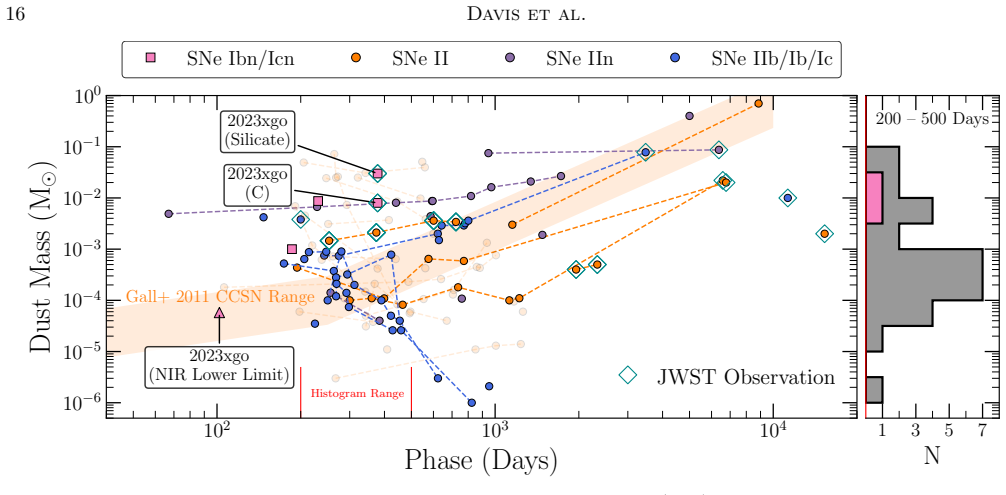
JWST observations of SN 2023xgo show at least 0.03 solar masses of cool silicate dust at the shock radius plus ongoing circumstellar interaction at 377 days post-explosion.
A machine-rendered reading of the paper's core claim, the machinery that carries it, and where it could break.
Core claim
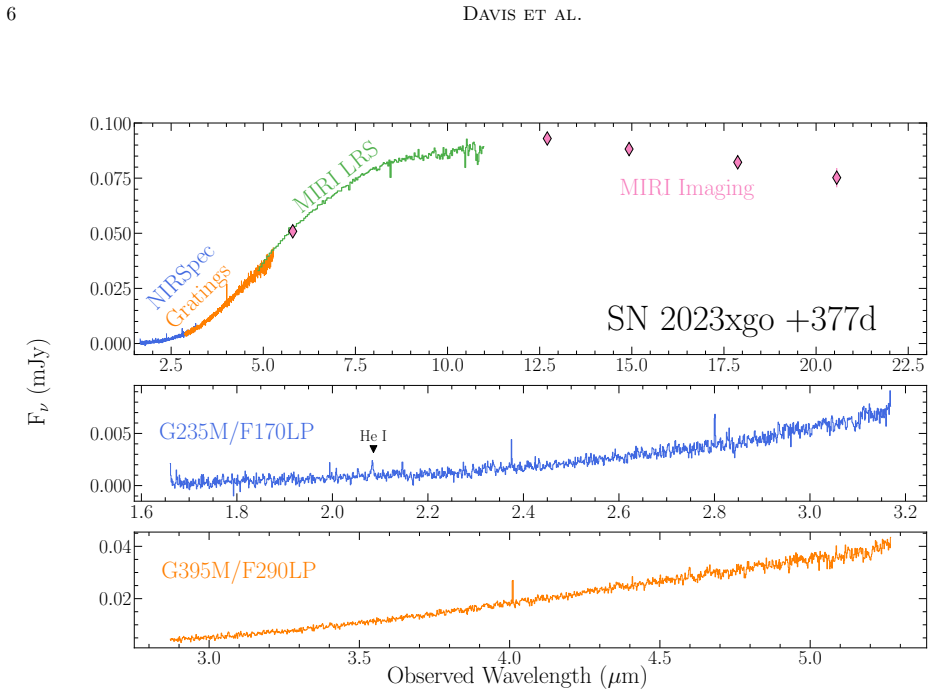
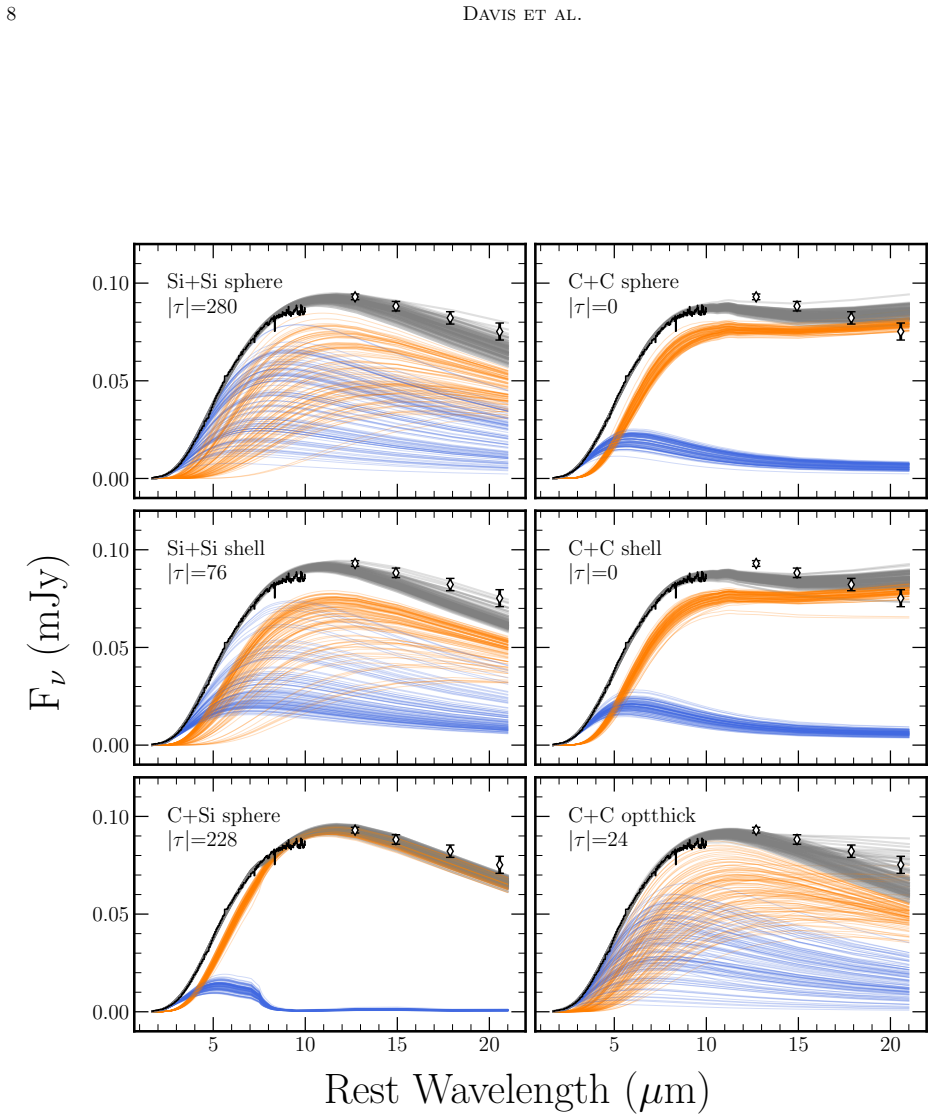
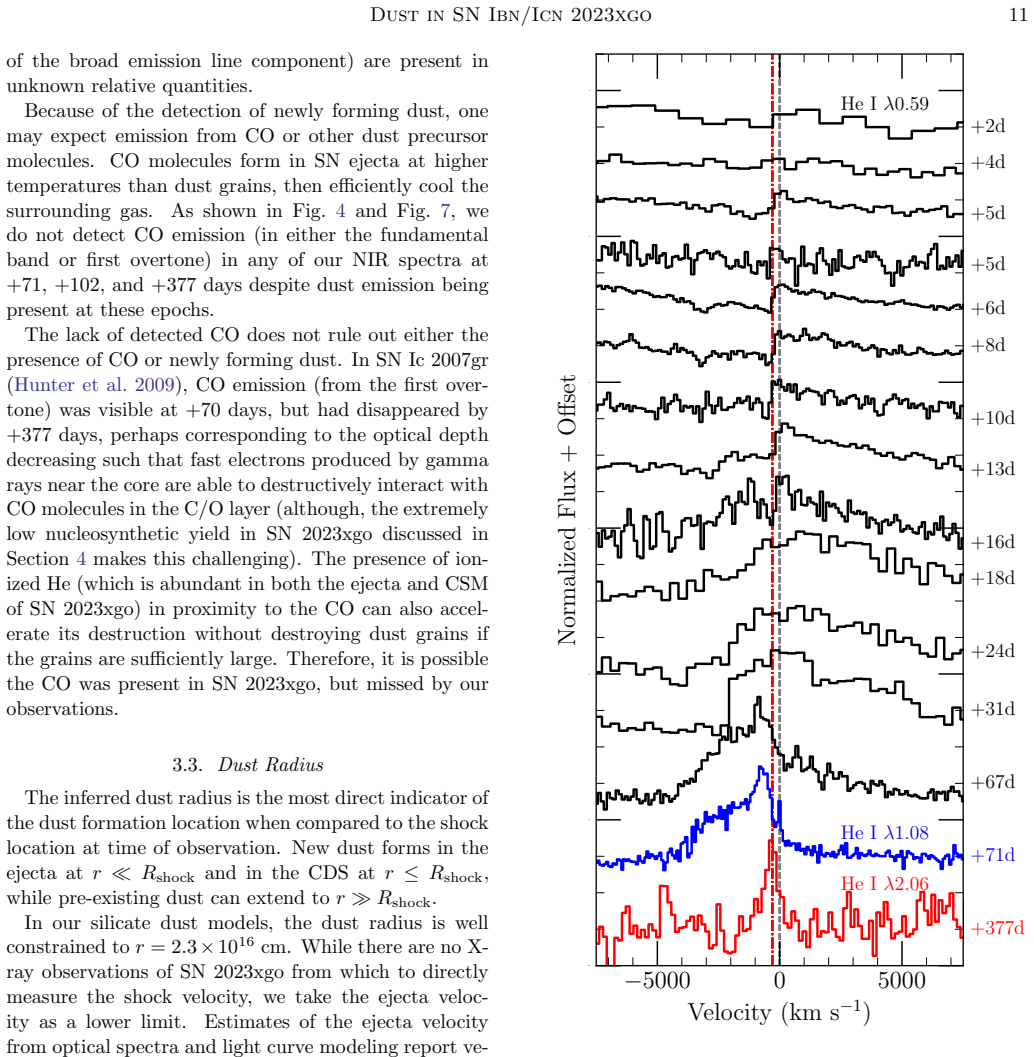
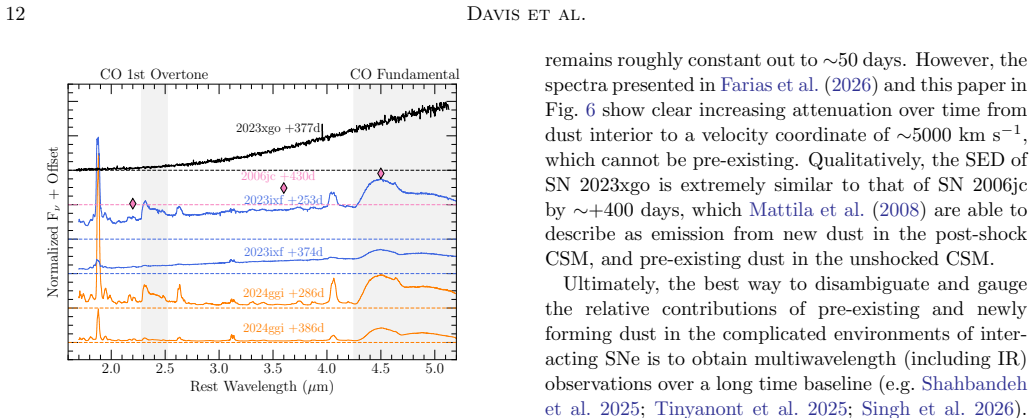
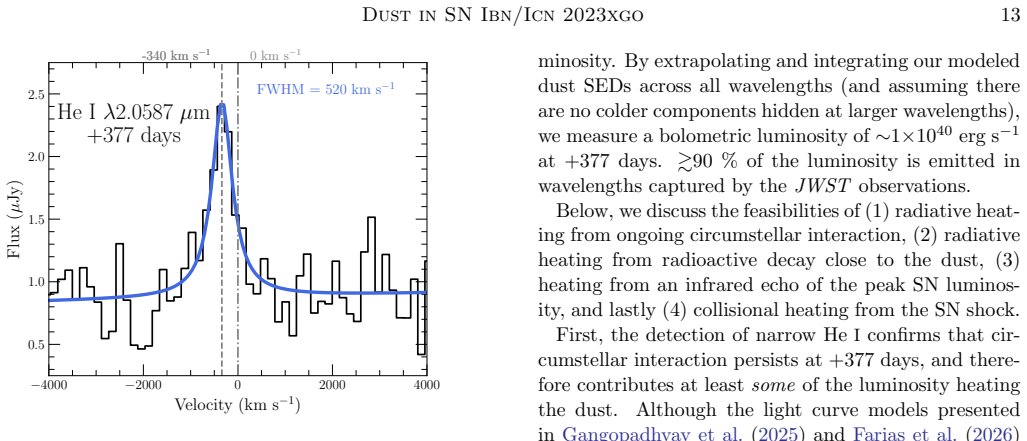
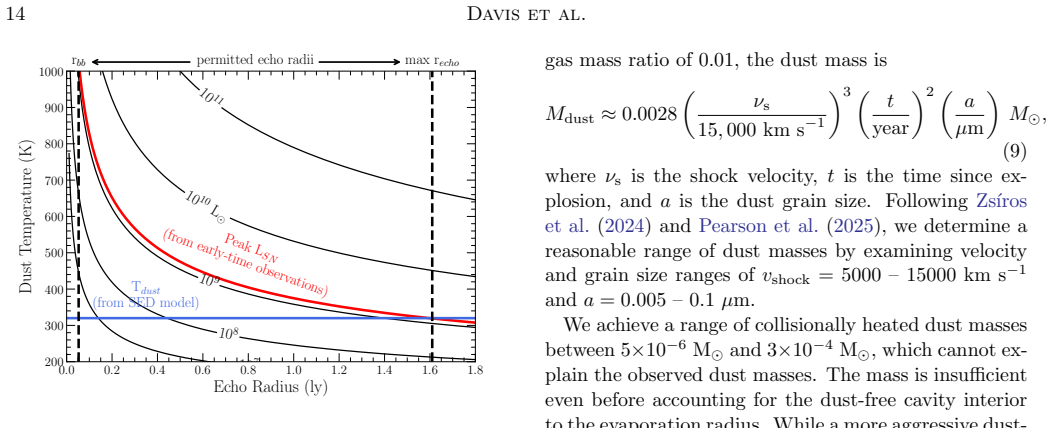
At +377 days, the JWST spectrum is consistent with emission from cool (~300-600 K) silicate dust with M ≳ 3 × 10^{-2} M⊙ at a radius similar to the shock radius (2.3 × 10^{16} cm), and we detect narrow (FWHM = 520+/-130 km s^{-1}) He I λ2.06 micron emission blueshifted by 340+/-40 km s^{-1}, indicating the SN shock continues to encounter circumstellar material. The large dust mass and rapid onset of dust formation observed in SN 2023xgo show that the unique physical environments of SNe Ibn/Icn facilitate substantial dust formation both before and after the SN.
What carries the argument
The +377-day JWST NIRSpec/MIRI spectrum modeled as thermal emission from silicate and carbonaceous dust grains combined with the narrow He I 2.06 micron line profile that tracks ongoing shock-CSM interaction.
If this is right
- SNe Ibn/Icn can produce total dust masses exceeding 0.03 solar masses within the first year.
- Dust formation begins rapidly, already detectable at 70 days, and continues at large radii matching the shock front.
- Circumstellar interaction with He/C-rich material persists at least to 377 days, traced by narrow blueshifted He I emission.
- The environments of hydrogen-poor interacting supernovae are efficient sites for both pre-explosion and post-explosion dust production.
Where Pith is reading between the lines
- Similar late-time JWST observations of other rare Ibn/Icn events could reveal whether large dust reservoirs are common in this subclass.
- If the dust mass scaling holds for higher-redshift analogs, these events may contribute measurably to cosmic dust budgets at early epochs.
- The blueshifted He I line offers a direct kinematic probe of the unshocked CSM velocity that can be compared with progenitor wind models.
Load-bearing premise
The observed mid-infrared flux and spectrum at late times arise primarily from thermal radiation by dust grains at the quoted temperatures and masses rather than from free-free, synchrotron, or other continuum processes.
What would settle it
A +377-day spectrum or photometry that shows infrared flux levels and spectral shape matching only the expected supernova continuum without requiring an additional 300-600 K blackbody component of the reported mass and radius.
Figures
read the original abstract
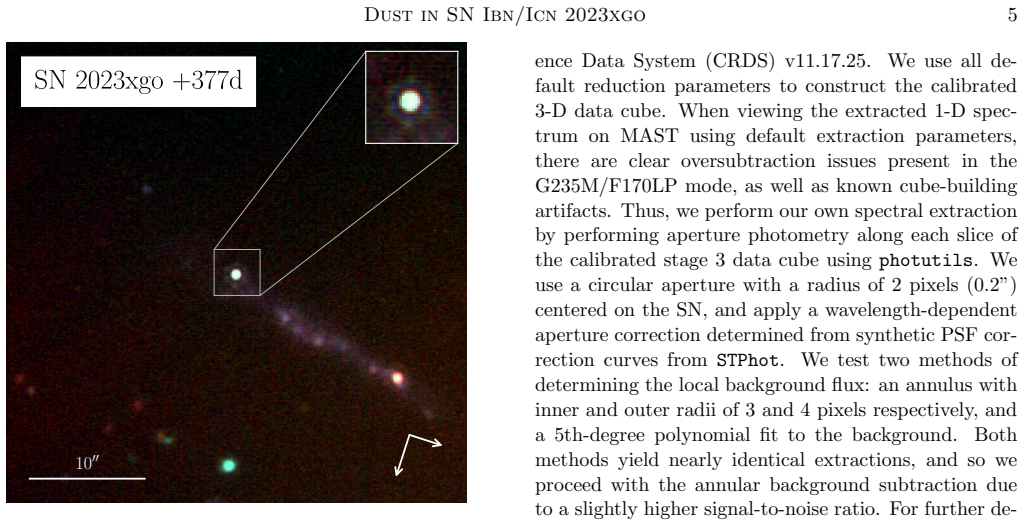
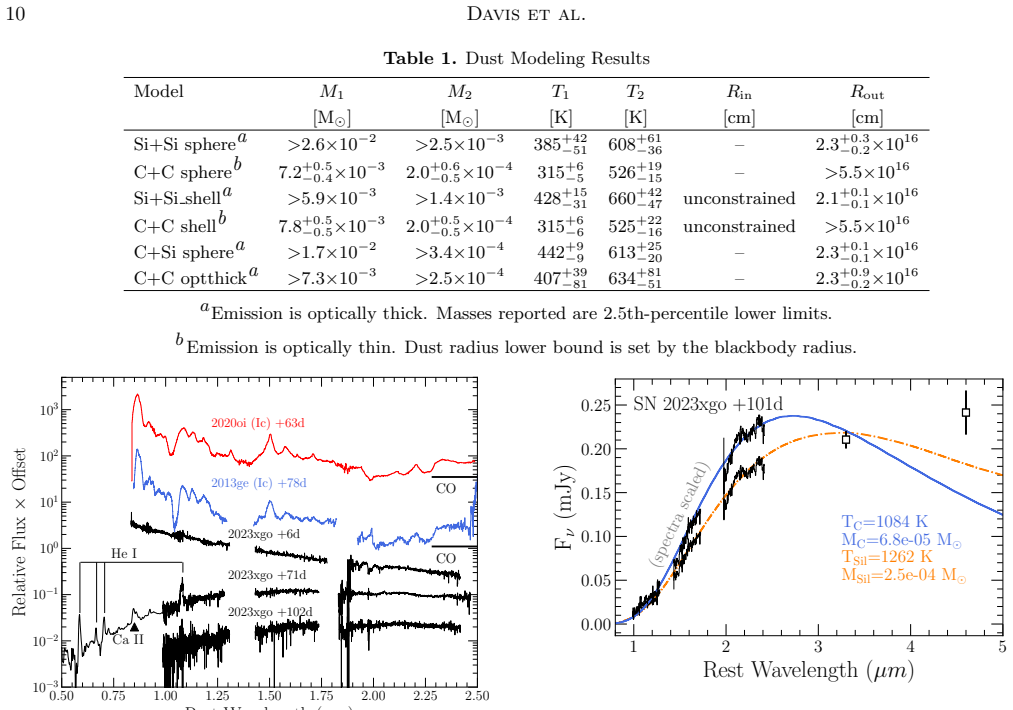
We present infrared (IR) photometric and spectroscopic observations of SN 2023xgo, a recent and nearby Type Ibn/Icn supernova (SN Ibn/Icn) which shows shock interaction with a He/C-rich and H-poor circumstellar medium (CSM). Although interacting SNe are predicted to produce large amounts of dust, the rarity of SNe Ibn and Icn has resulted in few opportunities to observe these objects in the IR at late times. Here, we report observations of SN 2023xgo from JWST (NIRSpec and MIRI), WISE, and Gemini taken out to +377 days post-explosion. At +377 days, the JWST spectrum is consistent with both emission from cool (~300-600 K) silicate dust with $M \gtrsim 3 \times 10^{-2}$ M$_{\odot}$ at a radius similar to the shock radius ($2.3 \times 10^{16}$ cm), and optically thin carbonaceous dust with $M = 8 \times 10^{-3}$ M$_{\odot}$. We also detect narrow (FWHM = 520+/-130 km s$^{-1}$) He I $\lambda$2.06 micron emission at +377 days, indicating that the SN shock continues to encounter material shed from the star to this late epoch. The emission line is blueshifted from the rest frame by 340+/-40 km s$^{-1}$. The Gemini and WISE observations at ~70-100 days reveal emission from 6.8$\times$10$^{-5}$ M$_{\odot}$ of hot (~1300 K) dust, which we interpret as a lower limit of the total dust mass at that phase. Molecular gas emission is not detected in any data, though emission line profiles in the optical and NIR taken at ~70 days after explosion show progressively less redshifted emission, attributed to attenuation from dust and suggesting that some dust is rapidly forming interior to the unshocked CSM. The large dust mass and rapid onset of dust formation observed in SN 2023xgo show that the unique physical environments of SNe Ibn/Icn facilitate substantial dust formation both before and after the SN.
Editorial analysis
A structured set of objections, weighed in public.
Referee Report
Summary. The manuscript presents JWST (NIRSpec+MIRI) spectroscopic and photometric observations of the Type Ibn/Icn supernova SN 2023xgo at +377 days post-explosion, supplemented by Gemini and WISE data at ~70-100 days. It claims that the +377 d spectrum is consistent with cool (~300-600 K) silicate dust with mass M ≳ 3×10^{-2} M⊙ at a radius (2.3×10^{16} cm) matching the shock radius, reports an alternative optically thin carbonaceous dust mass of 8×10^{-3} M⊙, and detects narrow (FWHM=520±130 km s^{-1}) blueshifted He I λ2.06 μm emission indicating ongoing CSM interaction. Earlier epochs show hot (~1300 K) dust at lower mass, with no molecular gas detected; the work concludes that SNe Ibn/Icn enable rapid, substantial dust formation both before and after explosion.
Significance. If the dust-mass and interaction results hold, the paper supplies rare late-time IR constraints on dust production in the uncommon Ibn/Icn subclass, with potential relevance to dust budgets in core-collapse events and early-universe enrichment. The direct spectroscopic evidence for continued shock-CSM interaction at +377 d and the JWST-enabled detection of cool dust at radii comparable to the forward shock constitute concrete observational anchors for models of dust formation in dense, He/C-rich environments.
major comments (1)
- [Abstract] Abstract (and the +377 d JWST spectral modeling section): the headline dust mass M ≳ 3×10^{-2} M⊙ is obtained by fitting the observed continuum to a cool silicate thermal-emission model. No quantitative upper limits or joint fits are supplied to demonstrate that non-dust continuum sources (free-free from the interaction zone, residual synchrotron, or unmodeled line wings) remain negligible across the fitted wavelength range; this assumption directly controls the conversion from flux to mass and radius.
minor comments (1)
- [Abstract] The abstract states the spectrum is 'consistent with both' silicate and carbonaceous dust but does not clarify whether these are mutually exclusive models or whether a two-component fit was performed.
Simulated Author's Rebuttal
We thank the referee for their careful and constructive review. We address the single major comment below and have revised the manuscript to incorporate additional quantitative checks on the continuum modeling.
read point-by-point responses
-
Referee: [Abstract] Abstract (and the +377 d JWST spectral modeling section): the headline dust mass M ≳ 3×10^{-2} M⊙ is obtained by fitting the observed continuum to a cool silicate thermal-emission model. No quantitative upper limits or joint fits are supplied to demonstrate that non-dust continuum sources (free-free from the interaction zone, residual synchrotron, or unmodeled line wings) remain negligible across the fitted wavelength range; this assumption directly controls the conversion from flux to mass and radius.
Authors: We agree that explicit quantification of possible non-dust contributions is necessary to robustly support the reported dust masses. In the revised manuscript we have added a dedicated paragraph to the +377 d spectral modeling section that (i) places an upper limit on free-free emission by scaling from the observed narrow He I λ2.06 μm luminosity and an assumed post-shock density consistent with the line width, finding <8% contribution longward of 5 μm; (ii) notes the lack of any radio detection that would indicate significant synchrotron; and (iii) demonstrates that the observed line profiles lack broad wings capable of affecting the continuum fit at the 5% level. These limits are now referenced in the abstract. The dust-mass and radius values themselves are unchanged, but the modeling assumptions are now stated with the requested quantitative support. revision: yes
Circularity Check
No circularity; results are direct model fits to new JWST data
full rationale
The paper reports new JWST NIRSpec+MIRI spectra and photometry of SN 2023xgo at +377 days, then fits these observed fluxes to standard cool silicate and carbonaceous dust emission models to obtain M_dust, T, and radius. These are conventional forward-model fits to external telescope data against calibrated flux standards; the output dust mass is not an input, nor is any quantity renamed or predicted from a prior fit within the same dataset. No equations, uniqueness theorems, or ansatzes are imported via self-citation in a load-bearing way. The derivation chain is therefore self-contained and non-circular.
Axiom & Free-Parameter Ledger
Reference graph
Works this paper leans on
-
[1]
Initial Performance of the NEOWISE Reactivation Mission
Initial Performance of the NEOWISE Reactivation Mission. , keywords =. doi:10.1088/0004-637X/792/1/30 , archivePrefix =. 1406.6025 , primaryClass =
work page internal anchor Pith review Pith/arXiv arXiv doi:10.1088/0004-637x/792/1/30
-
[2]
The Wide-field Infrared Survey Explorer (WISE): Mission Description and Initial On-orbit Performance. , keywords =. doi:10.1088/0004-6256/140/6/1868 , archivePrefix =. 1008.0031 , primaryClass =
work page internal anchor Pith review Pith/arXiv arXiv doi:10.1088/0004-6256/140/6/1868
-
[3]
ICORE: Image Co-addition with Optional Resolution Enhancement
ICORE: Image Co-addition with Optional Resolution Enhancement. arXiv e-prints , keywords =. doi:10.48550/arXiv.1301.2718 , archivePrefix =. 1301.2718 , primaryClass =
work page internal anchor Pith review Pith/arXiv arXiv doi:10.48550/arxiv.1301.2718
-
[4]
Infrared Emission from Interstellar Dust. I. Stochastic Heating of Small Grains. , keywords =. doi:10.1086/320227 , archivePrefix =. astro-ph/0011318 , primaryClass =
work page internal anchor Pith review Pith/arXiv arXiv doi:10.1086/320227
-
[5]
Monthly Notices of the Royal Astronomical Society , archivePrefix = "arXiv", eprint =
Evidence for top-heavy stellar initial mass functions with increasing density and decreasing metallicity. , keywords =. doi:10.1111/j.1365-2966.2012.20767.x , archivePrefix =. 1202.4755 , primaryClass =
-
[6]
Bright Supernova Precursors by Outbursts from Massive Stars with Compact Object Companions. , keywords =. doi:10.3847/1538-4357/ad3637 , archivePrefix =. 2401.02389 , primaryClass =
-
[7]
Evolution of Dust in Primordial Supernova Remnants: Can Dust Grains Formed in the Ejecta Survive and Be Injected into the Early Interstellar Medium?. , keywords =. doi:10.1086/520621 , archivePrefix =. 0706.0383 , primaryClass =
work page internal anchor Pith review Pith/arXiv arXiv doi:10.1086/520621
-
[8]
Hot Springs and Dust Reservoirs: JWST Reveals the Dusty, Molecular Aftermath of Extragalactic Stellar Mergers. , keywords =. doi:10.3847/1538-4357/ae38bf , archivePrefix =. 2508.03932 , primaryClass =
-
[9]
Near-infrared and Optical Observations of Type Ic SN 2020oi and Broad-lined Type Ic SN 2020bvc: Carbon Monoxide, Dust, and High-velocity Supernova Ejecta. , keywords =. doi:10.3847/1538-4357/abd850 , archivePrefix =. 2010.00662 , primaryClass =
-
[10]
Core-collapse, superluminous, and gamma-ray burst supernova host galaxy populations at low redshift: the importance of dwarf and starbursting galaxies. , keywords =. doi:10.1093/mnras/stab174 , archivePrefix =. 1911.09112 , primaryClass =
-
[11]
Seven Years of Coordinated Chandra-NuSTAR Observations of SN 2014C Unfold the Extreme Mass-loss History of Its Stellar Progenitor. , keywords =. doi:10.3847/1538-4357/ac8b14 , archivePrefix =. 2206.00842 , primaryClass =
-
[12]
Survival of the Fittest: Numerical Modeling of SN 2014C. , keywords =. doi:10.3847/1538-4357/ac649d , archivePrefix =. 2102.12581 , primaryClass =
-
[13]
Seven Years of SN 2014C: A Multiwavelength Synthesis of an Extraordinary Supernova. , keywords =. doi:10.3847/1538-4357/ac5fa6 , archivePrefix =. 2203.12747 , primaryClass =
-
[14]
SN 2014C: VLBI image shows a shell structure and decelerated expansion. , keywords =. doi:10.1093/mnras/staa4003 , archivePrefix =. 2012.12049 , primaryClass =
-
[15]
The changing-type SN 2014C may come from an 11-M _ star stripped by binary interaction and violent eruption. , keywords =. doi:10.1093/mnras/staa2277 , archivePrefix =. 2003.09325 , primaryClass =
-
[16]
Supernova 2014C: Ongoing Interaction with Extended Circumstellar Material with Silicate Dust. , keywords =. doi:10.3847/1538-4357/ab521b , archivePrefix =. 1909.06403 , primaryClass =
-
[17]
SN 2014C: VLBI Images of a Supernova Interacting with a Circumstellar Shell
SN 2014C: VLBI images of a supernova interacting with a circumstellar shell. , keywords =. doi:10.1093/mnras/stx3194 , archivePrefix =. 1707.09935 , primaryClass =
work page internal anchor Pith review Pith/arXiv arXiv doi:10.1093/mnras/stx3194
-
[18]
The peculiar mass-loss history of SN 2014C as revealed through AMI radio observations
The peculiar mass-loss history of SN 2014C as revealed through AMI radio observations. , keywords =. doi:10.1093/mnras/stw3310 , archivePrefix =. 1612.06059 , primaryClass =
work page internal anchor Pith review Pith/arXiv arXiv doi:10.1093/mnras/stw3310
-
[19]
Ejection of the massive Hydrogen-rich envelope timed with the collapse of the stripped SN2014C
Ejection of the Massive Hydrogen-rich Envelope Timed with the Collapse of the Stripped SN 2014C. , keywords =. doi:10.3847/1538-4357/835/2/140 , archivePrefix =. 1601.06806 , primaryClass =
work page internal anchor Pith review Pith/arXiv arXiv doi:10.3847/1538-4357/835/2/140
-
[20]
Metamorphosis of SN 2014C: Delayed Interaction between a Hydrogen Poor Core-collapse Supernova and a Nearby Circumstellar Shell. , keywords =. doi:10.1088/0004-637X/815/2/120 , archivePrefix =. 1511.01907 , primaryClass =
work page internal anchor Pith review Pith/arXiv arXiv doi:10.1088/0004-637x/815/2/120
-
[21]
Central Bureau Electronic Telegrams , year = 2014, month = jan, volume = 3777, pages =
Supernova 2014C in NGC 7331 = Psn J22370560+3424319. Central Bureau Electronic Telegrams , year = 2014, month = jan, volume = 3777, pages =
2014
-
[22]
Supernova Interaction with a Dense Detached Shell in SN 2001em. , keywords =. doi:10.3847/1538-4357/abb460 , archivePrefix =. 2008.13724 , primaryClass =
-
[23]
Late Emission from the Type Ib/c SN 2001em: Overtaking the Hydrogen Envelope
Late Emission from the Type Ib/c SN 2001em: Overtaking the Hydrogen Envelope. , keywords =. doi:10.1086/500539 , archivePrefix =. astro-ph/0510362 , primaryClass =
work page internal anchor Pith review Pith/arXiv arXiv doi:10.1086/500539
-
[24]
Radio Observations of SN2004dk with VLITE Confirm Late-time Rebrightening. , keywords =. doi:10.3847/1538-4357/ac2154 , archivePrefix =. 2101.07348 , primaryClass =
-
[25]
Interaction of SN Ib 2004dk with a Previously Expelled Envelope. , keywords =. doi:10.3847/1538-4357/ab3e36 , archivePrefix =. 1910.06395 , primaryClass =
-
[26]
Stripped-envelope supernova SN 2004dk is now interacting with hydrogen-rich circumstellar material
Stripped-envelope supernova SN 2004dk is now interacting with hydrogen-rich circumstellar material. , keywords =. doi:10.1093/mnras/sty1307 , archivePrefix =. 1803.07051 , primaryClass =
work page internal anchor Pith review Pith/arXiv arXiv doi:10.1093/mnras/sty1307
-
[27]
Two stripped envelope supernovae with circumstellar interaction. But only one really shows it. , keywords =. doi:10.1051/0004-6361/202038960 , archivePrefix =. 2009.04154 , primaryClass =
-
[28]
SN 2018ijp: the explosion of a stripped-envelope star within a dense H-rich shell?. , keywords =. doi:10.1051/0004-6361/202039068 , archivePrefix =. 2009.03331 , primaryClass =
-
[29]
Evidence for Extended Hydrogen-Poor CSM in the Three-Peaked Light Curve of Stripped Envelope Ib Supernova. arXiv e-prints , keywords =. doi:10.48550/arXiv.2207.07146 , archivePrefix =. 2207.07146 , primaryClass =
-
[30]
The broad-lined Type-Ic supernova SN 2022xxf and its extraordinary two-humped light curves. I. Signatures of H/He-free interaction in the first four months. , keywords =. doi:10.1051/0004-6361/202346526 , archivePrefix =. 2303.16925 , primaryClass =
-
[31]
A cool and inflated progenitor candidate for the Type Ib supernova 2019yvr at 2.6 yr before explosion. , keywords =. doi:10.1093/mnras/stab838 , archivePrefix =. 2101.03206 , primaryClass =
-
[32]
doi:10.5281/zenodo.7892935 , version =
The JWST HST Alignment Tool (JHAT). doi:10.5281/zenodo.7892935 , version =
-
[33]
The Keck Low-Resolution Imaging Spectrometer. , keywords =. doi:10.1086/133562 , adsurl =
-
[34]
Ground-based Instrumentation for Astronomy , year = 2004, editor =
Mass producing an efficient NIR spectrograph. Ground-based Instrumentation for Astronomy , year = 2004, editor =. doi:10.1117/12.550925 , adsurl =
-
[35]
PypeIt: The Python Spectroscopic Data Reduction Pipeline. The Journal of Open Source Software , keywords =. doi:10.21105/joss.02308 , archivePrefix =. 2005.06505 , primaryClass =
-
[36]
doi:10.5281/zenodo.3743493 , version =
pypeit/PypeIt: Release 1.0.0. doi:10.5281/zenodo.3743493 , version =
-
[37]
Keck Infrared Transient Survey. I. Survey Description and Data Release 1. , keywords =. doi:10.1088/1538-3873/ad1b39 , archivePrefix =. 2309.07102 , primaryClass =
-
[38]
JWST observations of dust reservoirs in type IIP supernovae 2004et and 2017eaw. , keywords =. doi:10.1093/mnras/stad1681 , archivePrefix =. 2301.10778 , primaryClass =
-
[39]
and Lang, Dustin and Goodman, Jonathan , year=
emcee: The MCMC Hammer. , archivePrefix = "arXiv", eprint =. doi:10.1086/670067 , adsurl =
-
[40]
Spectroscopic constraints on the properties of dust in active galactic nuclei. , keywords =. doi:10.1086/172149 , adsurl =
-
[41]
Optical properties of interstellar graphite and silicate grains. , keywords =. doi:10.1086/162480 , adsurl =
-
[42]
Astrophysics of gaseous nebulae and active galactic nuclei
-
[43]
, year = 1969, month = mar, volume =
Effects of Self-Absorption and Internal Dust on Hydrogen-Line Intensities in Gaseous Nebulae. , year = 1969, month = mar, volume =. doi:10.1086/149916 , adsurl =
-
[44]
Revisiting the Lick Observatory Supernova Search Volume-limited Sample: Updated Classifications and Revised Stripped-envelope Supernova Fractions. , keywords =. doi:10.1088/1538-3873/aa54a6 , archivePrefix =. 1609.02922 , primaryClass =
work page internal anchor Pith review Pith/arXiv arXiv doi:10.1088/1538-3873/aa54a6
-
[45]
Monthly Notices of the Royal Astronomical Society , archivePrefix = "arXiv", eprint =
Observed fractions of core-collapse supernova types and initial masses of their single and binary progenitor stars. , keywords =. doi:10.1111/j.1365-2966.2011.17229.x , archivePrefix =. 1006.3899 , primaryClass =
-
[46]
Mass Loss: Its Effect on the Evolution and Fate of High-Mass Stars
Mass Loss: Its Effect on the Evolution and Fate of High-Mass Stars. , keywords =. doi:10.1146/annurev-astro-081913-040025 , archivePrefix =. 1402.1237 , primaryClass =
work page internal anchor Pith review Pith/arXiv arXiv doi:10.1146/annurev-astro-081913-040025
-
[47]
Binary interaction dominates the evolution of massive stars
Binary Interaction Dominates the Evolution of Massive Stars. Science , keywords =. doi:10.1126/science.1223344 , archivePrefix =. 1207.6397 , primaryClass =
work page internal anchor Pith review Pith/arXiv arXiv doi:10.1126/science.1223344
-
[48]
The evolution of Red Supergiant mass-loss rates
The evolution of red supergiant mass-loss rates. , keywords =. doi:10.1093/mnras/stx3174 , archivePrefix =. 1712.01852 , primaryClass =
work page internal anchor Pith review Pith/arXiv arXiv doi:10.1093/mnras/stx3174
-
[49]
A new mass-loss rate prescription for red supergiants. , keywords =. doi:10.1093/mnras/staa255 , archivePrefix =. 2001.07222 , primaryClass =
-
[50]
The Impact of Realistic Red Supergiant Mass Loss on Stellar Evolution. , keywords =. doi:10.3847/1538-4357/ac2574 , archivePrefix =. 2109.03239 , primaryClass =
-
[51]
The Extreme Scarcity of Dust-enshrouded Red Supergiants: Consequences for Producing Stripped Stars via Winds. , keywords =. doi:10.3847/1538-4357/ac6dcf , archivePrefix =. 2205.02207 , primaryClass =
-
[52]
Bolometric light curves and explosion parameters of 38 stripped-envelope core-collapse supernovae
Bolometric light curves and explosion parameters of 38 stripped-envelope core-collapse supernovae. , keywords =. doi:10.1093/mnras/stv2983 , archivePrefix =. 1406.3667 , primaryClass =
work page internal anchor Pith review Pith/arXiv arXiv doi:10.1093/mnras/stv2983
-
[53]
A UV census of the environments of stripped-envelope supernovae. , keywords =. doi:10.1093/mnras/stad690 , archivePrefix =. 2209.05283 , primaryClass =
-
[54]
Presupernova Evolution in Massive Interacting Binaries. , keywords =. doi:10.1086/171341 , adsurl =
-
[55]
Constraints on core-collapse supernova progenitors from explosion site integral field spectroscopy
Constraints on core-collapse supernova progenitors from explosion site integral field spectroscopy. , keywords =. doi:10.1051/0004-6361/201731923 , archivePrefix =. 1711.05765 , primaryClass =
work page internal anchor Pith review Pith/arXiv arXiv doi:10.1051/0004-6361/201731923
-
[56]
PISCO: The Pmas/ppak Integral-field Supernova hosts COmpilation
PISCO: The PMAS/PPak Integral-field Supernova Hosts Compilation. , keywords =. doi:10.3847/1538-4357/aaaf20 , archivePrefix =. 1802.01589 , primaryClass =
work page internal anchor Pith review Pith/arXiv arXiv doi:10.3847/1538-4357/aaaf20
-
[57]
The First Systematic Study of Type Ibc Supernova Multi-band Light Curves
The First Systematic Study of Type Ibc Supernova Multi-band Light Curves. , keywords =. doi:10.1088/0004-637X/741/2/97 , archivePrefix =. 1011.4959 , primaryClass =
work page internal anchor Pith review Pith/arXiv arXiv doi:10.1088/0004-637x/741/2/97
-
[58]
Monthly Notices of the Royal Astronomical Society , archivePrefix = "arXiv", eprint =
Episodic mass loss in binary evolution to the Wolf-Rayet phase: Keck and HST proper motions of RY Scuti's nebula. , keywords =. doi:10.1111/j.1365-2966.2011.19614.x , archivePrefix =. 1105.2329 , primaryClass =
-
[59]
RY Scuti: Infrared and Radio Observations of the Mass-Loss Wind of a Massive Binary Star System. , keywords =. doi:10.1086/175184 , adsurl =
-
[60]
Multiwavelength observations of NaSt1 (WR 122): equatorial mass loss and X-rays from an interacting Wolf-Rayet binary. , keywords =. doi:10.1093/mnras/stv257 , archivePrefix =. 1502.01794 , primaryClass =
work page internal anchor Pith review Pith/arXiv arXiv doi:10.1093/mnras/stv257
-
[61]
The metamorphosis of the Type Ib SN 2019yvr: late-time interaction. , keywords =. doi:10.1093/mnrasl/slad195 , archivePrefix =. 2401.15052 , primaryClass =
-
[62]
A Systematic Study of Mid-Infrared Emission from Core-Collapse Supernovae with SPIRITS
A Systematic Study of Mid-infrared Emission from Core-collapse Supernovae with SPIRITS. , keywords =. doi:10.3847/1538-4357/833/2/231 , archivePrefix =. 1601.03440 , primaryClass =
work page internal anchor Pith review Pith/arXiv arXiv doi:10.3847/1538-4357/833/2/231
-
[63]
Late-Time Circumstellar Interaction in a Spitzer Selected Sample of Type IIn Supernovae
Late-time Circumstellar Interaction in a Spitzer Selected Sample of Type IIn Supernovae. , keywords =. doi:10.1088/0004-6256/146/1/2 , archivePrefix =. 1304.0248 , primaryClass =
work page internal anchor Pith review Pith/arXiv arXiv doi:10.1088/0004-6256/146/1/2
-
[64]
A Spitzer Survey for Dust in Type IIn Supernovae
A Spitzer Survey for Dust in Type IIn Supernovae. , keywords =. doi:10.1088/0004-637X/741/1/7 , archivePrefix =. 1104.5012 , primaryClass =
work page internal anchor Pith review Pith/arXiv arXiv doi:10.1088/0004-637x/741/1/7
-
[65]
A Comprehensive Analysis of Spitzer Supernovae
A Comprehensive Analysis of Spitzer Supernovae. , keywords =. doi:10.3847/1538-4365/ab10df , archivePrefix =. 1803.02571 , primaryClass =
work page internal anchor Pith review Pith/arXiv arXiv doi:10.3847/1538-4365/ab10df
-
[66]
SPIRITS: Uncovering Unusual Infrared Transients With Spitzer
SPIRITS: Uncovering Unusual Infrared Transients with Spitzer. , keywords =. doi:10.3847/1538-4357/aa6978 , archivePrefix =. 1701.01151 , primaryClass =
work page internal anchor Pith review Pith/arXiv arXiv doi:10.3847/1538-4357/aa6978
-
[67]
Spectral Irradiance Calibration in the Infrared. X. A Self-Consistent Radiometric All-Sky Network of Absolutely Calibrated Stellar Spectra. , keywords =. 1999. doi:10.1086/300813 , adsurl =
-
[68]
Optical and IR Telescope Instrumentation and Detectors , year = "2000", editor =
COMICS: the cooled mid-infrared camera and spectrometer for the Subaru telescope. Optical and IR Telescope Instrumentation and Detectors , year = "2000", editor =. doi:10.1117/12.395433 , adsurl =
-
[69]
Radiative-transfer modeling of He-star explosions from 1 to 10 years
The long-term influence of a magnetar power in stripped-envelope supernovae. Radiative-transfer modeling of He-star explosions from 1 to 10 years. arXiv e-prints , keywords =. doi:10.48550/arXiv.2408.13844 , archivePrefix =. 2408.13844 , primaryClass =
-
[70]
Evidence for a pulsar wind nebula in the Type Ib-peculiar supernova SN 2012au
Evidence for a Pulsar Wind Nebula in the Type Ib Peculiar Supernova SN 2012au. , keywords =. doi:10.3847/2041-8213/aadd4e , archivePrefix =. 1809.01141 , primaryClass =
work page internal anchor Pith review Pith/arXiv arXiv doi:10.3847/2041-8213/aadd4e 2041
-
[71]
The Journal of chemical physics , volume=
Direct observation of the fine structure transitions in the Ne+ and Ar+ ions with diode lasers , author=. The Journal of chemical physics , volume=. 1985 , publisher=
1985
-
[72]
A Long-duration Luminous Type IIn Supernova KISS15s: Strong Recombination Lines from the Inhomogeneous Ejecta-CSM Interaction Region and Hot Dust Emission from Newly Formed Dust. , keywords =. doi:10.3847/1538-4357/aaff6b , archivePrefix =. 1901.05508 , primaryClass =
work page internal anchor Pith review Pith/arXiv arXiv doi:10.3847/1538-4357/aaff6b 1901
-
[73]
JWST/MIRI Observations of Newly Formed Dust in the Cold, Dense Shell of the Type IIn SN 2005ip. , keywords =. doi:10.3847/1538-4357/adce77 , archivePrefix =. 2410.09142 , primaryClass =
-
[74]
, keywords =
A new subclass of type II supernovae ?. , keywords =
-
[75]
Massive stars exploding in a He-rich circumstellar medium - I. Type Ibn (SN 2006jc-like) events. , keywords =. doi:10.1111/j.1365-2966.2008.13602.x , archivePrefix =. 0801.2277 , primaryClass =
-
[76]
Transient Name Server AstroNote , keywords =
Introducing a new Supernova classification type: SN Icn. Transient Name Server AstroNote , keywords =
-
[77]
The Diverse Properties of Type Icn Supernovae Point to Multiple Progenitor Channels. , keywords =. doi:10.3847/1538-4357/ac8ff6 , archivePrefix =. 2205.07894 , primaryClass =
-
[78]
, keywords =
Mass loss rates in the Hertzsprung-Russell diagram. , keywords =
-
[79]
The contribution by luminous blue variable stars to the dust content of the Magellanic Clouds. , keywords =. doi:10.1051/0004-6361/202141279 , archivePrefix =. 2109.04093 , primaryClass =
-
[80]
, year = 1998, month = jan, volume =
Dust in LBV Nebulae. , year = 1998, month = jan, volume =. doi:10.1023/A:1001145110961 , adsurl =
discussion (0)
Sign in with ORCID, Apple, or X to comment. Anyone can read and Pith papers without signing in.