Co-adsorption mechanism drives CO oxidation on defective ZnS
Pith reviewed 2026-06-28 21:35 UTC · model grok-4.3
The pith
Oxygen coverage, not defect density alone, controls CO2-like intermediate formation on defective ZnS via co-adsorption.
A machine-rendered reading of the paper's core claim, the machinery that carries it, and where it could break.
Core claim
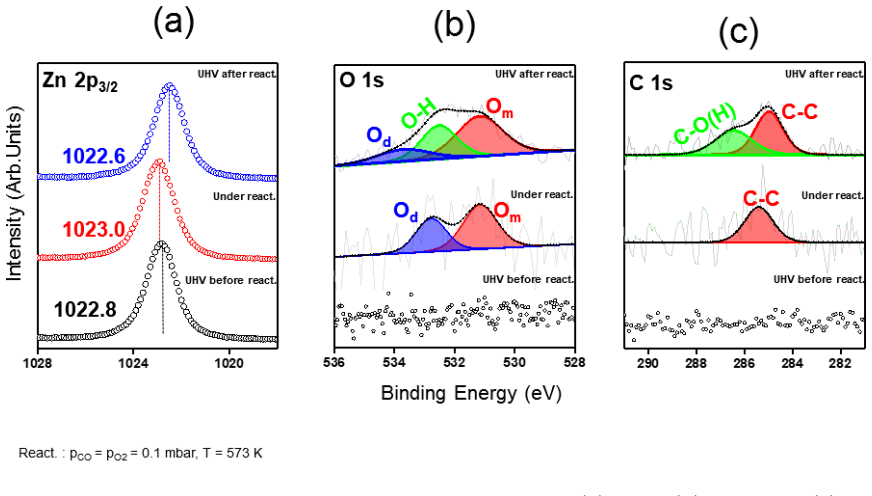
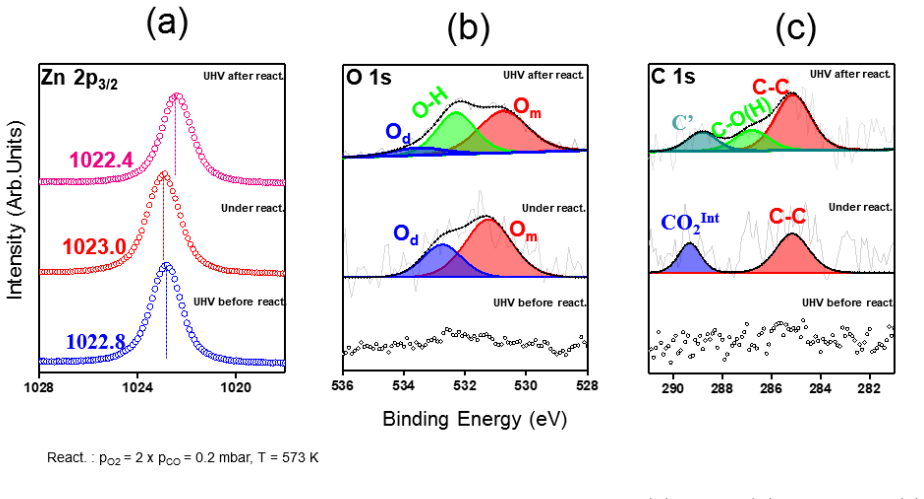
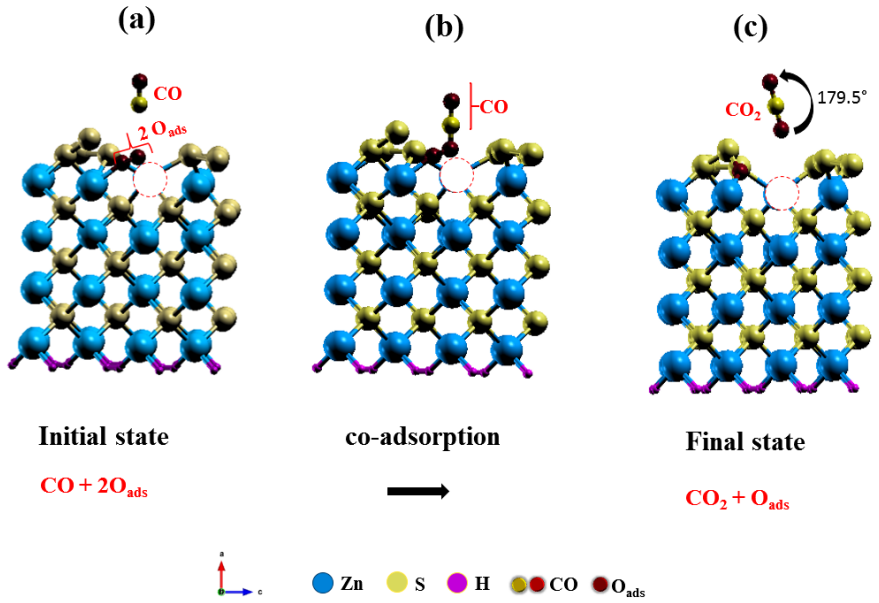
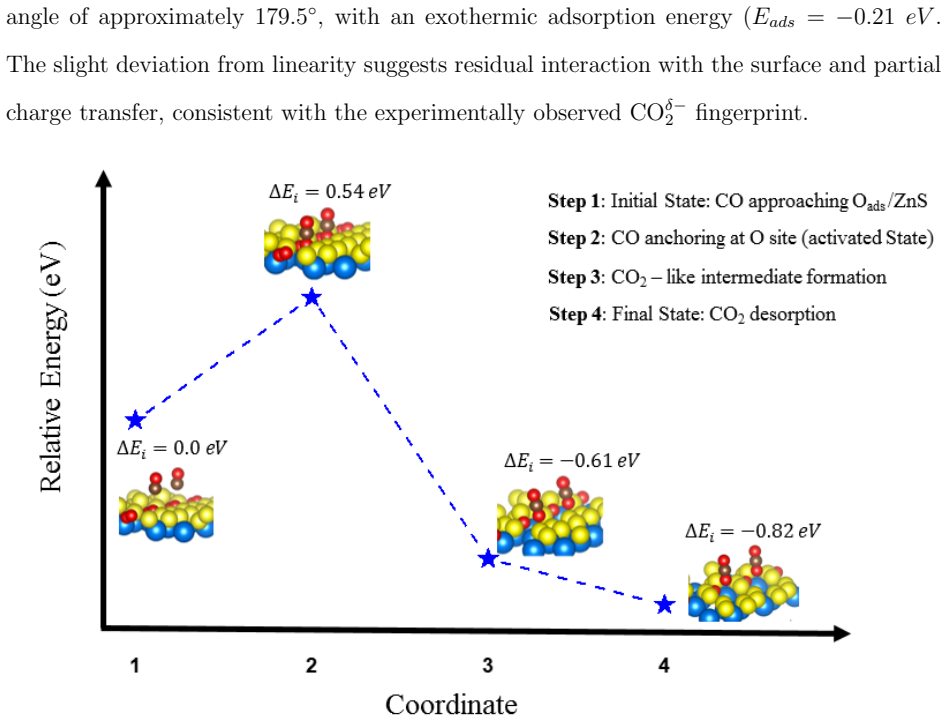
NAP-XPS measurements on defective ZnS reveal CO2-like surface intermediates exclusively under oxygen-rich conditions. DFT calculations identify an oxygen-assisted co-adsorption pathway in which CO interacts preferentially with adsorbed oxygen stabilized near Zn-deficient sites to form weakly bound CO2-like structures.
What carries the argument
oxygen-assisted co-adsorption pathway where CO binds to adsorbed oxygen near Zn vacancies
If this is right
- Oxygen coverage becomes the tunable parameter for driving CO oxidation reactivity on defective ZnS.
- Defective ZnS functions as a model system for oxygen-assisted surface chemistry on non-oxide semiconductors.
- Similar co-adsorption mechanisms are expected on other defective sulfide or semiconductor surfaces under oxygen-rich conditions.
Where Pith is reading between the lines
- Varying oxygen partial pressure in experiments could map the minimum coverage threshold needed for intermediate formation.
- The mechanism may generalize to predict reactivity trends across other metal chalcogenide surfaces with cation vacancies.
- Catalyst design for CO oxidation on sulfides could prioritize oxygen dosing protocols over maximizing defect density.
Load-bearing premise
The DFT calculations correctly identify the oxygen-assisted co-adsorption pathway as dominant and match the experimental NAP-XPS signatures without significant errors from exchange-correlation functional choice or surface slab model.
What would settle it
Detection of CO2-like intermediates in NAP-XPS under oxygen-poor conditions on the same defective ZnS surface would falsify the requirement for high oxygen coverage.
Figures
read the original abstract
Reactivity on wide-bandgap semiconductor surfaces relies critically on the generation of active sites. In the case of CO oxidation, however, the mere presence of defects is insufficient to drive reactivity. Here, we investigate CO oxidation on a defective ZnS single-crystal surface by combining near ambient pressure X-ray photoelectron spectroscopy (NAP-XPS) and density functional theory (DFT) calculations. NAP-XPS measurements reveal CO$_2$-like surface intermediates only under oxygen-rich conditions, consistent with oxygen-assisted CO oxidation. DFT calculations support an oxygen-assisted co-adsorption pathway in which CO interacts preferentially with adsorbed oxygen species stabilized near Zn-deficient sites, forming weakly bound CO$_2$-like structures. These results identify oxygen coverage, rather than defect density alone, as the key factor controlling CO$_2$-like intermediate formation on defective ZnS and establish defective ZnS as a model platform for studying oxygen-assisted surface chemistry on non-oxide semiconductors.
Editorial analysis
A structured set of objections, weighed in public.
Referee Report
Summary. The manuscript investigates CO oxidation on defective ZnS single-crystal surfaces using near-ambient-pressure X-ray photoelectron spectroscopy (NAP-XPS) and density functional theory (DFT). NAP-XPS detects CO2-like surface intermediates exclusively under oxygen-rich conditions. DFT calculations identify an oxygen-assisted co-adsorption pathway in which CO preferentially interacts with adsorbed oxygen species near Zn vacancies to form weakly bound CO2-like structures. The central claim is that oxygen coverage, rather than defect density alone, controls intermediate formation, establishing defective ZnS as a model platform for oxygen-assisted surface chemistry on non-oxide semiconductors.
Significance. If the reported consistency between NAP-XPS signatures and the DFT co-adsorption pathway holds, the work provides a concrete example of coverage-dependent reactivity on a defective non-oxide semiconductor and supplies an experimentally accessible model system for studying oxygen-assisted mechanisms. The independent experimental and computational grounding (no parameter fitting or circular reduction) strengthens the identification of oxygen coverage as the controlling variable.
minor comments (3)
- [Abstract] The abstract and introduction would benefit from explicit statement of the ZnS surface orientation and defect type (e.g., Zn vacancy concentration) to allow direct comparison with prior ZnS defect studies.
- [Methods] Computational details on slab thickness, k-point sampling, and the specific exchange-correlation functional (including any dispersion corrections) are needed to evaluate possible errors in the reported co-adsorption energetics.
- [Figures] Figure captions should specify the photon energy, takeoff angle, and binding-energy calibration procedure used in the NAP-XPS spectra to facilitate reproduction of the oxygen-rich vs. oxygen-poor contrast.
Simulated Author's Rebuttal
We thank the referee for the positive assessment of our manuscript, the accurate summary of our findings on the oxygen-assisted co-adsorption pathway, and the recommendation for minor revision. No major comments were provided in the report.
Circularity Check
No significant circularity detected
full rationale
The paper grounds its central claim in independent experimental NAP-XPS observations of CO2-like intermediates appearing exclusively under oxygen-rich conditions, combined with separate DFT calculations identifying the oxygen-assisted co-adsorption pathway near Zn vacancies. No equations, fitted parameters, or self-citations are invoked that reduce the reported pathway or coverage dependence to a tautological input or construction by definition. The mapping from observed conditional formation to the controlling role of oxygen coverage follows directly from the data without circular reduction, rendering the derivation self-contained against external benchmarks.
Axiom & Free-Parameter Ledger
axioms (2)
- domain assumption Density functional theory with chosen functional and slab model yields reliable relative energies for CO and O co-adsorption near Zn vacancies.
- domain assumption NAP-XPS spectra can unambiguously identify CO2-like surface intermediates under the oxygen-rich conditions used.
Reference graph
Works this paper leans on
-
[1]
ACS Applied Materials & Interfaces , volume=
Interfacial mechanical strength enhancement for high-performance ZnS thin-film anodes , author=. ACS Applied Materials & Interfaces , volume=. 2020 , publisher=
2020
-
[2]
ACS Applied Materials & Interfaces , volume=
Synthesis of a hexagonal phase ZnS photocatalyst for high CO selectivity in CO2 reduction reactions , author=. ACS Applied Materials & Interfaces , volume=. 2023 , publisher=
2023
-
[3]
Journal of Environmental Chemical Engineering , volume=
Metal oxides and metal organic frameworks for the photocatalytic degradation: A review , author=. Journal of Environmental Chemical Engineering , volume=. 2020 , publisher=
2020
-
[4]
ACS Applied Nano Materials , volume=
Review of metal sulfide nanostructures and their applications , author=. ACS Applied Nano Materials , volume=. 2023 , publisher=
2023
-
[5]
Vacuum , volume=
Zinc blende ZnS (001) surface structure investigated by XPS, LEED, and DFT , author=. Vacuum , volume=. 2024 , publisher=
2024
-
[6]
Applied Surface Science Advances , volume=
Systematic and collaborative approach to problem solving using X-ray photoelectron spectroscopy , author=. Applied Surface Science Advances , volume=. 2021 , publisher=
2021
-
[7]
Physical Review B , volume=
Electronic core levels of zinc chalcogenides , author=. Physical Review B , volume=. 1970 , publisher=
1970
-
[8]
J. H. Scofield , title =. Journal of Electron Spectroscopy and Related Phenomena , volume =. 1976 , doi =
1976
-
[9]
Calculations of electron inelastic mean free paths. V. Data for 14 organic compounds over the 50--2000 eV range , author=. Surface and interface analysis , volume=. 1994 , publisher=
2000
-
[10]
Chemistry of Materials , volume=
Interpretation of oxygen 1s X-ray photoelectron spectroscopy of ZnO , author=. Chemistry of Materials , volume=. 2023 , publisher=
2023
-
[11]
Dengo and A
N. Dengo and A. Vittadini and M. M. Natile and S. Gross , title =. The Journal of Physical Chemistry C , volume =. 2020 , doi =
2020
-
[12]
Journal of Physics D: Applied Physics , volume=
Formation mechanism, stability, and role of zinc and sulfur vacancies on the electronic properties and optical response of ZnS , author=. Journal of Physics D: Applied Physics , volume=. 2025 , pages =
2025
-
[13]
Surface science , volume=
Density-functional theory study of the catalytic oxidation of CO over transition metal surfaces , author=. Surface science , volume=. 1999 , publisher=
1999
-
[14]
Surface Science Reports , volume=
Surface chemistry of carbon dioxide , author=. Surface Science Reports , volume=. 1996 , publisher=
1996
-
[15]
The Journal of Physical Chemistry C , year=
Growth and Surface Characterization of a Type-II ZnO/ZnS Heterostructure , author=. The Journal of Physical Chemistry C , year=
-
[16]
Journal of the American Chemical Society , volume=
Direct electroreduction of carbonate to formate , author=. Journal of the American Chemical Society , volume=. 2023 , publisher=
2023
-
[17]
Acta Materialia , pages=
Initiation of dusting corrosion in high-temperature alloys under CO exposure , author=. Acta Materialia , pages=. 2025 , publisher=
2025
-
[18]
ACS omega , volume=
Theoretical study of ZnS monolayer adsorption behavior for CO and HF gas molecules , author=. ACS omega , volume=. 2022 , publisher=
2022
-
[19]
Chemical Society Reviews , volume=
Surface science under reaction conditions: CO oxidation on Pt and Pd model catalysts , author=. Chemical Society Reviews , volume=. 2017 , publisher=
2017
-
[20]
Journal of the American Chemical Society , volume=
CO oxidation mechanisms on CoO x-Pt thin films , author=. Journal of the American Chemical Society , volume=. 2020 , publisher=
2020
-
[21]
Angewandte Chemie International Edition , volume=
CO oxidation as a prototypical reaction for heterogeneous processes , author=. Angewandte Chemie International Edition , volume=. 2011 , publisher=
2011
-
[22]
Chemistry of Materials , volume=
Dilute Pd/Au alloy nanoparticles embedded in colloid-templated porous SiO2: stable Au-based oxidation catalysts , author=. Chemistry of Materials , volume=. 2019 , publisher=
2019
-
[23]
Chemical Engineering Journal , volume=
Study of Pt dispersion on Ce based supports and the influence on the CO oxidation reaction , author=. Chemical Engineering Journal , volume=. 2014 , publisher=
2014
-
[24]
RSC advances , volume=
Recent advances in noble metal-based catalysts for CO oxidation , author=. RSC advances , volume=. 2024 , publisher=
2024
-
[25]
Energy & Fuels , volume=
Recent progress in transition-metal sulfide catalyst regulation for improved oxygen evolution reaction , author=. Energy & Fuels , volume=. 2022 , publisher=
2022
-
[26]
ACS Catalysis , volume=
Operando identification of active species and intermediates on sulfide interfaced by Fe3O4 for ultrastable alkaline oxygen evolution at large current density , author=. ACS Catalysis , volume=. 2022 , publisher=
2022
-
[27]
Journal of Catalysis , pages=
In-situ NAP-XPS reveals water-induced phase segregation of MoS2 nanoparticles in hydrodeoxygenation catalysis , author=. Journal of Catalysis , pages=. 2026 , publisher=
2026
-
[28]
Applied Surface Science , volume=
An in situ XPS study of L-cysteine co-adsorbed with water on polycrystalline copper and gold , author=. Applied Surface Science , volume=. 2018 , publisher=
2018
-
[29]
Acs Sensors , volume=
Operando Investigation of WS2 Gas Sensors: Simultaneous Ambient Pressure X-ray Photoelectron Spectroscopy and Electrical Characterization in Unveiling Sensing Mechanisms during Toxic Gas Exposure , author=. Acs Sensors , volume=. 2024 , publisher=
2024
-
[30]
ACS Catalysis , volume=
Boosting oxygen activation via defect engineering to regulate CO oxidation pathway over Pt/TiO2 catalysts , author=. ACS Catalysis , volume=. 2025 , publisher=
2025
-
[31]
Advanced Functional Materials , volume=
Defect engineering in nanocatalysts: from design and synthesis to applications , author=. Advanced Functional Materials , volume=. 2024 , publisher=
2024
-
[32]
ACS nano , volume=
Defect engineering of two-dimensional transition-metal dichalcogenides: applications, challenges, and opportunities , author=. ACS nano , volume=. 2021 , publisher=
2021
-
[33]
ACS Energy Letters , volume=
Cation vacancy-initiated CO2 photoreduction over ZnS for efficient formate production , author=. ACS Energy Letters , volume=. 2019 , publisher=
2019
-
[34]
Inorganic Chemistry , volume=
Thermal evolution of ZnS nanostructures: Effect of oxidation phenomena on structural features and photocatalytical performances , author=. Inorganic Chemistry , volume=. 2018 , publisher=
2018
-
[35]
arXiv preprint arXiv:2601.13434 , year=
Insights into CO\_ \ 2 \ activation on defective ZnS surfaces , author=. arXiv preprint arXiv:2601.13434 , year=
-
[36]
The Journal of Physical Chemistry C , volume=
Understanding anomalous gas-phase peak shifts in dip-and-pull ambient pressure XPS experiments , author=. The Journal of Physical Chemistry C , volume=. 2024 , publisher=
2024
-
[37]
The Journal of Chemical Physics , volume=
CO oxidation on Pt (111) at near ambient pressures , author=. The Journal of Chemical Physics , volume=. 2016 , publisher=
2016
-
[38]
Chemical Engineering Science , volume=
Oxidations carried out by means of vanadium oxide catalysts , author=. Chemical Engineering Science , volume=. 1954 , publisher=
1954
discussion (0)
Sign in with ORCID, Apple, or X to comment. Anyone can read and Pith papers without signing in.