Perturbative methods for non-parametric instrumental variable
Pith reviewed 2026-06-28 23:14 UTC · model grok-4.3
The pith
Perturbative corrections reduce prediction error by up to 99% for nonparametric instrumental variables in high dimensions
A machine-rendered reading of the paper's core claim, the machinery that carries it, and where it could break.
Core claim
We introduce a perturbative approach for nonparametric instrumental variable estimation. By drawing inspiration from perturbation theory in physics, we extend standard kernel ridge methods with systematic higher perturbation order corrections that significantly improve estimation accuracy. Spectrally, the perturbation introduces mixing between different eigenmodes of the expectation integral operator, which becomes especially useful when the integral equation is ill-defined. One source for such ill-definedness can be the curse of dimensionality. Our method performs across various dimensionality regimes, particularly when the dimensionality parameter β which is defined through the number of s
What carries the argument
The perturbative corrections that introduce mixing between different eigenmodes of the expectation integral operator in the kernel ridge estimator.
Load-bearing premise
The assumption that perturbation theory can be systematically extended to the expectation integral operator in NPIV such that higher-order corrections remain stable and unbiased when the operator is ill-defined due to high dimensionality.
What would settle it
An experiment showing that first-order perturbative corrections fail to reduce or increase prediction error in NPIV settings with β > 0.7 compared to standard ridge regression would falsify the claim.
Figures

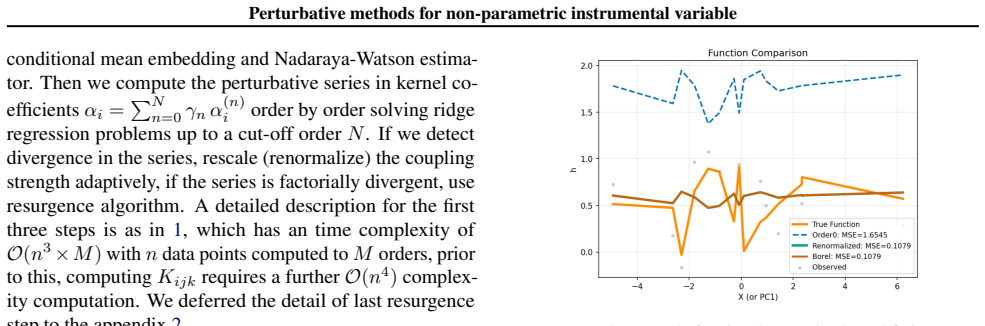
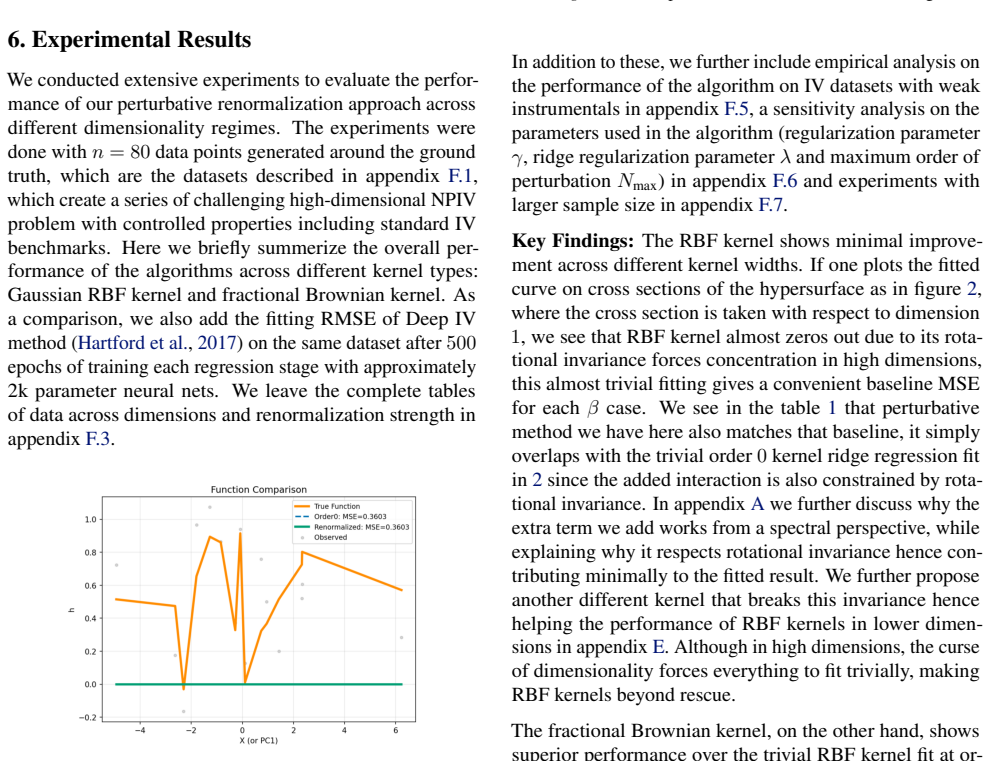
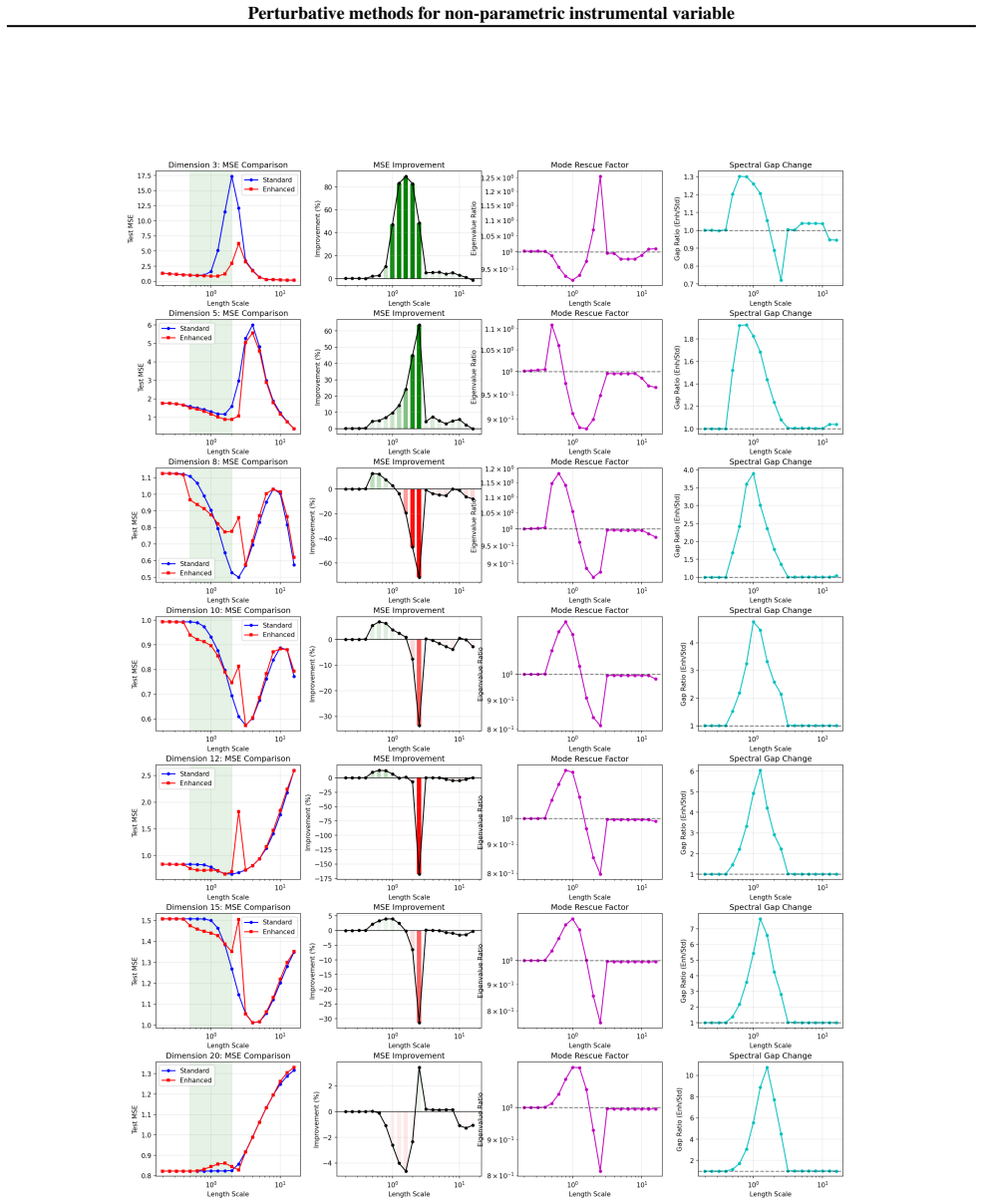
read the original abstract
We introduce a perturbative approach for nonparametric instrumental variable (NPIV) estimation. By drawing inspiration from perturbation theory in physics, we extend standard kernel ridge methods with systematic higher perturbation order corrections that significantly improve estimation accuracy. Spectrally, the perturbation introduces mixing between different eigenmodes of the expectation integral operator, which becomes especially useful when the integral equation is ill-defined. One source for such ill-definedness can be the curse of dimensionality. Our method performs across various dimensionality regimes, particularly when the dimensionality parameter $\beta$ which is defined through the number of samples $n$ and dimension $d$ as $n^\beta = d$, becomes large. Experimental results show that our first-order perturbative corrections can reduce prediction error by up to 99\% in high-dimensional ill-defined cases ($\beta > 0.7$) compared to standard ridge regression approaches. The performance improvement is maintained across a wide range of dimensions, with the advantage becoming more pronounced as dimensionality increases.
Editorial analysis
A structured set of objections, weighed in public.
Referee Report
Summary. The manuscript introduces a perturbative approach for nonparametric instrumental variable (NPIV) estimation. It extends standard kernel ridge methods by adding systematic higher-order perturbation corrections that introduce mixing between eigenmodes of the expectation integral operator, with the goal of improving accuracy in ill-defined regimes. The central claim is that first-order corrections yield up to 99% reduction in prediction error relative to ridge regression when the dimensionality parameter β (defined via n^β = d) exceeds 0.7.
Significance. If the perturbative corrections can be shown to remain accurate and the reported gains can be reproduced under standard experimental controls, the approach could provide a practical route to mitigating the effects of rapid eigenvalue decay in high-dimensional NPIV. No machine-checked proofs, reproducible code, or parameter-free derivations are presented.
major comments (2)
- [Abstract] Abstract: the claim that first-order perturbative corrections reduce prediction error by up to 99% in the regime β > 0.7 supplies no experimental protocol, baseline specifications, error bars, or statistical tests. This absence renders the central performance claim impossible to assess and is load-bearing for the paper's main contribution.
- [Abstract] Abstract: the assertion that the perturbation introduces useful eigenmode mixing for the compact expectation integral operator T when its singular values decay rapidly (high β) is not accompanied by any derivation showing that the remainder after the first-order term is o(1) uniformly in this regime, nor that the resulting estimator remains unbiased for the structural function. Standard perturbation theory requires the unperturbed operator to have spectrum bounded away from zero; here the unperturbed operator is already severely ill-conditioned.
minor comments (1)
- [Abstract] The definition of the dimensionality parameter β via n^β = d is introduced without reference to prior literature on effective dimension in nonparametric estimation.
Simulated Author's Rebuttal
We thank the referee for their careful reading and constructive comments. We address each major comment below and outline planned revisions to the manuscript.
read point-by-point responses
-
Referee: [Abstract] Abstract: the claim that first-order perturbative corrections reduce prediction error by up to 99% in the regime β > 0.7 supplies no experimental protocol, baseline specifications, error bars, or statistical tests. This absence renders the central performance claim impossible to assess and is load-bearing for the paper's main contribution.
Authors: The experimental protocol, baselines (standard kernel ridge regression), error bars from repeated trials, and statistical comparisons are presented in Section 4 of the manuscript. To address the concern that the abstract renders the claim difficult to assess, we will revise the abstract to include a brief reference to the experimental setup, the definition of the β regime, and the observed maximum reduction. revision: yes
-
Referee: [Abstract] Abstract: the assertion that the perturbation introduces useful eigenmode mixing for the compact expectation integral operator T when its singular values decay rapidly (high β) is not accompanied by any derivation showing that the remainder after the first-order term is o(1) uniformly in this regime, nor that the resulting estimator remains unbiased for the structural function. Standard perturbation theory requires the unperturbed operator to have spectrum bounded away from zero; here the unperturbed operator is already severely ill-conditioned.
Authors: We agree that the standard conditions for perturbation expansions are violated when the spectrum of T decays rapidly. The manuscript does not contain a derivation establishing that the first-order remainder is o(1) uniformly or that the estimator is unbiased. In the revision we will add a discussion subsection clarifying that the approach is motivated by eigenmode mixing and supported by empirical results rather than by a full perturbative error analysis under the classical assumptions. revision: partial
Circularity Check
No circularity; claims rest on external experimental evaluation
full rationale
The abstract presents a perturbative extension to kernel ridge regression for NPIV estimation, with performance claims grounded in experimental error reductions (up to 99% for β > 0.7) rather than any closed-form derivation that reduces to fitted parameters or self-citations. No equations, ansatzes, or uniqueness theorems are exhibited that would trigger self-definitional, fitted-input, or self-citation patterns. The dimensionality parameter β is introduced as a simple definition (n^β = d) without circular reuse, and the method is positioned as an extension inspired by external physics concepts. This leaves the central results self-contained against external benchmarks.
Axiom & Free-Parameter Ledger
Reference graph
Works this paper leans on
-
[1]
URL https://api.semanticscholar. org/CorpusID:207063850. Carrasco, M., Florens, J.-P., and Renault, E. Chapter 77 linear inverse problems in structural economet- rics estimation based on spectral decomposition and regularization. volume 6 ofHandbook of Econometrics, pp. 5633–5751. Elsevier, 2007. doi: https://doi.org/10.1016/S1573-4412(07)06077-1. URL htt...
-
[2]
URL https://proceedings.mlr.press/ v139/donhauser21a.html. Dorigoni, D. An introduction to resurgence, trans-series and alien calculus.Annals of Physics, 409:167914, 2019. doi: 10.1016/j.aop.2019.167914. Accessible survey for physicists covering resurgent analysis and alien calculus. Dyson, F. J. Divergence of perturbation theory in quantum electrodynamic...
-
[3]
URL http:// dx.doi.org/10.1002/prop.201400005
doi: 10.1002/prop.201400005. URL http:// dx.doi.org/10.1002/prop.201400005. Meunier, D., Moulin, A., Wornbard, J., Kostic, V . R., and Gretton, A. Demystifying spectral feature learning for instrumental variable regression, 2025. URL https: //arxiv.org/abs/2506.10899. Miao, W., Geng, Z., and Tchetgen, E. T. Identifying causal effects with proxy variables ...
-
[4]
ISBN 978-0-201-50397-5, 978-0-429-50355-9, 978-0-429-49417-8. doi: 10.1201/9780429503559. Rizzo, M. L. and Sz ´ekely, G. J. Energy distance.WIREs Comput. Stat., 8(1):27–38, January 2016. ISSN 1939- 5108. Sch¨olkopf, B., Herbrich, R., and Smola, A. J. A generalized representer theorem. In Helmbold, D. and Williamson, B. (eds.),Computational Learning Theory...
-
[5]
ISSN 00129682, 14680262. URLhttp://www. jstor.org/stable/2171753. Steinwart, I. and Christmann, A.Support vector machines. Information science and statistics. Springer, New York, NY , 2008. ISBN 978-0-387-77241-7 and 978-1-4899- 8963-5 and 978-6-611-92704-2 and 978-0-387-77242-4. Stock, J. H., Wright, J. H., and Yogo, M. A survey of weak instruments and w...
-
[6]
For allx∈ X, the functionK(·, x)belongs toH
-
[7]
Definition 5(Conditional Expectation Operators).Let X and Z be random variables with joint distribution PX,Z
For allx∈ Xand allf∈ H, the reproducing property holds:f(x) =⟨f, K(·, x)⟩ H. Definition 5(Conditional Expectation Operators).Let X and Z be random variables with joint distribution PX,Z. We define:
-
[8]
The conditional expectation operatorT:H →L 2(PZ)as(T f)(z) =E[f(X)|Z=z]
-
[9]
The adjoint operatorT ∗ :L 2(PZ)→ Hsatisfies⟨T f, g⟩ L2(PZ) =⟨f, T ∗g⟩H for allf∈ Handg∈L 2(PZ). We consider the nonparametric instrumental variable (NPIV) problem with a cubic interaction term: S[f] =S 0[f] +γS 1[f](93) =E Z h (E[Y|Z]−E[f(X)|Z]) 2 i +λ∥f∥ 2 H +γS 1[f],(94) whereS 1[f]represents the non-independent three-point interaction: S1[f] = 2 3 EZ ...
-
[10]
Couple(l 1, l2) = (1,5) =⇒intermediate angular momentuml 12 ∈ {4,5,6}
-
[11]
Let’s targetl12 = 4
We now seek an evenLthat allows coupling(l 3, L) = (1, L)to one of thesel 12 values. Let’s targetl12 = 4
-
[12]
The coupling rule requires|l 3 −L| ≤l 12 ≤l 3 +L, which for our values becomes|1−L| ≤4≤1 +L
-
[13]
Order 0” is standard kernel ridge IV; “Best Pert
The inequality4≤1 +LimpliesL≥3. The inequality|1−L| ≤4implies−3≤L≤5. The conditions require L to be in the range [3,5] . We can choose the even value L= 4 . The expansion of g(ˆω)contains a non-zero C4,M term. Therefore, a coupling pathway exists via the L= 4 channel, and the integral can be non-zero. This demonstrates that the triangle inequality on(l 1,...
2021
discussion (0)
Sign in with ORCID, Apple, or X to comment. Anyone can read and Pith papers without signing in.