Microstructure-specific mechanisms define multistage relaxation dynamics in a metallic model-glass
Pith reviewed 2026-06-28 21:33 UTC · model grok-4.3
The pith
Simulated X-ray photon correlation spectroscopy identifies three sequential atomic-scale decorrelation stages in a metallic model glass during annealing toward crystallization.
A machine-rendered reading of the paper's core claim, the machinery that carries it, and where it could break.
Core claim
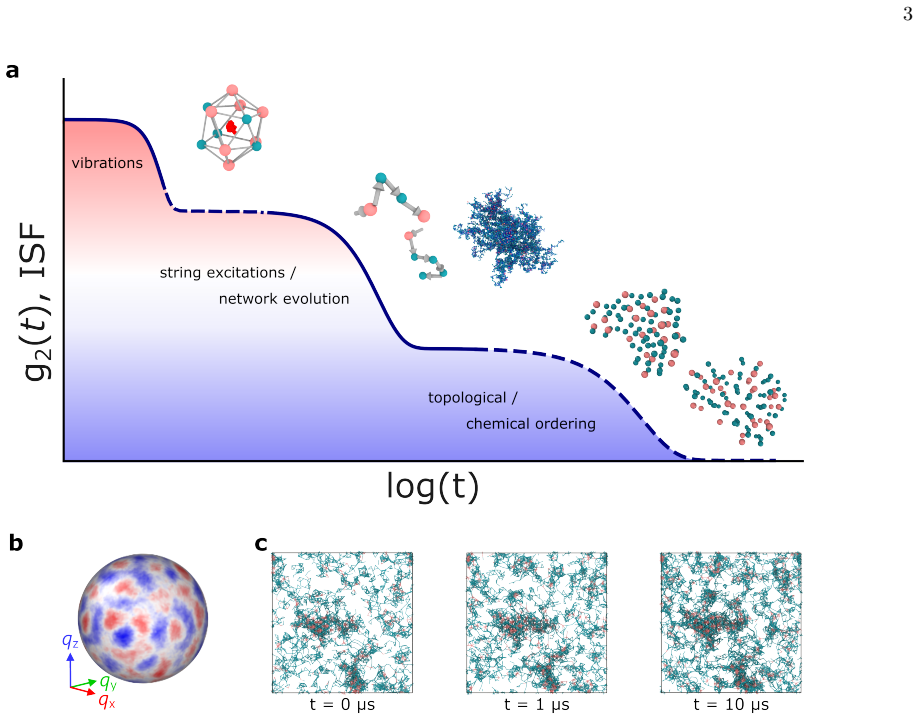
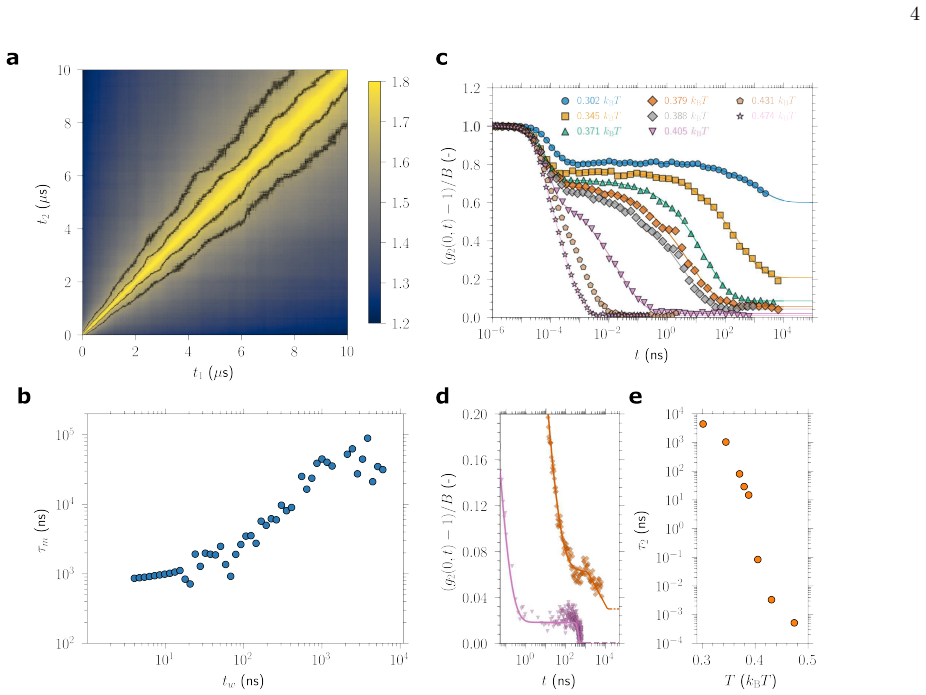
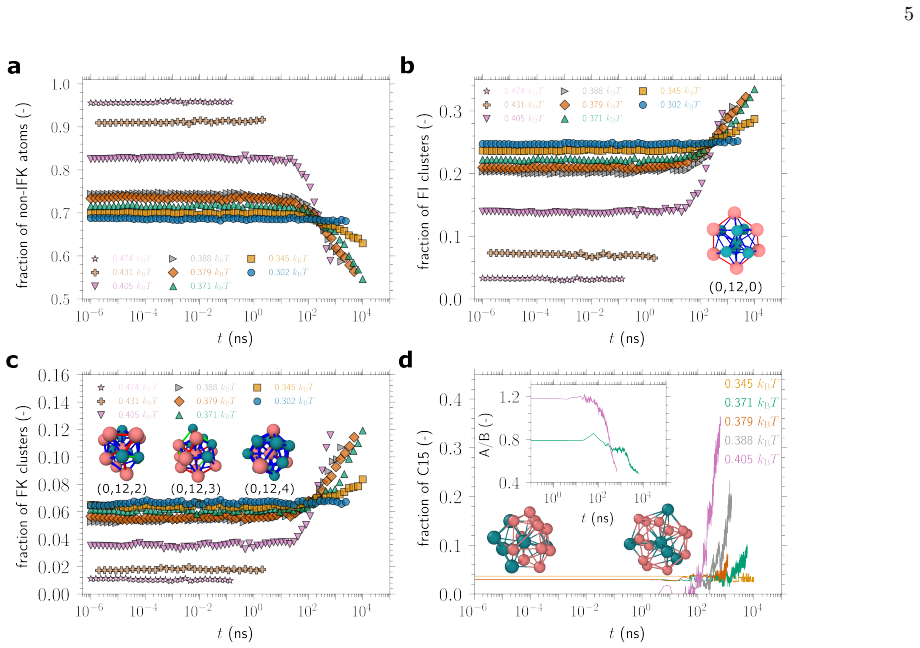
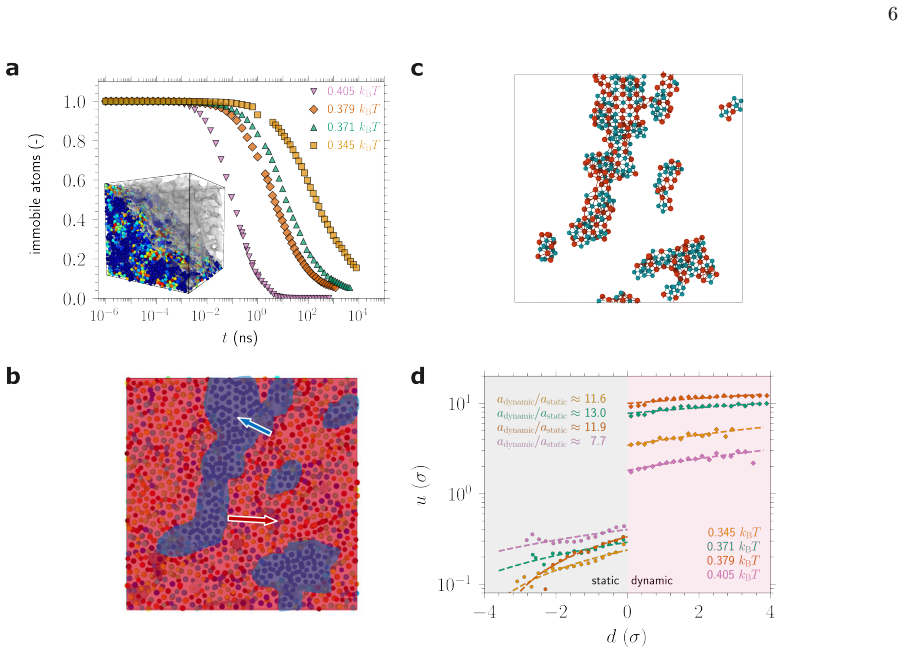
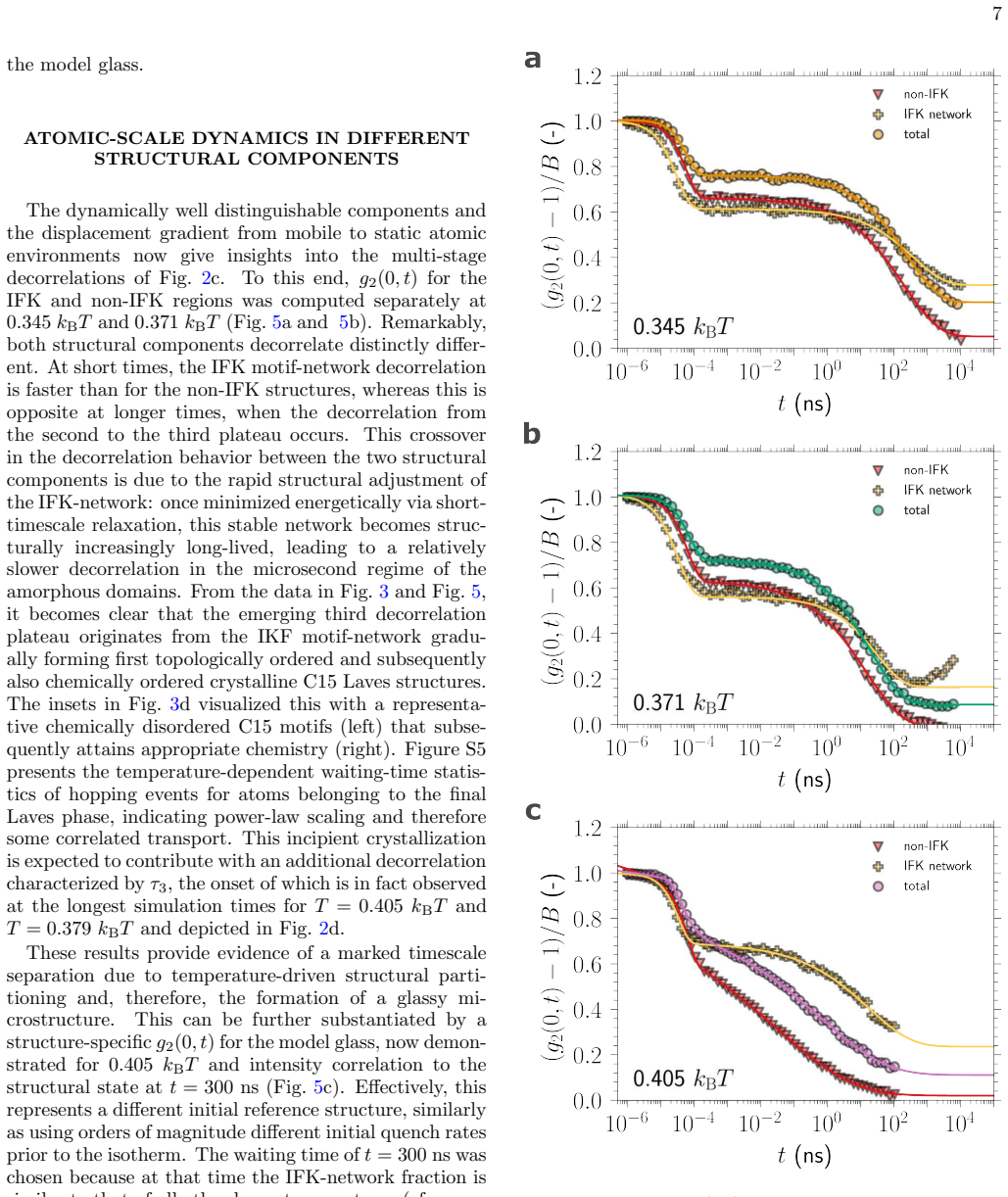
Assessed via simulated x-ray photon correlation spectroscopy, a multi-state structural decorrelation is uncovered via speckle-pattern analysis of the full three-dimensional diffraction sphere across the first peak of the structure factor. Over a simulation time of up to 10 μs, three distinct and subsequent decorrelation stages of thermal vibration, glassy network evolution, and structural and chemical ordering towards crystallization are identified. These findings promote a picture where specific dynamically-separated mechanisms drive the microstructural evolution during glass relaxation and suggest a much richer multi-mode relaxation behavior of metallic glasses than hitherto identified.
What carries the argument
Speckle-pattern analysis of the full three-dimensional diffraction sphere across the first peak of the structure factor, which tracks multi-state structural decorrelation during isothermal annealing.
If this is right
- Specific dynamically-separated mechanisms drive the microstructural evolution during glass relaxation.
- Metallic glasses exhibit a much richer multi-mode relaxation behavior than hitherto identified.
- Direct observation of dominant atomic-scale relaxation mechanisms becomes possible during isothermal annealing toward incipient crystallization.
- The method reveals multistage structural decorrelation rather than a single uniform process.
Where Pith is reading between the lines
- The multistage sequence identified here may appear in polymeric or oxide glasses when examined with the same speckle analysis.
- Varying quench rates or compositions in the model could test whether the three stages remain fixed or shift in duration.
- The approach offers a route to connect observed relaxation times directly to specific atomic rearrangements instead of relying solely on damping modes from mechanical spectroscopy.
Load-bearing premise
The assumption that speckle-pattern analysis of the full three-dimensional diffraction sphere directly reveals the dominant atomic-scale relaxation mechanisms without confounding effects from the simulation model or analysis choices.
What would settle it
A simulation or measurement in which only one or two decorrelation stages appear, or in which the ordering stage does not precede incipient crystallization, would falsify the three-stage sequence.
Figures
read the original abstract
Deciphering complex relaxation pathways in disordered solids is a central challenge across polymeric, oxide, and metallic glasses, which traditionally relies on the interpretation of mechanical spectroscopy and resulting damping modes. Here we demonstrate the direct observation of dominant atomic-scale relaxation mechanisms during isothermal annealing of an as-quenched binary model glass towards incipient crystallization. Assessed via simulated x-ray photon correlation spectroscopy, a multi-state structural decorrelation is uncovered via speckle-pattern analysis of the full three-dimensional diffraction sphere across the first peak of the structure factor. Over a simulation time of up to 10 $\mu$s, three distinct and subsequent decorrelation stages of thermal vibration, glassy network evolution, and structural and chemical ordering towards crystallization are identified. These findings promote a picture where specific dynamically-separated mechanisms drive the microstructural evolution during glass relaxation and suggest a much richer multi-mode relaxation behavior of metallic glasses than hitherto identified.
Editorial analysis
A structured set of objections, weighed in public.
Referee Report
Summary. The manuscript reports a molecular-dynamics study of isothermal annealing in a binary metallic model glass, using simulated X-ray photon correlation spectroscopy (XPCS) to track structural decorrelation. Speckle-pattern analysis of the full three-dimensional diffraction sphere around the first peak of the structure factor is claimed to reveal three sequential stages over simulation times up to 10 μs: short-time thermal vibrations, intermediate-time glassy network evolution, and long-time structural/chemical ordering that precedes crystallization. The central claim is that these stages reflect distinct, dynamically separated atomic-scale mechanisms rather than a single continuous process.
Significance. If the three-stage mapping can be shown to be robust against model and analysis choices, the work would supply direct microscopic evidence for multistage relaxation in metallic glasses, extending beyond the damping modes obtained from mechanical spectroscopy. The long accessible simulation window (10 μs) and the use of full 3D speckle statistics are potentially enabling features for accessing late-stage ordering processes.
major comments (2)
- [Speckle-pattern analysis and stage identification] The identification of three distinct decorrelation stages rests on the assumption that breakpoints in the time-dependent speckle correlations extracted from the first peak of S(q) map one-to-one onto thermal vibration, network evolution, and chemical ordering. No additional observables (e.g., mean-square displacement, bond-orientational order parameters, or chemical short-range order metrics) are shown to corroborate that the observed breakpoints correspond to these specific mechanisms rather than to features of the chosen binary potential, finite-size effects, or the q-shell integration procedure.
- [Methods and simulation details] The manuscript does not report tests of robustness against variations in system size, cooling rate, or the precise definition of the first-peak integration shell. Because the multistage interpretation is derived solely from one observable on one model, any hidden coupling between these choices and the reported breakpoints would undermine the claim that the stages are microstructure-specific and generalizable.
minor comments (2)
- [Abstract] The abstract states that the three stages are 'identified' but does not specify the quantitative criterion (e.g., change in slope, fitting to stretched exponentials) used to locate the temporal boundaries between stages.
- [Results] Notation for the structure factor and the precise q-range used for speckle extraction should be defined explicitly in the main text to allow reproduction of the 3D diffraction-sphere analysis.
Simulated Author's Rebuttal
We thank the referee for the constructive comments and the positive assessment of the work's potential significance. We address the two major comments point by point below.
read point-by-point responses
-
Referee: [Speckle-pattern analysis and stage identification] The identification of three distinct decorrelation stages rests on the assumption that breakpoints in the time-dependent speckle correlations extracted from the first peak of S(q) map one-to-one onto thermal vibration, network evolution, and chemical ordering. No additional observables (e.g., mean-square displacement, bond-orientational order parameters, or chemical short-range order metrics) are shown to corroborate that the observed breakpoints correspond to these specific mechanisms rather than to features of the chosen binary potential, finite-size effects, or the q-shell integration procedure.
Authors: The stages are identified from clear breakpoints in the two-time correlation functions obtained via full 3D speckle analysis at the first peak of S(q). These time scales align with established regimes in metallic-glass literature (vibrational <1 ns, network relaxation 10 ns–1 μs, ordering >1 μs). We agree that direct cross-validation with additional metrics would strengthen the mechanistic assignment. In the revised manuscript we will add mean-square displacement curves and chemical short-range order parameters plotted against the same time axis to corroborate the correspondence between breakpoints and mechanisms. revision: yes
-
Referee: [Methods and simulation details] The manuscript does not report tests of robustness against variations in system size, cooling rate, or the precise definition of the first-peak integration shell. Because the multistage interpretation is derived solely from one observable on one model, any hidden coupling between these choices and the reported breakpoints would undermine the claim that the stages are microstructure-specific and generalizable.
Authors: The chosen parameters (N = 10 000 atoms, cooling rate 10^10 K/s, q-shell width 0.2 Å^{-1}) are standard for this binary model to enable comparison with prior studies. We acknowledge that explicit robustness tests were not reported in the original submission. In the revised manuscript we will include supplementary simulations at doubled system size and at cooling rates varied by a factor of five, together with a sensitivity check on q-shell width, to demonstrate that the three-stage structure persists. revision: yes
Circularity Check
No significant circularity; central claim is direct observational identification from simulation data.
full rationale
The paper presents its multistage relaxation claim as arising from direct analysis of simulated XPCS speckle patterns extracted from MD trajectories of a binary model glass, with stages identified over time scales up to 10 μs via the first peak of S(q). No load-bearing derivation, parameter fitting, or self-citation chain is described in the abstract or provided text that reduces the identified stages (thermal vibration, network evolution, ordering toward crystallization) to the inputs by construction. The analysis is framed as observation of decorrelation dynamics rather than a predictive model whose outputs are forced by fitted parameters or prior self-referential results. Any potential confounding from the model or analysis choices is a question of external validity, not circularity within the reported chain.
Axiom & Free-Parameter Ledger
axioms (1)
- domain assumption The chosen binary model glass and simulation protocol capture the essential relaxation physics of real metallic glasses
Reference graph
Works this paper leans on
-
[1]
Kauzmann
Walter. Kauzmann. The nature of the glassy state and the behavior of liquids at low temperatures.Chemical Reviews, 43(2):219–256, October 1948
1948
-
[2]
Zanotto and John C
Edgar D. Zanotto and John C. Mauro. The glassy state of matter: Its definition and ultimate fate.Journal of Non-Crystalline Solids, 471:490–495, September 2017
2017
-
[3]
Wilkinson, Yongjian Yang, Kuo- Hao Lee, Liping Huang, and John C
Karan Doss, Collin J. Wilkinson, Yongjian Yang, Kuo- Hao Lee, Liping Huang, and John C. Mauro. Maxwell relaxation time for nonexponentialα-relaxation phenom- ena in glassy systems.Journal of the American Ceramic Society, 103(6):3590–3599, February 2020
2020
-
[4]
Ultrahigh energy- dissipation elastomers by precisely tailoring the relax- ation of confined polymer fluids.Nature Communica- tions, 12(1):3610, Jun 2021
Jin Huang, Yichao Xu, Shuanhu Qi, Jiajia Zhou, Wei Shi, Tianyi Zhao, and Mingjie Liu. Ultrahigh energy- dissipation elastomers by precisely tailoring the relax- ation of confined polymer fluids.Nature Communica- tions, 12(1):3610, Jun 2021
2021
-
[5]
Chang, H
C. Chang, H. P. Zhang, R. Zhao, F. C. Li, P. Luo, M. Z. Li, and H. Y. Bai. Liquid-like atoms in dense-packed solid glasses.Nature Materials, 21(11):1240–1245, Au- gust 2022
2022
-
[6]
Viscous liquids and the glass transi- tion: A potential energy barrier picture.The Journal of Chemical Physics, 51(9):3728–3739, November 1969
Martin Goldstein. Viscous liquids and the glass transi- tion: A potential energy barrier picture.The Journal of Chemical Physics, 51(9):3728–3739, November 1969
1969
-
[7]
K¨ uchemann and R
S. K¨ uchemann and R. Maass. Gamma relaxation in bulk metallic glasses.Scripta Materialia, 137:5–8, Au- gust 2017
2017
-
[8]
Boulougouris and Doros N
Georgios C. Boulougouris and Doros N. Theodorou. Probing subglass relaxation in polymers via a geomet- ric representation of probabilities, observables, and relax- ation modes for discrete stochastic systems.The Journal of Chemical Physics, 130(4):044905, 01 2009
2009
-
[9]
Schneider, R
U. Schneider, R. Brand, P. Lunkenheimer, and A. Loidl. Excess Wing in the Dielectric Loss of Glass Formers: A Johari-GoldsteinβRelaxation?Physical Review Letters, 84(24):5560–5563, June 2000
2000
-
[10]
Torchinsky, Christoph Klieber, Jeremy A
Tina Hecksher, Darius H. Torchinsky, Christoph Klieber, Jeremy A. Johnson, Jeppe C. Dyre, and Keith A. Nelson. Toward broadband mechanical spectroscopy.Proceedings of the National Academy of Sciences, 114(33):8710–8715, August 2017
2017
-
[11]
Schrøder, and Jeppe C
Liang Gao, Hai-Bin Yu, Thomas B. Schrøder, and Jeppe C. Dyre. Unified percolation scenario for theα andβprocesses in simple glass formers.Nature Physics, 21(3):471–479, February 2025
2025
-
[12]
Microscopic origin of excess wings in relax- ation spectra of supercooled liquids.Nature Physics, 18(4):468–472, March 2022
Benjamin Guiselin, Camille Scalliet, and Ludovic Berthier. Microscopic origin of excess wings in relax- ation spectra of supercooled liquids.Nature Physics, 18(4):468–472, March 2022. [13]Anelastic relaxation in crystalline solids. Elsevier, 1972
2022
-
[13]
Dynamic relaxations and relaxation- property relationships in metallic glasses.Progress in Materials Science, 106:100561, December 2019
Wei Hua Wang. Dynamic relaxations and relaxation- property relationships in metallic glasses.Progress in Materials Science, 106:100561, December 2019
2019
-
[14]
Predicting complex relaxation processes in metallic glass.Physical Review Letters, 123:105701, Sep 2019
Yang Sun, Si-Xu Peng, Qun Yang, Feng Zhang, Meng- Hao Yang, Cai-Zhuang Wang, Kai-Ming Ho, and Hai-Bin Yu. Predicting complex relaxation processes in metallic glass.Physical Review Letters, 123:105701, Sep 2019
2019
-
[15]
P. Luo, P. Wen, H. Y. Bai, B. Ruta, and W. H. Wang. Relaxation decoupling in metallic glasses at low temper- atures.Physical Review Letters, 118:225901, May 2017
2017
-
[16]
Probing slow glass dynamics down to 10−5 hz.Applied Physics Reviews, 11(4), October 2024
Xi-Ming Yang, Qun Yang, Tao Zhang, and Hai-Bin Yu. Probing slow glass dynamics down to 10−5 hz.Applied Physics Reviews, 11(4), October 2024
2024
-
[17]
David Rodney and Christopher A. Schuh. Yield stress in metallic glasses: The jamming-unjamming transi- tion studied through monte carlo simulations based on the activation-relaxation technique.Physical Review B, 80:184203, Nov 2009
2009
-
[18]
Energy landscape-driven non-equilibrium evolution of inherent structure in disordered material.Nature Communica- tions, 8(1):15417, May 2017
Yue Fan, Takuya Iwashita, and Takeshi Egami. Energy landscape-driven non-equilibrium evolution of inherent structure in disordered material.Nature Communica- tions, 8(1):15417, May 2017
2017
-
[19]
Liebscher, Konrad Samwer, Peter M
Birte Riechers, Catherine Ott, Saurabh Mohan Das, Christian H. Liebscher, Konrad Samwer, Peter M. Der- let, and Robert Maass. On the elastic microstructure of bulk metallic glasses.Materials & Design, 229:111929, 2023
2023
-
[20]
Rashidi, B
R. Rashidi, B. Riechers, J.M. Rosalie, and R. Maass. Annealing-dependent elastic microstructure in a Zr- based metallic glass.Scripta Materialia, 255:116380, Jan- uary 2025
2025
-
[21]
Der- let, and Robert Maaß
Birte Riechers, Amlan Das, Eric Dufresne, Peter M. Der- let, and Robert Maaß. Intermittent cluster dynamics and temporal fractional diffusion in a bulk metallic glass.Na- ture Communications, 15(1):6595, Aug 2024
2024
-
[22]
I.M. Hodge. Enthalpy relaxation and recovery in amor- phous materials.Journal of Non-Crystalline Solids, 169(3):211–266, April 1994
1994
-
[23]
Costa, Juan J
Miguel B. Costa, Juan J. Londo˜ no, Andreas Blatter, Avinash Hariharan, Annett Gebert, Michael A. Carpen- ter, and A. Lindsay Greer. Anelastic-like nature of the rejuvenation of metallic glasses by cryogenic thermal cy- cling.Acta Materialia, 244:118551, 2023
2023
-
[24]
Castellero, B
A. Castellero, B. Moser, D.I. Uhlenhaut, F.H. Dalla Torre, and J.F. L¨ offler. Room-temperature creep and structural relaxation of mg–cu–y metallic glasses.Acta Materialia, 56(15):3777–3785, September 2008
2008
-
[25]
Derlet and R
P.M. Derlet and R. Maass. Micro-plasticity in a fragile model binary glass.Acta Materialia, 209:116771, May 2021
2021
-
[26]
Derlet, and Robert Maass
Zengquan Wang, Birte Riechers, Peter M. Derlet, and Robert Maass. Atomic cluster dynamics causes in- termittent aging of metallic glasses.Acta Materialia, 267:119730, April 2024
2024
-
[27]
Derlet and R
P.M. Derlet and R. Maass. Thermally-activated stress relaxation in a model amorphous solid and the forma- tion of a system-spanning shear event.Acta Materialia, 143:205–213, January 2018
2018
-
[28]
P. M. Derlet, H. Bocquet, and R. Maass. Viscosity and transport in a model fragile metallic glass.Physical Re- view Materials, 5(12), December 2021
2021
-
[29]
P. M. Derlet. Correlated disorder in a model binary glass through a local SU(2) bonding topology.Physical Review Materials, 4:125601, Dec 2020. 12
2020
-
[30]
Oleg G. Shpyrko. X-ray photon correlation spectroscopy. Journal of Synchrotron Radiation, 21(5):1057–1064, Au- gust 2014
2014
-
[31]
Besser, Matthew Joseph Kramer, and Paul M
Li He, Pei Zhang, Matthew F. Besser, Matthew Joseph Kramer, and Paul M. Voyles. Electron correlation mi- croscopy: A new technique for studying local atom dy- namics applied to a supercooled liquid.Microscopy and Microanalysis, 21(4):1026–1033, June 2015
2015
-
[32]
B. Ruta, Y. Chushkin, G. Monaco, L. Cipelletti, E. Pineda, P. Bruna, V. M. Giordano, and M. Gonzalez- Silveira. Atomic-Scale Relaxation Dynamics and Aging in a Metallic Glass Probed by X-Ray Photon Correlation Spectroscopy.Physical Review Letters, 109:165701, Oct 2012
2012
-
[33]
Derlet, Chaoyang Liu, Eric M
Amlan Das, Peter M. Derlet, Chaoyang Liu, Eric M. Dufresne, and Robert Maaß. Stress breaks universal ag- ing behavior in a metallic glass.Nature Communications, 10(1):5006, Nov 2019
2019
-
[34]
Maldonis, Ze Liu, Jan Schroers, and Paul M
Pei Zhang, Jason J. Maldonis, Ze Liu, Jan Schroers, and Paul M. Voyles. Spatially heterogeneous dynamics in a metallic glass forming liquid imaged by electron correla- tion microscopy.Nature Communications, 9(1), March 2018
2018
-
[35]
Connecting field and intensity correlations: The siegert relation and how to test it.American Journal of Physics, 88(10):831–837, October 2020
Dilleys Ferreira, Romain Bachelard, William Guerin, Robin Kaiser, and Mathilde Fouch´ e. Connecting field and intensity correlations: The siegert relation and how to test it.American Journal of Physics, 88(10):831–837, October 2020
2020
-
[36]
Douglas, Walter Kob, Steven J
Claudio Donati, Jack F. Douglas, Walter Kob, Steven J. Plimpton, Peter H. Poole, and Sharon C. Glotzer. String- like cooperative motion in a supercooled liquid.Physical Review Letters, 80(11):2338–2341, March 1998
1998
-
[37]
Reichman
Ludovic Berthier and David R. Reichman. Modern com- putational studies of the glass transition.Nature Reviews Physics, 5(2):102–116, January 2023
2023
-
[38]
Yelash, P
L. Yelash, P. Virnau, K. Binder, and W. Paul. Three-step decay of time correlations at polymer-solid interfaces. EPL (Europhysics Letters), 98(2):28006, April 2012
2012
-
[39]
Solar, K
M. Solar, K. Binder, and W. Paul. Relaxation pro- cesses and glass transition of confined polymer melts: A molecular dynamics simulation of 1,4-polybutadiene be- tween graphite walls.The Journal of Chemical Physics, 146(20):203308, 02 2017
2017
-
[40]
Douglas, and Francis W
Wengang Zhang, Jack F. Douglas, and Francis W. Starr. Why we need to look beyond the glass transition tem- perature to characterize the dynamics of thin supported polymer films.Proceedings of the National Academy of Sciences, 115(22):5641–5646, May 2018
2018
-
[41]
Pedersen, Nicholas P
Ulf R. Pedersen, Nicholas P. Bailey, Jeppe C. Dyre, and Thomas B. Schrøder. Crystallization of the wahnstr¨ om binary lennard-jones liquid.arXiv, 2007
2007
-
[42]
Derlet and R
P.M. Derlet and R. Maass. Emergent structural length scales in a model binary glass - the micro-second molec- ular dynamics time-scale regime.Journal of Alloys and Compounds, 821:153209, April 2020
2020
-
[43]
Atomic level structure in multicomponent bulk metallic glass.Physical Review Letters, 102(24):245501, 2009
YQ Cheng, E Ma, and HW Sheng. Atomic level structure in multicomponent bulk metallic glass.Physical Review Letters, 102(24):245501, 2009
2009
-
[44]
Calderon Ortiz, Minhazul Islam, Geun Hee Yoo, Ji Young Kim, Soohyun Im, Yuchi Wang, Yuchu Wang, Yue Fan, Yunzhi Wang, Eun Soo Park, and Jin- woo Hwang
Gabriel A. Calderon Ortiz, Minhazul Islam, Geun Hee Yoo, Ji Young Kim, Soohyun Im, Yuchi Wang, Yuchu Wang, Yue Fan, Yunzhi Wang, Eun Soo Park, and Jin- woo Hwang. Substantial change in medium range order- ing and its influence on glass forming ability and mechan- ical properties of zrcu and zrcual metallic glasses.Acta Materialia, 298:121402, 2025
2025
-
[45]
Pekin, Xin-Yu Luo, Yonghao Sun, Christoph T
Birte Riechers, Thomas C. Pekin, Xin-Yu Luo, Yonghao Sun, Christoph T. Koch, Peter M. Derlet, and Robert Maass. Spatial distribution and connectivity of medium- range order signatures in a metallic glass probed with simulated and experimental 4dstem.Journal of Alloys and Compounds, 1058:186631, 2026
2026
-
[46]
Maximilian Frey, Nico Neuber, Sascha Sebastian Riegler, Antoine Cornet, Yuriy Chushkin, Federico Zontone, Lu- cas Matthias Ruschel, Bastian Adam, Mehran Naba- hat, Fan Yang, Jie Shen, Fabian Westermeier, Michael Sprung, Daniele Cangialosi, Valerio Di Lisio, Isabella Gallino, Ralf Busch, Beatrice Ruta, and Eloi Pineda. Liquid-like versus stress-driven dyna...
2025
-
[47]
Shen, Y.H
J. Shen, Y.H. Sun, J. Orava, H.Y. Bai, and W.H. Wang. Liquid-to-liquid transition around the glass-transition temperature in a glass-forming metallic liquid.Acta Ma- terialia, 225:117588, February 2022
2022
-
[48]
Molecular-dynamics study of a su- percooled two-component lennard-jones system.Physical Review A, 44(6):3752–3764, September 1991
G¨ oran Wahnstr¨ om. Molecular-dynamics study of a su- percooled two-component lennard-jones system.Physical Review A, 44(6):3752–3764, September 1991
1991
-
[49]
Rapid estimation of elastic constants by molecular dy- namics simulation under constant stress.Phys
Wataru Shinoda, Motoyuki Shiga, and Masuhiro Mikami. Rapid estimation of elastic constants by molecular dy- namics simulation under constant stress.Phys. Rev. B, 69:134103, Apr 2004
2004
-
[50]
Thompson, H
Aidan P. Thompson, H. Metin Aktulga, Richard Berger, Dan S. Bolintineanu, W. Michael Brown, Paul S. Crozier, Pieter J. in't Veld, Axel Kohlmeyer, Stan G. Moore, Trung Dac Nguyen, Ray Shan, Mark J. Stevens, Julien Tranchida, Christian Trott, and Steven J. Plimpton. LAMMPS - a flexible simulation tool for particle-based materials modeling at the atomic, mes...
2022
-
[51]
Visualization and analysis of atom- istic simulation data with OVITO-the Open Visualiza- tion Tool.Modelling and Simulation in Materials Science and Engineering, 18(1):15012, 2010
Alexander Stukowski. Visualization and analysis of atom- istic simulation data with OVITO-the Open Visualiza- tion Tool.Modelling and Simulation in Materials Science and Engineering, 18(1):15012, 2010
2010
-
[52]
Laves phase crystal analysis (LaCA): Atomistic identification of lattice de- fects in C14 and C15 topologically close-packed phases
Zhuocheng Xie, Dimitri Chauraud, Erik Bitzek, Sandra Korte-Kerzel, and Julien Gu´ enol´ e. Laves phase crystal analysis (LaCA): Atomistic identification of lattice de- fects in C14 and C15 topologically close-packed phases. Journal of Materials Research, 36(10):2010–2024, May 2021
2010
-
[53]
Douglas, Walter Kob, Steven J
Claudio Donati, Jack F. Douglas, Walter Kob, Steven J. Plimpton, Peter H. Poole, and Sharon C. Glotzer. String- like cooperative motion in a supercooled liquid.Physical Review Letters, 80(11):2338–2341, March 1998. ACKNOWLEDGEMENTS The authors gratefully acknowledge Peter M. Derlet for supporting the technical implementation of the simu- lations, for frui...
1998
discussion (0)
Sign in with ORCID, Apple, or X to comment. Anyone can read and Pith papers without signing in.