Robust control over polar skyrmion bubble density with a combined optical and electrical approach
Pith reviewed 2026-06-28 21:30 UTC · model grok-4.3
The pith
Twisted light assisted by a DC electric field can tune the density of polar skyrmion bubbles in ferroelectric ultrathin films between 10^2 and 10^4 per square micron.
A machine-rendered reading of the paper's core claim, the machinery that carries it, and where it could break.
Core claim
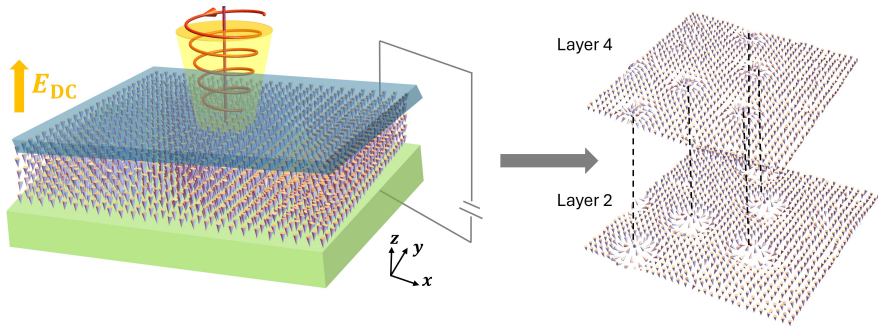
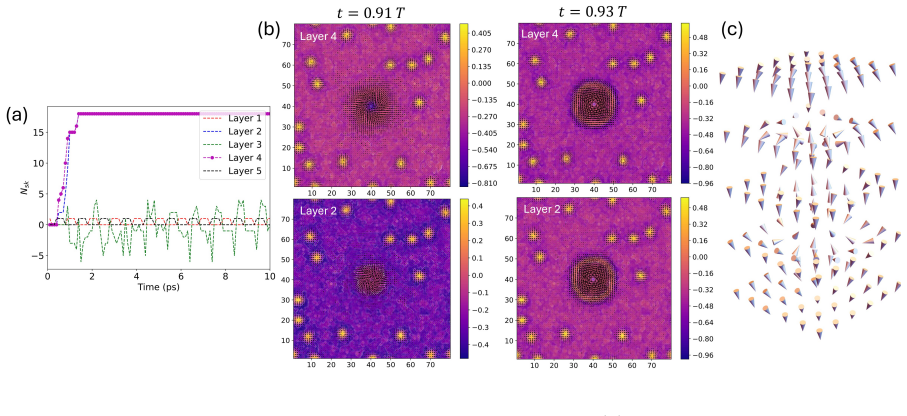
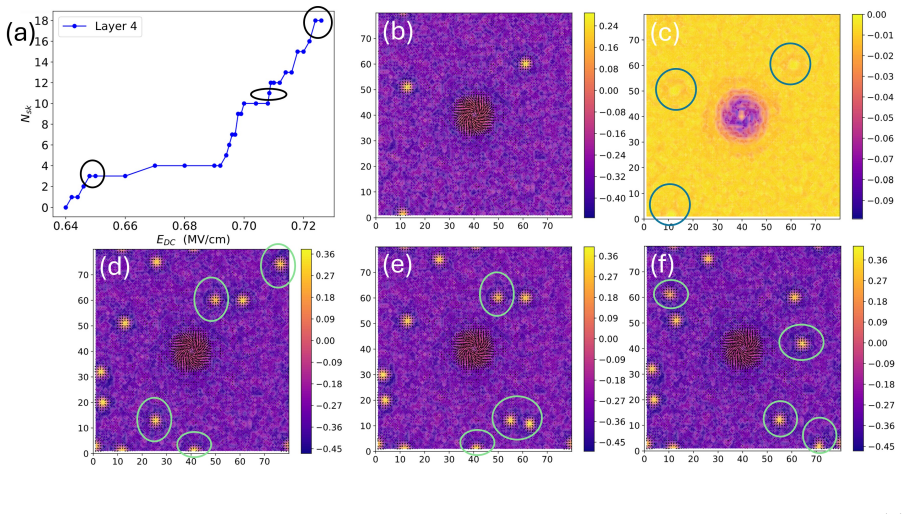
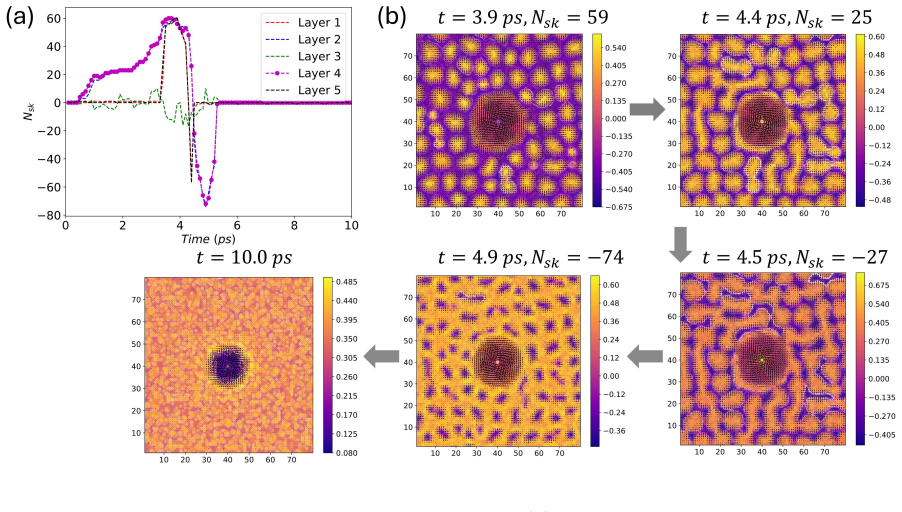
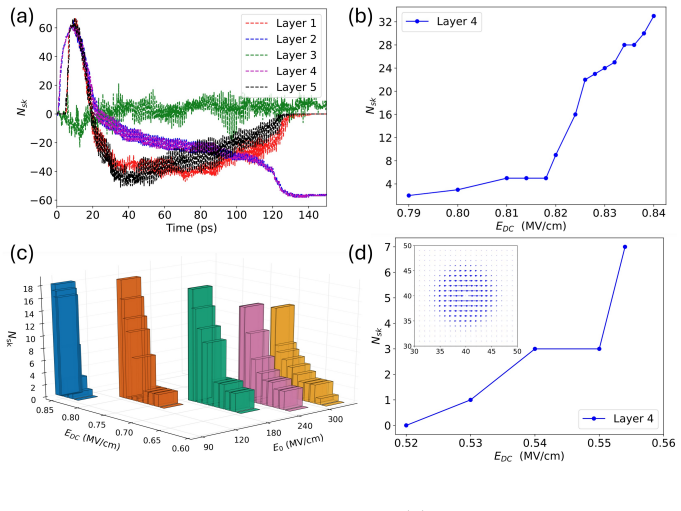
When assisted with a DC electric field, twisted light can robustly tune the density of polar skyrmion bubbles in ferroelectric ultrathin films between 10^2 and 10^4 bit per square micron. Modulating the DC and optical field strengths together with the beam radius also allows control over the nucleation rate that governs creation and annihilation speeds. These responses arise from the interaction of the inhomogeneous optical field pattern with the uniform electric field in the film.
What carries the argument
The spatially inhomogeneous electric field of twisted light combined with a uniform DC electric field, acting on the swirling polarization textures of the bubbles.
If this is right
- Information density in memory devices based on these bubbles can be set directly by the combined fields.
- Nucleation rates can be adjusted for faster writing and erasing operations.
- The approach enables ultrahigh-density non-volatile memory technologies in ferroelectric nanofilms.
- The distinct response to combined optical and electric fields opens control routes not available with electric fields alone.
Where Pith is reading between the lines
- If the calculated densities hold in devices, hybrid optical-electrical writing schemes could be integrated into existing ferroelectric memory architectures.
- The wide density window suggests the method could bridge current nanoscale bit densities with future ultradense requirements.
- Similar field combinations might be tested on other topological polarization patterns in related oxide systems.
Load-bearing premise
The first-principles-based calculations accurately capture the real nucleation and stability behavior of polar skyrmion bubbles under the combined inhomogeneous optical and uniform electric fields.
What would settle it
An experiment applying twisted light plus a DC electric field to a real ferroelectric ultrathin film and finding bubble densities that remain outside the 10^2 to 10^4 per square micron window for all tested field strengths and radii would falsify the claim.
Figures
read the original abstract
Polar skyrmion bubbles are nanoscale ferroelectric domain configurations with swirling polarization textures, and often emerge in ferroelectric oxide systems. Owing to their inhomogeneous polarization patterns, which endow them with distinct topologies and electrical responses from homogeneous monodomains, polar skyrmion bubbles are envisaged to be promising candidates for non-volatile memory devices. In such device, the recorded information density is directly proportional to the density of bubbles, underscoring the need for precise control over bubble nucleation. Here, using first-principles-based calculations, we demonstrate that when assisted with a DC electric field, twisted light, which has a spatially inhomogeneous field pattern, can robustly tune the density of polar skyrmion bubbles in ferroelectric ultrathin films between $10^2\sim 10^4 \rm{bit}/\mu m^2$. Moreover, by modulating DC and optical field strengths together with the beam radius, the nucleation rate, which characterizes the creation and annihilation speed of polar skyrmion bubbles, can also be well controlled. These findings highlight the unique response of ferroelectric nanofilms to optical and electric fields, which is crucial for employing polar skyrmion bubbles in the next-generation of ultrahigh-density memory technologies.
Editorial analysis
A structured set of objections, weighed in public.
Referee Report
Summary. The manuscript uses first-principles-based calculations to demonstrate that twisted light (with its spatially inhomogeneous electric-field pattern) assisted by a uniform DC electric field can robustly tune the density of polar skyrmion bubbles in ferroelectric ultrathin films over the range 10²–10⁴ bit/μm²; it further claims that simultaneous modulation of DC field, optical intensity, and beam radius controls the nucleation rate.
Significance. If the underlying model is accurate, the work identifies a potentially useful combined optical-electrical protocol for achieving high areal densities and tunable switching speeds in polar-skyrmion-based memory devices. The two-order-of-magnitude density window and the explicit dependence on beam radius are the most distinctive quantitative results.
major comments (3)
- [Computational Methods] Computational Methods section: the precise form of the optical perturbation added to the effective Hamiltonian (or to the first-principles-derived energy landscape) is not derived or benchmarked against known limits for inhomogeneous light-matter coupling in ferroelectrics; because the central claim rests on accurate nucleation barriers under a spatially varying field, this omission is load-bearing.
- [Results] Results, density-vs-field plots (presumably Figs. 3–5): the reported 10²–10⁴ bit/μm² window is obtained at zero temperature with a perfect lattice; no sensitivity analysis to thermal fluctuations, point defects, or substrate strain is provided, yet these factors directly affect whether the simulated densities remain accessible in real ultrathin films.
- [Results] Nucleation-rate analysis: the definition and extraction of the nucleation rate from the simulations are not cross-checked against any experimental time scales or against simpler Landau-Devonshire models; without such anchoring the claim that the rate “can also be well controlled” cannot be evaluated quantitatively.
minor comments (2)
- [Abstract] The abstract states the density range with a tilde; the corresponding figures should report the precise numerical bounds and the number of independent runs used to obtain them.
- [Throughout] Notation for the optical beam radius and the DC-field direction should be introduced once and used consistently in all equations and figure captions.
Simulated Author's Rebuttal
We thank the referee for the constructive and detailed review. We address each major comment point by point below.
read point-by-point responses
-
Referee: [Computational Methods] Computational Methods section: the precise form of the optical perturbation added to the effective Hamiltonian (or to the first-principles-derived energy landscape) is not derived or benchmarked against known limits for inhomogeneous light-matter coupling in ferroelectrics; because the central claim rests on accurate nucleation barriers under a spatially varying field, this omission is load-bearing.
Authors: We agree that the Computational Methods section would benefit from an explicit derivation of the optical perturbation term. In the revised manuscript we will add a dedicated subsection deriving the form of the inhomogeneous electric-field contribution from twisted light that is added to the effective Hamiltonian, together with benchmarks against established limits for light-matter coupling in ferroelectrics. This will directly support the nucleation-barrier calculations. revision: yes
-
Referee: [Results] Results, density-vs-field plots (presumably Figs. 3–5): the reported 10²–10⁴ bit/μm² window is obtained at zero temperature with a perfect lattice; no sensitivity analysis to thermal fluctuations, point defects, or substrate strain is provided, yet these factors directly affect whether the simulated densities remain accessible in real ultrathin films.
Authors: The reported densities are obtained at zero temperature on a defect-free lattice, which is the standard setting for first-principles-based effective-Hamiltonian studies that isolate the field-induced effects. We will add a new paragraph in the revised manuscript that discusses the expected influence of thermal fluctuations, point defects, and substrate strain on the accessible density window and that qualifies the 10²–10⁴ bit/μm² range as an ideal-case result. A comprehensive sensitivity analysis lies outside the scope of the present work. revision: partial
-
Referee: [Results] Nucleation-rate analysis: the definition and extraction of the nucleation rate from the simulations are not cross-checked against any experimental time scales or against simpler Landau-Devonshire models; without such anchoring the claim that the rate “can also be well controlled” cannot be evaluated quantitatively.
Authors: We will expand the description of how the nucleation rate is defined and extracted from the molecular-dynamics trajectories in the revised manuscript. In addition, we will include a short comparison of the simulated rates with those obtained from a minimal Landau-Devonshire model to provide an independent anchor. Direct quantitative mapping to experimental time scales remains difficult because of the coarse-grained nature of the effective Hamiltonian, but the added comparison will allow readers to assess the claimed controllability more quantitatively. revision: yes
Circularity Check
No circularity: first-principles simulation outputs density range directly from field inputs
full rationale
The paper's central result is obtained by running first-principles-based effective-Hamiltonian simulations under superimposed uniform DC and spatially varying optical fields. No parameter is fitted to the reported 10^2–10^4 bit/μm² window, no uniqueness theorem is invoked via self-citation, and no ansatz or renaming reduces the output to the input by construction. The nucleation-rate and density values are therefore independent computational predictions rather than tautological restatements of the model setup.
Axiom & Free-Parameter Ledger
Reference graph
Works this paper leans on
-
[1]
Matter , volume=
Local manipulation and topological phase transitions of polar skyrmions , author=. Matter , volume=. 2022 , publisher=
2022
-
[2]
Physical Review Letters , volume=
Dynamics of polar skyrmion bubbles under electric fields , author=. Physical Review Letters , volume=. 2022 , publisher=
2022
-
[3]
Strain manipulation of ferroelectric skyrmion bubbles in a freestanding
Zhang, Yixuan and Li, Qian and Huang, Houbing and Hong, Jiawang and Wang, Xueyun , journal=. Strain manipulation of ferroelectric skyrmion bubbles in a freestanding. 2022 , publisher=
2022
-
[4]
npj Quantum Materials , volume=
Dynamic mechanical writing of skyrmion-like polar nanodomains , author=. npj Quantum Materials , volume=. 2025 , publisher=
2025
-
[5]
Nature , volume=
Observation of room-temperature polar skyrmions , author=. Nature , volume=. 2019 , publisher=
2019
-
[6]
Nature Communications , volume=
Absence of critical thickness for polar skyrmions with breaking the Kittel’s law , author=. Nature Communications , volume=. 2023 , publisher=
2023
-
[7]
Advanced Materials , volume=
Nanoscale-confined terahertz polaritons in a van der Waals crystal , author=. Advanced Materials , volume=. 2021 , publisher=
2021
-
[8]
Nature Materials , volume=
Ultraconfined terahertz phonon polaritons in hafnium dichalcogenides , author=. Nature Materials , volume=. 2025 , publisher=
2025
-
[9]
Physical Review Letters , volume=
Dynamical control of topology in polar skyrmions via twisted light , author=. Physical Review Letters , volume=. 2024 , publisher=
2024
-
[10]
Nature Communications , volume=
Motion and teleportation of polar bubbles in low-dimensional ferroelectrics , author=. Nature Communications , volume=. 2024 , publisher=
2024
-
[11]
Reviews of Modern Physics , volume=
Topological phases in polar oxide nanostructures , author=. Reviews of Modern Physics , volume=. 2023 , publisher=
2023
-
[12]
Advanced Materials , volume=
Recent progress on topological structures in ferroic thin films and heterostructures , author=. Advanced Materials , volume=. 2021 , publisher=
2021
-
[13]
Nature Materials , volume=
Spherical ferroelectric solitons , author=. Nature Materials , volume=. 2023 , publisher=
2023
-
[14]
Nature Communications , volume=
Discovery of stable skyrmionic state in ferroelectric nanocomposites , author=. Nature Communications , volume=. 2015 , publisher=
2015
-
[15]
Advanced Materials , volume=
Nanoscale bubble domains and topological transitions in ultrathin ferroelectric films , author=. Advanced Materials , volume=. 2017 , publisher=
2017
-
[16]
Creating Ferroelectricity and Ultrahigh-Density Polar Skyrmion in Paraelectric Perovskite Oxide Monolayers by Moir
Xu, Tao and Qian, Tao and Pang, Jiafei and Zhang, Jingtong and Li, Sheng and He, Ri and Wang, Jie and Shimada, Takahiro , journal=. Creating Ferroelectricity and Ultrahigh-Density Polar Skyrmion in Paraelectric Perovskite Oxide Monolayers by Moir. 2025 , publisher=
2025
-
[17]
Physical Review B , volume=
Tailoring optical excitation to control magnetic skyrmion nucleation , author=. Physical Review B , volume=. 2022 , publisher=
2022
-
[18]
ACS Applied Materials & Interfaces , volume=
Precise tuning of skyrmion density in a controllable manner by ion irradiation , author=. ACS Applied Materials & Interfaces , volume=. 2022 , publisher=
2022
-
[19]
Nano Letters , volume=
The skyrmion switch: turning magnetic skyrmion bubbles on and off with an electric field , author=. Nano Letters , volume=. 2017 , publisher=
2017
-
[20]
Phase transitions in
Zhong, W and Vanderbilt, David and Rabe, KM , journal=. Phase transitions in. 1994 , publisher=
1994
-
[21]
First-principles theory of ferroelectric phase transitions for perovskites: The case of
Zhong, W and Vanderbilt, David and Rabe, KM , journal=. First-principles theory of ferroelectric phase transitions for perovskites: The case of. 1995 , publisher=
1995
-
[22]
Physical review A , volume=
Orbital angular momentum of light and the transformation of Laguerre-Gaussian laser modes , author=. Physical review A , volume=. 1992 , publisher=
1992
-
[23]
Nature Communications , volume=
Designing lead-free antiferroelectrics for energy storage , author=. Nature Communications , volume=. 2017 , publisher=
2017
-
[24]
Giant electrocaloric response in the prototypical
Jiang, Zhijun and Nahas, Y and Prokhorenko, Sergei and Prosandeev, S and Wang, D and. Giant electrocaloric response in the prototypical. Physical Review B , volume=. 2018 , publisher=
2018
-
[25]
Physical Review B , volume=
Low-dimensional ferroelectrics under different electrical and mechanical boundary conditions: Atomistic simulations , author=. Physical Review B , volume=. 2005 , publisher=
2005
-
[26]
Nature Communications , volume=
Hopfions emerge in ferroelectrics , author=. Nature Communications , volume=. 2020 , publisher=
2020
-
[27]
Advanced Materials , volume=
Polarization topology at the nominally charged domain walls in uniaxial ferroelectrics , author=. Advanced Materials , volume=. 2022 , publisher=
2022
-
[28]
Gao, Lingyuan and Shen, Yijie and Prokhorenko, Sergei and Nahas, Yousra and Bellaiche, Laurent , journal=. Poincar. 2025 , publisher=
2025
-
[29]
Nature Communications , volume=
Observation of switchable polar skyrmion bubbles down to the atomic layers in van der Waals ferroelectric CuInP2S6 , author=. Nature Communications , volume=. 2025 , publisher=
2025
-
[30]
Nature , volume=
High-density switchable skyrmion-like polar nanodomains integrated on silicon , author=. Nature , volume=. 2022 , publisher=
2022
-
[31]
Nature Materials , volume=
Mechanically liberating polarization bubbles in van der Waals ferroelectrics , author=. Nature Materials , volume=. 2025 , publisher=
2025
-
[32]
Nature Nanotechnology , volume=
Topological properties and dynamics of magnetic skyrmions , author=. Nature Nanotechnology , volume=. 2013 , publisher=
2013
-
[33]
Nature Communications , volume=
Giant electric field-induced second harmonic generation in polar skyrmions , author=. Nature Communications , volume=. 2024 , publisher=
2024
-
[34]
Nature Physics , volume=
Terahertz excitation of collective dynamics of polar skyrmions over a broad temperature range , author=. Nature Physics , volume=. 2025 , publisher=
2025
-
[35]
Nature Communications , volume=
Terahertz-field activation of polar skyrons , author=. Nature Communications , volume=. 2025 , publisher=
2025
-
[36]
Nature Nanotechnology , volume=
Skyrmions on the track , author=. Nature Nanotechnology , volume=. 2013 , publisher=
2013
-
[37]
Scientific Reports , volume=
A strategy for the design of skyrmion racetrack memories , author=. Scientific Reports , volume=. 2014 , publisher=
2014
-
[38]
APL Materials , volume=
Skyrmion devices for memory and logic applications , author=. APL Materials , volume=. 2021 , publisher=
2021
-
[39]
Science Advances , volume=
Theoretical guidelines to create and tune electric skyrmion bubbles , author=. Science Advances , volume=. 2019 , publisher=
2019
-
[40]
Physical Review Applied , volume=
Electrical control of skyrmion density via skyrmion-stripe transformation , author=. Physical Review Applied , volume=. 2020 , publisher=
2020
-
[41]
Nature Materials , volume=
Ferroelectrically tunable magnetic skyrmions in ultrathin oxide heterostructures , author=. Nature Materials , volume=. 2018 , publisher=
2018
-
[42]
Journal of Physics D: Applied Physics , volume=
Size and density control of skyrmions with picometer CoFeB thickness variations—observation of zero-field skyrmions and skyrmion merging , author=. Journal of Physics D: Applied Physics , volume=. 2023 , publisher=
2023
-
[43]
IEEE Access , year=
Controlling the skyrmion density and size for quantized convolutional neural network , author=. IEEE Access , year=
-
[44]
arXiv preprint arXiv:2504.11013 , year=
Effective Theory of Ultrafast Skyrmion Nucleation , author=. arXiv preprint arXiv:2504.11013 , year=
-
[45]
ACS Photonics , volume=
Orbital angular momentum in nanoplasmonic vortices , author=. ACS Photonics , volume=. 2023 , publisher=
2023
-
[46]
Applied Physics Reviews , volume=
Advances in ultrafast plasmonics , author=. Applied Physics Reviews , volume=. 2023 , publisher=
2023
-
[47]
Acta Materialia , volume=
Entangled polarizations in ferroelectrics: A focused review of polar topologies , author=. Acta Materialia , volume=. 2023 , publisher=
2023
-
[48]
Physical Review B , volume=
Quasihexagonal arrays of electric-skyrmion bubbles in thin-film ferroelectrics: Pattern formation and structure , author=. Physical Review B , volume=. 2024 , publisher=
2024
-
[49]
Electromechanical behavior of
Garcia, Alberto and Vanderbilt, David , journal=. Electromechanical behavior of. 1998 , publisher=
1998
-
[50]
Nature Electronics , volume=
Creation and annihilation of non-volatile fixed magnetic skyrmions using voltage control of magnetic anisotropy , author=. Nature Electronics , volume=. 2020 , publisher=
2020
-
[51]
Nature , volume=
All-electrical skyrmionic magnetic tunnel junction , author=. Nature , volume=. 2024 , publisher=
2024
-
[52]
Nano Letters , volume=
Creation of magnetic skyrmion bubble lattices by ultrafast laser in ultrathin films , author=. Nano Letters , volume=. 2018 , publisher=
2018
-
[53]
Nuclear Physics B , volume=
Definition and statistical distributions of a topological number in the lattice O (3) -model , author=. Nuclear Physics B , volume=. 1981 , publisher=
1981
-
[54]
Optics express , volume=
Graphene/liquid crystal based terahertz phase shifters , author=. Optics express , volume=. 2013 , publisher=
2013
-
[55]
Review of Scientific Instruments , volume=
Simultaneous direct measurement of the electrocaloric and dielectric dynamics of ferroelectrics with microsecond temporal resolution , author=. Review of Scientific Instruments , volume=. 2023 , publisher=
2023
-
[56]
Light: Science & Applications , volume=
Broadband tunable liquid crystal terahertz waveplates driven with porous graphene electrodes , author=. Light: Science & Applications , volume=. 2015 , publisher=
2015
-
[57]
arXiv preprint arXiv:2601.16604 , year=
Enhanced Terahertz Photoresponse via Acoustic Plasmon Cavity Resonances in Scalable Graphene , author=. arXiv preprint arXiv:2601.16604 , year=
-
[58]
Journal of the American Ceramic Society , volume=
Improvement of reliability and dielectric breakdown strength of Nb-doped lead zirconate titanate films via microstructure control of seed , author=. Journal of the American Ceramic Society , volume=. 2019 , publisher=
2019
-
[59]
Current Applied Physics , volume=
Experimental evidence of breakdown strength and its effect on energy-storage performance in normal and relaxor ferroelectric films , author=. Current Applied Physics , volume=. 2019 , publisher=
2019
-
[60]
Ferroelectrics , volume=
Dielectric characteristics of Pb (Zr, Ti) O3 films on MgO single crystal substrate by terahertz time domain spectroscopy , author=. Ferroelectrics , volume=. 2011 , publisher=
2011
-
[61]
Proposed universal relationship between dielectric breakdown and dielectric constant , author=. Digest. International Electron Devices Meeting, , pages=. 2002 , organization=
2002
discussion (0)
Sign in with ORCID, Apple, or X to comment. Anyone can read and Pith papers without signing in.