A Distribution-Free Framework for Rewrite-Based Human-text Detection via Knockoff Filtering
Pith reviewed 2026-06-28 20:59 UTC · model grok-4.3
The pith
Rewrite-based LLM text detectors inherit finite-sample FDR guarantees via a simple calibration that treats rewrites as knockoffs.
A machine-rendered reading of the paper's core claim, the machinery that carries it, and where it could break.
Core claim
Rewrite-based detection implicitly constructs knockoff samples, enabling LLM-generated text detection to be formulated as a multiple hypothesis testing problem with knockoff structure. This perspective separates the design of detection statistics from the control of false discoveries, allowing existing rewrite detectors to inherit finite-sample false discovery rate (FDR) guarantees through a simple calibration procedure.
What carries the argument
Knockoff filtering on rewrite pairs, which supplies the exchangeability structure required to calibrate any rewrite detector for FDR control.
If this is right
- Any existing rewrite detector acquires finite-sample FDR control without retraining or new assumptions.
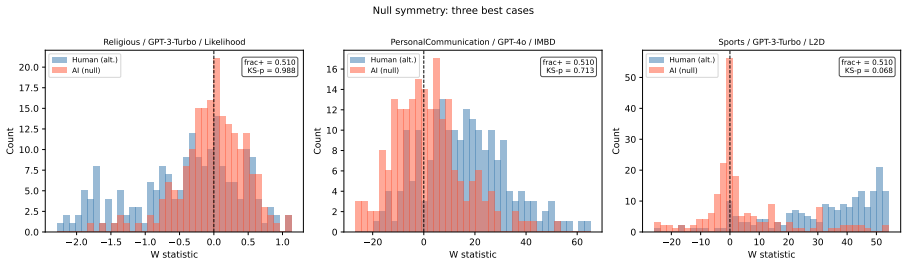
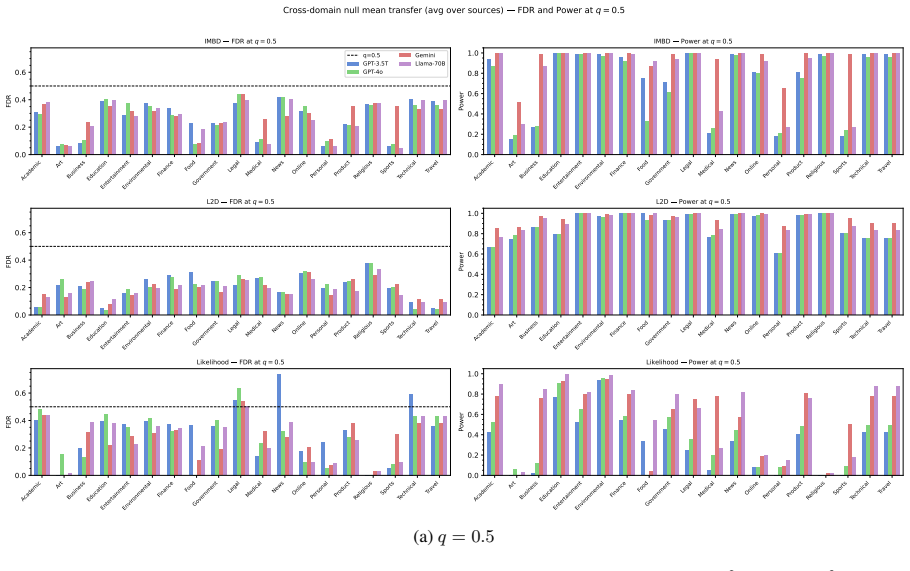
- The same calibration works across three detection models, nineteen domains, and four LLMs while preserving detection power.
- Design of the detection score can proceed independently of the error-rate guarantee.
- The resulting procedure remains distribution-free.
Where Pith is reading between the lines
- The same knockoff view might let practitioners combine several rewrite detectors under a single joint FDR guarantee.
- The calibration step could be packaged as a lightweight post-processor usable on any black-box rewrite detector.
- Similar paired-sample constructions in other detection tasks could receive the same distribution-free FDR treatment.
Load-bearing premise
Rewrite-based detection implicitly produces knockoff samples that meet the conditions needed for valid multiple-testing calibration.
What would settle it
A controlled experiment with labeled human and LLM texts in which the calibrated procedure's realized false discovery proportion exceeds the nominal target level.
Figures
read the original abstract
We propose a distribution-free statistical framework that converts arbitrary rewrite-based detectors into detectors with finite-sample FDR guarantees without retraining. Our key observation is that rewrite-based detection implicitly constructs knockoff samples, enabling LLM-generated text detection to be formulated as a multiple hypothesis testing problem with knockoff structure. This perspective separates the design of detection statistics from the control of false discoveries, allowing existing rewrite detectors to inherit finite-sample false discovery rate (FDR) guarantees through a simple calibration procedure. We demonstrate reliable FDR control with meaningful detection power across three detection models, 19 domains, and four LLMs.
Editorial analysis
A structured set of objections, weighed in public.
Referee Report
Summary. The paper proposes a distribution-free framework that converts arbitrary rewrite-based detectors into ones with finite-sample FDR guarantees by observing that rewrites implicitly construct knockoff samples, allowing LLM-generated text detection to be cast as a multiple hypothesis testing problem; existing detectors then inherit FDR control via a simple calibration step without retraining. Empirical results are reported across three detection models, 19 domains, and four LLMs.
Significance. If the exchangeability claim holds, the separation of statistic design from FDR control would be a meaningful contribution, permitting reuse of existing rewrite detectors with rigorous finite-sample guarantees. The broad empirical scope (multiple models, domains, LLMs) is a strength that would support practical utility if the theoretical foundation is secured.
major comments (2)
- [Abstract] Abstract: the central claim that 'rewrite-based detection implicitly constructs knockoff samples' enabling finite-sample FDR control is asserted without a derivation showing that the rewrite operator satisfies the pairwise exchangeability (or the required conditional independence) under the human-text null; if this symmetry fails to hold exactly, the calibration procedure inherits no exact finite-sample guarantee.
- [Abstract (and any theoretical section deriving the knockoff property)] The distribution-free assertion rests on the rewrite procedure preserving the joint symmetry needed for knockoff FDR control; without explicit conditions on the rewrite distribution or a proof that the detector statistic satisfies the knockoff filter requirements, the finite-sample guarantee is not established and may reduce to an approximate procedure.
minor comments (1)
- [Abstract] Abstract: quantitative statements such as 'reliable FDR control with meaningful detection power' should reference specific tables or figures reporting achieved FDR levels and power across the 19 domains and four LLMs.
Simulated Author's Rebuttal
We thank the referee for the thoughtful and detailed report. The major comments correctly identify that the abstract and theoretical claims regarding the knockoff property require a more explicit derivation of exchangeability. We address each point below and will revise the manuscript to include the requested formal arguments.
read point-by-point responses
-
Referee: [Abstract] Abstract: the central claim that 'rewrite-based detection implicitly constructs knockoff samples' enabling finite-sample FDR control is asserted without a derivation showing that the rewrite operator satisfies the pairwise exchangeability (or the required conditional independence) under the human-text null; if this symmetry fails to hold exactly, the calibration procedure inherits no exact finite-sample guarantee.
Authors: We agree that the abstract states the key observation without a self-contained derivation. Section 3 of the manuscript sketches why rewrites under the human-text null produce the required exchangeability for knockoff filtering, but the argument is not fully formalized. In revision we will add an explicit proof of pairwise exchangeability (including the precise conditional independence statement) together with the minimal assumptions on the rewrite distribution that make the finite-sample FDR control exact rather than approximate. revision: yes
-
Referee: [Abstract (and any theoretical section deriving the knockoff property)] The distribution-free assertion rests on the rewrite procedure preserving the joint symmetry needed for knockoff FDR control; without explicit conditions on the rewrite distribution or a proof that the detector statistic satisfies the knockoff filter requirements, the finite-sample guarantee is not established and may reduce to an approximate procedure.
Authors: The referee is correct that the current text does not supply a complete set of conditions on the rewrite distribution nor a line-by-line verification that the detector statistic meets the knockoff filter requirements. We will insert a dedicated subsection that states the necessary conditions on the rewrite operator, proves the joint symmetry, and verifies that the resulting test statistic satisfies the conditions for exact finite-sample FDR control via the knockoff filter. This change will make the guarantee rigorous rather than implicit. revision: yes
Circularity Check
No circularity; applies standard knockoff filter via modeling observation
full rationale
The paper's derivation rests on the modeling claim that rewrite-based detectors implicitly produce knockoff samples satisfying the conditions for the existing knockoff filter, then applies the standard calibration procedure for FDR control. No equations or steps in the provided abstract reduce a prediction or result to a fitted parameter, self-citation, or redefinition by construction. The framework separates detector design from FDR control using external knockoff theory, with no load-bearing self-citations or ansatzes imported from prior author work. This is a normal non-circular application of an established method to a new domain.
Axiom & Free-Parameter Ledger
axioms (1)
- domain assumption Rewrite-based detection implicitly constructs knockoff samples
Reference graph
Works this paper leans on
-
[1]
The Fourteenth International Conference on Learning Representations , abbr=
Learn-to-Distance: Distance Learning for Detecting LLM-Generated Text , author=. The Fourteenth International Conference on Learning Representations , abbr=
-
[2]
Journal of the Royal Statistical Society Series B: Statistical Methodology , volume =
Candès, Emmanuel and Fan, Yingying and Janson, Lucas and Lv, Jinchi , title =. Journal of the Royal Statistical Society Series B: Statistical Methodology , volume =. 2018 , month =. doi:10.1111/rssb.12265 , url =
-
[3]
The Annals of Statistics , volume=
Controlling the false discovery rate via knockoffs , author=. The Annals of Statistics , volume=. 2015 , publisher=
2015
-
[4]
Proceedings of the AAAI Conference on Artificial Intelligence , volume=
Imitate before detect: Aligning machine stylistic preference for machine-revised text detection , author=. Proceedings of the AAAI Conference on Artificial Intelligence , volume=
-
[5]
Beat LLM s at Their Own Game: Zero-Shot LLM -Generated Text Detection via Querying C hat GPT
Zhu, Biru and Yuan, Lifan and Cui, Ganqu and Chen, Yangyi and Fu, Chong and He, Bingxiang and Deng, Yangdong and Liu, Zhiyuan and Sun, Maosong and Gu, Ming. Beat LLM s at Their Own Game: Zero-Shot LLM -Generated Text Detection via Querying C hat GPT. Proceedings of the 2023 Conference on Empirical Methods in Natural Language Processing. 2023. doi:10.18653...
-
[6]
DPIC: Decoupling Prompt and Intrinsic Characteristics for LLM Generated Text Detection , url =
Yu, Xiao and Qi, Yuang and Chen, Kejiang and Chen, Guoqiang and Yang, Xi and Zhu, Pengyuan and Shang, Xiuwei and Zhang, Weiming and Yu, Nenghai , booktitle =. DPIC: Decoupling Prompt and Intrinsic Characteristics for LLM Generated Text Detection , url =. doi:10.52202/079017-0516 , editor =
-
[7]
The Twelfth International Conference on Learning Representations , year=
Raidar: geneRative AI Detection viA Rewriting , author=. The Twelfth International Conference on Learning Representations , year=
-
[8]
The Thirty-Ninth Annual Conference on Neural Information Processing Systems , year=
AdaDetectGPT: Adaptive Detection of LLM-Generated Text with Statistical Guarantees , author=. The Thirty-Ninth Annual Conference on Neural Information Processing Systems , year=
-
[9]
2024 , eprint=
Spotting LLMs With Binoculars: Zero-Shot Detection of Machine-Generated Text , author=. 2024 , eprint=
2024
-
[10]
The Twelfth International Conference on Learning Representations , year=
Fast-DetectGPT: Efficient Zero-Shot Detection of Machine-Generated Text via Conditional Probability Curvature , author=. The Twelfth International Conference on Learning Representations , year=
-
[11]
GLTR : Statistical Detection and Visualization of Generated Text
Gehrmann, Sebastian and Strobelt, Hendrik and Rush, Alexander. GLTR : Statistical Detection and Visualization of Generated Text. Proceedings of the 57th Annual Meeting of the Association for Computational Linguistics: System Demonstrations. 2019. doi:10.18653/v1/P19-3019
-
[12]
Intrinsic Dimension Estimation for Robust Detection of
Eduard Tulchinskii and Kristian Kuznetsov and Kushnareva Laida and Daniil Cherniavskii and Sergey Nikolenko and Evgeny Burnaev and Serguei Barannikov and Irina Piontkovskaya , booktitle=. Intrinsic Dimension Estimation for Robust Detection of. 2023 , url=
2023
-
[13]
D etect LLM : Leveraging Log Rank Information for Zero-Shot Detection of Machine-Generated Text
Su, Jinyan and Zhuo, Terry and Wang, Di and Nakov, Preslav. D etect LLM : Leveraging Log Rank Information for Zero-Shot Detection of Machine-Generated Text. Findings of the Association for Computational Linguistics: EMNLP 2023. 2023. doi:10.18653/v1/2023.findings-emnlp.827
-
[14]
Xiaomeng Hu and Pin. Advances in Neural Information Processing Systems 36: Annual Conference on Neural Information Processing Systems 2023, NeurIPS 2023, New Orleans, LA, USA, December 10 - 16, 2023 , year =
2023
-
[15]
Release Strategies and the Social Impacts of Language Models , author=
-
[16]
Learning to Rewrite: Generalized LLM -Generated Text Detection
Hao, Wei and Li, Ran and Zhao, Weiliang and Yang, Junfeng and Mao, Chengzhi. Learning to Rewrite: Generalized LLM -Generated Text Detection. Proceedings of the 63rd Annual Meeting of the Association for Computational Linguistics (Volume 1: Long Papers). 2025. doi:10.18653/v1/2025.acl-long.322
-
[17]
Proceedings of the 2024 Conference of the North American Chapter of the Association for Computational Linguistics: Human Language Technologies (Volume 1: Long Papers) , pages=
Ghostbuster: Detecting text ghostwritten by large language models , author=. Proceedings of the 2024 Conference of the North American Chapter of the Association for Computational Linguistics: Human Language Technologies (Volume 1: Long Papers) , pages=
2024
-
[18]
2024 , howpublished =
2024
-
[19]
and Ng, Andrew and Potts, Christopher
Socher, Richard and Perelygin, Alex and Wu, Jean and Chuang, Jason and Manning, Christopher D. and Ng, Andrew and Potts, Christopher. Recursive Deep Models for Semantic Compositionality Over a Sentiment Treebank. Proceedings of the 2013 Conference on Empirical Methods in Natural Language Processing. 2013
2013
-
[20]
arXiv preprint arXiv:2301.04253 , year=
Towards answering climate questionnaires from unstructured climate reports , author=. arXiv preprint arXiv:2301.04253 , year=
-
[21]
arXiv preprint arXiv:2104.08663 , year=
Beir: A heterogenous benchmark for zero-shot evaluation of information retrieval models , author=. arXiv preprint arXiv:2104.08663 , year=
-
[22]
Proceedings of the 22nd international conference on World Wide Web , pages=
From amateurs to connoisseurs: modeling the evolution of user expertise through online reviews , author=. Proceedings of the 22nd international conference on World Wide Web , pages=
-
[23]
Proceedings of the eighteenth international conference on artificial intelligence and law , pages=
When does pretraining help? assessing self-supervised learning for law and the casehold dataset of 53,000+ legal holdings , author=. Proceedings of the eighteenth international conference on artificial intelligence and law , pages=
-
[24]
Pubmedqa: A dataset for biomedical research question answering , author=. Proceedings of the 2019 conference on empirical methods in natural language processing and the 9th international joint conference on natural language processing (EMNLP-IJCNLP) , pages=
2019
-
[25]
Topic-aware convolutional neural networks for extreme summarization
Don’t give me the details, just the summary , author=. Topic-aware convolutional neural networks for extreme summarization. ArXiv abs/1808.08745 , year=
-
[26]
, author=
Effects of age and gender on blogging. , author=. AAAI spring symposium: Computational approaches to analyzing weblogs , volume=. 2006 , organization=
2006
-
[27]
, author=
Distinguishing Fact from Fiction: A Benchmark Dataset for Identifying Machine-Generated Scientific Papers in the LLM Era. , author=. Proceedings of the 3rd Workshop on Trustworthy Natural Language Processing (TrustNLP 2023) , pages=
2023
discussion (0)
Sign in with ORCID, Apple, or X to comment. Anyone can read and Pith papers without signing in.