AgentxGCore: Agentic AI for Next-Generation Mobile Core Network
Pith reviewed 2026-06-28 19:27 UTC · model grok-4.3
The pith
Multi-agent AI system adds closed-loop self-optimization to 6G core networks via existing APIs.
A machine-rendered reading of the paper's core claim, the machinery that carries it, and where it could break.
Core claim
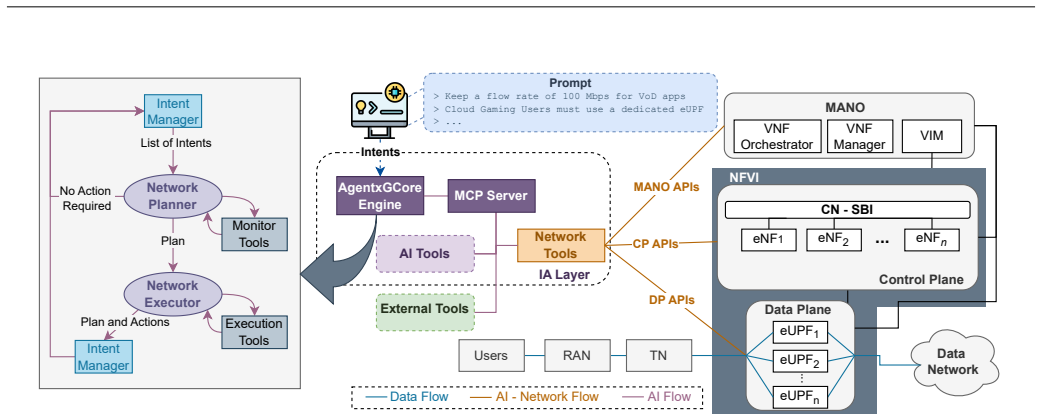
AgentxGCore extends the 3GPP core with an AI-driven closed-loop consisting of a network planner agent that visualizes state and builds intent-satisfying plans and a network executor agent that critiques and applies those plans using existing xGC APIs, enabling self-organization and self-adaptation based on real-time information.
What carries the argument
Multi-agent system with a network planner agent and network executor agent that apply ReAct reasoning on LLMs to translate intents into actions on standard network APIs.
If this is right
- Creates a continuous optimization loop driven by real-time network information.
- Enables self-organization and self-adaptation without relying on centralized managerial complexity.
- Operates on top of existing 3GPP APIs rather than requiring new interfaces.
- Supports intent-based networking by combining planning and execution in a ReAct-style loop.
- Validated through implementation with open-source core networks and varied LLMs.
Where Pith is reading between the lines
- The architecture could reduce the need for manual intervention in day-to-day core operations as network demands grow.
- Similar agent layers might be applied to other domains that already expose standardized APIs for orchestration.
- Performance under high-variability traffic patterns would need separate measurement to confirm robustness beyond the reported datasets.
- Integration with 3GPP analytics functions could create tighter coupling between observation and action.
Load-bearing premise
That the LLM-powered agents can map intents to correct, safe actions on live network APIs without hallucinations, errors, or causing instability.
What would settle it
Running the system on an open-source core with a specific intent and checking whether the executed configuration matches the intent while keeping the network stable under real traffic loads.
Figures
read the original abstract
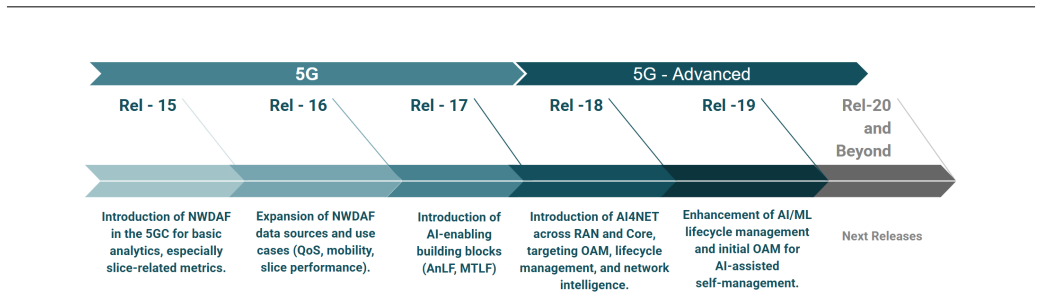
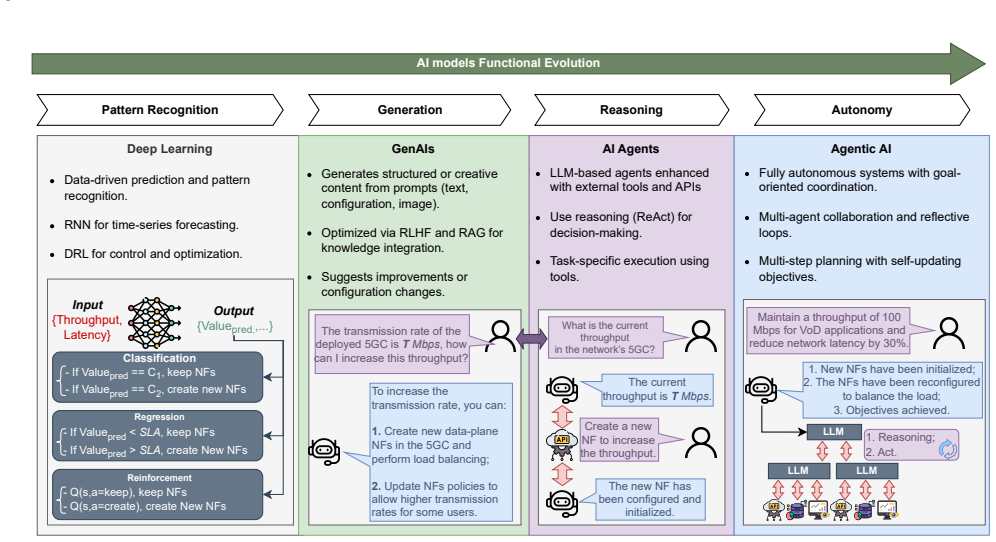
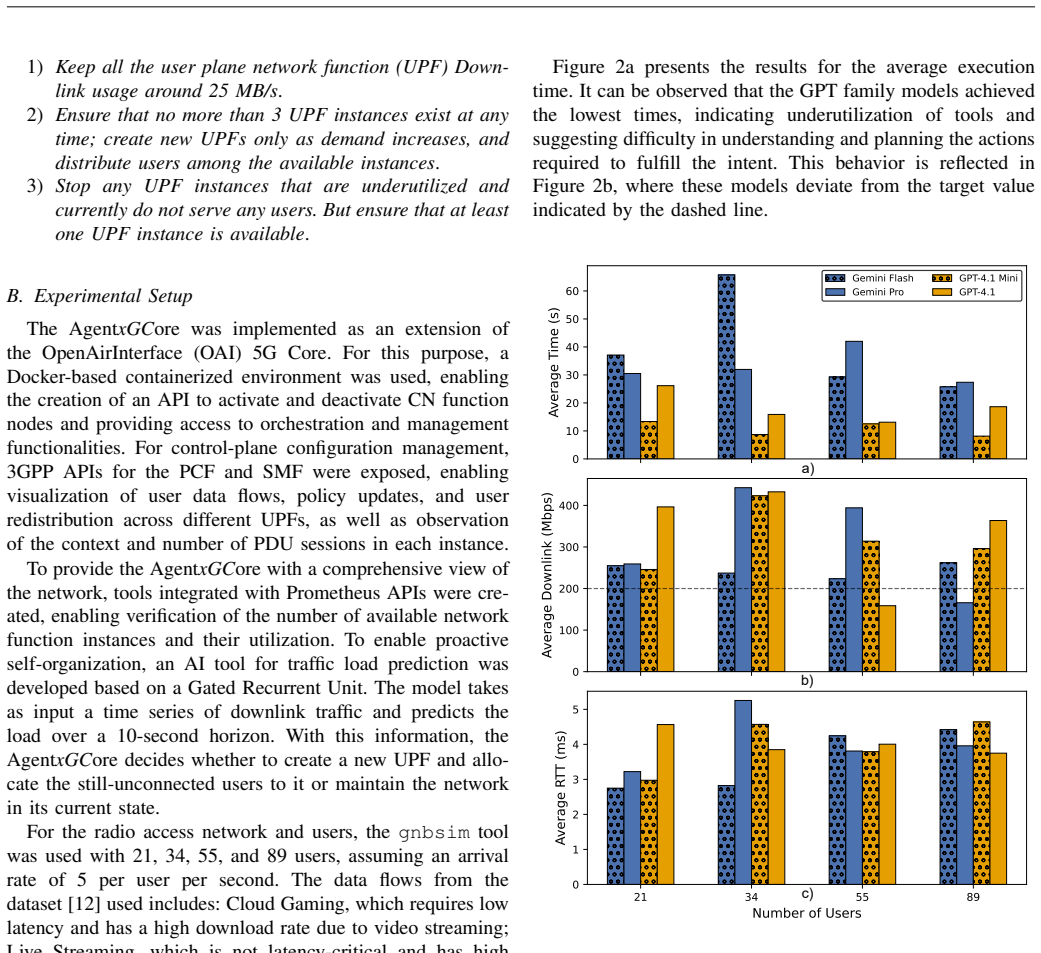
To meet the stringent requirements of emerging applications and the increasingly complex network management and operation, the Next Generation Mobile Networks (NextG), or 6G, will adopt an AI-native architecture on the Core Network (CN). In this movement, the Third Generation Partnership Project (3GPP) has extended the cellular CN with new function as a first step toward integrating analytics, Artificial Intelligence (AI), and machine learning. However, those new functionalities are constrained by a centralized approach and managerial complexity. Furthermore, with the rise of Large Language Models (LLMs), a new era in network orchestration and management begins, leveraging and empowering the Intent-based Networking (IBN) paradigm. In addition, AI agents and Agentic AI integrate Reasoning and Acting (ReAct), enabling the usage of such intents to continuously interact with the network. Unlike state-of-the-art approaches that primarily employ Agentic AI to mitigate deployment and configuration complexity in the CN, this paper introduces AgentxGCore, which leverages an Agentic AI-Native layer to extend the 3GPP architecture and enable a system based on the existing APIs across the Beyond Next Generation Core (xGC) domain. This proposal establishes an AI-driven closed-loop for continuous optimization based on real-time information, enabling self-organization and self-adaptation. Our approach involves a multi-agent specialized system, divided into a network planner agent, capable of visualizing the network state and developing a plan to meet the intents, and a network executor, responsible for criticizing and executing the plan. To validate the proposed solution, an environment was built using an open-source CN, heterogeneous datasets, and different LLMs were employed to demonstrate its effectiveness.
Editorial analysis
A structured set of objections, weighed in public.
Referee Report
Summary. The paper proposes AgentxGCore, an AI-native layer extending the 3GPP core network architecture for 6G/xGC. It introduces a multi-agent LLM system with a network planner agent (visualizing state and generating intent-driven plans) and a network executor agent (critiquing and executing plans via existing APIs). This is presented as enabling a closed-loop for real-time continuous optimization, self-organization, and self-adaptation. Validation is described via an open-source CN environment, heterogeneous datasets, and multiple LLMs to show effectiveness, contrasting with prior Agentic AI uses focused only on deployment complexity.
Significance. If substantiated, the architecture could advance intent-based networking in mobile cores by integrating ReAct-style agents for dynamic, decentralized management beyond 3GPP's centralized analytics functions. The use of existing APIs and open-source validation environment is a practical strength, but the absence of any reported performance data prevents assessing whether it delivers measurable gains in adaptability or reliability over current approaches.
major comments (2)
- [Abstract] Abstract (validation paragraph): The manuscript asserts that the open-source CN environment, heterogeneous datasets, and multiple LLMs 'demonstrate its effectiveness,' yet reports no quantitative results whatsoever—such as action success rate, plan validity, recovery time from errors, or stability metrics under load. This leaves the central claim of a reliable AI-driven closed-loop unsupported by evidence.
- [Architecture] Architecture description (planner-executor system): The proposal relies on LLMs reliably translating high-level intents into correct, non-disruptive sequences on xGC APIs without hallucinations or unsafe actions, but describes no concrete safeguards (e.g., formal plan verification, sandboxing, action bounding, or fallback mechanisms). This assumption is load-bearing for the self-organization claim and remains unaddressed.
minor comments (1)
- [Abstract] The abstract refers to 'Beyond Next Generation Core (xGC) domain' without defining the term or its relation to 3GPP Release 18/19 functions; a brief clarification would improve readability.
Simulated Author's Rebuttal
We thank the referee for the constructive feedback on the validation claims and architectural safeguards. We address each major comment below and will incorporate revisions to strengthen the manuscript.
read point-by-point responses
-
Referee: [Abstract] Abstract (validation paragraph): The manuscript asserts that the open-source CN environment, heterogeneous datasets, and multiple LLMs 'demonstrate its effectiveness,' yet reports no quantitative results whatsoever—such as action success rate, plan validity, recovery time from errors, or stability metrics under load. This leaves the central claim of a reliable AI-driven closed-loop unsupported by evidence.
Authors: We agree that the abstract and validation description would be strengthened by explicit quantitative metrics. The experiments described in the manuscript used an open-source CN environment with heterogeneous datasets and multiple LLMs, but specific numerical results (e.g., success rates or recovery times) were not reported in the current text. In the revised manuscript, we will add a dedicated evaluation subsection reporting these metrics from the conducted tests to support the effectiveness claims. revision: yes
-
Referee: [Architecture] Architecture description (planner-executor system): The proposal relies on LLMs reliably translating high-level intents into correct, non-disruptive sequences on xGC APIs without hallucinations or unsafe actions, but describes no concrete safeguards (e.g., formal plan verification, sandboxing, action bounding, or fallback mechanisms). This assumption is load-bearing for the self-organization claim and remains unaddressed.
Authors: The manuscript emphasizes the planner-executor roles and use of existing xGC APIs but does not detail implementation-level safeguards against LLM errors. We acknowledge this as a valid concern for the reliability of the closed-loop system. In the revision, we will expand the architecture section to include a discussion of safeguards, such as plan verification against network policies, action bounding via API constraints, and fallback mechanisms to rule-based controls. revision: yes
Circularity Check
No circularity: architectural proposal without derivations or fitted quantities
full rationale
The manuscript is an architectural proposal that extends 3GPP xGC with a planner-executor multi-agent LLM layer for intent translation and closed-loop optimization. No equations, parameters, or quantitative predictions appear in the provided text; the central claims (self-organization, self-adaptation) are asserted as consequences of the described design rather than derived from any self-referential definition, fitted input, or self-citation chain. Validation is described only at the level of building an open-source environment with heterogeneous datasets and multiple LLMs, without any reduction of results to the inputs by construction. This is a standard non-circular design paper.
Axiom & Free-Parameter Ledger
axioms (1)
- domain assumption LLMs can reliably reason about network states and generate executable plans via existing APIs without introducing instability.
invented entities (1)
-
AgentxGCore AI-native layer
no independent evidence
Reference graph
Works this paper leans on
-
[1]
Muhammad S. Akbar et al. "On challenges of sixth-generation (6G) wireless networks: A comprehensive survey of requirements, applications, and security issues, Journal of Network and Computer Applications, Volume 233, 2025, 104040, ISSN 1084-8045, https://doi.org/10.1016/j.jnca.2024.104040
-
[2]
Frankfurt, Germany: Next Generation Mobile Networks Alliance, Apr
NGMN Alliance, 6G Drivers and Vision, Final Deliverable, Version 1.0. Frankfurt, Germany: Next Generation Mobile Networks Alliance, Apr. 2021, approved by NGMN Board
2021
-
[3]
What is intent-based networking?
IBM, “What is intent-based networking?” IBM Think. Available: https://www.ibm.com/think/topics/intent-based-networking. Accessed: Jan. 6, 2026
2026
-
[4]
Towards AI-Native 6G Systems: Standards Enablers for 6G Network Automation,
S. Majumdar, Q. Wei, S. Schwarzmann, R. Trivisonno and G. Carle , "Towards AI-Native 6G Systems: Standards Enablers for 6G Network Automation," in IEEE Communications Standards Magazine, doi: 10.1109/MCOMSTD.2025.3585376
-
[5]
Intent-Based 5G Core Deployment Using Generative AI,
D. Brodimas, N. Tzanis and A. Birbas , "Intent-Based 5G Core Deployment Using Generative AI," 2025 International Conference on Computing, Networking and Communications (ICNC), Honolulu, HI, USA, 2025, pp. 406-410, doi: 10.1109/ICNC64010.2025.10993654
-
[6]
Intent-Based Management of Next-Generation Networks: an LLM-Centric Approach,
A. Mekrache, A. Ksentini and C. Verikoukis , "Intent-Based Management of Next-Generation Networks: an LLM-Centric Approach," in IEEE Network, vol. 38, no. 5, pp. 29-36, Sept. 2024, doi: 10.1109/MNET.2024.3420120
-
[7]
Intent-Based Infrastructure and Service Orchestration Using Agentic-AI,
D. Brodimas, A. Birbas, D. Kapolos and S. Denazis , "Intent-Based Infrastructure and Service Orchestration Using Agentic-AI," in IEEE Open Journal of the Communications Society, vol. 6, pp. 7150-7168, 2025, doi: 10.1109/OJCOMS.2025.3600706
-
[8]
AgentRAN: An Agentic AI Architecture for Autonomous Control of Open 6G Networks,
M. Elkael, S. D’Oro, L. Bonati, M. Polese, Y. Lee, K. Furueda, and T. Melodia, “AgentRAN: An Agentic AI Architecture for Autonomous Control of Open 6G Networks,” arXiv preprint arXiv:2508.17778, 2025
-
[9]
Advanced Architectures Integrated With Agentic AI for Next-Generation Wireless Networks,
K. Dev, S. A. Khowaja, E. Zeydan, K. Singh and M. Debbah, "Advanced Architectures Integrated With Agentic AI for Next-Generation Wireless Networks," in IEEE Communications Standards Magazine, doi: 10.1109/MCOMSTD.2025.3632205
-
[10]
Introducing the Model Context Protocol,
Anthropic, “Introducing the Model Context Protocol,” Anthropic, 25-Nov-2024. [Online]. Available: https://www.anthropic.com/news/model-context-protocol. [Accessed: 16-Jan-2026]
2024
-
[11]
OSS-GPT: An LLM-Powered Intent-Driven Operations Support System for 6G Networks,
A. Mekrache, A. Ksentini and C. Verikoukis , "OSS-GPT: An LLM-Powered Intent-Driven Operations Support System for 6G Networks," 2025 IEEE 11th International Conference on Network Softwarization (NetSoft), Budapest, Hungary, 2025, pp. 155-163, doi: 10.1109/NetSoft64993.2025.11080632
-
[12]
C. Baena, O. S. Peñaherrera-Pulla, L. Camacho, R. Barco and S. Fortes, "Video Streaming and Cloud Gaming Services Over 4G and 5G: A Complete Network and Service Metrics Dataset," in IEEE Communications Magazine, vol. 61, no. 9, pp. 154-160, September 2023, doi: 10.1109/MCOM.005.2200719
-
[13]
Xu Li, Weisen Shi, Hang Zhang, Chenghui Peng, Shaoyun Wu, Wen Tong, "The Agentic-AI Core: An AI-Empowered, Mission-Oriented Core Network for Next-Generation Mobile Telecommunications", Engineering, 2025, ISSN 2095-8099, https://doi.org/10.1016/j.eng.2025.06.027
-
[14]
AI Agent Based Autonomous Cognitive Architecture for 6G Core Network,
M. Yu, Y. Xing, X. Xia and J. Jia, "AI Agent Based Autonomous Cognitive Architecture for 6G Core Network," 2025 International Wireless Communications and Mobile Computing (IWCMC), Abu Dhabi, United Arab Emirates, 2025, pp. 538-542, doi: 10.1109/IWCMC65282.2025.11059600
-
[15]
AGILE-6G: Agentic AI for Autonomous Management of 6G Network/Application Services,
A. Antonopoulos et al., "AGILE-6G: Agentic AI for Autonomous Management of 6G Network/Application Services," in IEEE Network, doi: 10.1109/MNET.2025.3644039
discussion (0)
Sign in with ORCID, Apple, or X to comment. Anyone can read and Pith papers without signing in.