Parameter-Free and Group Conditional Online Conformal Prediction
Pith reviewed 2026-06-28 19:38 UTC · model grok-4.3
The pith
A parameter-free algorithm for online conformal prediction achieves the strongest group-conditional coverage guarantees.
A machine-rendered reading of the paper's core claim, the machinery that carries it, and where it could break.
Core claim
We propose a parameter-free algorithm for group-conditional OCP and demonstrate that it achieves the best group-conditional coverage guarantees. The algorithm unifies group-conditional coverage with parameter-free online algorithms for fair and robust uncertainty quantification in shifting environments.
What carries the argument
The parameter-free group-conditional online conformal prediction update rule that adapts prediction intervals based on group membership without fixed learning rates.
If this is right
- Delivers group-conditional coverage guarantees without needing to tune parameters.
- Improves the reliability of existing parameter-free OCP methods.
- Produces prediction intervals of comparable size to well-tuned group-conditional approaches.
- Supports fair uncertainty quantification across data groups in non-stationary settings.
Where Pith is reading between the lines
- This approach might extend naturally to cases where groups are learned from data rather than predefined.
- Similar unification could benefit other online uncertainty methods facing adversarial shifts.
- Testing on more complex group structures could reveal scalability limits not addressed in the paper.
Load-bearing premise
The approach depends on the data having a clear predefined group structure and on the online update rule holding for non-exchangeable sequences.
What would settle it
Observing that the method's empirical group-conditional coverage falls below the claimed rates on a dataset with known groups and controlled distribution shifts would disprove the guarantee.
Figures
read the original abstract
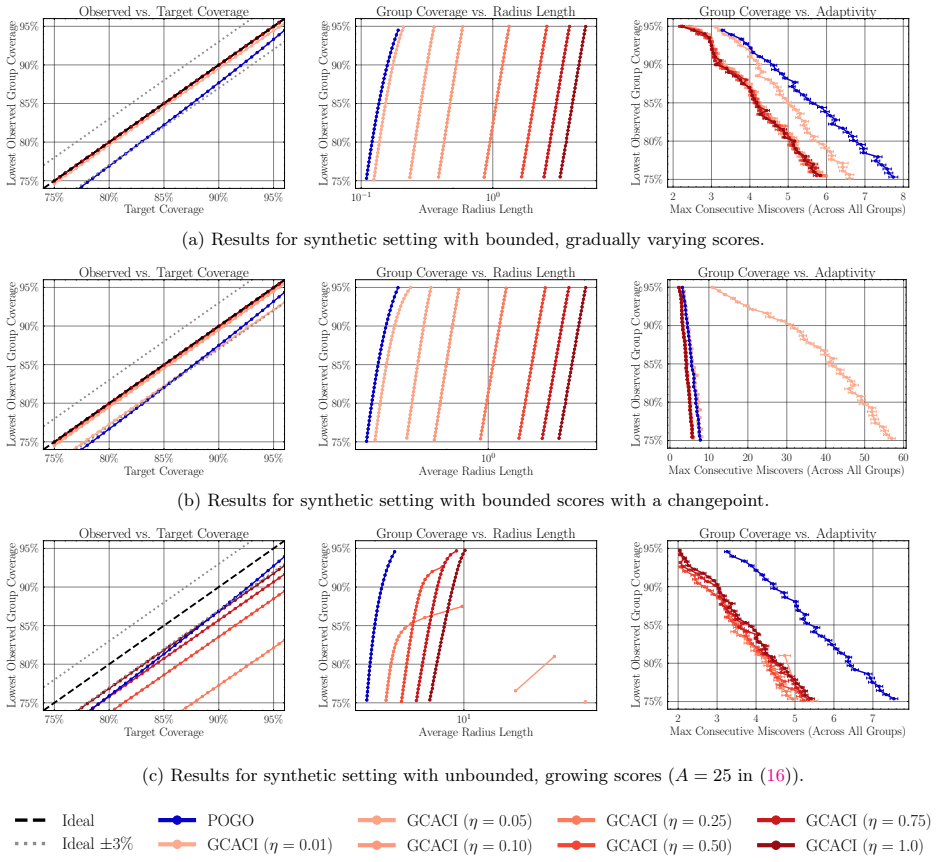
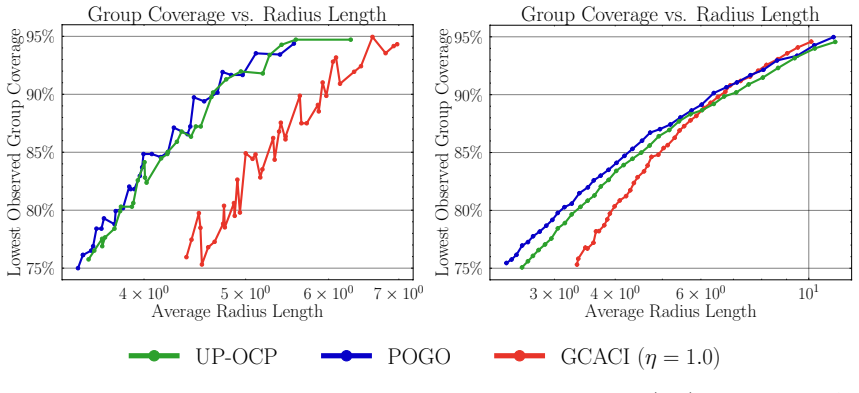
Uncertainty quantification (UQ) is critical for the deployment of machine learning predictors in real-world scenarios where the data distribution may shift over time (i.e., data may not be exchangeable). Online conformal prediction (OCP) methods address this issue at the expense of either (i) group-wise error control or (ii) learning-rate independent implementation. Group-conditional coverage is essential for fairness across different collections of data points and for providing finer UQ guarantees. Parameter-free optimization is crucial for robustness to adversarial and unknown data shifts. We propose a parameter-free algorithm for group-conditional OCP and demonstrate that it achieves the best group-conditional coverage guarantees. We evaluate our algorithm on synthetic and real-world data, demonstrating that our method not only improves the reliability of existing parameter-free OCP methods but also provides prediction intervals that are comparable in size to well-tuned group-conditional approaches. By unifying group-conditional coverage with parameter-free online algorithms, our work lays a foundation for fair and robust uncertainty quantification in shifting environments.
Editorial analysis
A structured set of objections, weighed in public.
Referee Report
Summary. The manuscript proposes a parameter-free algorithm for group-conditional online conformal prediction (OCP) under distribution shift. It claims this algorithm achieves the best group-conditional coverage guarantees, improves reliability over existing parameter-free OCP methods, and yields prediction intervals comparable in size to well-tuned group-conditional baselines. The claims are supported by evaluations on synthetic and real-world data.
Significance. If the stated guarantees and empirical competitiveness hold, the work would be significant for unifying parameter-free optimization with group-conditional coverage, enabling fairer and more robust uncertainty quantification in non-exchangeable streams. The absence of machine-checked proofs or reproducible code is noted but does not diminish the potential impact if the central derivation is correct.
major comments (2)
- [Abstract] Abstract: the central claim that the algorithm 'achieves the best group-conditional coverage guarantees' is presented without any derivation, error bound, or proof sketch. This prevents assessment of whether the bound is optimal or reduces to a standard result under the non-exchangeable update rule.
- [Abstract] The weakest assumption (validity of the online conformal update rule for non-exchangeable data with well-defined groups) is load-bearing for the coverage analysis, yet no concrete test or counter-example discussion is supplied to bound the risk that the guarantee fails when groups are misspecified or shifts violate the update premise.
Simulated Author's Rebuttal
We thank the referee for their comments. We address each major comment point by point below.
read point-by-point responses
-
Referee: [Abstract] Abstract: the central claim that the algorithm 'achieves the best group-conditional coverage guarantees' is presented without any derivation, error bound, or proof sketch. This prevents assessment of whether the bound is optimal or reduces to a standard result under the non-exchangeable update rule.
Authors: The abstract is a concise summary; the full derivation, error bounds, and proof that the algorithm achieves optimal group-conditional coverage (via a novel parameter-free update that matches minimax rates under the group-conditional non-exchangeable setting) appear in Section 3, Theorem 3.2 and its proof. The result extends rather than reduces to prior non-exchangeable OCP bounds. We will revise the abstract to reference the theorem. revision: partial
-
Referee: [Abstract] The weakest assumption (validity of the online conformal update rule for non-exchangeable data with well-defined groups) is load-bearing for the coverage analysis, yet no concrete test or counter-example discussion is supplied to bound the risk that the guarantee fails when groups are misspecified or shifts violate the update premise.
Authors: The assumption is stated and motivated in Section 2, consistent with prior non-exchangeable OCP work. We will add a short discussion paragraph (with a simple synthetic counter-example illustration) on risks under group misspecification or premise violation to bound the practical risk. revision: yes
Circularity Check
No significant circularity; derivation self-contained
full rationale
The abstract and available text present a novel parameter-free algorithm for group-conditional OCP with claimed coverage guarantees, without any equations, self-definitions, fitted parameters renamed as predictions, or load-bearing self-citations that reduce the central claims to their own inputs by construction. No uniqueness theorems or ansatzes are smuggled in, and no known results are merely renamed. The proposal and empirical demonstration stand as independent content against external benchmarks, consistent with the default expectation that most papers exhibit no circularity.
Axiom & Free-Parameter Ledger
Reference graph
Works this paper leans on
-
[1]
2024-2025 flu season marked highest hospitalization rate in nearly 15 years, 2025
Samantha Anderer. 2024-2025 flu season marked highest hospitalization rate in nearly 15 years, 2025
2024
-
[2]
Conformal pid control for time series prediction.Advances in neural information processing systems, 36:23047–23074, 2023
Anastasios Angelopoulos, Emmanuel Candes, and Ryan J Tibshirani. Conformal pid control for time series prediction.Advances in neural information processing systems, 36:23047–23074, 2023
2023
-
[3]
Conformal prediction: A gentle introduction.Founda- tions and Trends in Machine Learning, 16(4):494–591, 2023
Anastasios N Angelopoulos and Stephen Bates. Conformal prediction: A gentle introduction.Founda- tions and Trends in Machine Learning, 16(4):494–591, 2023
2023
-
[4]
Angelopoulos, Michael I
Anastasios N. Angelopoulos, Michael I. Jordan, and Ryan J. Tibshirani. Gradient equilibrium in online learning: Theory and applications.Journal of Machine Learning Research, 26(305):1–68, 2025. URL http://jmlr.org/papers/v26/25-0356.html
2025
-
[5]
Online conformal prediction with decaying step sizes
Anastasios Nikolas Angelopoulos, Rina Barber, and Stephen Bates. Online conformal prediction with decaying step sizes. InInternational Conference on Machine Learning, pages 1616–1630. PMLR, 2024
2024
-
[6]
Online conformal prediction via online optimization
Felipe Areces, Christopher Mohri, Tatsunori Hashimoto, and John Duchi. Online conformal prediction via online optimization. InInternational Conference on Machine Learning, pages 1604–1649. PMLR, 2025
2025
-
[7]
Practical adversarial multivalid conformai prediction
Osbert Bastani, Varun Gupta, Christopher Jung, Georgy Noarov, Ramya Ramalingam, and Aaron Roth. Practical adversarial multivalid conformai prediction. InProceedings of the 36th International Conference on Neural Information Processing Systems, pages 29362–29373, 2022. 11
2022
-
[8]
Improved online conformal prediction via strongly adaptive online learning
Aadyot Bhatnagar, Huan Wang, Caiming Xiong, and Yu Bai. Improved online conformal prediction via strongly adaptive online learning. InInternational Conference on Machine Learning, pages 2337–2363. PMLR, 2023
2023
-
[9]
Machine learning techniques for credit risk evaluation: a systematic literature review.Journal of Banking and Financial Technology, 4(1):111–138, 2020
Siddharth Bhatore, Lalit Mohan, and Y Raghu Reddy. Machine learning techniques for credit risk evaluation: a systematic literature review.Journal of Banking and Financial Technology, 4(1):111–138, 2020
2020
-
[10]
Cambridge university press, 2006
Nicolo Cesa-Bianchi and Gábor Lugosi.Prediction, learning, and games. Cambridge university press, 2006
2006
-
[11]
Online learning algorithms.Annual review of statistics and its application, 8(1):165–190, 2021
Nicolò Cesa-Bianchi and Francesco Orabona. Online learning algorithms.Annual review of statistics and its application, 8(1):165–190, 2021
2021
-
[12]
Distributional conformal prediction.Pro- ceedings of the National Academy of Sciences, 118(48):e2107794118, 2021
Victor Chernozhukov, Kaspar Wüthrich, and Yinchu Zhu. Distributional conformal prediction.Pro- ceedings of the National Academy of Sciences, 118(48):e2107794118, 2021
2021
-
[13]
Universal portfolios.Mathematical finance, 1(1):1–29, 1991
Thomas M Cover. Universal portfolios.Mathematical finance, 1(1):1–29, 1991
1991
-
[14]
Universal portfolios with side information.IEEE Transactions on Information Theory, 42(2):348–363, 1996
Thomas M Cover and Erik Ordentlich. Universal portfolios with side information.IEEE Transactions on Information Theory, 42(2):348–363, 1996
1996
-
[15]
The role of ai in emergency department triage: an integrative systematic review.Intensive and Critical Care Nursing, 89:104058, 2025
Rabie Adel El Arab and Omayma Abdulaziz Al Moosa. The role of ai in emergency department triage: an integrative systematic review.Intensive and Critical Care Nursing, 89:104058, 2025
2025
-
[16]
The limits of distribution-free conditional predictive inference.Information and Inference: A Journal of the IMA, 10 (2):455–482, 2021
Rina Foygel Barber, Emmanuel J Candes, Aaditya Ramdas, and Ryan J Tibshirani. The limits of distribution-free conditional predictive inference.Information and Inference: A Journal of the IMA, 10 (2):455–482, 2021
2021
-
[17]
Adaptive conformal inference under distribution shift
Isaac Gibbs and Emmanuel J Candès. Adaptive conformal inference under distribution shift. InProceed- ings of the 35th International Conference on Neural Information Processing Systems, pages 1660–1672, 2021
2021
-
[18]
Conformal inference for online prediction with arbitrary distri- bution shifts.Journal of Machine Learning Research, 25(162):1–36, 2024
Isaac Gibbs and Emmanuel J Candès. Conformal inference for online prediction with arbitrary distri- bution shifts.Journal of Machine Learning Research, 25(162):1–36, 2024
2024
-
[19]
Conformal prediction with conditional guaran- tees.Journal of the Royal Statistical Society Series B: Statistical Methodology, 87(4):1100–1126, 2025
Isaac Gibbs, John J Cherian, and Emmanuel J Candès. Conformal prediction with conditional guaran- tees.Journal of the Royal Statistical Society Series B: Statistical Methodology, 87(4):1100–1126, 2025
2025
-
[20]
Strictly proper scoring rules, prediction, and estimation
Tilmann Gneiting and Adrian E Raftery. Strictly proper scoring rules, prediction, and estimation. Journal of the American statistical Association, 102(477):359–378, 2007
2007
-
[21]
A survey of deep learning techniques for autonomous driving.Journal of field robotics, 37(3):362–386, 2020
Sorin Grigorescu, Bogdan Trasnea, Tiberiu Cocias, and Gigel Macesanu. A survey of deep learning techniques for autonomous driving.Journal of field robotics, 37(3):362–386, 2020
2020
-
[22]
Online multivalid learning: Means, moments, and prediction intervals.Innovations in Theoretical Computer Science (ITCS), 2022
Varun Gupta, Christopher Jung, Georgy Noarov, Mallesh M Pai, and Aaron Roth. Online multivalid learning: Means, moments, and prediction intervals.Innovations in Theoretical Computer Science (ITCS), 2022
2022
-
[23]
State of the art of machine learning–enabled clinical decision support in intensive care units: literature review.JMIR medical informatics, 10(3):e28781, 2022
Na Hong, Chun Liu, Jianwei Gao, Lin Han, Fengxiang Chang, Mengchun Gong, and Longxiang Su. State of the art of machine learning–enabled clinical decision support in intensive care units: literature review.JMIR medical informatics, 10(3):e28781, 2022
2022
-
[24]
Robust estimation of a location parameter
Peter J Huber. Robust estimation of a location parameter. InBreakthroughs in statistics: Methodology and distribution, pages 492–518. Springer, 1992
1992
-
[25]
Mimic-iv, a freely accessible electronic health record dataset.Scientific data, 10(1):1, 2023
Alistair EW Johnson, Lucas Bulgarelli, Lu Shen, Alvin Gayles, Ayad Shammout, Steven Horng, Tom J Pollard, Sicheng Hao, Benjamin Moody, Brian Gow, et al. Mimic-iv, a freely accessible electronic health record dataset.Scientific data, 10(1):1, 2023
2023
-
[26]
Improved strongly adap- tive online learning using coin betting
Kwang-Sung Jun, Francesco Orabona, Stephen Wright, and Rebecca Willett. Improved strongly adap- tive online learning using coin betting. InArtificial Intelligence and Statistics, pages 943–951. PMLR, 2017. 12
2017
-
[27]
Online learning for chang- ing environments using coin betting.Electronic Journal of Statistics, 11:5282–5310, 2017
Kwang-Sung Jun, Francesco Orabona, Stephen Wright, and Rebecca Willett. Online learning for chang- ing environments using coin betting.Electronic Journal of Statistics, 11:5282–5310, 2017
2017
-
[28]
Moment multicalibra- tion for uncertainty estimation
Christopher Jung, Changhwa Lee, Mallesh Pai, Aaron Roth, and Rakesh Vohra. Moment multicalibra- tion for uncertainty estimation. InConference on Learning Theory, pages 2634–2678. PMLR, 2021
2021
-
[29]
Batch multivalid conformal prediction
Christopher Jung, Georgy Noarov, Ramya Ramalingam, and Aaron Roth. Batch multivalid conformal prediction. InInternational Conference on Learning Representations (ICLR), 2023
2023
-
[30]
Adam: A Method for Stochastic Optimization
Diederik P Kingma and Jimmy Ba. Adam: A method for stochastic optimization.arXiv preprint arXiv:1412.6980, 2014
work page internal anchor Pith review Pith/arXiv arXiv 2014
-
[31]
Quantile regression.Journal of economic perspectives, 15(4): 143–156, 2001
Roger Koenker and Kevin F Hallock. Quantile regression.Journal of economic perspectives, 15(4): 143–156, 2001
2001
-
[32]
Distribution-free prediction bands for non-parametric regression.Jour- nal of the Royal Statistical Society Series B: Statistical Methodology, 76(1):71–96, 2014
Jing Lei and Larry Wasserman. Distribution-free prediction bands for non-parametric regression.Jour- nal of the Royal Statistical Society Series B: Statistical Methodology, 76(1):71–96, 2014
2014
-
[33]
Online conformal prediction via universal portfolio algorithms.arXiv preprint arXiv:2602.03168, 2026
Tuo Liu, Edgar Dobriban, and Francesco Orabona. Online conformal prediction via universal portfolio algorithms.arXiv preprint arXiv:2602.03168, 2026
-
[34]
S&p 500 stock data, Feb 2018
Cam Nugent. S&p 500 stock data, Feb 2018. URLhttps://www.kaggle.com/datasets/camnugent/ sandp500
2018
-
[35]
Holidays & trading hours, 2026
NYSE. Holidays & trading hours, 2026. URLhttps://www.nyse.com/trade/hours-calendars
2026
-
[36]
Online Learning: A Modern Introduction Using Convex Optimization
Francesco Orabona. A modern introduction to online learning.arXiv preprint arXiv:1912.13213, 2019
work page internal anchor Pith review Pith/arXiv arXiv 1912
-
[37]
Coin betting and parameter-free online learning
Francesco Orabona and Dávid Pál. Coin betting and parameter-free online learning. InProceedings of the 30th International Conference on Neural Information Processing Systems, pages 577–585, 2016
2016
-
[38]
Francesco Orabona and Dávid Pál. Parameter-free stochastic optimization of variationally coherent functions.arXiv preprint arXiv:2102.00236, 2021
-
[39]
Inductive confidence machines for regression
Harris Papadopoulos, Kostas Proedrou, Volodya Vovk, and Alex Gammerman. Inductive confidence machines for regression. InEuropean conference on machine learning, pages 345–356. Springer, 2002
2002
-
[40]
Adaptive conformal inference by betting
Aleksandr Podkopaev, Darren Xu, and Kuang-chih Lee. Adaptive conformal inference by betting. In Proceedings of the 41st International Conference on Machine Learning, pages 40886–40907, 2024
2024
-
[41]
Ramya Ramalingam, Shayan Kiyani, and Aaron Roth. The relationship between no-regret learning and online conformal prediction.arXiv preprint arXiv:2502.10947, 2025
-
[42]
With Malice Toward None: Assessing Uncertainty via Equalized Coverage.Harvard Data Science Review, 2(2), apr 30 2020
Yaniv Romano, Rina Foygel Barber, Chiara Sabatti, and Emmanuel Candès. With Malice Toward None: Assessing Uncertainty via Equalized Coverage.Harvard Data Science Review, 2(2), apr 30 2020. https://hdsr.mitpress.mit.edu/pub/qedrwcz3
2020
-
[43]
Outcomes after motor vehicle trauma: transfers to level i trauma centers compared with direct admissions.The Journal of Emergency Medicine, 53(3):295–301, 2017
Aleksandr Rozenberg, Timothy Danish, Viktor Y Dombrovskiy, and Todd R Vogel. Outcomes after motor vehicle trauma: transfers to level i trauma centers compared with direct admissions.The Journal of Emergency Medicine, 53(3):295–301, 2017
2017
-
[44]
Transduction with confidence and credibility
C Saunders, A Gammerman, and V Vovk. Transduction with confidence and credibility. InProceedings of the 16th international joint conference on Artificial intelligence-Volume 2, pages 722–726, 1999
1999
-
[45]
A tutorial on conformal prediction.Journal of machine learning research, 9(3), 2008
Glenn Shafer and Vladimir Vovk. A tutorial on conformal prediction.Journal of machine learning research, 9(3), 2008
2008
-
[46]
Forecasting at scale.The American Statistician, 72(1):37–45, 2018
Sean J Taylor and Benjamin Letham. Forecasting at scale.The American Statistician, 72(1):37–45, 2018
2018
-
[47]
Assessment of coma and impaired consciousness: a practical scale.The lancet, 304(7872):81–84, 1974
Graham Teasdale and Bryan Jennett. Assessment of coma and impaired consciousness: a practical scale.The lancet, 304(7872):81–84, 1974. 13
1974
-
[48]
J-L Vincent, Rui Moreno, Jukka Takala, Sheila Willatts, Arnaldo De Mendonça, Hajo Bruining, C Kathryn Reinhart, PeterM Suter, and Lambertius G Thijs. The sofa (sepsis-related organ failure assessment) score to describe organ dysfunction/failure: On behalf of the working group on sepsis- related problems of the european society of intensive care medicine (...
1996
-
[49]
Mondrianconfidencemachine
VladimirVovk, DavidLindsay, IliaNouretdinov, AlexGammerman, etal. Mondrianconfidencemachine. Technical Report, 2003
2003
-
[50]
Springer, 2005
Vladimir Vovk, Alexander Gammerman, and Glenn Shafer.Algorithmic learning in a random world. Springer, 2005
2005
-
[51]
Machine-learning applications of algorith- mic randomness
Volodya Vovk, Alexander Gammerman, and Craig Saunders. Machine-learning applications of algorith- mic randomness. InProceedings of the Sixteenth International Conference on Machine Learning, pages 444–453, 1999
1999
-
[52]
Zitong Yang, Emmanuel Candès, and Lihua Lei. Bellman conformal inference: Calibrating prediction intervals for time series.arXiv preprint arXiv:2402.05203, 2024
-
[53]
Hao Yu and Michael J Neely. A low complexity algorithm with o (√ t) regret and o (1) constraint violations for online convex optimization with long term constraints.Journal of Machine Learning Research, 21(1):1–24, 2020
2020
-
[54]
Adaptive con- formal predictions for time series
Margaux Zaffran, Olivier Féron, Yannig Goude, Julie Josse, and Aymeric Dieuleveut. Adaptive con- formal predictions for time series. InICML 2022-39th International Conference on Machine Learning, volume 162, 2022
2022
-
[55]
Discounted adaptive online learning: towards better regularization
Zhiyu Zhang, David Bombara, and Heng Yang. Discounted adaptive online learning: towards better regularization. InProceedings of the 41st International Conference on Machine Learning, pages 58631– 58661, 2024. 14 A Proofs A.1 Proof of Theorem 4.1 Theorem 4.1(POGO coverage guarantee).Letα∈(0,1), and let(S t,g t,c t)T t=1 be the sequences of non- conformity ...
2024
discussion (0)
Sign in with ORCID, Apple, or X to comment. Anyone can read and Pith papers without signing in.