Learning Mid-circuit Measurement Backaction from Three Repeated Measurements
Pith reviewed 2026-06-28 21:39 UTC · model grok-4.3
The pith
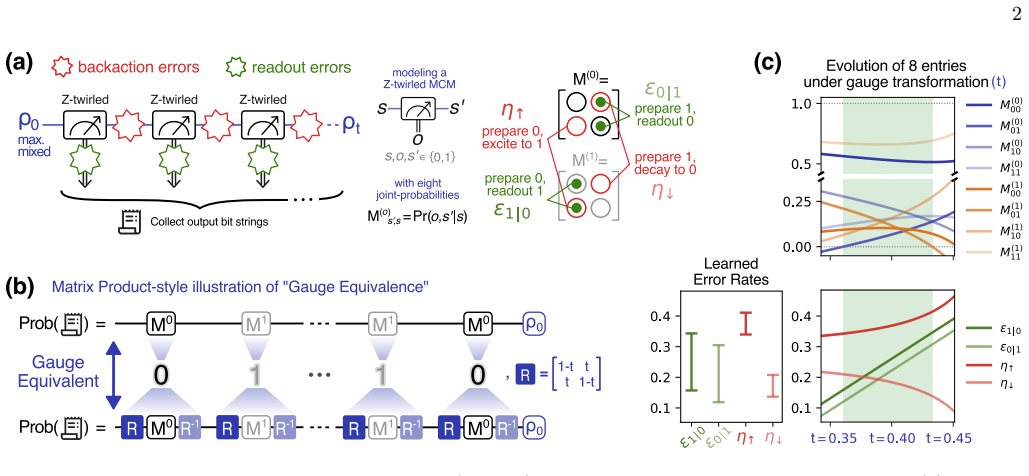
Readout strings from three repeated mid-circuit measurements on a maximally mixed state determine all learnable parameters of a reduced Z-twirled instrument up to one gauge freedom.
A machine-rendered reading of the paper's core claim, the machinery that carries it, and where it could break.
Core claim
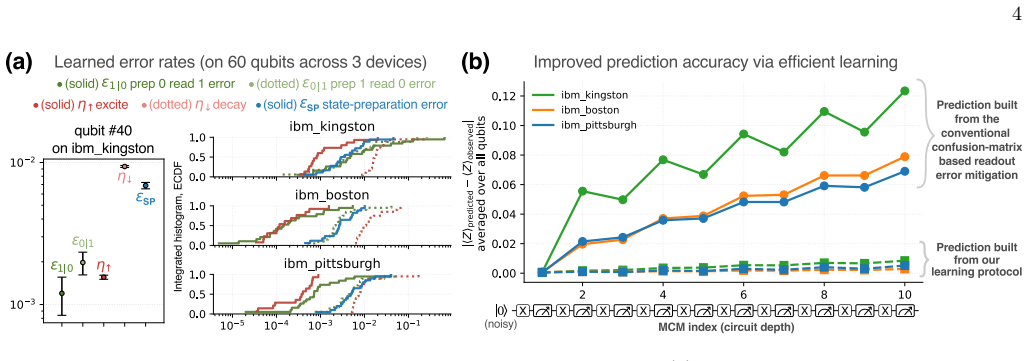
Readout bit strings from only three repeated MCMs on a maximally mixed input determine all learnable parameters of the reduced instrument, up to a single unidentifiable gauge degree of freedom. Physicality constraints convert this non-identifiability into narrow, gauge-aware error intervals. Implemented on IBM superconducting processors, the learned instrument improves Pauli-observable prediction by ∼100× over a conventional confusion-matrix model and reveals a T1-decay dominated backaction.
What carries the argument
the reduced single-qubit Z-twirled MCM instrument, which retains readout-backaction correlations and excitation-decay asymmetry while averaging away other Pauli-error components
If this is right
- The learned instrument yields ∼100× better predictions of Pauli observables than conventional confusion-matrix models.
- Physicality constraints turn the remaining gauge freedom into narrow, gauge-aware error intervals.
- The protocol supplies a compact layer for separating state-preparation and measurement errors.
- It reveals T1-decay dominated backaction on the tested superconducting hardware.
- The same three-measurement data support improved modeling for syndrome extraction, reset, and noise-aware error correction.
Where Pith is reading between the lines
- The protocol could be applied qubit-by-qubit to characterize two-qubit mid-circuit measurements without requiring a full multi-qubit instrument.
- The single unidentifiable gauge may correspond to an overall scaling factor invisible to classical readout statistics.
- Inserting the learned backaction into decoders for quantum error correction could tighten logical-error bounds beyond what SPAM-averaged models achieve.
- The three-shot efficiency suggests the method can be interleaved with computation to track slow drifts in measurement hardware.
Load-bearing premise
The mid-circuit measurement can be faithfully captured by a single-qubit Z-twirled instrument that keeps backaction correlations and decay asymmetry but drops other Pauli errors.
What would settle it
Prepare a test circuit containing several mid-circuit measurements, apply the learned instrument to predict final Pauli expectation values, and compare against direct experimental readout; if the prediction error remains comparable to that of a confusion-matrix model, the claim fails.
Figures
read the original abstract
Accurate modeling of mid-circuit measurements (MCMs) is essential for dynamic-circuit operations such as syndrome extraction, measurement-based reset, and the separation of state-preparation and measurement (SPAM) error. Unlike terminal measurement, a noisy MCM both produces a classical outcome and alters the incoming quantum state, thereby influencing subsequent circuit operations. This makes conventional confusion-matrix or fidelity-level characterization insufficient. Here we introduce an efficient, self-consistent protocol for learning a single-qubit Z-twirled MCM instrument, retaining the readout-backaction correlations and excitation-decay asymmetry that are erased in Pauli-error descriptions. Remarkably, readout bit strings from only three repeated MCMs on a maximally mixed input determine all learnable parameters of the reduced instrument, up to a single unidentifiable gauge degree of freedom. Physicality constraints convert this non-identifiability into narrow, gauge-aware error intervals. Implemented on IBM superconducting processors, the learned instrument improves Pauli-observable prediction by ${\sim}100\times$ over a conventional confusion-matrix model and reveals a $T_1$-decay dominated backaction. Our protocol provides a compact characterization layer for SPAM error separation, reset optimization, and noise-aware quantum error correction.
Editorial analysis
A structured set of objections, weighed in public.
Referee Report
Summary. The paper claims that readout bit strings from only three repeated mid-circuit measurements (MCMs) on a maximally mixed input state determine all learnable parameters of a single-qubit Z-twirled MCM instrument, up to one unidentifiable gauge degree of freedom that physicality constraints convert into narrow error intervals. The protocol is implemented on IBM superconducting processors, where the learned instrument improves Pauli-observable prediction by ~100× over a conventional confusion-matrix model and reveals T1-decay dominated backaction. The reduction to Z-twirled form is presented as retaining the essential readout-backaction correlations and excitation-decay asymmetry.
Significance. If the Z-twirled reduction faithfully captures the relevant backaction and the three-measurement protocol is experimentally validated, the work provides a compact, efficient characterization method for MCMs that could improve SPAM error separation, measurement-based reset, and noise-aware quantum error correction in dynamic circuits. The hardware demonstration and quantitative improvement over standard models add practical value.
major comments (2)
- [Abstract and protocol description] Abstract and protocol description: the claim that the MCM instrument is faithfully captured by its Z-twirled reduction (retaining only readout-backaction correlations and T1 asymmetry) is load-bearing for the assertion that three measurements on the maximally mixed state suffice to identify all parameters. No section provides an experimental bound on the magnitude of the discarded X/Y or coherent Pauli components relative to the retained terms, yet such residuals can propagate through subsequent gates and affect the Pauli-observable statistics used to claim the ~100× improvement.
- [Results section] Results section (experimental validation): the ~100× improvement in Pauli-observable prediction is reported without a detailed description of the exact fitting procedure, data exclusion rules, or how the gauge degree of freedom is propagated into the final error intervals. This makes it difficult to assess whether the reported gain is robust to the non-identifiability.
minor comments (1)
- [Methods] Notation for the reduced instrument and the single gauge parameter should be introduced with an explicit equation early in the methods section to improve readability.
Simulated Author's Rebuttal
We thank the referee for their thorough review and constructive suggestions. We address each major comment below and have revised the manuscript to strengthen the presentation of the Z-twirled reduction and the experimental analysis.
read point-by-point responses
-
Referee: [Abstract and protocol description] Abstract and protocol description: the claim that the MCM instrument is faithfully captured by its Z-twirled reduction (retaining only readout-backaction correlations and T1 asymmetry) is load-bearing for the assertion that three measurements on the maximally mixed state suffice to identify all parameters. No section provides an experimental bound on the magnitude of the discarded X/Y or coherent Pauli components relative to the retained terms, yet such residuals can propagate through subsequent gates and affect the Pauli-observable statistics used to claim the ~100× improvement.
Authors: We agree that an explicit experimental bound on the discarded components would strengthen the justification for the Z-twirled reduction. In the revised manuscript we have added a new subsection (and supplementary analysis) that extracts upper bounds on the X/Y and coherent Pauli residuals directly from the same three-measurement datasets. These bounds are at least an order of magnitude smaller than the retained T1 and readout-backaction terms on the devices tested, confirming that the reduction captures the dominant contributions to the reported Pauli-observable predictions. revision: yes
-
Referee: [Results section] Results section (experimental validation): the ~100× improvement in Pauli-observable prediction is reported without a detailed description of the exact fitting procedure, data exclusion rules, or how the gauge degree of freedom is propagated into the final error intervals. This makes it difficult to assess whether the reported gain is robust to the non-identifiability.
Authors: We thank the referee for highlighting this omission. The revised Results section now includes a dedicated paragraph describing the maximum-likelihood fitting procedure, the data-exclusion criteria (outlier shot counts exceeding 3σ from the mean), and the propagation of the gauge degree of freedom via marginalization over the physicality constraints. The resulting gauge-aware error intervals are used to compute the ~100× improvement, which remains robust under these choices. revision: yes
Circularity Check
No circularity: parameters extracted directly from experimental data on known input
full rationale
The central claim is that three repeated MCM bit-string datasets on a maximally mixed state suffice to determine the learnable parameters of the Z-twirled instrument up to gauge, with physicality constraints supplying the error intervals. This is a direct data-to-parameter mapping under an explicit modeling reduction; no equation in the abstract or protocol description reduces the output parameters to a quantity defined by the same fit, nor renames a fitted input as a prediction. The Z-twirled reduction is presented as a modeling choice rather than derived from the data itself. No load-bearing self-citation chain or uniqueness theorem imported from the same authors is required to close the derivation. The protocol is therefore self-contained against external benchmarks and receives the default non-circularity finding.
Axiom & Free-Parameter Ledger
free parameters (1)
- gauge degree of freedom
axioms (1)
- domain assumption Mid-circuit measurement can be modeled as a single-qubit Z-twirled instrument retaining readout-backaction correlations and excitation-decay asymmetry
Reference graph
Works this paper leans on
-
[1]
Quantum Error Correction below the Surface Code Threshold , year = 2025, month = feb, journal =. doi:10.1038/s41586-024-08449-y , url =
-
[2]
doi:10.1038/s41467-023-38247-5 , url =
Demonstrating Multi-Round Subsystem Quantum Error Correction Using Matching and Maximum Likelihood Decoders , year = 2023, month = may, journal =. doi:10.1038/s41467-023-38247-5 , url =
-
[3]
A Fault-Tolerant Neutral-Atom Architecture for Universal Quantum Computation , year = 2026, month = jan, journal =. doi:10.1038/s41586-025-09848-5 , url =
-
[4]
doi:10.48550/arXiv.2506.20661 , url =
Architectural Mechanisms of a Universal Fault-Tolerant Quantum Computer , year = 2025, month = jun, number =. doi:10.48550/arXiv.2506.20661 , url =. arXiv , author =:2506.20661 , primaryclass =
-
[5]
Efficient. PRX Quantum , volume =. doi:10.1103/PRXQuantum.5.030339 , url =
-
[6]
doi:10.22331/q-2024-12-09-1552 , url =
State Preparation by Shallow Circuits Using Feed Forward , year = 2024, month = dec, journal =. doi:10.22331/q-2024-12-09-1552 , url =
-
[7]
Physical Review Letters , volume =
Approximating Many-Body Quantum States with Quantum Circuits and Measurements , author =. Physical Review Letters , volume =. doi:10.1103/PhysRevLett.133.230401 , url =
-
[8]
Physical Review Letters , volume =
Measurement-Driven Quantum Advantages in Shallow Circuits , author =. Physical Review Letters , volume =. doi:10.1103/4b99-xmqn , url =
-
[9]
doi:10.1103/PhysRevLett.109.240502 , url =
Feedback Control of a Solid-State Qubit Using High-Fidelity Projective Measurement , year = 2012, month = dec, journal =. doi:10.1103/PhysRevLett.109.240502 , url =
-
[10]
doi:10.1103/PhysRevLett.109.050507 , url =
Initialization by Measurement of a Superconducting Quantum Bit Circuit , year = 2012, month = aug, journal =. doi:10.1103/PhysRevLett.109.050507 , url =
-
[11]
Physical Review Letters , volume =
Exploiting. Physical Review Letters , volume =. doi:10.1103/PhysRevLett.127.100501 , url =
-
[12]
doi:10.1103/PhysRevA.109.062617 , url =
Probabilistic Error Cancellation for Dynamic Quantum Circuits , year = 2024, month = jun, journal =. doi:10.1103/PhysRevA.109.062617 , url =
-
[13]
Ivashkov, Petr , year = 2024, journal =. High-
2024
-
[14]
doi:10.48550/arXiv.2603.05156 , url =
Constant-Depth Quantum Imaginary Time Evolution Using Dynamic Fan-out Circuits , year = 2026, month = mar, number =. doi:10.48550/arXiv.2603.05156 , url =. arXiv , author =:2603.05156 , primaryclass =
-
[15]
Quantum Science and Technology , volume =
Separate and Efficient Characterization of State-Preparation and Measurement Errors Using Single-Qubit Operations , author =. Quantum Science and Technology , volume =. doi:10.1088/2058-9565/ae65d7 , url =
-
[16]
Nature Communications , volume =
The. Nature Communications , volume =. doi:10.1038/s41467-021-22274-1 , url =
-
[17]
Physical Review Letters , volume =
Ultrahigh Error Threshold for Surface Codes with Biased Noise , author =. Physical Review Letters , volume =. doi:10.1103/PhysRevLett.120.050505 , url =
-
[18]
Fault-tolerant thresholds for the surface code in excess of5%under biased noise,
Fault-Tolerant Thresholds for the Surface Code in Excess of \ 5\ year = 2020, month = mar, journal =. doi:10.1103/PhysRevLett.124.130501 , url =
-
[19]
doi:10.1103/PhysRevX.13.031007 , url =
Improved Decoding of Circuit Noise and Fragile Boundaries of Tailored Surface Codes , year = 2023, month = jul, journal =. doi:10.1103/PhysRevX.13.031007 , url =
-
[20]
doi:10.1103/RevModPhys.95.045005 , url =
Quantum Error Mitigation , year = 2023, month = dec, journal =. doi:10.1103/RevModPhys.95.045005 , url =. arXiv , author =:2210.00921 , pages =
-
[21]
Bounding the. PRX Quantum , volume =. doi:10.1103/PRXQuantum.6.010354 , url =
-
[22]
Probabilistic Error Cancellation with Sparse. Nature Physics , volume =. doi:10.1038/s41567-023-02042-2 , url =
-
[23]
Mitigation of Readout Noise in Near-Term Quantum Devices by Classical Post-Processing Based on Detector Tomography , author =. Quantum , volume =. doi:10.22331/q-2020-04-24-257 , url =
-
[24]
, year = 2021, journal =
Nation, Paul D. , year = 2021, journal =. Scalable
2021
-
[25]
Physical Review A , volume =
Mitigating Measurement Errors in Multiqubit Experiments , author =. Physical Review A , volume =
-
[26]
Algorithmic Cooling for Resolving State Preparation and Measurement Errors in Quantum Computing , author =. Physical Review A , volume =. doi:10.1103/PhysRevA.106.012439 , url =. 2203.08114 , pages =
-
[27]
Efficient Separate Quantification of State Preparation Errors and Measurement Errors on Quantum Computers and Their Mitigation , author =. Quantum , volume =. doi:10.22331/q-2025-05-05-1724 , url =. 2310.18881 , primaryclass =
-
[28]
Physical Review Applied , volume =
Characterizing. Physical Review Applied , volume =. doi:10.1103/PhysRevApplied.17.014014 , url =
-
[29]
Characterizing Quantum Instruments: From Nondemolition Measurements to Quantum Error Correction , shorttitle =. PRX Quantum , volume =. doi:10.1103/PRXQuantum.3.030318 , url =
-
[30]
doi:10.22331/q-2021-10-05-557 , url =
Gate Set Tomography , year = 2021, month = oct, journal =. doi:10.22331/q-2021-10-05-557 , url =
-
[31]
Universal Framework for Simultaneous Tomography of Quantum States and. Quantum , volume =. doi:10.22331/q-2024-07-30-1426 , url =. arXiv , author =:2308.15648 , primaryclass =
-
[32]
doi:10.48550/arXiv.2602.03938 , url =
Detailed, Interpretable Characterization of Mid-Circuit Measurement on a Transmon Qubit , year = 2026, month = feb, number =. doi:10.48550/arXiv.2602.03938 , url =. arXiv , author =:2602.03938 , primaryclass =
-
[33]
doi:10.1103/PhysRevA.104.062440 , url =
Suppression of Midcircuit Measurement Crosstalk Errors with Micromotion , year = 2021, month = dec, journal =. doi:10.1103/PhysRevA.104.062440 , url =
-
[34]
Efficient Learning of Quantum Noise , author =. Nature Physics , volume =. doi:10.1038/s41567-020-0992-8 , url =
-
[35]
Nature Communications , volume =
The Learnability of. Nature Communications , volume =. doi:10.1038/s41467-022-35759-4 , url =
-
[36]
Efficient. PRX Quantum , volume =. doi:10.1103/1pnv-t9px , url =
-
[37]
Generalized. PRX Quantum , volume =. doi:10.1103/PRXQuantum.6.010310 , url =
-
[38]
Hines, Jordan and Proctor, Timothy , year = 2025, month = jan, journal =. Pauli. doi:10.1103/PhysRevLett.134.020602 , url =
-
[39]
Measuring error rates of mid-circuit measurements
Measuring Error Rates of Mid-Circuit Measurements , year = 2025, month = jul, journal =. doi:10.1038/s41467-025-60923-x , url =
-
[40]
doi:10.1088/1367-2630/ad0e19 , url =
A Randomized Benchmarking Suite for Mid-Circuit Measurements , year = 2023, month = dec, journal =. doi:10.1088/1367-2630/ad0e19 , url =. arXiv , author =:2207.04836 , primaryclass =
-
[41]
Randomized Benchmarking Protocol for Dynamic Circuits , author =. Physical Review A , volume =. doi:10.1103/PhysRevA.111.012611 , url =
-
[42]
doi:10.48550/arXiv.2304.06599 , url =
Randomized Compiling for Subsystem Measurements , author =. doi:10.48550/arXiv.2304.06599 , url =. 2304.06599 , primaryclass =
-
[43]
doi:10.1103/PhysRevLett.109.050506 , url =
Heralded State Preparation in a Superconducting Qubit , year = 2012, month = aug, journal =. doi:10.1103/PhysRevLett.109.050506 , url =
-
[44]
Algorithmic Cooling and Scalable NMR Quantum Computers
Algorithmic. Proceedings of the National Academy of Sciences , volume =. doi:10.1073/pnas.241641898 , url =. arXiv , author =:quant-ph/0106093 , pages =
work page internal anchor Pith review Pith/arXiv arXiv doi:10.1073/pnas.241641898
-
[45]
doi:10.1038/s41567-024-02708-5 , url =
Thermally Driven Quantum Refrigerator Autonomously Resets a Superconducting Qubit , year = 2025, month = feb, journal =. doi:10.1038/s41567-024-02708-5 , url =
-
[46]
Complexity of Local Quantum Circuits under Nonunital Noise , author =. PRX Quantum , volume =. doi:10.1103/xwz2-wfr4 , url =
-
[47]
Effect of. PRX Quantum , volume =. doi:10.1103/PRXQuantum.5.030317 , url =
-
[48]
doi:10.48550/arXiv.2506.09131 , url =
Enhancing Quantum Noise Characterization via Extra Energy Levels , year = 2025, month = jul, number =. doi:10.48550/arXiv.2506.09131 , url =. arXiv , author =:2506.09131 , primaryclass =
-
[49]
High-threshold and low-overhead fault-tolerant quantum mem- ory
High-Threshold and Low-Overhead Fault-Tolerant Quantum Memory , year = 2024, month = mar, journal =. doi:10.1038/s41586-024-07107-7 , url =
discussion (0)
Sign in with ORCID, Apple, or X to comment. Anyone can read and Pith papers without signing in.