REVIEW 2 major objections 2 minor 4 references
Subgrid Marching Tetrahedra
T0 review · 2 major / 2 minor · reviewed 2026-06-28 · grok-4.3
Pith's one-line read Integer intersection counts on grid edges let marching tetrahedra resolve surface features of any size inside one cell.
desk verdict The generalization of normal coordinates to arbitrary per-edge counts is the real novelty, but whether those counts alone fix a unique manifold surface per tet is the part that needs checking. read the letter →
The pith
A machine-rendered reading of the paper's core claim, the machinery that carries it, and where it could break.
The reading
What carries the argument
Generalized normal coordinates, which encode connectivity by recording integer intersection counts along each grid edge rather than binary signs.
What would settle it
A specific assignment of integer counts to the six edges of one tetrahedron for which the procedure either produces intersecting triangles, a non-manifold surface, or fails to match a known valid surface that satisfies those same counts.
Extended reading notes
Core claim
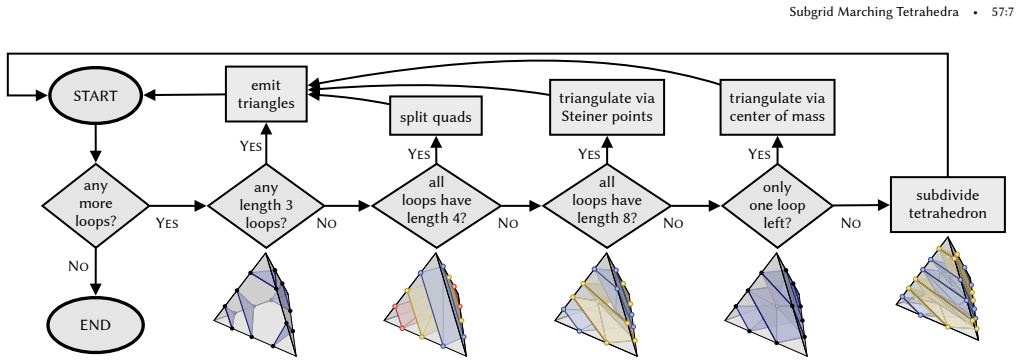
The paper claims that surface connectivity inside each tetrahedron is uniquely determined by arbitrary integer intersection counts on its six edges, via a generalization of normal coordinates from geometric topology. This determines a manifold, intersection-free triangulation without reference to a global inside/outside function or consistent input orientations, while still guaranteeing that the output meshes match across shared tet faces.
Load-bearing premise
Integer intersection counts on the edges of a tetrahedron are sufficient to determine a unique manifold surface connectivity inside it without ambiguity or extra global information.
Editorial extensions
If this is right
- Arbitrarily many disconnected surface patches can be recovered inside a single tetrahedron.
- Thin sheets and features smaller than the grid spacing are captured without adaptive refinement.
- Reconstruction works on surfaces with boundary and on inconsistently oriented input geometry.
- The output is always a manifold, intersection-free triangle mesh that conforms across cell boundaries.
- For equal grid resolution or equal triangle count, the meshes are more accurate than those from classic marching cubes or tets.
Reading between the lines
- The same count-based encoding might convert arbitrary polygon-soup geometry directly into clean manifold meshes.
- Similar integer encodings could extend to other grid-based tasks such as extracting curve networks or higher-dimensional isosurfaces.
- Because the method is strictly local, it could be combined with parallel processing or out-of-core techniques for very large grids.
Signed reviews
Editorial analysis
A structured set of objections, weighed in public.
Referee Report
Summary. The paper introduces a subgrid marching tetrahedra method for extracting manifold, intersection-free triangle meshes from edge piercing points on a tetrahedral grid. It generalizes normal coordinates from geometric topology to encode surface connectivity via arbitrary non-negative integer intersection counts per grid edge, claiming this allows arbitrarily many patches per cell (bypassing Nyquist limits), handles surfaces with boundary and unoriented input, and supports fully local per-tet reconstruction that produces conforming meshes.
Significance. If the local reconstruction from generalized normal coordinates is shown to be correct and unique, the result would be significant for isosurface extraction, mesh repair, and geometry processing by enabling sub-cell feature resolution on fixed grids with a topology-grounded, parameter-free encoding. The explicit connection to normal surface theory is a strength, as is the retention of locality and parallelism from classic marching methods.
major comments (2)
- [§3] §3 (reconstruction from generalized normal coordinates): The central claim that arbitrary integer edge counts uniquely determine a manifold, intersection-free surface inside each tet (without orientation or global data) is load-bearing but rests on an unstated local solver. Normal surface theory requires matching equations across faces and additional constraints to rule out intersections or non-manifold configurations; the manuscript must supply either a formal argument that the per-tet solver enforces these properties from counts alone or explicit validation that no ambiguous realizations exist.
- [Abstract, §4] Abstract and §4 (empirical claims): The statement that meshes are 'far more accurate' than classic marching for equal grid resolution or triangle count is central to the practical contribution but lacks cited quantitative metrics, error tables, or baseline comparisons in the provided description; this must be supported with specific results to substantiate the accuracy advantage.
minor comments (2)
- [§2] Notation for generalized normal coordinates should be defined with an explicit example (e.g., a single tet with sample counts) to clarify how the six edge integers map to triangle patches.
- [§3] The manuscript should include pseudocode or a clear algorithmic outline for the per-tet solver to make the method reproducible.
Simulated Author's Rebuttal
We thank the referee for the constructive and insightful comments. We address each major comment below with point-by-point responses, including commitments to revisions that strengthen the presentation without altering the core contributions.
read point-by-point responses
-
Referee: [§3] §3 (reconstruction from generalized normal coordinates): The central claim that arbitrary integer edge counts uniquely determine a manifold, intersection-free surface inside each tet (without orientation or global data) is load-bearing but rests on an unstated local solver. Normal surface theory requires matching equations across faces and additional constraints to rule out intersections or non-manifold configurations; the manuscript must supply either a formal argument that the per-tet solver enforces these properties from counts alone or explicit validation that no ambiguous realizations exist.
Authors: The local solver is presented in §3, where generalized normal coordinates (arbitrary non-negative integer counts on the six edges) are used to enumerate and select valid patch configurations inside the tetrahedron. Because reconstruction is strictly local to one tet and the grid edges are fixed, the counts alone suffice to determine connectivity and prevent intersections or non-manifold junctions by construction; global matching equations are not required. That said, we acknowledge the referee’s point that an explicit formal argument or validation would make the claim more robust. We will therefore add a concise proof sketch plus a small set of exhaustive enumeration examples for representative count combinations in the revised §3, confirming uniqueness and manifold properties. revision: yes
-
Referee: [Abstract, §4] Abstract and §4 (empirical claims): The statement that meshes are 'far more accurate' than classic marching for equal grid resolution or triangle count is central to the practical contribution but lacks cited quantitative metrics, error tables, or baseline comparisons in the provided description; this must be supported with specific results to substantiate the accuracy advantage.
Authors: The accuracy advantage is illustrated qualitatively in §4 through examples that capture sub-grid features impossible under classic marching. We agree that quantitative support is needed to substantiate the abstract claim. In the revision we will insert error tables in §4 reporting Hausdorff distance, mean surface error, and RMS error against ground-truth surfaces, for both equal grid resolution and equal output triangle count, with direct side-by-side numbers versus classic marching tetrahedra. These additions will be referenced from the abstract. revision: yes
Circularity Check
No significant circularity; derivation builds on external normal surface theory
full rationale
The paper presents its core contribution as a generalization of normal coordinates from geometric topology (an external body of work) to arbitrary integer edge intersection counts, enabling local per-tet reconstruction without inside/outside or orientation assumptions. No quoted equations, definitions, or steps in the manuscript reduce the claimed uniqueness or reconstruction procedure to a self-referential fit, a renamed input, or a load-bearing self-citation chain. The method is described as directly following from the integer counts and the topological generalization, remaining self-contained against external benchmarks rather than forcing predictions by construction. This is the expected honest non-finding for a paper whose central premise rests on established external mathematics.
Assumptions & free parameters
assumptions (1)
- domain assumption Input data consists of points where a continuous surface pierces the edges of a tetrahedral grid.
invented entities (1)
-
Generalized normal coordinates
Cite this review
Pith. "Pith review of Subgrid Marching Tetrahedra." pith.science (2026). https://pith.science/paper/4KPQJIGU
@misc{pith2026260600454,
  author       = {Pith},
  title        = {Pith review of: Subgrid Marching Tetrahedra},
  year         = {2026},
  howpublished = {\url{https://pith.science/paper/4KPQJIGU}},
  note         = {Machine review of arXiv:2606.00454}
}
read the original abstract
We describe a method for recovering a manifold, intersection-free triangle mesh from the points where edges of a tetrahedral grid pierce a continuous surface. Unlike classic marching cubes or tets, our subgrid marching scheme allows arbitrarily many surface patches within a single cell, capturing fine features and thin sheets. Moreover, it requires neither a well-defined inside/outside (allowing surfaces with boundary), nor consistently-oriented input geometry. Yet we retain the local, parallel nature of classic marching: reconstruction is performed independently per tet, yielding a conforming mesh across tet boundaries. Our key innovation is a generalization of normal coordinates from geometric topology, which encode surface connectivity via arbitrary integer intersection counts along each grid edge. This encoding sidesteps the usual Nyquist--Shannon limit, putting no lower bound on the size of features that can be resolved on a fixed grid. In practice, for similar compute time and equal grid resolution -- or even an equal number of output triangles -- meshes produced by subgrid marching are far more accurate than those from classic marching. Beyond standard contouring, our method can be used to convert polygon soup into a manifold, intersection-free mesh.
Figures


Figures from the paper (22 more)




Reference graph
Works this paper leans on
-
[1]
TetWeave: Isosurface Extraction using On-The-Fly Delaunay Tetrahedral Grids for Gradient-Based Mesh Optimization.ACM Transactions on Graphics (TOG) 44, 4 (2025), 1–19. doi:10.1145/3730851 ACM Trans. Graph., Vol. 45, No. 4, Article 57. Publication date: July 2026. Subgrid Marching Tetrahedra•57:13 ground truth subgrid marchingclassic marching classic dual ...
-
[2]
Digital Twin Catalog: A Large-Scale Photorealistic 3D Object Digital Twin Dataset. InProceedings of the IEEE/CVF Conference on Computer Vision and Pattern Recognition (CVPR). 753–763. doi:10.1109/CVPR52734.2025.00079 Laura Downs, Anthony Francis, Nate Koenig, Brandon Kinman, Ryan Hickman, Krista Reymann, Thomas B McHugh, and Vincent Vanhoucke. 2022. Googl...
-
[3]
In: 2022 IEEE/CVF Conference on Computer Vision and Pat- tern Recognition (CVPR)
DeepCurrents: Learning Implicit Representations of Shapes with Boundaries. InProceedings of the IEEE/CVF Conference on Computer Vision and Pattern Recognition (CVPR). 18665–18675. doi:10.1109/CVPR52688.2022.01811 Ulrich Pinkall and Konrad Polthier. 1993. Computing discrete minimal surfaces and their conjugates.Experimental Mathematics2, 1 (1993), 15–36. d...
-
[4]
Proceedings.IEEE, 70–76. doi:10.1109/PCCGA.2004.1348336 Nicholas Sharp, Mark Gillespie, and Keenan Crane. 2021. Geometry Processing with Intrinsic Triangulations. InACM SIGGRAPH 2021 Courses (SIGGRAPH ’21). ACM, 79 pages. https://nmwsharp.com/media/papers/int-tri-course/int_tri_course.pdf Nicholas Sharp and Alec Jacobson. 2022. Spelunking the Deep: Guaran...
Reviewed June 28, 2026 · model on record in the stance chip above.
Discussion (0). Continue with ORCID to comment.