Maximizing Compute Capacity in AI Data Centers through Cooling, Energy Storage, and Computing Adaptation
Pith reviewed 2026-06-28 18:14 UTC · model grok-4.3
The pith
ComputeAmp uses dynamic coordination of cooling, batteries, and compute throttling to run more servers under a fixed site power limit.
A machine-rendered reading of the paper's core claim, the machinery that carries it, and where it could break.
Core claim
ComputeAmp is a framework that maximizes compute capacity by jointly and dynamically leveraging cooling, battery energy storage, and computing-based adaptation, expanding usable compute capacity within local power and water resource limits.
What carries the argument
ComputeAmp framework for joint dynamic management of cooling power demand, battery energy storage, and compute adaptation.
If this is right
- Compute systems can be sized larger than the conservative peak-cooling rule without new power infrastructure.
- Battery discharge during hot periods offsets cooling spikes while compute throttling prevents overload.
- Water consumption stays within limits because the method avoids increasing peak cooling equipment size.
- Operational algorithms must solve a joint optimization over time-varying cooling, storage state, and compute load.
Where Pith is reading between the lines
- The same joint-control idea could extend to sites with on-site solar by aligning battery charge cycles with both temperature and solar output.
- If cooling systems include evaporative options, the framework might further reduce water draw by shifting load timing.
- Longer battery duration would be needed if heat waves last multiple days rather than hours.
Load-bearing premise
Cooling power demand increases substantially and predictably with ambient temperature during recurring multi-hour periods, creating exploitable variation.
What would settle it
A site-level measurement showing that total power still exceeds capacity during summer peaks even after applying the joint cooling-storage-compute schedule, or that average daily compute throughput does not increase.
Figures
read the original abstract
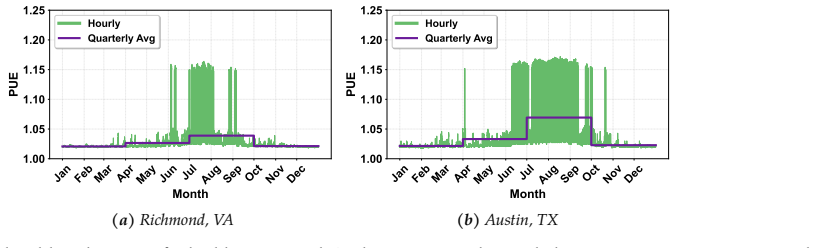
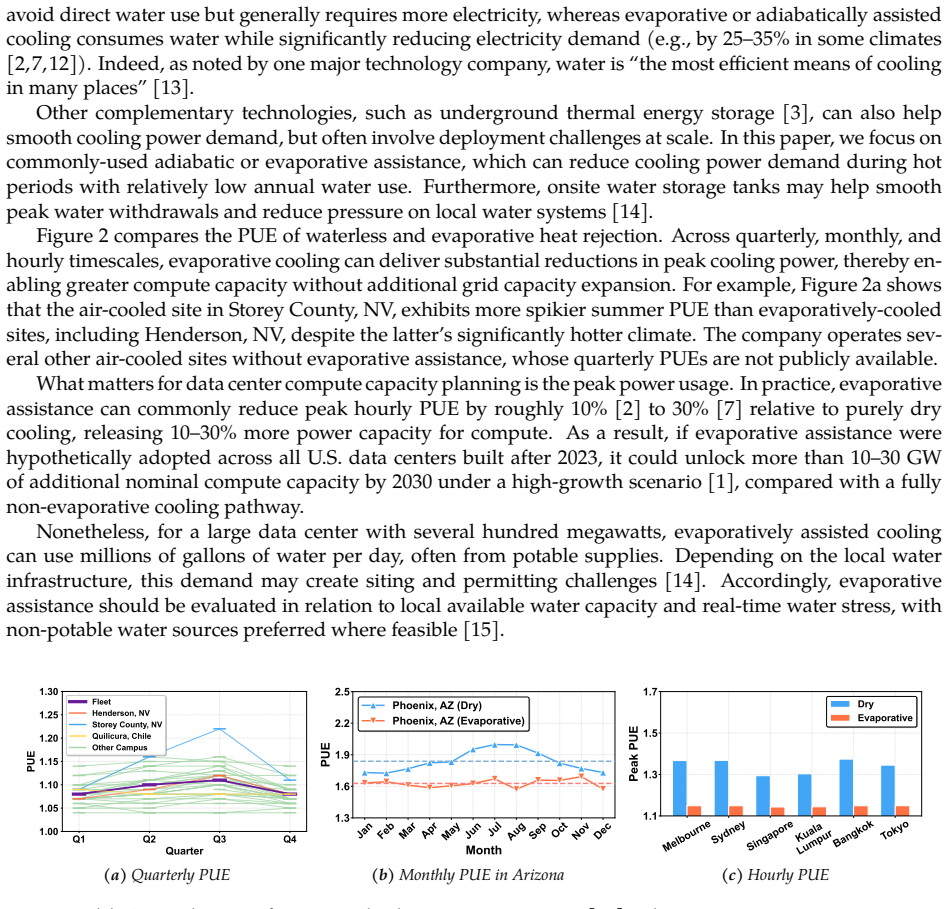
The deployment of artificial intelligence is increasingly constrained by limited site-level power capacity, which must support both compute systems and non-compute systems (primarily cooling) at all times. Cooling power demand, especially in non-evaporative cooling systems, can increase substantially with ambient temperature in the summer, producing recurring periods of elevated cooling power that often lasts for multiple hours per day. Therefore, maximizing compute capacity under a limited site-level power budget is an important planning and operational challenge. Sizing the compute system conservatively based on peak cooling power can leave part of the site-level power capacity underutilized when the cooling power is below its peak, particularly in cooler months. On the other hand, sizing the compute system aggressively based on low cooling power can cause the total site-level power demand to exceed the site-level power capacity during hot days in the summer. This paper proposes ComputeAmp (Compute Amplifier), a framework that maximizes the compute capacity by jointly and dynamically leveraging cooling, battery energy storage, and computing-based adaptation. We discuss the opportunities and limitations of ComputeAmp and illustrate its potential to significantly expand usable compute capacity within local power and water resource limits. We also present a problem formulation for ComputeAmp and highlight a few algorithmic and operational challenges.
Editorial analysis
A structured set of objections, weighed in public.
Referee Report
Summary. The paper proposes ComputeAmp, a conceptual framework to maximize usable compute capacity in AI data centers under fixed site-level power limits. It identifies recurring multi-hour periods of elevated cooling power demand driven by ambient temperature in non-evaporative systems, notes the resulting under-utilization or risk of overload depending on conservative vs. aggressive compute sizing, and advocates joint dynamic management of cooling, battery energy storage, and compute adaptation. The manuscript discusses opportunities and limitations, presents a high-level optimization problem formulation, and flags algorithmic and operational challenges, while claiming potential for significant capacity expansion within local power and water constraints.
Significance. If the joint optimization approach can be shown to deliver net gains after battery round-trip losses, adaptation overhead, and water constraints, it would address a practical bottleneck in AI infrastructure scaling. The core insight—that temperature-driven cooling variation creates exploitable slack that storage and compute throttling can arbitrage—is plausible and timely given rising data-center power densities, but the manuscript supplies no quantitative evidence, solved instances, or sensitivity analysis to establish the magnitude of the claimed expansion.
major comments (3)
- [Abstract and opportunities/limitations discussion] The central claim that ComputeAmp can 'significantly expand usable compute capacity' rests on the unverified premise that multi-hour cooling-power variation is both predictable and large enough to be arbitraged by storage and adaptation without net loss; the manuscript provides no data, model, or bound on this variation (e.g., no temperature-to-power curves or site measurements).
- [Problem formulation section] The problem formulation is described only at a narrative level; no explicit objective function, decision variables, or constraint set (e.g., power-balance equations coupling cooling, battery SOC, and compute throttling) appears, preventing assessment of whether the stated joint optimization is well-posed or tractable.
- [Entire manuscript] No simulation, trace-driven evaluation, or even stylized numerical example is supplied to quantify capacity gain, battery cycling cost, or water-use impact, so the 'potential to significantly expand' assertion cannot be evaluated.
minor comments (2)
- [Framework description] Notation for the three levers (cooling, storage, compute adaptation) is introduced informally; consistent symbols and a small table of variables would improve readability.
- [Abstract] The abstract states that the approach operates 'within local power and water resource limits' yet the water constraint is never formalized or discussed quantitatively.
Simulated Author's Rebuttal
We thank the referee for the constructive feedback. The comments correctly identify that the manuscript is a high-level conceptual proposal without quantitative backing or a fully specified optimization model. We agree these elements are needed to substantiate the claims and will revise the paper to address them.
read point-by-point responses
-
Referee: [Abstract and opportunities/limitations discussion] The central claim that ComputeAmp can 'significantly expand usable compute capacity' rests on the unverified premise that multi-hour cooling-power variation is both predictable and large enough to be arbitraged by storage and adaptation without net loss; the manuscript provides no data, model, or bound on this variation (e.g., no temperature-to-power curves or site measurements).
Authors: We agree that the manuscript supplies no site-specific measurements or explicit temperature-to-power curves. The discussion relies on the general, well-documented relationship between ambient temperature and cooling power in non-evaporative systems. In revision we will add representative curves drawn from public data-center cooling literature together with simple bounds on the magnitude and duration of the variation to make the premise explicit and falsifiable. revision: yes
-
Referee: [Problem formulation section] The problem formulation is described only at a narrative level; no explicit objective function, decision variables, or constraint set (e.g., power-balance equations coupling cooling, battery SOC, and compute throttling) appears, preventing assessment of whether the stated joint optimization is well-posed or tractable.
Authors: We accept that the formulation remains narrative. The revision will present an explicit optimization problem that defines the objective (maximize time-averaged compute capacity), the decision variables (cooling set-points, battery charge/discharge schedule, compute throttling factors), and the key constraints (site-level power balance, battery SOC dynamics, cooling-power dependence on temperature and compute load). revision: yes
-
Referee: [Entire manuscript] No simulation, trace-driven evaluation, or even stylized numerical example is supplied to quantify capacity gain, battery cycling cost, or water-use impact, so the 'potential to significantly expand' assertion cannot be evaluated.
Authors: We agree that no numerical evaluation of any kind is provided. The current manuscript is positioned as a framework proposal. In the revised version we will include a stylized numerical example that solves the formulated problem over a multi-day temperature trace, reports net capacity gain after round-trip battery losses and adaptation overhead, and notes water-use implications under the stated constraints. revision: yes
Circularity Check
No circularity: conceptual framework with optimization formulation only
full rationale
The paper presents a high-level proposal for ComputeAmp as a joint optimization framework over cooling, storage, and compute adaptation. It formulates an optimization problem and discusses opportunities/limitations but contains no equations, fitted parameters, predictions, or derivations that reduce to their own inputs by construction. No self-citations are load-bearing for any uniqueness claim, and the central premise rests on the observable physical variation in cooling power rather than any self-referential step. The derivation chain is therefore self-contained as a planning/operational model without circular reduction.
Axiom & Free-Parameter Ledger
Reference graph
Works this paper leans on
-
[1]
Powering intelligence 2026: Updated scenarios of U.S
EPRI. Powering intelligence 2026: Updated scenarios of U.S. data center electricity use and power strategies.Technical Report, 2026
2026
-
[2]
Van Zetten, Michael E
Jeffrey D. Van Zetten, Michael E. Cholette, and Keivan Bamdad. Energy and carbon savings in data cen- tres through liquid-to-chip cooling with differential temperature control.Advances in Applied Energy, 22:100269, 2026
2026
-
[3]
Wedan Emmanuel Gnibga and Andrew A. Chien. Datacenter cooling with cold underground thermal energy storage: Environmental and economic values. Ine-Energy, 2026
2026
-
[4]
Smith, Alex Hubbard, Alex Newkirk, Nuoa Lei, Md Abu Bakar Siddik, Billie Holecek, Jonathan Koomey, Eric Masanet, and Dale Sartor
Arman Shehabi, Sarah J. Smith, Alex Hubbard, Alex Newkirk, Nuoa Lei, Md Abu Bakar Siddik, Billie Holecek, Jonathan Koomey, Eric Masanet, and Dale Sartor. 2024 United States data center energy usage report.Lawrence Berkeley National Laboratory LBNL-2001637, December 2024
2024
-
[5]
M. A. Islam, Xiaoqi Ren, Shaolei Ren, Adam Wierman, and Xiaorui Wang. A market approach for handling power emergencies in multi-tenant data center. InHPCA, 2016
2016
-
[6]
Flexible data centers: A faster, more affordable path to power
Carlo Brancucci, Dylan Cutler, and Jesse Jenkins. Flexible data centers: A faster, more affordable path to power. Technical report, Camus, Encoord, and Princeton ZERO Lab, December 2025
2025
-
[7]
The energy and water use impacts of building system design for data centers: Design considerations for Oregon and Washington.PAE Technical Report, February 2025
Karina Hershberg, Ben Burnett, Jonathan Roraff, Paula Hopker, and Marc Brune. The energy and water use impacts of building system design for data centers: Design considerations for Oregon and Washington.PAE Technical Report, February 2025
2025
-
[8]
Google. Google response to the consultation on the establishment of a common EU rating scheme for data centres.https://ec.europa.eu/info/law/better-regulation/have-your-say/ initiatives/16035-Energy-efficiency-rating-scheme-for-data-centres-in-Europe/ F33395555_en, April 2026
2026
-
[9]
Beyond PUE: Rethinking efficient data center design in an era of power scarcity
Verrus Data Centers. Beyond PUE: Rethinking efficient data center design in an era of power scarcity. Technical Report, 2025. White paper
2025
-
[10]
Tran, Dai H
Nguyen H. Tran, Dai H. Tran, Shaolei Ren, Zhu Han, and Eui-Nam Huh; Choong Seon Hong. How geo-distributed data centers do demand response: A game-theoretic approach.IEEE Transactions on Smart Grid, pp(99), May 2015
2015
-
[11]
Drought Monitor.https://droughtmonitor.unl.edu/CurrentMap.aspx
U.S. Drought Monitor.https://droughtmonitor.unl.edu/CurrentMap.aspx
-
[12]
Amazon to invest$12 billion in first data center campuses in Louisiana.https://www
Amazon. Amazon to invest$12 billion in first data center campuses in Louisiana.https://www. aboutamazon.com/news/company-news/amazon-data-center-louisiana-new-jobs, February 2026
2026
-
[13]
Environmental report.https://www.gstatic.com/gumdrop/sustainability/ google-2025-environmental-report.pdf, 2025
Google. Environmental report.https://www.gstatic.com/gumdrop/sustainability/ google-2025-environmental-report.pdf, 2025
2025
-
[14]
Yuelin Han, Pengfei Li, Adam Wierman, and Shaolei Ren. Small bottle, big pipe: Quantifying and addressing the impact of data centers on public water systems.arXiv:2603.02705, 2026. 10
-
[15]
U.S. EPA. Water reuse action plan 2.0.https://www.epa.gov/waterreuse/ water-reuse-action-plan-20, 2026
2026
-
[16]
Growing the Internet While Reducing Energy Consumption.https://datacenters.google/ efficiency/
Google. Growing the Internet While Reducing Energy Consumption.https://datacenters.google/ efficiency/
-
[17]
Hickenbottom
Leila Karimi, Leeann Yacuel, Joseph Degraft-Johnson, Jamie Ashby, Michael Green, Matt Renner, Aryn Bergman, Robert Norwood, and Kerri L. Hickenbottom. Water-energy tradeoffs in data centers: A case study in hot-arid climates.Resources, Conservation and Recycling, 181:106194, 2022
2022
-
[18]
Esha Choukse, Brijesh Warrier, Scot Heath, Luz Belmont, April Zhao, Hassan Ali Khan, Brian Harry, Matthew Kappel, Russell J. Hewett, Kushal Datta, Yu Pei, Caroline Lichtenberger, John Siegler, David Lukofsky, Zaid Kahn, Gurpreet Sahota, Andy Sullivan, Charles Frederick, Hien Thai, Rebecca Naughton, Daniel Jurnove, Justin Harp, Reid Carper, Nithish Mahalin...
2025
-
[19]
Power provisioning for a warehouse-sized computer
Xiaobo Fan, Wolf-Dietrich Weber, and Luiz Andre Barroso. Power provisioning for a warehouse-sized computer. InISCA, 2007
2007
-
[20]
Opportunities and challenges for data center demand response
Adam Wierman, Zhenhua Liu, Iris Liu, and Hamed Mohsenian-Rad. Opportunities and challenges for data center demand response. InIGCC, 2014
2014
-
[21]
A truthful incentive mechanism for emer- gency demand response in colocation data centers
Linquan Zhang, Shaolei Ren, Chuan Wu, and Zongpeng Li. A truthful incentive mechanism for emer- gency demand response in colocation data centers. InINFOCOM, 2015
2015
-
[22]
Impact of charging rates on electric vehicle battery life.Findings, 2021(March), 2021
Sivapriya Mothilal Bhagavathy, Hannah Budnitz, Tim Schwanen, and Malcolm McCulloch. Impact of charging rates on electric vehicle battery life.Findings, 2021(March), 2021
2021
-
[23]
Islam, Kishwar Ahmed, Hong Xu, Nguyen H
Mohammad A. Islam, Kishwar Ahmed, Hong Xu, Nguyen H. Tran, Gang Quan, and Shaolei Ren. Exploiting spatio-temporal diversity for water saving in geo-distributed data centers.IEEE Transactions on Cloud Computing, 6(3):734–746, 2018
2018
-
[24]
Flexible cooling for AI growth: How zonal architecture supports diverse hardware needs
Microsoft. Flexible cooling for AI growth: How zonal architecture supports diverse hardware needs. Microsoft Azure Architecture Blog, April 2026
2026
-
[25]
Robust learning for smoothed online convex optimization with feedback delay
Pengfei Li, Jianyi Yang, Adam Wierman, and Shaolei Ren. Robust learning for smoothed online convex optimization with feedback delay. InNeurIPS, 2023
2023
-
[26]
Optimal robustness-consistency trade-offs for learning-augmented online algorithms
Alexander Wei and Fred Zhang. Optimal robustness-consistency trade-offs for learning-augmented online algorithms. InNeurIPS, 2020
2020
-
[27]
A regression approach to learning- augmented online algorithms
Keerti Anand, Rong Ge, Amit Kumar, and Debmalya Panigrahi. A regression approach to learning- augmented online algorithms. In A. Beygelzimer, Y. Dauphin, P. Liang, and J. Wortman Vaughan, editors,Advances in Neural Information Processing Systems, 2021
2021
-
[28]
Sutton and Andrew G
Richard S. Sutton and Andrew G. Barto.Reinforcement Learning: An Introduction. MIT Press, 2018. 11
2018
discussion (0)
Sign in with ORCID, Apple, or X to comment. Anyone can read and Pith papers without signing in.