An explainable hierarchical self attention-based approach for tremor detection in the time domain
Pith reviewed 2026-06-28 19:15 UTC · model grok-4.3
The pith
A two-stage neural network detects tremor directly from time-series motion data across body parts without frequency features.
A machine-rendered reading of the paper's core claim, the machinery that carries it, and where it could break.
Core claim
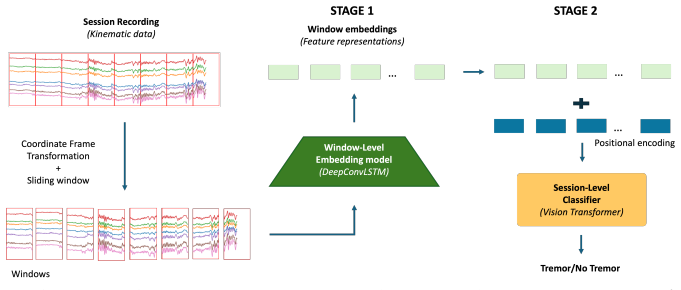
The authors demonstrate a proof-of-concept hierarchical framework that combines a convolutional and LSTM network to learn tremor representations from short, discrete, non-overlapping time segments of kinematic time-series data, followed by a vision transformer that models the long-term temporal dynamics of those segment features for trial-level classification, while attention weights and gradient-based class activation maps provide post-hoc interpretability of the learned time-domain patterns across anatomically diverse body parts.
What carries the argument
Hierarchical self-attention model that uses a CNN-LSTM encoder on discrete time segments followed by a vision transformer for sequence-level classification and attention-based explanation.
Load-bearing premise
Short, discrete, non-overlapping time segments of kinematic time series data contain enough information for the CNN-LSTM to learn tremor representations that the vision transformer can reliably classify at the trial level.
What would settle it
Evaluating the identical trained model on continuous or overlapping kinematic time series instead of the discrete non-overlapping segments and checking whether trial-level F1 scores drop substantially below the reported range.
Figures
read the original abstract
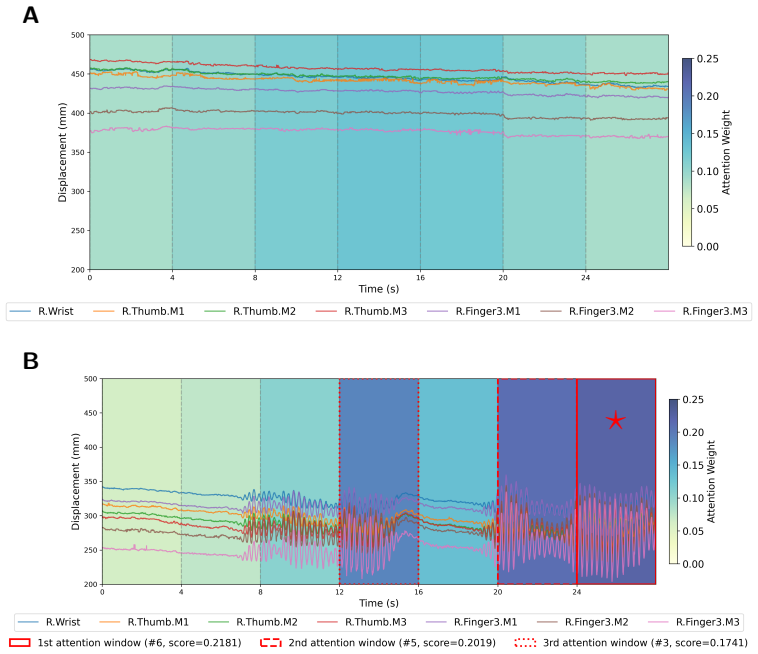
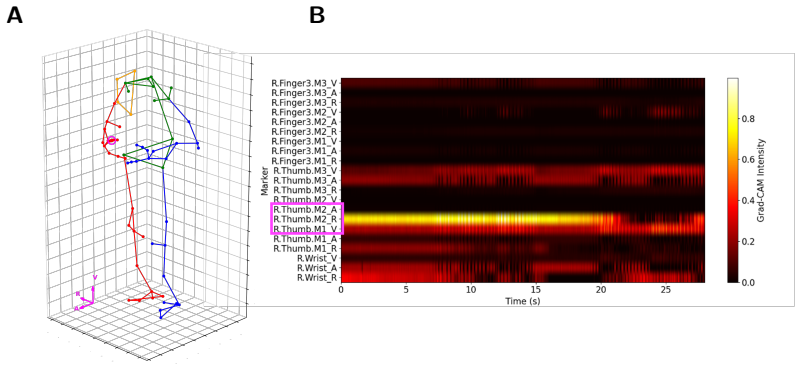
Tremor is a common movement disorder associated with conditions like Parkinson's disease and Essential tremor, traditionally diagnosed through expert clinician assessment. Current automated detection methods rely on frequency-domain features informed by clinical expertise. In this work, we present an explainable, two-stage hierarchical framework for tremor detection in the time domain that learns tremor patterns directly from 3D kinematic marker time-series data across entire tremor-provoking trials. Our framework combined a deep convolutional and long short-term memory network to learn tremor representations from short, discrete, non-overlapping time segments of kinematic time series data from trials, which are then processed by a vision transformer that models their long-term temporal dynamics of time segment features for trial (session) level classification. Evaluated across nine body parts, the framework achieved F1-scores of 0.594 - 0.947 depending on body parts (average: 0.765), falling short of the frequency-domain state-of-the-art performance (0.909) while requiring minimal preprocessing. Attention weights and gradient-based class activation maps (Grad-CAM) identified time-domain features of tremor across body parts. This proof of concept demonstrated the feasibility of data-driven time-domain modeling for tremor detection across anatomically diverse body parts, while reducing reliance on expert-engineered spectral features and providing posthoc interpretability of temporal and anatomical patterns of tremor.
Editorial analysis
A structured set of objections, weighed in public.
Referee Report
Summary. The paper presents a two-stage hierarchical model for tremor detection from 3D kinematic time-series data: a CNN-LSTM extracts representations from short, discrete, non-overlapping time segments, which are then fed to a Vision Transformer to model long-term dynamics for trial-level classification. The approach is evaluated across nine body parts, reports F1 scores of 0.594–0.947 (average 0.765), and uses attention weights plus Grad-CAM for post-hoc interpretability, positioning it as a data-driven time-domain alternative to frequency-domain methods that requires minimal preprocessing.
Significance. If the experimental details and validation hold, the work provides a proof-of-concept for purely time-domain tremor modeling across anatomically diverse sites with built-in explainability, reducing dependence on expert spectral features. The hierarchical design and use of attention maps for identifying temporal/anatomical patterns are strengths, though the reported performance remains below the cited frequency-domain SOTA (0.909).
major comments (3)
- [Abstract] Abstract: The reported F1 scores and comparison to frequency-domain SOTA are presented without any information on dataset size (subjects, trials, or total samples), cross-validation scheme, hyperparameter selection, or statistical testing. These omissions make it impossible to assess whether the central claim of feasible time-domain detection is supported by reliable evidence.
- [Abstract] Abstract: No segment duration, sampling rate, or overlap strategy is specified for the short non-overlapping time segments processed by the CNN-LSTM. This detail is load-bearing for the claim that the model learns tremor representations directly in the time domain, because segments shorter than a typical tremor half-cycle (∼40–125 ms at 4–12 Hz) would prevent local convolutions from observing periodicity.
- [Abstract] Abstract: The manuscript states that the framework “achieved F1-scores of 0.594–0.947 depending on body parts” yet provides no per-body-part breakdown, ablation on segment length, or comparison against a time-domain baseline that would isolate the contribution of the hierarchical ViT stage.
Simulated Author's Rebuttal
We thank the referee for the constructive feedback on the abstract and the overall framing of our work. We address each major comment below and will make revisions to improve clarity and completeness where the manuscript can be strengthened without new experiments.
read point-by-point responses
-
Referee: [Abstract] Abstract: The reported F1 scores and comparison to frequency-domain SOTA are presented without any information on dataset size (subjects, trials, or total samples), cross-validation scheme, hyperparameter selection, or statistical testing. These omissions make it impossible to assess whether the central claim of feasible time-domain detection is supported by reliable evidence.
Authors: We agree the abstract would be strengthened by including these details. The full manuscript (Methods and Results sections) reports the dataset (subjects, trials, total samples), 5-fold cross-validation, hyperparameter tuning via grid search, and statistical comparisons. We will revise the abstract to concisely incorporate dataset size, validation scheme, and note on statistical testing to allow readers to assess reliability directly from the abstract. revision: yes
-
Referee: [Abstract] Abstract: No segment duration, sampling rate, or overlap strategy is specified for the short non-overlapping time segments processed by the CNN-LSTM. This detail is load-bearing for the claim that the model learns tremor representations directly in the time domain, because segments shorter than a typical tremor half-cycle (∼40–125 ms at 4–12 Hz) would prevent local convolutions from observing periodicity.
Authors: This is a valid observation; the abstract does not specify these parameters. The full manuscript (Methods) details the sampling rate of the kinematic data and the chosen segment length with no overlap. We will add a brief statement on segment duration and sampling rate to the abstract to support the time-domain claim and address the periodicity concern. revision: yes
-
Referee: [Abstract] Abstract: The manuscript states that the framework “achieved F1-scores of 0.594–0.947 depending on body parts” yet provides no per-body-part breakdown, ablation on segment length, or comparison against a time-domain baseline that would isolate the contribution of the hierarchical ViT stage.
Authors: Per-body-part F1 scores are reported in the Results section and Table 1 of the full manuscript. We will revise the abstract to reference these detailed results. Ablation on segment length and an explicit time-domain baseline comparison are not present in the current manuscript; adding them would require additional experiments. We can note the hierarchical design rationale in the abstract but cannot provide new ablations without further work. revision: partial
Circularity Check
No circularity: empirical ML pipeline with no derivations or self-referential fits
full rationale
The paper presents a standard two-stage CNN-LSTM + ViT architecture trained end-to-end on kinematic time-series segments for binary classification, followed by post-hoc attention visualization. No equations, parameters, or uniqueness claims are defined in terms of the target outputs; performance metrics (F1 scores) are reported from held-out evaluation rather than being forced by construction from fitted inputs. The central feasibility claim rests on empirical results across body parts, not on any self-definitional loop or load-bearing self-citation. This is a self-contained empirical study with no load-bearing derivation chain to inspect.
Axiom & Free-Parameter Ledger
Reference graph
Works this paper leans on
-
[1]
Consensus Statement on the classification of tremors
Bhatia KP, Bain P, Bajaj N, Elble RJ, Hallett M, Louis ED, et al. Consensus Statement on the classification of tremors. from the task force on tremor of the International Parkinson and Movement Disorder Society. Movement disorders. 2018;33(1):75-87
2018
-
[2]
Consensus statement of the Movement Disorder Society on Tremor
Deuschl G, Bain P, Brin M. Consensus statement of the Movement Disorder Society on Tremor. Ad Hoc Scientific Committee. Movement Disorders. 1998;13(Suppl 3):2-23. doi:10.1002/mds.870131303
-
[3]
Tremor in Medicine and Other Secondary Tremors
Testa CM, Haubenberger D, Patel M, Caughman CY, Factor SA. Tremor in Medicine and Other Secondary Tremors. In: Tremors. Oxford University Press
-
[4]
p. 75-84. Available from: https://doi.org/10.1093/med/9780197529652.003.0007. doi:10.1093/med/9780197529652.003.0007
-
[5]
Continuous assessment of levodopa response in Parkinson’s disease using wearable motion sensors
Pulliam CL, Heldman DA, Brokaw EB, Mera TO, Mari ZK, Burack MA. Continuous assessment of levodopa response in Parkinson’s disease using wearable motion sensors. IEEE Transactions on Biomedical Engineering. 2017;65(1):159-64. June 2, 2026 15/25
2017
-
[6]
Clinician versus machine: reliability and responsiveness of motor endpoints in Parkinson’s disease
Heldman DA, Espay AJ, LeWitt PA, Giuffrida JP. Clinician versus machine: reliability and responsiveness of motor endpoints in Parkinson’s disease. Parkinsonism & related disorders. 2014;20(6):590-5
2014
-
[7]
The Parkinson pandemic—a call to action
Dorsey ER, Bloem BR. The Parkinson pandemic—a call to action. JAMA neurology. 2018;75(1):9-10
2018
-
[8]
A clinical view on the development of technology-based tools in managing Parkinson’s disease
Maetzler W, Klucken J, Horne M. A clinical view on the development of technology-based tools in managing Parkinson’s disease. Movement Disorders. 2016;31(9):1263-71
2016
-
[9]
Machine Learning in Tremor Analysis: Critique and Directions
De A, Bhatia KP, Volkmann J, Peach R, Schreglmann SR. Machine Learning in Tremor Analysis: Critique and Directions. Movement Disorders. 2023;38(5):717-31. doi:10.1002/mds.29376
-
[10]
Movement Disorder Society-sponsored revision of the Unified Parkinson’s Disease Rating Scale (MDS-UPDRS): scale presentation and clinimetric testing results
Goetz CG, Tilley BC, Shaftman SR, Stebbins GT, Fahn S, Martinez-Martin P, et al. Movement Disorder Society-sponsored revision of the Unified Parkinson’s Disease Rating Scale (MDS-UPDRS): scale presentation and clinimetric testing results. Movement disorders: official journal of the Movement Disorder Society. 2008;23(15):2129-70
2008
-
[11]
The essential tremor rating assessment scale
Elble RJ. The essential tremor rating assessment scale. Journal of Neurology & Neuromedicine. 2016;1(4)
2016
-
[12]
Analysis of hand tremor in parkinson’s disease: Frequency domain approach
Samadi E, Ahmadi H, Rahatabad FN. Analysis of hand tremor in parkinson’s disease: Frequency domain approach. Frontiers in Biomedical Technologies. 2020
2020
-
[13]
Using Frequency Domain Characteristics to Discriminate Physiologic and Parkinsonian Tremors
Beuter A, Edwards R. Using Frequency Domain Characteristics to Discriminate Physiologic and Parkinsonian Tremors. Journal of Clinical Neurophysiology. 1999 9;16(5):484. Available from: http://dx.doi.org/10.1097/00004691-199909000-00010. doi:10.1097/00004691-199909000-00010
-
[14]
Pang Y, Christenson J, Jiang F, Lei T, Rhoades R, Kern D, et al. Automatic detection and quantification of hand movements toward development of an objective assessment of tremor and bradykinesia in Parkinson’s disease. Journal of Neuroscience Methods. 2020 3;333:108576. Available from: http://dx.doi.org/10.1016/j.jneumeth.2019.108576. doi:10.1016/j.jneume...
-
[15]
Quantitative Analysis of Parkinsonian Tremor in a Clinical Setting Using Inertial Measurement Units
Lukˇ sys D, Jonaitis G, Griˇ skeviˇ cius J. Quantitative Analysis of Parkinsonian Tremor in a Clinical Setting Using Inertial Measurement Units. Parkinson’s Disease. 2018 jun 21;2018:1-7. Available from: http://dx.doi.org/10.1155/2018/1683831. doi:10.1155/2018/1683831
-
[16]
Distinguishing the Central Drive to Tremor in Parkinson’s Disease and Essential Tremor
Brittain JS, Cagnan H, Mehta AR, Saifee TA, Edwards MJ, Brown P. Distinguishing the Central Drive to Tremor in Parkinson’s Disease and Essential Tremor. The Journal of Neuroscience. 2015 jan 14;35(2):795-806. Available from: http://dx.doi.org/10.1523/JNEUROSCI.3768-14.2015
-
[17]
Linear and nonlinear tremor acceleration characteristics in patients with Parkinson’s disease
Meigal AY, Rissanen SM, Tarvainen MP, Georgiadis SD, Karjalainen PA, Airaksinen O, et al. Linear and nonlinear tremor acceleration characteristics in patients with Parkinson’s disease. Physiological Measurement. 2012 feb 28;33(3):395-412. Available from: http://dx.doi.org/10.1088/0967-3334/33/3/395. doi:10.1088/0967-3334/33/3/395. June 2, 2026 16/25
-
[18]
Accelerometry to distinguish psychogenic from essential or parkinsonian tremor
Zeuner KE, Shoge RO, Goldstein SR, Dambrosia JM, Hallett M. Accelerometry to distinguish psychogenic from essential or parkinsonian tremor. Neurology. 2003;61(4):548-50. doi:10.1212/01.wnl.0000076183.34915.cd
-
[19]
Development of a Tremor Detection Algorithm for Use in an Academic Movement Disorders Center
Mark Saad, Hefner S, Donovan S, Bernhard D, Tripathi R, Factor SA, et al. Development of a Tremor Detection Algorithm for Use in an Academic Movement Disorders Center. Sensors. 2024;24(15):4960. doi:10.3390/s24154960
-
[20]
Validation and application of computer vision algorithms for video-based tremor analysis
Friedrich MU, Roenn AJ, Palmisano C, Alty J, Paschen S, Deuschl G, et al. Validation and application of computer vision algorithms for video-based tremor analysis. npj Digital Medicine. 2024;7:165. doi:10.1038/s41746-024-01153-1
-
[21]
Transducer-Based Evaluation of Tremor
Haubenberger D, Abbruzzese G, Bain P, Bajaj N, Benito-Le´ on J, Bhatia K, et al. Transducer-Based Evaluation of Tremor. Movement Disorders. 2016;31(9):1327-36. doi:10.1002/mds.26649
-
[22]
Introduction to Random Signals and Applied Kalman Filtering: With MATLAB Exercises and Solutions
Brown RG, Hwang PYC. Introduction to Random Signals and Applied Kalman Filtering: With MATLAB Exercises and Solutions. 3rd ed. Wiley; 1997
1997
-
[23]
Probability and Stochastic Processes: A Friendly Introduction for Electrical and Computer Engineers
Yates RD, Goodman DJ. Probability and Stochastic Processes: A Friendly Introduction for Electrical and Computer Engineers. 4th ed. John Wiley & Sons; 2025
2025
-
[24]
High-accuracy automatic classification of Parkinsonian tremor severity using machine learning method
Jeon H, Lee W, Park H, Lee HJ, Kim SK, Kim HB, et al. High-accuracy automatic classification of Parkinsonian tremor severity using machine learning method. Physiological measurement. 2017;38(11):1980
2017
-
[25]
Savitzky-golay smoothing and differentiation filter
Gallagher NB. Savitzky-golay smoothing and differentiation filter. Eigenvector Research Incorporated. 2020
2020
-
[26]
WaveTremor: Tremor Detection for Parkinson’s Disease via Spatial-Temporal Learning
Chen X, Koltermann K, Clapham J, Blackwell G, Cloud L, Pretzer-Aboff I, et al. WaveTremor: Tremor Detection for Parkinson’s Disease via Spatial-Temporal Learning. In: Proceedings of the ACM/IEEE International Conference on Connected Health: Applications, Systems and Engineering Technologies; 2025. p. 309-13
2025
-
[27]
Discrete-time signal processing
Oppenheim AV. Discrete-time signal processing. Pearson Education India; 1999
1999
-
[28]
Tremor analysis in two normal cohorts
Raethjen J, Lauk M, K¨ oster B, Fietzek U, Friege L, Timmer J, et al. Tremor analysis in two normal cohorts. Clinical Neurophysiology. 2004;115(9):2151-6
2004
-
[29]
Tremor classification and tremor time series analysis
Deuschl G, Lauk M, Timmer J. Tremor classification and tremor time series analysis. Chaos: An Interdisciplinary Journal of Nonlinear Science. 1995;5(1):48-51
1995
-
[30]
Cross-spectral analysis of tremor time series
Timmer J, Lauk M, H¨ außler S, Radt V, K¨ oster B, Hellwig B, et al. Cross-spectral analysis of tremor time series. international Journal of Bifurcation and chaos. 2000;10(11):2595-610
2000
-
[31]
IMU Sensing Data-Based Kinetic Tremor Detection in Parkinson’s Disease Patients
Jung W, Koltermann K, Helm N, Blackwell G, Pretzer-Aboff I, Cloud L, et al. IMU Sensing Data-Based Kinetic Tremor Detection in Parkinson’s Disease Patients. In: Proceedings of the 20th ACM Conference on Embedded Networked Sensor Systems; 2022. p. 772-3
2022
-
[32]
WAKE: Wavelet decomposition coupled with adaptive Kalman filtering for pathological tremor extraction
Shahtalebi S, Atashzar SF, Patel RV, Mohammadi A. WAKE: Wavelet decomposition coupled with adaptive Kalman filtering for pathological tremor extraction. Biomedical Signal Processing and Control. 2019;48:179-88. June 2, 2026 17/25
2019
-
[33]
Wrist sensor-based tremor severity quantification in Parkinson’s disease using convolutional neural network
Kim HB, Lee WW, Kim A, Lee HJ, Park HY, Jeon HS, et al. Wrist sensor-based tremor severity quantification in Parkinson’s disease using convolutional neural network. Computers in biology and medicine. 2018;95:140-6
2018
-
[34]
Automatic resting tremor assessment in Parkinson’s disease using smartwatches and multitask convolutional neural networks
Sigcha L, Pav´ on I, Costa N, Costa S, Gago M, Arezes P, et al. Automatic resting tremor assessment in Parkinson’s disease using smartwatches and multitask convolutional neural networks. Sensors. 2021;21(1):291
2021
-
[35]
Parkinson’s disease tremor detection in the wild using wearable accelerometers
San-Segundo R, Zhang A, Cebulla A, Panev S, Tabor G, Stebbins K, et al. Parkinson’s disease tremor detection in the wild using wearable accelerometers. Sensors. 2020;20(20):5817
2020
-
[36]
Bag of samplings for computer-assisted Parkinson’s disease diagnosis based on recurrent neural networks
Ribeiro LC, Afonso LC, Papa JP. Bag of samplings for computer-assisted Parkinson’s disease diagnosis based on recurrent neural networks. Computers in biology and medicine. 2019;115:103477
2019
-
[37]
Wearable Sensors for Estimation of Parkinsonian Tremor Severity during Free Body Movements
Hssayeni MD, Jimenez-Shahed J, Burack MA, Ghoraani B. Wearable Sensors for Estimation of Parkinsonian Tremor Severity during Free Body Movements. Sensors. 2019;19(19). Available from: https://www.mdpi.com/1424-8220/19/19/4215. doi:10.3390/s19194215
-
[38]
PHTNet: Characterization and deep mining of involuntary pathological hand tremor using recurrent neural network models
Shahtalebi S, Atashzar SF, Samotus O, Patel RV, Jog MS, Mohammadi A. PHTNet: Characterization and deep mining of involuntary pathological hand tremor using recurrent neural network models. Scientific reports. 2020;10(1):2195
2020
-
[39]
Deep Convolutional and LSTM Recurrent Neural Networks for Multimodal Wearable Activity Recognition
Ord´ o˜ nez FJ, Roggen D. Deep Convolutional and LSTM Recurrent Neural Networks for Multimodal Wearable Activity Recognition. Sensors. 2016;16(1):115. Available from:https://www.mdpi.com/1424-8220/16/1/115. doi:10.3390/s16010115
-
[40]
Support vector machine
Suthaharan S. Support vector machine. In: Machine learning models and algorithms for big data classification: thinking with examples for effective learning. Springer; 2016. p. 207-35
2016
-
[41]
An image is worth 16x16 words: Transformers for image recognition at scale
Dosovitskiy A. An image is worth 16x16 words: Transformers for image recognition at scale. arXiv preprint arXiv:201011929. 2020
2020
-
[42]
Attention is all you need
Vaswani A, Shazeer N, Parmar N, Uszkoreit J, Jones L, Gomez AN, et al. Attention is all you need. Advances in neural information processing systems. 2017;30
2017
-
[43]
Grad-cam: Visual explanations from deep networks via gradient-based localization
Selvaraju RR, Cogswell M, Das A, Vedantam R, Parikh D, Batra D. Grad-cam: Visual explanations from deep networks via gradient-based localization. In: Proceedings of the IEEE international conference on computer vision; 2017. p. 618-26
2017
-
[44]
The use of fast Fourier transform for the estimation of power spectra: A method based on time averaging over short, modified periodograms
Welch P. The use of fast Fourier transform for the estimation of power spectra: A method based on time averaging over short, modified periodograms. IEEE Transactions on audio and electroacoustics. 1967;15(2):70-3
1967
-
[45]
Position and orientation in space of bones during movement: anatomical frame definition and determination
Cappozzo A, Catani F, Della Croce U, Leardini A. Position and orientation in space of bones during movement: anatomical frame definition and determination. Clinical biomechanics. 1995;10(4):171-8
1995
-
[46]
Pham MH, Elshehabi M, Haertner L, Heger T, Hobert MA, Faber GS, et al. Algorithm for turning detection and analysis validated under home-like conditions in patients with Parkinson’s disease and older adults using a 6 degree-of-freedom inertial measurement unit at the lower back. Frontiers in neurology. 2017;8:135. June 2, 2026 18/25
2017
-
[47]
A tutorial on human activity recognition using body-worn inertial sensors.ACM Comput
Bulling A, Blanke U, Schiele B. A Tutorial on Human Activity Recognition Using Body-Worn Inertial Sensors. ACM Computing Surveys. 2014 January;46(3):1-33. doi:10.1145/2499621
-
[48]
Wearable Assistant for Parkinsons Disease Patients with the Freezing of Gait Symptom
B¨ achlin M, Plotnik M, Roggen D, Maidan I, Hausdorff JM, Giladi N, et al. Wearable Assistant for Parkinsons Disease Patients with the Freezing of Gait Symptom. IEEE Transactions on Information Technology in Biomedicine. 2010 March;14(2):436-46. doi:10.1109/TITB.2009.2036165
-
[49]
Kwon H, Clifford GD, Genias I, Bernhard D, Esper CD, Factor SA, et al. An Explainable Spatial-Temporal Graphical Convolutional Network to Score Freezing of Gait in Parkinsonian Patients. Sensors. 2023 February;23(4). doi:10.3390/s23041766
-
[50]
Nested cross-validation when selecting classifiers is overzealous for most practical applications
Wainer J, Cawley G. Nested cross-validation when selecting classifiers is overzealous for most practical applications. Expert Systems with Applications. 2021;182:115222
2021
-
[51]
Consensus features nested cross-validation
Parvandeh S, Yeh HW, Paulus MP, McKinney BA. Consensus features nested cross-validation. Bioinformatics. 2020;36(10):3093-8
2020
-
[52]
Opitz J, Burst S. Macro F1 and Macro F1. CoRR. 2021;abs/1911.03347. Available from:https://arxiv.org/abs/1911.03347. arXiv:1911.03347. doi:10.48550/arXiv.1911.03347
-
[53]
Show, Attend and Tell: Neural Image Caption Generation with Visual Attention
Xu K, Ba J, Kiros R, Cho K, Courville A, Salakhudinov R, et al. Show, Attend and Tell: Neural Image Caption Generation with Visual Attention. In: Bach F, Blei D, editors. Proceedings of the 32nd International Conference on Machine Learning. vol. 37 of Proceedings of Machine Learning Research. Lille, France: PMLR; 2015. p. 2048-57. Available from: https://...
2015
-
[54]
End-to-end object detection with transformers
Carion N, Massa F, Synnaeve G, Usunier N, Kirillov A, Zagoruyko S. End-to-end object detection with transformers. In: European conference on computer vision. Springer; 2020. p. 213-29
2020
-
[55]
Individual comparisons by ranking methods
Wilcoxon F. Individual comparisons by ranking methods. In: Breakthroughs in statistics: Methodology and distribution. Springer; 1992. p. 196-202
1992
-
[56]
A deep explainable artificial intelligent framework for neurological disorders discrimination
Shahtalebi S, Atashzar SF, Patel RV, Jog MS, Mohammadi A. A deep explainable artificial intelligent framework for neurological disorders discrimination. Scientific reports. 2021;11(1):9630
2021
-
[57]
Differentiation of Parkinson’s disease tremor and essential tremor based on a novel hand posture
Mahendran S, Bichsel O, Gassert R, Baumann CR, Imbach LL, Waldvogel D. Differentiation of Parkinson’s disease tremor and essential tremor based on a novel hand posture. Clinical Parkinsonism & Related Disorders. 2022;7:100146
2022
-
[58]
A guide to deep learning in healthcare
Esteva A, Robicquet A, Ramsundar B, Kuleshov V, DePristo M, Chou K, et al. A guide to deep learning in healthcare. Nature medicine. 2019;25(1):24-9
2019
-
[59]
Scalable and accurate deep learning with electronic health records
Rajkomar A, Oren E, Chen K, Dai AM, Hajaj N, Hardt M, et al. Scalable and accurate deep learning with electronic health records. NPJ digital medicine. 2018;1(1):18
2018
-
[60]
A unified approach to interpreting model predictions
Lundberg SM, Lee SI. A unified approach to interpreting model predictions. In: Proceedings of the 31st International Conference on Neural Information Processing Systems. NIPS’17. Red Hook, NY, USA: Curran Associates Inc.; 2017. p. 4768–4777. June 2, 2026 19/25
2017
-
[61]
Efficient training of visual transformers with small datasets
Liu Y, Sangineto E, Bi W, Sebe N, Lepri B, Nadai M. Efficient training of visual transformers with small datasets. Advances in Neural Information Processing Systems. 2021;34:23818-30
2021
-
[62]
Transformers in time series: A survey
Wen Q, Zhou T, Zhang C, Chen W, Ma Z, Yan J, et al. Transformers in time series: A survey. arXiv preprint arXiv:220207125. 2022
2022
-
[63]
Temporal fluctuations of tremor signals from inertial sensor: a preliminary study in differentiating Parkinson’s disease from essential tremor
Thanawattano C, Pongthornseri R, Anan C, Dumnin S, Bhidayasiri R. Temporal fluctuations of tremor signals from inertial sensor: a preliminary study in differentiating Parkinson’s disease from essential tremor. Biomedical engineering online. 2015;14(1):101
2015
-
[64]
The Impact of Data Augmentation on Time Series Classification Models: An In-Depth Study with Biomedical Data
De B, Sakevych M, Metsis V. The Impact of Data Augmentation on Time Series Classification Models: An In-Depth Study with Biomedical Data. In: International Conference on Artificial Intelligence in Medicine. Springer; 2024. p. 192-203
2024
-
[65]
Semi-supervised learning for medical image classification using imbalanced training data
Huynh T, Nibali A, He Z. Semi-supervised learning for medical image classification using imbalanced training data. Computer methods and programs in biomedicine. 2022;216:106628
2022
-
[66]
Transfer learning for clinical time series analysis using deep neural networks
Gupta P, Malhotra P, Narwariya J, Vig L, Shroff G. Transfer learning for clinical time series analysis using deep neural networks. Journal of Healthcare Informatics Research. 2020;4(2):112-37
2020
-
[67]
wire frame
Angelopoulos AN, Bates S. Conformal prediction: A gentle introduction. Foundations and Trends in Machine Learning. 2023;16(4):494-591. Acknowledgments Supporting information Fig S1.This figure illustrates marker placement and motion capture facility as described in Saadet al.[18]. (A) Figure illustrating the marker placement on the 16 body extremities of ...
2023
discussion (0)
Sign in with ORCID, Apple, or X to comment. Anyone can read and Pith papers without signing in.