Accelerating Surface Radiation Content to Investigate the Impact of Radon Progeny on Superconducting Qubits
Pith reviewed 2026-06-28 19:00 UTC · model grok-4.3
The pith
A setup accelerates radon daughter plateout by 70000 times ambient levels to study its impact on superconducting qubits in situ.
A machine-rendered reading of the paper's core claim, the machinery that carries it, and where it could break.
Core claim
We present a setup capable of accelerating and enhancing radon daughter plateout by a factor of 7×10^4 over ambient, in order to study, in situ, the impact of these events on superconducting qubits. We also provide outlook on the potential impact of this source of ionizing radiation on current and future qubit arrays.
What carries the argument
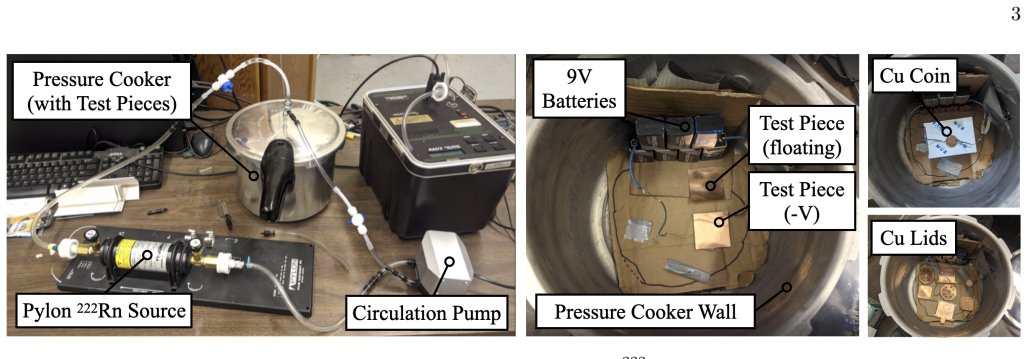
The radon daughter plateout acceleration setup, which boosts surface deposition rate by 70000 times to simulate long-term natural exposure in a short experimental window.
If this is right
- Surface plateout from radon daughters must be managed separately from external cosmic or ambient radiation when scaling qubit arrays.
- The accelerated setup enables direct in-situ testing of mitigation techniques during the device lifecycle.
- Larger chip areas will accumulate proportionally more of this persistent alpha source unless plateout is reduced at fabrication and packaging stages.
Where Pith is reading between the lines
- The same acceleration technique could be applied to test other surface contaminants or packaging materials for their radiation effects on qubits.
- If plateout proves significant, fabrication protocols might incorporate radon-minimizing steps such as controlled atmospheres during assembly.
- Future large-scale quantum processors could require dedicated surface passivation or active cleaning methods to limit this long-lived radiation source.
Load-bearing premise
The accelerated plate-out process produces the same local alpha-decay environment and qubit response as the slow natural plate-out that occurs over the device lifecycle.
What would settle it
A side-by-side measurement showing that qubit decoherence rates or error signatures differ between accelerated plateout exposure and an equivalent total dose from natural plateout accumulated over months or years.
Figures
read the original abstract
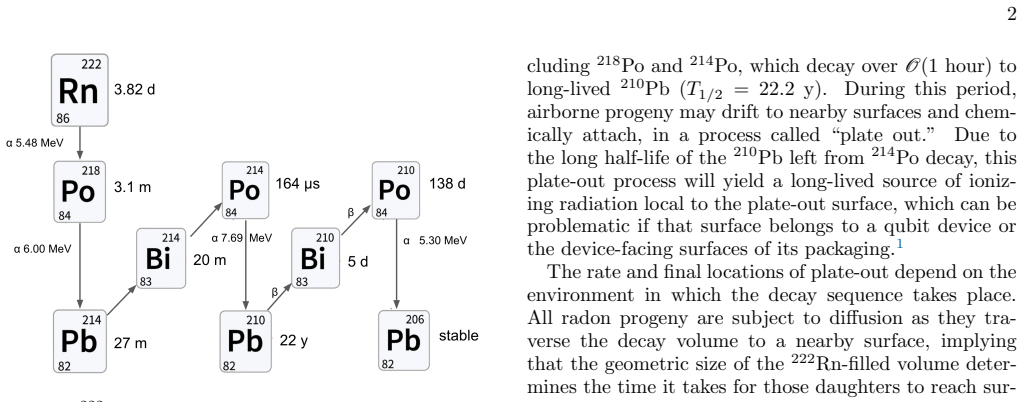
Ionizing radiation in the form of $\alpha$, $\beta$, $\gamma$, and additional high-energy particles can induce decoherence via phonon and quasiparticle poisoning in superconducting qubits. Recent studies have explored this effect using cosmic rays or controlled radioactive sources held in the proximity of a qubit package, and have concluded that reductions in such ``external'' environmental radiation may benefit stable operation of qubit devices. However, the effect of long-lived, unstable daughters of $^{222}$Rn that ``plate out'' directly on device and packaging surfaces has not been as extensively explored. This plate-out process, well-known to the dark matter direct detection field, occurs throughout the fabrication and testing lifecycle of a device and (separately) its packaging, and produces a local source of $\alpha$-decays which can remain active for decades. As this scales with chip area, understanding and managing this source of ionizing radiation is relevant for successfully scaling quantum computing architectures to larger numbers of qubits in a radiation-robust way. We present a setup capable of accelerating and enhancing radon daughter plateout by a factor of $7\times10^4$ over ambient, in order to study, \textit{in situ}, the impact of these events on superconducting qubits. We also provide outlook on the potential impact of this source of ionizing radiation on current and future qubit arrays.
Editorial analysis
A structured set of objections, weighed in public.
Referee Report
Summary. The manuscript presents an experimental setup intended to accelerate and enhance the plate-out of radon daughters on surfaces by a factor of 7×10^4 relative to ambient conditions. The goal is to enable in-situ investigation of α-decay effects from these long-lived daughters on superconducting qubits, with additional discussion of implications for scaling qubit arrays.
Significance. If the acceleration factor is experimentally validated and the accelerated process is shown to produce an equivalent local decay environment to natural plate-out, the setup could provide a useful controlled method for studying an under-explored source of ionizing radiation in qubit devices. This would be relevant for radiation-robust scaling of quantum processors, building on prior work with cosmic rays and external sources.
major comments (2)
- [Abstract] Abstract: The central claim that the setup accelerates radon daughter plateout by a factor of 7×10^4 is stated without any supporting data, validation measurements, error analysis, or direct comparison to ambient conditions. This leaves the capability of the apparatus unverified and is load-bearing for the paper's primary contribution.
- [Abstract] Abstract (plate-out process description): The premise that the accelerated plate-out produces the same local α-decay environment (including spatial distribution, surface binding, and phonon/quasiparticle sources) as the slow natural process over device lifetimes is asserted but not addressed or tested. Differences arising from elevated radon levels, fields, or humidity could invalidate the in-situ equivalence, undermining the study rationale.
Simulated Author's Rebuttal
We thank the referee for their constructive comments on our manuscript. We address each major comment below and indicate planned revisions.
read point-by-point responses
-
Referee: [Abstract] Abstract: The central claim that the setup accelerates radon daughter plateout by a factor of 7×10^4 is stated without any supporting data, validation measurements, error analysis, or direct comparison to ambient conditions. This leaves the capability of the apparatus unverified and is load-bearing for the paper's primary contribution.
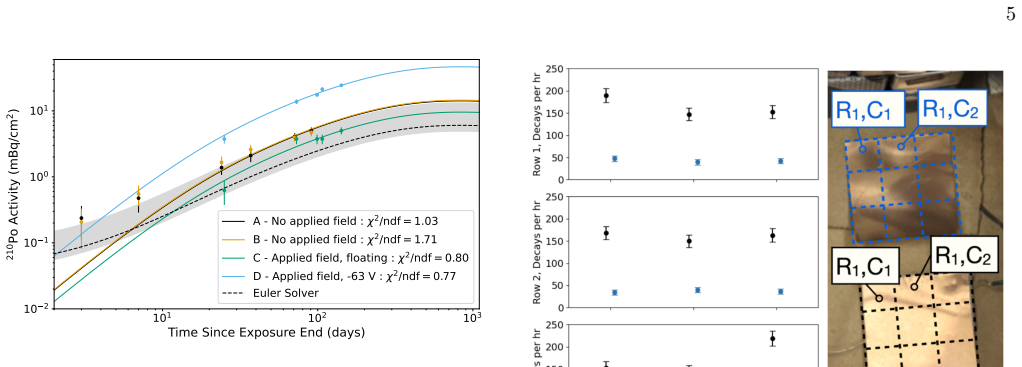
Authors: We agree that the abstract states the acceleration factor without supporting details or validation. The factor is based on the setup design parameters (controlled radon concentration and electrostatic enhancement), but the current manuscript provides neither the explicit calculation, error analysis, nor direct ambient comparison. We will revise the manuscript to include this supporting information, either as a dedicated methods subsection or supplementary material, with references to ambient plateout rates. revision: yes
-
Referee: [Abstract] Abstract (plate-out process description): The premise that the accelerated plate-out produces the same local α-decay environment (including spatial distribution, surface binding, and phonon/quasiparticle sources) as the slow natural process over device lifetimes is asserted but not addressed or tested. Differences arising from elevated radon levels, fields, or humidity could invalidate the in-situ equivalence, undermining the study rationale.
Authors: The equivalence is based on the physics that the same long-lived daughters are deposited, producing identical α-decays. The manuscript does not explicitly discuss or test for differences arising from the acceleration method. We will add a discussion paragraph in the revised version addressing potential impacts of radon levels, fields, and humidity, citing precedents from dark matter experiments, while noting this as a limitation of the current work. revision: yes
Circularity Check
No circularity: experimental apparatus description only
full rationale
The paper is a description of an experimental setup to accelerate radon daughter plateout by a stated factor of 7×10^4 for in-situ qubit studies. No derivations, equations, fitted parameters, or predictions appear in the abstract or claimed central result. The weakest assumption (equivalence of accelerated vs natural plateout environments) is an empirical premise to be tested by the apparatus itself, not a self-referential derivation. No self-citations, ansatzes, or uniqueness theorems are invoked as load-bearing steps. This is a standard non-circular experimental methods paper.
Axiom & Free-Parameter Ledger
Reference graph
Works this paper leans on
-
[1]
Nakamura, Yu
Y. Nakamura, Yu. A. Pashkin, and J. S. Tsai. Coher- ent control of macroscopic quantum states in a single- cooper-pair box.Nature, 398(6730):786–788, April 1999
1999
-
[2]
Schwartz, Jochen Braum- ller, Philip Krantz, Joel I.-J
Morten Kjaergaard, Mollie E. Schwartz, Jochen Braum- ller, Philip Krantz, Joel I.-J. Wang, Simon Gustavsson, and William D. Oliver. Superconducting qubits: Cur- rent state of play.Annual Review of Condensed Matter Physics, 11(1):369395, March 2020
2020
-
[3]
Oliver and Paul B
William D. Oliver and Paul B. Welander. Materi- als in superconducting quantum bits.MRS Bulletin, 38(10):816–825, October 2013
2013
-
[4]
Conal E. Murray. Material matters in superconducting qubits.Materials Science and Engineering: R: Reports, 146:100646, October 2021
2021
-
[5]
Systematic improvements in trans- mon qubit coherence enabled by niobium surface encap- sulation.npj Quantum Information, 10(1), April 2024
Mustafa Bal et al. Systematic improvements in trans- mon qubit coherence enabled by niobium surface encap- sulation.npj Quantum Information, 10(1), April 2024
2024
-
[6]
Bland et al
Matthew P. Bland et al. 2d transmons with lifetimes and coherence times exceeding 1 millisecond. March
- [7]
-
[8]
Bland et al
Matthew P. Bland et al. Millisecond lifetimes and coherence times in 2d transmon qubits.Nature, 647(8089):343–348, November 2025
2025
-
[9]
V. Iaia, J. Ku, A. Ballard, C. P. Larson, E. Yelton, C. H. Liu, S. Patel, R. McDermott, and B. L. T. Plourde. Phonon downconversion to suppress correlated errors in superconducting qubits.Nature Communications, 13(1), March 2022
2022
-
[10]
Barends et al
R. Barends et al. Minimizing quasiparticle generation from stray infrared light in superconducting quantum circuits.Applied Physics Letters, 99(11), 2011
2011
-
[11]
C´ orcoles et al
Antonio D. C´ orcoles et al. Protecting superconducting qubits from radiation.Applied Physics Letters, 99(18), October 2011
2011
-
[12]
Engineering superconducting qubits to reduce quasiparticles and charge noise.Na- ture Communications, 13(1), November 2022
Xianchuang Pan et al. Engineering superconducting qubits to reduce quasiparticles and charge noise.Na- ture Communications, 13(1), November 2022
2022
-
[13]
C. H. Liu et al. Quasiparticle poisoning of superconduct- ing qubits from resonant absorption of pair-breaking photons.Physical Review Letters, 132(1):017001, Jan- uary 2024
2024
-
[14]
Michael Kerschbaum et al. Assessing the sensitivity of niobium- and tantalum-based superconducting qubits to infrared radiation. February 2026. arXiv:2602.05806
-
[15]
Charge-insensitive qubit design de- rived from the cooper pair box.Physical Review A, 76(4):042319, October 2007
Jens Koch et al. Charge-insensitive qubit design de- rived from the cooper pair box.Physical Review A, 76(4):042319, October 2007
2007
-
[16]
Gambetta et al
Jay M. Gambetta et al. Investigating surface loss effects in superconducting transmon qubits.IEEE Transac- tions on Applied Superconductivity, 27(1):1–5, January 2017. 6 This corresponds to the rates on the right hand side of Fig. 11 (bottom), and yields to nearly identical scalings for each isotope
2017
-
[17]
Martinis
John M. Martinis. Surface loss calculations and de- sign of a superconducting transmon qubit with tapered wiring.npj Quantum Information, 8(1), March 2022
2022
-
[18]
Matt McEwen et al. Resisting high-energy impact events through gap engineering in superconducting qubit arrays, February 2024. arXiv:2402.15644 [quant- ph]
-
[19]
Methods to achieve near- millisecond energy relaxation and dephasing times for a superconducting transmon qubit.Nature Communi- cations, 16(1), 2025
Mikko Tuokkola et al. Methods to achieve near- millisecond energy relaxation and dephasing times for a superconducting transmon qubit.Nature Communi- cations, 16(1), 2025
2025
-
[20]
Douglas Pinckney et al
H. Douglas Pinckney et al. Characterization of radiation-induced errors in superconducting qubits pro- tected with various gap-engineering strategies. March
- [21]
-
[22]
Martinis
John M. Martinis. Saving superconducting quantum processors from decay and correlated errors generated by gamma and cosmic rays.npj Quantum Information, 7(1), June 2021
2021
-
[23]
Impact of ionizing radi- ation on superconducting qubit coherence.Nature, 584(7822):551–556, 2020
Antti Veps¨ al¨ ainen et al. Impact of ionizing radi- ation on superconducting qubit coherence.Nature, 584(7822):551–556, 2020
2020
-
[24]
C. P. Larson et al. Quasiparticle poisoning of supercon- ducting qubits with active gamma irradiation. March
- [25]
-
[26]
Resolving catastrophic error bursts from cosmic rays in large arrays of supercon- ducting qubits.Nature Physics 18, 107-111 (Jan 2022), 18(1):107–111, April 2021
Matt McEwen et al. Resolving catastrophic error bursts from cosmic rays in large arrays of supercon- ducting qubits.Nature Physics 18, 107-111 (Jan 2022), 18(1):107–111, April 2021
2022
-
[27]
Harrington et al
Patrick M. Harrington et al. Synchronous detection of cosmic rays and correlated errors in superconducting qubit arrays.Nature Communications, 16(1), 2025
2025
-
[28]
Wilen et al
C.D. Wilen et al. Correlated charge noise and relaxation errors in superconducting qubits.Nature, 594:369–373, 2021
2021
-
[29]
Tennant et al
Daniel M. Tennant et al. Low-frequency correlated charge-noise measurements across multiple energy tran- sitions in a tantalum transmon.PRX Quantum, 3:030307, Jul 2022
2022
-
[30]
Bratrud et al
G. Bratrud et al. Measurement of correlated charge noise in superconducting qubits at an underground fa- cility.Nature Communications, 16:9906, 2025
2025
-
[31]
McClure, and Malcolm Carroll
Ted Thorbeck, Andrew Eddins, Isaac Lauer, Douglas T. McClure, and Malcolm Carroll. Two-Level-System Dy- namics in a Superconducting Qubit Due to Background Ionizing Radiation.PRX Quantum, 4(2):020356, 2023
2023
-
[32]
Topological quantum memory.Journal of Mathematical Physics, 43(9):4452–4505, 2002
Eric Dennis, Alexei Kitaev, Andrew Landahl, and John Preskill. Topological quantum memory.Journal of Mathematical Physics, 43(9):4452–4505, 2002
2002
-
[33]
Fowler, Matteo Mariantoni, John M
Austin G. Fowler, Matteo Mariantoni, John M. Marti- nis, and Andrew N. Cleland. Surface codes: Towards practical large-scale quantum computation.Physical Review A, 86(3):032324, 2012
2012
-
[34]
Nickerson and Benjamin J
Naomi H. Nickerson and Benjamin J. Brown. Analysing correlated noise on the surface code using adaptive de- 16 coding algorithms.Quantum, 3:131, April 2019
2019
-
[35]
Quantum error correction below the surface code threshold.Nature, 638(8052):920–926, December 2024
Rajeev Acharya et al. Quantum error correction below the surface code threshold.Nature, 638(8052):920–926, December 2024
2024
-
[36]
Effect of multiqubit correlated noise on surface- code thresholds.Physical Review A, 112(6), December 2025
SiYing Wang, Yue Yan, ZhiXin Xia, and Xiang-Bin Wang. Effect of multiqubit correlated noise on surface- code thresholds.Physical Review A, 112(6), December 2025
2025
-
[37]
Pattison, Matt McEwen, and John Preskill
Shi Jie Samuel Tan, Christopher A. Pattison, Matt McEwen, and John Preskill. Resilience of the surface code to error bursts.Physical Review A, 113(2), Febru- ary 2026
2026
-
[38]
Fowler et al
Joseph W. Fowler et al. Spectroscopic measurements and models of energy deposition in the substrate of quantum circuits by natural ionizing radiation.PRX Quantum, 5(4):040323, November 2024
2024
-
[39]
Iaia et al
V. Iaia et al. Phonon downconversion to suppress corre- lated errors in superconducting qubits.Nat Commun., 13(6425), 2022
2022
-
[40]
Vladislav D. Kurilovich et al. Correlated error bursts in a gap-engineered superconducting qubit array, 2025. arXiv:2506.18228 [quant-ph]
-
[41]
J. Alvarez-Mu˜ niz, Z. Cao, U. F. Katz, P. Mertsch, and C. Spiering. Cosmic rays, March 2024. Review chap- ter in Review of Particle Physics; revised March 2024; accessed 2026-04-22. Parent article: Phys. Rev. D 110, 030001 (2024), DOI: 10.1103/PhysRevD.110.030001
-
[42]
Cardani et al
L. Cardani et al. Disentangling the sources of ioniz- ing radiation in superconducting qubits.The European Physical Journal C, 83(1):94, 2023
2023
- [43]
-
[44]
Chernyak, J
D. Chernyak, J. Howell, D. Majumdar, N. Mukherjee, O. Nusair, and A. Piepke. Comprehensive study of radon progeny attachment to surfaces.Phys. Rev. C, 107:065802, Jun 2023
2023
-
[45]
Aalbers et al
J. Aalbers et al. Background determination for the lux-zeplin dark matter experiment.Physical Review D, 108(1):012010, 2023
2023
-
[46]
Aprile et al
E. Aprile et al. First dark matter search with nuclear re- coils from the XENONnT experiment.Physical Review Letters, 131(4):041003, jul 2023
2023
-
[47]
Agnese, et al
SuperCDMS Collaboration, R. Agnese, et al. First dark matter constraints from a supercdms single-charge sen- sitive detector.Physical Review Letters, 121(5):051301, August 2018
2018
-
[48]
PhD thesis, University Libraries, University at Albany, State University of New York
Nishat and Parveen.Modeling The Wall Background In The Lux-Zeplin (Lz) Dark Matter Experiment. PhD thesis, University Libraries, University at Albany, State University of New York
-
[49]
Eric Morrison.Mitigation of Radon Daughter Back- grounds for the LUX-ZEPLIN Dark Matter Search Ex- periment. Ph.d. dissertation, South Dakota School of Mines and Technology, 2025. ProQuest Dissertations & Theses, document ID 3235127849
2025
-
[50]
Radon daughter plate-out mea- surements at SNOLAB for polyethylene and copper
Matthew Stein et al. Radon daughter plate-out mea- surements at SNOLAB for polyethylene and copper. Nuclear Instruments and Methods in Physics Research Section A: Accelerators, Spectrometers, Detectors and Associated Equipment, 880:92–97, 2018
2018
-
[51]
ACS Publications, 1987
Philip K Hopke.Radon and its decay products: Occur- rence, properties, and health effects. ACS Publications, 1987
1987
-
[52]
Radon and its decay products in indoor air
William W Nazaroff and Anthony V Nero Jr. Radon and its decay products in indoor air. 1987
1987
-
[53]
What is EPA’s action level for Radon and what does it mean?https://www.epa.gov/radon/ what-epas-action-level-radon-and-what-does-it-mean
United States Environmental Protection Agency. What is EPA’s action level for Radon and what does it mean?https://www.epa.gov/radon/ what-epas-action-level-radon-and-what-does-it-mean
-
[54]
Daily variation of the radon concentration indoors and outdoors and the influence of meteorological parameters.Health physics, 67(3):283–287, 1994
Justin Porstendorfer, Gernot Butterweck, and August Reineking. Daily variation of the radon concentration indoors and outdoors and the influence of meteorological parameters.Health physics, 67(3):283–287, 1994
1994
-
[55]
Daily variations of indoor air-ion and radon concentra- tions.Applied Radiation and Isotopes, 67(11):2062– 2067, 2009
PM Kolarˇ z, DM Filipovi´ c, and BP Marinkovi´ c. Daily variations of indoor air-ion and radon concentra- tions.Applied Radiation and Isotopes, 67(11):2062– 2067, 2009
2062
-
[56]
On the energy loss of heavy ions.Physical Review, 59(8):659–669, April 1941
Julian Knipp and Edward Teller. On the energy loss of heavy ions.Physical Review, 59(8):659–669, April 1941
1941
-
[57]
Radon- daughter ions and their relation to some electrical prop- erties of the atmosphere.Tellus, 18(2-3):679–684, 1966
MH Wilkening, M Kawano, and Carlton Lane. Radon- daughter ions and their relation to some electrical prop- erties of the atmosphere.Tellus, 18(2-3):679–684, 1966
1966
-
[58]
P. K. Hopke. The initial atmospheric behavior of radon decay products.Journal of Radioanalytical and Nuclear Chemistry Articles, 203(2):353–375, March 1996
1996
-
[59]
Electrical charge in radon daughter depo- sition: a critical review.Radiation Protection Dosime- try, 24(1-4):211–215, 1988
WH Marlow. Electrical charge in radon daughter depo- sition: a critical review.Radiation Protection Dosime- try, 24(1-4):211–215, 1988
1988
-
[60]
W. Jacobi. Activity and potential alpha-energy of 222Radon and 220Radon-daughters in different air at- mospheres.Health Physics, 22(5):441–450, May 1972
1972
-
[61]
Otto G. Raabe. Concerning the interactions that oc- cur between radon decay products and aerosols.Health Physics, 17(2):177–185, August 1969
1969
-
[62]
Porstendorfer, A
J. Porstendorfer, A. Wicke, and A. Schraub. The in- fluence of exhalation, ventilation and deposition pro- cesses upon the concentration of radon (222Rn), thoron (220Rn) and their decay products in room air.Health Physics, 34(5):465–473, May 1978
1978
-
[63]
Otahal and Eliska Fialova
Petr PS. Otahal and Eliska Fialova. Determination of the radon progeny activity size distribution at different types of workplaces.Journal of Environmental Radioac- tivity, 289:107781, October 2025
2025
-
[64]
C Huet, G Tymen, and D Boulaud. Size distribu- tion, equilibrium ratio and unattached fraction of radon decay products under typical indoor domestic condi- tions.Science of The Total Environment, 272(1-3):97– 103, May 2001
2001
-
[65]
Measure- ments of the unattached fractions of radon daughters in houses.Science of The Total Environment, 45:261–270, October 1985
A Reineking, K.H Becker, and J Porstendrfer. Measure- ments of the unattached fractions of radon daughters in houses.Science of The Total Environment, 45:261–270, October 1985
1985
-
[66]
Variation of the unattached fraction of radon progeny and its contribu- tion to radon exposure.Journal of Radiological Protec- tion, 36(2):N34–N41, May 2016
Lu Guo, Lei Zhang, and Qiuju Guo. Variation of the unattached fraction of radon progeny and its contribu- tion to radon exposure.Journal of Radiological Protec- tion, 36(2):N34–N41, May 2016
2016
-
[67]
Lund University, 2002
Birgitta Roos.Studies on the alpha-recoil implanta- tion of 214Pb and 210Pb in glass surfaces, Implications for retrospective radon measurements. Lund University, 2002
2002
-
[68]
Radon daughter plate-out onto teflon
Eric S Morrison, Therese Frels, Eric H Miller, Richard W Schnee, and Joseph Street. Radon daughter plate-out onto teflon. InAIP Conference Proceedings, volume 1921, page 090002. AIP Publishing LLC, 2018
1921
-
[69]
Eric W Hoppe et al. Cleaning and passivation of cop- per surfaces to remove surface radioactivity and prevent oxide formation.Nuclear Instruments and Methods in 17 Physics Research Section A: Accelerators, Spectrome- ters, Detectors and Associated Equipment, 579(1):486– 489, 2007
2007
-
[70]
Grzegorz Zuzel, Marcin W´ ojcik, B Majorovits, MO Lampert, and P Wendling. Removal and deposi- tion efficiencies of the long-lived 222Rn daughters dur- ing etching of germanium surfaces.Nuclear Instruments and Methods in Physics Research Section A: Acceler- ators, Spectrometers, Detectors and Associated Equip- ment, 676:149–154, 2012
2012
-
[71]
R. W. Schnee et al. Removal of long-lived 222Rn daughters by electropolishing thin layers of stainless steel.AIP Conf.Proc.1549:128-131,2013, pages 128– 131, April 2014
2013
-
[72]
A review and outlook for the removal of radon-generated Po-210 surface contamination
VE Guiseppe, CD Christofferson, KR Hair, and FM Adams. A review and outlook for the removal of radon-generated Po-210 surface contamination. InAIP Conference Proceedings, volume 1921, page 070003. AIP Publishing LLC, 2018
1921
-
[73]
Radon daughter removal from ptfe surfaces and its application in liquid xenon detectors
S Bruenner et al. Radon daughter removal from ptfe surfaces and its application in liquid xenon detectors. The European Physical Journal C, 81(4):343, 2021
2021
-
[74]
Grzegorz Zuzel and Marcin W´ ojcik. Removal of the long-lived 222Rn daughters from copper and stainless steel surfaces.Nuclear Instruments and Methods in Physics Research Section A: Accelerators, Spectrome- ters, Detectors and Associated Equipment, 676:140–148, 2012
2012
-
[75]
Behavior of the 222Rn daughters on copper surfaces during cleaning
Marcin W´ ojcik and Grzegorz Zuzel. Behavior of the 222Rn daughters on copper surfaces during cleaning. In AIP Conference Proceedings, volume 897, pages 53–58. American Institute of Physics, 2007
2007
-
[76]
Removal of radon progeny from delicate surfaces.The European Physical Journal Plus, 140(12):1232, 2025
Dmitry Chernyak and Andreas Piepke. Removal of radon progeny from delicate surfaces.The European Physical Journal Plus, 140(12):1232, 2025
2025
-
[77]
DURRIDGE Company Inc., 2012
DURRIDGE Company Inc.RAD7 Radon Detector User Manual. DURRIDGE Company Inc., 2012. Available online:https://durridge.com/documentation/RAD7% 20Manual.pdf
2012
-
[78]
AMETEK OR- TEC, 2022
AMETEK ORTEC.Alpha Duo, Alpha Mega, & Alpha Ensemble Integrated Alpha Spectrom- eter Hardware Users Manual. AMETEK OR- TEC, 2022. Available online:https://www. ortec-online.com/-/media/ametekortec/manuals/ a/alpha-duo-mega-ensemble-mnl.pdf
2022
-
[79]
Zuzel, K
G. Zuzel, K. Pelczar, and M. Wjcik. Removal of 222Rn daughters from metal surfaces. 1921:070004, 2018
1921
-
[80]
Surface contamination from radon progeny
Michael Leung. Surface contamination from radon progeny. InAIP Conference Proceedings, volume 785, pages 184–190. AIP, 2005
2005
discussion (0)
Sign in with ORCID, Apple, or X to comment. Anyone can read and Pith papers without signing in.